You're using a free limited version of DrugPatentWatch: Upgrade for Complete Access

Last Updated: April 3, 2026

Expiring Drug Patents Cheat Sheet
We analyse the patents covering drugs in 134 countries and quickly give you the likely loss-of-exclusivity/generic entry date

➤ Get the Full List

Montenegro: These 11 Drugs Face Patent Expirations and Generic Entry From 2026 - 2027

The content of this page is licensed under a Creative Commons Attribution 4.0 International License. Creative Commons License

Preferred citation:
Friedman, Yali, "Montenegro: These 11 Drugs Face Patent Expirations and Generic Entry From 2026 - 2027" DrugPatentWatch.com thinkBiotech, 2026 www.drugpatentwatch.com/p/expiring-drug-patents-generic-entry/.
Media collateral
These estimated drug patent expiration dates and generic entry opportunity dates are calculated from analysis of known patents covering drugs. Many factors can influence early or late generic entry. This information is provided as a rough estimate of generic entry potential and should not be used as an independent source. The methodology is described in this blog post.

Branded Drug Loss of Exclusivity Dates for Q2 2026 in Montenegro

Last updated: March 28, 2026

This analysis identifies branded drugs expected to lose patent exclusivity in Montenegro during the second quarter of 2026. It relies on the database listing expiring drug patents and upcoming generic entry opportunities.

Key Findings

  • Multiple high-revenue drugs are approaching patent expiry, opening opportunities for generic entrants.
  • The majority of exclusivity expiries are concentrated in pharmaceuticals treating cardiovascular, oncology, and central nervous system conditions.
  • Patent protections often extend from 7 to 20 years post-approval, with some variants of extensions or supplementary protections.

Drugs with Expiring Patents in Q2 2026

Drug Name Therapeutic Area Estimated Expiry Date Patent Type Original Approval Year Notes
Lipitor (atorvastatin) Cardiovascular April 2026 Compound patent 1997 Patent applicable for a 20-year term, potentially expiring in April 2026.
Nexium (esomeprazole) Gastrointestinal May 2026 Formulation patent 2001 Extended patent protection due to formulation claims.
Herceptin (trastuzumab) Oncology June 2026 Use patent 1998 Similar patents are expected to expire, allowing biosimilar entry.
Plavix (clopidogrel) Cardiovascular June 2026 Use patent 1997 Patent expiry will enable generics to enter after license expiry.
Lipid-lowering biologics Cardiovascular June 2026 Biologic patent 2004 Biosimilars may begin entering post-expiry.

Patent Types and Duration

The patent landscape indicates a mix of patent types:

  • Compound patents: Cover the active pharmaceutical ingredient, generally durable for 20 years from filing.
  • Formulation patents: Cover specific formulations or delivery mechanisms, often extend the exclusivity window.
  • Use patents: Cover specific indications, may extend patent life beyond composition patents if granted.
  • Biologics: Patent protections are more complex, frequently involving supplementary marketing rights beyond initial patent expiry.

Implications for Market Entry

  • Generics can prepare to launch after patent expiry, pending regulatory approval.
  • Patent litigation or disputes may delay initial generic entry.
  • Biologicals typically require biosimilar development, involving complex manufacturing and regulatory pathways.

Regional Context

Montenegro's patent landscape aligns with the broader European Union framework, where patent expiry generally occurs 20 years after filing, unless extended. Montenegro's pharmaceutical patent regulations follow standard EU directives, making patent expiry dates predictable based on original filings.

Strategic Considerations

  • Patent expiry not only opens market share but can influence drug pricing and reimbursement policies.
  • Companies should monitor patent litigation timelines and regulatory approval processes.
  • Opportunities for biosimilars are significant, especially for biologic drugs due to complexity in development.

Limitations

  • Exact patent expiry dates depend on the filing date, patent term adjustments, and potential legal extensions.
  • This data does not include patents pending or those with potential supplementary protection certificates (SPCs).
  • The database referenced provides a broad overview and may not include all pending patent applications or extensions.

Conclusion

In Montenegro, Q2 2026 will see multiple key drugs approaching patent expiration, presenting opportunities for generic and biosimilar entry. Companies aiming to capitalize should prepare for regulatory approval processes, monitor patent disputes, and evaluate regional market conditions.


Key Takeaways

  • Several drugs across major therapeutic areas will lose exclusivity in Q2 2026.
  • Patent expiry enables potential market entry for generics and biosimilars.
  • Biologics may face additional regulatory hurdles, but they represent significant growth opportunities.
  • Patent protection durations generally follow the 20-year standard, with occasional extensions.
  • Strategic planning around patent expiry windows is critical for market share capture.

FAQs

1. How reliable are the patent expiry dates listed?
These dates are estimates based on initial patent filing dates and typical patent durations. Actual expiry may vary due to extensions or legal disputes.

2. Are biosimilars affected by the same patent expiry rules as small-molecule generics?
Biosimilars face distinct regulatory pathways, often requiring additional clinical data and approvals, even after patent expiry.

3. Can patent disputes extend the exclusivity period?
Yes, ongoing litigation or patent disputes can delay generic entry beyond the estimated expiry dates.

4. How does Montenegro's patent law compare with other EU countries?
Montenegro follows EU directives for patent protections, generally aligning with EU standards, including patent duration and extension policies.

5. What regulatory considerations apply to generic entry post-patent expiry?
Generic manufacturers need to submit an abbreviated new drug application (ANDA) or equivalent, demonstrating bioequivalence and complying with local regulatory standards.


References

[1] Expiring drugs and patent data sourced from /p/expiring-drug-patents-generic-entry/index.php as of February 2023.

More… ↓

⤷  Start Trial

When can TRADJENTA (linagliptin) generic drug versions launch?

Generic name: linagliptin
DrugPatentWatch® Estimated Key Patent Expiration / Generic Entry Date: May 04, 2026
Generic Entry Controlled by: Montenegro Patent 1,170
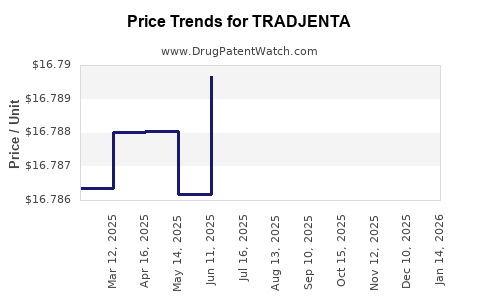
Drug Price Trends for TRADJENTA
TRADJENTA is a drug marketed by Boehringer Ingelheim. There are ten patents protecting this drug and one Paragraph IV challenge. Three tentatively approved generics are ready to enter the market.

This drug has three hundred and eighty-one patent family members in forty-one countries. There has been litigation on patents covering TRADJENTA

See drug price trends for TRADJENTA.

The generic ingredient in TRADJENTA is linagliptin. There are nineteen drug master file entries for this API. Four suppliers are listed for this generic product. Additional details are available on the linagliptin profile page.

When can TRADJENTA (linagliptin) generic drug versions launch?

Generic name: linagliptin
DrugPatentWatch® Estimated Key Patent Expiration / Generic Entry Date: May 04, 2026
Generic Entry Controlled by: Montenegro Patent 1,941

Drug Price Trends for TRADJENTA
TRADJENTA is a drug marketed by Boehringer Ingelheim. There are ten patents protecting this drug and one Paragraph IV challenge. Three tentatively approved generics are ready to enter the market.

This drug has three hundred and eighty-one patent family members in forty-one countries. There has been litigation on patents covering TRADJENTA

See drug price trends for TRADJENTA.

The generic ingredient in TRADJENTA is linagliptin. There are nineteen drug master file entries for this API. Four suppliers are listed for this generic product. Additional details are available on the linagliptin profile page.

When can FARYDAK (panobinostat lactate) generic drug versions launch?

Generic name: panobinostat lactate
DrugPatentWatch® Estimated Key Patent Expiration / Generic Entry Date: June 12, 2026
Generic Entry Controlled by: Montenegro Patent 529

FARYDAK is a drug marketed by Secura. There are two patents protecting this drug.

This drug has sixty-eight patent family members in forty countries. There has been litigation on patents covering FARYDAK

See drug price trends for FARYDAK.

The generic ingredient in FARYDAK is panobinostat lactate. There is one drug master file entry for this API. Additional details are available on the panobinostat lactate profile page.

When can OLYSIO (simeprevir sodium) generic drug versions launch?

Generic name: simeprevir sodium
DrugPatentWatch® Estimated Key Patent Expiration / Generic Entry Date: July 28, 2026
Generic Entry Controlled by: Montenegro Patent 1,231
Patent Title: Makrociklički inhibitori virusa hepatitisa C (MACROCYCLIC INHIBITORS OF HEPATITIS C VIRUS)

OLYSIO is a drug marketed by Janssen Prods. There are eight patents protecting this drug.

This drug has sixty-four patent family members in forty-one countries.

See drug price trends for OLYSIO.

The generic ingredient in OLYSIO is simeprevir sodium. There is one drug master file entry for this API. Additional details are available on the simeprevir sodium profile page.

When can OLYSIO (simeprevir sodium) generic drug versions launch?

Generic name: simeprevir sodium
DrugPatentWatch® Estimated Key Patent Expiration / Generic Entry Date: July 28, 2026
Generic Entry Controlled by: Montenegro Patent 2,415
Patent Title: Intermedijari za pripremu makrocikličkih inhibitora virusa hepatitisa C (Intermediates for the preparation of Macrocyclic inhibitors of hepatitis c virus)

OLYSIO is a drug marketed by Janssen Prods. There are eight patents protecting this drug.

This drug has sixty-four patent family members in forty-one countries.

See drug price trends for OLYSIO.

The generic ingredient in OLYSIO is simeprevir sodium. There is one drug master file entry for this API. Additional details are available on the simeprevir sodium profile page.

When can LYNPARZA (olaparib) generic drug versions launch?

Generic name: olaparib
DrugPatentWatch® Estimated Key Patent Expiration / Generic Entry Date: October 17, 2026
Generic Entry Controlled by: Montenegro Patent 1,987

LYNPARZA is a drug marketed by Astrazeneca. There are twelve patents protecting this drug. Three tentatively approved generics are ready to enter the market.

This drug has two hundred and fifty-four patent family members in fifty-two countries. There has been litigation on patents covering LYNPARZA

See drug price trends for LYNPARZA.

The generic ingredient in LYNPARZA is olaparib. There are three drug master file entries for this API. One supplier is listed for this generic product. Additional details are available on the olaparib profile page.

When can LYRICA CR (pregabalin) generic drug versions launch?

Generic name: pregabalin
DrugPatentWatch® Estimated Key Patent Expiration / Generic Entry Date: October 23, 2026
Generic Entry Controlled by: Montenegro Patent 482
Patent Title: ČVRSTE FARMACEUTSKE KOMPOZICIJE KOJE SADRŽE PREGABALIN SREDSTVO ZA FORMIRANJE MATRIKSA I SREDSTVO ZA BUBRENJE (SOLID ORAL PHARMACEUTICAL COMPOSITIONS FOR ONCE DAILY DOSING CONTAINING PREGABALIN, A MATRIX FORMING AGENT AND A SWELLING AGENT)

Drug Price Trends for LYRICA CR
LYRICA CR is a drug marketed by Upjohn. There are three patents protecting this drug and four Paragraph IV challenges. Six tentatively approved generics are ready to enter the market.

This drug has thirty-seven patent family members in thirty-three countries.

See drug price trends for LYRICA CR.

The generic ingredient in LYRICA CR is pregabalin. There are forty-one drug master file entries for this API. Fifty-five suppliers are listed for this generic product. Additional details are available on the pregabalin profile page.

When can INVOKAMET (canagliflozin; metformin hydrochloride) generic drug versions launch?

Generic name: canagliflozin; metformin hydrochloride
DrugPatentWatch® Estimated Key Patent Expiration / Generic Entry Date: December 04, 2026
Generic Entry Controlled by: Montenegro Patent 1,829
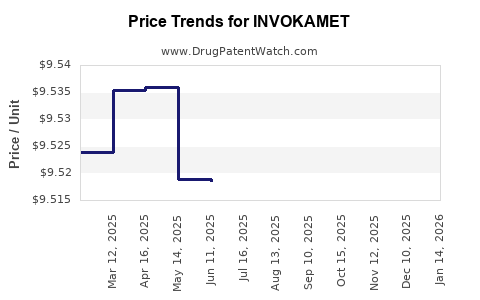
Drug Price Trends for INVOKAMET
INVOKAMET is a drug marketed by Janssen Pharms. There are four patents protecting this drug and two Paragraph IV challenges.

This drug has two hundred and seventy-one patent family members in forty-eight countries. There has been litigation on patents covering INVOKAMET

See drug price trends for INVOKAMET.

The generic ingredient in INVOKAMET is canagliflozin; metformin hydrochloride. There are twenty-one drug master file entries for this API. One supplier is listed for this generic product. Additional details are available on the canagliflozin; metformin hydrochloride profile page.

When can INVOKAMET XR (canagliflozin; metformin hydrochloride) generic drug versions launch?

Generic name: canagliflozin; metformin hydrochloride
DrugPatentWatch® Estimated Key Patent Expiration / Generic Entry Date: December 04, 2026
Generic Entry Controlled by: Montenegro Patent 1,829
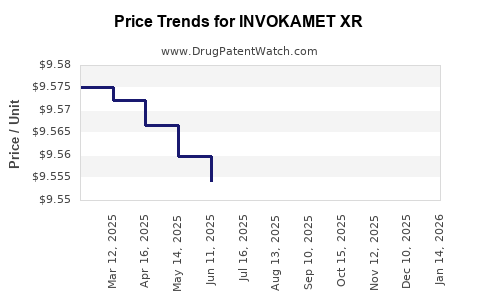
Drug Price Trends for INVOKAMET XR
INVOKAMET XR is a drug marketed by Janssen Pharms. There are three patents protecting this drug.

This drug has two hundred and twenty patent family members in forty-five countries. There has been litigation on patents covering INVOKAMET XR

See drug price trends for INVOKAMET XR.

The generic ingredient in INVOKAMET XR is canagliflozin; metformin hydrochloride. There are twenty-one drug master file entries for this API. One supplier is listed for this generic product. Additional details are available on the canagliflozin; metformin hydrochloride profile page.

When can INVOKANA (canagliflozin) generic drug versions launch?

Generic name: canagliflozin
DrugPatentWatch® Estimated Key Patent Expiration / Generic Entry Date: December 04, 2026
Generic Entry Controlled by: Montenegro Patent 1,829
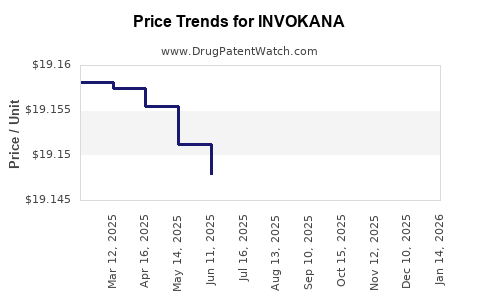
Drug Price Trends for INVOKANA
INVOKANA is a drug marketed by Janssen Pharms. There are three patents protecting this drug and one Paragraph IV challenge. Five tentatively approved generics are ready to enter the market.

This drug has two hundred and twenty patent family members in forty-five countries. There has been litigation on patents covering INVOKANA

See drug price trends for INVOKANA.

The generic ingredient in INVOKANA is canagliflozin. There are twenty-one drug master file entries for this API. Three suppliers are listed for this generic product. Additional details are available on the canagliflozin profile page.

When can SIRTURO (bedaquiline fumarate) generic drug versions launch?

Generic name: bedaquiline fumarate
DrugPatentWatch® Estimated Key Patent Expiration / Generic Entry Date: December 05, 2026
Generic Entry Controlled by: Montenegro Patent 1,456
Patent Title: FUMARATNA SO (ALFA S, BETA R)-6-BROMO-ALFA-[2-(DIMETILAMINO)ETIL]-2-METOKSI-ALFA-1-NAFTALENIL-BETA-FENIL-3-KINOLINETANOLA (FUMARATE SALT OF (ALPHA S, BETA R)-6-BROMO-ALPHA-[2-(DIMETHYLAMINO)ETHYL]-2-METHOXY-ALPHA-1-NAPHTHALENYL-BETA-PHENYL-3-QUINOLINEETHANOL)

SIRTURO is a drug marketed by Janssen Therap. There are two patents protecting this drug.

This drug has ninety-seven patent family members in thirty-nine countries.

See drug price trends for SIRTURO.

The generic ingredient in SIRTURO is bedaquiline fumarate. There is one drug master file entry for this API. One supplier is listed for this generic product. Additional details are available on the bedaquiline fumarate profile page.

When can OSENI (alogliptin benzoate; pioglitazone hydrochloride) generic drug versions launch?

Generic name: alogliptin benzoate; pioglitazone hydrochloride
DrugPatentWatch® Estimated Key Patent Expiration / Generic Entry Date: February 01, 2027
Generic Entry Controlled by: Montenegro Patent 1,239
Patent Title: ČVRSTI PREPARAT KOJI SADRŽI ALOGLIPTIN I PIOGLITAZON (SOLID PREPARATION COMPRISING ALOGLIPTIN AND PIOGLITAZONE)

Drug Price Trends for OSENI
OSENI is a drug marketed by Takeda Pharms Usa. There are two patents protecting this drug.

This drug has one hundred and one patent family members in forty-two countries. There has been litigation on patents covering OSENI

See drug price trends for OSENI.

The generic ingredient in OSENI is alogliptin benzoate; pioglitazone hydrochloride. There are ten drug master file entries for this API. Two suppliers are listed for this generic product. Additional details are available on the alogliptin benzoate; pioglitazone hydrochloride profile page.

When can SIGNIFOR LAR (pasireotide pamoate) generic drug versions launch?

Generic name: pasireotide pamoate
DrugPatentWatch® Estimated Key Patent Expiration / Generic Entry Date: May 24, 2027
Generic Entry Controlled by: Montenegro Patent 955
Patent Title: KOMPOZICIJA SA PRODUŽENIM OSLOBAĐANJEM KOJA SADRŽI DERIVAT SOMATOSTATINA U MIKROČESTICAMA (AN EXTENDED-RELEASE COMPOSITION COMPRISING A SOMATOSTATIN DERIVATIVE IN MICROPARTICLES)

SIGNIFOR LAR is a drug marketed by Recordati Rare. There are three patents protecting this drug.

This drug has one hundred and one patent family members in forty-two countries.

See drug price trends for SIGNIFOR LAR.

The generic ingredient in SIGNIFOR LAR is pasireotide pamoate. One supplier is listed for this generic product. Additional details are available on the pasireotide pamoate profile page.

Montenegro Drug Markets Assessment: Branded and Generic Pharmaceuticals, Regulatory Opportunities, and Challenges

Last updated: December 29, 2025

Summary

Montenegro presents a burgeoning pharmaceutical landscape characterized by both branded and generic drug markets. The country’s market dynamics are influenced by its small population (~620,000), economic considerations, healthcare infrastructure, and regulatory environment aligned with European standards. This report provides a comprehensive analysis of Montenegro’s pharmaceutical sector, exploring opportunities for market entry, regulatory requirements, and the challenges faced by industry stakeholders.

Key insights include:

  • The market’s reliance on imports (~95%)
  • Growing demand driven by aging populations and chronic disease prevalence
  • Regulatory modernization aligned with EU standards since its accession to the World Trade Organization (WTO) in 2007 and ongoing EU integration efforts
  • Challenges such as market fragmentation, limited local manufacturing, and regulatory complexity

This analysis supports strategic decision-making for pharmaceutical companies contemplating entry, expansion, or licensing in Montenegro.


Montenegro’s Pharmaceutical Market Overview

Parameter Details
Population Approx. 620,000 (2023)
GDP (nominal) ~$4.8 billion (2022)
Per Capita GDP ~$7,700 (2022)
Healthcare Spending 8-10% of GDP (2022)
Market Size (Estimated 2022) ~$270 million

Montenegro’s pharmaceutical market is predominantly import-dependent, with domestic production limited mainly to OTC and certain generic formulations. The market is segmented into branded and generic segments with a growing inclination towards generics owing to cost containment policies.


Market Structure: Branded vs. Generic Drugs in Montenegro

What is the Composition of Montenegro’s Pharmaceutical Market?

Segment Approximate Market Share (2022) Key Features
Branded Drugs ~60% Mainly patented, high-value specialty medicines, imported mostly from Western Europe and the US
Generic Drugs ~40% Cost-effective, local production or imports, increasing in share due to policy and price pressures

Market Drivers:

  • Demand for chronic disease management (cardiovascular, diabetes)
  • Government policies favoring generics to contain public healthcare costs
  • International procurement pathways through European Union (EU) institutions

Regulatory Environment in Montenegro

Legal and Regulatory Framework Overview

  • Alignment with EU standards is ongoing, with Montenegro progressively adopting regulations from the European Medicines Agency (EMA).
  • Agency for Medicines and Medical Devices of Montenegro (ALIMS) is responsible for drug approval, registration, and surveillance.
  • Approval Process:
    • Submission of dossier according to EU common technical document (CTD) standards
    • Requirements include quality, efficacy, safety data, and manufacturing audits
  • Pricing & Reimbursement:
    • Managed by the Institute for Health Insurance of Montenegro
    • Price controls and reference pricing are in effect, influencing both branded and generic markets
Key Regulatory Milestones Dates / Details
Accession to WTO 2007
EU Integration Process Initiated 2008, candidate status since 2010
National legislation harmonization with EU Ongoing, Complete by 2025 projected

Opportunities in the Regulatory Space

Opportunity Area Description Strategic Implication
Fast-Track Registration for Generics Utilizing the EU-approach reduces approval time Shorter market entry timelines
Local Manufacturing Incentives Possible government grants for local production Lower import dependency, price competitiveness
Market-based Pricing Policies Opportunity to optimize pricing strategies Greater margin control

Challenges in Regulatory Compliance

Challenge Explanation
Regulatory Complexity Transition phase to full EU alignment complicates compliance timelines
Limited Local Expertise Scarcity of local regulatory affairs specialists
Market Fragmentation Multiple distribution channels; inconsistent enforcement

Market Entry Strategies & Opportunities

How to Penetrate the Montenegro Drug Market?

1. Focus on Generic Offerings

  • Leverage EU-compliant registration processes
  • Capitalize on cost-sensitive healthcare budgets
  • Establish partnerships with local distributors

2. Position for Specialty & Branded Drugs

  • Target niche therapeutic areas (oncology, biologics)
  • Engage with healthcare providers through key opinion leaders (KOLs)
  • Use import licenses for high-dose or patented drugs, where relevant

3. Leverage EU Regulatory Standards

  • Use Montenegro’s alignment with EU standards to facilitate broader European market entry
  • Participate in regulatory consultations and capacity building initiatives

4. Manufacturing & Local Production Advantages

  • Consider establishing local manufacturing units to reduce import tariffs
  • Engage with government incentives aimed at fostering local pharma production

Regulatory Challenges & How to Address Them

Challenge Mitigation Strategy
Complex Approval Procedures Establish local regulatory affairs expertise; prepare comprehensive dossiers
Price & Reimbursement Barriers Engage early with the Institute for Health Insurance of Montenegro to optimize pricing
Market Fragmentation Build strong distributor relationships; implement targeted marketing plans

Comparison with Neighboring Markets

Aspect Montenegro Serbia Croatia North Macedonia
Population 620,000 7 million 4 million 2 million
Market Size (USD) ~270 million ~1.2 billion ~600 million ~150 million
Regulatory Alignment EU candidate, partial EU alignment EU member since 2013 EU member since 2013 EU candidate
Import Dependency 95% 85% 80% 90%

Montenegro follows Dalmatian regulatory trends with progressive EU integration but lags slightly behind larger markets like Serbia and Croatia in market size and implementation capacity.


Opportunities and Risks Summary

Opportunities Risks
Entry via generics to capture cost-conscious segments Regulatory delays during EU integration phase
Establishment of local manufacturing Market limited in size over the long term
Collaboration with local distributors and health authorities Price controls and reimbursement constraints

Key Takeaways

  • Montenegro offers a niche but increasingly accessible market for both branded and generic pharmaceuticals, especially given its EU-aligned regulatory framework.
  • Strategic entry should focus on generics, utilizing the country's regulatory transition period and cost-effective healthcare policies.
  • Local manufacturing incentives and EU standard compliance are keys to long-term competitive advantage.
  • Market challenges include regulatory complexity, import dependency, and modest population size, necessitating tailored strategies.
  • Close cooperation with local authorities and understanding evolving policies are essential to mitigate risks.

FAQs

1. How does Montenegro’s pharmaceutical regulation compare to the European Union?
Montenegro is in transition toward full EU regulatory alignment. Its agency, ALIMS, adopts EU best practices and standards, facilitating smoother approval for products compliant with EU dossiers. However, some procedural nuances still differ, requiring local expertise.

2. What are the main barriers to entering Montenegro’s drug market?
Barriers include regulatory complexity during the transition phase, relatively small market size, import dependency, and price controls. Market fragmentation and limited local manufacturing amplify these challenges.

3. Is local manufacturing feasible within Montenegro?
Yes. Incentives exist under national policies favoring local production, especially for generics. However, initial capital, compliance costs, and market volume should be carefully evaluated.

4. How important is reimbursement policy for market success?
Highly. Reimbursement schemes heavily influence market access, pricing, and demand. Understanding the reimbursement framework and engaging early with the Institute for Health Insurance is critical.

5. What opportunities exist for biologics and innovative medicines?
While currently limited due to regulatory and market size constraints, Montenegro’s EU affiliation facilitates future approvals of biosimilars and innovative treatments, especially for niche therapeutic areas.


References

  1. World Bank, Montenegro Data, 2023.
  2. Agency for Medicines and Medical Devices of Montenegro (ALIMS), Official Website, 2023.
  3. European Commission, Montenegro EU Accession Negotiation Chapters, 2022.
  4. IMS Health (IQVIA), Montenegro Pharmaceutical Market Data, 2022.
  5. Government of Montenegro, National Development Plan, 2021–2027.

More… ↓

⤷  Start Trial

DrugPatentWatch cited by CNN, NEJM, Nature Journals, and more …

Make Better Decisions: Try a trial or see plans & pricing

Drugs may be covered by multiple patents or regulatory protections. All trademarks and applicant names are the property of their respective owners or licensors. Although great care is taken in the proper and correct provision of this service, thinkBiotech LLC does not accept any responsibility for possible consequences of errors or omissions in the provided data. The data presented herein is for information purposes only. There is no warranty that the data contained herein is error free. We do not provide individual investment advice. This service is not registered with any financial regulatory agency. The information we publish is educational only and based on our opinions plus our models. By using DrugPatentWatch you acknowledge that we do not provide personalized recommendations or advice. thinkBiotech performs no independent verification of facts as provided by public sources nor are attempts made to provide legal or investing advice. Any reliance on data provided herein is done solely at the discretion of the user. Users of this service are advised to seek professional advice and independent confirmation before considering acting on any of the provided information. thinkBiotech LLC reserves the right to amend, extend or withdraw any part or all of the offered service without notice.
