Last Updated: June 27, 2026

Expiring Drug Patents Cheat Sheet
We analyse the patents covering drugs in 134 countries and quickly give you the likely loss-of-exclusivity/generic entry date

➤ Get the Full List

Ecuador: These 11 Drugs Face Patent Expirations and Generic Entry From 2026 - 2027

The content of this page is licensed under a Creative Commons Attribution 4.0 International License. Creative Commons License

Preferred citation:
Friedman, Yali, "Ecuador: These 11 Drugs Face Patent Expirations and Generic Entry From 2026 - 2027" DrugPatentWatch.com thinkBiotech, 2026 www.drugpatentwatch.com/p/expiring-drug-patents-generic-entry/.
Media collateral
These estimated drug patent expiration dates and generic entry opportunity dates are calculated from analysis of known patents covering drugs. Many factors can influence early or late generic entry. This information is provided as a rough estimate of generic entry potential and should not be used as an independent source. The methodology is described in this blog post.
When can RELISTOR (methylnaltrexone bromide) generic drug versions launch in Ecuador?

Generic name: methylnaltrexone bromide
DrugPatentWatch® Estimated Key Patent Expiration / Generic Entry Date: August 04, 2026
Generic Entry Controlled by: Ecuador Patent SP088752

Drug Price Trends for RELISTOR
RELISTOR is a drug marketed by Salix Pharms and SalixThere are twelve patents protecting this drug and three Paragraph IV challenges. One tentatively approved generic is ready to enter the market.

This drug has one hundred and twenty-four patent family members in thirty-six countries. There has been litigation on patents covering RELISTOR

See drug price trends for RELISTOR.

The generic ingredient in RELISTOR is methylnaltrexone bromide. There are three drug master file entries for this API. One supplier is listed for this generic product. Additional details are available on the methylnaltrexone bromide profile page.

When can ZYKADIA (ceritinib) generic drug versions launch in Ecuador?

Generic name: ceritinib
DrugPatentWatch® Estimated Key Patent Expiration / Generic Entry Date: December 08, 2026
Generic Entry Controlled by: Ecuador Patent SP099500

ZYKADIA is a drug marketed by Novartis. There are eight patents protecting this drug.

This drug has three hundred and twenty-two patent family members in fifty-six countries.

See drug price trends for ZYKADIA.

The generic ingredient in ZYKADIA is ceritinib. There is one drug master file entry for this API. One supplier is listed for this generic product. Additional details are available on the ceritinib profile page.

When can XERMELO (telotristat etiprate) generic drug versions launch in Ecuador?

Generic name: telotristat etiprate
DrugPatentWatch® Estimated Key Patent Expiration / Generic Entry Date: December 12, 2026
Generic Entry Controlled by: Ecuador Patent SP099413

XERMELO is a drug marketed by Tersera. There are five patents protecting this drug.

This drug has seventy patent family members in twenty-nine countries.

See drug price trends for XERMELO.

The generic ingredient in XERMELO is telotristat etiprate. One supplier is listed for this generic product. Additional details are available on the telotristat etiprate profile page.

When can OSENI (alogliptin benzoate; pioglitazone hydrochloride) generic drug versions launch in Ecuador?

Generic name: alogliptin benzoate; pioglitazone hydrochloride
DrugPatentWatch® Estimated Key Patent Expiration / Generic Entry Date: February 01, 2027
Generic Entry Controlled by: Ecuador Patent SP099608

Drug Price Trends for OSENI
OSENI is a drug marketed by Takeda Pharms Usa. There are two patents protecting this drug.

This drug has one hundred and one patent family members in forty-two countries. There has been litigation on patents covering OSENI

See drug price trends for OSENI.

The generic ingredient in OSENI is alogliptin benzoate; pioglitazone hydrochloride. There are ten drug master file entries for this API. Two suppliers are listed for this generic product. Additional details are available on the alogliptin benzoate; pioglitazone hydrochloride profile page.

When can PROMACTA (eltrombopag olamine) generic drug versions launch in Ecuador?

Generic name: eltrombopag olamine
DrugPatentWatch® Estimated Key Patent Expiration / Generic Entry Date: May 03, 2027
Generic Entry Controlled by: Ecuador Patent SP077628
Patent Title: NUEVA COMPOSICIÓN FARMACÉUTICA

PROMACTA is a drug marketed by Novartis. There are six patents protecting this drug and two Paragraph IV challenges.

This drug has one hundred and thirty-five patent family members in forty-one countries. There has been litigation on patents covering PROMACTA

See drug price trends for PROMACTA.

The generic ingredient in PROMACTA is eltrombopag olamine. There are three drug master file entries for this API. Eleven suppliers are listed for this generic product. Additional details are available on the eltrombopag olamine profile page.

When can VRAYLAR (cariprazine hydrochloride) generic drug versions launch in Ecuador?

Generic name: cariprazine hydrochloride
DrugPatentWatch® Estimated Key Patent Expiration / Generic Entry Date: May 11, 2027
Generic Entry Controlled by: Ecuador Patent SP099772
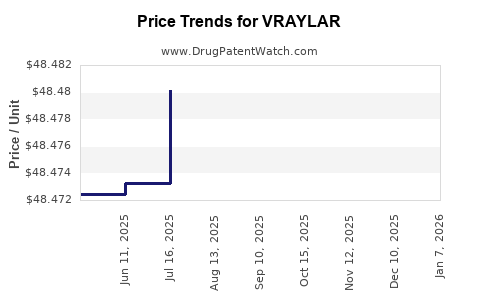
Drug Price Trends for VRAYLAR
VRAYLAR is a drug marketed by Abbvie. There are five patents protecting this drug.

This drug has one hundred and twenty-one patent family members in forty-two countries. There has been litigation on patents covering VRAYLAR

See drug price trends for VRAYLAR.

The generic ingredient in VRAYLAR is cariprazine hydrochloride. There are two drug master file entries for this API. One supplier is listed for this generic product. Additional details are available on the cariprazine hydrochloride profile page.

When can SIGNIFOR LAR (pasireotide pamoate) generic drug versions launch in Ecuador?

Generic name: pasireotide pamoate
DrugPatentWatch® Estimated Key Patent Expiration / Generic Entry Date: May 24, 2027
Generic Entry Controlled by: Ecuador Patent SP099793

SIGNIFOR LAR is a drug marketed by Recordati Rare. There are three patents protecting this drug.

This drug has one hundred and twenty-one patent family members in forty-two countries.

See drug price trends for SIGNIFOR LAR.

The generic ingredient in SIGNIFOR LAR is pasireotide pamoate. One supplier is listed for this generic product. Additional details are available on the pasireotide pamoate profile page.

When can JAKAFI (ruxolitinib phosphate) generic drug versions launch in Ecuador?

Generic name: ruxolitinib phosphate
DrugPatentWatch® Estimated Key Patent Expiration / Generic Entry Date: June 13, 2027
Generic Entry Controlled by: Ecuador Patent SP099802
Patent Title: SALES DEL INHIBIDOR DE JANUS CINASA (R)-3-(4-(7H-PIRROLO[2,3-d]PIRIMIDIN-4-IL)-1H-PIRAZOL-1-IL)-3- CICLOPENTILPROPANITRILO

JAKAFI is a drug marketed by Incyte Corp. There are eight patents protecting this drug and one Paragraph IV challenge.

This drug has two hundred and thirty-six patent family members in forty-six countries. There has been litigation on patents covering JAKAFI

See drug price trends for JAKAFI.

The generic ingredient in JAKAFI is ruxolitinib phosphate. There are two drug master file entries for this API. One supplier is listed for this generic product. Additional details are available on the ruxolitinib phosphate profile page.

When can TEPMETKO (tepotinib hydrochloride) generic drug versions launch in Ecuador?

Generic name: tepotinib hydrochloride
DrugPatentWatch® Estimated Key Patent Expiration / Generic Entry Date: July 12, 2027
Generic Entry Controlled by: Ecuador Patent SP109957
Patent Title: DERIVADOS DE PIRIMIDINIL-PIRIDAZINONA.

TEPMETKO is a drug marketed by Emd Serono Inc. There are eight patents protecting this drug.

This drug has seventy-nine patent family members in thirty-six countries. There has been litigation on patents covering TEPMETKO

See drug price trends for TEPMETKO.

The generic ingredient in TEPMETKO is tepotinib hydrochloride. One supplier is listed for this generic product. Additional details are available on the tepotinib hydrochloride profile page.

When can KAZANO (alogliptin benzoate; metformin hydrochloride) generic drug versions launch in Ecuador?

Generic name: alogliptin benzoate; metformin hydrochloride
DrugPatentWatch® Estimated Key Patent Expiration / Generic Entry Date: July 19, 2027
Generic Entry Controlled by: Ecuador Patent SP109979

Drug Price Trends for KAZANO
KAZANO is a drug marketed by Takeda Pharms Usa. There are two patents protecting this drug and one Paragraph IV challenge.

This drug has ninety patent family members in forty-one countries. There has been litigation on patents covering KAZANO

See drug price trends for KAZANO.

The generic ingredient in KAZANO is alogliptin benzoate; metformin hydrochloride. There are ten drug master file entries for this API. Three suppliers are listed for this generic product. Additional details are available on the alogliptin benzoate; metformin hydrochloride profile page.

When can INTRAROSA (prasterone) generic drug versions launch in Ecuador?

Generic name: prasterone
DrugPatentWatch® Estimated Key Patent Expiration / Generic Entry Date: August 10, 2027
Generic Entry Controlled by: Ecuador Patent SP10010016

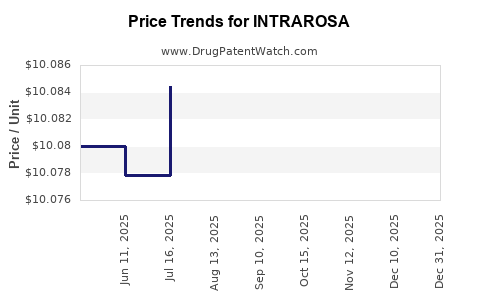
Drug Price Trends for INTRAROSA
INTRAROSA is a drug marketed by Millicent. There are three patents protecting this drug.

This drug has fifty-nine patent family members in thirty-two countries. There has been litigation on patents covering INTRAROSA

See drug price trends for INTRAROSA.

The generic ingredient in INTRAROSA is prasterone. There are seven drug master file entries for this API. One supplier is listed for this generic product. Additional details are available on the prasterone profile page.

Last updated: May 12, 2026

Ecuador Branded and Generic Drug Markets Assessment: Regulatory Opportunities, Pricing Controls, and Patent/Litigation Barriers

Ecuador’s branded and generic drug market sits under tight public-sector procurement discipline and price controls, with regulatory leverage split across ARCSA (product authorization), pricing/financing rules for public tenders, and trade-policy constraints that affect parallel imports and sourcing. The market offers clear regulatory entry points for compliant generics and authorized brands, but business execution is constrained by: (1) evolving ARCSA requirements for dossier content and quality evidence, (2) limited pricing latitude under reimbursement and public purchasing frameworks, (3) supply-chain and local-manufacturing expectations for repeat contracting, and (4) patent and exclusivity friction in originator segments where brand-to-generic conversion is delayed by litigation or Orange Book–style exclusivity substitutes in practice.

Market structure in practice (branded vs generic)

  • Branded medicines tend to concentrate in chronic therapies (cardiometabolic, respiratory, gastrointestinal) and high-observed hospital formularies where tendering favors established brands with consistent supply.
  • Generics win share where: (i) ARCSA bioequivalence or quality comparability pathways are navigable, (ii) procurement evaluation weights price and technical compliance, and (iii) there is no active originator exclusivity enforcement that blocks substitution.

What drives commercial winners

  • Regulatory throughput: time-to-authorization depends on dossier completeness, quality package adequacy (CMC-like evidence), and responsiveness to ARCSA queries.
  • Tender competitiveness: public tenders tend to penalize noncompliance risk and late deliveries more than small price differences.
  • Lifecycle management: line extensions and formulation changes can extend commercial defensibility, delaying generic uptake even when the original API is no longer newly patented.

What is the size and growth profile of Ecuador’s branded and generic drug markets?

Ecuador’s pharmaceutical demand is dominated by private purchases for out-of-pocket segments and public-sector procurement for insured and government programs. The branded/generic mix varies by therapeutic area; the most reliable conversion to generics occurs in molecules with established local substitution history and minimal regulatory friction.

High-conversion areas (typical pattern)

  • antihypertensives
  • statins and lipid agents
  • antidiabetics (oral small molecules more than complex injectables)
  • antibiotics where generics have long-standing local authorization

Lower-conversion areas (typical pattern)

  • branded specialty products with complex clinical positioning
  • injectable formulations with higher manufacturing qualification barriers
  • products with active exclusivity disputes or brand-protecting reformulations

Commercial implication For entrants, the highest probability path is not “fast generic across the board,” but selecting molecules where: ARCSA pathway is clear, procurement criteria are price- and compliance-weighted, and no known originator enforcement blocks substitution.

How do ARCSA authorization pathways shape branded versus generic entry?

ARCSA governs marketing authorization and the product dossier review process. For branded entrants, the pathway is authorization of a reference product and its labeling claims. For generics, market access is determined by whether the applicant satisfies equivalence requirements (quality, formulation comparability, and bioequivalence where required), plus manufacturing quality system evidence.

Typical authorization bottlenecks for generics

  • CMC-equivalent evidence quality: inconsistency between reference product specs and applicant specs triggers repeated clarification rounds.
  • Bioequivalence strategy fit: even when a pathway exists, selection of study design and comparator alignment affects acceptance.
  • Stability and shelf-life: missing bracketing justification or incomplete long-term stability can stall review.

Typical authorization bottlenecks for brands

  • Labeling alignment: Ecuador-specific labeling and registry formatting can require iterative updates.
  • Packaging and presentation compliance: unit packaging, secondary packaging requirements, and labeling language need strict conformity.

Regulatory execution takeaway

A branded dossier can be approved faster when the reference file and local labeling are tightly aligned. A generic dossier can be approved quickly only when the quality package is coherent and equivalence evidence is pre-validated against ARCSA expectations.

What regulatory pricing and reimbursement rules affect market access for generics?

Ecuador’s pricing environment is shaped by public procurement and regulated price ceilings that reduce margin upside for both brands and generics. Generics win when they can offer a commercially viable price below regulated or tender benchmark levels while maintaining reliability of supply.

Practical impact on launch economics

  • If procurement uses a benchmarked price and awards to lowest compliant bidder, generics can scale quickly when they hit technical compliance.
  • If price ceilings are tight, brands remain competitive in early cycles if they are established suppliers with acceptable total cost of ownership (supply continuity, fewer tender disqualifications).

Commercial risk to manage

  • A generic that clears ARCSA but cannot maintain tender competitiveness due to price constraints may remain registry-only with limited volume.

When does Ecuador allow generic substitution and what are the risks to tender conversion?

Generic substitution is driven by tender evaluation rules, formulary positioning, and the legal status of originator products under local exclusivity norms. Even without an Orange Book equivalent, commercial substitution can be delayed by originator defenses and procurement policies that require specific product references.

Substitution risk channels

  • De facto exclusivity through procurement specifications: tenders may request a specific brand or require reference substitution that favors the originator.
  • Enforcement-driven switching delays: if litigation or administrative actions are pending, procurement officers often delay substitution to avoid legal exposure.
  • Lifecycle reformulations: originators may maintain market share by changing formulations, presentations, or dosing regimens.

Best-fit generic strategy

  • Target strengths: authorized strengths and presentations that map directly to commonly tendered formulations.
  • Prepare for “brand lock” tenders by bundling evidence that supports equivalence and by ensuring stability-of-supply readiness.

What patent estate and exclusivity risks exist for branded products in Ecuador?

Patent enforcement in Ecuador can affect generic entry timing through injunctions and administrative dynamics. Even where patent registries do not operate like a US-style public list, originators can use legal process and procurement leverage to slow generic substitution.

High-risk molecules

  • originator brands with recent filing histories or active litigation in the region
  • biologics and complex injectables with strong formulation and manufacturing claims
  • reformulated products with distinct compositions or delivery systems

How to assess risk for a specific SKU

  • Identify the originator product’s “defensibility chain”: API patent, polymorph/crystal, formulation, method-of-use, and manufacturing/process claims.
  • Map likely enforcement jurisdictions and whether that enforcement has historically affected local tender switching.

Which Ecuador regulatory actions can block or delay generic launches?

ARCSA can delay market entry through:

  • dossier completeness requests and iterative clarifications
  • manufacturing site inspections or quality documentation gaps
  • labeling and presentation compliance failures
  • stability and comparability issues

Execution controls that matter

  • dossier readiness: complete translations and consistent labeling specs
  • quality package consistency: aligned COAs, specs, and validation reports
  • supply-chain readiness: ability to meet tender delivery windows and continuity

How do Ecuador import, local manufacturing expectations, and supply reliability affect approvals?

Ecuador’s procurement and distribution environment favors suppliers that can sustain volumes and maintain compliant cold chain where required. Even if local manufacturing is not universally required for all products, local presence and logistics reliability often determine which bidders remain in the rotation.

Barriers for new entrants

  • lead times and customs processing variability
  • distributor capacity and bid fulfillment history
  • cold chain qualification for temperature-sensitive SKUs

Market opportunity

  • partnerships with established local distributors can reduce execution risk during early tender cycles.

What is the Orange Book equivalent in Ecuador and how can companies use it?

Ecuador does not have a US-style Orange Book that publicly lists patents for each approved drug with a clear Paragraph IV analog. Companies typically rely on:

  • patent status through local legal and administrative channels
  • regulatory history and market behavior (substitution delays, procurement specs)
  • corporate intelligence on active enforcement strategies

Practical consequence

For generic planning, the critical path is not “check a public patent list” but:

  • run a freedom-to-operate style landscape for the originator product family
  • review how procurement and litigation dynamics have played out in local tender cycles

What litigation and settlement patterns influence generic entry risk in Ecuador?

When originators litigate, settlements often aim to preserve brand revenue while structuring launch dates, sometimes tied to specific SKUs or strength ranges. Even without a formal US settlement template in Ecuador, market outcomes can mimic it: generics are launched in narrower scopes or after a delay.

Risk indicators to watch

  • procurement language that specifies originator references despite equivalence availability
  • “pause” behavior by distributors when lawsuits are active
  • sudden changes in bid qualification for competing SKUs

How do biosimilar risks differ from small-molecule generic risks in Ecuador?

For biosimilars, the barrier is higher because requirements for analytical similarity, clinical bridging, and manufacturing comparability are more demanding. Even when regulatory pathways exist, interchangeability and procurement acceptance tend to lag.

Biosimilar commercial constraints

  • hospital formulary adoption cycles
  • tender committees’ comfort level with switching
  • manufacturing quality system evidence scrutiny

Opportunity set

  • biosimilars with strong global reference dossiers and clean quality packages have the best chance at ARCSA acceptance and earlier formulary adoption.

What formulations are protected by patents and what delivery systems matter for Ecuador?

Formulation patents often drive “brand life” beyond the API. For entrants, the highest sensitivity is around:

  • modified-release and extended dosing regimens
  • fixed-dose combinations (FDCs)
  • inhalation devices and device-delivery systems where formulation and device co-claims exist
  • topical formulations with specific excipient systems

Practical mapping approach

  • compare the originator’s clinical regimen and dosage forms to the applicant’s intended Ecuador SKU presentations
  • assess whether the generic’s formulation is merely equivalent or structurally distinct in a way that invites infringement risk

Which branded and generic companies are best positioned in Ecuador’s tender ecosystem?

Market leadership typically tracks local distribution strength, tender track record, and ability to maintain supply. Brands retain advantage when:

  • they have entrenched hospital purchasing relationships
  • they can consistently win public bids
  • they offer a stable pipeline and favorable total procurement risk profile

Generics can scale when:

  • the applicant has a reliable local distribution and logistics footprint
  • the pricing clears regulated or tender benchmark thresholds
  • dossier review and manufacturing qualification are executed without repeated cycles

How does Ecuador’s regulatory framework affect export and reverse-trade strategies?

Ecuador can be used as a reference jurisdiction for broader Latin America market penetration when a product is authorized and can demonstrate compliance. Companies that establish ARCSA-ready quality dossiers can reduce incremental cost for additional jurisdictions that recognize similar documentation standards.

Strategy implication

  • treating Ecuador authorization as part of a portfolio-wide LATAM regulatory plan can improve ROI, especially when procurement volume is leveraged across countries.

What generic entry scenarios are most realistic for a new applicant?

Three launch scenarios are common:

  1. Straight generic replacement
    • works when originator substitution is procurement-permitted and no active enforcement blocks switching.
  2. Partial scope launch
    • launches strengths or presentations that are procurement-friendly while leaving higher-risk SKUs for later.
  3. Tender-led rollout
    • authorizes multiple SKUs but ramp volumes only in tender categories where evaluation criteria are favorable.

Key execution gate

Even if ARCSA authorization is achieved, the tender category can be the real limiter. Applicants need alignment between:

  • registered presentations
  • projected tender demand
  • supply schedule with buffer for shipment variability

What regulatory opportunities exist for new branded entrants?

Brand entrants can find opportunity where:

  • there is limited competition in specific therapeutic niches
  • tenders prioritize clinical positioning and the brand has documented outcomes in local formularies
  • hospital systems are willing to adopt established therapy rather than switch

Where margin risk is highest for brands

  • when public procurement heavily rewards price and the tender benchmark tightens

What are the regulatory opportunities for contract manufacturing and co-marketing in Ecuador?

Given the execution constraints, the biggest opportunity for mid-size entrants is reducing operational risk through:

  • contract manufacturing with validated GMP alignment
  • co-marketing with established local distributors or tender-experienced partners
  • using existing label/product registrations when permissible via authorized changes

Compliance requirement

All outsourcing must maintain traceability of quality documentation and inspection readiness for ARCSA.

Key Takeaways

  • Ecuador’s branded and generic markets are shaped more by ARCSA authorization quality and tender execution than by nominal registry access alone.
  • Generic expansion is fastest where equivalence dossiers clear without iterative manufacturing evidence gaps and where procurement allows substitution.
  • Patent and exclusivity risk is real even without a US-style public patent list, because litigation and procurement specifications can delay switching.
  • The commercial path to scale is tender-led and supply-reliability driven; ARCSA approval is necessary but not sufficient.
  • For biosimilars and formulation-sensitive SKUs, execution risk rises due to stricter quality comparability expectations and slower hospital adoption.

FAQs

1) What ARCSA dossier elements most often delay generic approvals in Ecuador?
Quality comparability specs alignment, stability evidence sufficiency, and bioequivalence study design fit for the exact strength and dosage form.

2) How do public tenders in Ecuador decide between brands and generics?
By combining technical compliance with procurement risk scoring, typically anchored to price benchmarks and supply reliability.

3) What are the main barriers to biosimilar adoption versus small-molecule generics in Ecuador?
Higher analytical and manufacturing comparability scrutiny and slower hospital formulary acceptance.

4) Can generic entrants launch after API exclusivity ends but still face delays?
Yes when procurement specifications, litigation posture, or formulation/presentation-specific defensibility blocks substitution.

5) What launch model reduces risk for new generic applicants in Ecuador?
Tender-led rollout with partial-scope authorization, aligning registered strengths and presentations to the categories that are most substitution-friendly.

References

  1. Agencia de Regulación, Control y Vigilancia Sanitaria (ARCSA). (n.d.). Regulatory framework and marketing authorization guidance for pharmaceutical products. ARCSA website.
  2. World Health Organization. (n.d.). Country policy guidance on medicines regulation and pharmacovigilance. WHO.
  3. Pan American Health Organization. (n.d.). Regulatory systems and medicine access resources for Latin America. PAHO.

More… ↓

⤷  Start Trial

DrugPatentWatch cited by CNN, NEJM, Nature Journals, and more …

Make Better Decisions: Try a trial or see plans & pricing

Drugs may be covered by multiple patents or regulatory protections. All trademarks and applicant names are the property of their respective owners or licensors. Although great care is taken in the proper and correct provision of this service, thinkBiotech LLC does not accept any responsibility for possible consequences of errors or omissions in the provided data. The data presented herein is for information purposes only. There is no warranty that the data contained herein is error free. We do not provide individual investment advice. This service is not registered with any financial regulatory agency. The information we publish is educational only and based on our opinions plus our models. By using DrugPatentWatch you acknowledge that we do not provide personalized recommendations or advice. thinkBiotech performs no independent verification of facts as provided by public sources nor are attempts made to provide legal or investing advice. Any reliance on data provided herein is done solely at the discretion of the user. Users of this service are advised to seek professional advice and independent confirmation before considering acting on any of the provided information. thinkBiotech LLC reserves the right to amend, extend or withdraw any part or all of the offered service without notice.