Takeda Pharms Usa Company Profile
✉ Email this page to a colleague
What is the competitive landscape for TAKEDA PHARMS USA
TAKEDA PHARMS USA has forty approved drugs.
There are one hundred US patents protecting TAKEDA PHARMS USA drugs.
Summary for Takeda Pharms Usa
| US Patents: | 100 |
| Tradenames: | 43 |
| Ingredients: | 33 |
| NDAs: | 40 |
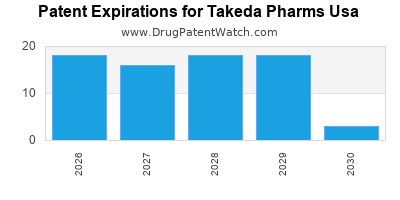
Drugs and US Patents for Takeda Pharms Usa
| Applicant | Tradename | Generic Name | Dosage | NDA | Approval Date | TE | Type | RLD | RS | Patent No. | Patent Expiration | Product | Substance | Delist Req. | Exclusivity Expiration |
|---|---|---|---|---|---|---|---|---|---|---|---|---|---|---|---|
| Takeda Pharms Usa | NINLARO | ixazomib citrate | CAPSULE;ORAL | 208462-003 | Nov 20, 2015 | RX | Yes | Yes | 7,442,830 | ⤷ Start Trial | Y | Y | ⤷ Start Trial | ||
| Takeda Pharms Usa | COLCRYS | colchicine | TABLET;ORAL | 022352-001 | Jul 29, 2009 | DISCN | Yes | No | 7,981,938 | ⤷ Start Trial | ⤷ Start Trial | ||||
| Takeda Pharms Usa | TRINTELLIX | vortioxetine hydrobromide | TABLET;ORAL | 204447-003 | Sep 30, 2013 | DISCN | Yes | No | 9,125,910*PED | ⤷ Start Trial | Y | ⤷ Start Trial | |||
| Takeda Pharms Usa | TRINTELLIX | vortioxetine hydrobromide | TABLET;ORAL | 204447-002 | Sep 30, 2013 | RX | Yes | No | 9,125,910*PED | ⤷ Start Trial | Y | ⤷ Start Trial | |||
| Takeda Pharms Usa | TRINTELLIX | vortioxetine hydrobromide | TABLET;ORAL | 204447-002 | Sep 30, 2013 | RX | Yes | No | 9,125,909*PED | ⤷ Start Trial | Y | ⤷ Start Trial | |||
| Takeda Pharms Usa | KAZANO | alogliptin benzoate; metformin hydrochloride | TABLET;ORAL | 203414-001 | Jan 25, 2013 | RX | Yes | No | 8,900,638 | ⤷ Start Trial | Y | ⤷ Start Trial | |||
| Takeda Pharms Usa | PENTASA | mesalamine | CAPSULE, EXTENDED RELEASE;ORAL | 020049-001 | May 10, 1993 | AB | RX | Yes | No | ⤷ Start Trial | ⤷ Start Trial | ||||
| >Applicant | >Tradename | >Generic Name | >Dosage | >NDA | >Approval Date | >TE | >Type | >RLD | >RS | >Patent No. | >Patent Expiration | >Product | >Substance | >Delist Req. | >Exclusivity Expiration |
Expired US Patents for Takeda Pharms Usa
Paragraph IV (Patent) Challenges for TAKEDA PHARMS USA drugs
| Drugname | Dosage | Strength | Tradename | Submissiondate |
|---|---|---|---|---|
| ➤ Subscribe | Capsules | 20 mg, 30 mg, 40 mg, 50 mg, 60 mg and 70 mg | ➤ Subscribe | 2011-02-23 |
| ➤ Subscribe | Injection | 10 mg/mL | ➤ Subscribe | 2015-08-25 |
| ➤ Subscribe | Oral Powder | 750 mg and 1000 mg | ➤ Subscribe | 2015-11-25 |
| ➤ Subscribe | Extended-release Tablets | 15 mg/1000 mg and 30 mg/1000 mg | ➤ Subscribe | 2011-09-23 |
| ➤ Subscribe | Tablets | 15 mg/500 mg and 15 mg/850 mg | ➤ Subscribe | 2008-03-06 |
| ➤ Subscribe | Delayed-release Pellets/Capsul | 15 mg and 30 mg | ➤ Subscribe | 2005-12-05 |
| ➤ Subscribe | Tablets | 30 mg/2 mg and 30 mg/4 mg | ➤ Subscribe | 2009-12-22 |
| ➤ Subscribe | Capsule | 60 mg | ➤ Subscribe | 2010-08-25 |
| ➤ Subscribe | Tablets | 6.25 mg, 12.5 mg and 25 mg | ➤ Subscribe | 2017-01-25 |
| ➤ Subscribe | Extended-release Capsules | 100 mg and 200 mg | ➤ Subscribe | 2006-02-02 |
| ➤ Subscribe | Tablets | 5 mg, 10 mg, 15 mgand 20 mg | ➤ Subscribe | 2017-10-02 |
| ➤ Subscribe | Extended-release Capsules | 12.5 mg and 25 mg | ➤ Subscribe | 2017-08-07 |
| ➤ Subscribe | For Injection | 3.5 mg/vial | ➤ Subscribe | 2008-11-20 |
| ➤ Subscribe | Chewable Tablet | 500 mg, 750 mg and 1000 mg | ➤ Subscribe | 2008-10-27 |
| ➤ Subscribe | Delayed-release Tablets | 1.2 g | ➤ Subscribe | 2009-12-16 |
| ➤ Subscribe | Extended-release Tablets | 1 mg, 2 mg, 3 mg and 4 mg | ➤ Subscribe | 2009-12-29 |
| ➤ Subscribe | Tablets | 0.6 mg | ➤ Subscribe | 2011-12-23 |
| ➤ Subscribe | Delayed-release Orally Disinte | 15 mg and 30 mg | ➤ Subscribe | 2006-12-27 |
| ➤ Subscribe | Tablets | 12.5 mg/500 mg and 12.5 mg/1000 mg | ➤ Subscribe | 2017-01-25 |
| ➤ Subscribe | Delayed-release Capsule | 30 mg | ➤ Subscribe | 2010-11-30 |
| ➤ Subscribe | Tablets | 8 mg | ➤ Subscribe | 2009-07-22 |
| ➤ Subscribe | Extended-release Capsules | 37.5 mg and50 mg | ➤ Subscribe | 2017-08-03 |
| ➤ Subscribe | Tablets | 40 mg and 80 mg | ➤ Subscribe | 2013-02-13 |
International Patents for Takeda Pharms Usa Drugs
| Country | Patent Number | Estimated Expiration |
|---|---|---|
| Montenegro | P6508 | ⤷ Start Trial |
| Canada | 2684571 | ⤷ Start Trial |
| South Korea | 101956261 | ⤷ Start Trial |
| Canada | 2723961 | ⤷ Start Trial |
| European Patent Office | 1768668 | ⤷ Start Trial |
| Mexico | 2010003917 | ⤷ Start Trial |
| France | 24C1055 | ⤷ Start Trial |
| >Country | >Patent Number | >Estimated Expiration |
Supplementary Protection Certificates for Takeda Pharms Usa Drugs
| Patent Number | Supplementary Protection Certificate | SPC Country | SPC Expiration | SPC Description |
|---|---|---|---|---|
| 1084705 | C01084705/05 | Switzerland | ⤷ Start Trial | PRODUCT NAME: ALOGLIPTIN; REGISTRATION NO/DATE: SWISSMEDIC 62955 21.11.2013 |
| 2300013 | SPC/GB19/036 | United Kingdom | ⤷ Start Trial | PRODUCT NAME: BRIGATINIB, OR A PHARMACEUTICALLY ACCEPTABLE SALT THEREOF; REGISTERED: UK EU/1/18/1264 (NI) 20181126; UK PLGB 15475/0037 20181126; UK PLGB 15475/0038 20181126; UK PLGB 15475/0039 20181126; UK PLGB 15475/0075 20181126 |
| 1973545 | 13C0069 | France | ⤷ Start Trial | PRODUCT NAME: PONATINIB OU UN SEL PHARMACEUTIQUEMENT ACCEPTABLE, SOLVATE OU HYDRATE DE CELUI-CI; REGISTRATION NO/DATE: EU/1/13/839/001-004 20130701 |
| 1436271 | PA2014013,C1436271 | Lithuania | ⤷ Start Trial | PRODUCT NAME: VORTIOKSETINAS ARBA JO FARMACINIU POZIURIU PRIIMTINA RUGSTIES PRISIJUNGIMO DRUSKA; REGISTRATION NO/DATE: EU/1/13/891 20131218 |
| 0174726 | 93C0021 | Belgium | ⤷ Start Trial | PRODUCT NAME: LANSOPRAZOLE; NAT. REG.: 150 S 539 F 4 19921119; FIRST REG.: FR 333 412.1 19901211 |
| 1586571 | C01586571/01 | Switzerland | ⤷ Start Trial | PRODUCT NAME: ALOGLIPTINUM; REGISTRATION NO/DATE: AUTORISATION SWISSMEDIC 62955 22.11.2013 |
| 2435024 | 132021000000095 | Italy | ⤷ Start Trial | PRODUCT NAME: UNA COMBINAZIONE DI FORMOTEROLO (INCLUSI SUOI SALI, ESTERI, SOLVATI O ENANTIOMERI FARMACEUTICAMENTE ACCETTABILI), GLICOPIRROLATO (INCLUSI SUOI SALI, ESTERI, SOLVATI O ENANTIOMERI FARMACEUTICAMENTE ACCETTABILI) E BUDESONIDE (INCLUSI SUOI SALI, ESTERI, SOLVATI O ENANTIOMERI FARMACEUTICAMENTE ACCETTABILI)(TRIXEO AEROSPHERE); AUTHORISATION NUMBER(S) AND DATE(S): EU/1/20/1498, 20201210 |
| >Patent Number | >Supplementary Protection Certificate | >SPC Country | >SPC Expiration | >SPC Description |
Similar Applicant Names
Applicants may be listed under multiple names.
Here is a list of applicants with similar names.
Here is a list of applicants with similar names.
