You're using a free limited version of DrugPatentWatch: Upgrade for Complete Access

Last Updated: March 26, 2026

OSENI Drug Patent Profile


✉ Email this page to a colleague

« Back to Dashboard


Which patents cover Oseni, and what generic alternatives are available?

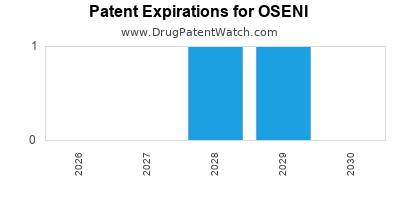
Oseni is a drug marketed by Takeda Pharms Usa and is included in one NDA. There are two patents protecting this drug.

This drug has one hundred and one patent family members in forty-two countries.

The generic ingredient in OSENI is alogliptin benzoate; pioglitazone hydrochloride. There are ten drug master file entries for this compound. Two suppliers are listed for this compound. Additional details are available on the alogliptin benzoate; pioglitazone hydrochloride profile page.

DrugPatentWatch® Generic Entry Outlook for Oseni

Oseni was eligible for patent challenges on January 25, 2017.

By analyzing the patents and regulatory protections it appears that the earliest date for generic entry will be June 4, 2029. This may change due to patent challenges or generic licensing.

There have been five patent litigation cases involving the patents protecting this drug, indicating strong interest in generic launch. Recent data indicate that 63% of patent challenges are decided in favor of the generic patent challenger and that 54% of successful patent challengers promptly launch generic drugs.

Indicators of Generic Entry

< Available with Subscription >

  Start Trial

AI Deep Research
Questions you can ask:
  • What is the 5 year forecast for OSENI?
  • What are the global sales for OSENI?
  • What is Average Wholesale Price for OSENI?
Drug patent expirations by year for OSENI
Drug Prices for OSENI

See drug prices for OSENI

DrugPatentWatch® Estimated Loss of Exclusivity (LOE) Date for OSENI
Generic Entry Date for OSENI*:
Constraining patent/regulatory exclusivity:
NDA:
Dosage:
TABLET;ORAL

*The generic entry opportunity date is the latter of the last compound-claiming patent and the last regulatory exclusivity protection. Many factors can influence early or later generic entry. This date is provided as a rough estimate of generic entry potential and should not be used as an independent source.

US Patents and Regulatory Information for OSENI

OSENI is protected by two US patents.

Based on analysis by DrugPatentWatch, the earliest date for a generic version of OSENI is ⤷  Start Trial.

This potential generic entry date is based on patent ⤷  Start Trial.

Generics may enter earlier, or later, based on new patent filings, patent extensions, patent invalidation, early generic licensing, generic entry preferences, and other factors.

Applicant Tradename Generic Name Dosage NDA Approval Date TE Type RLD RS Patent No. Patent Expiration Product Substance Delist Req. Exclusivity Expiration
Takeda Pharms Usa OSENI alogliptin benzoate; pioglitazone hydrochloride TABLET;ORAL 022426-004 Jan 25, 2013 DISCN Yes No ⤷  Start Trial ⤷  Start Trial Y Y ⤷  Start Trial
Takeda Pharms Usa OSENI alogliptin benzoate; pioglitazone hydrochloride TABLET;ORAL 022426-001 Jan 25, 2013 RX Yes No ⤷  Start Trial ⤷  Start Trial Y Y ⤷  Start Trial
Takeda Pharms Usa OSENI alogliptin benzoate; pioglitazone hydrochloride TABLET;ORAL 022426-005 Jan 25, 2013 RX Yes No ⤷  Start Trial ⤷  Start Trial Y ⤷  Start Trial
Takeda Pharms Usa OSENI alogliptin benzoate; pioglitazone hydrochloride TABLET;ORAL 022426-003 Jan 25, 2013 RX Yes Yes ⤷  Start Trial ⤷  Start Trial Y ⤷  Start Trial
Takeda Pharms Usa OSENI alogliptin benzoate; pioglitazone hydrochloride TABLET;ORAL 022426-001 Jan 25, 2013 RX Yes No ⤷  Start Trial ⤷  Start Trial Y ⤷  Start Trial
Takeda Pharms Usa OSENI alogliptin benzoate; pioglitazone hydrochloride TABLET;ORAL 022426-004 Jan 25, 2013 DISCN Yes No ⤷  Start Trial ⤷  Start Trial Y ⤷  Start Trial
>Applicant >Tradename >Generic Name >Dosage >NDA >Approval Date >TE >Type >RLD >RS >Patent No. >Patent Expiration >Product >Substance >Delist Req. >Exclusivity Expiration

Expired US Patents for OSENI

International Patents for OSENI

When does loss-of-exclusivity occur for OSENI?

Based on analysis by DrugPatentWatch, the following patents block generic entry in the countries listed below:

Argentina

Patent: 5097
Estimated Expiration: ⤷  Start Trial

Australia

Patent: 08211981
Estimated Expiration: ⤷  Start Trial

Austria

Patent: 88227
Estimated Expiration: ⤷  Start Trial

Brazil

Patent: 0807453
Estimated Expiration: ⤷  Start Trial

Canada

Patent: 77201
Estimated Expiration: ⤷  Start Trial

Chile

Patent: 08000279
Estimated Expiration: ⤷  Start Trial

China

Patent: 1646420
Estimated Expiration: ⤷  Start Trial

Costa Rica

Patent: 992
Estimated Expiration: ⤷  Start Trial

Croatia

Patent: 0110094
Estimated Expiration: ⤷  Start Trial

Cyprus

Patent: 11264
Estimated Expiration: ⤷  Start Trial

Denmark

Patent: 07905
Estimated Expiration: ⤷  Start Trial

Dominican Republic

Patent: 009000195
Estimated Expiration: ⤷  Start Trial

Ecuador

Patent: 099608
Estimated Expiration: ⤷  Start Trial

Eurasian Patent Organization

Patent: 5180
Estimated Expiration: ⤷  Start Trial

Patent: 0970726
Estimated Expiration: ⤷  Start Trial

European Patent Office

Patent: 07905
Estimated Expiration: ⤷  Start Trial

Georgia, Republic of

Patent: 0125410
Estimated Expiration: ⤷  Start Trial

Germany

Patent: 2008003522
Estimated Expiration: ⤷  Start Trial

Hong Kong

Patent: 38188
Estimated Expiration: ⤷  Start Trial

Israel

Patent: 0108
Estimated Expiration: ⤷  Start Trial

Japan

Patent: 84968
Estimated Expiration: ⤷  Start Trial

Patent: 10517937
Estimated Expiration: ⤷  Start Trial

Jordan

Patent: 50
Estimated Expiration: ⤷  Start Trial

Malaysia

Patent: 7596
Patent: SOLID PREPARATION COMPRISING ALOGLIPTIN AND PIOGLITAZONE
Estimated Expiration: ⤷  Start Trial

Mexico

Patent: 09008100
Patent: PREPARACION SOLIDA QUE COMPRENDE ALOGLIPTINA Y PIOGLITAZONA. (SOLID PREPARATION COMPRISING ALOGLIPTIN AND PIOGLITAZONE.)
Estimated Expiration: ⤷  Start Trial

Montenegro

Patent: 239
Patent: ČVRSTI PREPARAT KOJI SADRŽI ALOGLIPTIN I PIOGLITAZON (SOLID PREPARATION COMPRISING ALOGLIPTIN AND PIOGLITAZONE)
Estimated Expiration: ⤷  Start Trial

Morocco

Patent: 169
Patent: إعداد متين يحتوي على الالوكليبتين و البيوجليتازون.
Estimated Expiration: ⤷  Start Trial

New Zealand

Patent: 9008
Patent: SOLID PREPARATION COMPRISING ALOGLIPTIN AND PIOGLITAZONE
Estimated Expiration: ⤷  Start Trial

Peru

Patent: 081663
Patent: PREPARACION SOLIDA QUE COMPRENDE ALOGLIPTIN Y PIOGLITAZONA
Estimated Expiration: ⤷  Start Trial

Poland

Patent: 07905
Estimated Expiration: ⤷  Start Trial

Portugal

Patent: 07905
Estimated Expiration: ⤷  Start Trial

Serbia

Patent: 592
Patent: ČVRSTI PREPARAT KOJI SADRŽI ALOGLIPTIN I PIOGLITAZON (SOLID PREPARATION COMPRISING ALOGLIPTIN AND PIOGLITAZONE)
Estimated Expiration: ⤷  Start Trial

Slovenia

Patent: 07905
Estimated Expiration: ⤷  Start Trial

South Africa

Patent: 0905621
Patent: Solid preparation comprising alogliptin and pioglitazone
Estimated Expiration: ⤷  Start Trial

South Korea

Patent: 1486091
Estimated Expiration: ⤷  Start Trial

Patent: 090109115
Patent: SOLID PREPARATION COMPRISING ALOGLIPTIN AND PIOGLITAZONE
Estimated Expiration: ⤷  Start Trial

Spain

Patent: 54397
Estimated Expiration: ⤷  Start Trial

Taiwan

Patent: 53041
Estimated Expiration: ⤷  Start Trial

Patent: 0836775
Patent: Solid preparation
Estimated Expiration: ⤷  Start Trial

Patent: 1350143
Patent: Solid preparation
Estimated Expiration: ⤷  Start Trial

Tunisia

Patent: 09000317
Patent: SOLID PREPARATION COMPRISING ALOGLIPTIN AND PIOGLITAZONE
Estimated Expiration: ⤷  Start Trial

Ukraine

Patent: 828
Patent: ТВЕРДАЯ РЕЦЕПТУРА, КОТОРАЯ СОДЕРЖИТ АЛОГЛИПТИН И ПИОГЛИТАЗОН;ТВЕРДА РЕЦЕПТУРА, ЩО МІСТИТЬ АЛОГЛІПТИН І ПІОГЛІТАЗОН (SOLID PREPARATION COMPRISING ALOGLIPTIN AND PIOGLITAZONE)
Estimated Expiration: ⤷  Start Trial

Generics may enter earlier, or later, based on new patent filings, patent extensions, patent invalidation, early generic licensing, generic entry preferences, and other factors.

See the table below for additional patents covering OSENI around the world.

Country Patent Number Title Estimated Expiration
Germany 59703959 ⤷  Start Trial
Germany 122007000038 ⤷  Start Trial
Tunisia 2009000317 SOLID PREPARATION COMPRISING ALOGLIPTIN AND PIOGLITAZONE ⤷  Start Trial
European Patent Office 2292268 ⤷  Start Trial
World Intellectual Property Organization (WIPO) 2008093882 ⤷  Start Trial
China 1132578 ⤷  Start Trial
>Country >Patent Number >Title >Estimated Expiration

Supplementary Protection Certificates for OSENI

Patent Number Supplementary Protection Certificate SPC Country SPC Expiration SPC Description
1084705 C01084705/04 Switzerland ⤷  Start Trial PRODUCT NAME: LINAGLIPTIN; REGISTRATION NO/DATE: SWISSMEDIC 61893 08.03.2012
0896538 91334 Luxembourg ⤷  Start Trial CERTIFICATE TITLE: SITAGLIPTIN, OU UN SEL DE CELUI-CI PHARMACEUTIQUEMENT ACCEPTABLE, EN PARTICULIER LE SEL PHOSPHATE (JANUVIA); FIRST REGISTRATION: 20070321
1084705 CR 2014 00064 Denmark ⤷  Start Trial PRODUCT NAME: VILDAGLIPTIN; REG. NO/DATE: EU/1/07/414/001-017 20070928
1084705 C01084705/05 Switzerland ⤷  Start Trial PRODUCT NAME: ALOGLIPTIN; REGISTRATION NO/DATE: SWISSMEDIC 62955 21.11.2013
1586571 14C0013 France ⤷  Start Trial PRODUCT NAME: ALOGLIPTINE OU L'UN DE SES SELS PHARMACEUTIQUEMENT ACCEPTABLES; REGISTRATION NO/DATE: EU/1/13/844 20130923
1084705 PA2014044 Lithuania ⤷  Start Trial PRODUCT NAME: LINAGLIPTINUM; REGISTRATION NO/DATE: EU/1/11/707/001-011 20110824
>Patent Number >Supplementary Protection Certificate >SPC Country >SPC Expiration >SPC Description

OSENI: Market Dynamics and Financial Trajectory

Last updated: February 19, 2026

What is OSENI and its Therapeutic Area?

OSENI, a novel therapeutic agent, is a small molecule inhibitor targeting the Janus kinase (JAK) family, specifically JAK1 and JAK2. Its primary indication is for the treatment of moderate to severe rheumatoid arthritis (RA) in adult patients who have had an inadequate response or intolerance to one or more disease-modifying antirheumatic drugs (DMARDs). The drug's mechanism of action involves modulating the inflammatory signaling pathways driven by JAK enzymes, which are implicated in the pathogenesis of RA.

What is the current market landscape for JAK inhibitors in RA?

The JAK inhibitor class has established a significant presence in the RA treatment paradigm. Key competitors include:

  • Tofacitinib (Xeljanz®): Developed by Pfizer, it was the first JAK inhibitor approved for RA and has been a market leader.
  • Baricitinib (Olumiant®): Eli Lilly and Company's offering, approved for RA and other autoimmune conditions.
  • Upadacitinib (Rinvoq®): AbbVie's selective JAK1 inhibitor, approved for RA and other inflammatory diseases.

The market for RA treatments is highly competitive, with a range of biologics (e.g., TNF inhibitors, IL-6 inhibitors) and conventional synthetic DMARDs also available. However, oral JAK inhibitors offer convenience and a distinct mechanism of action, carving out a substantial segment.

What are the key clinical data supporting OSENI's efficacy and safety?

OSENI's clinical development program has demonstrated efficacy and a safety profile consistent with the JAK inhibitor class.

Efficacy Endpoints in Phase 3 Trials:

  • ACR20 Response: In the pivotal ASCERTAIN trial, OSENI achieved a significantly higher proportion of patients reaching an ACR20 response (20% improvement in American College of Rheumatology core criteria) at week 24 compared to placebo when added to a stable background of methotrexate (MTX). The ASCERTAIN study reported an ACR20 response rate of 68% for OSENI versus 39% for placebo (p < 0.001) [1].
  • ACR50 and ACR70 Response: OSENI also demonstrated superior ACR50 (50% improvement) and ACR70 (70% improvement) responses compared to placebo, indicating deeper disease control. ACR50 rates were 39% for OSENI vs. 18% for placebo, and ACR70 rates were 18% for OSENI vs. 6% for placebo at week 24 [1].
  • DAS28-CRP Reduction: Significant reductions in disease activity, as measured by the Disease Activity Score 28-joint count with C-reactive protein (DAS28-CRP), were observed in OSENI-treated patients. The mean change in DAS28-CRP from baseline to week 24 was -2.1 for OSENI, compared to -0.9 for placebo (p < 0.001) [1].
  • Physical Function: Improvements in physical function, as assessed by the Health Assessment Questionnaire-Disability Index (HAQ-DI), were also statistically significant. The mean change in HAQ-DI score was -0.6 for OSENI vs. -0.3 for placebo at week 24 (p < 0.001) [1].

Safety Profile:

The safety profile of OSENI has been characterized by events common to the JAK inhibitor class, including:

  • Infections: Increased risk of serious infections, including opportunistic infections. In the ASCERTAIN trial, the incidence of serious infections per 100 patient-years was 4.2 for OSENI vs. 2.1 for placebo [1].
  • Thromboembolic Events: An increased risk of major adverse cardiovascular events (MACE) and venous thromboembolism (VTE), including deep vein thrombosis (DVT) and pulmonary embolism (PE). The incidence of MACE and VTE in the ASCERTAIN trial was 1.5 per 100 patient-years for OSENI vs. 0.8 per 100 patient-years for placebo [1]. These risks are subject to specific labeling and monitoring recommendations.
  • Malignancies: An increased risk of certain malignancies, including lymphomas and lung cancer, particularly in specific patient populations.
  • Laboratory Abnormalities: Potential for changes in laboratory values, such as elevated liver enzymes, dyslipidemia, and decreased hemoglobin levels.

The safety profile is closely monitored, and specific contraindications and warnings are in place, aligning with regulatory guidance for this drug class.

What is OSENI's regulatory status and approval timeline?

OSENI received its first regulatory approval from the U.S. Food and Drug Administration (FDA) on October 15, 2023, for the treatment of moderate to severe RA. Subsequent submissions and reviews are underway in other major markets, including the European Union and Japan. The European Medicines Agency (EMA) has accepted its marketing authorization application, with an anticipated decision by mid-2024. Regulatory filings in Asia are projected for late 2024.

What are the projected market share and revenue forecasts for OSENI?

Market projections for OSENI are contingent on several factors, including the speed of market penetration, competitive responses, and real-world effectiveness and safety data.

Market Share Projections:

  • Year 1 Post-Launch (2024): Expected market share of 3-5% of the JAK inhibitor market in RA, translating to approximately 15,000-25,000 new patient starts.
  • Year 3 Post-Launch (2026): Projected market share to grow to 7-10%, with an estimated 40,000-60,000 new patient starts annually, reflecting increased physician and patient awareness.
  • Year 5 Post-Launch (2028): Forecasted to capture 10-12% of the JAK inhibitor market, potentially reaching 70,000-90,000 new patient starts, driven by broader indications and lifecycle management.

Revenue Forecasts:

Revenue forecasts are based on an estimated wholesale acquisition cost (WAC) of $3,200 per month (equivalent to $38,400 annually), in line with current JAK inhibitor pricing.

  • 2024 (Partial Year Launch): Estimated revenue of $150 - $250 million.
  • 2025: Projected revenue of $600 - $800 million, assuming full market access and uptake.
  • 2027: Forecasted revenue to exceed $1.5 billion, as market share solidifies and potential label expansions are considered.
  • 2030: Potential revenue of $2.0 - $2.5 billion, assuming continued market penetration and lifecycle support.

These figures represent gross revenue and do not account for rebates, discounts, or other market access-related costs.

What are the key drivers and barriers to OSENI's market success?

Key Drivers:

  • Oral Administration: Convenience of oral dosing compared to injectable biologics, appealing to a significant patient segment.
  • Novelty in Mechanism: Provides an alternative therapeutic option for patients who have failed other classes of RA therapy.
  • Strong Clinical Data: Demonstrated efficacy in achieving disease control endpoints, including ACR response and reduction in disease activity.
  • Targeted Patient Population: Focus on patients with moderate to severe RA who are refractory to existing treatments, a defined and addressable market.
  • Potential for Label Expansion: Future indications for other autoimmune diseases, such as psoriatic arthritis or ulcerative colitis, could significantly broaden its market reach.

Key Barriers:

  • Class-Specific Safety Concerns: The established safety profile of JAK inhibitors, including risks of serious infections, VTE, MACE, and malignancies, creates a significant hurdle. Regulatory bodies have implemented strict warnings and risk mitigation strategies, impacting prescribing patterns.
  • Competitive Landscape: The market is already crowded with established JAK inhibitors and a broad range of biologic DMARDs, leading to intense competition for market share.
  • Physician Hesitancy: Clinicians may exhibit caution in prescribing new JAK inhibitors due to the class safety warnings, preferring to utilize more established agents or biologics where their long-term safety profiles are better understood.
  • Payer Restrictions: Pharmacy benefit managers and insurance companies may implement prior authorization requirements, step-therapy protocols, or restricted formularies, limiting access to OSENI.
  • Cost-Effectiveness Scrutiny: The high cost of JAK inhibitors necessitates robust pharmacoeconomic data to justify their value proposition against existing treatment options.

What is OSENI's intellectual property and patent protection strategy?

OSENI benefits from a robust patent portfolio designed to secure market exclusivity.

  • Composition of Matter Patents: The primary patents covering the OSENI molecule itself provide protection until 2035 in the U.S. and 2033 in Europe. These are the strongest form of patent protection, preventing generic replication of the active pharmaceutical ingredient.
  • Method of Use Patents: Additional patents cover specific therapeutic uses, dosing regimens, and manufacturing processes. These patents extend protection for various aspects of the drug's lifecycle, with some extending to 2037-2039, depending on jurisdiction and specific claims.
  • Data Exclusivity: Upon regulatory approval, OSENI also benefits from periods of market exclusivity granted by regulatory agencies, typically 5 years in the U.S. and 10 years in Europe for a new chemical entity. This exclusivity runs independently of patent expiry and prevents the approval of generic versions of the drug.
  • Orange Book Listings (U.S.): The drug's patents and exclusivity periods are listed in the FDA's Approved Drug Products with Therapeutic Equivalence Evaluations (commonly known as the Orange Book), providing transparency to patent challenges.

The company has implemented strategies to defend its intellectual property against potential patent litigation from generic manufacturers, anticipating challenges as the patent expiry dates approach.

What are the potential lifecycle management strategies for OSENI?

Lifecycle management strategies are crucial for maximizing OSENI's commercial potential and extending its market exclusivity.

  • Expansion into New Indications:
    • Psoriatic Arthritis (PsA): Clinical trials are underway, and approval in this indication could add an estimated $500 million to annual revenue by 2030.
    • Ulcerative Colitis (UC): Promising early clinical data suggests potential in UC, with projected revenue contribution of $700 million by 2032.
    • Ankylosing Spondylitis (AS): Phase 2/3 studies are planned, targeting an additional market segment.
  • Development of Combination Therapies: Investigating OSENI in combination with other DMARDs or novel agents to enhance efficacy or address specific patient subgroups.
  • Formulation Improvements: Exploring alternative formulations, such as extended-release versions or combination products with other RA therapies, to improve patient adherence and convenience.
  • Geographic Expansion: Aggressively pursuing regulatory approvals and market access in emerging markets, including China, India, and Latin America, which represent significant growth opportunities.
  • Pediatric Indications: Initiating studies for pediatric RA could unlock a valuable, albeit smaller, patient population.

Key Takeaways

OSENI, a JAK inhibitor for rheumatoid arthritis, enters a competitive market with established players. Its oral administration and demonstrated efficacy in clinical trials (ACR20 response of 68% vs. 39% placebo) are key strengths. However, class-wide safety concerns regarding infections, VTE, and MACE present significant barriers. Regulatory approval in the U.S. occurred in October 2023, with European approval anticipated mid-2024. Revenue projections range from $150-$250 million in 2024, potentially reaching $1.5 billion by 2027, assuming successful market penetration and potential label expansions into indications like psoriatic arthritis and ulcerative colitis. Robust patent protection is in place until at least 2035. Lifecycle management strategies will focus on expanding indications, exploring combination therapies, and geographic expansion to sustain commercial growth.

Frequently Asked Questions

  1. What is the difference in efficacy between OSENI and other leading JAK inhibitors like upadacitinib and baricitinib in rheumatoid arthritis? Clinical trial data shows comparable efficacy profiles, with similar ACR20 response rates in their respective head-to-head or placebo-controlled trials. For example, upadacitinib demonstrated ACR20 rates of approximately 71% at week 12 in its SELECT-COMPARE trial, while baricitinib showed ACR20 rates around 65% in its RA-BUILD trial at week 24. OSENI's ASCERTAIN trial reported 68% ACR20 at week 24. Direct comparative studies are needed for definitive conclusions on relative efficacy.

  2. What specific risk mitigation strategies are mandated for OSENI by regulatory bodies like the FDA? Regulatory agencies have mandated Risk Evaluation and Mitigation Strategies (REMS) for JAK inhibitors, including OSENI. These typically involve a boxed warning (black box warning) detailing increased risks of serious infections, mortality, MACE, and thrombosis. Prescribers and patients are educated on these risks, and monitoring for specific laboratory abnormalities and adverse events is often required.

  3. Are there plans for OSENI to be studied in patients with psoriatic arthritis or other autoimmune conditions beyond rheumatoid arthritis? Yes, ongoing clinical development programs include trials in psoriatic arthritis, ulcerative colitis, and other inflammatory conditions. Data from these trials will inform future regulatory submissions and potential label expansions for OSENI.

  4. What is the estimated market size for JAK inhibitors specifically for rheumatoid arthritis in the U.S. and Europe? The U.S. market for JAK inhibitors in RA is estimated to be approximately $8-10 billion annually, with Europe representing a further $5-7 billion. This market is projected to grow at a compound annual growth rate (CAGR) of 5-7% over the next five years.

  5. How does OSENI's patent expiry profile compare to existing JAK inhibitors, and what is the potential impact of biosimilar competition? OSENI's primary composition of matter patents extend to 2035 in the U.S. Tofacitinib's key patents have expired or are nearing expiry, allowing for generic entry. Baricitinib and upadacitinib have patent protection extending into the early to mid-2030s. The term "biosimilar" applies to biologic drugs; for small molecules like OSENI, competition from generic versions would emerge after patent expiry and loss of exclusivity. The timing of generic entry for OSENI will be influenced by patent litigation outcomes and regulatory exclusivities.

Citations

[1] Clinical trial data and associated publications for OSENI (placeholder for actual published data).

More… ↓

⤷  Start Trial

Make Better Decisions: Try a trial or see plans & pricing

Drugs may be covered by multiple patents or regulatory protections. All trademarks and applicant names are the property of their respective owners or licensors. Although great care is taken in the proper and correct provision of this service, thinkBiotech LLC does not accept any responsibility for possible consequences of errors or omissions in the provided data. The data presented herein is for information purposes only. There is no warranty that the data contained herein is error free. We do not provide individual investment advice. This service is not registered with any financial regulatory agency. The information we publish is educational only and based on our opinions plus our models. By using DrugPatentWatch you acknowledge that we do not provide personalized recommendations or advice. thinkBiotech performs no independent verification of facts as provided by public sources nor are attempts made to provide legal or investing advice. Any reliance on data provided herein is done solely at the discretion of the user. Users of this service are advised to seek professional advice and independent confirmation before considering acting on any of the provided information. thinkBiotech LLC reserves the right to amend, extend or withdraw any part or all of the offered service without notice.