Last updated: September 23, 2026
Invokana (canagliflozin) is a Johnson & Johnson and Mitsubishi Tanabe Pharma sodium-glucose cotransporter-2 (SGLT2) inhibitor approved in the United States in 2013. Its U.S. new chemical entity exclusivity expired in 2018, while key composition-of-matter and formulation patents extended protection into the mid-to-late 2020s. Commercial performance peaked before broad competition from Jardiance and Farxiga, then stabilized as cardiovascular and renal indications expanded.
Johnson & Johnson reported worldwide Invokana sales of approximately $1.0 billion to $1.2 billion annually in recent years, well below the product's 2017 peak of about $1.4 billion. The principal commercial risk is generic entry after expiration of the core patent estate. Biosimilar risk is not relevant because Invokana is a small-molecule drug.
What is Invokana and how does it compete in the SGLT2 market?
Invokana contains canagliflozin, an oral SGLT2 inhibitor that reduces renal glucose reabsorption and increases urinary glucose excretion. The product is marketed primarily as Invokana tablets and in fixed-dose combinations with metformin under the Invokamet and Invokamet XR brands.
The FDA-approved U.S. indications include:
- Glycemic control in adults with type 2 diabetes mellitus.
- Reduction in the risk of major cardiovascular events in adults with type 2 diabetes and established cardiovascular disease.
- Reduction in the risk of end-stage kidney disease, doubling of serum creatinine, cardiovascular death, and hospitalization for heart failure in adults with type 2 diabetes and diabetic nephropathy with albuminuria.
The renal indication materially improved Invokana's market position after the CREDENCE trial demonstrated kidney and cardiovascular benefits in patients with diabetic kidney disease.[1] The FDA removed the boxed warning for lower-limb amputation in 2020, although amputation remains a warning in the prescribing information.[2]
How does Invokana compare with Jardiance and Farxiga?
Jardiance and Farxiga gained broader commercial momentum because their clinical evidence supported use across diabetes, heart failure, and chronic kidney disease populations. Invokana's earlier amputation safety signal and initial positioning in diabetes limited its share of the expanding SGLT2 market.
| Drug |
Active ingredient |
Manufacturer |
Key commercial strengths |
Principal competitive issue |
| Invokana |
Canagliflozin |
Janssen, Mitsubishi Tanabe |
CREDENCE renal data; cardiovascular indication |
Earlier safety concerns; patent maturity |
| Jardiance |
Empagliflozin |
Boehringer Ingelheim, Eli Lilly |
Strong cardiovascular and heart-failure franchise |
High class competition |
| Farxiga |
Dapagliflozin |
AstraZeneca |
Heart failure and chronic kidney disease indications |
Direct competition across non-diabetes markets |
| Steglatro |
Ertugliflozin |
Merck, Pfizer |
SGLT2 class participation |
Lower commercial scale |
Jardiance and Farxiga have become the principal growth products in the class. Invokana retains clinical value in diabetic kidney disease, but its sales base is more exposed to formulary substitution and generic erosion.
How has Invokana revenue changed over time?
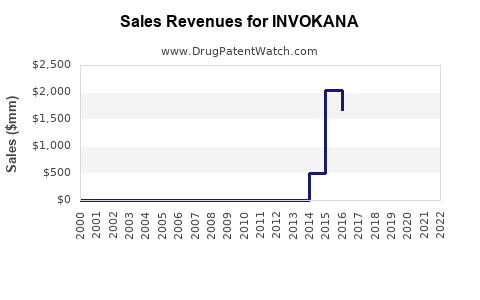
Invokana's revenue trajectory has three phases: rapid uptake through 2017, a sharp decline following safety concerns and competitive pressure, and stabilization supported by renal and cardiovascular use.
| Year |
Johnson & Johnson worldwide Invokana sales, approximate |
| 2015 |
$1.0 billion |
| 2016 |
$1.3 billion |
| 2017 |
$1.4 billion |
| 2018 |
$1.1 billion |
| 2019 |
$1.0 billion |
| 2020 |
$1.0 billion |
| 2021 |
$1.1 billion |
| 2022 |
$1.2 billion |
| 2023 |
$1.1 billion |
Source: Johnson & Johnson annual reports.[3-9]
Sales peaked before the market fully incorporated lower-limb amputation concerns and before Jardiance and Farxiga established stronger positions in cardiovascular and renal disease. The 2018 decline reflected the commercial effect of safety concerns, label changes, litigation costs, and payer pressure.
The subsequent stabilization was driven by:
- CREDENCE-based prescribing in diabetic kidney disease.
- Removal of the boxed warning for amputation.
- Continued use in combination therapy for type 2 diabetes.
- Persistent physician familiarity and established payer coverage.
- SGLT2 class growth in cardio-renal disease.
The product remains financially relevant to Johnson & Johnson, but its trajectory is mature rather than growth-oriented. Even with stable demand, the revenue base is vulnerable to rapid price compression after generic entry.
When does Invokana lose market exclusivity?
Invokana's five-year U.S. new chemical entity exclusivity expired in 2018. Patent protection continued after regulatory exclusivity ended.
| Protection category |
Approximate status |
| FDA approval |
March 29, 2013 |
| New chemical entity exclusivity |
Expired in 2018 |
| Core composition-of-matter patent |
Expired or reached nominal expiry around 2024-2025, subject to patent-term adjustment and pediatric extension |
| Later formulation and use patents |
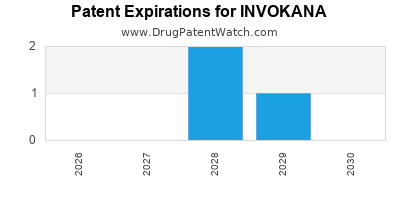
Extend into approximately 2027-2029 for selected products or indications |
| Generic exposure |
Highest for standalone canagliflozin tablets after core patent expiry |
The core U.S. patent commonly associated with Invokana is U.S. Patent No. 7,943,788. Later patents, including U.S. Patent Nos. 8,513,202 and 8,889,692, have been associated with additional protection for canagliflozin products and formulations.[10]
Patent expiry does not create an automatic, immediate generic launch. A generic applicant must receive FDA approval, address each listed patent through certification, and resolve any litigation-related stay or settlement restriction.
What patents protect Invokana and Invokamet?
The patent estate covers several layers of protection rather than a single expiration date.
Composition-of-matter protection
The earliest patents protect canagliflozin and related C-glucoside compounds. This protection is the most commercially important because it can block generic versions of the active ingredient itself.
Formulation patents
Later patents may cover:
- Immediate-release canagliflozin tablets.
- Pharmaceutical compositions containing canagliflozin.
- Canagliflozin and metformin combinations.
- Extended-release Invokamet XR formulations.
- Specific excipient or dosage configurations.
Formulation patents are narrower than composition-of-matter patents. They can delay or limit a generic product if the ANDA formulation falls within the claims, but they do not always prevent alternative formulations or a standalone active-ingredient product.
Method-of-use patents
Method-of-use protection may cover treatment of:
- Type 2 diabetes.
- Diabetic nephropathy.
- Cardiovascular disease risk.
- Heart-failure or renal-risk populations, depending on claim scope and patent issuance.
Method-of-use patents can support a so-called skinny-label generic strategy, under which a generic applicant removes patented indications from its labeling. That approach can preserve generic entry for non-patented uses while reducing infringement exposure.
What is the Orange Book status of Invokana?
The FDA Orange Book lists patents and exclusivity information for approved drug products. Invokana and combination products have had multiple patent listings, including patents directed to the active ingredient, formulations, and combinations.[10]
The commercial significance of an Orange Book listing depends on:
- Whether the patent remains unexpired.
- Whether the patent covers the proposed generic product.
- Whether the generic applicant files a Paragraph IV certification.
- Whether the patent holder brings litigation within 45 days.
- Whether a 30-month stay applies.
- Whether the parties settle before a final judgment.
Orange Book listing alone does not establish that a patent will survive validity or infringement challenges. It is a notice mechanism for ANDA applicants and patent holders.
Which companies are challenging Invokana patents through Paragraph IV filings?
Generic applicants typically use Paragraph IV certifications when they assert that an Orange Book-listed patent is invalid, unenforceable, or not infringed. Publicly reported Invokana patent disputes have involved multiple generic manufacturers and affiliates over time, including companies such as Lupin, Teva, Zydus, Sun Pharma, Alembic, Aurobindo, and Apotex.
The litigation pattern has generally focused on:
- Validity of the core canagliflozin patent.
- Scope of formulation claims.
- Infringement by proposed tablet compositions.
- The effect of later-issued patents on ANDA approval.
- Whether a generic can launch with a restricted label.
A complete current list of active Paragraph IV cases is not equivalent to the list of all historical challengers. Some cases are dismissed, consolidated, settled, or rendered moot by patent expiry. The practical risk to Invokana depends on the earliest approved ANDA that can enter without violating remaining enforceable claims.
What patent litigation and settlement agreements affect Invokana?
Invokana has faced product-liability litigation relating to ketoacidosis, kidney injury, bone fractures, and amputations. These cases differ from ANDA patent litigation and have affected the product's commercial reputation and legal expense profile.[11]
Patent settlements in the generic pharmaceutical sector often establish a licensed entry date rather than an immediate launch. The economic result can include:
- Entry before the latest patent expiry.
- Delayed entry tied to a specified date.
- No-admission provisions.
- Restrictions on formulation or indication.
- Acceleration if a patent is invalidated in separate litigation.
Settlement terms are not always fully public. A settlement does not establish that the patents are strong; it establishes the negotiated economic value of earlier entry and litigation risk.
How strong is the Invokana patent estate?
The patent estate is mixed.
The core composition-of-matter protection was commercially strong during the product's growth period because it covered the active ingredient. That protection has now matured. Later formulation and method-of-use patents provide narrower protection and are more vulnerable to design-around strategies, skinny-label filings, and claim-construction disputes.
| Patent layer |
Relative strength |
Commercial effect |
| Core compound patent |
Historically high; now expired or near expiry |
Main barrier to early generic entry |
| Combination patents |
Moderate |
Protect Invokamet products and selected combinations |
| Extended-release formulation patents |
Moderate to high for covered formulations |
May delay Invokamet XR competition |
| Method-of-use patents |
Variable |
May support indication-specific restrictions |
| Manufacturing patents |
Variable |
More relevant to cost and supply than direct market exclusivity |
Manufacturing know-how may provide a secondary barrier. Canagliflozin synthesis, impurity control, polymorph selection, scale-up, and tablet manufacturing can affect generic launch timing and cost. These barriers rarely sustain premium pricing after the core active-ingredient patent expires.
What generic launch scenarios exist for Invokana?
Three launch scenarios are commercially plausible.
Scenario one: standalone generic entry
A generic canagliflozin tablet enters after the main composition patent and any applicable stay expire. This scenario produces the fastest erosion in Invokana revenue because pharmacy substitution can occur without requiring physicians to change prescribing behavior.
Scenario two: restricted-label entry
A generic launches with patented indications removed. This strategy can reduce patent exposure while allowing competition for diabetes uses. The branded product may retain a portion of renal or cardiovascular demand if those uses remain protected or if payers prefer the labeled brand.
Scenario three: delayed or staggered combination-product entry
Standalone Invokana may face competition before Invokamet or Invokamet XR. Combination-product patents, different dosage strengths, and formulation claims can create a staggered erosion pattern.
In all three scenarios, net pricing typically declines faster than prescription volume because payers and pharmacy benefit managers use generic substitution and formulary controls.
What is the FDA regulatory status of Invokana?
Invokana remains FDA-approved for type 2 diabetes and specified cardiovascular and renal risk-reduction uses. The product is not a biologic and does not rely on the biosimilar pathway. Generic applicants would submit abbreviated new drug applications under section 505(j) of the Federal Food, Drug, and Cosmetic Act.
The key regulatory considerations are:
- Therapeutic equivalence to the reference listed drug.
- Bioequivalence for each strength.
- Compliance with Orange Book patent certifications.
- Labeling restrictions for patented indications.
- Separate approval issues for Invokamet and Invokamet XR.
What is the revenue exposure from generic Invokana entry?
A rapid generic launch could place most of the approximately $1 billion-plus annual brand revenue at risk over several years. The decline would probably be fastest in standalone Invokana, while combination products and protected indications could decline more gradually.
A simple commercial sensitivity framework is:
| Erosion case |
Approximate brand-sales effect |
| First year after generic entry |
30%-60% decline |
| Second year |
60%-85% decline |
| Mature generic market |
80%-95% decline |
| Protected or differentiated indications |
Residual branded demand possible |
The actual outcome depends on the number of approved ANDAs, settlement dates, payer substitution, authorized generic strategy, and the strength of continuing formulation patents.
How does Invokana compare with competing patent estates?
Jardiance and Farxiga have had longer periods of commercial growth because their patent and indication strategies aligned with the expansion of SGLT2 therapy into heart failure and chronic kidney disease. Invokana has strong renal clinical evidence but entered the patent-maturity phase while the class was still expanding.
For investors and licensing counterparties, the main distinction is timing:
- Invokana has mature revenue and near-term generic risk.
- Jardiance and Farxiga have larger growth-market exposure.
- Steglatro has weaker commercial scale and less strategic importance.
- Invokana's residual value depends on renal positioning, combination products, and the timing of generic approvals.
Key Takeaways
- Invokana is a mature SGLT2 franchise with annual worldwide sales near $1 billion to $1.2 billion in recent years.
- Revenue peaked at approximately $1.4 billion in 2017 before safety concerns and competition reduced sales.
- FDA new chemical entity exclusivity expired in 2018.
- Core patent protection reached nominal expiry around 2024-2025, while later formulation and method-of-use patents may extend protection into 2027-2029.
- Generic risk is substantially higher for standalone Invokana than for some combination or extended-release products.
- Paragraph IV litigation and settlement agreements can shift generic entry dates but do not eliminate eventual price erosion.
- Biosimilar competition does not apply because canagliflozin is a small molecule.
- CREDENCE and expanded renal use stabilized the franchise but did not restore its earlier growth profile.
- The principal competing products are Jardiance and Farxiga, both of which have stronger current class momentum.
- Brand revenue exposure remains material, but the long-term financial trajectory is downward once broad generic substitution begins.
FAQs
Is Invokana still patent protected?
The original core patent protection has expired or reached nominal expiry, subject to patent-term adjustment and pediatric extension. Later patents may continue to protect specific formulations, combinations, or uses.
Can generic canagliflozin launch before all Invokana patents expire?
Yes. A generic may launch after successfully challenging patents, settling with the patent holder, using a restricted label, or waiting for the relevant patent and regulatory stay to expire.
Does Invokamet have separate patent protection from Invokana?
Yes. Invokamet and Invokamet XR may be protected by patents directed to metformin combinations, extended-release formulations, dosage configurations, and related methods of use.
Will Invokana lose all sales immediately after generic entry?
No. Sales erosion is usually progressive, although pharmacy substitution can make the first two years particularly severe. Brand retention is more likely in protected indications, institutional channels, and segments with limited generic substitution.
Is canagliflozin a biosimilar opportunity?
No. Canagliflozin is a chemically synthesized small molecule. Competition proceeds through the generic drug pathway, typically using an ANDA rather than a biosimilar application.
References
-
Perkovic, V., Jardine, M. J., Neal, B., et al. (2019). Canagliflozin and renal outcomes in type 2 diabetes and nephropathy. New England Journal of Medicine, 380(24), 2295-2306.
-
U.S. Food and Drug Administration. (2020). FDA removes boxed warning about risk of leg and foot amputations for the diabetes medicine canagliflozin.
-
Johnson & Johnson. (2017). 2017 annual report.
-
Johnson & Johnson. (2018). 2018 annual report.
-
Johnson & Johnson. (2019). 2019 annual report.
-
Johnson & Johnson. (2020). 2020 annual report.
-
Johnson & Johnson. (2021). 2021 annual report.
-
Johnson & Johnson. (2022). 2022 annual report.
-
Johnson & Johnson. (2023). 2023 annual report.
-
U.S. Food and Drug Administration. (2024). Approved drug products with therapeutic equivalence evaluations: Orange Book.
-
U.S. Judicial Panel on Multidistrict Litigation. (2020). In re: Invokana (Canagliflozin) Products Liability Litigation, MDL No. 2750.