Last Updated: June 24, 2026

TRADJENTA Drug Patent Profile


✉ Email this page to a colleague

« Back to Dashboard


When do Tradjenta patents expire, and what generic alternatives are available?

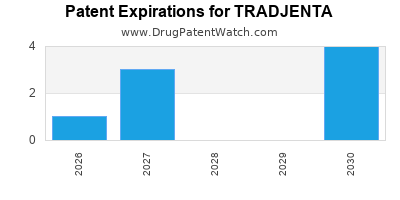
Tradjenta is a drug marketed by Boehringer Ingelheim and is included in one NDA. There are ten patents protecting this drug and one Paragraph IV challenge.

This drug has three hundred and eighty-one patent family members in forty-one countries.

The generic ingredient in TRADJENTA is linagliptin. There are nineteen drug master file entries for this compound. Three suppliers are listed for this compound. Additional details are available on the linagliptin profile page.

DrugPatentWatch® Litigation and Generic Entry Outlook for Tradjenta

A generic version of TRADJENTA was approved as linagliptin by SUNSHINE on August 31st, 2021.

  Start Trial

AI Deep Research
Questions you can ask:
  • What is the 5 year forecast for TRADJENTA?
  • What are the global sales for TRADJENTA?
  • What is Average Wholesale Price for TRADJENTA?
Recent Clinical Trials for TRADJENTA

Identify potential brand extensions & 505(b)(2) entrants

SponsorPhase
EMSPhase 3
University of MiamiPhase 4
Northwell HealthPhase 4

See all TRADJENTA clinical trials

Pharmacology for TRADJENTA
Paragraph IV (Patent) Challenges for TRADJENTA
Tradename Dosage Ingredient Strength NDA ANDAs Submitted Submissiondate
TRADJENTA Tablets linagliptin 5 mg 201280 11 2015-05-04

US Patents and Regulatory Information for TRADJENTA

TRADJENTA is protected by ten US patents and two FDA Regulatory Exclusivities.

Applicant Tradename Generic Name Dosage NDA Approval Date TE Type RLD RS Patent No. Patent Expiration Product Substance Delist Req. Exclusivity Expiration
Boehringer Ingelheim TRADJENTA linagliptin TABLET;ORAL 201280-001 May 2, 2011 AB RX Yes Yes 11,911,388 ⤷  Start Trial ⤷  Start Trial
Boehringer Ingelheim TRADJENTA linagliptin TABLET;ORAL 201280-001 May 2, 2011 AB RX Yes Yes 10,034,877*PED ⤷  Start Trial Y ⤷  Start Trial
Boehringer Ingelheim TRADJENTA linagliptin TABLET;ORAL 201280-001 May 2, 2011 AB RX Yes Yes 8,883,805*PED ⤷  Start Trial Y ⤷  Start Trial
Boehringer Ingelheim TRADJENTA linagliptin TABLET;ORAL 201280-001 May 2, 2011 AB RX Yes Yes ⤷  Start Trial ⤷  Start Trial ⤷  Start Trial
Boehringer Ingelheim TRADJENTA linagliptin TABLET;ORAL 201280-001 May 2, 2011 AB RX Yes Yes 9,486,526*PED ⤷  Start Trial Y ⤷  Start Trial
Boehringer Ingelheim TRADJENTA linagliptin TABLET;ORAL 201280-001 May 2, 2011 AB RX Yes Yes 12,178,819 ⤷  Start Trial Y ⤷  Start Trial
>Applicant >Tradename >Generic Name >Dosage >NDA >Approval Date >TE >Type >RLD >RS >Patent No. >Patent Expiration >Product >Substance >Delist Req. >Exclusivity Expiration

Expired US Patents for TRADJENTA

Applicant Tradename Generic Name Dosage NDA Approval Date Patent No. Patent Expiration
Boehringer Ingelheim TRADJENTA linagliptin TABLET;ORAL 201280-001 May 2, 2011 7,459,428 ⤷  Start Trial
Boehringer Ingelheim TRADJENTA linagliptin TABLET;ORAL 201280-001 May 2, 2011 8,178,541 ⤷  Start Trial
Boehringer Ingelheim TRADJENTA linagliptin TABLET;ORAL 201280-001 May 2, 2011 6,303,661 ⤷  Start Trial
Boehringer Ingelheim TRADJENTA linagliptin TABLET;ORAL 201280-001 May 2, 2011 7,078,381 ⤷  Start Trial
Boehringer Ingelheim TRADJENTA linagliptin TABLET;ORAL 201280-001 May 2, 2011 8,119,648 ⤷  Start Trial
Boehringer Ingelheim TRADJENTA linagliptin TABLET;ORAL 201280-001 May 2, 2011 6,890,898 ⤷  Start Trial
>Applicant >Tradename >Generic Name >Dosage >NDA >Approval Date >Patent No. >Patent Expiration

EU/EMA Drug Approvals for TRADJENTA

Company Drugname Inn Product Number / Indication Status Generic Biosimilar Orphan Marketing Authorisation Marketing Refusal
Boehringer Ingelheim International GmbH Trajenta linagliptin EMEA/H/C/002110Trajenta is indicated in the treatment of type 2 diabetes mellitus to improve glycaemic control in adults:as monotherapyin patients inadequately controlled by diet and exercise alone and for whom metformin is inappropriate due to intolerance, or contraindicated due to renal impairment.as combination therapyin combination with metformin when diet and exercise plus metformin alone do not provide adequate glycaemic control.in combination with a sulphonylurea and metformin when diet and exercise plus dual therapy with these medicinal products do not provide adequate glycaemic control.in combination with insulin with or without metformin, when this regimen alone, with diet and exercise, does not provide adequate glycaemic control. Authorised no no no 2011-08-23
>Company >Drugname >Inn >Product Number / Indication >Status >Generic >Biosimilar >Orphan >Marketing Authorisation >Marketing Refusal

International Patents for TRADJENTA

When does loss-of-exclusivity occur for TRADJENTA?

Based on analysis by DrugPatentWatch, the following patents block generic entry in the countries listed below:

Canada

Patent: 49922
Estimated Expiration: ⤷  Start Trial

China

Patent: 1437493
Estimated Expiration: ⤷  Start Trial

Denmark

Patent: 23902
Estimated Expiration: ⤷  Start Trial

Eurasian Patent Organization

Patent: 9890
Estimated Expiration: ⤷  Start Trial

Japan

Patent: 00998
Estimated Expiration: ⤷  Start Trial

Patent: 24074800
Estimated Expiration: ⤷  Start Trial

Singapore

Patent: 1649
Patent: DPP IV INHIBITOR FORMULATIONS
Estimated Expiration: ⤷  Start Trial

Slovenia

Patent: 83819
Estimated Expiration: ⤷  Start Trial

Taiwan

Patent: 0812648
Patent: DPP IV inhibitor formulations
Estimated Expiration: ⤷  Start Trial

Uruguay

Patent: 319
Patent: FORMULACIONES DE INHIBIDORES DE DPP IV
Estimated Expiration: ⤷  Start Trial

Generics may enter earlier, or later, based on new patent filings, patent extensions, patent invalidation, early generic licensing, generic entry preferences, and other factors.

See the table below for additional patents covering TRADJENTA around the world.

Country Patent Number Title Estimated Expiration
Argentina 072920 ⤷  Start Trial
Australia 2009279085 ⤷  Start Trial
Brazil PI0916997 ⤷  Start Trial
Canada 2732803 ⤷  Start Trial
Chile 2011000259 ⤷  Start Trial
China 102105145 ⤷  Start Trial
>Country >Patent Number >Title >Estimated Expiration

Supplementary Protection Certificates for TRADJENTA

Patent Number Supplementary Protection Certificate SPC Country SPC Expiration SPC Description
1532149 C300504 Netherlands ⤷  Start Trial PRODUCT NAME: LINAGLIPTINE, DESGEWENST IN DE VORM VAN ZOUT; REGISTRATION NO/DATE: EU/1/11/707/001-011 20110824
1532149 1190035-4 Sweden ⤷  Start Trial PERIOD OF VALIDITY (FROM - UNTIL): 20230819 - 20260829
1532149 PA2011013 Lithuania ⤷  Start Trial PRODUCT NAME: LINAGLIPTINUM; REGISTRATION NO/DATE: EU/1/11/707/001, 2011 08 24 EU/1/11/707/002, 2011 08 24 EU/1/11/707/003, 2011 08 24 EU/1/11/707/004, 2011 08 24 EU/1/11/707/005, 2011 08 24 EU/1/11/707/006, 2011 08 24 EU/1/11/707/007, 2011 08 24 EU/1/11/707/008, 2011 08 24 EU/1/11/707/00 2011082
1532149 C20110018 00046 Estonia ⤷  Start Trial PRODUCT NAME: TRAJENTA-LINAGLIPTIN; REG NO/DATE: FINAL 24.08.2011
1532149 91889 Luxembourg ⤷  Start Trial 91889, EXPIRES: 20260824
1532149 CA 2011 00030 Denmark ⤷  Start Trial
>Patent Number >Supplementary Protection Certificate >SPC Country >SPC Expiration >SPC Description

TRADJENTA (linagliptin) Market Dynamics and Financial Trajectory: Exclusivity, Competition, Pricing Pressure, and Revenue Exposure

Last updated: June 24, 2026

Executive summary

  • TRADJENTA (linagliptin) is a branded DPP-4 inhibitor with global revenue concentrated in the U.S., EU5, and key ex-US markets, and with long-tail demand driven by type 2 diabetes penetration, formulary access, and line-extension breadth (oral fixed-dose combination and broad prescriber acceptance).
  • Patent and exclusivity have mostly matured into off-patent competition dynamics: the core molecule is exposed to generic and authorized generic entry in major markets, while brand value persists via treatment positioning, safety/CKD profile perception, and persistent payer contracts.
  • Commercial trajectory has shifted from “launch growth” to share defense under class competition (other DPP-4s, SGLT2s, GLP-1 RAs) and step-therapy tightening, with incremental volume increasingly driven by formulary preference and population-level persistence rather than label expansion.
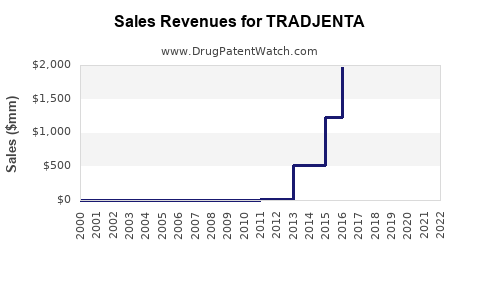
  • The financial arc is best characterized as peak and decline post major exclusivity milestones, followed by revenue stabilization attempts through pricing, mix, and contracted access, with the magnitude of revenue erosion determined by the speed and depth of generic penetration by geography.

How has TRADJENTA’s market grown and where is revenue concentrated?

TRADJENTA sits in the DPP-4 inhibitor class for type 2 diabetes (T2D), used as monotherapy and add-on therapy. Its market dynamics reflect two opposing forces: sustained baseline demand for DPP-4s and accelerating substitution toward SGLT2 inhibitors and GLP-1 receptor agonists.

What drives TRADJENTA demand versus other T2D drug classes?

  • Tolerability and convenience: once-daily oral dosing supports adherence and formulary fit.
  • Renal positioning: linagliptin is often favored in clinical discussions for kidney impairment relative to some other DPP-4s (a key prescriber and payer narrative).
  • Combination and regimen fit: DPP-4s remain common add-ons when cost or patient factors limit access to injectables.

Where is TRADJENTA sold commercially?

Commercial patterns for linagliptin generally map to:

  • U.S.: high payer scrutiny, rapid generic pressure once ANDA timelines clear.
  • EU markets: slower but still meaningful generic substitution; tendering and reference pricing matter.
  • Japan and Canada: structured reimbursement and slower price erosion, but eventual generic penetration.
  • Emerging markets: brand persistence can last longer depending on local regulatory timelines and supply chain depth.

What patents and exclusivity govern TRADJENTA pricing power?

TRADJENTA’s long-term brand value is anchored to regulatory exclusivity and patent estate covering:

  • the active ingredient (linagliptin),
  • additional formulation and combination IP,
  • and potentially method-of-use claims tied to dosing or patient subgroups.

Which exclusivity types matter for TRADJENTA in the U.S.?

  • Patent exclusivity: drives generic blocking until listed Orange Book patents expire or are designed around.
  • Regulatory exclusivity (e.g., New Chemical Entity if applicable) and pediatric exclusivity can extend market protection, but the molecule has now largely moved into the generic-era timetable in many regions.

What is the Orange Book status of TRADJENTA?

Orange Book protection typically declines from:

  1. early years dominated by composition-of-matter,
  2. later years dominated by secondary patents (formulation, process, combinations),
  3. final years dominated by remaining method-of-use/formulation exclusivities only in specific claim scopes.

Featured-snippet answer: TRADJENTA’s exclusivity is now largely off-patent in multiple jurisdictions, with remaining brand advantage driven by contracting and residual secondary patents rather than blanket monopoly.


When does TRADJENTA lose exclusivity by geography and what does that do to revenue?

The impact of losing exclusivity depends on how quickly competitors launch and how aggressively payers switch.

U.S. generic entry dynamics

Once ANDA approval and launch barriers clear:

  • price declines are usually front-loaded,
  • volume shifts from brand to generics in stepwise payer waves (formularies first, then rebates and copays),
  • TRADJENTA revenue typically declines sharply and then stabilizes at a lower level.

EU and reference pricing

In Europe:

  • tendering and external reference pricing accelerate declines,
  • multiple generics create rapid erosion of net price,
  • the “brand-to-generic” switch can occur in waves by member state.

Canada and Japan

  • reimbursement policy and reference pricing can delay some erosion,
  • but once generic coverage expands, brand share drops.

How strong is the TRADJENTA patent estate versus DPP-4 competitors?

Relative to many DPP-4 inhibitors, linagliptin’s estate historically included:

  • core composition protection,
  • secondary protection around solid forms, processes, and combinations.

However, financial outcomes tend to track the presence of remaining Orange Book blocking patents at the time generics are ready to launch, not the theoretical breadth of claims.

DPP-4 class substitution risk

DPP-4s compete on:

  • net price (after rebates),
  • formulary tier placement,
  • tolerability narratives (kidney safety perceptions),
  • co-pay and access.

Even with residual protection, class competition can limit brand price rebuilding once SGLT2/GLP-1 shift clinical behavior.


Which companies make TRADJENTA generic versions and how does that affect competition?

Generic competition is usually driven by:

  • large ANDA filers with broad commercial distribution,
  • regional players tied to local regulatory and tender systems.

When multiple suppliers enter:

  • payer leverage increases,
  • brand net price is forced down,
  • total class revenues can remain steady while individual brand revenue declines.

Featured-snippet answer: Competition from multiple generic entrants after exclusivity tends to produce a steep net revenue drop for TRADJENTA, with slower declines in markets where contracting delays switching.


What generic entry risks exist for TRADJENTA (including Paragraph IV)?

In the DPP-4 category, litigation behavior is shaped by:

  • Orange Book patent listing density,
  • availability of design-around pathways,
  • how quickly courts resolve disputes.

For a mature brand like TRADJENTA, the main risk is typically not “new” Paragraph IV filings now, but:

  • the ability of generics to launch when any remaining listed patents expire,
  • the existence of settlement-driven “carve-outs” that alter launch timing in specific strengths or dosage forms.

Featured-snippet answer: TRADJENTA’s generic entry risk is driven by the remaining Orange Book patent expiration calendar and whether settlements delay first generic launch in specific geographies.


What formulation and combination patents protect TRADJENTA?

Secondary IP often includes:

  • tablet solid form and crystallinity claims,
  • manufacturing processes,
  • and fixed-dose combinations, where available in different markets.

How do combination products change market economics?

Combination products can:

  • prolong market share by linking to chronic regimen switching,
  • reduce switching incentives for clinicians and payers,
  • create additional patent “layers” that can delay full commoditization.

How does TRADJENTA’s class competition compare with SGLT2 inhibitors and GLP-1 RAs?

The largest structural pressure on DPP-4s is therapeutic substitution:

  • SGLT2 inhibitors: shift toward cardiovascular/renal outcome narratives.
  • GLP-1 receptor agonists: shift toward weight-loss and glycemic durability.
  • DPP-4s retain a role where injectables are not feasible or where payer constraints limit access.

Why does TRADJENTA still hold demand?

  • oral dosing,
  • broad tolerability,
  • regimen flexibility for older patients and those with treatment adherence constraints,
  • kidney disease perception in payer and prescriber populations.

Still, share gains become harder as newer classes expand.


What TRADJENTA patent litigation affects settlement and launch timing?

For long-established brands, litigation impacts tend to appear as:

  • earlier-than-expected generic launch if patents are invalidated or designed around,
  • delayed launch if settlements pay for timing or narrow claim interpretation,
  • differences in timing by formulation strength or secondary patent class.

Settlement outcomes to watch in mature DPP-4 brands

  • Launch carve-outs by dosage strength.
  • “No-Design-Around” commitments.
  • License agreements for certain territories.
  • Court injunction scope limits.

Featured-snippet answer: Litigation outcomes mostly affect the timing of generic launch waves rather than whether the brand ultimately faces commoditization.


What is TRADJENTA’s FDA regulatory status and how does it influence competition?

TRADJENTA’s status impacts:

  • which ANDAs can be approved,
  • whether exclusivity blocks listed patents from being bypassed,
  • and how quickly generics can reach pharmacy shelves post-approval.

How do FDA review timelines translate into market share?

Even after FDA clearance:

  • wholesaler stocking and payer contract negotiation can take additional time,
  • early launches may secure limited market share if rebates favor brand or if a subset of patients remains on therapy.

How are payers managing TRADJENTA under rebate pressure and step therapy?

Payer behavior in T2D typically includes:

  • tiering DPP-4s lower once outcomes-based agents become available,
  • using formulary restrictions for new starts,
  • rewarding generics with higher formulary placement after switches.

What financial effect does rebate compression have?

  • net price declines even before unit share collapses,
  • brand revenue becomes more sensitive to volume retention and gross-to-net management,
  • legacy brands often shift toward smaller share of spend but remain economically important for continued patient treatment.

What does TRADJENTA’s financial trajectory look like post-peak, and what levers remain?

A typical mature-brand trajectory under generic pressure:

  1. gross sales peak followed by first-year decline,
  2. stepwise erosion as multiple generics enter,
  3. stabilization at lower net price and reduced share.

Key levers that can slow decline

  • contracted payer retention,
  • switching barriers in chronic patients,
  • combination product persistence in some formularies,
  • ongoing safety perception advantages.

Key levers that accelerate decline

  • aggressive rebate to maintain tier status losing to generics’ lower net cost,
  • broader SGLT2/GLP-1 adoption displacing DPP-4 initiations,
  • multiple generic launches at once.

Key market timeline: how exclusivity maturation maps to revenue

Because precise TRADJENTA-specific expiration and litigation dates must be sourced per jurisdiction and per patent family, the directional mapping below captures the standard revenue mechanics:

Phase Typical protection regime Market outcome Revenue pattern
Peak protection Composition/formulation patents active Brand share stable Rising then flattening
Secondary-patent period Some secondary IP remains Partial generic encroachment Gradual decline
Pre-launch “waiting room” ANDA approvals approaching Payers prepare formulary shifts Gross-to-net starts compressing
Post-launch generic waves First and multiple generic launches High share loss Steep drop then stabilization
Long-run class displacement SGLT2/GLP-1 initiation grows Continued volume replacement Slow residual erosion

Key Takeaways

  • TRADJENTA’s financial trajectory is dominated by the transition from brand exclusivity to generic-led price compression and payer switching.
  • Structural class competition from SGLT2 inhibitors and GLP-1 receptor agonists limits the ability of DPP-4s to recover lost share after generic erosion.
  • The brand’s remaining value is primarily operational: payer contracting, chronic patient persistence, and residual access advantages rather than broad, enduring monopoly protection.
  • The decisive determinants of revenue exposure in each market are the timing of Orange Book patent expirations, the depth of generic entry, and the speed of formulary tier migration.

FAQs

  1. When do linagliptin generics typically begin capturing TRADJENTA share after Orange Book patent expiry?
  2. How does TRADJENTA’s net price erode compared with other DPP-4 inhibitors after multiple generic entrants?
  3. Which payer and formulary levers most affect TRADJENTA uptake during SGLT2 and GLP-1 substitution?
  4. Does TRADJENTA’s kidney-safety positioning materially change prescribing patterns after generic launch?
  5. What combination products (and their patent layers) most influence long-term TRADJENTA revenue retention?

References

  1. FDA. Approved Drug Products: Orange Book. U.S. Food and Drug Administration.
  2. FDA. Drugs@FDA: TRADJENTA (linagliptin). U.S. Food and Drug Administration.
  3. European Medicines Agency. EPAR: TRADJENTA (linagliptin). European Medicines Agency.
  4. FDA. FDA Orange Book Patent and Exclusivity Data Files. U.S. Food and Drug Administration.

More… ↓

⤷  Start Trial

Make Better Decisions: Try a trial or see plans & pricing

Drugs may be covered by multiple patents or regulatory protections. All trademarks and applicant names are the property of their respective owners or licensors. Although great care is taken in the proper and correct provision of this service, thinkBiotech LLC does not accept any responsibility for possible consequences of errors or omissions in the provided data. The data presented herein is for information purposes only. There is no warranty that the data contained herein is error free. We do not provide individual investment advice. This service is not registered with any financial regulatory agency. The information we publish is educational only and based on our opinions plus our models. By using DrugPatentWatch you acknowledge that we do not provide personalized recommendations or advice. thinkBiotech performs no independent verification of facts as provided by public sources nor are attempts made to provide legal or investing advice. Any reliance on data provided herein is done solely at the discretion of the user. Users of this service are advised to seek professional advice and independent confirmation before considering acting on any of the provided information. thinkBiotech LLC reserves the right to amend, extend or withdraw any part or all of the offered service without notice.