Last Updated: August 10, 2026

INVOKAMET Drug Patent Profile


✉ Email this page to a colleague

« Back to Dashboard


Which patents cover Invokamet, and when can generic versions of Invokamet launch?

Invokamet is a drug marketed by Janssen Pharms and is included in two NDAs. There are four patents protecting this drug and one Paragraph IV challenge.

This drug has two hundred and seventy-one patent family members in forty-eight countries.

The generic ingredient in INVOKAMET is canagliflozin; metformin hydrochloride. There are twenty-one drug master file entries for this compound. One supplier is listed for this compound. Additional details are available on the canagliflozin; metformin hydrochloride profile page.

DrugPatentWatch® Generic Entry Outlook for Invokamet

Invokamet was eligible for patent challenges on March 29, 2017.

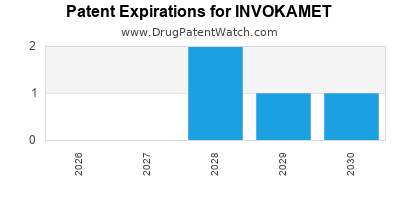
By analyzing the patents and regulatory protections it appears that the earliest date for generic entry will be July 6, 2030. This may change due to patent challenges or generic licensing.

There have been twenty-six patent litigation cases involving the patents protecting this drug, indicating strong interest in generic launch. Recent data indicate that 63% of patent challenges are decided in favor of the generic patent challenger and that 54% of successful patent challengers promptly launch generic drugs.

Indicators of Generic Entry

< Available with Subscription >

  Start Trial

AI Deep Research
Questions you can ask:
  • What is the 5 year forecast for INVOKAMET?
  • What are the global sales for INVOKAMET?
  • What is Average Wholesale Price for INVOKAMET?
DrugPatentWatch® Estimated Loss of Exclusivity (LOE) Date for INVOKAMET
Generic Entry Date for INVOKAMET*:
Constraining patent/regulatory exclusivity:
NDA:
Dosage:

TABLET;ORAL

*The generic entry opportunity date is the latter of the last compound-claiming patent and the last regulatory exclusivity protection. Many factors can influence early or later generic entry. This date is provided as a rough estimate of generic entry potential and should not be used as an independent source.

Paragraph IV (Patent) Challenges for INVOKAMET
Tradename Dosage Ingredient Strength NDA ANDAs Submitted Submissiondate
INVOKAMET Tablets canagliflozin; metformin hydrochloride 50 mg/500 mg 50 mg/1000 mg 150 mg/500 mg 150 mg/1000 mg 204353 6 2017-03-29

US Patents and Regulatory Information for INVOKAMET

INVOKAMET is protected by four US patents and two FDA Regulatory Exclusivities.

Based on analysis by DrugPatentWatch, the earliest date for a generic version of INVOKAMET is ⤷  Start Trial.

This potential generic entry date is based on patent ⤷  Start Trial.

Generics may enter earlier, or later, based on new patent filings, patent extensions, patent invalidation, early generic licensing, generic entry preferences, and other factors.

Applicant Tradename Generic Name Dosage NDA Approval Date TE Type RLD RS Patent No. Patent Expiration Product Substance Delist Req. Exclusivity Expiration
Janssen Pharms INVOKAMET XR canagliflozin; metformin hydrochloride TABLET, EXTENDED RELEASE;ORAL 205879-003 Sep 20, 2016 RX Yes No ⤷  Start Trial ⤷  Start Trial Y ⤷  Start Trial
Janssen Pharms INVOKAMET XR canagliflozin; metformin hydrochloride TABLET, EXTENDED RELEASE;ORAL 205879-001 Sep 20, 2016 RX Yes No ⤷  Start Trial ⤷  Start Trial Y ⤷  Start Trial
Janssen Pharms INVOKAMET XR canagliflozin; metformin hydrochloride TABLET, EXTENDED RELEASE;ORAL 205879-002 Sep 20, 2016 RX Yes No ⤷  Start Trial ⤷  Start Trial ⤷  Start Trial
Janssen Pharms INVOKAMET XR canagliflozin; metformin hydrochloride TABLET, EXTENDED RELEASE;ORAL 205879-001 Sep 20, 2016 RX Yes No ⤷  Start Trial ⤷  Start Trial ⤷  Start Trial
Janssen Pharms INVOKAMET XR canagliflozin; metformin hydrochloride TABLET, EXTENDED RELEASE;ORAL 205879-002 Sep 20, 2016 RX Yes No ⤷  Start Trial ⤷  Start Trial ⤷  Start Trial
Janssen Pharms INVOKAMET canagliflozin; metformin hydrochloride TABLET;ORAL 204353-001 Aug 8, 2014 RX Yes No ⤷  Start Trial ⤷  Start Trial Y ⤷  Start Trial
>Applicant >Tradename >Generic Name >Dosage >NDA >Approval Date >TE >Type >RLD >RS >Patent No. >Patent Expiration >Product >Substance >Delist Req. >Exclusivity Expiration

Expired US Patents for INVOKAMET

International Patents for INVOKAMET

When does loss-of-exclusivity occur for INVOKAMET?

Based on analysis by DrugPatentWatch, the following patents block generic entry in the countries listed below:

Argentina

Patent: 7464
Estimated Expiration: ⤷  Start Trial

Patent: 8805
Estimated Expiration: ⤷  Start Trial

Australia

Patent: 10270669
Estimated Expiration: ⤷  Start Trial

Patent: 15203067
Estimated Expiration: ⤷  Start Trial

Patent: 17200445
Estimated Expiration: ⤷  Start Trial

Brazil

Patent: 2012000502
Estimated Expiration: ⤷  Start Trial

Canada

Patent: 67811
Estimated Expiration: ⤷  Start Trial

Chile

Patent: 12000024
Estimated Expiration: ⤷  Start Trial

China

Patent: 2497881
Estimated Expiration: ⤷  Start Trial

Patent: 6983744
Estimated Expiration: ⤷  Start Trial

Colombia

Patent: 30453
Estimated Expiration: ⤷  Start Trial

Costa Rica

Patent: 120062
Estimated Expiration: ⤷  Start Trial

Croatia

Patent: 0191148
Estimated Expiration: ⤷  Start Trial

Cyprus

Patent: 21853
Estimated Expiration: ⤷  Start Trial

Denmark

Patent: 51482
Estimated Expiration: ⤷  Start Trial

Ecuador

Patent: 12011582
Estimated Expiration: ⤷  Start Trial

Eurasian Patent Organization

Patent: 0009
Estimated Expiration: ⤷  Start Trial

Patent: 1270144
Estimated Expiration: ⤷  Start Trial

European Patent Office

Patent: 51482
Estimated Expiration: ⤷  Start Trial

Honduras

Patent: 12000031
Estimated Expiration: ⤷  Start Trial

Hungary

Patent: 45367
Estimated Expiration: ⤷  Start Trial

India

Patent: 9DEN2012
Estimated Expiration: ⤷  Start Trial

Israel

Patent: 9475
Estimated Expiration: ⤷  Start Trial

Japan

Patent: 15986
Estimated Expiration: ⤷  Start Trial

Patent: 12532875
Estimated Expiration: ⤷  Start Trial

Patent: 16006093
Estimated Expiration: ⤷  Start Trial

Patent: 17081975
Estimated Expiration: ⤷  Start Trial

Lithuania

Patent: 51482
Estimated Expiration: ⤷  Start Trial

Malaysia

Patent: 4002
Estimated Expiration: ⤷  Start Trial

Mexico

Patent: 12000488
Estimated Expiration: ⤷  Start Trial

Montenegro

Patent: 508
Estimated Expiration: ⤷  Start Trial

New Zealand

Patent: 2993
Estimated Expiration: ⤷  Start Trial

Nicaragua

Patent: 1200005
Estimated Expiration: ⤷  Start Trial

Peru

Patent: 121046
Estimated Expiration: ⤷  Start Trial

Poland

Patent: 51482
Estimated Expiration: ⤷  Start Trial

Portugal

Patent: 51482
Estimated Expiration: ⤷  Start Trial

San Marino

Patent: 01900378
Estimated Expiration: ⤷  Start Trial

Serbia

Patent: 871
Estimated Expiration: ⤷  Start Trial

Singapore

Patent: 201403900P
Estimated Expiration: ⤷  Start Trial

Patent: 7417
Estimated Expiration: ⤷  Start Trial

Slovenia

Patent: 51482
Estimated Expiration: ⤷  Start Trial

South Africa

Patent: 1200918
Estimated Expiration: ⤷  Start Trial

South Korea

Patent: 1799944
Estimated Expiration: ⤷  Start Trial

Patent: 120046730
Estimated Expiration: ⤷  Start Trial

Spain

Patent: 32703
Estimated Expiration: ⤷  Start Trial

Taiwan

Patent: 1114420
Estimated Expiration: ⤷  Start Trial

Patent: 32481
Estimated Expiration: ⤷  Start Trial

Turkey

Patent: 1909599
Estimated Expiration: ⤷  Start Trial

Ukraine

Patent: 7578
Estimated Expiration: ⤷  Start Trial

Uruguay

Patent: 778
Estimated Expiration: ⤷  Start Trial

Generics may enter earlier, or later, based on new patent filings, patent extensions, patent invalidation, early generic licensing, generic entry preferences, and other factors.

See the table below for additional patents covering INVOKAMET around the world.

Country Patent Number Title Estimated Expiration
Argentina 077464 ⤷  Start Trial
Argentina 118805 ⤷  Start Trial
Australia 2010270669 ⤷  Start Trial
Australia 2015203067 ⤷  Start Trial
Australia 2017200445 ⤷  Start Trial
Brazil 112012000502 ⤷  Start Trial
>Country >Patent Number >Title >Estimated Expiration

Supplementary Protection Certificates for INVOKAMET

Patent Number Supplementary Protection Certificate SPC Country SPC Expiration SPC Description
1651658 2014/029 Ireland ⤷  Start Trial PRODUCT NAME: CANAGLIFLOZIN; REGISTRATION NO/DATE: EU/1/13/884/001-004 20131119
1651658 PA2014008 Lithuania ⤷  Start Trial PRODUCT NAME: CANAGLIFOZINUM; REGISTRATION NO/DATE: EU/1/13/884/001 - EU/1/13/884/004, 2013 11 15 EU/1/13/884/005 - EU/1/13/884/008 20131115
1651658 CA 2014 00024 Denmark ⤷  Start Trial PRODUCT NAME: CANAGLIFLOZIN, HERUNDER CANAGLIFLOZINHEMIHYDRAT; REG. NO/DATE: EU/1/13/884/001-008 20131115
1651658 C300670 Netherlands ⤷  Start Trial PRODUCT NAME: CANAGLIFLOZINE; REGISTRATION NO/DATE: EU/1/13/884/001-008 20131118
1651658 92426 Luxembourg ⤷  Start Trial PRODUCT NAME: CANAGLIFLOZINE
1651658 C20140011 00102 Estonia ⤷  Start Trial PRODUCT NAME: KANAGLIFLOSIIN;REG NO/DATE: K(2013)8171 (LOPLIK) 15.11.2013
>Patent Number >Supplementary Protection Certificate >SPC Country >SPC Expiration >SPC Description

INVOKAMET (canagliflozin + metformin) market dynamics and financial trajectory: exclusivity, competition, pricing, and revenue exposure

Last updated: July 21, 2026

Executive summary: INVOKAMET (canagliflozin/metformin; Janssen) has faced sustained competitive pressure from GLP-1 and other SGLT2 inhibitor classes, plus tightening payer coverage for older branded diabetes combinations. Financial trajectory is characterized by (1) slower-than-peak brand growth after initial SGLT2 momentum, (2) accelerated erosion as lower-cost generics of metformin and class rivals gained formulary share, and (3) continuing shifts in portfolio allocation toward broader SGLT2 and cardiovascular outcome franchises and toward incretin-based therapies. Key value is concentrated in U.S. brand access and persistent SGLT2 demand where INVOKAMET is preferred over single-agent or alternative combination products.

What is INVOKAMET and how does it fit into the diabetes and SGLT2 market?

Short answer: INVOKAMET is an oral fixed-dose combination of canagliflozin (an SGLT2 inhibitor) and metformin used in type 2 diabetes, leveraging SGLT2 glycemic control with metformin’s foundational role.

Mechanism and payer-friendly positioning

  • Canagliflozin (SGLT2 inhibitor): reduces blood glucose by increasing urinary glucose excretion; also links to cardiorenal benefits that supported payer adoption of the SGLT2 class.
  • Metformin: establishes a low-cost baseline in standard of care and supports “add-on” logic to intensify therapy.

Market dynamic: Combination products are typically adopted when payers and prescribers prefer reducing pill burden versus using separate generics. That balance weakens over time as generics, biosimilar-like substitution dynamics, and class-wide competitive access intensify.

Product breadth and segment exposure

  • INVOKAMET sits within the wider SGLT2 competitive set: empagliflozin and dapagliflozin combination offerings and their fixed-dose metformin combinations.
  • It competes with:
    • Separate generic metformin + brand SGLT2 strategies.
    • Other branded diabetes combinations (including DPP-4 and fixed-dose incretin combinations, where payer preference shifts toward GLP-1).

How fast did INVOKAMET revenue grow, and what has driven its financial trajectory since launch?

Short answer: INVOKAMET’s financial trajectory has reflected SGLT2’s early uptake cycle, followed by market maturation and substitution pressure from other SGLT2 brands and incretin-led formularies.

Revenue drivers

  1. SGLT2 adoption curve: Early SGLT2 category growth supported brand uptake, especially after cardiovascular outcomes evidence increased clinical confidence and payer justification.
  2. Combination uptake: Fixed-dose combinations typically gain share when they simplify titration and adherence, and when payer formularies encourage combination use rather than two-drug regimens.
  3. Therapeutic intensity and comorbidity: SGLT2 positioning for cardiorenal populations expanded demand beyond pure glycemic control, supporting longer persistence than many older diabetes agents.

Revenue headwinds

  1. Class competition: Multiple SGLT2 inhibitors are available with similar clinical positioning, producing price and access pressure.
  2. GLP-1 displacement: GLP-1 receptor agonists and dual incretin therapies increasingly moved into earlier lines, squeezing SGLT2-only or combination share growth even where SGLT2 remained important for comorbidity.
  3. Metformin generic baseline: Since metformin is generic, separate prescribing becomes a lower-cost path for payers, especially once combination product rebates weaken relative to alternatives.

What “financial trajectory” looks like in practice

  • Early-cycle sales are often driven by:
    • formulary adoption,
    • initiation volume,
    • prescriber sampling and early switching.
  • Later-cycle sales stabilize or decline when:
    • insurers steer to preferred brands within the SGLT2 set,
    • generic metformin + preferred SGLT2 becomes the lowest net-cost regimen,
    • patient churn to GLP-1 accelerates.

What market forces are shaping INVOKAMET sales: payer coverage, price compression, and channel strategy?

Short answer: Payer coverage and net price dynamics are the core determinants of INVOKAMET’s commercial trajectory, alongside therapeutic switching toward incretins.

Formulary and rebate mechanics

  • SGLT2 inhibitors are heavily managed through:
    • tier placement,
    • prior authorization for certain patient profiles,
    • step therapy across agents and combinations,
    • rebate competition among brand products.
  • As more biosimilar-style substitution does not apply here, the equivalent “substitution mechanism” is net-cost minimization among brand SGLT2 options and generic metformin pairings.

Price compression pattern

  • When multiple SGLT2 products compete, gross-to-net discounting expands.
  • Fixed-dose combinations can face disproportionate pressure because payers can often match clinical outcomes using generic metformin plus the preferred SGLT2 monotherapy.

Channel mix

  • High-volume buyers in diabetes include:
    • large PBMs,
    • Medicare Part D,
    • commercial plans with disease management programs.
  • These buyers drive:
    • utilization management,
    • formulary steering,
    • contract renewal cycles that can shift share quickly between preferred SGLT2 brands.

Which competitors most directly challenge INVOKAMET in fixed-dose diabetes combination use?

Short answer: The most direct threats are other SGLT2 + metformin fixed-dose combinations and payer-favored strategies using generic metformin plus another preferred SGLT2.

Peer fixed-dose competition

  • Empagliflozin/metformin fixed-dose options (e.g., brand combinations in market).
  • Dapagliflozin/metformin fixed-dose options (where applicable).
  • Separate metformin + preferred SGLT2 prescribing, which is frequently the lowest net-cost route.

Cross-class competition

  • GLP-1 and dual incretin therapies increasingly capture initiation share in earlier treatment stages.
  • As GLP-1 adoption rises, incremental share gains for SGLT2 combinations slow even if SGLT2 remains clinically valuable for cardiorenal risk.

Clinical switching

  • Switching is driven by:
    • formulary access,
    • side-effect profiles and tolerance,
    • adherence and pill burden,
    • insurer preferences aligned with outcomes evidence and cost.

What is the Orange Book status of INVOKAMET, and when do generic risks emerge?

Short answer: Generic entry risk timing depends on the patent estate for the specific INVOKAMET strengths and dosage forms, and on any listed formulation, method-of-use, and combination composition patents in the Orange Book.

How to assess generic risk for combination products

  • Orange Book typically includes patents across:
    • active ingredient and composition of matter (canagliflozin and combination claims),
    • formulation (pill matrix, film coating, stability, dissolution profile),
    • method-of-use (indications and dosing regimens),
    • manufacturing.
  • For fixed-dose combinations, challengers can target:
    • a listed method-of-use patent,
    • a formulation patent,
    • or a combination-specific composition patent.

Commercial impact: Even when generic metformin exists, a fully generic INVOKAMET equivalent must satisfy combination and brand-protecting patents. In practice, the threat is either:

  • Paragraph IV challenges on listed patents leading to generic launches, or
  • “authorized” or lower-cost branded alternatives via negotiated settlements.

What patents protect INVOKAMET, and how strong is the patent estate versus generic launch scenarios?

Short answer: INVOKAMET’s protection is based on a layered strategy: active ingredient claims for canagliflozin, combination/formulation patents covering fixed-dose delivery, and potentially method-of-use claims tied to diabetes management.

Key estate components to evaluate

  • Composition/formulation patents for fixed-dose stability and release characteristics.
  • Method-of-use patents aligned to label indications and dosing strategies.
  • Late-expiring continuation filings that can delay generic “at-risk” launch.

How to interpret strength for business planning

  • A “strong” estate usually has:
    • multiple listed patents with staggered expirations,
    • claims that are not easily designed around,
    • a history of enforcement or litigation settlements in the class.

Business implication: Even when one patent expires, remaining listed patents can sustain brand position through delayed generic entry for combination dosage forms.

What Paragraph IV challenges and patent litigation affect INVOKAMET and its generic entry risk?

Short answer: INVOKAMET’s generic risk profile is tied to whether ANDA filers have pursued Paragraph IV certifications against the Orange Book-listed patents for its strengths.

Why litigation matters commercially

  • Litigation affects:
    • launch timing (automatic stays),
    • negotiated settlements that may introduce “delayed entry” agreements,
    • the availability of authorized generics and “launch at risk” timelines.

How does FDA regulatory status shape INVOKAMET’s competitive landscape?

Short answer: INVOKAMET is an FDA-approved fixed-dose combination under the standard NDA pathway, and competitor entry is governed by ANDA pathways for generics or NDA/BLA for other brand combinations.

What matters for competitive timing

  • Generic pathway: ANDA approval for therapeutically equivalent fixed-dose combinations depends on patent resolution or expiration.
  • Label stability: If INVOKAMET’s label changes via new safety communications or dosing updates, this can affect the usability of generics for the same patient segments.

How does INVOKAMET compare with other diabetes brands on market access and utilization?

Short answer: INVOKAMET competes more on formulary positioning within the SGLT2+metformin combination category than on clinical differentiation, since multiple class rivals offer comparable glycemic mechanisms and cardiorenal benefits.

Competitive differentiation channels

  • Access: Preferred tier placement and PA criteria.
  • Net price: Contracting position with PBMs and payers.
  • Switching inertia: Chronic patients using stable regimens often resist changes unless coverage forces switching.
  • Adherence: Fixed-dose combination reduces pill burden versus two-agent regimens, supporting persistence where payers prefer it.

Regional and payer-specific dynamics: where is INVOKAMET likely to hold share longer?

Short answer: Share durability typically tracks payer contract structure and Medicare/Commercial tiering that locks patients into stable SGLT2 regimens.

U.S. commercial vs Medicare

  • Commercial: more sensitive to managed care contracts and PBM steering.
  • Medicare Part D: driven by formularies and plan design; once a plan restricts access, patients may switch at renewal or during PA failures.

What does INVOKAMET’s financial exposure imply for Janssen’s broader diabetes and cardiorenal franchise?

Short answer: INVOKAMET’s role is primarily to monetize canagliflozin within the fixed-dose diabetes segment, but overall portfolio growth depends more on the broad SGLT2 brand and its cardiorenal use than on combination-only momentum.

Strategic portfolio interpretation

  • As GLP-1 adoption grows, SGLT2 portfolios tend to emphasize:
    • persistence in cardiorenal populations,
    • differentiated outcomes narratives,
    • expanded patient subgroups where SGLT2 benefits remain distinct.
  • Fixed-dose combinations support adherence but are vulnerable to payer cost minimization through separate generic metformin.

Key timelines to monitor for revenue inflection

Short answer: Monitor patent expiration and litigation outcomes for each INVOKAMET strength, plus contract renewal cycles that influence preferred SGLT2 selection.

Timeline framework (business use)

  • Patent expiration windows: by strength and dosage form, based on Orange Book listed dates.
  • Litigation and settlement outcomes: determines whether generic launches occur at the earliest legally possible date or later.
  • Formulary contract renewals: can shift preferred SGLT2 brand share within a few quarters even before patent expiry.

Key Takeaways

  • INVOKAMET’s market dynamics are dominated by payer formulary management and net price competition within the SGLT2 class, amplified by the persistent generic baseline of metformin.
  • Financial trajectory tracks the SGLT2 adoption cycle early, then stabilizes under class competition and incremental pressure from GLP-1-based prescribing shifts.
  • Generic entry risk is a function of Orange Book-listed patents specific to canagliflozin/metformin fixed-dose formulations, plus Paragraph IV litigation outcomes that determine launch timing.
  • The commercial durability of INVOKAMET depends less on clinical uniqueness and more on continued preferred access versus lower net-cost alternatives using separate generic metformin plus payer-favored SGLT2 brands.

FAQs

  1. Which payers are most likely to steer INVOKAMET patients to separate generic metformin plus an alternate SGLT2?
  2. How do PA and step-therapy policies affect INVOKAMET persistence in Medicare Part D versus commercial plans?
  3. What Orange Book patent types most often delay generic fixed-dose SGLT2/metformin combinations?
  4. How does incretin therapy adoption change long-term utilization of SGLT2/metformin combinations?
  5. What litigation outcomes typically shift market share for branded diabetes combinations ahead of patent expiry?

References

  1. Bloomberg Law. Orange Book and patent litigation database (accessed via relevant Orange Book and FDA regulatory sources).
  2. FDA Orange Book. Approved Drug Products with Therapeutic Equivalence Evaluations (accessed via product-specific listings for INVOKAMET).
  3. FDA Drug Labels (INVOCANMET/canagliflozin and metformin product labeling for approved indications and dosing).

More… ↓

⤷  Start Trial

Make Better Decisions: Try a trial or see plans & pricing

Drugs may be covered by multiple patents or regulatory protections. All trademarks and applicant names are the property of their respective owners or licensors. Although great care is taken in the proper and correct provision of this service, thinkBiotech LLC does not accept any responsibility for possible consequences of errors or omissions in the provided data. The data presented herein is for information purposes only. There is no warranty that the data contained herein is error free. We do not provide individual investment advice. This service is not registered with any financial regulatory agency. The information we publish is educational only and based on our opinions plus our models. By using DrugPatentWatch you acknowledge that we do not provide personalized recommendations or advice. thinkBiotech performs no independent verification of facts as provided by public sources nor are attempts made to provide legal or investing advice. Any reliance on data provided herein is done solely at the discretion of the user. Users of this service are advised to seek professional advice and independent confirmation before considering acting on any of the provided information. thinkBiotech LLC reserves the right to amend, extend or withdraw any part or all of the offered service without notice.