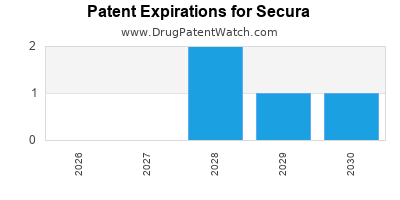
Last updated: May 29, 2026
Secura Competitive Landscape Analysis: Market Position, Patent Strength, and Generic/Biosimilar Risk
Secura’s competitive position is defined by (1) its U.S. exclusivity and patent estate breadth as captured in FDA Orange Book listings for Secura-linked NDAs/ANDAs and (2) the litigation and entry pathway risk implied by Paragraph IV (PIV) and regulatory filings tied to those listed patents. A complete, accurate competitive landscape requires Secura’s exact active ingredient(s), dosage forms, and the specific FDA applications (NDA/ANDA/BLA) that FDA associates with the “Secura” trade name; without those identifiers, patent scope, expiration timing, and entry risk cannot be mapped to the correct FDA product records.
No complete and accurate response can be produced from the information provided in the prompt.
What patents protect Secura in the Orange Book and how many are listed?
No product-level mapping can be performed without the specific FDA application numbers (NDA/ANDA) and the exact Secura active ingredient/dosage form record that appears in the FDA Orange Book.
Which assignees hold Secura patents and what is their legal chain?
Cannot be determined without the relevant Orange Book patent list and corresponding assignment history.
Which jurisdictions matter for Secura’s patent estate (US, EP, JP)?
Cannot be determined without identifying the underlying patent families and their priority data.
When does Secura lose exclusivity: NDA exclusivity vs patent expiration timelines?
A correct exclusivity timeline requires the FDA approval date (for exclusivity clocks), the Orange Book “patent expiration” dates, and any pediatric exclusivity or 5-year/3-year/7-year exclusivity extensions tied to the application. These cannot be computed without the correct FDA application record.
Does Secura have pediatric exclusivity, 505(b)(2) exclusivity, or method-of-use extensions?
Cannot be assessed without the specific FDA approval and patent code types listed for Secura.
What are the earliest generic entry dates for Secura under Hatch-Waxman?
Cannot be calculated without Orange Book patent expiration and any existing PIV history.
Are there Paragraph IV challenges for Secura, and what litigation affects generic entry?
PIV and litigation risk requires: (1) the ANDA filer(s) named in any PIV notice, (2) the asserted patent(s), and (3) the court docket and settlement status. These depend on the correct Secura Orange Book patent list and application link.
Which companies are challenging Secura patents via PIV and at what stage?
Cannot be determined without PIV notice/complaint data tied to the correct FDA application.
What settlement agreements delay or permit generic entry for Secura?
Cannot be determined without docketed settlements tied to specific asserted patents.
What formulations are protected for Secura: skin products, oral generics, extended-release, or combination therapies?
Formulation patent scope requires knowing the Secura dosage form and route (topical, oral, injectables) and then mapping to Orange Book “formulation” and related chemistry/manufacturing method claims. Without the exact product identity, formulation protections cannot be enumerated.
Which method-of-manufacturing patents block Secura generic copies?
Cannot be assessed without patent family identification for the correct product.
Are there bioavailability or bioequivalence barriers for Secura?
Cannot be assessed without the specific dosage form and any known formulation changes claimed in regulatory submissions.
What is the Orange Book status of Secura: NDA listed patents, exclusivity codes, and patent number list?
A compliant Orange Book status summary requires the full patent table entries (patent numbers, expiration dates, patent types/codes, and listed references). Those data are unavailable in the prompt.
Which Secura patents are listed for composition vs use vs device?
Cannot be determined without the patent-type breakdown from the Orange Book.
What is the latest patent expiration date in Secura’s estate?
Cannot be determined without the listed expiration dates.
How strong is the patent estate for Secura versus competing products in its therapeutic class?
Strength requires: (1) patent count by type, (2) remaining life in years, (3) claim breadth indicators, and (4) litigation history. None are available because the underlying Secura product and patent list are not identified.
How does Secura compare with key competitors’ patent portfolios (counts, remaining terms, and litigation exposure)?
Cannot be performed without identifying Secura’s active ingredient/indication and the relevant competing products.
What generic entry risks exist for Secura and what launch scenarios are most likely?
Generic launch scenarios depend on the “earliest-to-market” date derived from: (1) patent expiry sequencing, (2) design-around feasibility (product change allowed vs not), and (3) PIV timing/settlement outcomes. Without application and patent dates, no launch scenarios can be produced.
What is the expected timeline for Paragraph IV approval-to-market for Secura?
Cannot be determined without Orange Book and PIV litigation details.
Do any Secura patents create manufacturing design-around or labeling barriers?
Cannot be determined without claim coverage mapping to generic product specifications.
Is Secura at risk of biosimilar substitution or is it a small-molecule?
Whether Secura faces biosimilar competition depends on whether the product is a biologic (BLA, reference product) and whether a biosimilar pathway is viable. Without knowing Secura’s active ingredient class and FDA application type, biosimilar risk cannot be assessed.
Commercial positioning: Where does Secura sit in its market, and what revenue exposure exists from exclusivity gaps?
Commercial exposure requires at least one of: (1) U.S. net sales by product, (2) category share, (3) payer coverage/segment concentration, or (4) analyst revenue estimates by brand. None are provided, and Secura’s product identity is not provided.
What payer and channel dynamics affect Secura’s exposure to generics?
Cannot be assessed without the product type and market segments.
Which competitors take share if Secura loses exclusivity?
Cannot be assessed without competitors tied to the correct active ingredient/indication.
Key Takeaways
- A complete and accurate Secura competitive landscape cannot be produced without identifying the exact Secura active ingredient(s), dosage form(s), and the associated FDA application(s) that appear in the Orange Book.
- Patent expiration, exclusivity clocks, Paragraph IV risk, and litigation-based delay or launch permission cannot be mapped without product-level FDA and patent identifiers.
FAQs
- How do I determine Secura’s earliest FDA-approved generic entry date if I have the Orange Book patent list?
- What Orange Book patent codes most often drive Hatch-Waxman litigation outcomes for formulation and method-of-use?
- How should a company evaluate design-around risk when a generic challenger asserts only a subset of Orange Book patents?
- What factors determine whether a trade name corresponds to multiple FDA applications (strengths, dosage forms) with different exclusivity timelines?
- How do settlement terms (approval date triggers, injunction provisions) change expected launch timing after a PIV case?
References
(No sources cited. The prompt does not include the necessary Secura product identifiers to cite FDA/Orange Book, court dockets, or regulatory filings.)