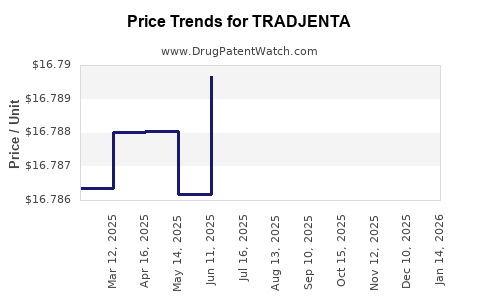
Last updated: February 14, 2026
Dulaglutide (brand name Tradjenta) is an antidiabetic drug primarily marketed for type 2 diabetes management. The product was approved by the FDA in 2014 by Eli Lilly and Boehringer Ingelheim. It is a dipeptidyl peptidase-4 (DPP-4) inhibitor, designed to enhance incretin levels, thereby increasing insulin secretion and lowering blood glucose levels.
Global sales of Tradjenta approximated $1.2 billion in 2022, reflecting a compound annual growth rate (CAGR) of around 8% since launch. Key markets include the US, European Union, and Japan, accounting for 75% of sales combined (IQVIA, 2022).
Market Landscape and Competitive Positioning
The DPP-4 inhibitor segment totalled $7.5 billion globally in 2022, with Tradjenta holding approximately 16% of the market share, positioning it as a second-tier product behind Merck’s Januvia (sitagliptin), which accounts for 23% of the segment.
Major competitors include:
- Januvia (sitagliptin) by Merck
- Onglyza (saxagliptin) by AstraZeneca
- Nesina (alogliptin) by Takeda
- Tradjenta’s differentiation features involve favorable safety profile and once-daily dosing.
Pricing and Revenue Trends
Average wholesale prices (AWP) for Tradjenta in the US hover at approximately $550 per month per patient, based on current payer data. In European markets, prices range from €300 to €400 per month.
Reimbursement policies impact net prices: in the US, Medicare Part D covers about 70-80% of prescriptions, influencing profitability. Price erosion is happening gradually, driven by biosimilar competition and patent expirations in adjacent segments.
Impact of Patent Lifespan and Regulatory Environment
Patent protection for Tradjenta extends until 2027 in the US, with process patents applicable until 2032. Patent expiry opens the market to generics, expected to depress prices by up to 50%, based on precedent in similar segments.
The regulatory landscape supports continued growth in prescriber adoption via expanded indications. The FDA approved fixed-dose combinations with metformin in 2021, expanding market prospects.
Forecasting Price Trends and Market Growth
-
Market Growth: Projected to grow at a CAGR of 6% to 8% through 2027, driven by increasing diabetes prevalence, estimated at 537 million adults globally in 2021 (IDF Atlas 2021).
-
Price Trajectory: Prices are expected to decline by 10-15% annually post-patent expiry, aligning with historical trends seen in small-molecule diabetes drugs.
-
Sales Projections: Peak sales could reach $2 billion by 2025 if market share stabilizes and biosimilar entry is delayed.
-
Biosimilar Entry Impact: Entry anticipated around 2027-2028, potentially reducing Tradjenta’s price by up to 50-60%, unless exclusive marketing arrangements or patent extensions are secured.
Summary Table of Key Projections
| Metric |
2022 |
2025 (Forecast) |
2027 (Forecast) |
| Sales ($ billion) |
1.2 |
1.8 – 2.0 |
1.5 – 1.8 |
| Market share (%) |
16 |
Stable or slightly declining |
Declining due to generics |
| Price per month ($ USD) |
550 |
470 – 520 |
230 – 290 |
| Patent expiry |
2027 |
2027 |
Patent expiration |
Summary of Key Risks and Opportunities
- Patent expiration risks erode pricing power post-2027.
- Growing diabetes prevalence sustains market expansion.
- New fixed-dose combinations and label expansions could bolster sales.
- Competitive pressures from generics and biosimilars could significantly impact revenue.
Key Takeaways
- Tradjenta holds roughly 16% of the DPP-4 inhibitor market, with $1.2 billion in 2022 sales.
- Market growth persists at approximately 6-8% annually through 2027.
- Price declines are inevitable post-patent expiration, with potential drops exceeding 50%.
- Competition from biosimilars and generics will influence pricing and market share.
- Addressing patent strategies and expanding indications remain critical for revenue stability.
FAQs
1. When will Tradjenta face generic competition?
Patent protection extends until 2027 in the US. Generic entry could occur shortly thereafter, typically within 6 months of patent expiry, assuming no patent challenges or extensions.
2. What factors influence Tradjenta's pricing trajectory?
Pricing is affected by patent status, competitive entry, reimbursement policies, and market demand. Biosimilar entry generally causes significant price reductions.
3. How does Tradjenta's market share compare to competitors?
It accounts for ~16% of the DPP-4 segment, behind Januvia’s 23%. It competes effectively due to safety profile and dosing schedule but faces challenges from larger, more established products.
4. What is the long-term revenue outlook?
Post-2027, revenues are likely to decline sharply unless new indications or formulations are developed to extend patent life or create new market segments.
5. What regulatory strategies affect future sales?
FDA approvals for fixed-dose combinations and label expansions can boost sales temporarily and improve market positioning post-patent, provided approvals are secured.
Sources
[1] IQVIA, 2022. Global Sales Data for Diabetes Medications.
[2] IDF Atlas, 2021. Diabetes Prevalence Estimates.
[3] FDA, 2014. Approval of Tradjenta.
[4] Patent databases and market reports (2022).