Last Updated: November 16, 2026

Expiring Drug Patents Cheat Sheet
We analyse the patents covering drugs in 134 countries and quickly give you the likely loss-of-exclusivity/generic entry date

➤ Get the Full List

Russian Federation: These 16 Drugs Face Patent Expirations and Generic Entry From 2026 - 2027

The content of this page is licensed under a Creative Commons Attribution 4.0 International License. Creative Commons License

Preferred citation:
Friedman, Yali, "Russian Federation: These 16 Drugs Face Patent Expirations and Generic Entry From 2026 - 2027" DrugPatentWatch.com thinkBiotech, 2026 www.drugpatentwatch.com/p/expiring-drug-patents-generic-entry/.
Media collateral
These estimated drug patent expiration dates and generic entry opportunity dates are calculated from analysis of known patents covering drugs. Many factors can influence early or late generic entry. This information is provided as a rough estimate of generic entry potential and should not be used as an independent source. The methodology is described in this blog post.
When can AXUMIN (fluciclovine f-18) generic drug versions launch in the Russian Federation?

Generic name: fluciclovine f-18
DrugPatentWatch® Estimated Key Patent Expiration / Generic Entry Date: November 28, 2026
Generic Entry Controlled by: Russian Federation Patent 2,428,415
Patent Title: СОЕДИНЕНИЕ-ПРЕДШЕСТВЕННИК ОРГАНИЧЕСКОГО СОЕДИНЕНИЯ, МЕЧЕННОГО РАДИОАКТИВНЫМ ГАЛОГЕНОМ (RADIOACTIVE HALOGEN-LABELLED ORGANIC COMPOUND PRECURSOR)

AXUMIN is a drug marketed by Blue Earth. There are eight patents protecting this drug. There has been litigation on patents covering AXUMIN

The generic ingredient in AXUMIN is fluciclovine f-18. Additional details are available on the fluciclovine f-18 profile page.

When can PANCREAZE (pancrelipase (amylase;lipase;protease)) generic drug versions launch in the Russian Federation?

Generic name: pancrelipase (amylase;lipase;protease)
DrugPatentWatch® Estimated Key Patent Expiration / Generic Entry Date: February 20, 2027
Generic Entry Controlled by: Russian Federation Patent 2,009,135,038
Patent Title: СТАБИЛЬНЫЕ КОМПОЗИЦИИ ПИЩЕВАРИТЕЛЬНЫХ ФЕРМЕНТОВ (STABLE COMPOSITIONS OF DIGESTIVE ENZYMES)

PANCREAZE is a drug marketed by

See drug price trends for PANCREAZE.

The generic ingredient in PANCREAZE is pancrelipase (amylase;lipase;protease). Additional details are available on the pancrelipase (amylase;lipase;protease) profile page.

When can PANCREAZE (pancrelipase (amylase;lipase;protease)) generic drug versions launch in the Russian Federation?

Generic name: pancrelipase (amylase;lipase;protease)
DrugPatentWatch® Estimated Key Patent Expiration / Generic Entry Date: February 20, 2027
Generic Entry Controlled by: Russian Federation Patent 2,445,952
Patent Title: СТАБИЛЬНЫЕ КОМПОЗИЦИИ ПИЩЕВАРИТЕЛЬНЫХ ФЕРМЕНТОВ (STABLE COMPOSITIONS OF DIGESTIVE ENZYMES)

PANCREAZE is a drug marketed by

See drug price trends for PANCREAZE.

The generic ingredient in PANCREAZE is pancrelipase (amylase;lipase;protease). Additional details are available on the pancrelipase (amylase;lipase;protease) profile page.

When can ZENPEP (pancrelipase (amylase;lipase;protease)) generic drug versions launch in the Russian Federation?

Generic name: pancrelipase (amylase;lipase;protease)
DrugPatentWatch® Estimated Key Patent Expiration / Generic Entry Date: February 20, 2027
Generic Entry Controlled by: Russian Federation Patent 2,009,135,038
Patent Title: СТАБИЛЬНЫЕ КОМПОЗИЦИИ ПИЩЕВАРИТЕЛЬНЫХ ФЕРМЕНТОВ (STABLE COMPOSITIONS OF DIGESTIVE ENZYMES)

ZENPEP is a drug marketed by

See drug price trends for ZENPEP.

The generic ingredient in ZENPEP is pancrelipase (amylase;lipase;protease). Additional details are available on the pancrelipase (amylase;lipase;protease) profile page.

When can ZENPEP (pancrelipase (amylase;lipase;protease)) generic drug versions launch in the Russian Federation?

Generic name: pancrelipase (amylase;lipase;protease)
DrugPatentWatch® Estimated Key Patent Expiration / Generic Entry Date: February 20, 2027
Generic Entry Controlled by: Russian Federation Patent 2,445,952
Patent Title: СТАБИЛЬНЫЕ КОМПОЗИЦИИ ПИЩЕВАРИТЕЛЬНЫХ ФЕРМЕНТОВ (STABLE COMPOSITIONS OF DIGESTIVE ENZYMES)

ZENPEP is a drug marketed by

See drug price trends for ZENPEP.

The generic ingredient in ZENPEP is pancrelipase (amylase;lipase;protease). Additional details are available on the pancrelipase (amylase;lipase;protease) profile page.

When can VANFLYTA (quizartinib dihydrochloride) generic drug versions launch in the Russian Federation?

Generic name: quizartinib dihydrochloride
DrugPatentWatch® Estimated Key Patent Expiration / Generic Entry Date: March 16, 2027
Generic Entry Controlled by: Russian Federation Patent 2,441,011
Patent Title: СОЕДИНЕНИЯ ИМИДАЗОЛОТИАЗОЛА ДЛЯ ЛЕЧЕНИЯ ЗАБОЛЕВАНИЙ (IMIDAZOLOTHIAZOL DERIVATIVES FOR TREATING DISEASES)

VANFLYTA is a drug marketed by Daiichi Sankyo Inc. There are eleven patents protecting this drug.

See drug price trends for VANFLYTA.

The generic ingredient in VANFLYTA is quizartinib dihydrochloride. Additional details are available on the quizartinib dihydrochloride profile page.

When can XTANDI (enzalutamide) generic drug versions launch in the Russian Federation?

Generic name: enzalutamide
DrugPatentWatch® Estimated Key Patent Expiration / Generic Entry Date: March 29, 2027
Generic Entry Controlled by: Russian Federation Patent 2,449,993
Patent Title: ДИАРИЛТИОГИДАНТОИНОВЫЕ СОЕДИНЕНИЯ (DIARYLTHIOHYDATOIC COMPOUNDS)

XTANDI is a drug marketed by Astellas. There are seven patents protecting this drug and one Paragraph IV challenge. Three tentatively approved generics are ready to enter the market. There has been litigation on patents covering XTANDI

See drug price trends for XTANDI.

The generic ingredient in XTANDI is enzalutamide. Additional details are available on the enzalutamide profile page.

When can INLYTA (axitinib) generic drug versions launch in the Russian Federation?

Generic name: axitinib
DrugPatentWatch® Estimated Key Patent Expiration / Generic Entry Date: April 05, 2027
Generic Entry Controlled by: Russian Federation Patent 2,009,136,593

INLYTA is a drug marketed by Pf Prism Cv. There are four patents protecting this drug and one Paragraph IV challenge. Two tentatively approved generics are ready to enter the market. There has been litigation on patents covering INLYTA

See drug price trends for INLYTA.

The generic ingredient in INLYTA is axitinib. Additional details are available on the axitinib profile page.

When can INLYTA (axitinib) generic drug versions launch in the Russian Federation?

Generic name: axitinib
DrugPatentWatch® Estimated Key Patent Expiration / Generic Entry Date: April 05, 2027
Generic Entry Controlled by: Russian Federation Patent 2,518,898

INLYTA is a drug marketed by Pf Prism Cv. There are four patents protecting this drug and one Paragraph IV challenge. Two tentatively approved generics are ready to enter the market. There has been litigation on patents covering INLYTA

See drug price trends for INLYTA.

The generic ingredient in INLYTA is axitinib. Additional details are available on the axitinib profile page.

When can SYMDEKO (COPACKAGED) (ivacaftor; ivacaftor, tezacaftor) generic drug versions launch in the Russian Federation?

Generic name: ivacaftor; ivacaftor, tezacaftor
DrugPatentWatch® Estimated Key Patent Expiration / Generic Entry Date: April 09, 2027
Generic Entry Controlled by: Russian Federation Patent 2,008,144,124
Patent Title: МОДУЛЯТОРЫ АТФ-СВЯЗЫВАЮЩИХ КАССЕТНЫХ ТРАНСПОРТЕРОВ

SYMDEKO (COPACKAGED) is a drug marketed by Vertex Pharms Inc. There are twenty-six patents protecting this drug. There has been litigation on patents covering SYMDEKO (COPACKAGED)

The generic ingredient in SYMDEKO (COPACKAGED) is ivacaftor; ivacaftor, tezacaftor. Additional details are available on the ivacaftor; ivacaftor, tezacaftor profile page.

When can SYMDEKO (COPACKAGED) (ivacaftor; ivacaftor, tezacaftor) generic drug versions launch in the Russian Federation?

Generic name: ivacaftor; ivacaftor, tezacaftor
DrugPatentWatch® Estimated Key Patent Expiration / Generic Entry Date: April 09, 2027
Generic Entry Controlled by: Russian Federation Patent 2,451,018
Patent Title: МОДУЛЯТОРЫ АТФ-СВЯЗЫВАЮЩИХ КАССЕТНЫХ ТРАНСПОРТЕРОВ (MODULATORS OF ATP-BINDING CASSETTE TRANSPORTERS)

SYMDEKO (COPACKAGED) is a drug marketed by Vertex Pharms Inc. There are twenty-six patents protecting this drug. There has been litigation on patents covering SYMDEKO (COPACKAGED)

The generic ingredient in SYMDEKO (COPACKAGED) is ivacaftor; ivacaftor, tezacaftor. Additional details are available on the ivacaftor; ivacaftor, tezacaftor profile page.

When can BYFAVO (remimazolam besylate) generic drug versions launch in the Russian Federation?

Generic name: remimazolam besylate
DrugPatentWatch® Estimated Key Patent Expiration / Generic Entry Date: July 10, 2027
Generic Entry Controlled by: Russian Federation Patent 2,009,104,311
Patent Title: БЕНЗОДИАЗЕПИНОВЫЕ СОЛИ КРАТКОВРЕМЕННОГО ДЕЙСТВИЯ И ИХ ПОЛИМОРФНЫЕ ФОРМЫ

BYFAVO is a drug marketed by Acacia. There are eleven patents protecting this drug. There has been litigation on patents covering BYFAVO

See drug price trends for BYFAVO.

The generic ingredient in BYFAVO is remimazolam besylate. Additional details are available on the remimazolam besylate profile page.

When can BYFAVO (remimazolam besylate) generic drug versions launch in the Russian Federation?

Generic name: remimazolam besylate
DrugPatentWatch® Estimated Key Patent Expiration / Generic Entry Date: July 10, 2027
Generic Entry Controlled by: Russian Federation Patent 2,470,935
Patent Title: БЕНЗОДИАЗЕПИНОВЫЕ СОЛИ КРАТКОВРЕМЕННОГО ДЕЙСТВИЯ И ИХ ПОЛИМОРФНЫЕ ФОРМЫ (SHORT-TERM ACTION BENZODIAZEPINE SALTS AND POLYMORPHS THEREOF)

BYFAVO is a drug marketed by Acacia. There are eleven patents protecting this drug. There has been litigation on patents covering BYFAVO

See drug price trends for BYFAVO.

The generic ingredient in BYFAVO is remimazolam besylate. Additional details are available on the remimazolam besylate profile page.

When can EPIDUO (adapalene; benzoyl peroxide) generic drug versions launch in the Russian Federation?

Generic name: adapalene; benzoyl peroxide
DrugPatentWatch® Estimated Key Patent Expiration / Generic Entry Date: July 12, 2027
Generic Entry Controlled by: Russian Federation Patent 2,009,104,949
Patent Title: КОМБИНАЦИЯ АДАПАЛЕНА И ПЕРОКСИДА БЕНЗОИЛА ДЛЯ ЛЕЧЕНИЯ ПОРАЖЕНИЙ АКНЕ
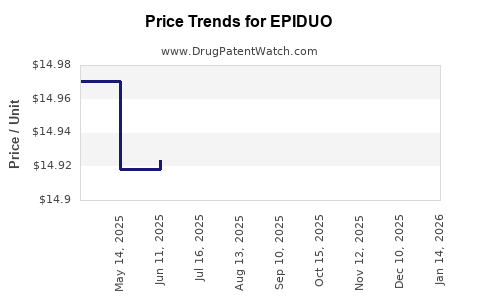
Drug Price Trends for EPIDUO
EPIDUO is a drug marketed by Galderma Labs Lp and Galderma LabsThere are three patents protecting this drug and two Paragraph IV challenges. There has been litigation on patents covering EPIDUO

See drug price trends for EPIDUO.

The generic ingredient in EPIDUO is adapalene; benzoyl peroxide. Additional details are available on the adapalene; benzoyl peroxide profile page.

When can EPIDUO FORTE (adapalene; benzoyl peroxide) generic drug versions launch in the Russian Federation?

Generic name: adapalene; benzoyl peroxide
DrugPatentWatch® Estimated Key Patent Expiration / Generic Entry Date: July 12, 2027
Generic Entry Controlled by: Russian Federation Patent 2,009,104,949
Patent Title: КОМБИНАЦИЯ АДАПАЛЕНА И ПЕРОКСИДА БЕНЗОИЛА ДЛЯ ЛЕЧЕНИЯ ПОРАЖЕНИЙ АКНЕ
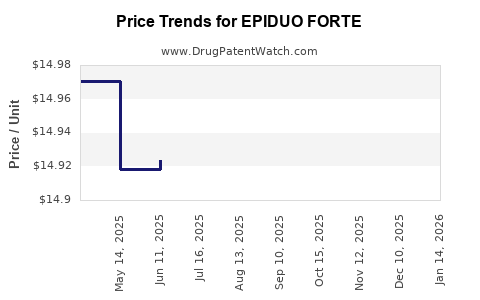
Drug Price Trends for EPIDUO FORTE
EPIDUO FORTE is a drug marketed by Galderma Labs. There has been litigation on patents covering EPIDUO FORTE

See drug price trends for EPIDUO FORTE.

The generic ingredient in EPIDUO FORTE is adapalene; benzoyl peroxide. Additional details are available on the adapalene; benzoyl peroxide profile page.

When can MULPLETA (lusutrombopag) generic drug versions launch in the Russian Federation?

Generic name: lusutrombopag
DrugPatentWatch® Estimated Key Patent Expiration / Generic Entry Date: July 31, 2027
Generic Entry Controlled by: Russian Federation Patent 2,010,107,169

MULPLETA is a drug marketed by Vancocin Italia. There are three patents protecting this drug.

See drug price trends for MULPLETA.

The generic ingredient in MULPLETA is lusutrombopag. Additional details are available on the lusutrombopag profile page.

When can MULPLETA (lusutrombopag) generic drug versions launch in the Russian Federation?

Generic name: lusutrombopag
DrugPatentWatch® Estimated Key Patent Expiration / Generic Entry Date: July 31, 2027
Generic Entry Controlled by: Russian Federation Patent 2,476,429

MULPLETA is a drug marketed by Vancocin Italia. There are three patents protecting this drug.

See drug price trends for MULPLETA.

The generic ingredient in MULPLETA is lusutrombopag. Additional details are available on the lusutrombopag profile page.

When can RELISTOR (methylnaltrexone bromide) generic drug versions launch in the Russian Federation?

Generic name: methylnaltrexone bromide
DrugPatentWatch® Estimated Key Patent Expiration / Generic Entry Date: August 03, 2027
Generic Entry Controlled by: Russian Federation Patent 2,539,387
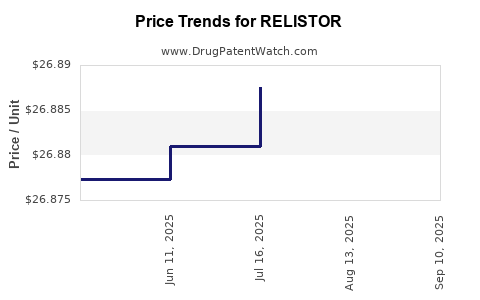
Drug Price Trends for RELISTOR
RELISTOR is a drug marketed by Salix Pharms and SalixThere are twelve patents protecting this drug and three Paragraph IV challenges. One tentatively approved generic is ready to enter the market. There has been litigation on patents covering RELISTOR

See drug price trends for RELISTOR.

The generic ingredient in RELISTOR is methylnaltrexone bromide. Additional details are available on the methylnaltrexone bromide profile page.

When can WINLEVI (clascoterone) generic drug versions launch in the Russian Federation?

Generic name: clascoterone
DrugPatentWatch® Estimated Key Patent Expiration / Generic Entry Date: August 03, 2027
Generic Entry Controlled by: Russian Federation Patent 2,010,107,599
Patent Title: ФЕРМЕНТАТИВНЫЙ СПОСОБ ПОЛУЧЕНИЯ 17-МОНОЭФИРОВ КОРТЕКСОЛОНА И/ИЛИ ИХ 9,11-ДЕГИДРОПРОИЗВОДНЫХ (CRYSTALLINE FORMS OF CORTEXOLONE-17?-PROPIONATE AND METHOD FOR PREPARING THEM)
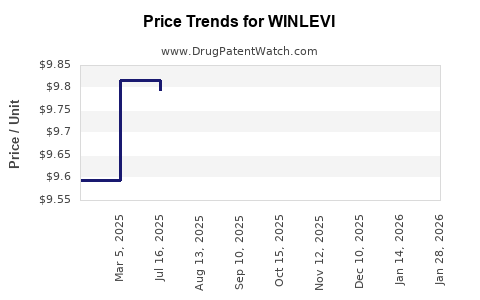
Drug Price Trends for WINLEVI
WINLEVI is a drug marketed by Sun Pharm. There are seven patents protecting this drug. There has been litigation on patents covering WINLEVI

See drug price trends for WINLEVI.

The generic ingredient in WINLEVI is clascoterone. Additional details are available on the clascoterone profile page.

When can WINLEVI (clascoterone) generic drug versions launch in the Russian Federation?

Generic name: clascoterone
DrugPatentWatch® Estimated Key Patent Expiration / Generic Entry Date: August 03, 2027
Generic Entry Controlled by: Russian Federation Patent 2,599,452
Patent Title: КРИСТАЛЛИЧЕСКАЯ СОЛЬВАТНАЯ ФОРМА КОРТЕКСОЛОН-17альфа-ПРОПИОНАТА, СПОСОБ ЕЕ ПОЛУЧЕНИЯ И ФАРМАЦЕВТИЧЕСКАЯ КОМПОЗИЦИЯ НА ЕЕ ОСНОВЕ (CRYSTALLINE SOLVATE FORM OF CORTEXOLONE-17alpha-PROPIONATE, A PREPARATION METHOD THEREOF AND A PHARMACEUTICAL COMPOSITION BASED THEREON)

Drug Price Trends for WINLEVI
WINLEVI is a drug marketed by Sun Pharm. There are seven patents protecting this drug. There has been litigation on patents covering WINLEVI

See drug price trends for WINLEVI.

The generic ingredient in WINLEVI is clascoterone. Additional details are available on the clascoterone profile page.

When can VIZAMYL (flutemetamol f-18) generic drug versions launch in the Russian Federation?

Generic name: flutemetamol f-18
DrugPatentWatch® Estimated Key Patent Expiration / Generic Entry Date: August 30, 2027
Generic Entry Controlled by: Russian Federation Patent 2,010,101,935
Patent Title: РАДИОФАРМАЦЕВТИЧЕСКАЯ КОМПОЗИЦИЯ (RADIOPHARMACEUTICAL COMPOSITION)

VIZAMYL is a drug marketed by Ge Healthcare. There is one patent protecting this drug.

See drug price trends for VIZAMYL.

The generic ingredient in VIZAMYL is flutemetamol f-18. Additional details are available on the flutemetamol f-18 profile page.

When can VIZAMYL (flutemetamol f-18) generic drug versions launch in the Russian Federation?

Generic name: flutemetamol f-18
DrugPatentWatch® Estimated Key Patent Expiration / Generic Entry Date: August 30, 2027
Generic Entry Controlled by: Russian Federation Patent 2,475,267
Patent Title: РАДИОФАРМАЦЕВТИЧЕСКАЯ КОМПОЗИЦИЯ (RADIOPHARMACEUTICAL COMPOSITION)

VIZAMYL is a drug marketed by Ge Healthcare. There is one patent protecting this drug.

See drug price trends for VIZAMYL.

The generic ingredient in VIZAMYL is flutemetamol f-18. Additional details are available on the flutemetamol f-18 profile page.

When can PREPOPIK (citric acid; magnesium oxide; sodium picosulfate) generic drug versions launch in the Russian Federation?

Generic name: citric acid; magnesium oxide; sodium picosulfate
DrugPatentWatch® Estimated Key Patent Expiration / Generic Entry Date: October 12, 2027
Generic Entry Controlled by: Russian Federation Patent 2,010,112,483
Patent Title: СПОСОБ ИЗГОТОВЛЕНИЯ ФАРМАЦЕВТИЧЕСКОГО ПРОДУКТА, СОДЕРЖАЩЕГО ЛИМОННУЮ КИСЛОТУ, ОКСИД МАГНИЯ, БИКАРБОНАТ КАЛИЯ И ПИКОСУЛЬФАТ НАТРИЯ, ФАРМАЦЕВТИЧЕСКИЕ КОМПОЗИЦИИ, СОДЕРЖАЩИЕ ГРАНУЛЫ, ПОЛУЧЕННЫЕ ТАКИМ СПОСОБОМ, И ПРОМЕЖУТОЧНОЕ СОЕДИНЕНИЕ (METHOD OF MANUFACTURING PHARMACEUTICAL PRODUCT, CONTAINING CITRIC ACID, MAGNESIUM OXIDE, POTASSIUM BICARBONATE AND SODIUM PICOSULFATE, PHARMACEUTICAL COMPOSITIONS, CONTAINING THUS OBTAINED GRANULES AND INTERMEDIATE COMPOUND)

PREPOPIK is a drug marketed by Ferring Pharms Inc. There are two patents protecting this drug and one Paragraph IV challenge. One tentatively approved generic is ready to enter the market. There has been litigation on patents covering PREPOPIK

See drug price trends for PREPOPIK.

The generic ingredient in PREPOPIK is citric acid; magnesium oxide; sodium picosulfate. Additional details are available on the citric acid; magnesium oxide; sodium picosulfate profile page.

When can PREPOPIK (citric acid; magnesium oxide; sodium picosulfate) generic drug versions launch in the Russian Federation?

Generic name: citric acid; magnesium oxide; sodium picosulfate
DrugPatentWatch® Estimated Key Patent Expiration / Generic Entry Date: October 12, 2027
Generic Entry Controlled by: Russian Federation Patent 2,473,332
Patent Title: СПОСОБ ИЗГОТОВЛЕНИЯ ФАРМАЦЕВТИЧЕСКОГО ПРОДУКТА, СОДЕРЖАЩЕГО ЛИМОННУЮ КИСЛОТУ, ОКСИД МАГНИЯ, БИКАРБОНАТ КАЛИЯ И ПИКОСУЛЬФАТ НАТРИЯ, ФАРМАЦЕВТИЧЕСКИЕ КОМПОЗИЦИИ, СОДЕРЖАЩИЕ ГРАНУЛЫ, ПОЛУЧЕННЫЕ ТАКИМ СПОСОБОМ, И ПРОМЕЖУТОЧНОЕ СОЕДИНЕНИЕ (METHOD OF MANUFACTURING PHARMACEUTICAL PRODUCT, CONTAINING CITRIC ACID, MAGNESIUM OXIDE, POTASSIUM BICARBONATE AND SODIUM PICOSULFATE, PHARMACEUTICAL COMPOSITIONS, CONTAINING THUS OBTAINED GRANULES AND INTERMEDIATE COMPOUND)

PREPOPIK is a drug marketed by Ferring Pharms Inc. There are two patents protecting this drug and one Paragraph IV challenge. One tentatively approved generic is ready to enter the market. There has been litigation on patents covering PREPOPIK

See drug price trends for PREPOPIK.

The generic ingredient in PREPOPIK is citric acid; magnesium oxide; sodium picosulfate. Additional details are available on the citric acid; magnesium oxide; sodium picosulfate profile page.

When can VELPHORO (sucroferric oxyhydroxide) generic drug versions launch in the Russian Federation?

Generic name: sucroferric oxyhydroxide
DrugPatentWatch® Estimated Key Patent Expiration / Generic Entry Date: November 16, 2027
Generic Entry Controlled by: Russian Federation Patent 2,010,124,424
Patent Title: ФАРМАЦЕВТИЧЕСКИЕ КОМПОЗИЦИИ (PHARMACEUTICAL COMPOSITIONS)
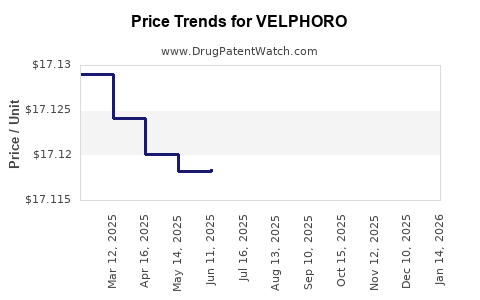
Drug Price Trends for VELPHORO
VELPHORO is a drug marketed by Vifor Fresenius. There are eleven patents protecting this drug. There has been litigation on patents covering VELPHORO

See drug price trends for VELPHORO.

The generic ingredient in VELPHORO is sucroferric oxyhydroxide. Additional details are available on the sucroferric oxyhydroxide profile page.

When can VELPHORO (sucroferric oxyhydroxide) generic drug versions launch in the Russian Federation?

Generic name: sucroferric oxyhydroxide
DrugPatentWatch® Estimated Key Patent Expiration / Generic Entry Date: November 16, 2027
Generic Entry Controlled by: Russian Federation Patent 2,013,128,356
Patent Title: ФАРМАЦЕВТИЧЕСКАЯ КОМПОЗИЦИЯ, СОДЕРЖАЩАЯ ОКСИГИДРОКСИД ЖЕЛЕЗА, СПОСОБ ЕЕ ПОЛУЧЕНИЯ И ПРИМЕНЕНИЕ (PHARMACEUTICAL COMPOSITION COMPRISING IRON OXY-HYDROXIDE, METHOD OF PRODUCTION THEREOF AND USE)

Drug Price Trends for VELPHORO
VELPHORO is a drug marketed by Vifor Fresenius. There are eleven patents protecting this drug. There has been litigation on patents covering VELPHORO

See drug price trends for VELPHORO.

The generic ingredient in VELPHORO is sucroferric oxyhydroxide. Additional details are available on the sucroferric oxyhydroxide profile page.

When can VELPHORO (sucroferric oxyhydroxide) generic drug versions launch in the Russian Federation?

Generic name: sucroferric oxyhydroxide
DrugPatentWatch® Estimated Key Patent Expiration / Generic Entry Date: November 16, 2027
Generic Entry Controlled by: Russian Federation Patent 2,493,831
Patent Title: ФАРМАЦЕВТИЧЕСКИЕ КОМПОЗИЦИИ (PHARMACEUTICAL COMPOSITIONS)

Drug Price Trends for VELPHORO
VELPHORO is a drug marketed by Vifor Fresenius. There are eleven patents protecting this drug. There has been litigation on patents covering VELPHORO

See drug price trends for VELPHORO.

The generic ingredient in VELPHORO is sucroferric oxyhydroxide. Additional details are available on the sucroferric oxyhydroxide profile page.

When can VELPHORO (sucroferric oxyhydroxide) generic drug versions launch in the Russian Federation?

Generic name: sucroferric oxyhydroxide
DrugPatentWatch® Estimated Key Patent Expiration / Generic Entry Date: November 16, 2027
Generic Entry Controlled by: Russian Federation Patent 2,648,760
Patent Title: ФАРМАЦЕВТИЧЕСКАЯ КОМПОЗИЦИЯ, СОДЕРЖАЩАЯ ОКСИГИДРОКСИД ЖЕЛЕЗА, СПОСОБ ЕЕ ПОЛУЧЕНИЯ И ПРИМЕНЕНИЕ (PHARMACEUTICAL COMPOSITION COMPRISING IRON OXY-HYDROXIDE, METHOD OF PRODUCTION THEREOF AND USE)

Drug Price Trends for VELPHORO
VELPHORO is a drug marketed by Vifor Fresenius. There are eleven patents protecting this drug. There has been litigation on patents covering VELPHORO

See drug price trends for VELPHORO.

The generic ingredient in VELPHORO is sucroferric oxyhydroxide. Additional details are available on the sucroferric oxyhydroxide profile page.

Russian Federation Branded and Generic Drug Market: Regulatory Assessment, Patent Risk and Commercial Opportunities

Last updated: October 13, 2026

Russia is a large, state-directed pharmaceutical market with strong demand for imported innovative medicines, domestic generics, biosimilars and hospital products. The commercial opportunity is constrained by price regulation, public-procurement localization rules, sanctions, payment restrictions, parallel imports and uncertain enforcement of intellectual-property rights. Russia has no U.S.-style Orange Book or Paragraph IV system. Market access depends primarily on registration in the Russian State Register of Medicines, EAEU requirements, procurement eligibility, pricing approval and patent-risk management.

What is the size and structure of the Russian pharmaceutical market?

Russia’s pharmaceutical market is divided between retail sales, hospital procurement and state reimbursement programs.

Market segment Principal buyers Commercial characteristics
Retail pharmacy Patients and private insurers Branded generics and prescription medicines dominate unit sales
Hospital procurement Federal and regional institutions Price-sensitive, tender-driven and heavily influenced by localization
State reimbursement Federal and regional programs Includes high-cost medicines, essential medicines and disease-specific programs
Private healthcare Clinics, hospitals and employers Greater access to imported brands and specialty therapies

DSM Group reported Russian commercial pharmaceutical sales of approximately RUB 1.5 trillion in 2023, with continued growth in value despite pressure on volumes and affordability (DSM Group, 2024). Total pharmaceutical consumption is higher when hospital purchases and state programs are included.

Domestic products account for most units sold, while imported products retain a disproportionate share of value in oncology, immunology, rare diseases, vaccines, advanced biologics and specialty hospital care. Multinational companies remain commercially relevant, although several have suspended investment, reduced product portfolios or shifted to local distributors.

Which drugs have the strongest commercial demand?

The most attractive segments generally include:

  • Oncology and hematology
  • Diabetes and metabolic disease
  • Cardiovascular disease
  • Central nervous system disorders
  • Immunology and rheumatology
  • Rare diseases
  • Vaccines
  • Antimicrobials
  • Biosimilars
  • Hospital injectables
  • High-cost specialty medicines

The largest revenue exposure is concentrated in medicines supplied through state procurement and reimbursement programs. Retail generics offer greater volume potential but face intense price competition and substitution among multiple Russian and foreign manufacturers.

How does Russia regulate branded and generic medicines?

The primary national statute is Federal Law No. 61-FZ on the Circulation of Medicines. The law governs registration, manufacturing, quality, pharmacovigilance, distribution and state control of medicines (Russian Federation, 2010).

Russia also participates in the Eurasian Economic Union. EAEU rules increasingly govern registration, Good Manufacturing Practice, pharmacovigilance, clinical trials and technical documentation for medicines intended for Russia, Belarus, Kazakhstan, Armenia and Kyrgyzstan.

What is the Russian drug-registration pathway?

A conventional registration package generally includes:

  1. Administrative documentation.
  2. Pharmaceutical development and quality data.
  3. Nonclinical information where required.
  4. Clinical data or bioequivalence evidence.
  5. Manufacturing and GMP documentation.
  6. Risk-management and pharmacovigilance materials.
  7. Russian-language labeling and instructions.
  8. Samples and quality-control documentation.

The applicant must obtain a marketing authorization and inclusion in the Russian State Register of Medicines. The registration holder is responsible for maintaining the dossier, reporting safety information and complying with post-registration obligations.

Russia has increasingly required electronic submission, local pharmacovigilance infrastructure and compliance with EAEU dossier standards. Registration strategy must therefore distinguish between national Russian procedures and EAEU mutual or centralized mechanisms.

How are generic drugs registered in Russia?

Generic applicants usually rely on pharmaceutical equivalence, bioequivalence and quality data rather than repeating the full clinical-development program for the reference product. The evidentiary burden depends on dosage form, route of administration, active substance, therapeutic index and applicable EAEU guidance.

High-risk categories include:

  • Modified-release products
  • Complex injectables
  • Inhaled medicines
  • Transdermal systems
  • Biotechnological products
  • Products with complex delivery devices
  • Narrow-therapeutic-index medicines

A generic can be commercially substitutable yet remain exposed to patent litigation involving composition, formulation, manufacturing process or method of use.

Does Russia have an Orange Book or Paragraph IV system?

Russia does not have a direct equivalent to the U.S. Orange Book or the U.S. Paragraph IV certification process.

The Russian State Register of Medicines identifies registered products, marketing authorization holders, active ingredients, dosage forms and certain regulatory information. It does not provide the same integrated patent-listing and certification function as the U.S. Orange Book.

How do patent challenges work in Russia?

Patent disputes are generally handled through Russian commercial courts. A generic or biosimilar applicant may challenge:

  • Patent validity
  • Novelty
  • Inventive step
  • Industrial applicability
  • Claim construction
  • Patent-term extensions
  • Ownership or assignment
  • Infringement allegations
  • Preliminary injunctions
  • Importation or manufacturing activity

Russia has a Bolar-type exemption under Article 1359 of the Civil Code. Activities undertaken for regulatory approval may be exempt from infringement liability, although commercial manufacture, stockpiling and sale remain subject to patent risk depending on the facts (Russian Federation, 2006).

The absence of a formal Paragraph IV pathway creates less procedural certainty than in the United States. Companies commonly conduct freedom-to-operate reviews, seek invalidity judgments or defend infringement actions after launch.

What patents protect branded medicines in Russia?

Russian patent protection follows the national and EAEU framework, with international filing options under the Patent Cooperation Treaty.

IP category Typical protection
Active pharmaceutical ingredient Compound patent
Salt, polymorph or crystal form Solid-state patent
Formulation Composition, excipient or release-profile patent
Manufacturing method Process patent
Dosage regimen Method-of-treatment or administration patent, subject to claim format
Combination therapy Combination patent
Device or delivery system Device, formulation or use patent
Biological product Product-by-process, sequence, formulation or manufacturing claims

The standard Russian patent term is generally 20 years from the filing date. Pharmaceutical and pesticide patents may qualify for a patent-term extension of up to five years, subject to statutory limits and regulatory conditions. Patent-term analysis must be performed patent by patent because Russian filing dates, supplementary protection calculations, divisional applications and claim scope affect the effective expiry date.

What formulations are protected in Russia?

Formulation patents are commercially significant where the active ingredient is old or approaching expiry. Common targets include:

  • Controlled-release tablets
  • Injectable formulations
  • Long-acting depot products
  • Stabilized biologics
  • Lyophilized formulations
  • Fixed-dose combinations
  • Pediatric dosage forms
  • Inhaled formulations
  • Device-assisted delivery systems

Formulation claims can delay generic competition only if they are valid, enforceable and commercially necessary for the product. A generic may avoid infringement by using a different excipient system, release mechanism, dosage form or manufacturing process.

How strong is the Russian patent estate for innovative medicines?

Patent strength is highest when a product has several independent layers of protection:

  1. A valid composition-of-matter patent.
  2. A commercially necessary formulation patent.
  3. A manufacturing-process patent.
  4. A device or delivery patent.
  5. A defensible method-of-use patent.
  6. Regulatory exclusivity or procurement advantages.

Patent strength is weaker when the estate depends only on narrow formulation claims or method-of-use claims that can be designed around. Enforcement risk is also affected by local manufacturing capacity, court practice, evidence quality and the availability of compulsory licensing.

When do branded medicines lose exclusivity in Russia?

Loss of exclusivity is usually determined by the interaction of patent expiry, regulatory data protection, market authorization and procurement conditions.

Russia does not replicate the U.S. Hatch-Waxman exclusivity structure. Relevant protections include:

  • Patent rights, generally lasting 20 years from filing.
  • Patent-term extensions for eligible pharmaceutical inventions.
  • Regulatory data protection for the originator’s clinical information.
  • Market access restrictions for certain biological and innovative products.
  • Trademark rights and unfair-competition remedies.
  • Procurement preferences for domestic and localized products.

Regulatory data protection and patent protection are separate. A generic may complete development under the Bolar exemption while still facing restrictions on commercial marketing or patent infringement.

Indicative exclusivity timeline

Event Typical legal or commercial effect
Patent filing Starts the standard patent term
Marketing authorization Enables lawful commercial distribution
Patent-term extension May extend protection beyond the ordinary term
Data-protection period Limits reliance on originator data for a defined period
Patent expiry Removes protection under the expired claims
Generic registration Does not automatically eliminate patent risk
Generic launch Depends on remaining patents, injunctions and procurement access

Exact expiry dates require a claim-level review of Russian and EAEU patent records. Patent family expiry in the United States or Europe does not establish Russian expiry.

What is the Russian regulatory status of biosimilars?

Russia has an established biosimilar pathway, although it is more complex than the pathway for conventional small-molecule generics. The regulatory framework covers comparative quality, nonclinical and clinical data, immunogenicity and pharmacovigilance.

Biosimilar exposure is concentrated in:

  • Insulins
  • Erythropoietins
  • Filgrastim
  • Monoclonal antibodies
  • Recombinant hormones
  • Blood-clotting factors

What biosimilar risks affect originators?

Originators face several risks:

  • Earlier local development by Russian manufacturers.
  • Tender-driven substitution.
  • Lower-cost products in state programs.
  • Weak visibility into future procurement volumes.
  • Manufacturing localization incentives.
  • Patent challenges involving biological composition or process claims.
  • Limited practical control over interchangeability at the point of procurement.

Biosimilar sponsors face different risks. They must demonstrate comparability, maintain reliable cold-chain distribution, comply with GMP requirements and address patents covering cell lines, formulations, manufacturing processes and dosing regimens.

Russia’s biosimilar opportunity is commercially strongest in hospital and state-funded channels. Retail penetration depends on physician practice, procurement rules, reimbursement status and patient confidence.

Which companies are active in Russia’s branded and generic markets?

The market includes domestic manufacturers, multinational originators, contract manufacturers and distributors.

Important Russian manufacturers include:

  • Pharmstandard
  • R-Pharm
  • Biocad
  • Generium
  • Ozon Pharmaceuticals
  • Veropharm
  • Renewal
  • Vertex
  • Geropharm
  • Promomed

International companies have historically included Novartis, Sanofi, Bayer, AstraZeneca, Roche, Pfizer, MSD, Novo Nordisk, Takeda and Servier. Their operating models now differ substantially. Some continue supplying medicines through local entities or distributors, while others have reduced promotional activity, suspended new clinical investment or transferred commercial responsibilities.

Foreign participation remains strongest where products are difficult to replace, including oncology, rare diseases, biologics, vaccines and specialty hospital medicines.

What licensing deals and localization opportunities exist?

Licensing and contract manufacturing can reduce market-entry risk. Common structures include:

  • Local packaging and secondary manufacturing.
  • Technology-transfer agreements.
  • In-licensing of Russian registration rights.
  • Exclusive distribution.
  • Contract development and manufacturing.
  • Co-development of biosimilars.
  • Local production under a foreign trademark.
  • Joint ventures involving Russian pharmaceutical groups.

Localization is commercially valuable because Russian procurement rules can favor domestic manufacturers and products meeting local production criteria. Government Decree No. 719 establishes industrial-production requirements relevant to pharmaceutical localization. Government policy has also expanded domestic preference mechanisms and procurement restrictions affecting foreign-origin products (Government of the Russian Federation, 2015).

A licensing agreement should address:

  • Registration ownership.
  • Patent prosecution and enforcement.
  • GMP responsibility.
  • Pharmacovigilance.
  • Currency and payment controls.
  • Sanctions compliance.
  • Supply interruption.
  • Change-of-control rights.
  • Technology-transfer scope.
  • Data ownership.
  • Exit rights.

What procurement rules affect branded and generic drugs?

Public procurement is a central commercial determinant. Federal Law No. 44-FZ governs much state procurement, while Federal Law No. 223-FZ governs procurement by certain state-affiliated entities (Russian Federation, 2013a, 2011).

Key commercial factors include:

  • International nonproprietary name procurement.
  • Lowest-price competition.
  • Domestic-product preferences.
  • Localization scoring.
  • Restrictions on foreign products.
  • Tender bundling.
  • Supply-security requirements.
  • Regional procurement practices.
  • Inclusion in the Vital and Essential Drugs list.

The Vital and Essential Drugs list is particularly important because listed products face regulated pricing and reimbursement implications. Price registration can limit launch economics even where clinical demand is strong.

What is the impact of parallel imports and sanctions?

Russia authorized parallel imports for selected products after supply disruptions caused by sanctions and corporate exits. The relevant product list is administered through government and ministry measures, including Ministry of Industry and Trade Order No. 1718-r and subsequent amendments (Ministry of Industry and Trade of the Russian Federation, 2022).

Parallel imports create four risks:

  1. Trademark and channel-control erosion.
  2. Variable product packaging and labeling.
  3. Pharmacovigilance and serialization complexity.
  4. Uncertain supply continuity.

They also create an opportunity for distributors able to manage customs, authentication, cold-chain logistics and regulatory documentation.

Parallel import authorization does not eliminate patent risk in every scenario. Trademark exhaustion, patent exhaustion, customs treatment and contract restrictions must be assessed separately.

What patent litigation affects the Russian market?

Russian pharmaceutical litigation is conducted primarily before commercial courts, with appeals through the Russian judicial system. Disputes can involve:

  • Patent invalidity.
  • Non-infringement.
  • Trademark infringement.
  • Parallel-import restrictions.
  • Regulatory decisions.
  • Procurement exclusions.
  • Unfair competition.
  • Compulsory licensing.
  • Technology-transfer obligations.

The Federal Antimonopoly Service can become relevant where conduct affects procurement, pricing, market access or abuse of dominance.

Patent holders can seek injunctions and damages, although the practical outcome depends on claim validity, technical evidence, local manufacturing facts and the court’s treatment of regulatory and public-health considerations.

Are there Russian settlement agreements for patent disputes?

Patent settlements are possible, but they do not operate through a mandatory U.S.-style notification and review framework. Settlement terms may cover:

  • Launch dates.
  • Supply rights.
  • Local manufacturing.
  • Licensing.
  • Patent non-assertion.
  • Distribution territory.
  • Procurement participation.
  • Royalty arrangements.

Sanctions, currency restrictions and changing corporate ownership can make older settlement agreements difficult to perform. Agreements should include sanctions clauses, alternative payment mechanisms, supply-continuity terms and clear treatment of Russian affiliates.

What generic launch risks exist in Russia?

Generic launch risk is highest when five conditions overlap:

Risk factor Commercial effect
Unexpired compound or formulation patent Potential injunction or damages
State-controlled price Limited gross margin
Strong domestic competitors Tender price erosion
Foreign-exchange restrictions Higher supply and royalty costs
Uncertain procurement eligibility Reduced addressable market

A generic launch may proceed after registration but before full patent expiry only if the launch activity falls within a valid exemption or the product does not infringe enforceable claims. Regulatory approval alone does not provide a blanket safe harbor for commercial sales.

How does Russia compare with other major generic markets?

Issue Russia United States European Union
Orange Book No direct equivalent Yes No single EU-wide Orange Book
Paragraph IV No direct equivalent Yes No direct equivalent
Patent litigation Commercial courts Hatch-Waxman and federal courts National courts and EPO-related mechanisms
Pricing Strong state intervention More market-driven, payer-dependent National reimbursement control
Procurement High state influence Mixed public and private National and regional systems
Localization Increasingly important Less central to ordinary approval Relevant in selected strategic sectors
Parallel imports Expanded after 2022 Generally restricted by U.S. rules Established intra-EU principle
Biosimilar regulation National and EAEU framework FDA pathway EMA and national reimbursement systems

Russia is more procurement-driven than the United States and more centralized in pricing than many European markets. It offers substantial volume but lower predictability for imported products.

What regulatory opportunities are available?

The strongest opportunities are:

  • Localized production of high-demand generics.
  • Biosimilars for state-funded therapies.
  • Contract manufacturing for multinational companies.
  • Supply of essential medicines.
  • Regional distribution and cold-chain services.
  • Digital pharmacovigilance and serialization support.
  • Technology transfer to Russian manufacturers.
  • Specialty products with limited domestic competition.
  • EAEU registration strategies covering several markets.

The most defensible commercial positions combine regulatory approval with local manufacturing, reliable procurement access and a diversified supply chain.

Key Takeaways

  • Russia is a large pharmaceutical market with high state involvement and significant demand for imported specialty medicines.
  • Domestic manufacturers dominate units, while foreign companies retain substantial value exposure in innovative and biologic therapies.
  • Russia has no Orange Book or Paragraph IV system.
  • Patent expiry, data protection and market authorization must be analyzed separately.
  • Formulation, manufacturing-process and biosimilar patents can remain commercially important after compound patents expire.
  • Public procurement, the Vital and Essential Drugs list and localization rules often determine commercial success.
  • Parallel imports improve availability but increase channel, trademark, pharmacovigilance and supply risks.
  • Local manufacturing and licensing can improve procurement eligibility and reduce sanctions-related exposure.
  • Generic and biosimilar launches require patent, regulatory, procurement and supply-chain analysis rather than registration review alone.

FAQs

Does Russia recognize U.S. or European patent expiry dates?

No. Russian exclusivity depends on Russian patent rights, applicable EAEU rights, local patent-term extensions and Russian regulatory protections.

Can a generic be registered before the originator patent expires?

Development and regulatory activities may qualify for the Russian Bolar exemption. Commercial launch remains subject to enforceable patent claims and other legal restrictions.

Are Russian generic medicines automatically interchangeable with branded products?

No. Interchangeability depends on regulatory classification, bioequivalence or comparability evidence, procurement rules and clinical practice.

Can foreign pharmaceutical companies still sell medicines in Russia?

Yes, subject to sanctions, export controls, registration, supply arrangements, payment mechanisms, local compliance and product-specific restrictions.

Is local manufacturing mandatory for Russian market access?

No. Local manufacturing is not universally mandatory, but it can materially improve procurement eligibility, pricing position, supply security and government-market access.

References

  1. DSM Group. (2024). Pharmaceutical market in Russia: Results of 2023. DSM Group.

  2. Government of the Russian Federation. (2015). Decree No. 719 of July 17, 2015, on confirmation of production of industrial products in the Russian Federation.

  3. Ministry of Industry and Trade of the Russian Federation. (2022). Order No. 1718-r on the list of foreign goods permitted for parallel importation into the Russian Federation.

  4. Russian Federation. (2006). Part IV of the Civil Code of the Russian Federation.

  5. Russian Federation. (2010). Federal Law No. 61-FZ of April 12, 2010, on the circulation of medicines.

  6. Russian Federation. (2011). Federal Law No. 223-FZ of July 18, 2011, on procurement of goods, works and services by certain legal entities.

  7. Russian Federation. (2013a). Federal Law No. 44-FZ of April 5, 2013, on the contract system in procurement of goods, works and services for state and municipal needs.

  8. Eurasian Economic Commission. (2016). Rules for registration and examination of medicines for medical use within the Eurasian Economic Union.

More… ↓

⤷  Start Trial

DrugPatentWatch cited by CNN, NEJM, Nature Journals, and more …

Make Better Decisions: Try a trial or see plans & pricing

Drugs may be covered by multiple patents or regulatory protections. All trademarks and applicant names are the property of their respective owners or licensors. Although great care is taken in the proper and correct provision of this service, thinkBiotech LLC does not accept any responsibility for possible consequences of errors or omissions in the provided data. The data presented herein is for information purposes only. There is no warranty that the data contained herein is error free. We do not provide individual investment advice. This service is not registered with any financial regulatory agency. The information we publish is educational only and based on our opinions plus our models. By using DrugPatentWatch you acknowledge that we do not provide personalized recommendations or advice. thinkBiotech performs no independent verification of facts as provided by public sources nor are attempts made to provide legal or investing advice. Any reliance on data provided herein is done solely at the discretion of the user. Users of this service are advised to seek professional advice and independent confirmation before considering acting on any of the provided information. thinkBiotech LLC reserves the right to amend, extend or withdraw any part or all of the offered service without notice.
