You're using a free limited version of DrugPatentWatch: Upgrade for Complete Access

Last Updated: December 31, 2025

FARYDAK Drug Patent Profile


✉ Email this page to a colleague

« Back to Dashboard


When do Farydak patents expire, and when can generic versions of Farydak launch?

Farydak is a drug marketed by Secura and is included in one NDA. There are two patents protecting this drug.

This drug has sixty-eight patent family members in forty countries.

The generic ingredient in FARYDAK is panobinostat lactate. There is one drug master file entry for this compound. Additional details are available on the panobinostat lactate profile page.

DrugPatentWatch® Generic Entry Outlook for Farydak

Farydak was eligible for patent challenges on February 23, 2019.

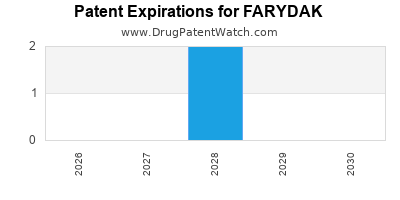
By analyzing the patents and regulatory protections it appears that the earliest date for generic entry will be January 17, 2028. This may change due to patent challenges or generic licensing.

There has been one patent litigation case involving the patents protecting this drug, indicating strong interest in generic launch. Recent data indicate that 63% of patent challenges are decided in favor of the generic patent challenger and that 54% of successful patent challengers promptly launch generic drugs.

Indicators of Generic Entry

< Available with Subscription >

  Get Started Free

AI Deep Research
Questions you can ask:
  • What is the 5 year forecast for FARYDAK?
  • What are the global sales for FARYDAK?
  • What is Average Wholesale Price for FARYDAK?
Summary for FARYDAK
Drug patent expirations by year for FARYDAK
Drug Prices for FARYDAK

See drug prices for FARYDAK

DrugPatentWatch® Estimated Loss of Exclusivity (LOE) Date for FARYDAK
Generic Entry Date for FARYDAK*:
Constraining patent/regulatory exclusivity:
NDA:
Dosage:
CAPSULE;ORAL

*The generic entry opportunity date is the latter of the last compound-claiming patent and the last regulatory exclusivity protection. Many factors can influence early or later generic entry. This date is provided as a rough estimate of generic entry potential and should not be used as an independent source.

Recent Clinical Trials for FARYDAK

Identify potential brand extensions & 505(b)(2) entrants

SponsorPhase
Abdullah KhanPhase 1
Secura Bio, Inc.Phase 1
Secura BioPhase 1

See all FARYDAK clinical trials

US Patents and Regulatory Information for FARYDAK

FARYDAK is protected by two US patents.

Based on analysis by DrugPatentWatch, the earliest date for a generic version of FARYDAK is ⤷  Get Started Free.

This potential generic entry date is based on patent 7,989,494.

Generics may enter earlier, or later, based on new patent filings, patent extensions, patent invalidation, early generic licensing, generic entry preferences, and other factors.

Applicant Tradename Generic Name Dosage NDA Approval Date TE Type RLD RS Patent No. Patent Expiration Product Substance Delist Req. Exclusivity Expiration
Secura FARYDAK panobinostat lactate CAPSULE;ORAL 205353-001 Feb 23, 2015 DISCN Yes No 8,883,842 ⤷  Get Started Free ⤷  Get Started Free
Secura FARYDAK panobinostat lactate CAPSULE;ORAL 205353-002 Feb 23, 2015 DISCN Yes No 7,989,494 ⤷  Get Started Free Y Y ⤷  Get Started Free
Secura FARYDAK panobinostat lactate CAPSULE;ORAL 205353-001 Feb 23, 2015 DISCN Yes No 7,989,494 ⤷  Get Started Free Y Y ⤷  Get Started Free
Secura FARYDAK panobinostat lactate CAPSULE;ORAL 205353-002 Feb 23, 2015 DISCN Yes No 8,883,842 ⤷  Get Started Free ⤷  Get Started Free
Secura FARYDAK panobinostat lactate CAPSULE;ORAL 205353-003 Feb 23, 2015 DISCN Yes No 7,989,494 ⤷  Get Started Free Y Y ⤷  Get Started Free
Secura FARYDAK panobinostat lactate CAPSULE;ORAL 205353-003 Feb 23, 2015 DISCN Yes No 8,883,842 ⤷  Get Started Free ⤷  Get Started Free
>Applicant >Tradename >Generic Name >Dosage >NDA >Approval Date >TE >Type >RLD >RS >Patent No. >Patent Expiration >Product >Substance >Delist Req. >Exclusivity Expiration

Expired US Patents for FARYDAK

Applicant Tradename Generic Name Dosage NDA Approval Date Patent No. Patent Expiration
Secura FARYDAK panobinostat lactate CAPSULE;ORAL 205353-002 Feb 23, 2015 6,833,384 ⤷  Get Started Free
Secura FARYDAK panobinostat lactate CAPSULE;ORAL 205353-003 Feb 23, 2015 7,067,551 ⤷  Get Started Free
Secura FARYDAK panobinostat lactate CAPSULE;ORAL 205353-001 Feb 23, 2015 6,552,065 ⤷  Get Started Free
Secura FARYDAK panobinostat lactate CAPSULE;ORAL 205353-003 Feb 23, 2015 6,552,065 ⤷  Get Started Free
Secura FARYDAK panobinostat lactate CAPSULE;ORAL 205353-001 Feb 23, 2015 6,833,384 ⤷  Get Started Free
Secura FARYDAK panobinostat lactate CAPSULE;ORAL 205353-002 Feb 23, 2015 7,067,551 ⤷  Get Started Free
>Applicant >Tradename >Generic Name >Dosage >NDA >Approval Date >Patent No. >Patent Expiration

International Patents for FARYDAK

When does loss-of-exclusivity occur for FARYDAK?

Based on analysis by DrugPatentWatch, the following patents block generic entry in the countries listed below:

Argentina

Patent: 1297
Estimated Expiration: ⤷  Get Started Free

Australia

Patent: 07257881
Estimated Expiration: ⤷  Get Started Free

Brazil

Patent: 0712993
Estimated Expiration: ⤷  Get Started Free

Canada

Patent: 50263
Estimated Expiration: ⤷  Get Started Free

Chile

Patent: 07001689
Estimated Expiration: ⤷  Get Started Free

China

Patent: 1641328
Estimated Expiration: ⤷  Get Started Free

Patent: 2584673
Estimated Expiration: ⤷  Get Started Free

Costa Rica

Patent: 440
Estimated Expiration: ⤷  Get Started Free

Ecuador

Patent: 088976
Estimated Expiration: ⤷  Get Started Free

Eurasian Patent Organization

Patent: 7984
Estimated Expiration: ⤷  Get Started Free

Patent: 0802383
Estimated Expiration: ⤷  Get Started Free

European Patent Office

Patent: 86930
Estimated Expiration: ⤷  Get Started Free

Patent: 09967
Estimated Expiration: ⤷  Get Started Free

Georgia, Republic of

Patent: 0115175
Estimated Expiration: ⤷  Get Started Free

Guatemala

Patent: 0800280
Estimated Expiration: ⤷  Get Started Free

Honduras

Patent: 08001862
Estimated Expiration: ⤷  Get Started Free

Israel

Patent: 5015
Estimated Expiration: ⤷  Get Started Free

Japan

Patent: 09540006
Estimated Expiration: ⤷  Get Started Free

Patent: 13139476
Estimated Expiration: ⤷  Get Started Free

Patent: 15164968
Estimated Expiration: ⤷  Get Started Free

Malaysia

Patent: 9337
Estimated Expiration: ⤷  Get Started Free

Mexico

Patent: 08015900
Estimated Expiration: ⤷  Get Started Free

Montenegro

Patent: 529
Estimated Expiration: ⤷  Get Started Free

Morocco

Patent: 511
Estimated Expiration: ⤷  Get Started Free

Nicaragua

Patent: 0800306
Estimated Expiration: ⤷  Get Started Free

Norway

Patent: 090135
Estimated Expiration: ⤷  Get Started Free

Peru

Patent: 080852
Estimated Expiration: ⤷  Get Started Free

Philippines

Patent: 012501724
Estimated Expiration: ⤷  Get Started Free

Patent: 012501725
Estimated Expiration: ⤷  Get Started Free

San Marino

Patent: 200900001
Estimated Expiration: ⤷  Get Started Free

Patent: 00900001
Estimated Expiration: ⤷  Get Started Free

South Africa

Patent: 0809094
Estimated Expiration: ⤷  Get Started Free

South Korea

Patent: 090015968
Estimated Expiration: ⤷  Get Started Free

Patent: 140142335
Estimated Expiration: ⤷  Get Started Free

Patent: 150082690
Estimated Expiration: ⤷  Get Started Free

Patent: 160032264
Estimated Expiration: ⤷  Get Started Free

Taiwan

Patent: 53196
Estimated Expiration: ⤷  Get Started Free

Patent: 15179
Estimated Expiration: ⤷  Get Started Free

Patent: 0815344
Estimated Expiration: ⤷  Get Started Free

Patent: 1441190
Estimated Expiration: ⤷  Get Started Free

Tunisia

Patent: 08495
Estimated Expiration: ⤷  Get Started Free

Ukraine

Patent: 243
Estimated Expiration: ⤷  Get Started Free

Uruguay

Patent: 406
Estimated Expiration: ⤷  Get Started Free

Generics may enter earlier, or later, based on new patent filings, patent extensions, patent invalidation, early generic licensing, generic entry preferences, and other factors.

See the table below for additional patents covering FARYDAK around the world.

Country Patent Number Title Estimated Expiration
Spain 2292610 ⤷  Get Started Free
China 101641328 ⤷  Get Started Free
European Patent Office 1870399 ⤷  Get Started Free
Poland 221738 ⤷  Get Started Free
China 101232880 Use of HDAC inhibitors for the treatment of myeloma ⤷  Get Started Free
Norway 2015026 ⤷  Get Started Free
>Country >Patent Number >Title >Estimated Expiration

Supplementary Protection Certificates for FARYDAK

Patent Number Supplementary Protection Certificate SPC Country SPC Expiration SPC Description
1318980 CR 2015 00068 Denmark ⤷  Get Started Free PRODUCT NAME: PANOBINOSTAT ELLER ET FARMACEUTISK ACCEPTABELT SALT DERAF, HERUNDER PANOBINOSTATLAKTAT; REG. NO/DATE: EU/1/15/1023 20150901
1912640 PA2016003,C1912640 Lithuania ⤷  Get Started Free PRODUCT NAME: PANOBINOSTATAS ARBA JO FARMACINIU POZIURIU PRIIMTINA DRUSKA; REGISTRATION NO/DATE: EU/1/15/1023 20120828
1318980 15C0086 France ⤷  Get Started Free PRODUCT NAME: PANOBINOSTAT OU UN DE SES SELS PHARMACEUTIQUEMENT ACCEPTABLES; REGISTRATION NO/DATE: EU/1/15/1023 20150901
1318980 72/2015 Austria ⤷  Get Started Free PRODUCT NAME: PANOBINOSTAT ODER EIN PHARMAZEUTISCH AKZEPTABLES SALZ DAVON; REGISTRATION NO/DATE: EU/1/15/1023 (MITTEILUNG) 20150901
1318980 CA 2015 00068 Denmark ⤷  Get Started Free PRODUCT NAME: PANOBINOSTAT ELLER ET FARMACEUTISK SALT ELLER DERIVAT DERAF; REG. NO/DATE: EU/1/15/1023 20150901
1318980 C 2015 053 Romania ⤷  Get Started Free PRODUCT NAME: PANOBINOSTAT SAU O SARE ACCEPTABILA FARMACEUTIC SAU UNDERIVAT AL ACESTUIAN-HIDROXI-3-[-[4-({[2-(2-METIL-1H-INDOL-3-IL)ETIL}AMINO}METIL)FENIL]]-2E-2-PROPENAMIDA; NATIONAL AUTHORISATION NUMBER: EU/1/15/1023/001, EU/1/15/1023/002, EU/1/15/1023/003, EU/1/15/1023/004, EU/1/15/1023/005, EU/1/15/1023/006, EU/1/15/1023/007, EU/1/15/1023/008, EU/1/15/1023/009; DATE OF NATIONAL AUTHORISATION: 20150828; NUMBER OF FIRST AUTHORISATION IN EUROPEAN ECONOMIC AREA (EEA): EU/1/15/1023/001, EU/1/15/1023/002, EU/1/15/1023/003, EU/1/15/1023/004, EU/1/15/1023/005, EU/1/15/1023/006, EU/1/15/1023/007, EU/1/15/1023/008, EU/1/15/1023/009; DATE OF FIRST AUTHORISATION IN EEA: 20150828
>Patent Number >Supplementary Protection Certificate >SPC Country >SPC Expiration >SPC Description

Market Dynamics and Financial Trajectory for FARYDAK (Fungal Infections Treatment)

Last updated: July 29, 2025

Introduction

FARYDAK (fadulvac) is an antifungal agent developed for the treatment of invasive fungal infections, particularly in immunocompromised patients. As a critical therapy in hematology and oncology settings, its market dynamics are shaped by clinical need, regulatory pathways, competition, and evolving healthcare priorities related to fungal infections. Assessing FARYDAK’s financial trajectory involves understanding its current market positioning, patent landscape, commercialization strategies, and regulatory outlook amidst emerging antifungal therapies. This analysis offers healthcare investors and industry stakeholders a comprehensive view of the opportunities and challenges facing FARYDAK.


Market Overview and Clinical Significance

Prevalence of Fungal Infections

Invasive fungal infections (IFIs), such as invasive candidiasis, aspergillosis, and mucormycosis, pose substantial mortality risks in immunocompromised populations. According to the Infectious Diseases Society of America (IDSA), the incidence of invasive fungal infections in hematopoietic stem cell transplant (HSCT) and solid organ transplant recipients remains high—ranging from 10% to 15% in certain cohorts (1). The rise of immunosuppressive therapies and increased survival rates for critical illnesses extend patient vulnerability.

FARYDAK’s Therapeutic Role

FARYDAK is indicated for the treatment of invasive aspergillosis and other filamentous fungal infections. Its mechanism involves inhibiting fungal cell wall synthesis, offering advantages in resistant fungal strains and specific patient populations. Its formulation allows for intravenous administration, critical in acutely ill patients unable to tolerate oral medications.


Competitive Landscape and Market Positioning

Key Competitors

FARYDAK’s main competitors include:

  • Voriconazole: Widely used first-line for invasive aspergillosis (2). Offers broad-spectrum antifungal coverage.
  • Isavuconazole: Approved as a broader-spectrum agent with improved safety profile over voriconazole (3).
  • Liposomal Amphotericin B: Reserved for refractory cases owing to its toxicity profile, but remains a potent option.

The antifungal market is mature, yet highly competitive, with emerging agents targeting resistant strains and providing better safety profiles.

Unique Selling Proposition

FARYDAK’s niche centers on resistant fungal infections and immunocompromised patient care, where resistance patterns or drug interactions limit other therapies. Its pharmacokinetic profile and formulary positioning may allow for targeted pediatric and adult indications, augmenting its market appeal.


Regulatory Environment and IP Landscape

Patents and Exclusivity

The patent landscape significantly influences FARYDAK’s financial outlook. The original formulation patents likely expire in the next 5–7 years, opening potential for generics or biosimilars, which could dilute revenues (4). However, supplementary patents on formulations or manufacturing processes may extend exclusivity.

Regulatory Approvals

FARYDAK received regulatory approval primarily in North America and select European markets for specific invasive fungal infections (5). Pending or expanded approvals in emerging markets and pediatric indications could unlock additional revenue streams.


Market Drivers

  • Growing Incidence of Immunocompromised Patients: Solid organ transplantation, cancer therapies, and HIV/AIDS contribute to the rising demand for antifungal agents.
  • Resistance to Existing Therapies: Increasing resistance among Candida and Aspergillus species incentivizes the development and use of newer agents like FARYDAK.
  • Advancements in Diagnostics: Improved diagnostic tools facilitate timely, targeted antifungal therapy, enhancing treatment outcomes and increasing FARYDAK’s utilization.
  • Guideline Endorsements: Recognition by clinical guidelines (e.g., IDSA) bolsters FARYDAK’s clinical adoption.

Financial Trajectory and Revenue Forecasts

Current Financial Performance

FARYDAK’s sales profile remains modest relative to dominant antifungals due to its niche clinical use, limited indications, and competitive pressures. Revenue estimates vary, but preliminary reports suggest annual sales in the range of $50 million to $100 million in key markets (6).

Growth Opportunities

  • Expanding Indications: Broader approvals—for example, prophylaxis in high-risk populations—could significantly increase sales.
  • Geographical Expansion: Penetration into emerging markets, notably Asia-Pacific, where fungal infections and immunosuppressive therapy are rising, could serve as revenue catalysts.
  • Formulation Extensions: Development of oral formulations or combination therapies to improve adherence and efficacy could enhance market share.

Potential Market Challenges

  • Patent Expiry and Generics: As patents lapse, generic competition could lead to drastic price erosion.
  • Competitive Innovations: New antifungal agents with superior safety profiles, broader spectrum, or cost advantages threaten FARYDAK’s market share.
  • Pricing and Reimbursement: Healthcare payers' willingness to reimburse for niche antifungal therapies is critical to maintain revenue levels.

Forecast Overview

Given the current market dynamics, FARYDAK’s global revenues could experience moderate growth over the next 3–5 years, potentially reaching $150 million to $250 million if regulatory and commercialization efforts succeed. Post-patent expiry, revenues are expected to decline unless backed by unique clinical advantages or significant market penetration.


Future Outlook and Strategic Considerations

Research and Development

Investments in clinical trials exploring expanded indications, combination therapies, and formulations are pivotal. The development of oral formulations could position FARYDAK favorably within outpatient management and prophylaxis settings.

Partnerships and Licensing

Strategic collaborations with biotech firms, regional distributors, and healthcare providers enhance market reach and accelerate adoption.

Regulatory and Intellectual Property Strategy

Securing extended exclusivity via patents and regulatory designations (e.g., Orphan Drug, Fast Track) can buffer against generic entry and accelerate uptake.


Key Takeaways

  • The global antifungal market is growing, driven by increasing fungal infections among immunocompromised populations.
  • FARYDAK’s niche positioning offers opportunities in resistant infections and specialty care, but faces competition from well-established antifungals.
  • Patent expiries will challenge revenue streams; thus, innovation and regional expansion are vital.
  • Strategic regulatory approvals and formulation advancements can boost FARYDAK’s financial trajectory.
  • Overall, FARYDAK's revenue potential hinges on clinical differentiation, regulatory success, and market expansion efforts.

FAQs

1. What are the main factors influencing FARYDAK’s market growth?
Market growth depends on expanding clinical indications, geographical penetration, patent protection duration, and competitive positioning relative to existing antifungals.

2. How does FARYDAK compare to other antifungals like voriconazole?
FARYDAK is particularly targeted at resistant or refractory fungal infections, offering advantages in specific patient populations. However, voriconazole’s broader approval and established use make it a primary comparator.

3. What are the key regulatory challenges faced by FARYDAK?
Securing approvals for additional indications, extending market access in emerging regions, and navigating patent cliff risks are primary regulatory hurdles.

4. How might patent expirations impact FARYDAK’s revenues?
Patent expirations could lead to generic competition, significantly decreasing pricing power and revenues unless offset by new formulations or indications.

5. What strategic moves could enhance FARYDAK’s financial trajectory?
Engaging in R&D to broaden indications, formulating oral variants, securing additional patents, and forming strategic partnerships are essential for growth.


Sources:

  1. Pappas PG, et al. Clinical practice guidelines for the management of invasive fungal infections. Clin Infect Dis. 2016.
  2. Walsh TJ, et al. Voriconazole versus Amphotericin B for invasive aspergillosis. N Engl J Med. 2002.
  3. Maertens J, et al. Isavuconazole versus voriconazole for primary treatment of invasive mould disease. Lancet Infect Dis. 2016.
  4. PatentScope, WIPO. Patent landscape of antifungal agents.
  5. U.S. FDA. FARYDAK approval documentation.
  6. Industry reports, biospectrum intelligence.

More… ↓

⤷  Get Started Free

Make Better Decisions: Try a trial or see plans & pricing

Drugs may be covered by multiple patents or regulatory protections. All trademarks and applicant names are the property of their respective owners or licensors. Although great care is taken in the proper and correct provision of this service, thinkBiotech LLC does not accept any responsibility for possible consequences of errors or omissions in the provided data. The data presented herein is for information purposes only. There is no warranty that the data contained herein is error free. We do not provide individual investment advice. This service is not registered with any financial regulatory agency. The information we publish is educational only and based on our opinions plus our models. By using DrugPatentWatch you acknowledge that we do not provide personalized recommendations or advice. thinkBiotech performs no independent verification of facts as provided by public sources nor are attempts made to provide legal or investing advice. Any reliance on data provided herein is done solely at the discretion of the user. Users of this service are advised to seek professional advice and independent confirmation before considering acting on any of the provided information. thinkBiotech LLC reserves the right to amend, extend or withdraw any part or all of the offered service without notice.