SIRTURO Drug Patent Profile
Which patents cover Sirturo, and what generic alternatives are available?
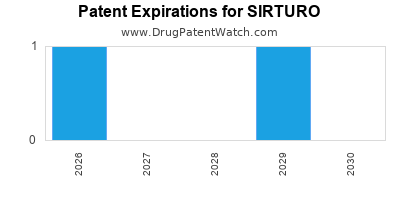
Sirturo is a drug marketed by Janssen Therap and is included in one NDA. There are two patents protecting this drug.
The generic ingredient in SIRTURO is bedaquiline fumarate. There is one drug master file entry for this compound. One supplier is listed for this compound. Additional details are available on the bedaquiline fumarate profile page.
DrugPatentWatch® Generic Entry Outlook for Sirturo
Sirturo was eligible for patent challenges on December 28, 2016.
By analyzing the patents and regulatory protections it appears that the earliest date
for generic entry will be July 28, 2028. This may change due to patent challenges or generic licensing.
Indicators of Generic Entry
AI Deep Research
Questions you can ask:
- What is the 5 year forecast for SIRTURO?
- What are the global sales for SIRTURO?
- What is Average Wholesale Price for SIRTURO?
Summary for SIRTURO
| US Patents: | 2 |
| Applicants: | 1 |
| NDAs: | 1 |
| Finished Product Suppliers / Packagers: | 1 |
| Raw Ingredient (Bulk) Api Vendors: | 54 |
| Clinical Trials: | 16 |
| Patent Applications: | 121 |
| Drug Prices: | Drug price information for SIRTURO |
| What excipients (inactive ingredients) are in SIRTURO? | SIRTURO excipients list |
| DailyMed Link: | SIRTURO at DailyMed |

DrugPatentWatch® Estimated Loss of Exclusivity (LOE) Date for SIRTURO
Generic Entry Date for SIRTURO*:
Constraining patent/regulatory exclusivity:
NEW PATIENT POPULATION NDA:
Dosage:
TABLET;ORAL |
*The generic entry opportunity date is the latter of the last compound-claiming patent and the last regulatory exclusivity protection. Many factors can influence early or later generic entry. This date is provided as a rough estimate of generic entry potential and should not be used as an independent source.
Recent Clinical Trials for SIRTURO
Identify potential brand extensions & 505(b)(2) entrants
| Sponsor | Phase |
|---|---|
| Tuberculosis Trials Consortium | Phase 2/Phase 3 |
| Centers for Disease Control and Prevention | Phase 2/Phase 3 |
| Beijing Chest Hospital | Phase 4 |
Pharmacology for SIRTURO
| Drug Class | Diarylquinoline Antimycobacterial |
US Patents and Regulatory Information for SIRTURO
SIRTURO is protected by two US patents and five FDA Regulatory Exclusivities.
Based on analysis by DrugPatentWatch, the earliest date for a generic version of SIRTURO is ⤷ Start Trial.
This potential generic entry date is based on NEW PATIENT POPULATION.
Generics may enter earlier, or later, based on new patent filings, patent extensions, patent invalidation, early generic licensing, generic entry preferences, and other factors.
| Applicant | Tradename | Generic Name | Dosage | NDA | Approval Date | TE | Type | RLD | RS | Patent No. | Patent Expiration | Product | Substance | Delist Req. | Exclusivity Expiration |
|---|---|---|---|---|---|---|---|---|---|---|---|---|---|---|---|
| Janssen Therap | SIRTURO | bedaquiline fumarate | TABLET;ORAL | 204384-002 | May 27, 2020 | RX | Yes | No | 8,546,428 | ⤷ Start Trial | Y | Y | ⤷ Start Trial | ||
| Janssen Therap | SIRTURO | bedaquiline fumarate | TABLET;ORAL | 204384-001 | Dec 28, 2012 | RX | Yes | Yes | 7,498,343 | ⤷ Start Trial | Y | Y | ⤷ Start Trial | ||
| Janssen Therap | SIRTURO | bedaquiline fumarate | TABLET;ORAL | 204384-002 | May 27, 2020 | RX | Yes | No | ⤷ Start Trial | ⤷ Start Trial | ⤷ Start Trial | ||||
| Janssen Therap | SIRTURO | bedaquiline fumarate | TABLET;ORAL | 204384-001 | Dec 28, 2012 | RX | Yes | Yes | ⤷ Start Trial | ⤷ Start Trial | ⤷ Start Trial | ||||
| Janssen Therap | SIRTURO | bedaquiline fumarate | TABLET;ORAL | 204384-001 | Dec 28, 2012 | RX | Yes | Yes | 8,546,428 | ⤷ Start Trial | Y | Y | ⤷ Start Trial | ||
| Janssen Therap | SIRTURO | bedaquiline fumarate | TABLET;ORAL | 204384-002 | May 27, 2020 | RX | Yes | No | 7,498,343 | ⤷ Start Trial | Y | Y | ⤷ Start Trial | ||
| Janssen Therap | SIRTURO | bedaquiline fumarate | TABLET;ORAL | 204384-002 | May 27, 2020 | RX | Yes | No | ⤷ Start Trial | ⤷ Start Trial | ⤷ Start Trial | ||||
| >Applicant | >Tradename | >Generic Name | >Dosage | >NDA | >Approval Date | >TE | >Type | >RLD | >RS | >Patent No. | >Patent Expiration | >Product | >Substance | >Delist Req. | >Exclusivity Expiration |
International Patents for SIRTURO
When does loss-of-exclusivity occur for SIRTURO?
Based on analysis by DrugPatentWatch, the following patents block generic entry in the countries listed below:
African Regional IP Organization (ARIPO)
Patent: 98
Estimated Expiration: ⤷ Start Trial
Argentina
Patent: 4149
Estimated Expiration: ⤷ Start Trial
Australia
Patent: 07328945
Estimated Expiration: ⤷ Start Trial
Brazil
Patent: 0719693
Estimated Expiration: ⤷ Start Trial
Canada
Patent: 68512
Estimated Expiration: ⤷ Start Trial
Chile
Patent: 07003472
Estimated Expiration: ⤷ Start Trial
China
Patent: 1547904
Estimated Expiration: ⤷ Start Trial
Patent: 5012303
Estimated Expiration: ⤷ Start Trial
Croatia
Patent: 0120639
Estimated Expiration: ⤷ Start Trial
Cyprus
Patent: 13594
Estimated Expiration: ⤷ Start Trial
Denmark
Patent: 86940
Estimated Expiration: ⤷ Start Trial
Eurasian Patent Organization
Patent: 7091
Estimated Expiration: ⤷ Start Trial
Patent: 0970532
Estimated Expiration: ⤷ Start Trial
European Patent Office
Patent: 86940
Estimated Expiration: ⤷ Start Trial
Hong Kong
Patent: 14513
Estimated Expiration: ⤷ Start Trial
Israel
Patent: 9077
Estimated Expiration: ⤷ Start Trial
Japan
Patent: 94239
Estimated Expiration: ⤷ Start Trial
Patent: 10511663
Estimated Expiration: ⤷ Start Trial
Patent: 15028049
Patent: (アルファS,ベータR)−6−ブロモ−アルファ−[2−(ジメチルアミノ)エチル]−2−メトキシ−アルファ−1−ナフタレニル−ベータ−フェニル−3−キノリンエタノールのフマル酸塩 (FUMARATE SALT OF (ALPHA S, BETA R)-6-BROMO-ALPHA-[2-(DIMETHYLAMINO)ETHYL]-2-METHOXY-ALPHA-1-NAPHTHALENYL-BETA-PHENYL-3-QUINOLINEETHANOL)
Estimated Expiration: ⤷ Start Trial
Jordan
Patent: 73
Estimated Expiration: ⤷ Start Trial
Malaysia
Patent: 8844
Patent: FUMARATE SALT OF (ALPHA S, BETA R)-6- BROMO-ALPHA-[2-(DIMETHYLAMINO)ETHYL]-2-METHOXY-ALPHA-1-NAPHTHALENYL-BETA-PHENYL-3-QUINOLINEETHANOL
Estimated Expiration: ⤷ Start Trial
Mexico
Patent: 09005909
Patent: SAL FUMARATO DE (ALFA S, BETA R)-6-BROMO-ALFA-[2-(DIMETILAMINO)ETI L]-2-METOXI-ALFA-1-NAFTALENIL-BETA-FENIL-3-QUINOLINAETANOL. (FUMARATE SALT OF (ALPHA S, BETA R)-6-BROMO-ALPHA-[2-(DIMETHYLAMIN O)ETHYL]-2-METHOXY-ALPHA-1-NAPHTHALENYL-BETA-PHENYL-3-QUINOLINEE THANOL.)
Estimated Expiration: ⤷ Start Trial
Montenegro
Patent: 456
Patent: FUMARATNA SO (ALFA S, BETA R)-6-BROMO-ALFA-[2-(DIMETILAMINO)ETIL]-2-METOKSI-ALFA-1-NAFTALENIL-BETA-FENIL-3-KINOLINETANOLA (FUMARATE SALT OF (ALPHA S, BETA R)-6-BROMO-ALPHA-[2-(DIMETHYLAMINO)ETHYL]-2-METHOXY-ALPHA-1-NAPHTHALENYL-BETA-PHENYL-3-QUINOLINEETHANOL)
Estimated Expiration: ⤷ Start Trial
New Zealand
Patent: 6485
Patent: FUMARATE SALT OF (ALPHA S, BETA R)-6-BROMO-ALPHA-[2-(DIMETHYLAMINO)ETHYL]-2-METHOXY-ALPHA-1-NAPHTHALENYL-BETA-PHENYL-3-QUINOLINEETHANOL
Estimated Expiration: ⤷ Start Trial
Norway
Patent: 2773
Estimated Expiration: ⤷ Start Trial
Patent: 092535
Estimated Expiration: ⤷ Start Trial
Peru
Patent: 081350
Patent: SAL FUMARATO DE (ALFAS S, BETA R)-6-BROMO-ALFA-[2(DIMETILAMINO)ETIL]-2-METOXI-ALFA-1-NAFTALENIL-BETA-FENIL-3-QUINOLINAETANOL
Estimated Expiration: ⤷ Start Trial
Poland
Patent: 86940
Estimated Expiration: ⤷ Start Trial
Portugal
Patent: 86940
Estimated Expiration: ⤷ Start Trial
Serbia
Patent: 408
Patent: FUMARATNA SO (ALFA S, BETA R)-6-BROMO-ALFA-[2-(DIMETILAMINO)ETIL]-2-METOKSI-ALFA-1-NAFTALENIL-BETA-FENIL-3-KINOLINETANOLA (FUMARATE SALT OF (ALPHA S, BETA R)-6-BROMO-ALPHA-[2-(DIMETHYLAMINO)ETHYL]-2¬METHOXY-ALPHA-1-NAPHTHALENYL-BETA-PHENYL-3-QUlNOLINEETHANOL)
Estimated Expiration: ⤷ Start Trial
Slovenia
Patent: 86940
Estimated Expiration: ⤷ Start Trial
South Africa
Patent: 0903907
Patent: FUMARATE SALT OF (ALPHA S,BETA R)-6-BROMO-ALPHA-[2-(DIMETHYLAMINO)ETHYL]-2-METHOXY-ALPHA-1-NAPHTHALENYL-BETA-PHENYL-3-QUINOLINEETHANOL
Estimated Expiration: ⤷ Start Trial
South Korea
Patent: 1514700
Estimated Expiration: ⤷ Start Trial
Patent: 090087020
Patent: (알파 S, 베타 R)―6―브로모―알파―[2―(디메틸아미노)에틸]―2―메톡시―알파―1―나프탈레닐―베타―페닐―3―퀴놀린에탄올의 푸마레이트 염 (FUMARATE SALT OF ALPHA S BETA R-6-BROMO-ALPHA-[2-DIMETHYLAMINOETHYL]-2-METHOXY-ALPHA-1-NAPHTHALENYL-BETA-PHENYL-3-QUINOLINEETHANOL)
Estimated Expiration: ⤷ Start Trial
Spain
Patent: 87923
Estimated Expiration: ⤷ Start Trial
Taiwan
Patent: 0838527
Patent: Fumarate salt of (alpha S, beta R)-6-bromo-alpha-[2-(dimethylamino)ethyl]-2-methoxy-alpha-1-naphthalenyl-beta-phenyl-3-quinolineethanol
Estimated Expiration: ⤷ Start Trial
Patent: 17098
Estimated Expiration: ⤷ Start Trial
Ukraine
Patent: 813
Patent: ФУМАРАТНА СІЛЬ (АЛЬФА S, БЕТА R)-6-БРОМ-АЛЬФА-[2-(ДИМЕТИЛАМІНО)ЕТИЛ]-2-МЕТОКСІ-АЛЬФА-1-НАФТАЛЕНІЛ-БЕТА-ФЕНІЛ-3-ХІНОЛІНЕТАНОЛУ (FUMARATE SALT OF (ALPHA S, BETA R)-6-BROMO-ALPHA-[2-(DIMETHYLAMINO)ETHYL]-2-METHOXY-ALPHA-1-NAPHTHALENYL-BETA-PHENYL-3-QUINOLINEETHANOL)
Estimated Expiration: ⤷ Start Trial
Uruguay
Patent: 762
Patent: SAL FUMARATO DE (ALFA S, BETA R)-6-BROMO-ALFA-[2(DIMETILAMINO) ETIL]-2-METOXI-ALFA-1-NAFTALENIL-BETA-FENIL-3-QUINOLINAETANOL
Estimated Expiration: ⤷ Start Trial
Generics may enter earlier, or later, based on new patent filings, patent extensions, patent invalidation, early generic licensing, generic entry preferences, and other factors.
See the table below for additional patents covering SIRTURO around the world.
| Country | Patent Number | Title | Estimated Expiration |
|---|---|---|---|
| African Regional IP Organization (ARIPO) | 2421 | Quinoline derivatives and their use as mycobacterial inhibitors. | ⤷ Start Trial |
| Argentina | 040673 | INHIBIDORES MICOBACTERIANOS, COMPOSICION FARMACEUTICA Y PROCESO DE PREPARACION DEL COMPUESTO | ⤷ Start Trial |
| Austria | 463482 | ⤷ Start Trial | |
| Australia | 2003262529 | QUINOLINE DERIVATIVES AND THEIR USE AS MYCOBACTERIAL INHIBITORS | ⤷ Start Trial |
| Brazil | 0312927 | Derivados de quinolina e seu uso como inibidores micobacterias | ⤷ Start Trial |
| Brazil | PI0312927 | "compostos, derivados de quinolina, composição, seu uso como inibidores micobacteriais, bem como processo para preparação dos referidos derivados". | ⤷ Start Trial |
| Canada | 2493225 | DERIVES DE QUINOLEINE ET LEUR UTILISATION EN TANT QU'INHIBITEURS MYCOBACTERIENS (QUINOLINE DERIVATIVES AND THEIR USE AS MYCOBACTERIAL INHIBITORS) | ⤷ Start Trial |
| >Country | >Patent Number | >Title | >Estimated Expiration |
Supplementary Protection Certificates for SIRTURO
| Patent Number | Supplementary Protection Certificate | SPC Country | SPC Expiration | SPC Description |
|---|---|---|---|---|
| 1527050 | C300684 | Netherlands | ⤷ Start Trial | PRODUCT NAME: BEDAQUILINE, OF EEN FARMACEUTISCH AANVAARDBAAR ZUUR- OF BASE-ADDITIEZOUT DAARVAN, WAARONDER BEDAQUILINEFUMARAAT; REGISTRATION NO/DATE: EU/1/13/901 20140307 |
| 1527050 | PA2014032 | Lithuania | ⤷ Start Trial | PRODUCT NAME: BEDAQUILINUM; REGISTRATION NO/DATE: EU/1/13/901 20140305 |
| 1527050 | CA 2014 00044 | Denmark | ⤷ Start Trial | PRODUCT NAME: BEDAKILIN ELLER ET FARMACEUTISK ACCEPTABELT SYRE-ELLER BASEADDITIONSSALT DERAF, HERUNDER BEDAKILINFUMARAT; REG. NO/DATE: EU/1/13/901 20140305 |
| 1527050 | C20140026 00112 | Estonia | ⤷ Start Trial | PRODUCT NAME: BEDAKVILIIN;REG NO/DATE: K(2014)1616 (LOPLIK) 07.03.2014 |
| 1527050 | 1490050-0 | Sweden | ⤷ Start Trial | PRODUCT NAME: BEDAQUILINE, OR A PHARMACEUTICALLY ACCEPTABLE ACID OR BASE ADDITION SALT THEREOF, INCLUDING BEDAQUILINE FUMARATE; REG. NO/DATE: EU/1/13/901 20140305 |
| 1527050 | 178 5021-2014 | Slovakia | ⤷ Start Trial | PRODUCT NAME: BEDACHILIN FUMARAT; REGISTRATION NO/DATE: EU/1/13/901 20140305 |
| 1527050 | CR 2014 00044 | Denmark | ⤷ Start Trial | PRODUCT NAME: BEDAKILIN ELLER ET FARMACEUTISK ACCEPTABELT SYRE- ELLER BASEADDITIONSSALT DERAF, HERUNDER BEDAKILINFUMARAT; REG. NO/DATE: EU/1/13/901 20140305 |
| >Patent Number | >Supplementary Protection Certificate | >SPC Country | >SPC Expiration | >SPC Description |
SIRTURO Market Dynamics, Patent Exclusivity, Financial Trajectory, and Generic Competition
More… ↓
Make Better Decisions: Try a trial or see plans & pricing
Drugs may be covered by multiple patents or regulatory protections. All trademarks and applicant names are the property of their respective owners or licensors. Although great care is taken in the proper and correct provision of this service, thinkBiotech LLC does not accept any responsibility for possible consequences of errors or omissions in the provided data. The data presented herein is for information purposes only. There is no warranty that the data contained herein is error free. We do not provide individual investment advice. This service is not registered with any financial regulatory agency. The information we publish is educational only and based on our opinions plus our models. By using DrugPatentWatch you acknowledge that we do not provide personalized recommendations or advice. thinkBiotech performs no independent verification of facts as provided by public sources nor are attempts made to provide legal or investing advice. Any reliance on data provided herein is done solely at the discretion of the user. Users of this service are advised to seek professional advice and independent confirmation before considering acting on any of the provided information. thinkBiotech LLC reserves the right to amend, extend or withdraw any part or all of the offered service without notice.
ISSN: 2162-2639

Privacy and Cookies
Terms & Conditions
Site Map
DrugPatentWatch Alternatives
LOE / Major Patent Expirations 2026 - 2027
NCE-1 Patent Challenge Dates 2026 - 2027
Friedman, Yali. "DrugPatentWatch" DrugPatentWatch, thinkBiotech, 2026, www.DrugPatentWatch.com.
See Primary Research Papers Citing DrugPatentWatch