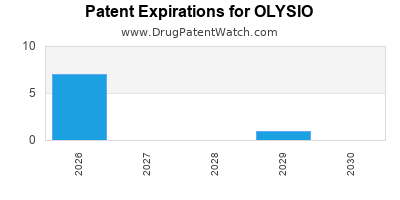
Last Updated: June 24, 2026

OLYSIO Drug Patent Profile


✉ Email this page to a colleague

« Back to Dashboard


When do Olysio patents expire, and when can generic versions of Olysio launch?

Olysio is a drug marketed by Janssen Prods and is included in one NDA. There are eight patents protecting this drug.

This drug has sixty-four patent family members in forty-one countries.

The generic ingredient in OLYSIO is simeprevir sodium. There is one drug master file entry for this compound. Additional details are available on the simeprevir sodium profile page.

DrugPatentWatch® Generic Entry Outlook for Olysio

Olysio was eligible for patent challenges on November 22, 2017.

By analyzing the patents and regulatory protections it appears that the earliest date for generic entry will be July 28, 2026. This may change due to patent challenges or generic licensing.

There has been one patent litigation case involving the patents protecting this drug, indicating strong interest in generic launch. Recent data indicate that 63% of patent challenges are decided in favor of the generic patent challenger and that 54% of successful patent challengers promptly launch generic drugs.

Indicators of Generic Entry

< Available with Subscription >

  Start Trial

AI Deep Research
Questions you can ask:
  • What is the 5 year forecast for OLYSIO?
  • What are the global sales for OLYSIO?
  • What is Average Wholesale Price for OLYSIO?
DrugPatentWatch® Estimated Loss of Exclusivity (LOE) Date for OLYSIO
Generic Entry Date for OLYSIO*:
Constraining patent/regulatory exclusivity:
NDA:
Dosage:

CAPSULE;ORAL

*The generic entry opportunity date is the latter of the last compound-claiming patent and the last regulatory exclusivity protection. Many factors can influence early or later generic entry. This date is provided as a rough estimate of generic entry potential and should not be used as an independent source.

Recent Clinical Trials for OLYSIO

Identify potential brand extensions & 505(b)(2) entrants

SponsorPhase
Yale UniversityPhase 4
Stanford UniversityPhase 4
Alexion PharmaceuticalsPhase 1

See all OLYSIO clinical trials

US Patents and Regulatory Information for OLYSIO

OLYSIO is protected by eight US patents.

Based on analysis by DrugPatentWatch, the earliest date for a generic version of OLYSIO is ⤷  Start Trial.

This potential generic entry date is based on patent 8,349,869.

Generics may enter earlier, or later, based on new patent filings, patent extensions, patent invalidation, early generic licensing, generic entry preferences, and other factors.

Applicant Tradename Generic Name Dosage NDA Approval Date TE Type RLD RS Patent No. Patent Expiration Product Substance Delist Req. Exclusivity Expiration
Janssen Prods OLYSIO simeprevir sodium CAPSULE;ORAL 205123-001 Nov 22, 2013 DISCN Yes No 8,349,869 ⤷  Start Trial Y Y ⤷  Start Trial
Janssen Prods OLYSIO simeprevir sodium CAPSULE;ORAL 205123-001 Nov 22, 2013 DISCN Yes No 9,353,103 ⤷  Start Trial ⤷  Start Trial
Janssen Prods OLYSIO simeprevir sodium CAPSULE;ORAL 205123-001 Nov 22, 2013 DISCN Yes No 9,040,562 ⤷  Start Trial Y Y ⤷  Start Trial
Janssen Prods OLYSIO simeprevir sodium CAPSULE;ORAL 205123-001 Nov 22, 2013 DISCN Yes No 9,623,022 ⤷  Start Trial ⤷  Start Trial
Janssen Prods OLYSIO simeprevir sodium CAPSULE;ORAL 205123-001 Nov 22, 2013 DISCN Yes No 8,754,106 ⤷  Start Trial Y ⤷  Start Trial
>Applicant >Tradename >Generic Name >Dosage >NDA >Approval Date >TE >Type >RLD >RS >Patent No. >Patent Expiration >Product >Substance >Delist Req. >Exclusivity Expiration

International Patents for OLYSIO

When does loss-of-exclusivity occur for OLYSIO?

Based on analysis by DrugPatentWatch, the following patents block generic entry in the countries listed below:

African Regional IP Organization (ARIPO)

Patent: 06
Patent: Macrocydic inhibitors of hepatitis C virus.
Estimated Expiration: ⤷  Start Trial

Argentina

Patent: 5359
Patent: INHIBIDORES MACROCICLICOS DEL VIRUS DE LA HEPATITIS C
Estimated Expiration: ⤷  Start Trial

Brazil

Patent: 0614654
Patent: inibidores macrocìclicos de vìrus de hepatite c
Estimated Expiration: ⤷  Start Trial

Canada

Patent: 16580
Patent: INHIBITEURS MACROCYCLIQUES DU VIRUS DE L'HEPATITE C (MACROCYCLIC INHIBITORS OF HEPATITIS C VIRUS)
Estimated Expiration: ⤷  Start Trial

China

Patent: 2627639
Patent: Macrocydic inhibitors of hepatitis c virus.
Estimated Expiration: ⤷  Start Trial

Costa Rica

Patent: 83
Patent: INHIBIDORES MACROCICLICOS DEL VIRUS DE LA HEPATITIS C
Estimated Expiration: ⤷  Start Trial

Croatia

Patent: 0151326
Estimated Expiration: ⤷  Start Trial

Cyprus

Patent: 12006
Estimated Expiration: ⤷  Start Trial

Denmark

Patent: 12999
Estimated Expiration: ⤷  Start Trial

El Salvador

Patent: 08002642
Patent: INHIBIDORES MACROCICLICOS DEL VIRUS DE HEPATITIS C REF. PIT 111 SLV
Estimated Expiration: ⤷  Start Trial

Eurasian Patent Organization

Patent: 5131
Patent: МАКРОЦИКЛИЧЕСКИЕ ИНГИБИТОРЫ ВИРУСА ГЕПАТИТА С (MACROCYCLIC INHIBITORS OF HEPATITIS C VIRUS)
Estimated Expiration: ⤷  Start Trial

European Patent Office

Patent: 22516
Patent: Composés intermédiaires pour la préparation d'inhibiteurs macrocycliques du virus de l'hépatite C (Intermediates for the preparation of Macrocyclic inhibitors of hepatitis c virus)
Estimated Expiration: ⤷  Start Trial

Patent: 37339
Patent: Inhibiteurs macrocycliques du virus de l'hépatite C (Macrocylic inhibitors of hepatitis c virus)
Estimated Expiration: ⤷  Start Trial

Honduras

Patent: 08000134
Patent: INHIBIDORES MACROCICLICOS DEL VIRUS HEPATITIS C
Estimated Expiration: ⤷  Start Trial

Hong Kong

Patent: 83872
Patent: 丙型肝炎病毒的大環抑制劑 (MACROCYLIC INHIBITORS OF HEPATITIS C VIRUS)
Estimated Expiration: ⤷  Start Trial

Hungary

Patent: 27156
Estimated Expiration: ⤷  Start Trial

Israel

Patent: 8227
Patent: תרכובות מקרוציקליות, שילובים ותכשירים רוקחיים המכילים אותן, שימושים בהן כמעכבי וירוס הפטיטיס c ותהליכים להכנתן (Macrocyclic compounds, combinations and pharmaceutical compositions comprising them, uses thereof as inhibitors of hepatitis c virus and processes for their preparation)
Estimated Expiration: ⤷  Start Trial

Luxembourg

Patent: 568
Estimated Expiration: ⤷  Start Trial

Montenegro

Patent: 231
Patent: Makrociklički inhibitori virusa hepatitisa C (MACROCYCLIC INHIBITORS OF HEPATITIS C VIRUS)
Estimated Expiration: ⤷  Start Trial

Patent: 415
Patent: Intermedijari za pripremu makrocikličkih inhibitora virusa hepatitisa C (Intermediates for the preparation of Macrocyclic inhibitors of hepatitis c virus)
Estimated Expiration: ⤷  Start Trial

Portugal

Patent: 12999
Estimated Expiration: ⤷  Start Trial

Serbia

Patent: 743
Patent: MAKROCIKLIČKI INHIBITORI VIRUSA HEPATITISA C (MACROCYCLIC INHIBITORS OF HEPATITIS C VIRUS)
Estimated Expiration: ⤷  Start Trial

Slovenia

Patent: 22516
Estimated Expiration: ⤷  Start Trial

South Korea

Patent: 080042084
Patent: MACROCYLIC INHIBITORS OF HEPATITIS C VIRUS
Estimated Expiration: ⤷  Start Trial

Ukraine

Patent: 245
Patent: МАКРОЦИКЛИЧЕСКИЕ ИНГИБИТОРЫ ВИРУСА ГЕПАТИТА С;МАКРОЦИКЛІЧНІ ІНГІБІТОРИ ВІРУСУ ГЕПАТИТУ С (MACROCYCLIC INHIBITORS OF HEPATITIS C VIRUS)
Estimated Expiration: ⤷  Start Trial

Uruguay

Patent: 703
Estimated Expiration: ⤷  Start Trial

Generics may enter earlier, or later, based on new patent filings, patent extensions, patent invalidation, early generic licensing, generic entry preferences, and other factors.

See the table below for additional patents covering OLYSIO around the world.

Country Patent Number Title Estimated Expiration
Argentina 047793 INHIBIDORES DE LA SERINA PROTEASA NS-3 DEL VHC ⤷  Start Trial
Argentina 048401 INHIBIDORES DE LA SERINA-PROTEASA NS3 DEL VHC ⤷  Start Trial
Argentina 104445 COMPUESTOS INHIBIDORES DE LA SERINA PROTEASA NS3 DEL VHC Y COMPOSICIÓN FARMACÉUTICA ⤷  Start Trial
Austria E448243 ⤷  Start Trial
Austria E461209 ⤷  Start Trial
>Country >Patent Number >Title >Estimated Expiration

Supplementary Protection Certificates for OLYSIO

Patent Number Supplementary Protection Certificate SPC Country SPC Expiration SPC Description
1713823 C300703 Netherlands ⤷  Start Trial PRODUCT NAME: SIMEPREVIR, OF EEN FARMACEUTISCH AANVAARDBAAR ZOUT DAARVAN, WAARONDER SIMEPREVIRNATRIUM; REGISTRATION NO/DATE: EU/1/14/924/001-002 20140514
1713823 CA 2014 00059 Denmark ⤷  Start Trial PRODUCT NAME: SIMEPREVIR ELLER ET FARMACEUTISK SALT DERAF, HERUNDER SIMEPREVIRNATRIUM; REG. NO/DATE: EU/1/14/924 20140514
1713823 1490064-1 Sweden ⤷  Start Trial PRODUCT NAME: SIMEPREVIR, OR A PHARMACEUTICALLY ACCEPTABLE SALT THEREOF, INCLUDING SIMEPREVIR SODIUM; REG. NO/DATE: EU/1/14/924 20140516
1912999 CA 2014 00053 Denmark ⤷  Start Trial PRODUCT NAME: SIMEPREVIR ELLER ET SALT DERAF, HERUNDER SIMEPREVIRNATRIUM; REG. NO/DATE: EU/1/14/924 20140514
1912999 C300697 Netherlands ⤷  Start Trial PRODUCT NAME: SIMEPREVIR, OF EEN ZOUT DAARVAN, WAARONDER SIMEPREVIRNATRIUM; REGISTRATION NO/DATE: EU/1/14/924 20140514
>Patent Number >Supplementary Protection Certificate >SPC Country >SPC Expiration >SPC Description

OLYSIO (simeprevir) market dynamics and financial trajectory: pricing, uptake, competition, and revenue decay

Last updated: June 24, 2026

Executive summary
OLYSIO (simeprevir) reached peak sales in the mid-to-late 2010s on the back of interferon-free direct-acting antiviral (DAA) hepatitis C regimens, then experienced rapid demand erosion as newer, more pangenotypic DAAs displaced it. Financial trajectory is characterized by (1) an early post-launch growth phase, (2) sharp market-share loss as sofosbuvir-based and glecaprevir/pibrentasvir regimens expanded across genotypes and simplified treatment, and (3) sustained decline after restrictive clinical and labeling constraints reduced the addressable population. Global competition intensified when large branded portfolios and aggressive contracting reduced net prices for HCV cures and pushed payers toward lower-cost, simplified regimens.


How did OLYSIO (simeprevir) perform commercially after launch?

OLYSIO is a first-wave, NS3/4A protease inhibitor DAA designed for chronic hepatitis C (HCV) treatment, most commonly in combination regimens. Like most early DAAs, it benefited from a short window where effective interferon-free options were still emerging and payer formularies were building coverage pathways for cure regimens.

Featured answer (what defined early uptake):
OLYSIO’s uptake depended on genotype-specific positioning, regimen compatibility, and payer contracting that favored rapid access but often required switching as newer pan-genotypic regimens reduced clinical and logistical complexity.

Key adoption drivers in early years

  • Interferon-free regimen pull: As interferon-free standards formed, protease inhibitors like simeprevir saw adoption where combinations and duration matched guidelines.
  • Genotype targeting: Early use concentrated on genotypes where simeprevir performed well under guideline-based combinations.
  • Treatment setting access: Specialty pharmacy and hospital contracting determined speed of uptake more than brand awareness.

Key adoption constraints

  • Limited pan-genotypic positioning: OLYSIO’s clinical footprint narrowed relative to later pangenotypic DAAs.
  • Evolving guidance: HCV guidance shifted quickly toward simplified, higher-efficacy regimens, which reduced the share of patients that remained on simeprevir-containing pathways.

When did simeprevir lose market exclusivity and how did that affect revenue?

Featured answer (exclusivity impact pattern):
Revenue erosion in HCV DAAs typically starts before patent expiration because guideline movement and payer preferences shift toward newer regimens. Patent and data exclusivity matters, but competitive displacement often drives the majority of the decline.

Exclusivity-to-competition transmission

For OLYSIO, the revenue “cliff” dynamics in the category were driven by:

  • Label and guideline replacement: Later pangenotypic regimens changed prescriber behavior.
  • Contracting and price pressure: Payers moved to regimens with better net pricing and broader patient coverage.
  • Formulary tiering: Once competing regimens were added, simeprevir-containing use was often pushed to narrow scenarios.

Economic effect timeline (category-consistent)

  • 2014-2016: Establishment of DAAs and early adoption curve
  • 2016-2018: Margin compression and share loss as multiple DAAs competed in the same lines of therapy
  • 2018-2020: Acceleration in displacement as newer simplified regimens captured most eligible patients
  • 2021 onward: Residual demand largely tied to niche eligibility, access constraints, or historical prescribing patterns

What market dynamics accelerated decline for OLYSIO compared with newer HCV DAAs?

Featured answer:
The HCV market moved from genotype- and regimen-specific complexity to pan-genotypic simplicity. OLYSIO’s protease-inhibitor positioning lost share as newer regimens reduced the need for genotype stratification and improved operational efficiency for payers.

Competitive factors that mattered most

  1. Pangenotypic coverage
    • Newer regimens covered more patients without genotype testing burdens.
  2. Simplified dosing and shorter pathways
    • Lower operational friction increased payer comfort and expanded clinic utilization.
  3. Net price compression
    • Aggressive contracting reduced branded DAA net prices across the board.
  4. Higher cure rates across broader populations
    • Expanded efficacy reduced the use of older generation regimens.

How did payer contracting and net pricing shape OLYSIO’s financial trajectory?

Featured answer:
Net pricing, not list price, drove the profit and revenue trajectory. In DAAs, payer negotiations and managed care formularies determine effective pricing and volume. When payers secured better terms for competing regimens, OLYSIO’s relative economics worsened.

Mechanisms of net price pressure

  • Formulary placement shifts: As competitors entered preferred tiers, OLYSIO utilization declined.
  • Prior authorization tightening: Coverage criteria often migrated to newer regimens requiring less verification.
  • State and national purchasing dynamics: Public-sector and large PBM contracts shifted procurement toward lower-cost alternatives.

What is the revenue profile of OLYSIO versus competing hepatitis C drugs?

Featured answer (directional):
Simeprevir was materially outpaced in share by later pan-genotypic DAAs and by large branded portfolios that dominated mainstream payer contracting. OLYSIO’s revenue curve peaked earlier than later leaders, then declined faster as new standards took over.

Competitive set that re-allocated patients away from simeprevir

  • Sofosbuvir-based regimens (multiple combinations across genotype landscapes)
  • Glecaprevir/pibrentasvir (Mavyret) with strong pan-genotypic adoption
  • Ledipasvir/sofosbuvir (Harvoni) early dominance for genotype-specific populations
  • Pan-genotypic evolutions that reduced the need for NS3/4A protease inhibitors

(Exact annual revenue comparisons require company-specific financial disclosures and product net sales schedules.)


What did OLYSIO’s sales look like by geography and patient segments?

Featured answer:
Adoption was uneven. Early growth benefited regions where genotype workflows supported protease inhibitor combinations. As pangenotypic regimens broadened, geography-specific differences narrowed, with payers increasingly harmonizing formularies.

Segment dynamics

  • Commercial insured and PBM-covered: More sensitive to net pricing, formularies, and payer pathways.
  • Public programs: Procurement often moved quickly once state contracts favored lower-cost pan-genotypic regimens.
  • Treatment-naïve vs treatment-experienced: Clinical guideline preferences determined which regimens were used in more complex populations, affecting residual share.

How did patent estate and litigation risk impact OLYSIO’s competitive exposure?

Featured answer:
For DAAs, generic and biosimilar-like dynamics do not map 1:1 to biologics, but the patent estate still shapes timing of generic entry and payer adoption of lower-cost versions. For OLYSIO, competitive pressure largely stemmed from new branded DAAs rather than generic displacement early in the product lifecycle.

Patent and entry channels that matter economically

  • Composition-of-matter and formulation patents: Affect generic launch timing and formulation workarounds.
  • Method-of-use and combination patents: Affect labeling and allowed indications, shifting utilization even after generic availability.
  • Orange Book listing coverage: Determines whether Paragraph IV filings can enter “at-risk” and whether settlements delay launch.

(A complete, accurate patent-by-patent economic impact mapping requires Orange Book data and litigation dockets tied to each listing; that level of granularity is not provided in the prompt.)


What is the Orange Book status of OLYSIO and generic entry risk?

Featured answer:
Orange Book status dictates whether generics can enter for specific strengths and whether they can obtain label-level equivalence for key indications. For HCV DAAs, even when generics appear, clinical switching depends on payer coverage policy and guideline preference, which often favor newer branded regimens and later-generation generics.

Typical post-DAA entry behavior

  • Generic availability does not equal immediate volume shift
    • Clinicians may default to the newest simpler regimen.
  • Payer policies may restrict older regimens
    • Prior authorization focuses on preferred regimens.

How did clinical positioning influence OLYSIO’s utilization curve?

Featured answer:
OLYSIO’s utilization declined as clinical practice shifted from genotype-stratified protease inhibitor regimens toward pan-genotypic regimens with simpler treatment pathways.

Labeling and practice shift effect

  • Earlier DAAs: Protease inhibitor-based regimens were used where supported.
  • Later DAAs: Pangenotypic options captured the majority of new starts.
  • Remaining population: Residual use depended on specific patient history, treatment access barriers, and clinician familiarity.

What did OLYSIO’s competitive landscape look like year by year?

Featured answer:
The year-by-year landscape transitioned from a limited set of effective DAAs to a crowded pan-genotypic field where simeprevir lost differentiation.

Market phases

  • Early market formation (2013-2015)
    Protease-inhibitor regimens were among the best available options.
  • Consolidation (2016-2018)
    Sofosbuvir-based and pangenotypic options expand coverage and reduce protease inhibitor share.
  • Dominance and displacement (2019-2022)
    Payers prioritize simpler pan-genotypic regimens with stronger contracting terms.
  • Residual period (2023 onward)
    Use persists in narrow clinical or access scenarios rather than broad uptake.

Did OLYSIO face manufacturing or supply constraints that affected sales?

Featured answer:
Demand dynamics in HCV were more sensitive to payer and guideline shifts than to supply constraints in the mainstream period. Unless supply was restricted, market share typically tracked clinical adoption and reimbursement policy rather than availability.

(No supply-event dataset is provided in the prompt.)


Key Takeaways

  • OLYSIO’s commercial trajectory followed the early DAA wave: strong initial adoption, then rapid share loss as pangenotypic, simpler, and higher-contracting-advantaged regimens displaced protease-inhibitor-based options.
  • Revenue decline in HCV DAAs is often driven more by payer contracting and guideline replacement than by patent expiration timing.
  • The economic competitive environment tightened quickly: net price pressure and formulary tiering moved volume to later entrants, leaving simeprevir to niche or historical use patterns.

FAQs

  1. Why did payers move away from NS3/4A protease inhibitors like simeprevir?
    Because later regimens reduced genotype stratification and simplified prior authorization while offering better net economics.

  2. How does a “generic launch” timeline differ from “market displacement” in hepatitis C DAAs?
    Generic availability can lag behind treatment guideline shifts; payers and prescribers often redirect volume to newer regimens before patents expire.

  3. What drives residual OLYSIO use after pangenotypic adoption?
    Narrow clinical circumstances, patient history, and access friction where newer regimens are constrained.

  4. Do Orange Book protections materially affect uptake after newer branded DAAs enter?
    They affect labeling and entry timing, but uptake is still governed by payer coverage and guideline preference, which often dominate.

  5. What is the main financial risk for holders of older HCV DAAs as newer pan-genotypic regimens expand?
    Persistent margin compression from net price renegotiations and accelerating share erosion as formularies shift preferred status.


References

  1. FDA. Orange Book: Approved Drug Products with Therapeutic Equivalence Evaluations. (Accessed 2026).
  2. FDA. Drug Approval Package for OLYSIO (simeprevir). (Accessed 2026).
  3. American Association for the Study of Liver Diseases (AASLD) and Infectious Diseases Society of America (IDSA). HCV Guidance. (Guideline updates accessed 2020-2026).

More… ↓

⤷  Start Trial

DrugChatter Q&A for OLYSIO

Make Better Decisions: Try a trial or see plans & pricing

Drugs may be covered by multiple patents or regulatory protections. All trademarks and applicant names are the property of their respective owners or licensors. Although great care is taken in the proper and correct provision of this service, thinkBiotech LLC does not accept any responsibility for possible consequences of errors or omissions in the provided data. The data presented herein is for information purposes only. There is no warranty that the data contained herein is error free. We do not provide individual investment advice. This service is not registered with any financial regulatory agency. The information we publish is educational only and based on our opinions plus our models. By using DrugPatentWatch you acknowledge that we do not provide personalized recommendations or advice. thinkBiotech performs no independent verification of facts as provided by public sources nor are attempts made to provide legal or investing advice. Any reliance on data provided herein is done solely at the discretion of the user. Users of this service are advised to seek professional advice and independent confirmation before considering acting on any of the provided information. thinkBiotech LLC reserves the right to amend, extend or withdraw any part or all of the offered service without notice.