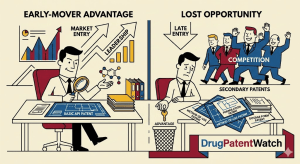
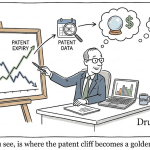
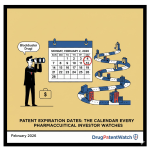
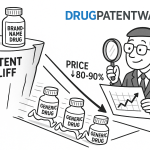
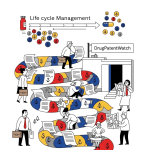
The pharmaceutical industry faces a revenue contraction of $236 billion through 2030 as blockbuster patents expire.1 For active pharmaceutical ingredient (API) suppliers, this period represents a massive opportunity that is frequently squandered. Most suppliers focus on the primary composition of matter patent, assuming that its expiration provides a clear path to market. This molecule-centric view is obsolete.1 Modern lifecycle management (LCM) uses secondary patents to build a “patent fortress” that persists for years after the original chemical entity (NCE) patent dies.1
API suppliers that ignore these secondary layers—polymorphs, formulations, and methods of use—face two primary risks. First, they may develop a synthesis route that inadvertently infringes a secondary patent, leading to massive legal liability or the sudden disqualification of their product by generic manufacturers. Second, they may miss the “second wave” of generic filers who prioritize stability and non-infringement over the 180-day exclusivity race.4 Understanding the secondary patent landscape is not a legal formality; it is the central determinant of commercial viability.3
The Molecule-Centric Fallacy
A primary patent protects the core active pharmaceutical ingredient (API) of a new drug.5 These are the most robustly drafted and heavily defended assets in a pharmaceutical company’s portfolio.6 Because they cover the molecule itself, they are easy for API suppliers to identify. However, relying on the NCE expiration date to time market entry is a strategic error.1
Secondary patents are filed on subsequent modifications to the drug, such as new salt forms, different dosage strengths, or specific crystalline structures.5 These patents are often filed and issued much later in the product’s life, sometimes even after the drug is approved.7 Professor Robin Feldman found that a majority of drugs on the market are protected by these follow-on filings rather than new innovations.5
The pharmaceutical sector uses these patents to extend the period of exclusivity, generating concerns among policymakers who view them as “evergreening” strategies.5 From a business perspective, evergreening is a rational response to declining R&D productivity. It is often more profitable to protect an existing asset than to find a new one.2
Architecting the Patent Fortress
The “patent thicket” is a complicated, overlapping system of patents on one drug.10 Brand manufacturers construct these walls by obtaining patents for the drug’s composition, manufacturing processes, formulations, and indications.10 For an API supplier, this means the end of the molecule patent is just the beginning of the legal maze.
The IP Onion Framework
Experts suggest framing an IP portfolio as an “IP Onion” with multiple layers of protection.2 Each layer provides a different type of barrier for generic entry.
Layer
Type of Protection
Impact on Generic Entry
Layer 1
Core Composition of Matter (NCE)
Foundational protection; expires first
Layer 2
Formulations, Salts, and Polymorphs
Protects the physical state of the API
Layer 3
Methods of Use and Treatment
Protects specific medical indications
Layer 4
Manufacturing Processes and Intermediates
Protects the “how” of API synthesis
API suppliers often get stuck at Layer 1. When a generic manufacturer chooses a supplier, they look for a partner who has already cleared the other three layers. If a supplier’s synthesis route infringes a process patent (Layer 4) or produces a patented polymorph (Layer 2), that supplier is a liability, not an asset.3
Secondary Patent Types and Life Extensions
Secondary patents provide substantial additional patent life, at least nominally.7 For API suppliers, the timing of these filings is critical. If a polymorph patent is filed before the prior art date of the compound patent, it adds little value. But if it is delayed to maximize effective patent term, it can push generic entry back by years.12
Patent Category
Average Life Extension (Years)
Key Characteristics
Formulation
6.5
Protects excipients, coatings, and release mechanisms
Method of Use
7.4
Protects specific indications or dosing regimens
Polymorph/Salt
6.3
Protects crystalline structures and salt forms
Delivery Device
7.5
Protects injector pens or inhalers
The Crystalline Battleground
Polymorph patents are intensely strategic because they are often listed in the FDA’s Orange Book.1 This regulatory action forces generic applicants to either challenge the polymorph patent through a Paragraph IV certification—triggering a 30-month stay—or find a non-infringing, bioequivalent alternative.1
Polymorph Strategy and Risk
Small molecule APIs can exist in different crystalline forms (polymorphs) that affect solubility, stability, and bioavailability.1 Brand manufacturers typically conduct an early polymorph screen and patent the form with the best formulation characteristics.12
For the API supplier, polymorphism control is a primary manufacturing challenge. If the API spontaneously recrystallizes into the brand’s patented form during the drug’s shelf-life, the product is infringing.4 Suppliers must use Quality by Design (QbD) frameworks to ensure that critical material attributes like particle size and crystalline form are consistent and non-infringing.4
Technical Characterization of Polymorphs
Claiming a polymorph in a patent involves detailed technical work. Patent applications typically use multiple methods to identify the crystalline state:
X-ray Powder Diffraction (XRPD) peak listings and spectra.1
Differential Scanning Calorimetry (DSC) to determine melting points.1
Fourier-Transform Infrared (FTIR) or Raman spectroscopy to identify the chemical “fingerprint” of the solid state.1
API suppliers must use these same tools to perform Freedom to Operate (FTO) analysis. If their synthesis route leads to an amorphous form or a different polymorph, they must provide data proving it is bioequivalent to the Reference Listed Drug (RLD) without infringing the brand’s patent.4
Formulation and Delivery Device Moats
While the polymorph defines the crystal structure of the API, formulation patents protect the specific composition of the final dosage form.1 These include excipient ratios, specific coatings, and delivery systems like sustained-release technology.1
The Drug-Device Combination
For biologics and some small molecules, the delivery device is the most potent barrier. In a study of 331 drug-device combinations approved by the FDA from 1986 to 2023, more than half of the patent listings were on the delivery devices.14 These device patents extended protection for over 50% of the products by a median of 7.5 years.14
Product Example
Primary Device Component
Impact of Device Patent
Advair Diskus
Inhaler mechanism
Extends control beyond individual drug patents
Humalog KwikPen
Injection mechanism
Multiple patents on the mechanical assembly
Epipen
Auto-injector mechanism
Delayed generic entry due to device complexity
API suppliers must understand these devices because the physical properties of the API—such as flowability and particle size—directly influence how it performs in a device.3 A supplier that provides an API incompatible with a non-infringing delivery device design loses their competitive edge.
Methods of Use and the Skinny Label Tightrope
Method-of-use patents do not claim the drug itself but a specific way to use the drug to achieve a therapeutic outcome.13 This is a powerful evergreening tool because it allows companies to obtain new patents on a drug that is already on the market.13
Indication Expansion and Repurposing
Innovator companies often discover new medical uses for known molecules.9 For example, a drug originally approved for hypertension might be found effective for heart failure. The brand manufacturer will then file a new patent for the second indication, extending the period of exclusivity for that specific use.1
The Section viii Carve-Out
Generic manufacturers can sometimes bypass these patents using a “skinny label.” Under Section viii of the Hatch-Waxman regulations, a generic manufacturer can carve a specific patented indication out of its label, seeking approval only for the uses that are no longer protected.6
However, this strategy is risky. If the generic manufacturer’s marketing or instructions are found to “induce” doctors or patients to use the drug for the patented indication, they can be held liable for infringement.15 API suppliers are indirectly affected here; if their customer is sued for induced infringement, the supply contract is at risk.
The Mechanics of Paragraph IV Litigation
The Hatch-Waxman Act re-engineered pharmaceutical patent disputes by creating an “artificial” act of infringement: the filing of a Paragraph IV (PIV) certification.4
The 180-Day Prize
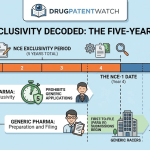
The first company or group of companies to file an ANDA with a PIV certification is eligible for 180 days of market exclusivity.6 This is the “treasure” generic manufacturers seek.15 During this period, the generic can capture 60% to 80% of the product’s total lifetime profit.3
The API Sourcing Dependency
A generic company cannot file a PIV certification without a qualified API source and a comprehensive Drug Master File (DMF) from the supplier.3 The race to be “first-to-file” is, in essence, a race to secure an API source early. Suppliers that are late to qualify their material or those whose synthesis routes are not clearly non-infringing disqualify their customers from the 180-day window.3
The 30-Month Stay: A Structural Delay
If the brand manufacturer files suit within 45 days of receiving a PIV notice, the FDA is prohibited from authorizing generic entry for 30 months.4 This stay gives the brand time to litigate without a generic product flooding the market.6
For API suppliers, the 30-month stay is a logistical challenge. They must ensure their material remains compliant and available throughout a multi-year litigation period where the launch date is uncertain.3
API Supplier Liability and Legal Risks
Most API suppliers believe they are protected from litigation because they are not the ANDA applicant. This is incorrect. Suppliers can be held liable for infringement through several mechanisms.
Contributory and Induced Infringement
Contributory infringement arises when a party supplies a component that has no substantial non-infringing use, knowing it is for a patented invention.20 If an API supplier provides a specialized salt or polymorph that is only used for a patented drug, they are liable.
Induced infringement involves actively encouraging another party to infringe.20 If an API supplier provides instructions or technical support that directs a generic manufacturer to use the API in a way that violates a method-of-use patent, they are inducing infringement.16
Case Study: Lundbeck v. Idealfarma
In Brazil, the Sao Paulo State Court of Appeals established that suppliers of APIs for compounding pharmacies are liable for patent infringement when selling wholesale.22 The court found that only compounding pharmacies, not their suppliers, were exempt from infringement under certain statutes. This decision establishes a precedent for supplier liability in the pharmaceutical supply chain.22
Case Study: Shire v. Amneal
The Federal Circuit recently addressed whether API suppliers are protected by the “safe harbor” provision of 35 U.S.C. § 271(e)(1). In Shire v. Amneal, the court held that API supplier Johnson Matthey did not induce infringement by providing material to ANDA applicants for use in obtaining FDA approval.17 While this provides some protection during the R&D phase, that protection vanishes once the product enters commercial marketing.
The Financial Risks of At-Risk Launches
Launching “at-risk” means entering the market after FDA approval but before a final court ruling on patent validity.23 This is a perilous financial gamble.
Catastrophic Damages
If the generic firm loses the litigation, it is liable for massive damages. These damages typically include the “lost profits” of the brand-name incumbent, which are much higher than the profits earned by the generic manufacturer.23 If the infringement is found to be “willful,” the damages can be tripled.4
The Protonix Precedent
Generic manufacturers Teva and Sun Pharma launched versions of Pfizer’s heartburn medication Protonix before its patent expired. They eventually agreed to pay $2.15 billion to settle the dispute.24 This settlement shows the extreme financial exposure of at-risk launches for both the generic company and its API supplier, who may be required to provide indemnification.4
Serial Litigation and the Patent Thicket
Brand-name firms increasingly use “serial litigation” to delay competition. This involve filing successive patent infringement lawsuits based on non-innovative “continuation” or “child” patents.25
Case Study: Mirabegron (Astellas)
Astellas’s overactive bladder drug mirabegron has been the subject of five successive rounds of lawsuits since 2016.25
Litigation 1 (2016): Settled with a generic entry date of 2024.
Litigation 2 (2020): Astellas sued again using a new patent.
Litigation 3 (2023): Another lawsuit based on another patent.
Litigation 4 & 5 (2024): Filed after the final two firms launched “at-risk.”
The original settlement date was May 2024. Due to serial litigation, the expiration of the last patent is now projected for March 2030, a delay of nearly six years.25
Case Study: Tasimelteon (Hetlioz)
Vanda has pursued three lawsuits over a period of nearly eight years.25 Although generics won the first litigation in 2022, serial litigation has pushed the potential expiration of the last patent to August 2035—a total delay of over 12 years.25
Strategic Calibration for API Suppliers
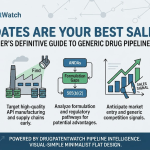
To win in this environment, API suppliers must transition from transactional component vendors into primary drivers of generic business strategy.4
Targeting the Second Wave
While the first-to-file (FTF) captures the headlines, the “second wave” of filers represents a broader and potentially more lucrative volume opportunity.4 The FTF exclusivity period is high-margin but short-lived. The post-exclusivity market is where the majority of prescriptions are filled.4
By offering pilot batches to second-wave filers early, an API manufacturer ensures these firms are “tentatively approved” and ready to launch the moment the exclusivity window opens or if the first-filer forfeits its exclusivity.4
The Pilot Batch Playbook
API suppliers should calibrate their manufacturing with PIV milestones. For an API manufacturer, the ability to deliver pilot batches—typically ranging from 30 kg to 250 kg—immediately after a PIV filing is a transformative strategy.4
Step 1: Pre-Emptive Route Scouting. Identify blockbuster targets years before the patent cliff and develop synthesis routes that bypass patent thickets.3
Step 2: Predictive Monitoring. Use tools like DrugPatentWatch to monitor “soft” signals of generic intent, such as requests for reference product samples and DMF activations.4
Step 3: Immediate Outreach. Offer pilot batches to all interested generic firms immediately after the first PIV notification is disclosed.4
Step 4: Legal and Regulatory Support. Provide comprehensive indemnification and detailed audit trails to support a non-infringement defense.4
Technical Triage and Reverse Engineering
Generic manufacturers use patent intelligence platforms like DrugPatentWatch to select candidates.28 Once a candidate is chosen, the focus shifts to reverse engineering the RLD to gain a comprehensive understanding of its composition.13
Analytical Techniques for API Characterization
API suppliers must use the same advanced analytical techniques to ensure their material matches the RLD’s physical properties without infringing its patents:
FTIR Spectroscopy: Provides a chemical “fingerprint” of the formulation.13
GC/MS: Analyzes volatile components and identifying solvents.13
HPLC/MS: Separates complex molecules and identifying minor but critical additives.13
Solid-State Characterization: Essential for identifying and quantifying the API’s polymorphism.28
Bypassing Synthesis Patents
Brand manufacturers often have “secondary patents” on specific manufacturing processes or reagents.3 Generic manufacturers must select API suppliers whose synthesis routes are demonstrably non-infringing. For example, the synthesis of the anticoagulant apixaban (Eliquis) is technically demanding, involving more than 10 steps starting from complex precursors.4
$$-4-\text{iodo}-6-\text{oxabicyclo}[3.2.1]\text{ precursors for Apixaban}$$
A supplier that can perform this synthesis using biocatalysis or “one-pot” reactions can bypass patented isolation steps for intermediates, providing a safer legal path for their customers.4
The Global Jurisdictional Landscape
The legal environment for secondary patents varies significantly by country. API suppliers must adapt their strategies accordingly.
The Permissive U.S. Environment
The United States is generally considered the most permissive environment for evergreening.1 The Hatch-Waxman framework and the 30-month stay provide significant leverage to brand manufacturers. However, recent court decisions in the U.S. may make secondary patents more difficult to obtain.7
The Evolving EU Landscape
In Europe, filing polymorph patents should proceed only in situations where there are potential unexpected properties.12 The EU also increasingly utilizes competition law to regulate evergreening practices.1 The Unified Patent Court (UPC) has been effective in resolving cases within a year, often granting permanent injunctions where a patent is found valid and infringed.29
India’s Section 3(d) Hurdle
India uses strict patentability criteria to curb evergreening. Section 3(d) of the Patent Act requires that claimed improvements to known substances demonstrate significantly enhanced efficacy.1 This makes India a major hub for generic production, though it also creates a complex intellectual property barrier for firms trying to export to more permissive jurisdictions.
The ROI of Lifecycle Extension Audits
Regulatory and legal service firms are delivering lifecycle extension (LCE) audits to biopharmaceutical companies to prepare for the 2025-2030 patent cliff.1 For a brand manufacturer, an LCE audit is a high-yield insurance policy that protects their R&D investment.
Quantifiable ROI Examples
Advanced analytics and strategic reformulations can yield massive returns.
Transitioning a 30-minute IV infusion to a 2-minute subcutaneous injection can preserve $1 billion to $2 billion in annual revenue.2
Utilizing the 505(b)(2) regulatory pathway can offer a 50% to 70% reduction in development costs by relying on existing safety data.2
Advanced analytics can boost pharmaceutical EBITDA by 15% to 30% within five years.2
For the API supplier, understanding these LCE strategies allows them to anticipate brand moves. If a brand is planning a “product hop” to a new formulation, the supplier must be ready to provide the specific grade of API required for that new dosage form.1
The Impact of the Inflation Reduction Act (IRA)
The IRA of 2022 is a new variable in drug lifecycle management. It allows the government to set prices for high-expenditure drugs after 9 years for small molecules and 13 years for biologics.1
This “pill penalty” is shifting R&D investment. Because small molecules face earlier price negotiations, their effective patent-protected lifecycle is truncated.1 For API suppliers, this means the window for capturing high-margin sales is shrinking. They must prioritize efficiency and volume to maintain profitability in a landscape where traditional patent protection is less certain.
Key Takeaways
Reliance on the NCE Patent is Obsolete. Secondary patents add an average of 6 to 7.5 years to a drug’s life. API suppliers must map formulation, polymorph, and method-of-use patents to identify the true market entry date.1
Supplier Liability is Real. API suppliers can be held liable for contributory or induced infringement if their material is used to violate secondary patents. FTO analysis must cover the entire synthesis route and the final drug’s physical properties.20
The Second Wave is a Strategic Prize. Targeting the second wave of generic filers with early pilot batches and robust DMFs allows suppliers to diversify risk and capture high-volume contracts.4
At-Risk Launches Require Indemnification. The financial risk of a loss in PIV litigation includes the brand’s premium-priced lost profits. API suppliers must provide technical and legal support to mitigate this catastrophic exposure.4
Use Data to Navigate Thickets. Platforms like DrugPatentWatch provide the intelligence needed to track Orange Book listings, litigation trends, and competitor pipelines, transforming complex data into a competitive advantage.3
FAQ
What is a secondary pharmaceutical patent? A secondary patent protects modifications to an existing drug, such as different dosage forms, formulations, production methods, specific crystalline structures (polymorphs), or new medical uses for known molecules.8
How do secondary patents impact the cost of healthcare? By delaying generic competition, secondary patents allow brand manufacturers to maintain high prices for longer periods. The cumulative impact for just three blockbuster drugs—Humira, Eliquis, and Enbrel—is estimated at $167 billion in excess costs to the healthcare system.31
Can an API supplier be sued for patent infringement? Yes. Under the concepts of contributory and induced infringement, a supplier can be liable if they provide an API that has no substantial non-infringing use or if they provide instructions that lead a customer to violate a patent.16
What is the 30-month stay in pharmaceutical litigation? Under the Hatch-Waxman Act, if a brand manufacturer sues a generic applicant within 45 days of a Paragraph IV notice, the FDA cannot approve the generic drug for 30 months, or until the court resolves the dispute. This delay preserves the brand’s monopoly regardless of the legal outcome.4
How should API suppliers manage the risk of polymorphism? Suppliers must conduct extensive polymorph screens and use techniques like XRPD and DSC to ensure their API does not infringe the form listed in the Orange Book. They must also provide stability data to prove their non-infringing form does not convert to the patented form over time.4