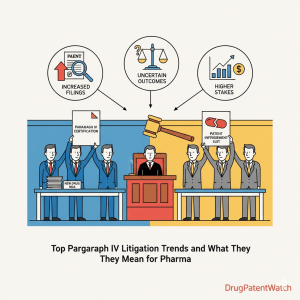
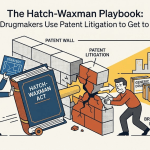
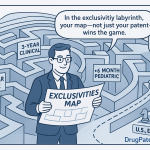
Every major drug facing generic competition is a battlefield. The weapon of choice is not chemistry or clinical data—it is Paragraph IV of the Hatch-Waxman Act, a single certification buried inside an abbreviated new drug application that can trigger years of litigation, billions of dollars in legal costs, and corporate strategies designed to delay competitors by half a decade or more.
Paragraph IV litigation has produced some of the most consequential—and least understood—corporate maneuvering in modern American business. AbbVie used it to extract an extra seven years of monopoly from Humira, worth over $100 billion in U.S. sales. Generic companies have used it to win 180-day exclusivity periods worth hundreds of millions of dollars in windfall profits. Settlements born from it now routinely contain clauses structured specifically to evade the antitrust scrutiny those settlements attracted in the first place.
If you are an IP strategist, a pharmaceutical executive, a portfolio manager with drug-sector exposure, or a healthcare policy analyst, Paragraph IV litigation is not an obscure legal backwater. It is the mechanism that determines when medicines become affordable. Understanding its current trends—who is filing, who is winning, how the rules are changing, and what regulators plan to do next—is the difference between getting caught flat-footed and having genuine strategic foresight.
What Paragraph IV Actually Is
The Hatch-Waxman Bargain
The Drug Price Competition and Patent Term Restoration Act of 1984, universally known as the Hatch-Waxman Act, created the legal architecture that governs every small-molecule generic drug in the United States. The law was a deliberate trade. Generic manufacturers got a streamlined pathway to drug approval—the Abbreviated New Drug Application (ANDA)—that allowed them to rely on a brand drug’s safety and efficacy data rather than repeating expensive clinical trials. Brand manufacturers got patent term extensions, data exclusivity periods, and a formal mechanism to challenge generic applications before any infringing product reached patients.
The ANDA requires a patent certification for each patent listed in the FDA’s Orange Book—the official compendium of approved drugs and their associated patents. An applicant has four choices. A Paragraph I certification says no patents are listed. A Paragraph II certification says all listed patents have expired. A Paragraph III certification says the applicant will wait until the patents expire before launching. None of these three triggers litigation.
Paragraph IV is different. It is a certification that the listed patents are invalid, unenforceable, or will not be infringed by the proposed generic product. Filing it is, by statutory design, an artificial act of patent infringement—before a single generic pill has been sold. It hands the brand manufacturer the right to sue immediately.
The 30-Month Stay as a Structural Feature
Once a brand company receives a Paragraph IV notice letter, it has 45 days to file suit. If it does, it automatically receives a 30-month stay of FDA approval of the ANDA. The clock starts from the later of the two dates on which the patent owner and the NDA holder received the notice letter. The stay gives the brand and generic time to litigate their dispute without a generic product flooding the market while the case is pending.
That 30-month stay is not a trivial administrative formality. It is a structural feature of the litigation that brand companies treat as a strategic asset. Filing suit within the 45-day window is almost reflexive for major brand manufacturers, because the alternative—allowing the FDA to approve a generic without litigation—is commercially unthinkable for any drug generating more than a few hundred million dollars in annual sales. The stay effectively creates a floor of 30 months of continued exclusivity for the brand, regardless of the underlying legal merits.
The notice letter itself is a legally significant document. It must contain the factual and legal bases for the applicant’s invalidity and non-infringement positions. If the applicant makes non-infringement assertions, it must also include an Offer of Confidential Access, allowing the brand to examine the ANDA before deciding which patents to assert. Generic companies invest substantial resources in crafting these letters because the arguments made—while not legally binding in subsequent litigation—set the stage for discovery and trial strategy.
The Numbers: How Much Litigation Is There?
Scale and Scope of ANDA Filings
The volume of Paragraph IV activity is enormous by any reasonable measure. The FDA publishes biweekly lists of ANDA applications containing Paragraph IV certifications, and the pace of filings has remained robust across the past decade. While ANDA cases represent roughly one-tenth of all patent litigation filed in the U.S. federal courts, they punch far above their weight in economic terms. A single successful Paragraph IV challenge to a blockbuster drug can shift billions of dollars from a brand manufacturer to consumers and generic competitors.
Lex Machina’s patent litigation reports consistently show ANDA cases as a distinct and economically disproportionate category. Between 2013 and 2022, thousands of ANDA cases were filed in U.S. district courts, with case volumes showing sensitivity to two major variables: the volume of brand drug approvals in prior years and the concentration of high-value drugs approaching their primary patent cliffs. Drugs with annual U.S. sales above $500 million face Paragraph IV challenges with near-certain regularity.
Between fiscal years 2018 and 2021—the period covered by the FTC’s most recently published MMA reports released in January 2025—the Commission tracked hundreds of pharmaceutical patent settlement agreements per year. The volume of final settlements ranged broadly but consistently exceeded 100 per fiscal year, covering dozens of distinct pharmaceutical products.
Where Cases Get Filed
The geography of Paragraph IV litigation has shifted considerably over the past decade, with meaningful strategic implications. Historically, the District of New Jersey—home to major brand pharmaceutical companies and a court system well-versed in pharmaceutical patent law—handled the bulk of cases. The District of Delaware has also been a dominant venue given its established pharmaceutical patent docket and experienced judges.
The rise of the Western District of Texas as a preferred venue for patent litigation generally rippled into ANDA cases as well, until a July 2022 standing order by Judge Albright curtailed random assignment of cases to his docket. After that order, case filings in the Western District of Texas dropped significantly, and the redistribution of volume back to traditional pharmaceutical venues became apparent in 2022 and 2023 filing data.
The choice of venue matters for reasons beyond mere administrative convenience. Different courts have different track records on claim construction, different tendencies on summary judgment, and different judges with varying degrees of familiarity with pharmaceutical patents. Brand companies and generic challengers both study venue statistics—platforms like DrugPatentWatch allow subscribers to examine litigation histories, judge-by-judge outcomes, and settlement patterns by district—because the court where you fight can be as determinative as the legal arguments you make.
What Generic Companies Are Actually Challenging
The Patent Anatomy of a Blockbuster
A brand manufacturer does not list one patent in the Orange Book—it lists as many as it can legitimately claim. A modern blockbuster drug routinely has its active ingredient patent, formulation patents covering specific dosage forms, method of use patents covering each approved indication, and process patents covering how the molecule is manufactured. Taken together, these patents can create a coverage landscape that extends well past the expiration of the original compound patent.
Paragraph IV challengers have become sophisticated about which patents to challenge and how. The most valuable challenges target active ingredient patents because invalidating one wipes out the foundational protection. But active ingredient patents are also the most robustly drafted and the most heavily defended. Generic companies often achieve their commercial goals by challenging formulation patents—and winning a determination of non-infringement rather than invalidity—because non-infringement of a secondary patent can unlock market entry without touching the compound patent at all.
Method of treatment patents occupy their own strategic category. Under Section viii of the Hatch-Waxman regulations, a generic manufacturer can carve a specific approved indication out of its label, thereby avoiding a method-of-use patent covering only that indication, without filing a Paragraph IV certification for that patent at all. These “skinny label” approaches have generated their own litigation wave as brand manufacturers argue that a generic manufacturer’s marketing activities constitute induced infringement of method patents even when the label itself excludes the patented use.
The Federal Circuit’s treatment of skinny labels has been evolving and contested. Cases like GlaxoSmithKline v. Teva have raised genuine uncertainty about the scope of marketing communications that can give rise to induced infringement liability, and practitioners now counsel generic companies to scrutinize their promotional materials with the same care previously reserved for the label text itself.
Secondary Patents and Evergreening
The term “evergreening” describes a practice as old as Hatch-Waxman itself: filing new patents on secondary characteristics of a drug—new formulations, new salt forms, new dosing regimens, new delivery mechanisms—before the primary patents expire, and listing those patents in the Orange Book to extend the litigation landscape available against generic challengers.
The number of patents per drug product has roughly tripled over the past two decades. One study examining 21 biologic drug patent litigations found nine to twelve times more patents asserted against biosimilars in the United States than against the same biosimilars in Canada or the United Kingdom. For small molecule drugs, the same basic dynamic applies, though at a less extreme ratio.
Regulators have taken notice. In September 2023, the FTC issued a policy statement warning pharmaceutical companies that improper Orange Book listings—patents that do not legitimately claim the drug substance, drug product, or a method of use for the approved indication—could constitute an antitrust violation. The FTC sent letters directly to brand manufacturers flagging specific patents it viewed as potentially improper listings. Private plaintiffs followed quickly: in June 2024, a federal court in New Jersey allowed antitrust claims to proceed against a brand manufacturer over disputed Orange Book listings, and multiple members of Congress have signaled continued interest in the issue.
The 180-Day Exclusivity Game
First-Filer Advantage
The 180-day generic exclusivity period is the carrot that drives Paragraph IV challenges against the most valuable drugs. The first company—or group of companies filing on the same day—to file an ANDA with a Paragraph IV certification against a given patent is eligible for 180 days of exclusivity before any other generic can enter the market with FDA approval. During those 180 days, the first-filer faces no generic competition and can price its product at a significant premium to what generic prices look like once multiple manufacturers enter.
For a drug with $2 billion in annual U.S. sales, a conservative estimate of generic market share during the 180-day exclusivity period might yield $200 to $400 million in revenue for the first-filer, against legal costs that rarely exceed $20 to $30 million even in protracted trials. The expected value calculation—probability of success times potential reward, minus litigation costs—is strongly positive for most high-revenue drugs with challengeable patents, which is precisely why the pipeline of Paragraph IV challenges never runs dry.
The race to be first is intensely competitive. Generic companies maintain sophisticated surveillance programs—monitoring Orange Book patent listings, brand drug revenue data, and competitive intelligence from sources like DrugPatentWatch—specifically to identify high-value drugs that may be vulnerable to Paragraph IV challenge and ensure they file before any competitor.
The Authorized Generic Countermove
Brand manufacturers developed a direct tactical response to first-filer exclusivity: the authorized generic, or AG. When a first-filer is set to launch during its 180-day exclusivity window, the brand can authorize a third party—or launch through its own generic subsidiary—to sell an identical product under the brand’s own NDA. The authorized generic is not subject to the first-filer’s exclusivity because it does not rely on an ANDA. It is simply the brand drug marketed in different packaging at a lower price.
The effect of authorized generic competition on first-filer revenues is substantial. Studies have shown that first-filers facing authorized generic competition earn significantly less during their exclusivity period than those who face no such competition. Pfizer’s defense of Lipitor is the most studied example: when atorvastatin lost exclusivity in late 2011, Pfizer launched its own authorized generic simultaneously with Ranbaxy’s first-filer product, compressing the value of Ranbaxy’s exclusivity period considerably.
In settlement negotiations, a brand company’s commitment not to launch an authorized generic—a “no-AG clause”—has become recognized as a form of value transfer to the generic company. Courts in multiple circuits have held that no-AG provisions can constitute unlawful reverse payments under FTC v. Actavis. Brand companies therefore structure their settlements with considerable care to either include an authorized generic right explicitly, or to ensure that any no-AG commitment is carefully balanced against other settlement terms that might draw antitrust scrutiny.
Settlement Dynamics: Where Most Cases Actually End
The Settlement-Heavy Landscape
Paragraph IV litigation resolves through settlement far more often than through trial. Academic analysis of Paragraph IV settlements between 2003 and 2020 found that the number of patents being litigated and the years of remaining market exclusivity are the strongest predictors of settlement. Drugs with many patents and substantial remaining exclusivity are most likely to settle because the cost and uncertainty of litigating every patent to judgment becomes prohibitive for both sides.
The brand company’s leverage in settlement negotiations is considerable. It has the 30-month stay working in its favor, often has more patents than the generic challenger can realistically contest in a single proceeding, and can use the threat of serial waves of patent litigation—adding newly issued patents to the dispute as litigation proceeds—to increase the cost and uncertainty for the generic. Generic companies, for their part, hold the 180-day exclusivity as a negotiating chip and the threat of a successful invalidity verdict as a credible deterrent. <blockquote> “The FTC estimates that pay-for-delay patent settlements cost consumers and taxpayers $3.5 billion in higher drug costs every year.” — Federal Trade Commission Staff Study, 2010 </blockquote>
The typical settlement grants the generic company a licensed market entry date that is earlier than the last-expiring asserted patent but later than the generic would have entered had it won at trial. From the brand’s perspective, the settlement buys time—often several years of additional exclusivity—without the risk of a judgment invalidating core patents. From the generic’s perspective, it provides certainty: a guaranteed entry date, elimination of litigation risk, and sometimes the elimination of authorized generic competition for a defined period.
Reverse Payments and the Actavis Regime
Before 2013, a brand company could pay a generic challenger cash—sometimes hundreds of millions of dollars—in exchange for the generic’s agreement to delay market entry and abandon its patent challenge. These “reverse payment” or “pay-for-delay” settlements were controversial but not clearly illegal under prevailing circuit court doctrine.
The Supreme Court changed that in 2013 with FTC v. Actavis, Inc. The Court held that reverse payment settlements are not immune from antitrust scrutiny merely because the payment falls within the scope of the patent’s exclusionary potential. Instead, courts must apply traditional rule-of-reason antitrust analysis. The decision did not make reverse payments per se illegal, but it made them substantially riskier to execute and created a clear legal mechanism for the FTC and private plaintiffs to challenge them.
The impact on settlement structure was immediate and measurable. Explicit cash reverse payments dropped sharply after Actavis. In FY 2016, of 232 final patent settlements received by the FTC, only one contained a no-AG commitment or side deal—the lowest level recorded. The pharmaceutical industry had absorbed the lesson and restructured its settlements.
But “restructured” is not the same as “cleaned up.” The FTC’s January 2025 reports covering fiscal years 2018 through 2021 document a significant emerging trend: “quantity restrictions” as a form of possible compensation. Under these arrangements, a settling generic agrees to limit the volume of product it sells during a defined period, rather than accepting a flat market exclusivity delay. The practical effect can be similar to a traditional delay—if the quantity permitted is small enough, the generic has little incentive to compete aggressively on price—but the structure avoids the explicit quid-pro-quo that characterized pre-Actavis settlements.
The FTC under both the Biden and subsequent administrations has signaled continued aggressive monitoring of settlement terms. Private class action plaintiffs, emboldened by the Actavis framework, have brought claims against settlements involving no-AG provisions, exclusive licenses, and supply arrangements that effectively allocate markets between brand and generic manufacturers.
The Biologics Complication: BPCIA vs. Hatch-Waxman
A Structurally Different Framework
Paragraph IV litigation is a Hatch-Waxman construct that applies to small-molecule drugs. The 2010 Biologics Price Competition and Innovation Act (BPCIA) created a separate pathway for biosimilar drugs—the 351(k) application—with its own patent resolution mechanism. The two frameworks differ in ways that matter enormously for litigation strategy.
Under Hatch-Waxman, the patent list is defined by the Orange Book, which limits what brand manufacturers can assert. Under the BPCIA, the “patent dance” is a statutory exchange of information between the brand and biosimilar applicant, through which both parties identify which patents will be litigated. Critically, the BPCIA places no cap on the total number of patents a brand company can assert against a single biosimilar challenger. This is not a minor procedural distinction—it is the structural feature that enabled AbbVie to assert over 60 patents against individual Humira biosimilar challengers, a scale of litigation that would be procedurally constrained under Hatch-Waxman.
The BPCIA also has no automatic stay equivalent to Hatch-Waxman’s 30-month provision. A biosimilar applicant must provide 180 days of notice before commercial launch, and the brand can seek a preliminary injunction during that period. But there is no automatic stoppage of FDA approval, which creates a different risk calculus for both parties.
Humira: The Ultimate Patent Thicket
The Humira case has become the defining illustration of how patent portfolios function as competitive weapons in the biologics space. AbbVie’s original compound patent on adalimumab expired in 2016. By that time, AbbVie had assembled approximately 136 additional patents covering formulations, manufacturing processes, dosing regimens, and antibody characteristics. Some of these patents extend to 2034.
The biosimilar manufacturers who sought to challenge that portfolio faced a stark choice: litigate every patent in sequence, potentially spending years and tens of millions of dollars on each wave of litigation, or settle. One by one, they settled. Eight major biosimilar manufacturers entered settlement agreements granting them licensed U.S. market entry in 2023—five years after European biosimilars of Humira had already launched in 2018, and eleven years before AbbVie’s last-expiring patent. AbbVie secured royalty payments from each settling manufacturer, ensuring continued revenue from Humira even after competition arrived.
AbbVie accumulated approximately 136 patents that far extended its exclusivity period beyond its 2004 approval date. Boehringer Ingelheim was the sole biosimilar manufacturer that chose to litigate rather than immediately settle, and the resulting case produced detailed allegations about AbbVie’s patent prosecution practices—including claims that the company pursued patents on processes already in use without disclosing that prior art to the USPTO, and filed formulation patents that did not reflect the actual Humira formulation. Boehringer ultimately settled as well, agreeing to a July 1, 2023, launch date.
The antitrust implications of AbbVie’s strategy generated major litigation of their own. A class action brought by welfare benefit plan purchasers of Humira argued the patent thicket and associated settlements constituted antitrust violations under the Sherman Act. The Seventh Circuit dismissed those claims, finding that accumulating patents is not itself an antitrust violation and that AbbVie’s settlements—which allowed biosimilar entry before the last-expiring patents—were not unlawful reverse payments under the Actavis standard because no payment flowed from AbbVie to the biosimilar manufacturers.
The legal outcome does not resolve the policy controversy. The five-year gap between European and U.S. biosimilar entry for Humira cost American patients and payers enormous sums by any reasonable estimate. The structural differences between the U.S. and European patent frameworks—not fraud or unlawful conduct—produced that gap. That is precisely what regulators and legislators are now trying to change.
Key Legal Doctrines Shaping Outcomes
Obviousness After KSR
The Supreme Court’s 2007 decision in KSR International v. Teleflex changed how courts analyze obviousness for all patents, but its effects in pharmaceutical patent litigation have been particularly significant. KSR rejected the rigid teaching-suggestion-motivation test that had made it difficult to invalidate patents on obviousness grounds, instead embracing a more flexible, common-sense inquiry into whether a skilled person in the relevant field would have been motivated to combine prior art references to reach the claimed invention.
Generic challengers have used KSR arguments with considerable success against formulation patents, method of treatment patents, and secondary patents. A patent claiming a specific polymorphic form of a known drug compound, or a specific dosing regimen, or a particular salt form, often faces substantial obviousness vulnerability when a skilled medicinal chemist would have had obvious reasons to try the same combinations. Brand companies have responded by building more robust prosecution histories and by structuring their patent claims to capture specific technical advantages—improved stability, enhanced bioavailability, reduced side effects—that go beyond mere routine optimization.
Written Description and Enablement Post-Amgen
The Supreme Court’s 2023 decision in Amgen Inc. v. Sanofi significantly tightened the enablement standard for functional genus claims in the pharmaceutical context. The Court held that a patent must enable a skilled practitioner to make and use the full scope of the claimed invention without undue experimentation. For broad antibody claims covering any antibody that binds a particular target and achieves a particular function, the Court found that Amgen’s patent claims were not enabled because the specification did not provide adequate guidance for making the full scope of what was claimed.
The Federal Circuit has applied the Amgen enablement standard aggressively in subsequent decisions, extending it from composition claims to method claims as well. The practical consequence for patent prosecution and litigation is significant: broad functional genus claims that cover entire classes of molecules based on what they do—rather than specifically what they are—face heightened invalidity risk. Brand manufacturers in the biologic space are revising their prosecution strategies to provide richer structural disclosure in specifications, while generic and biosimilar challengers have added Amgen-based enablement arguments to their standard challenge playbooks.
The Skinny Label Debate
Method of treatment patents covering specific uses of a drug create a strategic option for generic manufacturers: carving the patented indication out of the product label entirely and seeking approval only for the unpatented indications. The Hatch-Waxman framework explicitly permits this through the Section viii carveout mechanism.
The viability of the skinny label strategy depends on whether a generic manufacturer’s marketing activities—beyond the label itself—give rise to induced infringement of the method patent. GSK v. Teva, litigated in the Delaware courts and through the Federal Circuit, produced a jury verdict of induced infringement against Teva despite the use of a skinny label, based on evidence that Teva’s marketing materials and sales force communications encouraged prescribers to use the drug for the patented indication. The Federal Circuit’s handling of that verdict generated uncertainty throughout the industry about how aggressive a generic company’s promotional activities can be without crossing into induced infringement territory.
The practical effect is a new layer of legal analysis that generic manufacturers must conduct before and during their marketing activities. The label itself is no longer the only document that matters—every press release, detail card, and sales training material is now potential evidence.
Orange Book Reform and the FTC’s Offensive
The FTC’s Patent Listing Campaign
The FTC’s September 2023 policy statement on Orange Book patent listings marked a meaningful escalation of regulatory attention to the front end of the Paragraph IV system. The FTC’s theory is that improper Orange Book listings—patents that do not legitimately claim the drug substance, drug product, or a method of using the drug for an approved indication—can delay generic competition by triggering automatic 30-month stays even for patents that should never have been listed in the first place.
The FTC sent dispute letters to pharmaceutical companies covering dozens of specific Orange Book-listed patents, asserting that those patents did not meet the statutory listing criteria. This campaign targeted device patents—patents on drug delivery systems like inhalers and auto-injectors—that brand manufacturers had listed in connection with combination products, a practice the FTC viewed as extending Hatch-Waxman protections to patents that the statute was not designed to cover.
Congressional interest in Orange Book reform has been bipartisan and sustained. The Congressional Research Service published a report examining whether FDA, the FTC, or courts should have expanded authority to challenge improper listings, suggesting that the current system—where the FDA takes a “ministerial” role and does not independently evaluate whether submitted patents actually meet listing criteria—creates structural opportunities for abuse.
Private litigants have moved quickly alongside the FTC. The June 2024 New Jersey decision allowing antitrust claims to proceed based on improper Orange Book listings demonstrated that plaintiffs can use the antitrust laws as a direct tool against manipulative listing practices, without waiting for FDA rulemaking or FTC enforcement action.
The USPTO’s Proposed Terminal Disclaimer Rules
In May 2024, the USPTO proposed rules that would have significantly changed how terminal disclaimers function in pharmaceutical patent portfolios. Terminal disclaimers are the mechanism by which patent applicants obtain patents on obvious variants of already-patented inventions by agreeing to limit those patents’ terms to the expiration of the original patent. Brand pharmaceutical companies use terminal disclaimers extensively to build patent portfolios where dozens or hundreds of related patents all expire at roughly the same time.
The USPTO’s proposal would have required that terminally disclaimed patents be invalidated if the patent to which they are disclaimed is found invalid. This would effectively have made terminal disclaimer-linked patents stand or fall together—a single successful invalidity challenge could potentially topple an entire family of related patents simultaneously. The FTC praised the proposal enthusiastically. The pharmaceutical industry responded with near-uniform opposition.
In December 2024, the USPTO withdrew the proposed rule, citing resource constraints—widely interpreted as a response to intense political and legal pressure. The withdrawal does not resolve the underlying policy tension. Both the legislative and regulatory interest in constraining terminal disclaimer portfolios is clear, and further action in some form is likely under future administrations or congressional sessions.
The IRA’s Shadow Over Patent Strategy
How Drug Price Negotiation Reshapes the Patent Game
The Inflation Reduction Act of 2022 introduced Medicare drug price negotiation for the first time in U.S. history. The IRA’s structure creates new incentive dynamics that reverberate directly through patent strategy and Paragraph IV litigation calculus.
Under the IRA, drugs are eligible for price negotiation after a set period following approval—9 years for small molecules and 13 years for biologics. Brand manufacturers have argued, with some merit, that this structure systematically devalues the late-stage patents—the formulation patents, the method of use patents, the secondary and tertiary claims—that form the backbone of patent thicket strategies. If Medicare negotiates prices after 9 years for small molecules, the commercial value of a secondary patent that extends exclusivity from year 10 to year 14 becomes substantially smaller than it was before the IRA.
The litigation response to this dynamic is still developing, but early patterns are visible. Some brand manufacturers have restructured their patent prosecution strategies to front-load exclusivity into the primary patent term. Generic manufacturers are recalculating which drugs are worth challenging and at what point in a drug’s lifecycle the commercial case for a Paragraph IV challenge remains compelling even accounting for IRA pricing exposure.
For generic challengers using platforms like DrugPatentWatch to model the commercial value of potential Paragraph IV challenges, the IRA requires integrating a new variable: not just the peak sales figure and generic market share assumptions, but the expected Medicare negotiated price trajectory across the exclusivity period being contested.
The Institutional Players
Who Files the Most Challenges
The Paragraph IV challenge landscape is concentrated among a relatively small group of sophisticated generic manufacturers with the legal resources, scientific capabilities, and financial staying power to engage in extended patent litigation. Teva, Mylan (now Viatris), Sun Pharmaceutical, Amneal, Lupin, Aurobindo, and Hikma have consistently appeared among the most active filers over the past decade. Indian generic manufacturers—particularly those with substantial U.S.-facing operations—have been especially aggressive Paragraph IV filers, driven by the combination of lower internal cost structures and the enormous financial rewards available from 180-day exclusivity periods.
Specialty generic companies have also become more active in challenging branded products in niche categories: specialty drugs for rare diseases, controlled substances, and complex formulations that require significant technical capability to replicate. These challenges tend to involve smaller drug markets but also fewer competing generic filers, making the commercial case for the first-filer exclusivity period more straightforward.
Brand Defender Strategies
Brand manufacturers have developed sophisticated multi-layer defense strategies that go well beyond simple patent assertion. The coordinated approach typically involves listing the maximum number of defensible patents in the Orange Book, filing continuation patents to extend prosecution timelines, preparing for litigation in parallel with any commercial response strategy, and maintaining active intelligence programs that monitor generic company ANDA filings and competitive pipeline developments.
The decision whether to sue within the 45-day window—and which patents to assert—requires careful strategic analysis. Asserting too many weak patents creates obviousness risk and can generate an adverse invalidity ruling that wipes out patent protection earlier than a more selective approach would. Asserting too few patents risks leaving the brand exposed to market entry before it is commercially prepared.
Brand companies also have to plan for the post-litigation environment. If a generic wins invalidity of a patent, the consequences are not just loss of the litigation—they create prior art that constrains future patent prosecution and can affect the brand’s ability to prosecute related continuation applications.
What Intelligence Systems Make Possible
Data as Competitive Advantage
The sophistication with which both brand and generic companies approach Paragraph IV strategy has increased dramatically with the availability of comprehensive patent and litigation data platforms. DrugPatentWatch provides subscribers with detailed intelligence on Orange Book patent listings, ANDA filing histories, litigation outcomes, settlement patterns, and the litigation track records of specific generic manufacturers.
This data infrastructure allows brand manufacturers to run proactive analyses: which of their own products are most likely to face Paragraph IV challenges based on revenue, patent strength, and competitive activity in the ANDA pipeline? Which generic filers have a history of filing early and litigating aggressively, versus filing later and settling quickly? What is the probability distribution of outcomes—trial win, settlement, at-risk launch—given the specific patent portfolio and the identity of the challengers?
Generic companies use the same intelligence offensively: which brand drugs are most commercially attractive to challenge? Which patents in a specific drug’s Orange Book listing are most vulnerable based on prior art, obviousness analysis, or patent term considerations? Has the brand manufacturer previously had patents invalidated in related litigation, creating potentially useful collateral estoppel arguments?
The analytical capability that this data infrastructure enables is not a marginal advantage—it can be determinative. A generic company that identifies a two-year window of ANDA exclusivity before a competitor files, based on proprietary analysis of ANDA pipeline data and patent expiration modeling, captures a 180-day exclusivity period that might be worth $300 million in revenue. A brand manufacturer that identifies a weak formulation patent likely to be challenged and proactively files continuation applications—or structures its commercial strategy to minimize dependence on that patent’s exclusivity—avoids being blindsided.
Cross-Border Dynamics: What Happens Outside the U.S.
International Patent Landscapes
Paragraph IV is a U.S.-specific mechanism, but the drugs at stake have global patent footprints. A brand manufacturer defending its U.S. Orange Book patents is simultaneously managing patent disputes in Europe, Canada, Japan, and other markets under entirely different legal frameworks. The patent strategies that work in the U.S.—large secondary patent portfolios, terminal disclaimer linkages, aggressive Orange Book listing—often do not translate directly to foreign markets, and the outcomes in foreign patent litigation can create leverage in U.S. negotiations.
The Humira case illustrates this clearly. European biosimilars of adalimumab launched in October 2018 following the expiration of the basic product patent under European Patent Convention rules. The European patent landscape for Humira was far thinner than the U.S. portfolio—fewer secondary patents were available, and the European Patent Office’s opposition procedures made many of them vulnerable. U.S. biosimilar manufacturers aware of European outcomes could calibrate their U.S. settlement strategies accordingly, knowing that the longer the U.S. litigation dragged on, the more pressure they faced to settle.
This international dimension creates both risk and opportunity. A brand manufacturer that loses a key patent in the European Patent Office opposition proceedings—finding that an EPO board of appeal has concluded a patent was obvious—faces awkward questions about the validity of the corresponding U.S. patent in subsequent Paragraph IV litigation. Conversely, a brand that wins a validity determination in a U.S. trial may find that precedent useful in defending corresponding patents in other markets.
Legislative Pressure and What Is Coming
Bipartisan Political Attention
The Paragraph IV system and its associated settlement dynamics have attracted bipartisan political attention in both the House and Senate. The PRESERVE Act, S. 1096, introduced in the Senate, would significantly restrict Hatch-Waxman settlements and create presumptions of anticompetitiveness for a broader range of settlement terms. The Association for Accessible Medicines has argued vigorously that such legislation would eliminate the commercial incentive for patent settlements, leaving generic manufacturers with no practical path through complex patent thickets and actually delaying patient access to affordable medicines rather than accelerating it.
The policy debate centers on a genuine tension. Patent settlements, including ones with terms that favor the brand manufacturer, have delivered enormous savings relative to the hypothetical world in which biosimilar manufacturers attempted to litigate every patent in AbbVie’s Humira portfolio to judgment. The FTC’s concern is that the same settlements can operate as market allocation agreements that suppress competition well below what patent validity and litigation outcomes would otherwise dictate.
AI, Patent Prosecution, and the Coming Generation of Challenges
Artificial intelligence is beginning to affect both drug discovery and patent prosecution in ways that will reshape Paragraph IV litigation over the next decade. The first AI-designed drug candidate entered Phase 2 clinical trials in June 2023. As AI-generated drug candidates progress through development and seek patent protection, fundamental questions arise about inventorship, enablement, and the adequacy of disclosure for inventions where the mechanistic basis for a compound’s activity may be partially or fully unknown.
On the generic side, AI tools are accelerating prior art searches, obviousness analysis, and predictive modeling of patent claim scope. A skilled Paragraph IV litigator in 2026 has access to natural language processing tools that can survey patent prosecution histories, identify inconsistent claim scope arguments, and flag potential prosecution history estoppel arguments in hours rather than weeks. The speed advantage this creates will not evenly benefit both sides—organizations that integrate AI into their patent intelligence workflows earlier will gain measurable advantages in filing timing and claim construction strategy.
The USPTO’s withdrawal of its proposed terminal disclaimer rules in December 2024 does not eliminate the regulatory risk—it defers it. The political and economic pressure to limit evergreening strategies will not disappear. Brand manufacturers building their patent strategies for the next decade must account for the genuine probability that the legal rules governing secondary patent portfolios will be more restrictive in 2030 than they are today.
District Court Litigation Mechanics: How Cases Actually Run
From Notice Letter to Trial
Most practitioners inside the industry have a theoretical understanding of Paragraph IV procedure. Fewer appreciate how the practical mechanics of litigation play out across the years between a notice letter and a final judgment. The gap between the procedural framework and the lived reality of these cases explains a great deal about why settlement is so common and why the cases that do reach trial are fought so intensely.
After a brand manufacturer files suit within the 45-day window, the case enters the standard federal civil litigation process—but with some pharmaceutical-specific complications. Claim construction, the judicial interpretation of what the patent claims actually cover, is typically the most important single event in the case. Different claim construction outcomes can swing a case from certain infringement to clear non-infringement, and parties know this. The Markman hearing—where the court constructs the claims—is typically preceded by months of claim charts, expert declarations, and extensive briefing.
The typical Hatch-Waxman case from filing to trial runs two to three years, though complex multi-patent cases with large generic challenger groups can run longer. The 30-month stay gives the parties roughly 30 months to conduct discovery and prepare for trial before the generic could theoretically receive FDA approval—a timeline that roughly tracks the natural litigation pace but creates deadline pressure that shapes settlement dynamics.
Discovery in Paragraph IV cases is unusually document-intensive because both the patent prosecution history and the generic company’s ANDA are central to the case. Brand companies seek access to the generic company’s formulation data, its bioequivalence study results, and its internal communications about how the ANDA product was developed. Generic companies seek brand company internal documents about the patent prosecution, about commercial embodiments of the patented invention, and about the brand’s own testing and formulation development. Both sides rely heavily on expert witnesses—typically practicing scientists with specific expertise in pharmaceutical formulation, pharmacokinetics, or the relevant chemistry—whose opinions on technical questions like infringement of formulation claims can be dispositive.
The Federal Circuit handles virtually all appeals from district court Paragraph IV decisions, and its case law directly defines the legal standards that district courts apply. Over the past decade, the Federal Circuit has issued hundreds of opinions in ANDA cases, creating a body of claim construction, obviousness, and enablement precedent that practitioners track meticulously. Outcomes in Federal Circuit appeals are meaningfully correlated with the specific judges assigned to a panel, which is why sophisticated litigants analyze Federal Circuit panel composition with the same rigor they apply to claim construction.
PTAB as the Second Front
Inter partes review proceedings at the Patent Trial and Appeal Board operate on a parallel timeline to district court litigation and have fundamentally changed Paragraph IV strategy over the past decade. An IPR petition challenges the validity of specific patent claims before the USPTO’s administrative patent judges, with a typical timeline of 12 to 18 months from petition to final written decision—significantly faster than district court trials.
The strategic value of IPR for generic challengers is twofold. First, the evidentiary standard for invalidity at the PTAB is preponderance of the evidence rather than the clear and convincing evidence standard that applies in district court. This lower threshold makes invalidation meaningfully more achievable at the PTAB. Second, a final written decision finding claims unpatentable creates estoppel in district court proceedings for grounds that were or reasonably could have been raised in the IPR, which requires careful petition drafting to preserve maximum flexibility for the parallel district court case.
Brand manufacturers have developed sophisticated responses to the IPR threat. Filing continuation applications—which the PTAB cannot address because it reviews only issued patents—creates a moving target for IPR petitioners. Amended claims in IPR proceedings, while available, are procedurally difficult to secure. And the use of patent owner estoppel and prosecution history in subsequent district court proceedings means that IPR responses must be drafted with trial strategy in mind even when the PTAB proceeding itself seems focused solely on validity.
The relationship between IPR outcomes and Paragraph IV litigation settlement dynamics is important and underappreciated. An IPR institution decision—where the PTAB finds it is more likely than not that at least one challenged claim is unpatentable—is not a final invalidity finding, but it meaningfully shifts settlement leverage toward the generic challenger. A final written decision finding claims unpatentable is devastating for the brand manufacturer’s litigation position, and typically precipitates rapid settlement of any remaining district court proceedings.
At-Risk Launches: The Nuclear Option
An at-risk generic launch occurs when a generic company begins selling its product after receiving FDA approval but before the district court patent dispute is resolved. The generic is “at risk” because if the brand subsequently wins the infringement case, the generic faces exposure for damages—running royalties or lost profits—for the period it was on the market.
At-risk launches are uncommon relative to the total number of Paragraph IV cases, but they occur regularly enough to constitute a recognized strategic option. The decision to launch at risk involves weighing the probability of winning the underlying patent case, the magnitude of potential damages if the brand wins, the commercial value of early market entry, and the effect of early generic entry on the brand company’s willingness to settle.
Brand manufacturers respond to at-risk launches by seeking preliminary injunctions—court orders requiring the generic to stop selling pending resolution of the case. The standard for a preliminary injunction requires showing likelihood of success on the merits, likelihood of irreparable harm absent the injunction, that the balance of hardships favors the brand, and that the public interest does not disfavor an injunction. Courts have been inconsistent in granting preliminary injunctions in ANDA cases, and the outcome depends heavily on the strength of the brand’s patent position.
The Lipitor situation in late 2011 included a significant at-risk component from Ranbaxy, which launched its authorized generic version before an appellate ruling clarified the patent landscape. The commercial and legal complexity of that episode—involving multiple parties, an appellate reversal, and contested damages calculations—contributed to the enormous commercial stakes of at-risk launch decisions and the elaborate scenario planning that now precedes them.
The Dynamics of Multi-Party Litigation
When Multiple Generics File Simultaneously
High-revenue branded drugs that approach the end of their primary patent term routinely attract Paragraph IV filings from multiple generic companies within a short window. FDA practice permits companies filing on the same day as the first filer to share first-filer exclusivity status, which means the race to be first is often a race to be simultaneous rather than strictly first.
When five, eight, or twelve generic companies all file ANDAs with Paragraph IV certifications for the same drug, the resulting litigation landscape is complex. The brand manufacturer sues some or all of them in district court, the cases are often consolidated before a single judge, and the generic companies must coordinate among themselves on certain aspects of case management while maintaining separate legal strategies on their individual non-infringement and invalidity positions—which may differ significantly based on each company’s specific formulation.
The settlement dynamics in multi-party cases are substantially more complicated than bilateral situations. Each generic company has its own commercial interests, its own assessment of the litigation merits, and its own timeline pressures from FDA approval and manufacturing readiness. Early-settling generic companies can obtain favorable terms—earlier market entry dates, no-AG commitments, licensed territory provisions—that are no longer available to later settlers who negotiate after the brand has given away its most valuable concessions. This dynamic creates pressure to settle relatively early once it becomes clear that a settlement process is underway.
The interaction between settlements by some generic challengers and the continuing litigation positions of holdouts is also strategically significant. If six of eight generic companies settle with a licensed 2026 market entry date, the two remaining litigants have additional leverage—the brand now faces the risk of a court-ordered entry date earlier than 2026 that would moot the settled exclusivity period for the settling companies—but also additional pressure, because the 180-day exclusivity period they might win has been rendered less valuable by the licensed generics who will be on the market anyway.
Collateral Estoppel and Shared Outcomes
When a court finds a patent invalid in one Paragraph IV case, the consequences extend beyond the parties to that case. Under the doctrine of collateral estoppel, a final judgment that a patent is invalid can bind the brand manufacturer in subsequent litigation involving the same patent against different defendants who were not party to the original case. This creates a race dynamic in multi-party litigation: a generic company that wins invalidity at trial eliminates the patent not just for itself but for every other generic company waiting in line.
The brand manufacturer’s response to this dynamic is strategic narrowness. In litigation involving multiple challengers, brand counsel often assess which of their patents to emphasize based not just on the strength of the patent but on the collateral estoppel risk if that patent is invalidated. A broad patent covering the active ingredient, if invalidated through careless claim construction or a weak expert on the brand’s side, can eliminate a year or more of expected exclusivity for the entire drug franchise—a cost that makes the incremental legal savings from a weaker defense look trivial.
Case Studies That Define the Current Landscape
Revlimid: The Volume Restriction Innovation
Bristol Myers Squibb’s Revlimid (lenalidomide) generated some of the most scrutinized Paragraph IV settlements of the recent era. The drug, a blood cancer treatment with annual U.S. sales exceeding $7 billion at peak, faced Paragraph IV challenges from multiple generic manufacturers. The resulting settlements contained “quantity restriction” provisions—limiting generic manufacturers to selling only specified volumes of the generic product in early years of launch, with those volumes escalating toward open-label competition over time.
The volume restriction approach drew intense antitrust scrutiny. A federal court in New Jersey handling the Revlimid purchaser antitrust litigation in 2024 addressed whether a de facto no-AG provision in the settlement arrangements rendered the settlements anticompetitive. The case illustrated how settlement architects have shifted from explicit reverse payments to structural mechanisms that achieve similar effects through volume allocation rather than direct payment.
The Eliquis Defense
Bristol Myers Squibb and Pfizer’s defense of Eliquis (apixaban), the blood thinner generating over $10 billion in annual U.S. revenue, against multiple Paragraph IV challenges illustrates how a brand company with a robust patent portfolio can use litigation to extract maximum commercial value even from a drug where primary patent protection was arguably limited. The Eliquis patent battles in the District of Delaware involved method of treatment claims, formulation patents, and dose-specific patents across multiple waves of litigation with different generic challengers.
The litigation outcomes were favorable for the brand manufacturers across several key contests, and the combination of litigation success and strategic settlement negotiations allowed Eliquis to maintain branded pricing power well into a period when pure patent strength might have suggested earlier generic entry.
Reading the Litigation for Investment Signals
What Patent Data Predicts
For investors with pharmaceutical sector exposure, Paragraph IV litigation timelines are among the most material undisclosed risks in drug company financial models. A generic challenge to a major drug does not become fully public until the brand manufacturer’s next quarterly report—at which point the share price reaction can be severe if the market had not priced in the risk.
Patent data platforms like DrugPatentWatch allow analysts to track ANDA pipeline activity and Orange Book patent listings in near-real time. When an ANDA with a Paragraph IV certification appears in FDA publication data for a drug company’s major revenue source, a sophisticated analyst can begin modeling expected cash flows under different litigation outcome scenarios before the brand company’s public disclosure. The 45-day clock from notice letter to lawsuit creates a time window during which asymmetric information about the risk exists in the market.
The financial stakes are asymmetric. A brand company successfully defending a $5 billion annual revenue drug for an additional three years generates $15 billion in protected revenue. A failed defense that accelerates generic entry by three years destroys the same value. No other category of corporate litigation routinely involves this magnitude of cash flow at stake.
Patent Cliff Modeling and Its Limitations
Standard analyst models for pharmaceutical companies incorporate “patent cliff” projections that estimate when branded drugs will face generic competition. These projections typically use the nominal expiration date of the primary compound patent as the trigger for generic entry. This approach significantly understates the complexity of actual outcomes.
The real determinant of generic entry timing is not patent expiration—it is the outcome of Paragraph IV litigation, including the strategic decisions about which cases to litigate, which to settle, at what terms, and when. A drug whose primary compound patent expires in 2027 may face Paragraph IV filings against formulation patents expiring in 2031, and the resolution of those disputes—settlement at 2028, litigation to judgment at 2030, or at-risk launch in 2026—can shift the revenue model by hundreds of millions of dollars over the relevant period.
Analysts who integrate Paragraph IV litigation history, ANDA pipeline data, and patent strength assessments into their models produce materially more accurate revenue projections than those relying on nominal patent expiration alone. The drug industry’s standard earnings forecast models have routinely been surprised by at-risk generic launches, early settlement dates, and multi-patent litigation outcomes that extended or shortened exclusivity beyond what patent expirations suggested. The information to avoid those surprises is publicly available in Orange Book data, ANDA certification publication, and court filings—the challenge is assembling and analyzing it systematically.
Brand Manufacturers’ Own Patent Analytics Programs
Major brand pharmaceutical companies have built internal patent analytics capabilities that would have been unrecognizable 20 years ago. The largest companies maintain dedicated teams that monitor competitor ANDA filings, track the litigation histories of serial Paragraph IV filers, analyze the obviousness vulnerability of their own patent portfolios before expiration, and model the commercial impact of different litigation outcomes on their pipeline planning.
These internal programs operate continuously, not reactively. A brand manufacturer that waits until it receives a Paragraph IV notice letter to begin assessing its patent position has already lost significant preparation time. The best-prepared brand companies begin their defense planning 18 to 24 months before the first possible ANDA filing for a key drug, running mock invalidity analyses against their own patents, identifying which patents are most vulnerable, and deciding in advance which vulnerabilities to address through continuation prosecution and which represent acceptable risks.
The shift toward proactive IP management has changed the nature of the notice letter-to-lawsuit sequence as well. Brand companies that have conducted thorough pre-suit analysis know within days of receiving a notice letter which patents they want to assert, which claims are most defensible, and how they want to structure the litigation. Generic challengers who expect the brand to make mistakes in the heat of the 45-day response window find increasingly that well-prepared brand defendants have already mapped the battleground.
The New Regulatory Environment: 2024 and Beyond
The FTC’s Expanded Enforcement Posture
The FTC’s activity in the pharmaceutical patent space has expanded well beyond its traditional focus on reverse payment settlements. The Commission has pursued an integrated strategy that combines enforcement actions, policy statements, regulatory comment letters, and congressional testimony to reshape the competitive landscape for pharmaceutical patents.
The FTC’s September 2023 Orange Book policy statement was accompanied by a dispute process through which the Commission formally challenged specific patent listings as improper. This administrative challenge mechanism operates independently of litigation—the FTC does not need to win a court case to create commercial uncertainty around a disputed patent listing. Merely receiving an FTC dispute letter signals to potential generic challengers that the Commission views a specific patent as vulnerable, which can accelerate Paragraph IV filing decisions.
The Commission has also been increasingly active in supporting private antitrust plaintiffs who challenge pharmaceutical patent practices. Filing amicus briefs in cases involving reverse payments, market allocation, and Orange Book listing practices, the FTC has used its policy platform to shape the legal standards that private litigants and courts apply. In the Bystolic hypertension drug antitrust litigation, the FTC filed an amicus brief in 2023 supporting the plaintiffs’ challenge to the settlement structure used to delay generic competition.
State-Level Action
State attorneys general have become a meaningful additional front in pharmaceutical patent enforcement. California’s successful settlement with Teva over pay-for-delay practices in 2019 for $69 million signaled that state consumer protection laws can provide an independent enforcement mechanism against anticompetitive patent settlements. Multiple state attorneys general have coordinated investigations into pharmaceutical patent practices, using both their consumer protection authority and state antitrust laws.
The state-level enforcement threat creates additional complexity for brand manufacturers structuring Paragraph IV settlements. A settlement that survives FTC scrutiny under the federal antitrust standards may still face challenge under state consumer protection statutes, which have different analytical frameworks and different remedies. Companies operating across all 50 states must assess whether settlement structures create exposure under state-specific consumer protection standards that go beyond federal antitrust requirements.
Congressional Action Risk
The legislative risk to current Paragraph IV settlement practices is real and deserves treatment as a quantifiable business risk rather than a theoretical concern. Bills addressing pay-for-delay practices, Orange Book listing abuse, and patent thicket strategies have been introduced in multiple congressional sessions with bipartisan support. The Preserve Access to Affordable Generics and Biosimilars Act represents the most ambitious legislative challenge to current settlement practices.
While no comprehensive reform legislation has passed, the sustained legislative attention affects industry behavior in several ways. Brand manufacturers are cautious about pursuing the most aggressive settlement structures when congressional staff are actively scrutinizing pharmaceutical patent practices. The information gathering process that precedes legislation—including congressional hearings, requests for documents, and formal investigations—itself creates legal and reputational costs that shape company decision-making.
The Inflation Reduction Act’s drug pricing provisions passed over significant industry opposition and fundamentally changed the commercial landscape. That precedent demonstrates that pharmaceutical industry lobbying, while formidable, does not guarantee legislative outcomes. The industry’s assumption that Paragraph IV reform legislation will always fail is a strategic error if it leads to under-investment in compliance monitoring and settlement structure review.
Key Takeaways
The 30-month stay is the most valuable thing a brand manufacturer receives by filing suit within 45 days. It is not a litigation tactic—it is a structural economic protection built into the statute. Brand companies almost always exercise it for significant drugs, regardless of their confidence in the underlying patent positions.
Second-generation settlement structures have replaced explicit cash reverse payments. In the post-Actavis landscape, quantity restrictions, supply arrangements, exclusive license terms, and staggered entry dates serve functions that cash payments once served. The FTC has documented this shift and is monitoring it actively.
Patent thickets work—up to a point. AbbVie’s Humira strategy secured seven additional years of U.S. exclusivity and generated over $100 billion in protected revenue. But the strategy attracted sustained antitrust scrutiny, congressional attention, and regulatory pressure on the specific tools—terminal disclaimers, aggressive secondary patenting—that make thickets possible.
The Amgen enablement decision has meaningfully raised the bar for broad functional claims. Brand companies in the biologic space are revising their patent prosecution strategies, and generic challengers have a new and well-established invalidity argument to deploy.
The IRA changes the commercial math for patent challenges. Drugs subject to Medicare price negotiation after 9 years have materially different exclusivity value profiles than pre-IRA analysis suggested. Generic companies and brand defenders alike must integrate IRA price trajectory modeling into their Paragraph IV strategy.
Data intelligence has become a core competency. The organizations that use comprehensive patent and litigation data—from sources like DrugPatentWatch through to proprietary litigation analytics—to inform their filing timing, venue selection, settlement valuation, and claim construction strategy operate at a systematic advantage over those relying on anecdotal knowledge and reactive monitoring.
Orange Book reform is not hypothetical. The FTC’s September 2023 policy statement, the private antitrust litigation that followed, and sustained congressional interest mean that the permissible scope of Orange Book patent listings will narrow over the coming years. Brand manufacturers listing device patents, method patents, and secondary composition patents should conduct defensibility audits against the emerging standard.
The USPTO’s terminal disclaimer rule withdrawal is a ceasefire, not a resolution. The regulatory intent behind the proposed rule—constraining the use of large, terminally disclaimed patent families as evergreening tools—reflects the political consensus that will survive any particular administration. Future versions of the rule, or direct legislation, are probable.
FAQ
Q: Can a generic company launch its product commercially while Paragraph IV litigation is still ongoing?
Yes, this is called an “at-risk launch,” and it is one of the most consequential decisions a generic company can make. If the brand manufacturer wins the patent infringement case after the generic has already launched, the generic company faces exposure for damages during the period it was on the market—potentially billions of dollars depending on the drug’s revenue. Generic companies that choose at-risk launches typically do so because they have high confidence in their non-infringement or invalidity position, or because the commercial window is time-sensitive enough that waiting for a final judgment would eliminate most of the market opportunity. The decision requires detailed analysis of the specific patent claims, the strength of the invalidity or non-infringement arguments, and the potential damage exposure versus the commercial gain from early launch.
Q: Why does the same drug sometimes face 10 or 15 Paragraph IV cases simultaneously?
Multiple generic companies can file ANDAs with Paragraph IV certifications at the same time, and a brand manufacturer can sue all of them in separate actions (which are often consolidated). The phenomenon reflects the competitive dynamics around first-filer exclusivity: if multiple generic companies identify the same target and file on the same day, they all qualify as first-filers and must share the 180-day exclusivity period. For extremely high-revenue drugs, even a shared 180-day period can be commercially attractive, so multiple generic companies file simultaneously rather than risk being second. Brand companies then have to manage coordinated litigation against all the challengers, which significantly complicates their strategic calculus.
Q: What happens to 180-day exclusivity if the first-filer settles with the brand manufacturer?
Under a 2003 legal change, generic companies can trigger their 180-day exclusivity period through a settlement rather than requiring a court victory. This change was specifically intended to prevent settlements that merely deferred the exclusivity trigger indefinitely. However, if a first-filer forfeits its exclusivity through a forfeiture event—for example, failing to market the drug within a defined period after approval, or entering into a settlement that effectively surrenders the marketing right—subsequent filers can access the market. Settlements are carefully drafted to preserve the first-filer’s exclusivity while structuring the market entry date to benefit the brand. The FDA has the authority to determine whether a forfeiture event has occurred, and those determinations have been litigated.
Q: How has PTAB inter partes review affected Paragraph IV litigation strategy?
Post-grant review proceedings at the Patent Trial and Appeal Board—particularly inter partes review (IPR)—have become a central complement to district court Paragraph IV litigation. A generic company challenging a patent can simultaneously pursue IPR at the PTAB, which offers a potentially faster timeline to invalidity (typically 12 to 18 months from institution versus 2 to 3 years at trial) and an estoppel risk profile that differs from district court proceedings. Brand companies have developed defensive IPR strategies, including aggressive petition monitoring, rapid response filing, and prosecution of continuation applications to create moving targets for any PTAB petitioner. The interaction between PTAB outcomes and district court litigation—including how a PTAB final written decision finding a patent invalid affects ongoing Hatch-Waxman cases—has generated its own body of law.
Q: What role does the notice letter play beyond its formal legal function?
The Paragraph IV notice letter is formally required to contain the legal and factual basis for the applicant’s invalidity and non-infringement positions, but its strategic significance goes well beyond compliance. A well-crafted notice letter can set the scope of the brand’s response, influence which patents get asserted and which get dropped, and establish positions that carry through discovery and trial. Generic companies invest substantial resources—sometimes six to twelve months of preparation—in drafting notice letters for major drug targets. The letter also establishes the applicant’s good faith, which has relevance if the brand subsequently argues inequitable conduct or attempts to use the letter’s positions as admissions against the applicant in litigation. Some generic companies use the notice letter process as an opportunity to negotiate pre-suit settlements, treating it as the opening move in a commercial negotiation rather than purely as a litigation notice.
This article draws on publicly available litigation data, FTC enforcement records, FDA Orange Book filings, federal court decisions, and patent analytics from DrugPatentWatch. All revenue and settlement figures cited reflect publicly available sources or documented estimates from regulatory filings.