Hims & Hers Health posted a net loss of $86.3 million in the second quarter of 2026, on revenue of $753.2 million that grew 38% year over year.[1] Gross margin fell from 76% to 64% in twelve months.[1] Three weeks before that report, the Federal Trade Commission sued the company, alleging it shared customers’ health data with Meta and Snap and made cancellation “unnecessarily difficult.”[2] Five months earlier, Novo Nordisk sued Hims for patent infringement over compounded semaglutide, then dropped the suit when Hims agreed to stop selling it.[3]
None of that happened by accident, and none of it was inevitable. It is the arrival of the two risks that were always built into the direct-to-consumer telehealth model: the regulatory fragility of compounding as a supply strategy, and the consumer-protection exposure of a subscription business built on friction-heavy cancellation and third-party ad tracking. This is an updated account of how the DTC telehealth value chain actually performed once its defining 2024-2025 arbitrage — cheap compounded GLP-1s sold into an FDA shortage — collided with the regulatory and legal system, and what that resolution means for the next round of patent-cliff drugs telehealth platforms are already positioning to sell.
1. The Compounding Arbitrage Is Over. Here Is How It Actually Ended.
The compounded-GLP-1 business line that built Hims & Hers into a multi-billion-dollar revenue company did not survive 2026. It did not end through a court ruling on the “essentially a copy” doctrine, which is how most 2025-era analysis assumed the fight would resolve. It ended through a settlement forced by a combination of a federal patent lawsuit, a Department of Justice referral, and an FDA warning-letter campaign — three separate enforcement tracks converging inside six weeks.
The Six-Week Collapse: February–March 2026
On February 5, 2026, Hims & Hers launched a compounded oral semaglutide pill, priced to undercut Novo Nordisk’s newly approved branded oral Wegovy tablet.[4] The company withdrew the pill two days later, on February 7.[4] That withdrawal did not end the dispute. On February 9, Novo Nordisk filed a patent infringement suit in the U.S. District Court for the District of Delaware, asserting U.S. Patent 8,129,343 — the patent covering the semaglutide compound itself, its pharmaceutical compositions, and methods of treatment — against Hims’ continued sale of compounded injectable semaglutide.[5] Novo’s own testing, cited in its press release, claimed impurity levels as high as 86% in compounded injectable semaglutide products and up to 75% in compounded oral versions.[5]
The patent suit did not arrive alone. On February 6, 2026, HHS General Counsel Mike Stuart announced on X that HHS had referred Hims & Hers to the Department of Justice for investigation of potential Federal Food, Drug, and Cosmetic Act and Title 18 violations.[6] Hims disclosed in its 10-K that it received a related SEC Division of Enforcement letter in February 2026, requesting preservation of documents concerning its public statements about compounded semaglutide.[7] On February 20, 2026, the FDA sent warning letters to 30 telehealth companies over marketing claims about compounded GLP-1 drugs.[8] The agency followed with a second wave of 30 warning letters on March 3, 2026.[9]
By early March 2026, Hims and Novo had reached an agreement: Hims would wind down its compounded GLP-1 offerings and instead sell FDA-approved Wegovy and Ozempic at established self-pay prices, and Novo would dismiss the patent suit without prejudice.[10] Hims’ own 10-Q confirms the company “currently only use[s] 503A compounding pharmacies for the fulfillment and dispensing of compounded GLP-1 products,” and that in March 2026 it “announced a strategic shift for our U.S.” business away from mass-market compounding.[11]
Why the Legal Threat, Not the FDA Rule, Forced the Exit
This sequence matters for anyone modeling the next compounding-driven arbitrage opportunity. The original “essentially a copy” restriction under 21 CFR 216.23 had existed since before the GLP-1 shortage began, and the FDA’s removal of semaglutide from the shortage list in February 2025 had already triggered the 60-day compliance clock for 503B facilities.[12] That regulatory mechanism alone did not force Hims to exit. What forced the exit was a patent-infringement suit that put Hims’ own 503A pharmacy network — not just its MedisourceRx 503B facility — at direct legal risk, combined with a DOJ referral that raised the possibility of criminal exposure. The lesson for telehealth business-development teams is that the compounding exemption’s real boundary is set less by FDA’s shortage-list mechanics than by a brand manufacturer’s willingness to litigate a composition-of-matter patent against a mass-market compounder — a willingness Novo Nordisk had not previously shown at this scale.
What Replaced It: The Branded-Access Model
Hims now sells Eli Lilly’s Zepbound and Mounjaro, alongside Novo’s branded semaglutide products and generic liraglutide, rather than compounded formulations.[13] This mirrors the branded-partnership model Ro built earlier through LillyDirect. Eli Lilly has continued to expand branded self-pay access independent of any single telehealth partner: in March 2026 the company announced that Zepbound KwikPen would be available at self-pay pricing at major retail pharmacies nationwide, not only through LillyDirect, at prices ranging from $299 per month for the 2.5 mg starting dose to $699 per month for the 12.5 mg and 15 mg doses.[14] That price compression — a roughly 45% cut from the original $1,349.02 list price the source-era telehealth arbitrage was built against — closes much of the price gap that made compounding attractive in the first place.
2. The Q2 2026 Numbers: What a Post-Compounding Hims & Hers Actually Looks Like
Revenue Growth Without Margin
Hims & Hers reported $753.2 million in Q2 2026 revenue, up 38% year over year from $544.8 million in Q2 2025, beating consensus by roughly 9%.[1] Domestic revenue grew 16% to $621.8 million; international revenue grew more than 17-fold to $131.4 million, with the newly closed Eucalyptus acquisition contributing about $40 million of that quarter’s total.[1] Subscribers reached 2.891 million, up 19% year over year, with monthly revenue per average subscriber up 21% to $92.[15]
Gross margin, however, fell from 76% in Q2 2025 to 64% in Q2 2026 — a 12-point decline in a single year.[15] Gross profit was $480.8 million on $753.2 million of revenue.[16] The company swung from operating income of $26.7 million in Q2 2025 to an operating loss of $97.2 million in Q2 2026, and from net income of $42.5 million to a net loss of $86.3 million.[16] Adjusted EBITDA fell to $60.3 million (an 8% margin) from $82.2 million (15% margin) a year earlier.[15]
“Revenue climbed 40% year over year to $753 million in the June quarter… [management] stripped out roughly $81 million in the June quarter alone, covering Eucalyptus acquisition costs, restructuring tied to the weight loss pivot, and legal accruals from the FTC lawsuit filed in late July.”[17]
What the Margin Collapse Is Actually Measuring
The 12-point gross-margin decline is not primarily a marketing story; it is a direct read on the cost of the compounding-to-branded pivot. Compounded semaglutide sourced generic API at commodity prices and layered on a service fee — the arbitrage mechanic the source-era analysis of this sector correctly identified. Branded Zepbound and Wegovy carry manufacturer list economics even at negotiated self-pay rates, and Hims now books that cost of goods instead of a compounder’s cost of goods. Mix shift toward lower-margin international revenue via Eucalyptus, and toward branded weight-loss product generally, both push in the same direction.
Original Calculation: The Dollar Cost of the Margin Reset
If Hims & Hers had held its Q2 2025 gross margin of 76% on its actual Q2 2026 revenue of $753.2 million, gross profit would have been approximately $572.4 million. Actual reported gross profit was $480.8 million.[16] The gap — roughly $91.6 million in a single quarter — is a DrugChatter/DrugPatentWatch calculation, not a company-disclosed figure, and it isolates the margin-rate effect from the revenue-growth effect. It is the clearest single number for what abandoning compounded fulfillment cost the company’s unit economics in the twelve months since the source-era analysis of this business model was written, independent of the $81 million in one-time acquisition, restructuring, and legal costs layered on top of it in the same quarter.[17]
Guidance Still Rising Despite the Loss
Management nonetheless raised full-year 2026 revenue guidance twice during the year: from an initial $2.7–$2.9 billion range to $2.8–$3.0 billion after Q1, then to $3.1–$3.3 billion after Q2, alongside adjusted EBITDA guidance of $275–$325 million.[18] The company’s long-stated 2030 target — at least $6.5 billion in revenue and $1.3 billion in adjusted EBITDA — has not changed.[18] Management projected Q3 2026 revenue of $880–$900 million and told analysts it expects free cash flow to turn positive in the second half of the year.[19]
3. The FTC Lawsuit: A Different Risk Category Than Compounding
What the FTC Alleges
On July 29, 2026, the FTC, joined by California and Utah, sued Hims & Hers in the U.S. District Court for the Northern District of California.[2] The complaint alleges three distinct practices. First, that Hims shared sensitive user health information — including specific health conditions — with third-party advertising platforms owned by Meta and Snap through embedded tracking technologies, despite public privacy commitments.[21] Second, that Hims enrolled consumers in recurring subscriptions and, in some cases, charged them for prescriptions before a provider had reviewed or approved the treatment, with patients given “virtually no opportunity to review the provider’s recommended treatment.”[22] Third, that even after Hims added an online cancellation option, the FTC alleges the cancel button was “buried behind several steps,” implicating the Restore Online Shoppers’ Confidence Act (ROSCA).[23]
Hims disputed the allegations publicly, stating the lawsuit “disregards substantial evidence we provided the FTC during its nearly three-year investigation… and contorts the law to try to manufacture claims.”[24] Shares fell approximately 10–15% on the news, closing at $25.00 on July 29, a decline of $4.32, or 14.73%.[25]
Why This Is Structurally Different From the Compounding Fight
The compounding dispute was a supply-chain and intellectual-property problem: it threatened one product line (compounded GLP-1s) and was resolved by exiting that line. The FTC’s privacy and billing allegations target the core mechanics of the subscription model itself — data-sharing infrastructure used across every specialty, and a cancellation and pre-authorization flow that is not specific to weight loss. A negotiated resolution here is more likely to require platform-wide changes to consent flows, ad-tech integrations, and billing sequencing than to require dropping a single product category. That makes it a harder risk to price, and a harder one to exit by simply discontinuing a product.
Original Taxonomy: Two Kinds of DTC Telehealth Regulatory Risk
The Hims case now offers a clean, documented illustration of a distinction useful for evaluating any DTC telehealth platform, not just Hims: product-specific IP/regulatory risk (the compounding fight — narrow in scope, resolvable by product substitution, driven by a brand manufacturer’s patent and a shortage-list determination) versus platform-wide consumer-protection risk (the FTC suit — broad in scope, resolvable only by re-architecting data flows and billing UX, driven by federal and state consumer-protection statutes that apply regardless of which drug is being sold). This is a DrugChatter/DrugPatentWatch framework, not a classification used in the underlying source reporting, and it generalizes to Ro, Remedy Meds, and any DTC platform layering ad-tech tracking onto a health-intake funnel.
The Securities Class Action
The FTC suit triggered a securities fraud class action, Velanki v. Hims & Hers Health, Inc., filed in the U.S. District Court for the Northern District of California, covering purchasers of HIMS securities between August 4, 2025 and July 29, 2026, with a lead-plaintiff deadline of November 2, 2026.[26] A separate securities class action from Hagens Berman names the State of Utah and Los Angeles County (representing California) as co-plaintiffs in the underlying FTC action and centers its claims on the same data-sharing and ROSCA allegations.[27]
Definition: ROSCA and the “Click-to-Cancel” Standard
The Restore Online Shoppers’ Confidence Act requires that online sellers using negative-option billing — the subscription mechanic the source-era analysis correctly identified as central to the DTC telehealth model — clearly disclose material terms before obtaining billing information, obtain express informed consent, and provide a simple mechanism to stop recurring charges. The FTC has pursued ROSCA claims against a widening set of subscription businesses since 2023; the Hims complaint places telehealth squarely inside that enforcement priority rather than treating it as a healthcare-specific carve-out.
4. Definitions: The Regulatory Vocabulary This Sector Runs On
503A vs. 503B Compounding
A 503A pharmacy compounds against a patient-specific prescription and is regulated primarily by state boards of pharmacy. A 503B outsourcing facility — the category Hims’ MedisourceRx acquisition placed it in — can compound in bulk without patient-specific prescriptions, subject to direct FDA registration, inspection, and cGMP compliance.[28] Hims’ 2026 10-Q confirms it has since narrowed to using only 503A pharmacies for GLP-1 fulfillment, a materially more conservative posture than the 503B bulk-manufacturing model the original business case relied on.[11]
“Essentially a Copy”
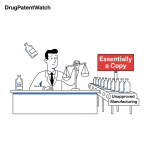
Under 21 CFR 216.23, a 503B facility cannot compound a drug that is “essentially a copy” of a commercially available FDA-approved drug — defined by identical active ingredient, route of administration, dosage form, and strength — unless a prescriber determines an individual patient has a documented clinical difference. FDA guidance has been explicit that adding a vitamin such as B12 does not, on its own, establish that clinical difference.[29] This is the provision the 2025-era compounding arbitrage was built around; it is also the provision that, in practice, was overtaken by the patent-litigation and DOJ-referral route rather than tested directly in court.
NCE-1 Date and Paragraph IV Certification
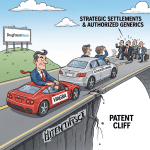
The NCE-1 date — four years after a new chemical entity’s original approval — marks the earliest point a generic manufacturer can file an Abbreviated New Drug Application with a Paragraph IV certification challenging an Orange Book-listed patent. For Eliquis, approved in December 2012, the NCE-1 date passed in December 2016; the first ANDA approvals for Micro Labs and Mylan followed in 2019, with launch delayed by settlement, not by the underlying patent term.[30]
5. The Eliquis Timeline, Corrected: Why “2026–2028” Was Never a Single Date
The 2026–2030 opportunity map published in earlier analysis of this sector listed Eliquis generic entry as occurring “between 2026 and 2028.” That range was directionally correct but obscured a specific, litigated, and now-settled date that matters for any DTC platform planning a cardiovascular vertical around apixaban.
What BMS and Pfizer Have Disclosed
Bristol Myers Squibb’s own 10-Q filings describe active litigation, not a resolved date, for the composition-of-matter patent: in December 2025, BMS and Pfizer filed a patent infringement action against Azurity Pharmaceuticals over a proposed generic apixaban product, targeting a formulation patent expiring in 2031 — not the underlying composition-of-matter patent.[31] In May and June 2026, BMS received additional Paragraph IV notice letters from Aurobindo Pharma and initiated corresponding infringement actions.[32] Separately, BMS’s earlier settlements with the first ANDA filers — reached after a 2020 Delaware court ruling upheld the core composition and formulation patents against a different set of challengers — set a negotiated earliest launch date.[33] Public patent-tracking sources now put that settled date at April 1, 2028, with the underlying pediatric-extended composition-of-matter patent not expiring until 2031 for any challenger who has not settled.[34][35]
Why the Distinction Matters for DTC Cardiovascular Planning
A telehealth platform building a “heart health” or anticoagulant-monitoring vertical around Eliquis’s patent cliff is planning around two different dates depending on which competitor it is modeling: April 1, 2028 for parties bound by the existing settlement, and potentially 2031 for any new challenger, such as Azurity, litigating the formulation patent independently.[31][35] Treating “2026–2028” as a single generic-entry date — as opposed to a settlement-governed date that is later than the composition patent’s raw Orange Book expiration but earlier than full patent-term exhaustion — is the kind of gap that a spreadsheet built from an Orange Book date alone, without checking the underlying docket, will miss by two to three years in either direction.
Table 2: Patent-Cliff Timeline Corrections for DTC-Suitable Drugs
Drug
Active Ingredient
Originally Cited Date
Updated, Sourced Date
Source
Eliquis
Apixaban
“2026” (general)
April 1, 2028 (settled first-filer entry); formulation patent litigation vs. Azurity ongoing, patent expires 2031
No update identified; treat as directional, not settled
Original DPW analysis[36]
Eucrisa
Crisaborole
~2030
No update identified; treat as directional, not settled
Original DPW analysis[36]
6. The International Pivot: Eucalyptus and Diversification Away From U.S. Regulatory Risk
Deal Mechanics
On February 19, 2026, Hims & Hers announced an agreement to acquire Eucalyptus, an Australia-based digital health company operating in Australia, the U.K., Germany, Canada, and Japan, in a deal valued at up to $1.15 billion, including approximately $240 million payable in cash at closing.[37] Eucalyptus brought roughly 775,000 customers and approximately $450 million in annualized revenue at signing, operating brands including weight-loss platform Juniper and men’s health brands Pilot and Compound.[38] The deal closed June 2, 2026.[39] Eucalyptus CEO Tim Doyle became SVP of International at Hims & Hers.[37]
Timing as a Signal
The acquisition was announced thirteen days after Novo Nordisk’s patent suit and closed one month before the FTC filed its complaint. One trade publication framed the deal explicitly against that backdrop: “The deal signals a deliberate pivot toward global expansion as the company faces mounting regulatory and legal scrutiny in the United States.”[38] By Q2 2026, international revenue had grown more than 17-fold year over year to $131.4 million, with the U.K., Australia, and Germany each independently producing more than $100 million in annualized revenue.[19] This followed Hims’ 2024 acquisitions of U.K. platform Zava and Canadian telehealth company Livewell — meaning Eucalyptus extends, rather than initiates, a multi-year international diversification strategy that predates the 2026 U.S. enforcement wave.[38]
What International Diversification Does and Does Not Solve
International expansion diversifies revenue concentration but does not resolve the FTC’s U.S. consumer-protection claims or the securities litigation tied to U.S. disclosures, both of which are venue-locked to U.S. courts and U.S. shareholders. It does reduce the share of company-wide revenue exposed to any single U.S. regulatory action — a materially different risk profile than the source-era analysis, which modeled Hims almost entirely as a U.S. compounding and cash-pay story.
On April 21, 2026, Amazon One Medical launched a GLP-1 Management Program integrating primary care, Amazon Pharmacy fulfillment, and virtual care, offering FDA-approved brand-name products only — Wegovy, Zepbound, oral tirzepatide (Foundayo), and oral semaglutide — with pricing starting at $25 per month with insurance and same-day delivery expanding to roughly 4,500 cities by the end of 2026.[40] Shares of Hims & Hers, along with Viking Therapeutics and Amgen, fell on the announcement; one report cited a same-day decline of roughly 4–6%.[41][42] Non-primary-care patients can access 24/7 telehealth for prescription renewals starting at $29 for a messaging visit or $49 for video.[40] Amazon has stated its pharmacy customers have saved more than $200 million through related programs.[43]
Why Amazon’s Entry Is Structurally Different From a New Telehealth Competitor
Amazon is not entering as a compounder or a cash-pay arbitrage player; it is entering with brand-name-only inventory, existing Prime logistics, and same-day delivery infrastructure that no telehealth-only platform can replicate without a comparable retail and fulfillment footprint. This removes the “convenience premium” that justified telehealth’s cash-pay pricing relative to a slower traditional pharmacy fill, without requiring Amazon to take on any of the compounding-related regulatory exposure that defined Hims’ 2025–2026 legal year.
Ro’s Branded-First Strategy, Validated by the Market’s Own Correction
Ro’s earlier decision to partner with Eli Lilly through LillyDirect rather than build a 503B compounding facility — the “collaborative ecosystem” approach — now reads as the more durable strategic choice in hindsight, given that Hims’ vertically integrated compounding model is the one that drew the patent suit, the DOJ referral, and the FTC action. Ro’s model was never tested against the same enforcement wave because it was never built on the same compounding exposure.
LillyDirect’s Retail Expansion Beyond Any Single Telehealth Partner
Lilly’s March 2026 decision to make Zepbound KwikPen available at self-pay pricing at major retail pharmacies nationwide — not exclusively through LillyDirect or any telehealth partner — signals that manufacturers are increasingly willing to sell branded cash-pay product through every available channel simultaneously, rather than picking a single DTC partner. That reduces the exclusivity value of any one telehealth platform’s manufacturer relationship, including Ro’s.[14]
Remedy Meds and Thirty Madison: The Consolidation Completed
Remedy Meds’ acquisition of Thirty Madison, announced in September 2025 at a value just over $500 million in an all-stock transaction, combined Remedy’s roughly $450 million in annual revenue with Thirty Madison’s roughly $220 million, creating a combined entity with more than $670 million in annual revenue spanning weight loss (Remedy), men’s hair loss (Keeps), women’s health and contraception (Nurx), and migraine care (Cove).[44][45] The deal was expected to close in Q4 2025, positioning the combined company as a more direct multi-specialty competitor to both Hims and Ro heading into 2026.[45]
~$199–$299/mo (historical compounded tier); branded Zepbound/Mounjaro at $1,899/mo list before further negotiated pricing
Pharmaceutical Commerce[46]; TrimRX[47]
Ro
Brand-name, LillyDirect-integrated
$149/mo (Wegovy pill, insured-favorable)
TrimRX comparison[47]
8. Methodology
This analysis draws primarily on SEC filings (Hims & Hers 8-K earnings releases and 10-Q/10-K disclosures, Bristol Myers Squibb and Pfizer 10-Q legal-proceedings notes, Eli Lilly 8-K earnings releases), FDA warning-letter and shortage-list announcements, court filings referenced in contemporaneous legal-industry reporting (Frier Levitt, McDermott Will & Emery), and news coverage from wire services, trade press, and financial media published between January 2026 and September 2026. Where a figure is a calculation rather than a disclosed number — the gross-margin dollar-impact estimate in Section 2 — it is explicitly labeled as such and the underlying inputs are disclosed. Patent-expiration and generic-entry dates are drawn from primary-source SEC litigation disclosures where available, supplemented by third-party patent-tracking aggregators (Pharsight/GreyB) where SEC disclosures do not specify an exact date; aggregator-sourced dates are marked as estimates subject to revision. This piece does not independently verify FTC or Novo Nordisk complaint allegations against Hims & Hers, which remain contested in active litigation as of this writing; allegations are reported as allegations, and the underlying cases had not reached judgment at the time of research.
9. Strategic Intelligence: What Patent Monitoring Should Actually Track Now
The strategic case for patent-intelligence platforms like DrugPatentWatch in this sector has shifted since compounding-era analysis was written. The immediate opportunity is no longer primarily “which drug is about to lose exclusivity” — that calculation still matters for the 2028–2031 cardiovascular and 2029–2030 dermatology and mental-health verticals — but increasingly “which settlement date governs entry for a given manufacturer,” given that Eliquis alone now has at least two live tracks (the 2028 settled date and the Azurity-litigated 2031 date) running in parallel.[31][35] A platform monitoring only Orange Book expiration dates, without tracking the underlying Paragraph IV docket and settlement terms, will misprice the entry window by years in exactly the way the earlier 2026–2028 Eliquis range did.
Formulation Loopholes Remain Live, But Compounding Is Not the Only Route
The 505(b)(2) pathway — seeking approval for a new formulation of an off-patent active ingredient — remains available to telehealth-adjacent manufacturers even as the compounding route has narrowed. Azurity’s own strategy against Eliquis illustrates this: rather than compounding apixaban, Azurity filed a 505(b)(2) application with a Paragraph IV certification against a formulation patent specifically, leaving the composition-of-matter patent unchallenged.[31] That is a materially lower-risk path than the compounding route Hims pursued, precisely because it works inside patent law rather than around a shortage-list exemption.
10. FAQ
1. Is compounded semaglutide still legal to sell through telehealth platforms in 2026? Compounded semaglutide remains legally available in narrow circumstances — individualized 503A prescriptions where a prescriber documents a genuine clinical difference — but the mass-market 503B compounding model that Hims & Hers built around a shortage-list exemption ended in March 2026 following its settlement with Novo Nordisk.[10][11] Other telehealth compounders received FDA warning letters in February and March 2026 covering similar marketing claims.[8][9]
2. Why did Novo Nordisk drop its patent lawsuit against Hims & Hers? Novo dismissed the suit without prejudice after Hims agreed to discontinue compounded semaglutide and offer Novo’s FDA-approved Ozempic and Wegovy at established self-pay prices instead.[10] “Without prejudice” means Novo retains the right to refile if Hims resumes the disputed conduct.
3. What is the FTC actually alleging against Hims & Hers, separate from the compounding dispute? The FTC’s July 2026 complaint, joined by California and Utah, alleges Hims shared sensitive health data with Meta and Snap for advertising purposes despite privacy commitments, charged some customers before a provider reviewed their treatment, and made subscription cancellation unreasonably difficult in potential violation of ROSCA.[2][21][22][23] These allegations are unrelated to the compounding/patent dispute and remain contested.
4. When will generic Eliquis actually be available? There is no single date. BMS’s earlier settlements with the original ANDA filers set a negotiated earliest entry around April 1, 2028; separately, BMS and Pfizer are actively litigating a formulation patent (expiring 2031) against later challenger Azurity Pharmaceuticals, a dispute that remained unresolved in BMS’s mid-2026 SEC filings.[31][32][35] Which date applies depends on which manufacturer’s product is being modeled.
5. How has Amazon’s entry changed the DTC telehealth competitive landscape? Amazon One Medical’s April 2026 GLP-1 program offers only FDA-approved brand-name products, backed by Amazon Pharmacy fulfillment and same-day delivery expanding to roughly 4,500 cities, undercutting the “convenience” advantage that justified telehealth cash-pay pricing without carrying any compounding-related regulatory exposure.[40][43] Hims shares fell on the announcement.[41][42]
6. What happened to Thirty Madison? Thirty Madison was acquired by Remedy Meds in an all-stock deal valued just over $500 million, announced September 2025 and expected to close in Q4 2025, combining Remedy’s roughly $450 million weight-loss-focused revenue with Thirty Madison’s roughly $220 million across Keeps, Nurx, and Cove.[44][45]
7. Why did Hims & Hers acquire Eucalyptus if it was already under U.S. regulatory scrutiny? The Eucalyptus deal, announced February 2026 and closed June 2026 for up to $1.15 billion, extended a multi-year international diversification strategy that began with the 2024 Zava and Livewell acquisitions; industry reporting has explicitly framed the timing as reducing Hims’ revenue concentration in the U.S. market where its compounding and FTC exposure is concentrated.[37][38][39]
8. Did Hims & Hers’ gross margin collapse because of the FTC lawsuit? Not primarily. The margin decline from 76% to 64% reflects the shift from compounded-drug cost of goods to branded-drug cost of goods after the Novo Nordisk settlement, plus international mix shift from Eucalyptus; the FTC-related legal accruals were a separate, smaller one-time cost layered on top in the same quarter.[15][17]
9. What is the difference between a 503A pharmacy and a 503B outsourcing facility? A 503A pharmacy compounds against individual patient prescriptions and is regulated mainly by state pharmacy boards; a 503B facility can manufacture in bulk without patient-specific prescriptions but is directly FDA-registered, inspected, and cGMP-regulated, and is subject to the stricter “essentially a copy” prohibition once a shortage resolves.[28][29] Hims now limits itself to 503A fulfillment for GLP-1 products.[11]
10. Is the DTC telehealth business model still viable after this round of enforcement? Hims & Hers’ own guidance suggests yes at the revenue-growth level — full-year 2026 guidance was raised twice, to $3.1–$3.3 billion — but the era of arbitraging a compounding exemption for outsized margin appears closed; growth is now increasingly built on branded-product distribution, international expansion, and subscriber-count growth rather than the commodity-API cost advantage the model relied on in 2024–2025.[18][19]
Key Takeaways
The compounding-arbitrage business model that defined DTC telehealth in 2024–2025 ended for Hims & Hers in March 2026, forced by a Novo Nordisk patent suit and DOJ referral rather than by the FDA’s shortage-list mechanics alone.[5][6][10]
Hims & Hers posted a $86.3 million net loss in Q2 2026 on $753.2 million of revenue, with gross margin falling from 76% to 64% as the company shifted from compounded to branded product mix; the margin-rate effect alone cost an estimated $91.6 million in gross profit that quarter, by DrugChatter/DrugPatentWatch calculation.[15][16]
A separate FTC lawsuit filed July 29, 2026, over health-data sharing with Meta and Snap and subscription-cancellation practices, represents a structurally different, platform-wide risk than the product-specific compounding dispute, and has already triggered securities class-action litigation.[2][21][26]
Eliquis generic entry is not a single “2026–2028” date: BMS’s settlement with original ANDA filers sets entry around April 1, 2028, while a separate, unresolved formulation-patent fight with Azurity runs to the 2031 patent expiration.[31][32][35]
Amazon’s April 2026 entry into brand-name GLP-1 distribution via One Medical and same-day Pharmacy delivery removes the convenience premium that justified telehealth cash-pay pricing, without the compounding-related regulatory exposure that defined 2025–2026 enforcement actions against telehealth compounders.[40][43]
Works Cited
Hims & Hers Health, Inc. (2026, August 10). Reports Second Quarter 2026 Financial Results. SEC 8-K. https://www.sec.gov/Archives/edgar/data/0001773751/000177375126000161/hims-20260630x8xkearningsr.htm
Washington Post. (2026, July 29). FTC sues Hims & Hers, saying telehealth company breached patient privacy. https://www.washingtonpost.com/health/2026/07/29/ftc-sues-hims-hers-alleging-it-breached-patient-privacy/
PharmLaw News / HMP Global Learning Network. (2026). Novo Nordisk Drops Patent Suit as Hims & Hers Shifts to FDA-Approved Semaglutide Products. https://www.hmpgloballearningnetwork.com/site/pln/news/novo-nordisk-drops-patent-suit-hims-hers-shifts-fda-approved-semaglutide-products
Novo Nordisk. (2026, February 9). Novo Nordisk takes legal action against Hims & Hers to protect patients from unsafe, knock-off Wegovy and Ozempic. https://www.novonordisk.com/news-and-media/news-and-ir-materials/news-details.html?id=916493
Telehealth.org. (2026). FDA Warns Telehealth Companies Over Marketing of Compounded GLP-1 Weight-Loss Drugs. https://telehealth.org/news/fda-warns-telehealth-companies-over-marketing-of-compounded-glp-1-weight-loss-drugs/
Hims & Hers Health, Inc. (2026). Form 10-K, FY2025. SEC filing. https://www.sec.gov/Archives/edgar/data/1773751/000177375126000022/hims-20251231.htm
Telehealth.org. (2026). FDA Warns Telehealth Firms Over Compounded GLP-1 [Feb. 20, 2026 warning-letter wave]. https://telehealth.org/news/fda-warns-telehealth-companies-over-marketing-of-compounded-glp-1-weight-loss-drugs/
Frier Levitt. (2026). From Crackdown to Collaboration: FDA Warning Letters and the Hims-Novo Nordisk Deal Signal a New Era for Compounded GLP-1 Drugs. https://www.frierlevitt.com/articles/fda-warning-letters-hims-novo-nordisk-compounded-glp1/
HMP Global Learning Network. (2026). Novo Nordisk Drops Patent Suit as Hims & Hers Shifts to FDA-Approved Semaglutide Products. https://www.hmpgloballearningnetwork.com/site/pln/news/novo-nordisk-drops-patent-suit-hims-hers-shifts-fda-approved-semaglutide-products
Hims & Hers Health, Inc. (2026). Form 10-Q, Q2 2026. SEC filing. https://www.sec.gov/Archives/edgar/data/0001773751/000177375126000163/hims-20260630.htm
Burr & Forman LLP. (2025). The FDA Removes Semaglutide from the Drug Shortage List. https://www.burr.com/newsroom/articles/the-fda-removes-semaglutide-from-the-drug-shortage-list
Fierce Healthcare. DTC obesity med market heats up: Eli Lilly taps knownwell, Hims & Hers adds new weight loss meds to platform. https://www.fiercehealthcare.com/digital-health/dtc-obesity-med-market-heats-eli-lilly-taps-knownwell-hims-hers-adds-new-weight-loss
TryTrimi. (2026). LillyDirect Zepbound Price 2026: $299–$699/Mo by Dose. https://trytrimi.com/blog/lillydirect-zepbound-pricing-guide
BusinessWire / Hims & Hers Health, Inc. (2026, August 10). Hims & Hers Health, Inc. Reports Second Quarter 2026 Financial Results. https://www.businesswire.com/news/home/20260810713364/en/Hims-Hers-Health-Inc.-Reports-Second-Quarter-2026-Financial-Results
Yahoo Finance. (2026). Hims & Hers Just Went Negative on Profit. Twice. https://finance.yahoo.com/markets/stocks/articles/hims-hers-just-went-negative-182802968.html
Hims & Hers Health, Inc. (2026, February 23). Reports Fourth Quarter and Full Year 2025 Financial Results. SEC 8-K. https://www.sec.gov/Archives/edgar/data/1773751/000177375126000019/hims-20251231x8xkearningsr.htm
Hims & Hers Health, Inc. (2026, May 11). Reports First Quarter 2026 Financial Results. SEC 8-K. https://www.sec.gov/Archives/edgar/data/0001773751/000177375126000074/hims-20260331x8xkearningsr.htm
NPR. (2026, July 30). The FTC is suing the popular telehealth company Hims & Hers. https://www.npr.org/2026/07/30/g-s1-136312/ftc-federal-trade-commission-hims-hers-telehealth
STAT News. (2026, July 29). Hims misled consumers and violated their privacy, FTC alleges in a lawsuit. https://www.statnews.com/2026/07/29/ftc-lawsuit-hims-alleging-deceptive-business-practices/
HealthDay / US News. (2026, July 31). FTC Sues Hims & Hers Over Health Privacy And Billing Practices. https://www.usnews.com/news/health-news/articles/2026-07-31/ftc-sues-hims-hers-over-health-privacy-and-billing-practices
CNBC. (2026, July 29). Hims and Hers shares fall 10% as FTC sues company over data, billing practices. https://www.cnbc.com/2026/07/29/hims-and-hers-ftc-lawsuit-stock.html
NewMediaWire. (2026). Hims & Hers Health, Inc. (NYSE: HIMS) Class Action Lawsuit: Investors Face November 2, 2026 Deadline. https://newmediawire.com/news/hims-hers-health-inc-nyse-hims-class-action-lawsuit-investors-face-november-2-2026-deadline-7090096
FinancialContent / NewMediaWire. (2026). Hims & Hers Health, Inc. (NYSE: HIMS) Class Action Lawsuit: Investors Face November 2, 2026, Deadline. https://financialcontent.com/article/newmediawire-2026-9-27-hims-and-hers-health-inc-nyse-hims-class-action-lawsuit-investors-face-november-2-2026-deadline
Morningstar / Hagens Berman. (2026). Hims & Hers Health (NYSE: HIMS) Faces Securities Class Action After FTC Lawsuit Reveal Drives Stock Sharply Lower. https://www.morningstar.com/news/pr-newswire/20260903sf40424/hims-hers-health-nyse-hims-faces-securities-class-action-after-ftc-lawsuit-reveal-drives-stock-sharply-lower-hbss
DrugPatentWatch. (2026). The Unbundling of the Apothecary [Table 1: Regulatory Framework for Telehealth Compounding]. https://www.drugpatentwatch.com/blog/novel-pharmaceutical-strategies-and-business-models-the-rise-of-telehealth-companies-like-ro-and-hims-hers/
Montgomery Purdue. (2025). FDA Compliance Alert for Weight Management Providers: Compounded GLP-1s with Additives. https://www.montgomerypurdue.com/blog/fda-compliance-alert-for-weight-management-providers-compounded-glp-1s-with-additives/
BioPharma Dive. Bristol Myers, Pfizer fend off a key challenge to their top-selling heart drug. https://www.biopharmadive.com/news/bristol-myers-pfizer-eliquis-patent-court-ruling/583027/
ScienceWatch.blog. (2026). Is Generic Apixaban Available in the US Yet? [2026 Release Update]. https://sciencewatch.blog/generic-apixaban-us-availability
DrugPatentWatch. (2026). The Unbundling of the Apothecary [Table 2: Key Patent Expirations & DTC Suitability]. https://www.drugpatentwatch.com/blog/novel-pharmaceutical-strategies-and-business-models-the-rise-of-telehealth-companies-like-ro-and-hims-hers/
Hims & Hers Health, Inc. (2026, February 19). Hims & Hers Announces Agreement to Acquire Eucalyptus. SEC 8-K. https://www.sec.gov/Archives/edgar/data/1773751/000177375126000010/a260219_pressreleasexproje.htm
HLTH. (2026). Hims & Hers Acquires Eucalyptus Health in $1.15bn International Expansion. https://hlth.com/insights/news/hims-and-hers-acquires-eucalyptus-health-in-1-15bn-international-expansion-2026-02-20
Hims & Hers Health, Inc. (2026, June 2). Hims & Hers Completes Acquisition of Eucalyptus. SEC 8-K exhibit. https://www.sec.gov/Archives/edgar/data/1773751/000177375126000091/ex991pressreleaserercfeuc.htm
American Med Spa Association. (2026). Amazon Launches GLP-1 Weight Loss Program with One Medical. https://www.americanmedspa.org/news/amazon-launches-glp-1-weight-loss-program-with-one-medical/
BigGo Finance. (2026). Amazon Enters Weight-Loss Drug Market with Integrated Management Service Starting at $25 per Month. https://finance.biggo.com/news/S3AQs50BJouf4oEhOK7L
PharmExec. (2026). Amazon One Medical Launches GLP-1 Management Program. https://www.pharmexec.com/view/amazon-one-medical-launches-glp1-management-program
Inc. (2026). Amazon’s New GLP-1 Service Promises Less Expensive, Faster Access to Popular Weight-Loss Drugs. https://www.inc.com/leila-sheridan/amazon-glp-1-program/91334186
FemTech Insider. (2025). Remedy Meds Acquires Thirty Madison in $500M All-Stock Deal. https://femtechinsider.com/remedy-meds-acquires-thirty-madison-in-500m-all-stock-deal/
Fierce Healthcare. (2025). GLP-1 newcomer Remedy Meds to acquire Thirty Madison in $500M deal. https://www.fiercehealthcare.com/telehealth/glp-1-newcomer-remedy-meds-acquire-thirty-madison-500m-deal