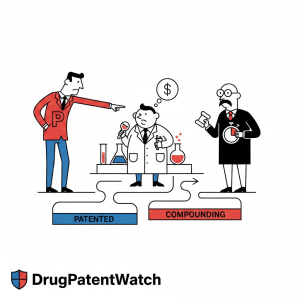
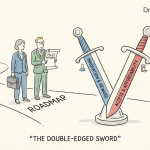
The pharmaceutical sector currently faces a structural conflict between two divergent regulatory and legal regimes: the intellectual property protections afforded to innovators under the Hatch-Waxman Act and the exemption-based operational framework of compounding pharmacies under the Drug Quality and Security Act (DQSA). This conflict has intensified due to the proliferation of high-value biologic and peptide therapeutics, specifically Glucagon-like peptide-1 (GLP-1) receptor agonists, which have exposed the friction between patient access mechanisms and commercial exclusivity rights.
For decades, the boundaries were relatively clear. Innovators held patent monopolies to recoup research and development costs—estimated at $2.6 billion per successful drug—while compounders operated in a niche, providing customized medications for individual patients with specific needs, such as allergies to excipients.1 However, the industrialization of compounding, particularly through the Section 503B outsourcing facility model, has created a parallel manufacturing sector that operates largely outside the Abbreviated New Drug Application (ANDA) framework but competes directly with approved products.2
This report analyzes the legal exposure compounding pharmacies face when fulfilling doctor orders. It dissects the failure of traditional defenses such as the “Safe Harbor” and “Medical Practitioner Immunity,” examines the strategic pivot by major pharmaceutical companies toward trademark and unfair competition litigation, and quantifies the economic imperatives driving these legal confrontations. Furthermore, it outlines the necessity of rigorous Freedom to Operate (FTO) analysis, leveraging data intelligence platforms like DrugPatentWatch to navigate the patent thickets that remain enforceable even when regulatory exemptions apply.4
The Regulatory Architecture: Bifurcation of Liability
To assess patent risk, one must first distinguish the operational and legal variances between the two classes of compounding facilities established by the DQSA. The distinction is not merely administrative; it dictates the level of federal preemption, the applicability of state consumer protection laws, and the scale of potential patent damages.
Section 503A: The Traditional Pharmacy Model
Section 503A facilities represent the historical definition of pharmacy practice. These entities are primarily regulated by state boards of pharmacy rather than the FDA, provided they adhere to strict limitations regarding the scope of their distribution and the nature of their compounding.3
The central tenet of 503A compliance is the requirement for a valid, patient-specific prescription.6 This requirement theoretically limits the scale of operation to a “one-to-one” relationship between the pharmacist, prescriber, and patient. From a patent perspective, this individualization has historically provided a shield against “willful infringement” claims, as the pharmacy argues it is providing a professional service rather than manufacturing a commercial product.
However, 503A pharmacies are prohibited from compounding “regularly or in inordinate amounts” any drug products that are “essentially copies” of a commercially available drug product.2 The FDA defines “essentially a copy” for 503A facilities as a product that is substantially similar to a commercially available drug. A critical exception exists if the prescribing practitioner determines that a change is made for an individual patient that produces a “significant difference” for that patient (e.g., removing a preservative).2
Table 1: Operational and Legal Distinctions Between 503A and 503B Facilities
Feature
Section 503A Pharmacy
Section 503B Outsourcing Facility
Regulatory Oversight
State Boards of Pharmacy
FDA (Federal Registration)
Prescription Requirement
Patient-specific prescription required
May distribute for “office use” (bulk)
Quality Standards
USP (Non-sterile) / (Sterile)
Current Good Manufacturing Practice (CGMP)
“Essentially a Copy”
Prohibited if “regular or inordinate”
Strictly Prohibited (with narrow exceptions)
Patent Defense Argument
Individual medical necessity (Practice of Pharmacy)
Drug Shortage Exception (Section 506E)
Litigation Risk
High (State statutes, induced infringement)
Very High (Direct infringement, Lanham Act)
Section 503B: The Outsourcing Facility Model
Section 503B created a new category of “outsourcing facilities” authorized to manufacture large batches of drugs without patient-specific prescriptions, primarily for sale to hospitals and clinics for office use.3 These facilities must comply with Current Good Manufacturing Practices (CGMP), the same rigorous quality standards applied to commercial pharmaceutical manufacturers.2
The IP implications for 503B facilities are severe. By operating at an industrial scale and distributing drugs for office use, 503B facilities lose the “practice of pharmacy” defense that protects individual patient care. They function as manufacturers. Consequently, 503B facilities are strictly prohibited from compounding a drug that is “essentially a copy” of one or more approved drugs.7 This prohibition is absolute, unlike the “regular or inordinate” buffer provided to 503A pharmacies.
When a 503B facility produces a copy of a branded drug, it engages in direct competition with the patent holder. The facility utilizes the same Active Pharmaceutical Ingredient (API) but bypasses the clinical trial costs and the New Drug Application (NDA) or ANDA process. This creates a profound economic asymmetry that incentivizes patent holders to litigate aggressively to protect their market share.2
The “Essentially a Copy” Doctrine and Market Exclusivity
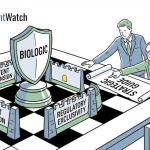
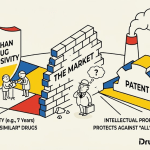
The “essentially a copy” provision serves as the primary regulatory barrier protecting the market exclusivity of approved drugs from compounding competition. It is designed to prevent compounders from functioning as unapproved generic manufacturers. However, this barrier is permeable, particularly regarding the “clinical difference” exception and the drug shortage exemption.
The Clinical Difference Loophole
For 503A pharmacies, a compounded drug is not considered an essential copy if the prescriber documents a “significant difference” for the patient. This might include a change in dosage form (capsule to liquid), strength, or the exclusion of allergens.2
In practice, this creates a mechanism for regulatory arbitrage. Compounding pharmacies may encourage prescribers to document minor or theoretically beneficial changes—such as adding a vitamin (e.g., B12 or L-Carnitine) to a GLP-1 injection—to assert that the compounded product is not a “copy” of the commercial drug.9
Pharmaceutical companies argue that these combinations are often pretextual. For example, in Eli Lilly and Company v. Empower Clinic Services, LLC, Lilly alleges that Empower’s “Tirzepatide ODT” (orally disintegrating tablet) and injections combined with niacinamide are “knockoffs” designed to circumvent the copy restrictions rather than address genuine medical needs.10 The legal argument here shifts from regulatory compliance to unfair competition, positing that the pharmacy is manufacturing an unapproved new drug under the guise of compounding.10
The Section 506E Drug Shortage Exemption
The most significant disruption to patent exclusivity in the compounding sector arises from Section 506E of the FD&C Act. When the FDA designates a drug as “in shortage,” it is no longer considered “commercially available”.2
Mechanism: During a designated shortage, the restriction on compounding “essential copies” is lifted for both 503A and 503B facilities. This permits compounders to mass-produce identical copies of the branded drug using bulk API.11
Patent Implications: Critically, the FD&C Act’s shortage exemption does not suspend patent law. A patent holder retains the right to exclude others from making, using, or selling the patented invention under 35 U.S.C. § 271, regardless of the drug’s shortage status.2
Industry Insight: “It would indeed be counterintuitive for the FDA to prohibit the compounding of drugs in shortage only if they are patented when no statutes, regulations, or guidance say otherwise. Unfortunately, the FDA has no jurisdiction over patent law and no power to immunize compounding pharmacies from liability for patent infringement.” — Georgetown Law, Scholarship on IP & Compounding.13
This creates a liability trap. A pharmacy may be fully compliant with FDA regulations by compounding a drug in shortage, yet simultaneously be liable for treble damages for willful patent infringement. The primary reason pharmaceutical companies rarely sue for patent infringement during the height of a shortage is public relations risk—suing to stop the production of a life-saving drug that the innovator cannot supply is reputational suicide. However, as the shortage resolves, this restraint evaporates.
Patent Infringement Liability Analysis
Patent liability for compounding pharmacies is not limited to direct infringement. The complex interplay between prescribers, patients, and pharmacies implicates multiple forms of liability under 35 U.S.C. § 271.
Direct Infringement (35 U.S.C. § 271(a))
Direct infringement occurs when a party makes, uses, offers to sell, or sells any patented invention within the United States without authority.12
Composition of Matter: If the pharmacy uses the protected API (e.g., semaglutide) to create a product, they are “making” the patented invention. This applies even if the API is sourced from a registered facility, as the patent covers the molecule itself.1
Formulation Patents: Many drugs are protected not just by the molecule but by the delivery mechanism (e.g., specific excipients, pH stabilizers). A compounder creating a generic version may inadvertently infringe these formulation patents even if the primary molecule patent has expired or is otherwise accessible.1
Induced Infringement (35 U.S.C. § 271(b))
Induced infringement imposes liability on a party that actively encourages another to infringe a patent. This is particularly relevant for “Method of Use” patents.15
Scenario: A patent covers the method of using a drug for weight loss, but the drug itself (the molecule) is off-patent or available.
Liability: If a compounding pharmacy advertises its compounded semaglutide specifically for “weight loss” or provides instructions to the patient on how to administer it for that condition, the pharmacy is inducing the patient (or the doctor) to practice the patented method.
Evidence of Intent: Marketing materials, website claims, and patient counseling protocols serve as evidence of specific intent to induce infringement. In Novo Nordisk v. Mylan, the court emphasized that the scope of method claims must align with the approved label, but for compounders operating without a label, their marketing materials substitute as the “label” for proving intent.16
Contributory Infringement (35 U.S.C. § 271(c))
Contributory infringement occurs when a party sells a component of a patented invention that has no substantial non-infringing use.17
Application: If a pharmacy sells a specialized kit or a pre-filled syringe containing a drug that is only useful for a patented treatment method, they may be liable for contributory infringement. This prevents actors from selling the “parts” of a patent to bypass liability.17
Failure of Traditional Defenses
Compounding pharmacies often rely on statutory defenses designed for clinical practice or generic drug development. Analysis of case law reveals that these defenses are largely ineffective for commercial compounding operations.
The “Medical Practitioner” Immunity (35 U.S.C. § 287(c))
Congress enacted 35 U.S.C. § 287(c) in 1996 to protect doctors from patent liability when performing medical procedures. This section states that remedies (damages, injunctions) shall not apply against a medical practitioner or a related healthcare entity for a “medical activity”.18
Why It Fails Pharmacists:
Exclusion of Composition of Matter: The statute explicitly excludes “the use of a patented machine, manufacture, or composition of matter in violation of such patent” from the definition of “medical activity”.19
Manufacturing Distinction: Courts distinguish between the performance of a medical procedure (e.g., a surgical technique) and the manufacture of a drug used in that procedure. A pharmacist compounding a drug is creating a “composition of matter,” which falls squarely within the exclusion.18
Biotechnology Exception: The immunity also does not apply to the practice of a process in violation of a “biotechnology patent.” Given that many modern compounded drugs (like peptides and biologics) fall under biotechnology, this further erodes the defense.21
In VetStem Biopharma, Inc. v. California Stem Cell Treatment Center, the court rejected the § 287(c) defense where the alleged activity involved manipulating biological materials, clarifying that the immunity is narrowly tailored to “pure procedure” patents.21
The Hatch-Waxman “Safe Harbor” (35 U.S.C. § 271(e)(1))
The “Safe Harbor” provision exempts acts reasonably related to the development and submission of information to the FDA from patent infringement.23 This was intended to allow generic manufacturers to conduct bioequivalence testing before a patent expires so they can launch immediately upon expiration.
Why It Fails Commercial Compounders:
Commercial Intent: Courts have consistently ruled that the Safe Harbor does not protect commercial sales. While a compounder might argue they are “gathering data” or are regulated by the FDA, the sale of the drug to patients for revenue is not “solely for uses reasonably related” to FDA submission.24
Routine Activity: In Classen Immunotherapies, Inc. v. Biogen IDEC, the Federal Circuit held that routine submissions to the FDA post-approval (such as adverse event reporting) do not bring commercial sales under the Safe Harbor umbrella.24 Compounding is a commercial activity, not a regulatory compliance exercise in the context of creating an ANDA.
The Strategic Shift: Trademark and Unfair Competition Litigation
Recognizing the cost and complexity of patent litigation—and the risk of patent invalidation via Inter Partes Review (IPR)—pharmaceutical companies have opened a second front: Trademark and Unfair Competition.
Weaponizing the Lanham Act
The Lanham Act (15 U.S.C. § 1051 et seq.) prohibits false advertising, trademark infringement, and unfair competition. This statute has become the primary weapon against compounders selling GLP-1 agonists.
1. False Association and Trademark Infringement:
Pharma companies argue that the use of their trade names (e.g., “Ozempic,” “Mounjaro,” “Zepbound”) in compounder advertising creates a likelihood of confusion. Even if the pharmacy disclaims that the product is generic, the use of the trademark to attract traffic constitutes infringement.26
Nominative Fair Use Defense: Compounders argue “Nominative Fair Use”—that they must use the name to identify the drug they are copying.
Rebuttal: Courts often reject this if the product is not actually identical. Since compounded peptides often use salt forms (semaglutide sodium) rather than the base molecule, they are not the branded drug. Therefore, calling it “Generic Ozempic” is factually false.28
2. False Advertising (Safety and Efficacy Claims):
Compounders often advertise their products as “safe,” “effective,” or “FDA-approved.”
The Violation: Compounded drugs are unapproved new drugs. They have not undergone clinical trials for safety and efficacy. Therefore, any claim of safety or efficacy is technically false advertising under the Lanham Act.10
Case Example: In Eli Lilly v. Empower Pharmacy, Lilly alleges that Empower’s marketing of “Tirzepatide ODT” misleads consumers into believing the oral form has been proven effective, despite the absence of any clinical data supporting oral absorption of the peptide.10
The Preemption Defense Failure
Compounders have attempted to dismiss these lawsuits by arguing “Preemption”—that private companies cannot sue to enforce the FD&C Act; only the FDA can.
Novo Nordisk v. Wells Pharmacy Network: Novo Nordisk sued Wells Pharmacy, alleging violations of the Florida Deceptive and Unfair Trade Practices Act (FDUTPA) based on the sale of “unapproved” drugs in violation of the FD&C Act.31 The court dismissed these claims, ruling that the claim required the court to determine a violation of the FD&C Act, which is the FDA’s exclusive domain.31
The Strategic Pivot: Following this, pharmaceutical companies refined their complaints. Instead of suing for “illegal compounding” (a regulatory violation), they sue for False Advertising regarding the quality and nature of the drug. The argument is not “you violated the FD&C Act,” but “you lied to consumers by telling them this unapproved salt is the same as our approved drug”.33 This subtle distinction allows the claims to proceed under the Lanham Act, bypassing the preemption hurdle.
Case Study: The GLP-1 Agonist Battlefield
The litigation surrounding Semaglutide (Ozempic/Wegovy) and Tirzepatide (Mounjaro/Zepbound) provides a real-time stress test of these legal theories.
The Economic Driver
The market for GLP-1 agonists is unprecedented. By 2024, revenues for these drugs exceeded $53 billion, with projections reaching $170 billion by 2033.35 Compounded versions, selling at discounts of 50-80%, represent a massive revenue leakage for innovators. Novo Nordisk explicitly cited the “widespread availability of compounded GLP-1s” as a factor dampening sales growth in early 2025.36
The “Salt” Controversy
A central technical dispute involves the chemical form of the API.
Innovator Product: Contains the base form of semaglutide.
Compounded Product: Often uses “semaglutide sodium” or “semaglutide acetate” because the base form is patent-protected and difficult to source.
FDA Stance: The FDA has stated that salt forms are different active ingredients. Compounding with salts when the base is the approved drug may violate 503A/B standards unless there is a clinical need.2
Litigation Impact: This chemical difference destroys the compounder’s defense that they are making a legitimate “copy” allowed during shortage. Instead, they are making a different, unapproved drug, strengthening the false advertising claim.28
The End of Shortage Transition
As of late 2024 and early 2025, the FDA began resolving the shortages of tirzepatide and semaglutide.
Enforcement Discretion: The FDA announced a transition period (60 days for 503A, 90 days for 503B) to allow facilities to wind down operations.37
The Cliff: Once this period expires (e.g., May 2025 for 503B semaglutide), the full weight of patent liability returns. Any 503B facility continuing to manufacture these drugs will face immediate patent infringement suits for the API and formulation, with no “shortage” shield to hide behind.39
Freedom to Operate (FTO): The Strategic Imperative
In this high-liability environment, the “Freedom to Operate” (FTO) analysis becomes the single most critical risk management tool for business development teams and pharmacy executives.
The Patent Thicket Reality
A pharmaceutical product is rarely protected by a single patent. It is surrounded by a “thicket” of IP rights:
Composition of Matter: Covers the molecule itself (e.g., semaglutide).
Formulation: Covers the delivery vehicle, stabilizers, or extended-release mechanisms.1
Method of Use: Covers the treatment of specific indications (e.g., weight loss vs. diabetes).1
Manufacturing Process: Covers the synthesis of the API.1
Even if the primary API patent expires or is unavailable, a compounder can be sued for infringing the formulation or method of use patents.
Leveraging DrugPatentWatch for FTO
Platforms like DrugPatentWatch provide the intelligence necessary to navigate this minefield. Unlike basic patent searches, DrugPatentWatch integrates regulatory data with IP status.1
Mapping the Exclusivity Stack: Users can identify all active patents linked to a specific NDA, including their expiration dates and extensions (PTE/PTA).41
Litigation Tracking: By monitoring Paragraph IV certifications and ongoing litigation, companies can assess the “litigiousness” of a patent holder. If Eli Lilly is actively asserting a specific formulation patent against generic manufacturers, a compounder using that same formulation is a prime target.41
Generic Entry Forecasting:DrugPatentWatch predicts when generic versions will enter the market. This data point is crucial for compounders because the entry of approved generics often signals the definitive end of a “shortage” status, marking the date when compounding liability spikes.44
Table 2: FTO Analysis Checklist for Compounding Decisions
Analysis Component
Critical Question
Data Source Utility (DrugPatentWatch)
Active Patents
Are there unexpired patents on the API, formulation, or use?
Aggregates all Orange Book and non-Orange Book patents.
Litigation History
Is the innovator suing others for this specific patent?
Tracks Paragraph IV litigation and outcomes.
Regulatory Exclusivity
Is there orphan drug, pediatric, or NCE exclusivity?
Monitors FDA exclusivity periods distinct from patents.
Generic Entry
When will approved generics launch?
Forecasts generic entry to predict end of shortage exemptions.
Shortage Status
Is the drug currently on the FDA 506E list?
Cross-references shortage status with patent enforceability.
Future Legal Horizons: 2025 and Beyond
The conflict between compounders and innovators is evolving toward more sophisticated legal theories.
Design-Around Strategies and “Sham” Customization
As the shortage exemption closes, compounders will likely pivot to “design-around” strategies—adding ingredients (e.g., B12) to claim the product is a customized medication, not a copy.
Prediction: Innovators will challenge these “clinical differences” as shams. We expect litigation focusing on whether the added ingredients provide actual clinical benefit or are merely pretexts to circumvent the “essentially a copy” rule.9
Telehealth Inducement Liability
The rise of telehealth platforms (e.g., Hims, Ro) that connect patients to compounders creates a new liability node.
Prediction: Pharma companies will sue these platforms for Induced Infringement (35 U.S.C. § 271(b)). By building the infrastructure that facilitates the prescription and sale of the infringing product, the platform is “actively inducing” the infringement. This targets the “mastermind” of the transaction rather than the individual pharmacy.15
International Trade Commission (ITC) Enforcement
Eli Lilly has already utilized the ITC to block imports of bulk tirzepatide.46
Prediction: Innovators will increasingly use the ITC’s “General Exclusion Orders” to block the importation of APIs from China and India. This is a highly effective tactic as it cuts off the raw material supply for the entire compounding industry at the border, bypassing the need to sue individual pharmacies.46
Key Takeaways
Regulatory Compliance is Not Patent Immunity: Adherence to FDA Section 503A or 503B regulations does not shield a pharmacy from federal patent infringement liability. The Patent Act and the FD&C Act are distinct statutes; satisfying one does not excuse violations of the other.
The Shortage Shield is Porous: The Section 506E shortage exemption lifts the FDA’s “essential copy” ban but does not suspend patent rights. Innovators often withhold litigation during shortages for PR reasons, but as shortages resolve, the “patent trap” snaps shut immediately.
Pharmacists Are Not “Medical Practitioners”: The 35 U.S.C. § 287(c) immunity for medical practitioners explicitly excludes the creation of a “composition of matter.” Pharmacists manufacturing drugs are creating compositions, rendering them ineligible for this defense.
Trademark Litigation is the New Standard: To bypass complex patent defenses and FDA preemption issues, pharma companies are successfully using the Lanham Act (false advertising/trademark infringement) to secure injunctions against compounders, focusing on the “false association” with branded products.
Intelligence is Defense: Compounding pharmacies and their partners must utilize FTO analysis platforms like DrugPatentWatch to identify blocking patents and forecast the end of shortage windows. Operating without this intelligence in the current litigation climate is a fiduciary hazard.
FAQ
Q1: Can a compounding pharmacy rely on the “Safe Harbor” provision (35 U.S.C. § 271(e)(1)) if they claim to be collecting data on their compounded products?
A: No. The Safe Harbor provision is narrowly construed to protect activities “solely for uses reasonably related” to the submission of information to the FDA, such as a generic manufacturer preparing an ANDA. Courts have consistently ruled that the commercial sale of compounded drugs does not fall under this protection, even if the pharmacy claims to be monitoring patient outcomes or collecting data. If the primary intent is commercial distribution, the Safe Harbor does not apply.23
Q2: Does adding a vitamin (e.g., B12) to a patented drug protect a pharmacy from being sued for making an “essential copy”?
A: It is a high-risk strategy. While adding an ingredient might theoretically satisfy the FDA’s “clinical difference” requirement for 503A pharmacies (if prescribed for a valid medical need), it does not negate patent infringement of the underlying active ingredient. Furthermore, if the addition is deemed a pretext to avoid regulations—a “sham” customization—courts may view it as evidence of willful infringement or unfair competition. Innovators are actively litigating against these “combined” products.2
Q3: Why are pharmaceutical companies suing under the Lanham Act instead of just Patent Law?
A: The Lanham Act offers speed and avoids the risks of patent invalidation. Proving patent infringement is technical, expensive, and takes years. Proving that a pharmacy is falsely advertising a “generic” version of a drug that is not actually FDA-approved (or uses a different salt form) is factually simpler. It allows companies to secure preliminary injunctions to stop sales quickly without risking their core patent assets in an Inter Partes Review.27
Q4: What happens to 503B inventory when a drug is removed from the FDA shortage list?
A: The FDA typically grants a brief “enforcement discretion” period (e.g., 60 to 90 days) to allow facilities to clear inventory. However, filling new orders after the shortage is resolved is a violation of the FD&C Act (manufacturing an unapproved new drug) and exposes the facility to immediate patent infringement liability, as the “shortage exemption” for making copies no longer applies. Continuing operations past this window is legally perilous.37
Q5: How does DrugPatentWatch help a compounding pharmacy avoid litigation?
A: DrugPatentWatch enables pharmacies to conduct a comprehensive Freedom to Operate (FTO) analysis. It aggregates data on active patents (including formulation and method-of-use patents), litigation history, and regulatory exclusivity. By identifying which patents are being aggressively enforced and forecasting when approved generics will enter the market (signaling the end of a shortage), pharmacies can make informed decisions about which products to compound and when to exit the market to avoid liability.41
Sharpening a biotech patent through methods claims under the litigation strategy of induced infringement: A message from the US Federal Circuit full court decision – NIH, accessed December 19, 2025, https://pmc.ncbi.nlm.nih.gov/articles/PMC4130279/