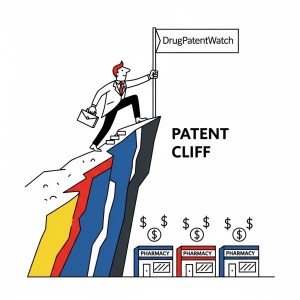
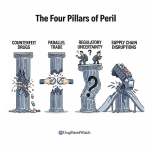
The pharmaceutical supply chain is a system where the loss of exclusivity for a brand-name drug creates a massive transfer of market value from innovator companies to generic manufacturers and payers. For a pharmacy, this transition is the most volatile period for margin management. Between 2025 and 2030, an estimated 200 billion to 400 billion dollars in branded drug revenue is at risk as dozens of blockbuster medications reach the end of their patent protection.1 When a small-molecule drug loses exclusivity, its revenue often drops by 80 percent to 90 percent within the first 12 months of multi-source generic entry.1 A pharmacy that does not track these specific entry dates accurately risks holding high-cost brand inventory while reimbursement rates plummet to generic levels.
Mastering this transition requires an understanding of the legal and regulatory triggers that dictate when a generic becomes available. The simple act of looking up an expiration date in the FDA Orange Book is insufficient for professional procurement.4 Launch dates are variables dependent on federal court outcomes, patent settlements, and 180-day exclusivity rewards.5 This report analyzes the economic mechanics of the 180-day duopoly, the tactics used by pharmacy benefit managers to extract margin during generic launches, and the strategic inventory models necessary to protect the bottom line.
## The Economics of Generic Displacement and Price Erosion
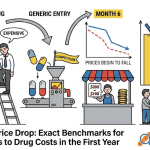
The entry of a generic drug into the market follows a predictable trajectory of price erosion. The magnitude of this decline depends on the number of manufacturers competing for the same molecule. According to FDA analysis, a single generic competitor typically enters the market at a price 31 percent to 39 percent lower than the brand price.6 This initial discount provides a significant margin opportunity for pharmacies, as the generic acquisition cost is lower than the brand, but the reimbursement rate from payers often lags, remaining at brand-like levels for a short period.
As more competitors enter, the price decline accelerates. With two competitors, the price drops by approximately 44 percent to 54 percent.5 When the market reaches six or more competitors, prices often plummet by more than 95 percent compared to the original brand price.4 This commoditization phase turns the drug into a high-volume, low-margin product where profitability depends on operational efficiency and wholesaler rebate compliance.
Number of Generic Labelers
Average Price Reduction (vs. Brand)
Market Dynamic
1 Manufacturer
31% – 39%
Supranormal profit window; high-margin duopoly.
2 Manufacturers
44% – 54%
Early competition; rapid share shift.
3 – 5 Manufacturers
60% – 79%
Competitive erosion; margin compression.
6 – 10+ Manufacturers
80% – 95%
Full commoditization; price near marginal cost.
### The 180-Day Duopoly and Supranormal Profits
The Hatch-Waxman Act provides a 180-day period of market exclusivity to the first generic manufacturer that successfully challenges a brand-name patent via a Paragraph IV certification.8 This window is the economic engine of the generic industry. During these six months, the market structure shifts from a monopoly to a duopoly consisting of the brand manufacturer and the first generic filer.9 This limited competition allows the first entrant to maintain relatively high prices while capturing up to 90 percent of the generic volume within weeks of launch.11
For a pharmacy, the 180-day window is the most lucrative phase of a drug’s lifecycle. The acquisition cost of the first generic is often 20 percent to 30 percent below the brand price, but because no other generic options exist, the pharmacy maintains strong bargaining power.5 Research indicates that generic companies generate 60 percent to 80 percent of their total lifetime profit for a molecule during this single 180-day window.11 Pharmacies that track these dates and dispense the generic on day one can capture a portion of this “supranormal” profit before the market opens to multiple competitors on Day 181.12
### Day 181 and the Flooding of the Market
The end of the 180-day exclusivity period marks a second, more severe inflection point known as Day 181. On this day, the FDA is permitted to approve any other pending generic applications for that molecule.12 The sudden influx of five, ten, or even twenty new manufacturers creates a ruthless race to the bottom on price.10
Pharmacies that do not adjust their inventory levels before Day 181 face significant financial risk. If a pharmacy is holding a large stock of the more expensive “first-to-file” generic, its value will vanish overnight as cheaper alternatives enter the market. The discount relative to the brand price often jumps from 30 percent to over 80 percent in a matter of days once the floodgates open.12 Professional procurement requires a countdown to Day 181 to ensure that inventory is drawn down and replaced with the lowest-cost NDCs available in the new, fully competitive landscape.
## PBM Manipulation of Maximum Allowable Cost Lists
Pharmacy benefit managers (PBMs) use Maximum Allowable Cost (MAC) lists to set the upper limit on what they will reimburse a pharmacy for a generic drug. While the stated purpose of these lists is to control costs, PBMs often manipulate the timing of MAC updates to extract margin from community pharmacies.13
When a new generic drug launches, its acquisition cost is often volatile. PBMs frequently update their MAC lists immediately when a price drops, ensuring they capture the savings for themselves. However, if a generic drug price increases due to a manufacturer exit or a supply chain shortage, PBMs often lag in updating the MAC list for months.13 During this time, the pharmacy is reimbursed at the old, lower rate while paying a higher acquisition cost, often resulting in a net loss on every prescription filled.
### MAC List Arbitrage and Spread Pricing
PBMs often use multiple, non-transparent MAC lists to generate revenue through spread pricing. In this model, the PBM reimburses the pharmacy using a low-rate MAC list but bills the plan sponsor or employer using a higher-rate list.13 The PBM pockets the difference, known as the spread.
Independent pharmacies have little negotiating power against these tactics. Because large PBMs control over 70 percent of the marketplace, pharmacies are forced to accept one-sided contracts that allow PBMs to set reimbursement rates arbitrarily.13 Pharmacies that proactively track generic entry dates can use this data to identify when a PBM has shifted a drug from a brand reimbursement schedule to a generic MAC schedule. If the MAC price is set before a generic is commercially available, the pharmacy can document the loss and file an appeal based on market reality.
### The Impact of Multiple MAC Lists on Independent Margins
The use of multiple MAC lists allows PBMs to discriminate against different types of pharmacies. An audit of Mississippi’s commercial drug claims in 2022 revealed that a large PBM used 49 distinct MAC lists. Independent pharmacies were reimbursed 74 percent less than chain pharmacies for the identical generic drugs.15 This discrepancy is often justified by PBMs as a “volume discount,” but it places independent pharmacies at a severe competitive disadvantage.
PBM Practice
Impact on Pharmacy Margin
Mechanism
Update Lag
Negative
Reimburses based on old prices after drug costs rise.
Spread Pricing
Negative
PBM pockets the difference between client charge and pharmacy pay.
MAC Arbitrage
Negative
Using different lists for different pharmacy networks.
Immediate MAC Drop
Neutral to Negative
Reimburses less as soon as a low-cost generic is available.
## Wholesaler Generic Compliance Ratios and Rebates
The majority of a community pharmacy’s profit comes from generic drug rebates provided by their primary wholesaler. To secure these rebates, pharmacies must adhere to a generic compliance ratio, which is the number of generic units purchased divided by the total units.16
Wholesalers use tiered systems to reward pharmacies that maintain high compliance. A pharmacy that hits a 20 percent volume might receive a 20 percent rebate, while hitting a 25 percent volume could trigger a 35 percent rebate.16 These rebates are essential for survival. For a typical pharmacy, the difference between the lowest and highest tiers can represent more than 15,000 dollars in monthly income.16
### The Compliance Ratio Trap During Brand Loss of Exclusivity
When a blockbuster brand drug loses exclusivity, it creates a massive shift in a pharmacy’s purchasing data. If a pharmacy continues to buy the brand drug instead of the new generic, or if they purchase the generic from a secondary wholesaler to save a few dollars on the invoice price, they risk falling out of their primary wholesaler’s top rebate tier.
A single decision to buy a generic medication from a secondary supplier to save 50 dollars can cause a pharmacy’s generic compliance to drop from 20 percent to 19.99 percent. For an average pharmacy, this single purchase could result in the loss of 3,000 dollars in rebates for that month.16 Tracking generic entry dates allows a pharmacy to ensure that all high-volume new generics are sourced through the primary wholesaler on the first day of availability, protecting the overall rebate structure.
### Rebate Tiers and Annual Profitability
The financial impact of wholesaler compliance is cumulative. Over a single year, a pharmacy that manages its generic purchasing through proactive data tracking can earn between 27,600 and 210,000 dollars in additional rebates.16 This revenue is often the difference between a profitable operation and a business failure.
Compliance Level
Monthly Rebate (Avg)
Annual Profit Impact
High Tier (Top performance)
$17,500
$210,000
Medium Tier
$8,500
$102,000
Low Tier (Entry level)
$2,300
$27,600
Below Minimum Tier
$0
$0
## Patent Litigation as a Procurement Signal
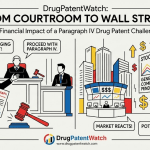
The timing of a generic launch is rarely a matter of simple patent expiration. Most early entries are the result of settlements in patent litigation. Under the Hatch-Waxman Act, a generic applicant must certify that the patents listed in the FDA Orange Book are either invalid or will not be infringed by the generic product. This is known as a Paragraph IV certification.17
When a brand-name company receives a Paragraph IV notice, it has 45 days to file a patent infringement lawsuit. Filing this suit triggers an automatic 30-month stay on FDA approval of the generic drug.17 This 30-month window provides the brand company with a guaranteed period of delay, but it also provides pharmacies with a clear timeline for when competition might begin.
### The 30-Month Stay and Settlement Dates
Pharmacies must monitor the outcome of these 30-month stays. If a generic manufacturer wins its case in a district court, the stay can be lifted early, allowing for an immediate launch.5 More often, the parties reach a settlement that allows the generic to enter the market on a specific, “licensed” date before the actual patent expires.20
For example, the diabetes drug Januvia (sitagliptin) had a core patent expire in 2023, but secondary patents extend through 2027. Merck reached settlements with over 25 generic companies, allowing them to launch in May 2026.2 A pharmacy that only looks at the 2027 patent expiration date would be unprepared for the market shift in 2026. Data from DrugPatentWatch shows that the median time between the expiration of a 30-month stay and the actual launch of a generic is 3.2 years, indicating that litigation or strategic settlements are the true determinants of timing.5
### The Ranbaxy Bottleneck and Regulatory Risk
Regulatory quality issues can also delay generic entry even after patents have expired. A historical example is the “Ranbaxy Bottleneck.” Ranbaxy was the first filer for several blockbuster drugs, granting them 180 days of exclusivity. However, because the FDA discovered fraud in Ranbaxy’s manufacturing data, their applications were frozen.9 Under the law at the time, no other generic could launch until Ranbaxy’s 180-day clock had run, but the clock could not start because they could not launch. This left the market in a state of “parked exclusivity,” where the brand continued its monopoly because the generic challenger was stuck in regulatory limbo.9 Pharmacies must track the FDA approval status and manufacturing compliance of generic filers to identify these potential delays.
## The New Frontier: Medicare Price Negotiation
The introduction of the Medicare drug price negotiation program under the Inflation Reduction Act has introduced a new layer of complexity to pharmacy reimbursement. For the first ten drugs selected for negotiation, the government has set a Maximum Fair Price (MFP) that replaces traditional reimbursement models.23
For a pharmacy, the transition to MFP represents a significant revenue loss. Initial estimates suggest an annual revenue loss of 40,279 to 46,475 dollars per pharmacy.23 This loss occurs because the MFP sets a reimbursement ceiling that is often no better than the pharmacy’s acquisition cost, eliminating the small margins previously earned on these high-cost brand-name drugs.23
### The MFP Liquidity Gap and Cash Flow Shortfalls
Beyond the loss of margin, the MFP model creates a liquidity challenge. In the traditional model, pharmacies receive reimbursement from PBMs shortly after dispensing. Under the MFP system, pharmacies will experience a delay in receiving manufacturer refund payments.23
Calculations suggest a weekly cash flow shortfall of approximately 10,838 dollars per pharmacy.23 While a 14-day prompt pay window exists for manufacturer refunds, many payments may fall outside the same calendar year as the acquisition costs, meaning a pharmacy might pay for 14 acquisition cycles but only receive 13 refund cycles in a given year.23 Tracking generic entry is the only way to escape this “MFP trap.” If a bona fide generic enters the market for an MFP drug, the negotiation process is suspended, and the drug returns to a market-based pricing model.23
### Impact on 340B Providers and Specialized Networks
Specialized providers, such as 340B Covered Entities, face even more drastic impacts from the transition to MFP. These providers acquire brand medications at 25 percent to 50 percent lower costs than standard pharmacies, historically yielding higher margins on those drugs.23 The shift to MFP eliminates this advantage. The margin loss for a 340B provider can range from 307 to 555 dollars per transaction, leading to an estimated annual impact of 240,060 to 433,633 dollars.23 For these entities, the ability to switch to a generic alternative as soon as exclusivity ends is not just a margin strategy; it is a requirement for organizational survival.
Medicare Negotiation Impact
Value (Estimated)
Entity Affected
Annual Revenue Loss
$40,279 – $46,475
Standard Retail Pharmacy
Weekly Cash Flow Shortfall
$10,838
Standard Retail Pharmacy
Annual Margin Loss (340B)
$240,060 – $433,633
340B Covered Entity
Per-Transaction Margin Loss
$307 – $555
340B Provider
## Authorized Generics and the Revenue Tax
An Authorized Generic (AG) is the brand-name drug product sold under a generic label. Because the AG is approved under the brand’s original New Drug Application (NDA), the brand manufacturer can launch it at any time, including during the 180-day exclusivity period awarded to an independent generic challenger.3
Brand companies use AGs as a defensive tactic to disrupt the high margins that an independent generic filer would otherwise enjoy. The entry of an AG converts the generic’s monopoly into a duopoly, which typically reduces the first-filer’s revenue by 40 percent to 52 percent during the exclusivity window.3 For a pharmacy, an AG is often the first “generic” available, and it is identical to the brand product, which can help overcome patient skepticism regarding bioequivalence.25
### Price Moderation and the No-AG Bargaining Chip
While AGs reduce the profit for the generic manufacturer, they can lead to lower prices for consumers and pharmacies. Research from the FTC shows that retail prices in the 180-day window are 4 percent to 8 percent lower when an AG is present, and wholesale prices are 7 percent to 14 percent lower.26
In some cases, brand manufacturers use the promise not to launch an AG as a bargaining chip in settlement negotiations. The brand company agrees to hold its AG off the market in exchange for the generic manufacturer agreeing to delay its entry. The FTC has characterized these “No-AG” commitments as a form of illegal pay-for-delay payment, as they protect the brand’s monopoly for longer while rewarding the generic challenger with a period of guaranteed high prices once they eventually launch.22 Pharmacies must monitor these “No-AG” commitments to predict whether price erosion will be moderate or rapid during the first six months.
### Authorized Generic Trends in 2024 and 2025
The use of authorized generics has become a fixture of the U.S. market, with roughly 85 launches occurring per year.26 However, recent studies published in 2025 indicate that the practice of delaying authorized generics through settlements is on the decline due to increased regulatory scrutiny from the FTC and DOJ.29 In 2024 and 2025, it has become increasingly common for brand manufacturers to launch their AG on the exact same day as the independent generic to maximize their remaining revenue.26
Competitor Type
Approval Pathway
Launch Timing
Impact on Price
First-to-File Generic
ANDA (Paragraph IV)
At patent expiry or settlement
31% – 39% reduction.
Authorized Generic
Original NDA
Any time (including during exclusivity)
Additional 7% – 14% drop.
Subsequent Generic
ANDA
Day 181 (after exclusivity ends)
80% – 95% reduction.
## Strategic Inventory Management for Loss of Exclusivity
The transition from a brand monopoly to generic competition is the primary determinant of pharmacy asset valuation. For small-molecule drugs, this transition is a “cliff,” while for biologics, it behaves more like a “slope”.3 Professional procurement requires different strategies for each profile.
For small-molecule “cliffs,” such as Januvia or Eliquis, the revenue loss is catastrophic and immediate. Pharmacies must employ a “Day 1 Imperative” strategy. This involves identifying the exact launch date and drawing down brand-name inventory to near-zero levels 30 days prior.7 Any units of the brand drug remaining on the shelf on the day the generic launches will lose most of their reimbursement value instantly.
### The Day 1 Imperative and Stock Drawdown
A successful Day 1 launch requires a multi-disciplinary approach that aligns legal, regulatory, and commercial functions. Procurement leaders should use Total Cost of Ownership (TCO) models rather than simple acquisition price to make buying decisions.30
Operating costs that are often hidden in the TCO model include:
Labor costs for managing drug shortages when a low-cost supplier fails to deliver.
The carrying cost of high-value brand inventory that could be replaced by lower-cost generics.
The risk of expiration or price protection loss during the transition period.
The impact of split-sourcing on wholesaler rebate compliance.
### Biosimilar Slopes and Clinical Inertia
In contrast to the rapid shift of small molecules, biosimilars (generic versions of biologic drugs) face a more gradual uptake. This is because biosimilars are not always automatically interchangeable at the pharmacy level. Substitution often depends on prescriber behavior and payer formulary placement.3
The price floor for biosimilars is also much higher. While small-molecule generics can drop to 5 percent of the brand price, biosimilars typically stabilize at a 15 percent to 40 percent discount.3 Pharmacies must manage biosimilar inventory with a more gradual drawdown, as patients may be shifted to the new product over months rather than days. The launch of Stelara (ustekinumab) biosimilars in early 2025 is a primary example of this “slope” dynamic.32
Erosion Profile
Small-Molecule “Cliff”
Biologic “Slope”
Year 1 Revenue Loss
80% – 90%
30% – 70%
Competitor Count
10+
2 – 5
Price Floor
5% – 10% of Brand Price
50% – 85% of Brand Price
Substitution
Automatic (AB-Rated)
Not Automatic (Unless Interchangeable)
## Case Study: The 2025 Stelara Biosimilar Wave
The loss of exclusivity for Stelara (ustekinumab) in early 2025 provides a real-world case study in the complexity of modern drug launches. Stelara, a blockbuster treatment for psoriasis and Crohn’s disease, generated 9.72 billion dollars in global sales in 2022.33 Its patent protection was extended through a series of settlements, creating a “launch group” of biosimilars in the first half of 2025.
Amgen launched the first interchangeable biosimilar, Wezlana, on January 1, 2025.32 This was followed by Alvotech/Teva’s Selarsdi in February and Sandoz’s Pyzchiva later that month.32 These products launched with massive discounts off the Stelara wholesale acquisition cost (WAC). Pyzchiva launched at an 80 percent discount, while Yesintek entered at a 90 percent discount.32
### Private-Label PBM Deals and Market Access
A critical detail for pharmacies was the use of private-label deals by PBMs. Sandoz/Samsung Bioepis signed a deal with an undisclosed PBM for the distribution of Pyzchiva, effectively securing formulary placement through a vertical partnership.32 Johnson & Johnson, the innovator, immediately sued Samsung Bioepis for breach of settlement, alleging that this private-label arrangement would cause “irreparable harm” and significant erosion of Stelara’s remaining market share.32
For a pharmacy, this litigation meant that the availability of certain Stelara biosimilars was at risk from the first week. Pharmacies that tracked the BLA approval dates and the litigation dockets could navigate these supply chain disruptions. By March 2025, there were already four competing biosimilars on the market, creating a unique “multi-source slope” that provided immediate margin relief for pharmacies that had drawn down their Stelara brand stock in December 2024.
## The 2026 Innovation Frontier and Patent Thickets
Looking ahead to 2026, several more blockbuster drugs are set to face generic competition. However, innovator companies are increasingly using “patent thickets”—a series of overlapping secondary patents on formulations, dosages, and delivery devices—to extend their monopolies.1
For example, Eliquis (apixaban), an anticoagulant with over 10 billion dollars in sales, has a core compound patent that was extended to November 2026. However, a complex thicket of secondary patents could potentially push full competition as far as 2040.1 Pharmacies that rely on the 2026 date without investigating the litigation status of the secondary patents may find themselves waiting for a generic that will not arrive for another decade.
### Januvia and sitagliptin-Based Franchise Shifts
The sitagliptin franchise (Januvia and Janumet) is the most significant opportunity in 2026. Merck has reached settlements that allow for a commercial launch in May 2026, even though the salt/polymorph patents extend to 2027.2 This is a high-certainty event because the settlements involve more than 25 separate generic companies.
A pharmacy with high Januvia volume should treat May 2026 as a “Hard Launch” date. This means drawing down inventory starting in March and preparing for a rapid shift in reimbursement. Because Januvia is a small molecule, the price will likely drop by 70 percent to 90 percent within the first few months as the large number of settlement parties enter the market simultaneously.2
### Major Drugs Losing Exclusivity (2025-2026)
Brand Name
Active Ingredient
2023 Sales (US)
Predicted Launch
Januvia
Sitagliptin
$2.25 Billion
May 2026
Xeljanz
Tofacitinib
$1.61 Billion
Aug 2025 / 2026
Ozempic
Semaglutide
$20+ Billion (Global)
Mar 20, 2026
Eliquis
Apixaban
$4 Billion
Nov 21, 2026
Pradaxa
Dabigatran
Not Available
March 7, 2026
Voltaren
Diclofenac
$0.2 Billion
June 16, 2026
Rexulti
Brexpiprazole
$0.6 Billion
April 12, 2026
Bridion
Sugammadex
$0.3 Billion
Jan 27, 2026
## Conclusion: The ROI of Precision Tracking
The financial viability of the modern pharmacy depends on its ability to navigate the patent cliff. Reactive procurement, which relies on wholesaler notifications, is a system that transfers profit away from the pharmacy and toward PBMs and manufacturers. By tracking Paragraph IV certifications, 30-month stays, and patent settlements, pharmacies can transform intellectual property data into a competitive advantage.
The ROI of this approach is quantifiable. A pharmacy that hits its top-tier wholesaler rebates through disciplined generic purchasing can earn an additional 15,000 dollars per month. A pharmacy that avoids the MFP liquidity gap by switching to generics as soon as exclusivity ends protects its weekly cash flow by over 10,000 dollars. Finally, a pharmacy that draws down brand inventory before a generic “cliff” avoids thousands of dollars in uncompensated acquisition costs. In the high-volume, low-margin world of pharmacy, these precision adjustments are the difference between growth and insolvency.
## Key Takeaways
The 180-day exclusivity period is a duopoly phase where the first generic entrant captures 90 percent of the market while maintaining a price only 30 percent below the brand.10
PBMs use non-transparent MAC lists and update delays to extract margin. Pharmacies must track entry dates to challenge reimbursement rates that do not reflect current market availability.13
A 1 percent swing in generic compliance can cost a pharmacy 3,000 dollars in monthly rebates. All new generics should be sourced through the primary wholesaler on Day 1 to protect these tiers.16
Small-molecule generics follow a “cliff” erosion profile (90 percent drop), while biologics follow a “slope” profile (gradual decrease). Inventory drawdown strategies must be tailored to these specific lifecycles.3
Medicare MFP negotiations will create a weekly cash flow shortfall of 10,838 dollars per pharmacy. Switching to generics is the primary mechanism to escape these negotiated price traps.23
## FAQ
### What is the difference between a licensed entry date and a patent expiration date? A patent expiration date is the legal end of a drug’s monopoly based on the patent term. A licensed entry date is the result of a legal settlement where the brand company allows a generic to enter the market before the patent expires in exchange for ending a lawsuit. Pharmacies must track these settlement dates, as they are often years earlier than the expiration dates listed in the Orange Book.18
### How does an Authorized Generic affect a pharmacy’s 180-day exclusivity margin? An Authorized Generic (AG) is the brand drug in a generic package. Because it can launch during the 180-day window, it turns a generic monopoly into a duopoly. This presence typically reduces the independent generic’s revenue by 40 percent to 52 percent and lowers wholesale prices by an additional 7 percent to 14 percent.3
### Why is the 75-day forfeiture rule important for pharmacies to track? For drugs designated as Competitive Generic Therapies (CGT), the manufacturer must market the drug within 75 days of approval or they lose their 180-day exclusivity. This prevents manufacturers from “parking” exclusivity to delay competition. Pharmacies should watch this 75-day window to see if a market will open to full competition earlier than expected.10
### What is “MAC list arbitrage” and how can a pharmacy spot it? MAC list arbitrage occurs when a PBM uses different pricing lists for different pharmacies or for different clients. A pharmacy can spot this by comparing its reimbursement rate for an NDC against the rates received by other pharmacies in the same region or through a Pharmacy Services Administrative Organization (PSAO). Wide discrepancies often indicate the PBM is manipulating the MAC lists for its own profit.15
### How will the Medicare MTF impact a pharmacy’s weekly cash flow? The Medicare Transaction Facilitator (MTF) model introduces a delay in manufacturer refund payments for drugs with a Maximum Fair Price (MFP). Instead of receiving full reimbursement at the point of sale, pharmacies will experience a weekly cash flow shortfall of approximately 10,838 dollars as they wait for the manufacturer to process the refund.23
Estimating the Value of Adding 30 Days to the 180-Day Market Exclusivity of the First-to-File Generic Drug Manufacturer – PMC – NIH, accessed February 5, 2026, https://pmc.ncbi.nlm.nih.gov/articles/PMC12796020/