Who this is for: Business development leads managing loss-of-exclusivity (LOE) timelines, IP counsel evaluating secondary patent thickets, portfolio managers modeling post-cliff revenue tails, and buy-side analysts pricing patent risk into pharma equity.
Section 1: The Patent Cliff, By the Numbers
The Economics of Exclusivity
Every composition-of-matter (CoM) patent granted by the USPTO runs for 20 years from its earliest filing date. For a drug that takes 10 to 12 years from IND filing to commercial launch, the effective period of market exclusivity is often closer to eight years. That eight-year window is where everything happens: pricing power, margin expansion, the revenue that funds the next pipeline. When it closes, the financial effect is fast and severe.
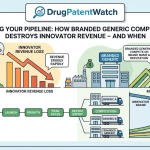
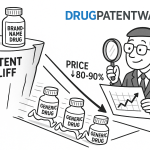
Pfizer’s atorvastatin (Lipitor) is the case study that never gets old, because the numbers are so stark. Before generic entry in November 2011, Lipitor generated approximately $9.6 billion in global sales annually. U.S. branded sales collapsed by more than 80 percent within 12 months of generic launch. In Q1 2012 alone, U.S. Lipitor revenue fell from roughly $1.5 billion to $240 million, a drop no cost-cutting program could absorb. Pfizer’s response included a large-scale authorized generic (AG) deal with Watson Pharmaceuticals (now Allergan Generics), which captured a portion of the volume loss but at drastically lower margins.
Lipitor’s case is not exceptional. It is the template. IQVIA data consistently show that branded small-molecule drugs lose 80 to 90 percent of prescription volume within 12 months of first generic entry when multiple ANDA filers are present. The pattern is different in specialty categories with fewer generic filers, where volume erosion may run to 50 to 60 percent in year one. The critical input is ANDA count, and tracking Paragraph IV certifications before they mature into generic launches is a core BD function, not an afterthought.
Market Exclusivity Types: What Survives the CoM Patent Expiry
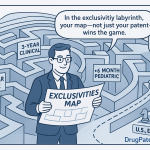
The CoM patent is not the only clock running. Understanding the full exclusivity stack is mandatory for valuing any mature asset. Four categories matter.
New Chemical Entity (NCE) data exclusivity under the Hatch-Waxman Act blocks the FDA from approving any ANDA or 505(b)(2) application that relies on the innovator’s safety and efficacy data for five years from first U.S. approval. This exclusivity runs parallel to and independently of patent protection. If a company’s CoM patent expires before the NCE exclusivity period ends (unusual but possible for late-filing or fast-expiring patents), the NCE clock is what controls generic entry. The practical implication for out-licensing: an asset with 18 months of NCE data exclusivity remaining has a defensible commercial window that its bare patent life would not reveal.
Pediatric exclusivity attaches an additional six months to all existing exclusivities and Orange Book-listed patents when the holder completes FDA-requested pediatric studies under the Best Pharmaceuticals for Children Act (BPCA) or the Pediatric Research Equity Act (PREA). Six months sounds modest; on a product generating $2 billion annually, it is worth approximately $1 billion in protected revenue. It is licensable IP, and its presence in a deal package changes valuation calculations materially.
Orphan Drug Exclusivity (ODE) grants seven years of marketing exclusivity in the U.S. for drugs treating conditions affecting fewer than 200,000 patients. ODE runs concurrently with patent protection but can extend protection for an asset whose CoM patent has already expired. A mature drug with a newly approved orphan indication carries ODE value into a licensing deal that a purely patent-focused due diligence would miss.
Secondary patents, covering formulations, dosing regimens, delivery systems, manufacturing processes, or method-of-use claims, may survive the CoM patent by years. They are the core of the ‘patent thicket’ strategy and the source of most Paragraph IV litigation in the U.S. pharmaceutical market. The Orange Book lists all patents that a holder has certified as relevant to product approval; as of 2024, the average branded drug in the U.S. had more than six Orange Book-listed patents. Each one is a potential litigation lever and a deal asset.
IP Valuation: The Lipitor Patent Estate as a Case Study
Pfizer’s atorvastatin estate illustrates how secondary patents layer value on top of a CoM.
The CoM patent on atorvastatin calcium (U.S. Patent 4,681,893) expired in March 2010 under standard 20-year term calculation, though Pfizer held a valid pediatric extension that delayed generic entry until November 30, 2011. That six-month extension was worth, by industry estimates, approximately $1.8 billion in protected U.S. revenue at Lipitor’s then-current run rate.
Pfizer also held formulation and process patents that generic companies challenged via Paragraph IV certifications. Ranbaxy (now Sun Pharma) filed the first Paragraph IV against Lipitor in 2003 and secured 180-day first-filer exclusivity by statute, which it eventually monetized through a settlement agreement with Pfizer that included an authorized generic arrangement. The financial value of that 180-day exclusivity to Ranbaxy, and the strategic value of the AG deal to Pfizer, both flowed directly from the IP architecture of the secondary patent estate, not from the CoM.
For teams evaluating mature assets for out-licensing, this structure has a direct implication: the dollar value of the out-licensing package is not simply a function of remaining CoM patent life. It is a function of the full exclusivity stack, including secondary patents by jurisdiction, any remaining NCE or pediatric extensions, the Orange Book listing status, and the litigation posture with any active Paragraph IV filers. A pre-deal patent audit conducted in parallel with commercial due diligence is not optional; it is the foundation of the rNPV model.
Patent Term Extensions Under 35 U.S.C. Section 156
A Patent Term Extension (PTE) under 35 U.S.C. 156 restores up to five years of patent life lost during FDA regulatory review. The calculation is complex: the extension equals roughly half the IND period plus the full NDA review period, subject to a cap of five years’ extension and a maximum of 14 years of effective exclusivity from approval. Importantly, only one patent per product may receive a PTE, which means choosing the right patent, typically the CoM, to extend is itself a strategic IP decision.
PTEs are public record and searchable through USPTO databases. When conducting due diligence on a mature asset, confirming whether a PTE was obtained, correctly calculated, and applied to the highest-value patent is a non-trivial task. Errors in PTE applications have been contested successfully by generic filers. A BD team that uncovers an incorrectly calculated PTE during licensee due diligence has found a deal-pricing variable that will drive the conversation in negotiation.
Key Takeaways: Section 1
Patent expiry for a branded small-molecule drug triggers 80 to 90 percent volume loss within 12 months when more than two ANDA filers are present. The out-licensing decision must be made at least 36 months before that date to capture maximum negotiating leverage. The IP estate that matters is the full exclusivity stack (CoM patent, NCE data exclusivity, pediatric extensions, ODE, secondary formulation and method-of-use patents, and Orange Book listings), not just the primary patent expiry date. Failure to map this stack before approaching a licensee is a mispricing event.
Section 2: The IP Valuation Framework for Mature Assets
Risk-Adjusted NPV Modeling for Post-Exclusivity Revenue
Risk-adjusted Net Present Value (rNPV) is the standard tool for valuing pharma assets, and it requires particular care for mature drugs because the key variables, generic entry timing, price erosion rate, and residual branded market share, carry high uncertainty.
The rNPV model for a mature asset builds from a peak sales figure and discounts forward using two adjustment mechanisms: a probability-weighted generic entry schedule and a price-erosion curve calibrated to the number of ANDA filers and the reimbursement environment.
The generic entry schedule derives from tracking Paragraph IV filings. A drug with six Paragraph IV filers, all of whom have received tentative approvals, will face a different year-one price dynamic than one with two filers in active litigation. DrugPatentWatch, Citeline’s Pharmaprojects, and the FDA’s Paragraph IV certification database (published in the Federal Register) are the primary public data sources. The first generic to win a Paragraph IV challenge retains 180-day exclusivity under Hatch-Waxman, during which the market typically settles at a price roughly 20 to 30 percent below brand. After that exclusivity expires and multiple generics enter, prices move to 85 to 90 percent below brand within 24 months.
The price-erosion curve is steeper in markets with aggressive pharmacy benefit manager (PBM) formulary management. In the U.S., PBMs routinely move branded drugs to non-preferred tiers the moment a generic is available, which accelerates substitution beyond what clinical inertia alone would predict. Modeling this correctly requires understanding the formulary landscape for the specific therapeutic category.
For biologics, the erosion curve is shallower. EvaluatePharma and IQVIA data on the first wave of U.S. biosimilar launches (post-2015) show average price discounts of 20 to 40 percent from reference biologic list prices, and market share losses in year one of only 10 to 30 percent in most therapeutic areas. This creates a different rNPV structure and, correspondingly, a different out-licensing value proposition.
Quantifying Secondary Patent Value
Secondary patents have real but probabilistic value. Their contribution to an rNPV model requires estimating two inputs: the probability that each secondary patent survives an ANDA or IPR challenge, and the revenue it protects if it does survive.
Inter Partes Review (IPR) at the USPTO Patent Trial and Appeal Board (PTAB) has materially changed the risk calculus for secondary patents since the America Invents Act (AIA) came into full effect in 2012. PTAB institutes IPR petitions at a rate of approximately 60 percent of petitions filed, and instituted trials result in at least partial cancellation of claims in over 70 percent of cases, based on USPTO statistics through 2024. This means that a secondary patent cited as protective in a licensing deal package needs to be stress-tested against its IPR vulnerability before it enters the rNPV as a full-value asset.
A structured approach assigns each secondary patent a ‘survival probability’ based on claim breadth (narrow, specific claims survive IPR at higher rates), prior art density in the relevant technical field, and litigation history (has the patent already survived a district court challenge?). A formulation patent on a common excipient combination will carry a lower survival probability than a method-of-use patent covering a novel therapeutic mechanism in a disease area with sparse prior art.
The resulting output is a probability-weighted secondary patent portfolio value, expressed in dollars, that the licensor can present as defensible deal value in negotiation.
Brand Equity as a Quantifiable Asset
Brand equity is not soft value. For a drug that has been first-line therapy for a decade or more, prescribing inertia, physician trust, and patient preference for the branded product translate directly into revenue that persists post-LOE. The market research methodology to quantify this is specific: conjoint analysis or discrete choice experiments with prescribers, measuring willingness to prescribe branded over generic when price difference is held constant.
In markets where branded substitution is physician-directed rather than pharmacy-driven (CNS, for example, or complex specialty categories where physicians counsel patients directly on adherence), brand loyalty is measurable and material. A licensee paying for the right to commercialize a ‘branded generic’ or ‘authorized generic’ version of a trusted CNS product is buying a prescribing preference that survives patient switches to PBM-mandated substitution.
The brand equity calculation feeds into rNPV as an adjustment to the base case residual market share assumption. If conjoint data show that 15 percent of prescribers would choose the branded product at a 30-percent price premium over generic, that 15-percent retention carries a significantly higher gross margin than the volume that converts to the authorized generic, and it is a distinct line item in the deal’s financial projections.
Transfer Pricing and Royalty Rate Setting in Cross-Border Deals
Cross-border out-licensing deals introduce transfer pricing complexity that is often underestimated. When an innovator licenses a mature asset to a partner in a different tax jurisdiction and receives royalties, the royalty rate must be set on an ‘arm’s length’ basis consistent with OECD Transfer Pricing Guidelines and local tax law. Both the licensor and licensee are exposed to transfer pricing audits if the royalty deviates materially from comparables.
The Comparable Uncontrolled Transaction (CUT) method uses actual royalty rates from comparable licensing transactions as benchmarks. The Profit Split method allocates combined profits from the licensed asset in proportion to each party’s relative contribution (IP ownership, marketing investment, manufacturing). For mature, off-patent drugs, the Profit Split is typically the more defensible approach when no perfect CUT comparables exist.
A deal that looks financially attractive on a gross royalty basis may look different after accounting for withholding taxes, which range from zero (under certain tax treaties) to 25 percent in some jurisdictions on royalty payments, and after the licensor’s own local tax treatment of that income. Optimal deal structuring includes tax counsel in the negotiation from the outset, not as a post-signing cleanup exercise.
Key Takeaways: Section 2
rNPV models for mature assets must incorporate the full Paragraph IV filing landscape, calibrated price erosion curves by ANDA filer count and PBM formulary posture, and probability-weighted secondary patent survival rates post-PTAB IPR risk. Brand equity is quantifiable through prescriber conjoint analysis. Transfer pricing rules constrain royalty rate setting in cross-border deals and must be factored at term sheet stage.
Investment Strategy: Section 2
For institutional investors pricing patent risk into pharma equity, the market consistently underestimates residual value in branded drugs with strong physician loyalty and narrow generic competition (fewer than three ANDA filers). Stocks of companies holding these assets often trade at near-zero implied value for the mature drug’s post-LOE revenue tail. An out-licensing deal that surfaces even $200 to $400 million in NPV from that tail can be a meaningful catalyst on a mid-cap name. The signal to watch: a company that files an 8-K disclosing an out-licensing deal for a mature asset with double-digit royalty rates and geographic carve-outs in emerging markets, while retaining U.S. commercial rights. That structure is the tell of a well-managed LOE transition, not a distressed asset sale.
Section 3: Out-Licensing as Active Portfolio Management
The Opportunity Cost of Defensive Commercialization
The case against continuing to commercialize a post-LOE branded drug internally is fundamentally about opportunity cost, not pride.
An oncology sales force costs approximately $350,000 to $500,000 per rep per year in total compensation, benefits, and infrastructure when fully loaded. A company deploying 200 reps against a cardiovascular drug losing 80 percent of its market to generics is spending $70 to $100 million annually to defend revenue that is structurally impaired. That same headcount and budget, redeployed to support an early commercial oncology or immunology launch, would operate against a market where the incremental return on sales investment is vastly higher.
The portfolio logic extends beyond commercial resources. Every management hour spent on a declining asset is an hour not spent on pipeline prioritization, partnership negotiations for next-generation assets, or navigating a Phase 3 data readout. The organizational bandwidth cost of a mature asset, while harder to quantify than the sales force budget, is real and documented in organizational design research.
Out-licensing resolves the opportunity cost problem cleanly. The asset moves to a partner whose entire commercial model is built around products in exactly this lifecycle stage, and the innovator receives a structured financial return (upfront, milestones, royalties) that converts the declining revenue tail into a near-term capital event.
Three Categories of Mature Asset Value
Mature drug assets carry value in three distinct categories, and each category may be most efficiently extracted by a different type of partner.
Revenue protection value is the gross profit that survives in the branded market even after generic entry. It is highest in therapeutic areas with physician-directed prescribing, complex delivery mechanisms that slow generic substitution, or markets with limited PBM influence. A specialty pharma partner with a focused therapeutic area sales force is typically the best vehicle for extracting this value.
Geographic expansion value is the revenue available in markets the innovator has not penetrated, typically emerging economies in Latin America, Southeast Asia, the Middle East, and Africa, where brand reputation carries weight, regulatory pathways are navigable for an experienced local partner, and generic competition may be less developed. A regional pharmaceutical champion is the right vehicle for this category.
Life cycle management value is the incremental revenue and IP protection available from formulation development, fixed-dose combination products, new indications, or OTC switches. This category often requires a partner with specific development capabilities. Capturing it in the deal structure means defining LCM rights explicitly at signing and agreeing on royalty economics for any new products before the licensee has an incentive to resist those terms.
Key Takeaways: Section 3
Defensive internal commercialization of post-LOE assets is an opportunity cost problem, not a revenue optimization strategy. Out-licensing converts a structurally declining P&L line into a capital event and a royalty annuity. The optimal partner type differs by value category: specialty pharma for revenue protection, regional champions for geographic expansion, development-capable players for LCM value.
Section 4: The Evergreening Technology Roadmap
Evergreening is the industry term for using secondary patents and regulatory strategies to extend effective market exclusivity beyond the CoM patent. It is the subject of regulatory and antitrust scrutiny and public criticism, but it is a legal and widely used commercial strategy. For out-licensing purposes, understanding the remaining evergreening potential of an asset is essential to pricing it correctly.
Stage 1: Formulation and Delivery Innovation
The most common evergreening tactic is the development of a new formulation that offers a genuine (or arguable) clinical advantage over the original and that can be patent-protected independently. The technology roadmap for this stage runs roughly as follows.
Extended-release (ER) or controlled-release (CR) reformulation of an immediate-release drug typically takes 18 to 36 months from initiation to NDA filing under the 505(b)(2) pathway, using the innovator’s existing safety data combined with new pharmacokinetic bridging studies. The resulting product can carry a new CoM patent (if the extended-release polymer matrix is novel) or, more commonly, a formulation patent that extends protection by 8 to 12 years from filing. AstraZeneca’s Nexium (esomeprazole magnesium), the ‘purple pill,’ is the definitive example: a single-enantiomer reformulation of omeprazole (Prilosec) that successfully transitioned sales to a new, patent-protected product before Prilosec’s cliff.
Pediatric formulations, including oral liquids, orally disintegrating tablets (ODTs), or age-appropriate dosing regimens, trigger PREA compliance obligations but also generate three years of additional market exclusivity for the formulation change and six months of pediatric exclusivity if conducted under BPCA. A licensee with pediatric development capabilities may extract this value even from an asset the innovator has abandoned for LCM purposes.
Device-integrated delivery systems carry the highest barrier to generic competition. An inhaler device, auto-injector, or metered-dose pump that is integral to product function is covered by device patents separately from drug patents. Generic drug manufacturers must navigate not just the drug patent estate but also device intellectual property, often held by third-party device specialists. GlaxoSmithKline’s Advair Diskus generated sustained revenue protection well into the post-LOE period precisely because Ellipta-device alternatives required device patent clearance in addition to drug patent challenges.
Stage 2: Fixed-Dose Combination Products
Fixed-dose combinations (FDCs) combine two or more active pharmaceutical ingredients into a single dosage form. When one component is a mature, off-patent molecule, combining it with either another mature molecule or a newer compound creates a new regulatory and IP entity.
The regulatory path is typically a 505(b)(2) NDA relying on existing clinical data for each component supplemented by new fixed-dose pharmacokinetic and safety data. The patent strategy covers the combination per se (the specific ratio of components, the specific formulation achieving that ratio) rather than either molecule independently. These combination patents are harder to design around and have shown strong IPR survival rates when the combination is truly novel.
In cardiovascular medicine, FDCs became a systematic strategy. Pfizer’s Caduet combined atorvastatin (Lipitor) and amlodipine (Norvasc), creating a new IP-protected product that extended the commercial life of both branded molecules and captured compliance-driven prescribing in a single-pill regimen. Both components had robust generic competition independently; the FDC created a period of renewed exclusivity. The model has been replicated in diabetes (GLP-1 agonists combined with basal insulin), hypertension, and HIV (where single-tablet regimens like Biktarvy are arguably the most commercially successful FDC strategy in pharmaceutical history).
For an out-licensing deal, FDC rights are high-value provisions. The licensing agreement must specify: does the licensee have the right to develop an FDC incorporating the licensed molecule? Who bears the development cost? Who owns the resulting FDC patent? And at what royalty rate will the licensor participate in FDC sales? Leaving these questions to ‘good-faith negotiation’ at some future date, as illustrated in Section 11’s ‘ImmuGuard’ cautionary case study, is a structural flaw that consistently produces costly disputes.
Stage 3: New Indication Development
A new approved indication generates three years of market exclusivity for the new label change under Hatch-Waxman, even for a molecule already off-patent. If the new indication qualifies for orphan drug status (a disease affecting fewer than 200,000 patients in the U.S.), ODE applies and extends to seven years.
The technology roadmap for indication expansion runs much longer than formulation development: a Phase 2a proof-of-concept study typically takes two to three years, a Phase 3 program another three to five years, and regulatory review 12 to 18 months thereafter. Total timeline from indication hypothesis to approval runs eight to ten years, which means this strategy requires early initiation, ideally before or simultaneous with the core patent cliff.
An out-licensing partner with therapeutic area expertise may be willing to fund this development in exchange for licensed rights to the new indication. The licensor retains the original indication rights (or licenses them separately) while the licensee bears all development risk and cost for the new indication, paying a royalty to the licensor on any resulting sales. The IP ownership structure for the new indication patents should be negotiated at signing: a standard approach grants the licensee ownership of new indication IP they develop, with the licensor receiving a royalty and retaining a right-of-first-negotiation for any future acquisition of that IP.
Stage 4: OTC Switch Strategy
The Over-the-Counter (OTC) switch converts a prescription-only drug to a non-prescription product after demonstrating that consumers can safely self-select and self-administer the treatment without physician oversight. The FDA’s OTC switch pathway requires new consumer behavior studies (label comprehension studies, actual use studies) and a separate NDA or supplement.
A successful OTC switch reaches a consumer market orders of magnitude larger than the prescription market, but at far lower per-unit prices and with entirely different distribution economics. The switch also generates three years of market exclusivity for the OTC formulation. Johnson & Johnson’s switch of loratadine (Claritin) from Rx to OTC in 2002, timed to coincide with Schering-Plough’s patent expiry, is the canonical example of using an OTC switch to reposition a blockbuster franchise before generic competition eliminated its prescription revenue entirely.
For out-licensing purposes, the OTC switch is a complex but high-value right to assign. A consumer healthcare company (Haleon, Kenvue, P&G Health) has the retail distribution infrastructure, the marketing capabilities for direct-to-consumer, and the formulation expertise to execute an OTC switch that a pure-play pharma company may not. Including OTC switch rights in a licensing deal, with clear governance over the development process and financial terms tied to OTC net sales rather than prescription net sales, broadens the pool of potential licensees and the financial ceiling of the deal.
Stage 5: The Interplay of Evergreening Tactics with Antitrust Risk
Evergreening strategies exist in a regulatory and legal environment that has grown more hostile to practices perceived as anticompetitive. The FTC’s 2023 report on pharmaceutical mergers and the Biden and Trump administrations’ drug pricing executive orders both targeted patent thicket strategies and authorized generic deals as subjects of elevated scrutiny.
The Orange Book Reform Act provisions embedded in the Consolidated Appropriations Act of 2023 require drug companies to withdraw Orange Book patents that the FDA determines do not satisfy listing criteria. The FTC has used this provision to challenge device patents listed for drug-device combinations, arguing that some innovators have used device patent listings to improperly block generic entry. Companies structuring an out-licensing deal that includes a device-integrated product must now assess whether their Orange Book listings are litigation-defensible under this tightened standard, as a delisted patent disappears from the deal value calculation.
In the EU, the European Commission’s pharmaceutical sector inquiry (published 2009) and the subsequent rise of pay-for-delay enforcement under Articles 101 and 102 TFEU have created specific constraints on settlement agreements with generic competitors in the context of European licensing deals. Servier’s perindopril litigation (Commission Decision of 2014, upheld partially by the Court of Justice of the EU in 2023) established that value transfers from brand to generic in a settlement agreement can constitute a market-sharing arrangement, regardless of how the transfer is structured (royalty, license, supply arrangement, or outright payment). European counsel must review any licensing deal where the licensee is also a potential generic competitor.
Key Takeaways: Section 4
The evergreening technology roadmap has five stages: formulation and delivery innovation (18 to 36 months, typically a 505(b)(2) path), FDC development (three to five years), new indication development (eight to ten years), OTC switch (two to four years for consumer studies), and the integration of device IP. Each stage generates distinct patent protection and regulatory exclusivity. The deal structure for an out-licensing agreement must specify rights, cost allocation, and financial terms for each evergreening strategy the licensee may pursue. Antitrust risk, particularly from the FTC’s Orange Book reform campaign and the EU’s pay-for-delay enforcement, is a material constraint that must be assessed with specialized counsel before deal signing.
Section 5: Asset Identification: A Data-Driven Scoring System
Building a Portfolio Scoring Model
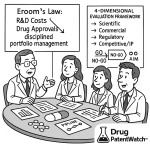
Not every mature drug is an out-licensing candidate. A disciplined internal process produces a rank-ordered priority list based on objective criteria. The scoring model should cover at least six dimensions.
Remaining exclusivity duration, measured as the weighted-average remaining life of all Orange Book-listed patents plus any applicable regulatory exclusivities, determines the length of the ‘brand protection window’ available to a licensee. Assets with longer weighted-average patent life are inherently more attractive because the licensee has more time to recoup development and marketing investments.
Market size and growth trajectory by geography identifies which assets have material value outside the innovator’s commercial footprint. A drug with $800 million in annual U.S. revenue but minimal penetration in Asia-Pacific, where disease burden for the indicated condition is high and healthcare spend is growing at 8 to 12 percent annually, carries geographic expansion value that a U.S.-centric analysis would miss.
Generic entry complexity, measured by the number of approved ANDAs or biosimilar applications, the presence of first-filer 180-day exclusivity, and the manufacturing barriers (sterility, device integration, biologic complexity), determines how much of the branded market share can realistically be defended or retained in a branded generic position.
LCM potential scores the asset against the evergreening roadmap described in Section 4. An asset with a feasible ER reformulation, a strong FDC partner molecule in the same therapeutic area, and a potential pediatric use case has higher LCM value than one where no further development pathways are evident.
Brand equity persistence, measured through prescriber surveys or, where available, actual post-LOE branded market share data from comparable molecules, predicts the residual prescription volume a licensee can reasonably capture.
Manufacturing complexity, from simple oral solid dosage (OSD) to complex sterile injectable to biological drug substance, determines the pool of qualified licensees and the feasibility of technology transfer. Higher complexity narrows the licensee pool but increases the defensibility of the asset and the deal’s financial terms.
The Role of Patent Intelligence Platforms
Manual patent monitoring at scale is operationally impossible. The Paragraph IV certification landscape for a company with a portfolio of 20 to 40 branded products, each with multiple Orange Book-listed patents, generates hundreds of data points that require continuous tracking.
Patent intelligence platforms consolidate this data. DrugPatentWatch tracks patent expiry dates globally, Orange Book listings, ANDA filings, Paragraph IV certifications by filer, tentative approvals, and first-filer exclusivity status. Citeline’s Pharmaprojects covers pipeline intelligence. Derwent Innovation and PatSnap track global patent family coverage for secondary patents.
The combination of these platforms allows a BD team to build the ‘Paragraph IV heat map’ for their portfolio: a jurisdiction-by-jurisdiction timeline of when each asset is at risk of generic entry, calibrated by filer count and litigation posture. That heat map drives the out-licensing priority list and sets the timeline for partner search.
The practical recommendation: establish a quarterly patent cliff review process in which the BD, IP, and commercial teams jointly update each asset’s exclusivity stack and generic entry probability model. The review output is a portfolio-wide ‘action list’ that identifies assets where out-licensing should be initiated, deals that should be accelerated, and assets where defensive litigation against Paragraph IV filers remains the right posture.
Key Takeaways: Section 5
Asset scoring on six dimensions (remaining exclusivity, geographic market opportunity, generic entry complexity, LCM potential, brand equity persistence, and manufacturing complexity) produces a defensible, rank-ordered priority list for out-licensing candidates. Patent intelligence platforms are a mandatory infrastructure investment for any portfolio with more than five products approaching LOE in the next five years.
Section 6: Profiling and Selecting the Right Licensee
Specialty Pharma: Deep Domain, High-Touch Execution
A specialty pharma company focused on a single therapeutic area brings three things to a mature asset that a large-cap innovator’s declining commercial organization cannot: focused sales force deployment, key opinion leader (KOL) relationships specific to the prescribing community, and the institutional motivation to fight for every percentage point of market share.
Companies in this category, think Supernus Pharmaceuticals (CNS), Assertio Therapeutics (pain and CNS), or Amneal’s specialty division, build their entire commercial model around acquiring and defending branded and branded-generic products in competitive markets. They have absorbed the cost of building therapeutic-area infrastructure and need volume across multiple products to justify that cost. A new in-license is a top-line driver, not a distraction.
The due diligence question for this partner type is commercial track record with analogous products: specifically, what is the prescribing coverage rate (percentage of target prescribers called upon monthly) and what is the realized market share retention rate they have achieved on comparable drugs in the post-LOE period? Companies willing to share those metrics in due diligence are serious bidders. Those who present projected share without historical validation should be pressed.
Generic and Hybrid Manufacturers: The Authorized Generic Play
An authorized generic (AG) is the brand-name drug, manufactured to the same specification as the reference listed drug, distributed by or under license from the innovator company under a generic drug label. The AG is not a Paragraph IV filer; it does not need to certify against Orange Book patents. It is launched at generic pricing (typically 20 to 30 percent below brand at first generic entry) but carries the supply reliability and quality assurance of the innovator’s manufacturing site.
The AG strategy has two commercial objectives. First, the innovator captures a direct financial return from volume that would otherwise flow to independent generic competitors. Second, a well-capitalized AG partner launched on Day 1 of generic entry creates intense price competition for other generic filers, compressing their margins and potentially deterring investment in that generic product by other players.
Pfizer deployed exactly this strategy with Lipitor: the Watson AG deal, signed 10 months before Ranbaxy’s first-filer entry, gave Watson an AG for sale during the 180-day exclusivity period and positioned Pfizer to collect royalties from both Watson’s AG sales and from its own branded Lipitor volume simultaneously.
The legal constraint to understand: the FTC monitors AG arrangements carefully under the post-Actavis framework. An AG deal where the innovator compensates the AG partner beyond a fair supply price, or where the AG partner agrees to limit competition in ways beyond the license scope, can attract antitrust scrutiny. Any AG arrangement should be reviewed by antitrust counsel with specific experience in Hatch-Waxman market dynamics before execution.
Emerging Market Specialists: Capturing Untapped Geographic Value
A regional pharma champion in a high-growth emerging market has three structural advantages for managing a mature branded asset that the innovator cannot replicate at reasonable cost: an existing regulatory dossier management capability with the local health authority (ANVISA in Brazil, CDSCO in India, COFEPRIS in Mexico, NMPA in China, BPOM in Indonesia), an established distributor and hospital access network, and the financial model to generate acceptable returns at price points that reflect local healthcare purchasing power.
For the innovator, the financial terms on an emerging market deal reflect the market’s growth trajectory rather than its current size. A mid-single-digit royalty on 2025 Brazilian cardiovascular drug sales may look modest in absolute dollar terms. On a compound annual growth rate of 9 to 12 percent in the Brazilian pharmaceutical market, projected through 2030, the NPV of that royalty stream over a 10-year deal term can be substantial, particularly when the alternative is zero revenue from a market the innovator has never entered.
The regulatory transfer component of an emerging market deal is often the long-lead item. Transferring the marketing authorization holder (MAH) status in multiple jurisdictions requires local regulatory filings and approval. The deal structure should include a ‘registration milestone’ payment schedule that compensates the licensor when each country-level approval is obtained, rather than a single lump sum that does not distinguish between successful and failed registrations. This aligns incentives and ensures the licensee prioritizes regulatory filings across the agreed territory.
Conducting Licensor Due Diligence on the Licensee
The due diligence process runs both ways, and the licensor’s investigation of the licensee is as critical as the reverse. The virtual data room (VDR) the licensor prepares for the licensee (containing clinical data, regulatory filings, the full IP dossier, commercial history, and manufacturing information) receives most of the planning attention. The licensor’s own review of the licensee receives less, often to the deal’s detriment.
Commercial diligence on the licensee should include independent verification of sales figures and market share data for analogous in-licensed products, reference checks with other companies that have licensed assets to the same party, and a review of any regulatory warning letters or consent decrees that the licensee’s manufacturing sites have received from the FDA or other authorities. A manufacturing quality problem at the licensee’s site post-deal transfer is the licensor’s brand problem too; the product still carries the original innovator’s name on the regulatory dossier in many jurisdictions.
Financial diligence on the licensee means reviewing audited financial statements, modeling their capacity to fund the upfront and milestone payments from available cash and credit facilities, and assessing their leverage ratio. A licensee that reaches maximum leverage shortly after signing the deal and cannot fund the marketing investment required to defend the branded market share is a deal structure failure, not a licensing success.
Key Takeaways: Section 6
Specialty pharma partners maximize revenue protection value; generic manufacturers execute AG strategies; emerging market specialists capture geographic expansion value. Each requires a different diligence framework. Licensor due diligence on the licensee, including verified commercial track records, manufacturing quality standing, and financial capacity, is as important as the reverse and must be completed before term sheet, not as a post-signing formality.
Section 7: Deal Architecture: Financial Engineering and Legal Precision
The Compensation Stack: Upfront, Milestones, Royalties
A well-designed compensation structure does three things: it compensates the licensor fairly for the value transferred at signing, it aligns the licensee’s incentives with the asset’s commercial success over time, and it creates enough financial upside on both sides to sustain the relationship through the inevitable challenges of post-deal execution.
The upfront payment is the price of access. It is non-refundable, provides the licensor with immediate capital, and signals the licensee’s conviction in the asset. Sizing the upfront is a negotiation that reflects the licensor’s alternative options (competitive tension from other bidders), the asset’s remaining exclusivity duration, and the balance of the other terms. A deal with a conservative royalty rate and modest milestones may justify a higher upfront; one with an ambitious milestone schedule and tiered royalties may command a lower upfront because the licensor participates more in upside.
Milestone payments structure the deal’s risk-sharing. Two categories of milestones are standard in mature asset deals. Regulatory milestones trigger on approval of the drug in a new major market (e.g., $15 million on EMA approval; $8 million on Health Canada approval), compensating the licensor for the asset’s regulatory value in territories where it was not previously registered. Sales milestones trigger when aggregate net sales in the licensed territory exceed defined thresholds (e.g., $25 million on first year exceeding $50 million in net sales; $50 million on first year exceeding $150 million). They are the licensor’s primary tool for participating in the upside of a well-executed commercial program without bearing the operational risk.
The royalty is the annuity. Standard royalty rates for mature branded pharmaceuticals licensed to specialty pharma or regional partners in post-LOE markets range from mid-single digits to low double digits as a percentage of net sales, depending on the asset’s competitive position, remaining IP protection, and the strength of the brand. Royalties on pure authorized generic arrangements typically run lower, reflecting the lower net margin structure of the generic market. Biologic out-licenses carry higher royalty rates, reflecting the higher barriers to biosimilar competition and the retained value of the brand.
Tiered royalty structures, where the royalty rate increases as net sales exceed defined thresholds, are the preferred design for deals where the licensor believes in the licensee’s ability to grow the business. The lower tier reduces the financial burden on the licensee during the ramp period; the higher tier rewards the licensor for every dollar of sales above the base case.
The ‘Net Sales’ Definition: Where Deals Are Won and Lost
The definition of ‘net sales’ in a royalty-bearing license agreement is the single most negotiated financial clause in these transactions, and for good reason. The licensor collects royalties on net sales; the licensee pays them. Every dollar of deduction from gross sales that the licensee is permitted to apply reduces the royalty base.
Standard permissible deductions from gross sales in pharma licensing agreements include trade discounts (direct discounts given to wholesalers and pharmacies), government rebates mandated by law (Medicaid best price rebates in the U.S., statutory rebates in EU markets), PBM rebates that are the price of formulary placement, returns and chargebacks, freight charges, and duties. Each category is legitimate. The negotiation centers on the breadth of each category and whether the deductions are capped.
The licensor’s position should be to define each category narrowly and explicitly, cap aggregate deductions as a percentage of gross sales (commonly 20 to 30 percent in mature pharma markets), and require the licensee to provide annual reconciliation reports with audit rights over the royalty calculation. The right to audit net sales calculations, with the ability to engage an independent accountant at the licensor’s expense, is non-negotiable. Royalty audits in pharmaceutical licensing consistently find discrepancies in the licensee’s favor; the average recovery from a well-executed pharma royalty audit typically exceeds the audit cost by a substantial margin.
Territory Definition and Field-of-Use Restrictions
Territory and field-of-use clauses in a pharmaceutical license agreement define the boundaries of the grant and protect the licensor’s ability to extract value from the asset through other channels or partners.
Territory should be defined exhaustively by country, not by region, to prevent ambiguity about whether a specific country is included. The inclusion of ‘and all territories and possessions thereof’ after each named country captures dependencies (e.g., French Guiana under France) that can otherwise become disputed. When the licensor plans to retain rights in certain markets, those exclusions must be explicit, and the agreement must address ‘passive sales,’ where the licensee’s product is ordered from outside the licensed territory by a customer in a territory the licensor has retained.
Field-of-use restrictions allow the licensor to grant a license only for specified indications while retaining rights to develop and commercialize the molecule for other indications independently. If the innovator has a Phase 2 program exploring the drug in a new oncology indication, a field-of-use restriction preserving the oncology field is a specific and essential clause that protects that value from being inadvertently granted away.
Termination Provisions and Post-Termination Obligations
Termination clauses are the exit architecture of any licensing agreement. They matter most when the relationship breaks down, which is precisely when careful drafting prevents the most harm.
The standard grounds for termination should include material breach by either party (with a cure period of 30 to 60 days for remediable breaches), insolvency or bankruptcy of the licensee, failure to use ‘commercially reasonable efforts’ (CRE) in commercializing the asset (defined with specificity rather than as a general standard), and, from the licensor’s perspective, any challenge by the licensee to the validity of the licensed patents. The patent non-challenge clause is contentious: courts in both the U.S. and EU have questioned its enforceability in certain circumstances, and antitrust implications of a strict no-challenge provision should be reviewed before inclusion.
Termination-for-convenience provisions, where the licensee can exit the deal by giving notice (typically 60 to 180 days) without cause, are a licensee-favorable term the licensor should grant only in exchange for a termination fee and a specific inventory sell-off period followed by a prohibition on manufacturing or selling the product. Without a termination fee, a licensee facing an unexpected market deterioration (a new competing generic launch or a formulary exclusion) has a costless option to exit the deal, transferring all downside risk back to the licensor.
Post-termination obligations must address supply continuity for patients, the return of all regulatory files and clinical data to the licensor, a transition assistance obligation requiring the licensee to cooperate with any new licensee for a defined period, and the fate of any inventory. A licensee holding six months of finished goods inventory at termination, which they can sell down at cost to recoup their investment, can depress the market and damage the brand reputation in the transitional period. Capping the sell-down period and specifying the pricing floor for terminated inventory protects both the asset and the patients depending on it.
Key Takeaways: Section 7
The compensation stack (upfront, milestones, royalties) must align licensee incentives with asset performance across the full deal term. The ‘net sales’ definition is the highest-leverage financial clause in the agreement; capping aggregate deductions and preserving audit rights are non-negotiable protections. Territory and field-of-use restrictions must be drafted exhaustively, not by reference to regions or vague categories. Termination provisions should specify cure periods, termination fees for convenience exits, and supply continuity obligations to protect patients and brand reputation.
Investment Strategy: Section 7
Analysts reviewing pharma licensing deal disclosures should parse royalty rate disclosures relative to net sales definitions. A 12-percent royalty on a permissive net sales definition (with uncapped Medicaid rebates and PBM rebates) may generate less actual cash than a 9-percent royalty on a tightly defined gross-to-net construct. Companies that disclose royalty rates without disclosing net sales deduction methodology are providing incomplete information to the market. Pressing investor relations for this detail, or modeling sensitivity to gross-to-net assumptions in deal NPV analysis, is a standard practice for pharma-specialist investors and an edge for those who apply it consistently.
Section 8: Biologics and Complex Generics: A Different Out-Licensing Calculus
Why Biologic LOE Looks Nothing Like Small-Molecule LOE
A biosimilar is not a generic drug. Generics require demonstration of bioequivalence to the reference product through pharmacokinetic studies. Biosimilars require demonstration of ‘no clinically meaningful differences’ to the reference biologic through a ‘totality of evidence’ pathway that typically includes structural and functional analytical studies, animal toxicology, and clinical pharmacokinetic and pharmacodynamic studies, plus in some cases clinical efficacy data.
The development cost of a biosimilar runs from $100 million to over $300 million, compared to $1 to $5 million for a small-molecule generic ANDA. This cost barrier limits the number of biosimilar competitors entering any given market, which means the price erosion and volume shift dynamics are fundamentally different from the small-molecule cliff.
The U.S. adalimumab (Humira) market after July 2023 illustrates the pattern. AbbVie’s Humira, which generated approximately $21 billion in global net revenues at peak, began facing biosimilar competition in the U.S. after an agreement between AbbVie and its Paragraph IV challengers delayed U.S. biosimilar entry from the theoretical patent expiry date to January 2023. By mid-2024, roughly a year after first biosimilar entry, Humira retained approximately 70 percent of U.S. unit volume in the reference product market, with biosimilars commanding only 20 to 30 percent. The price erosion was 30 to 40 percent on biosimilar net selling prices below Humira’s list price, but far less than the 85-to-90-percent discount typical of small-molecule generics.
This matters directly for out-licensing valuation: a mature biologic has a longer, shallower revenue tail post-LOE than a mature small molecule, and that tail carries a higher per-unit margin. The rNPV of the biologic’s post-LOE revenue stream is correspondingly higher, and the out-licensing deal value should reflect it.
Biosimilar Interchangeability: A Deal-Defining FDA Designation
The FDA Biologics Price Competition and Innovation Act (BPCIA) created two biosimilar pathways: standard biosimilar approval and interchangeability designation. An interchangeable biosimilar may be substituted for the reference product at the pharmacy without physician intervention, in states that have passed substitution laws (as of 2025, nearly all U.S. states have such laws). The commercial significance of interchangeability is that it enables pharmacy-level substitution, bringing the biosimilar’s competitive dynamic closer to (though not identical to) the small-molecule generic model.
Insulin biosimilars have the most extensive interchangeability designation experience. Semglee (insulin glargine-yfgn, manufactured by Viatris/Biocon) received the first FDA interchangeability designation for a complex biologic in July 2021. Its commercial impact was initially limited by formulary positioning decisions by PBMs, but it established that interchangeability is achievable and that the reference biologic’s LOE event, when an interchangeable biosimilar launches, is more severe than when only standard biosimilars are available.
For out-licensing of mature biologics, the interchangeability status of any competing biosimilars already on the market is a critical diligence input. A reference biologic with no interchangeable biosimilar competitors is a defensibly premiumizable branded asset. A reference biologic facing an interchangeable biosimilar with PBM formulary support is in a structurally different competitive position. The deal economics must reflect which scenario the licensee is actually entering.
Manufacturing as the Core IP Asset in Biologic Licensing
For a small-molecule drug, manufacturing is a commodity cost center that can be transferred to a contract development and manufacturing organization (CDMO) with manageable risk. For a biologic, the manufacturing process is the product. Cell line development, upstream bioreactor conditions, purification sequences, and glycosylation profiles are all integral to the molecule’s clinical performance and regulatory approval. The FDA’s position, established consistently across multiple guidance documents, is that a manufacturing change requires a new comparability exercise demonstrating that the product remains clinically equivalent before and after the change.
This means that for a mature biologic out-licensing deal, the technology transfer is not a logistics exercise; it is a scientific and regulatory project with a two-to-four-year timeline and a cost that can reach $50 to $100 million for a full site transfer. The alternative, a long-term manufacturing and supply agreement where the licensor continues to manufacture and supply the drug substance while the licensee handles fill-finish and commercialization, is far more common for mature biologic deals. This structure keeps the most complex manufacturing IP in the hands of the party best equipped to manage it.
The supply agreement in a biologic licensing deal is, in practical terms, as important as the license agreement itself. Drug substance pricing, capacity reservation requirements, technology transfer rights (if the licensee eventually wants to internalize manufacturing), batch release responsibilities, and the consequences of failed batches must be fully negotiated and documented. Disputes over biologic supply agreements between licensor and licensee are a consistent source of late-stage deal failures that could have been avoided with more thorough initial negotiation.
‘Authorized Biologic’ Structures
The authorized biologic, analogous to the authorized generic, is an emerging deal structure where the originator company deploys a lower-priced version of its own biologic through a separate channel or entity to compete directly with biosimilar entrants. AbbVie’s own-brand ‘biosimilar’ strategy for Humira through its unbranded version (adalimumab), offered at a significant list price discount to the branded Humira, is the highest-profile example.
The authorized biologic structure allows the originator to maintain manufacturing volume, which is critical for biologic cost efficiency (scale drives unit costs down), while capturing volume that would otherwise flow entirely to independent biosimilar manufacturers. It also allows the originator to offer the same clinical profile as the reference product, backed by the same pharmacovigilance infrastructure, at a competitive price point.
For out-licensing, the authorized biologic concept introduces a new licensee profile: large pharmaceutical companies or specialty biosimilar players who want to launch a biologically identical product without the cost of a full biosimilar development program. The license grants them the right to sell the originator’s manufactured product under a different label, at a different price tier. This is a more complex deal from a branding, regulatory, and pricing transparency perspective, but it is a rapidly evolving area of biologic commercialization.
Key Takeaways: Section 8
Biologic LOE dynamics are materially different from small-molecule LOE: slower volume erosion (10 to 30 percent in year one versus 80 to 90 percent), shallower price discounts (20 to 40 percent versus 85 to 90 percent), and longer revenue tails. Biosimilar interchangeability designation is a deal-defining competitive variable. Manufacturing IP is the primary defensible asset in a mature biologic, and a long-term manufacturing supply agreement is typically more practical than a full technology transfer. The authorized biologic model is an emerging deal structure worth evaluating for high-volume reference biologics facing imminent biosimilar interchangeability competition.
Investment Strategy: Section 8
Equity analysts covering large-cap biopharma should model mature biologic revenue tails using biosimilar-specific erosion curves, not small-molecule generic curves. Using the wrong erosion model overstates the severity of the biologic LOE event and understates the asset’s residual value. Companies with mature biologics entering the post-exclusivity period that announce out-licensing deals, particularly authorized biologic structures, should be modeled with the royalty income offsetting at least 20 to 30 percent of the branded revenue decline in the base case.
Section 9: The Regulatory and Antitrust Labyrinth
Hatch-Waxman Mechanics: Paragraph IV as a Competitive Intelligence Tool
The Drug Price Competition and Patent Term Restoration Act of 1984 (Hatch-Waxman Act) established the abbreviated regulatory pathway for generic drug approval in the U.S. and created the statutory framework that governs all U.S. pharmaceutical patent litigation and all authorized generic deals.
A Paragraph IV certification is a generic manufacturer’s declaration that an Orange Book-listed patent is invalid, unenforceable, or will not be infringed by the generic product. Filing a Paragraph IV certification triggers an automatic 30-month stay on FDA approval of the ANDA, during which the innovator may pursue patent infringement litigation in district court. The first company to file a substantially complete ANDA with a Paragraph IV certification against a particular patent receives 180 days of generic market exclusivity, which is the most valuable regulatory prize in the pharmaceutical generics industry.
For out-licensing strategy, Paragraph IV filings are the earliest available signal of generic competitive pressure. They are published in the Federal Register within 20 days of the ANDA acceptance date and are searchable through the FDA’s website and through platforms like DrugPatentWatch. A BD team that monitors Paragraph IV certifications in real time knows, within weeks of the filing, that a specific generic manufacturer has a completed ANDA and is prepared to challenge the product’s IP. That signal should directly inform the timeline for initiating out-licensing partner discussions: a Paragraph IV filing with a serious generic filer is the moment to move, not a moment to wait and see.
FTC v. Actavis (2013) and the Post-Actavis Compliance Framework
The Supreme Court’s 2013 decision in FTC v. Actavis established that ‘pay-for-delay’ settlements (also called ‘reverse payment’ settlements) between brand-name pharmaceutical companies and Paragraph IV filers are subject to antitrust scrutiny under the rule of reason. The decision rejected the prior predominant view that such settlements were immune from antitrust challenge if they fell within the scope of the underlying patent.
The practical post-Actavis compliance framework requires that any settlement of Paragraph IV litigation include: a clear business justification for any value transferred from the brand to the generic company beyond a reasonable estimate of litigation cost avoidance; documentation showing that the generic’s entry date in the settlement is earlier than the patent expiry date (a later entry date than the patent would require is a structural red flag); and no restraints on the generic’s ability to manufacture or market non-infringing products outside the scope of the specific settlement.
For out-licensing transactions involving assets where Paragraph IV litigation is ongoing or has been settled, the deal structure must be reviewed under this framework. A royalty-bearing license granted to a Paragraph IV filer as part of a litigation settlement is permissible if the royalty reflects fair market value and the entry date is not later than what would result from fully litigated patent claims. A license that includes a non-compete covenant (restricting the licensee from launching other generic products in the same therapeutic area) is a significant antitrust exposure. Every such deal should receive pre-signing review from antitrust counsel with specific Hatch-Waxman experience.
European Competition Law: Articles 101 and 102 TFEU
The European Commission applies EU competition law to pharmaceutical licensing agreements through two provisions: Article 101, which prohibits agreements that restrict competition, and Article 102, which prohibits abuse of a dominant market position.
The Servier perindopril enforcement action (Commission Decision C(2014) 4955) is the defining case. The Commission found that Servier had used a combination of patent acquisition strategies, Paragraph IV-analog settlements with generic companies, and supply agreements to delay generic entry for perindopril, and that this conduct constituted a market-partitioning arrangement under Article 101. The Commission imposed fines totaling approximately 428 million euros. The General Court partially annulled the decision on the market dominance findings under Article 102 in 2018, but the Court of Justice of the EU largely reinstated the Commission’s analysis in July 2023.
For European out-licensing deals, the compliance implications are specific. Any value transfer from the brand to a potential generic competitor (whether structured as a royalty, a supply discount, a license fee, or any other form of commercial consideration) must be justified by a legitimate commercial rationale that does not rely on the generic company delaying its market entry. Territorial restrictions in the license (limiting the licensee to specific EU member states) must comply with the EU’s ‘passive sales’ rules under the Vertical Block Exemption Regulation (VBER), updated in 2022, which limits the ability of a licensor to restrict a licensee from accepting orders from customers outside the designated territory.
Information exchange provisions in the licensing agreement, such as obligations to share commercial data, sales reports, or market intelligence, must be designed to avoid creating a mechanism for coordinating competitive behavior. Even legitimate monitoring provisions (royalty audit rights, sales reporting) can attract scrutiny if they go beyond what is reasonably necessary for the licensor to verify its royalty income.
Key Takeaways: Section 9
Paragraph IV filings are the primary real-time signal of imminent generic entry and should trigger the out-licensing timeline. The post-Actavis compliance framework requires careful structuring of any license granted to a Paragraph IV litigation adversary, with documented justification for any value transfers and no entry-date restrictions beyond what the patent supports. EU compliance under Articles 101 and 102 TFEU limits territorial restrictions and mandates that any value transfer to a generic competitor have a legitimate commercial justification independent of entry-delay.
Technology Transfer: The Scientific and Regulatory Project
A technology transfer for a pharmaceutical product is the transfer of all process, analytical, and quality knowledge required to manufacture the drug at a new site to the same standard as the originating site. It is one of the most technically demanding activities in pharmaceutical operations, and it routinely takes longer and costs more than planned.
For small-molecule OSD products (tablets, capsules), a tech transfer to a qualified CDMO or the licensee’s own manufacturing facility takes 12 to 18 months under favorable conditions: well-characterized process, complete batch records, validated analytical methods, and an experienced receiving site. The tech transfer includes process documentation transfer, analytical method transfer and co-validation, process performance qualification (PPQ) batches at the receiving site, stability testing of PPQ batches, and a regulatory submission (prior approval supplement in the U.S. or a Type II variation in the EU) before commercial product can be released from the new site.
For complex dosage forms (sterile injectables, drug-device combinations, or controlled-release formulations), add six to 12 months. For biologics, the timeline extends to two to four years, and the cost of bioreactor qualification, cell bank transfer, upstream and downstream process validation, and comparability studies can reach $50 to $100 million. These numbers must be in the deal economics before signing. If the licensor is absorbing the tech transfer cost, the upfront payment should reflect it. If the licensee is absorbing it, their financial model must be stress-tested against a tech transfer overrun.
The ‘human transfer’ is the underappreciated component of every tech transfer. Process documents convey what is done; experienced process scientists convey why it is done that way and what to do when the process deviates from specification. The licensing agreement should include a specific ‘know-how transfer’ provision requiring the licensor to make subject-matter experts available to the licensee for a defined period post-signing, with costs allocated explicitly. Failure to include this provision, or to treat it as a trivial formality, is a consistent contributor to failed tech transfers.
Manufacturing and Supply Agreements: The Operational Backbone
When the licensor continues to manufacture and supply the drug to the licensee under a Manufacturing and Supply Agreement (MSA), the MSA is the operational backbone of the partnership. Its quality and specificity determine whether patients receive a consistent, high-quality product and whether both parties can manage the commercial relationship without constant renegotiation.
Supply pricing mechanisms come in two forms. Cost-plus pricing sets the supply price as the licensor’s actual cost of goods sold plus a defined percentage margin. It is transparent but requires the licensor to share detailed manufacturing cost data, which creates confidentiality sensitivities and may constrain the licensor’s flexibility to optimize its manufacturing network. Fixed-price-per-unit is simpler to administer but requires price adjustment mechanisms to handle raw material cost inflation and currency fluctuation. Most MSAs in the pharmaceutical sector use a fixed price with annual adjustments tied to a defined inflation index (e.g., the U.S. Producer Price Index for pharmaceutical preparations) and a cap on year-over-year increases.
Forecasting and ordering provisions must balance the licensee’s need for supply flexibility against the licensor’s need for manufacturing planning certainty. A common structure provides for a 24-month rolling forecast updated monthly, with the first three months ‘firm and binding’ (the licensee must take and pay for any ordered quantity), the next three months ‘semi-firm’ (variable within a defined percentage band), and the remaining 18 months ‘indicative only.’ Safety stock requirements on both sides, typically two to four months of forward coverage, protect against supply disruption.
Alliance Management: The Governance Layer That Prevents Disputes
A Joint Steering Committee (JSC) with decision-making authority over specified areas (commercial strategy, regulatory filings, LCM investment decisions, supply planning) is the standard governance structure for a pharmaceutical licensing partnership. The JSC operates under a charter that defines membership, meeting frequency, decision-making rules (unanimous versus majority), and escalation pathways when the JSC cannot reach agreement.
The alliance manager role, one on each side of the partnership, is the daily operational interface between the two organizations. Alliance managers resolve routine issues, facilitate information flow, flag emerging problems before they escalate to the JSC, and maintain the relationship’s working health between formal governance meetings. Companies that underinvest in experienced alliance management for their out-licensing deals, treating it as a coordination role for junior staff rather than a senior commercial function, consistently report higher rates of partnership failure and dispute escalation.
Key Takeaways: Section 10
Tech transfer timelines (12 to 18 months for simple OSD, up to four years for biologics) and costs must be in the deal economics before signing. The MSA is the operational backbone of any deal where the licensor retains manufacturing; its pricing, forecasting, quality, and supply continuity provisions are as important as the license agreement itself. Alliance management is a senior commercial function, not an administrative one. JSCs and alliance managers are the governance infrastructure that determines whether a structurally sound deal delivers its projected value.
Section 11: Case Studies
Case Study 1: AstraZeneca and the Nexium Evergreening Playbook
AstraZeneca’s esomeprazole (Nexium) strategy is the most widely analyzed pharmaceutical lifecycle management case in the industry, and it remains directly relevant to out-licensing planning because it illustrates the timing relationship between LCM execution and out-licensing opportunity.
AstraZeneca launched Nexium in 2001, two years before omeprazole (Prilosec) lost U.S. patent protection. Nexium was a single-enantiomer reformulation of omeprazole’s racemic mixture, covered by a new composition patent, with clinical data supporting modest efficacy advantages in a subset of patients. The clinical and commercial argument was close enough to generate significant prescriber adoption before omeprazole generics arrived.
What AstraZeneca did not do was out-license Nexium’s underlying formulation IP during the period when it was generating $5 billion in annual global sales. By the time Nexium’s own patent protection approached expiry (U.S. generic entry occurred in 2014), the peak sales period had already funded AstraZeneca’s pipeline. The lesson for out-licensing planners: the Nexium model works for companies that execute the LCM play themselves and have the commercial infrastructure to transition physicians from the old to the new product. For companies lacking that infrastructure in a given market or therapeutic area, the equivalent strategy is to find a licensee who can execute the same transition and share the value.
Case Study 2: The Warner Chilcott / Allergan Branded Asset Aggregation Model
Warner Chilcott (acquired by Allergan in 2013 for approximately $8.5 billion) built its entire business model around acquiring mature branded drugs in women’s health, dermatology, and gastroenterology from innovator companies who no longer prioritized them commercially. The Warner Chilcott model demonstrates what a well-focused specialty pharma licensee or acquirer does with a mature asset: it deploys a tightly focused sales force, invests in patient support programs, pursues aggressive formulary access, and executes targeted LCM (notably extended-release reformulations in dermatology).
From the licensor’s perspective, the Warner Chilcott model validates the specialty pharma licensee profile described in Section 6. Innovator companies that out-licensed or sold mature women’s health or dermatology assets to Warner Chilcott received upfront payments at multiples of what the asset would have generated internally in a managed-decline scenario, plus in some cases continuing royalties. The assets performed better commercially under Warner Chilcott’s focused management than they had as declining priorities of a large-cap pharmaceutical company.
Case Study 3: The ‘Respira’ Partner Selection Failure (Illustrative)
The original source article’s ‘Respira’ case study illustrates a failure mode that appears in real-world deals with enough frequency to warrant specific attention. The structural failure was prioritizing the upfront payment over partner capability.
A device-integrated respiratory product requires a licensee with three specific capabilities: a sales force experienced in respiratory care and capable of training physicians and patients on device technique, a manufacturing and supply chain team capable of managing device components (inhaler canisters, actuators, or spacers) with the same rigor as drug substance, and a regulatory team experienced with combination product submissions (which require coordination between the drug and device centers at FDA).
A primary care-focused licensee typically has none of these capabilities at the required depth. The highest upfront payment in a licensing negotiation does not compensate for a licensee who will fail to execute. This is not hypothetical: real-world licensing failures for device-integrated respiratory products (not named here for legal reasons) have produced exactly the pattern described: supply disruptions caused by device component manufacturing problems, below-target sales from sales force inexperience, and eventual deal termination with brand reputation damage.
The preventive measure is a capability-weighted scoring matrix for licensee selection, where commercial capability, regulatory expertise, and manufacturing quality scores each carry defined minimum thresholds below which a bidder is disqualified regardless of their financial offer. Building this into the formal partner selection process removes the bias toward selecting the highest bidder.
Case Study 4: The ‘ImmuGuard’ Ambiguous LCM Rights Dispute (Illustrative)
The ‘ImmuGuard’ case from the source article illustrates a documentation failure rather than a partner selection failure. ‘Good faith negotiation’ clauses in licensing agreements are not provisions; they are placeholders for conversations that were too difficult to have at signing.
The specific failure: a licensee who independently funds subcutaneous reformulation of a licensed biologic has invested capital and IP-creation capacity into an asset they do not fully own. When the original agreement is silent on royalty terms for the new formulation, both parties have maximally incompatible incentives in the resulting negotiation. The licensor wants full benefit of an asset they perceive as enhanced by the licensee’s investment, using the licensor’s underlying IP. The licensee wants full retention of value from an asset they developed at their own risk.
The fix is technical and well-understood: at the time of the original license agreement, include a schedule that defines the royalty rate applicable to any line extension or new formulation developed by the licensee using the licensed molecule, the royalty rate applicable to a fixed-dose combination incorporating the licensed molecule, the ownership of any new IP generated by the licensee, the licensor’s right to acquire that new IP (via a right-of-first-negotiation or right-of-first-refusal), and the financial terms of any such acquisition. This is a long schedule to negotiate at the outset, and both sides may resist the specificity. It is far less expensive than an arbitration.
Key Takeaways: Section 11
The AstraZeneca Nexium case shows that the LCM window for an asset precedes its out-licensing window. Companies that execute LCM themselves and then out-license at the end of the protection period have the strongest deal leverage. The Warner Chilcott model confirms that specialty pharma licensees genuinely outperform internal managed-decline commercialization for focused therapeutic areas. The Respira and ImmuGuard case studies identify the two most common structural failure modes: partner selection driven by upfront payment rather than capability, and LCM rights left ambiguous in the original agreement.
Section 12: Competitive Intelligence and Technology Platforms
Building a Real-Time Patent Monitoring Infrastructure
A company with a portfolio of 15 or more branded products approaching LOE within a 10-year planning horizon requires continuous, automated patent monitoring across multiple jurisdictions. This is not achievable with manual tracking processes. The operational components of a functional monitoring infrastructure include the following.
A primary patent intelligence platform, such as DrugPatentWatch, provides U.S. Orange Book data, Paragraph IV certification tracking, ANDA approval tracking, and global patent expiry calendars. This is the core tool for the BD and IP teams. A secondary platform covering global patent families (Derwent Innovation or PatSnap) tracks secondary patent filings in jurisdictions beyond the U.S., which is critical for out-licensing deals covering Europe, Japan, or emerging markets, where the secondary patent landscape may differ materially from the U.S. A regulatory intelligence platform (Citeline’s Pharmaprojects, Evaluate Pharma) tracks pipeline products that may compete with the mature asset in the post-LOE period, which is a variable in rNPV modeling that is frequently underweighted.
These platforms should feed into a centralized portfolio dashboard, maintained by the business development team and reviewed in a quarterly cross-functional meeting (BD, IP, commercial, R&D). The dashboard output is the LOE risk-adjusted revenue model for each asset and the action list described in Section 5.
AI-Assisted Partner Identification and Deal Valuation
Large language models and machine learning systems are beginning to change how BD teams build long lists of potential licensees. The manual approach of reading company websites, scanning press releases, and attending conference partnering sessions produces a list constrained by human bandwidth and existing network bias. AI-assisted tools can scan a much larger universe of potential partners and surface companies whose therapeutic focus, geographic footprint, past deal activity, and financial profile match a specific asset’s requirements.
Practical AI applications in pharma BD include natural language processing of scientific publications to identify companies with published interest in a therapeutic mechanism, analysis of deal databases (Citeline Deals, GlobalData) to identify companies with a track record of in-licensing mature assets in the relevant therapeutic area, and financial statement parsing to score potential licensees by financial capacity to fund the deal and the associated commercial investment.
AI partner-identification tools do not replace human judgment. They produce a higher-quality long list. The conversion from long list to short list still requires human validation: phone conversations, relationship mapping, and qualitative assessment of strategic fit and cultural compatibility. The value is efficiency: BD teams using AI-assisted tools report being able to complete a comprehensive partner search in six to eight weeks rather than the three to four months required by traditional methods.
Real-World Evidence as a Deal Asset
Real-World Evidence (RWE), derived from insurance claims data, electronic health records, patient registries, and pharmacy dispensing data, has become a standard component of pharmaceutical regulatory submissions, payer negotiations, and licensing transactions. For a mature drug with 10 or more years of market history, the RWE base is substantial and potentially more persuasive to a licensee’s clinical and medical affairs team than the original registration trial data.
Specific RWE analyses that add deal value include long-term safety evidence from pharmacovigilance databases (which can be particularly reassuring for licensees considering an OTC switch strategy), patient adherence and persistence data comparing the branded drug to therapeutic alternatives (which quantifies the brand loyalty advantage), outcome comparisons between the brand and early generic competitors (which provides clinical justification for a premium pricing strategy in markets where branded generic positioning is feasible), and off-label use pattern data (which may identify a new indication worth pursuing under a licensee-funded development program).
Packaging the RWE alongside the clinical trial data package in the VDR, with explicit analysis demonstrating its implications for the licensee’s commercial and regulatory strategy, is a differentiating move that signals analytical sophistication and strengthens the licensor’s negotiating position.
Key Takeaways: Section 12
A three-platform monitoring infrastructure (patent intelligence, global patent family, regulatory pipeline) is the minimum viable technology stack for portfolio LOE planning. AI-assisted partner identification tools reduce long-list construction time from months to weeks and reduce network-bias distortion in partner selection. RWE is a genuine deal asset for mature drugs and should be explicitly packaged for the VDR with analysis of its commercial implications, not simply deposited as a raw data file.
Section 13: The Inflation Reduction Act Variable: A New Wrinkle in Mature Asset Valuation
IRA Provisions That Directly Affect Out-Licensing Economics
The Inflation Reduction Act (IRA) of 2022 introduced Medicare drug price negotiation for the first time in U.S. history. The CMS negotiation program, which began with insulin products and selected small-molecule drugs in 2024 and is expanding to additional products in subsequent years, directly changes the post-LOE revenue model for certain asset categories.
The IRA’s ‘small molecule disadvantage,’ a term widely used in the industry to describe the different exclusivity schedules under the IRA for small molecules versus biologics, is a material structural issue. Under the IRA, small-molecule drugs become eligible for Medicare price negotiation nine years after FDA approval, regardless of their patent status. Biologics become eligible 13 years after approval. This means a small molecule with a patent-protected period of 12 years and strong branded revenues in year nine or ten is subject to CMS-negotiated pricing years before its competitors would be similarly constrained.
For out-licensing planning, the IRA introduces a new variable in the rNPV model: the probability and magnitude of a Medicare negotiated price, and its spillover effect on commercial market pricing. If CMS negotiates a significant reduction in the Medicare reimbursement rate for a drug, that reduction may create downward pricing pressure in the commercial market through formulary management by PBMs, who use Medicare negotiated prices as a benchmark.
Assets with high Medicare patient populations (cardiovascular, diabetes, oncology) are more exposed to this pressure than assets in therapeutic areas with younger patient demographics. A mature cardiovascular or diabetes drug approaching its nine-year eligibility window for CMS negotiation is a materially different out-licensing proposition than it was before the IRA’s passage.
IRA Impact on Biologic Out-Licensing Value
The IRA’s 13-year small-molecule/biologic differential has already changed pharmaceutical R&D investment behavior, with companies redirecting development resources from small molecules toward biologics that have a longer negotiation-free exclusivity window. For out-licensing planning, this has two implications.
Mature biologics entering the post-exclusivity period in the near term benefit from the 13-year window: if a biologic was approved in 2012, it becomes eligible for Medicare negotiation in 2025. If it was approved in 2015, the window extends to 2028. The timing of the negotiation window relative to the out-licensing deal’s royalty term determines whether the licensee’s sales in the Medicare channel will be at market price or at a CMS-negotiated price, a distinction that can affect deal NPV by tens to hundreds of millions of dollars.
The practical implication for deal structuring: for assets approaching IRA negotiation eligibility, the licensor should model the royalty tail under both a market-price and a CMS-negotiated-price scenario and propose royalty rate adjustments triggered if a CMS negotiated price goes into effect. Building IRA price adjustment provisions into the royalty structure, rather than leaving both parties exposed to an undiscounted outcome, is a forward-looking structural move that both parties benefit from.
Impact on Emerging Market Deals
The IRA’s domestic provisions do not directly govern pricing in other countries. But the policy environment the IRA represents, a shift toward government drug price intervention in the largest pharmaceutical market, influences the reference pricing systems used by many countries.
Countries with external reference pricing (ERP) systems that benchmark against U.S. prices, Germany’s AMNOG system takes a value-based approach rather than reference pricing, but many smaller European countries and several Asian markets do reference U.S. prices in their reimbursement negotiations, may see downward pressure on reference prices as CMS-negotiated prices become the U.S. benchmark. A licensee operating in markets with U.S.-referenced ERP systems should model the impact of potential CMS-negotiated prices on their local reimbursement baseline before committing to the royalty terms of an emerging market out-license.
Key Takeaways: Section 13
The IRA’s Medicare price negotiation provisions introduce a new and undermodeled variable into mature asset rNPV calculations for U.S. deals. Small molecules become eligible for CMS negotiation nine years post-approval; biologics at 13 years. Assets with high Medicare patient populations are most exposed. Deal structures for these assets should include IRA price-adjustment provisions in the royalty formula. Emerging market deals referencing U.S. prices through ERP systems are indirectly affected by CMS-negotiated prices.
Investment Strategy: Section 13
Institutional investors should model IRA Medicare negotiation probability for any pharma company’s mature assets generating more than $200 million in annual U.S. Medicare channel revenue and approaching the nine-year (small molecule) or 13-year (biologic) eligibility threshold. Companies that announce out-licensing deals with IRA-adjusted royalty structures signal awareness of this risk and active management of it, which is a positive signal about management’s overall LOE preparedness. Companies that appear not to have modeled the IRA impact into their out-licensing deal valuations are carrying unpriced downside.
Section 14: Future Deal Structures and Market Trends
Portfolio-Based Licensing: The Clean Separation
The next evolution in mature asset out-licensing is the portfolio deal, where an innovator out-licenses a basket of five to ten mature products to a single licensee or a newly formed entity. This ‘clean separation’ model allows the innovator to exit an entire segment of its commercial portfolio in a single transaction, rather than managing multiple individual deals across different partners.
The Viatris formation (the 2020 combination of Mylan and Pfizer’s off-patent branded medicines division, Upjohn) is the large-cap version of this concept: Pfizer created a separate company to house its mature portfolio and spun it off, achieving a clean organizational separation that allowed Pfizer to focus its capital and management attention on its innovative pipeline. The deal generated upfront value for Pfizer shareholders via the spinoff structure while placing the mature assets in an entity designed and resourced to manage them optimally.
For smaller-scale portfolio deals, a private equity-backed specialty pharma vehicle or a purpose-built licensing company can be the acquirer. The deal structure combines elements of an out-license (royalty stream retained by the innovator) and an asset sale (upfront payment reflecting the portfolio’s NPV), with the resulting entity having the operational freedom of a focused commercial organization.
The operational complexity of a portfolio deal, particularly the simultaneous technology transfer of multiple manufacturing processes and the regulatory transition of multiple marketing authorizations, requires a dedicated transition management team. Companies attempting to manage a multi-asset portfolio transfer without dedicated deal management resources consistently report timeline overruns and quality issues that erode the deal’s projected value.
Digital Therapeutics as a Licensing Companion
Digital Therapeutic (DTx) devices, defined as software-based interventions delivering evidence-based therapeutic benefit to patients and subject to regulatory clearance (FDA De Novo or 510(k) in the U.S.; CE marking in the EU), are a genuine emerging category for combination with mature branded drugs.
The commercial logic: a DTx that improves medication adherence, tracks clinical outcomes, or augments the therapeutic effect of a mature drug creates a differentiated ‘drug-plus’ offering that commands preferred formulary placement, supports a premium pricing argument against generic alternatives, and generates proprietary patient data that has secondary commercial and scientific value.
The licensing implication: the out-licensing deal for the drug may now involve a three-party structure (innovator, commercial licensee, DTx developer), with separate IP ownership, regulatory pathways (drug NDA versus device submission), and revenue streams for each component. Defining the data ownership provisions in such a deal, specifically who owns the patient outcome data generated by the DTx when used in combination with the licensed drug, requires explicit and detailed negotiation. Leaving data ownership to ‘standard terms’ in a partnership agreement for a DTx collaboration is not an adequate strategy given the commercial and regulatory value of real-world outcomes data.
The Cell and Gene Therapy Precedent for Licensing Complex IP
Cell and gene therapy licensing agreements, which must address not only the molecular IP but also the manufacturing process (patient-specific or off-the-shelf), the delivery system, and the clinical administration protocol, are providing deal architects with new frameworks for structuring complex IP transfers. Some of these frameworks, particularly around field-of-use restrictions, grant-back provisions, and milestone structures tied to technical rather than purely commercial events, are beginning to migrate into conventional small-molecule and biologic licensing.
The field-of-use restriction model from gene therapy (where a single viral vector may be useful in multiple disease applications, and each application is separately licensed to a different partner with different expertise) is directly applicable to small-molecule out-licensing when the drug has multiple therapeutic area applications, only some of which the innovator wishes to divest. The financial model for licensing each field-of-use separately, with different royalty rates reflecting different market sizes and competitive landscapes, creates more precise value extraction than a single global license across all indications.
Key Takeaways: Section 14
Portfolio-based licensing deals, where an innovator exits an entire mature portfolio segment in a single transaction, are the largest-scale version of the out-licensing strategy and produce the cleanest organizational separation. DTx combination deals introduce three-party IP structures and data ownership provisions that require explicit negotiation. Cell and gene therapy licensing frameworks offer useful models for field-of-use restriction design in complex multi-indication out-licenses.
Section 15: Investment Strategy Synthesis
This section consolidates the deal-specific investment signals from each section into a unified framework for pharma portfolio managers and institutional investors.
Pre-deal signals to monitor. A company that begins filing ‘commercially reasonable efforts’ language into its earnings call guidance for mature products, combined with a disclosed increase in business development headcount or the appointment of a senior BD executive, is typically in the early stages of an out-licensing process for one or more assets. Track SEC filings for Form 8-K disclosures of licensing agreements and the company’s 10-K patent expiry disclosures for assets generating more than $200 million in annual revenue with LOE dates within three years.
Deal announcement pricing. At announcement, the market typically prices the upfront payment and near-term milestones as the deal’s value, discounting future royalties heavily due to uncertainty. For deals with a strong licensee (established specialty pharma with a track record in the therapeutic area, or a large-cap generic manufacturer with demonstrated AG execution capability), this market discount is often excessive. The royalty tail for a well-structured deal with a capable licensee is more durable and less discounted than the market implies.
Post-deal monitoring. The first 24 months of a licensing deal’s commercial operation are the critical validation period. Indicators to monitor include whether the licensee is meeting or exceeding the sales milestone thresholds defined in the agreement (usually disclosed in the licensor’s royalty income line on its financial statements), whether any supply disruption events are disclosed, and whether the licensor and licensee maintain a stated strategic relationship or begin to communicate distance from each other in public statements.
Royalty income as a quality signal. A royalty income stream from a well-structured out-licensing deal is a high-quality earnings component: it is non-dilutive, requires no ongoing capital investment by the licensor, and is paid net of the licensee’s commercial risk. Companies with 10 to 20 percent of annual revenue derived from pharmaceutical royalties (including royalties from both out-licensed mature products and in-licensed technology royalties) tend to trade at higher EV/EBITDA multiples than pure-play commercial pharma companies of comparable size, reflecting the lower capital intensity and risk of the royalty income component.
Frequently Asked Questions
Q: When, precisely, should a company begin the out-licensing process relative to the expected LOE date?
The partner search should begin no later than 36 months before expected LOE, and the strategic decision to out-license should be made no later than 48 months before LOE. This timeline reflects the reality that a rigorous partner search and due diligence process takes 12 to 18 months before deal signing, and that manufacturing supply continuity (whether via tech transfer or an MSA) requires an additional 12 to 24 months to establish post-signing. Beginning the process 24 months before LOE is a reactive posture; beginning at 36 months is a managed process; beginning at 48 months creates competitive tension among multiple potential licensees and maximizes deal terms.
Q: How should we value a secondary patent thicket when the primary CoM patent has already expired?
Each secondary patent should be valued individually using a probability-weighted approach: assign each patent a survival probability based on claim breadth, prior art density, and PTAB IPR vulnerability, then multiply the remaining revenue it protects by that probability. Aggregate these individual patent values to derive a portfolio-level secondary patent value. The discount rate applied to this value should reflect the legal risk premium: secondary patents in pharma have a materially higher probability of invalidation than CoM patents, and the rNPV should reflect that risk explicitly.
Q: Can we out-license a mature drug in some markets and continue marketing it ourselves in others?
Yes. This hybrid commercialization model is common. A company typically retains rights in its highest-volume markets (most commonly the U.S., where commercial infrastructure and brand investment are concentrated) and out-licenses to regional partners in markets it has not penetrated or cannot efficiently defend. The legal complexity of the hybrid model centers on cross-border sales: the license agreement must specify whether and under what conditions the licensee can sell into territories the licensor has retained (passive sales), and how the parties will coordinate on global brand standards, pharmacovigilance reporting, and regulatory change notifications.
Q: What is the most common source of royalty disputes in mature asset licensing deals?
The definition of ‘net sales’ and the gross-to-net deduction methodology is the most common source of royalty disputes, followed by disagreements over whether specific commercial activities (such as co-promotional expenses, patient assistance program costs, or market access-related payments) qualify as permissible royalty base deductions. Preventing these disputes requires three things at the time of deal negotiation: a precise, exhaustive definition of net sales with each deduction category defined specifically rather than by reference to ‘industry standard practice’; a cap on aggregate deductions as a percentage of gross sales; and robust audit rights exercised on a regular cycle (annually or biannually rather than only upon suspicion of error).
Q: How does the IRA’s Medicare price negotiation affect our decision to out-license versus retain a mature product?
For assets approaching the nine-year (small molecule) or 13-year (biologic) IRA eligibility threshold for Medicare price negotiation, the IRA creates a financial argument for out-licensing rather than retaining and defending the commercial position internally. An out-licensed asset, under a royalty structure with an IRA adjustment clause, shifts the primary Medicare pricing risk to the licensee, who is a commercial entity better positioned to absorb that risk as a cost of doing business in the Medicare channel. The licensor retains a royalty stream adjusted for the CMS-negotiated price outcome. This does not fully eliminate IRA-related downside, but it distributes the risk more appropriately between the parties and removes the operational complexity of the IRA negotiation process from the innovator’s commercial team.
Q: What makes an LCM provision in a licensing agreement enforceable rather than aspirational?
Enforceability requires specificity on four dimensions: what the licensee is permitted (and obligated) to develop, who bears the development cost and at what maximum, who owns the resulting intellectual property, and at what financial terms the licensor participates in any resulting product sales. A provision that says the parties will ‘explore LCM opportunities in good faith’ is aspirational. A provision that says ‘Licensee shall have the right, but not the obligation, to develop an extended-release formulation of the Licensed Product at Licensee’s sole cost and expense; any New IP generated by such development shall be owned by Licensee; Licensor shall receive a royalty of [X] percent on Net Sales of any such extended-release product; and Licensor shall retain a right of first negotiation for a period of 90 days upon any proposed transfer of such New IP to a third party’ is enforceable.
Glossary of Key Terms
505(b)(2) NDA: An NDA pathway that relies in part on data from studies not conducted by or for the applicant, typically used for reformulations, new dosage forms, or new indications of approved drugs.
ANDA (Abbreviated New Drug Application): The regulatory filing pathway for generic drugs in the U.S., requiring demonstration of bioequivalence to the reference listed drug.
Authorized Generic (AG): A brand-name drug distributed by or under license from the innovator at generic pricing, without the requirement of ANDA approval.
Biosimilar Interchangeability: An FDA designation indicating that a biosimilar may be substituted for the reference biologic at the pharmacy level without physician intervention.
CoM Patent (Composition of Matter Patent): The patent covering the active pharmaceutical ingredient itself; the strongest and typically the first patent to expire.
CRE (Commercially Reasonable Efforts): A contractual standard requiring the licensee to use the level of efforts that a similarly situated company would deploy for a product of comparable commercial potential.
FDC (Fixed-Dose Combination): A single dosage form containing two or more active pharmaceutical ingredients.
Hatch-Waxman Act: The Drug Price Competition and Patent Term Restoration Act of 1984, which created the ANDA pathway and the Paragraph IV certification framework.
LOE (Loss of Exclusivity): The date on which a branded drug’s last meaningful market protection (patent or regulatory exclusivity) expires.
NCE Data Exclusivity: A five-year period following first U.S. approval of a new chemical entity during which the FDA cannot use the innovator’s data to approve a generic ANDA.
ODE (Orphan Drug Exclusivity): Seven years of marketing exclusivity in the U.S. for drugs treating diseases affecting fewer than 200,000 patients.
Orange Book: The FDA’s Approved Drug Products with Therapeutic Equivalence Evaluations, listing all patents and exclusivities associated with approved drug products.
Paragraph IV Certification: A generic filer’s certification that an Orange Book-listed patent is invalid, unenforceable, or not infringed by the generic product.
PTE (Patent Term Extension): An extension of patent life, up to five years, compensating for time lost during FDA regulatory review, available under 35 U.S.C. 156.
rNPV (Risk-Adjusted Net Present Value): A valuation methodology that discounts projected cash flows by both a time-value discount rate and a probability adjustment for risk factors (e.g., probability of patent challenge success, probability of regulatory approval).
RWE (Real-World Evidence): Clinical evidence derived from real-world data sources, including insurance claims, electronic health records, and patient registries, rather than controlled clinical trials.
Tech Transfer (Technology Transfer): The process of transferring all process, analytical, and quality knowledge required to manufacture a drug product from one site to another.
VDR (Virtual Data Room): A secure, online repository of documents made available to potential licensees during due diligence.