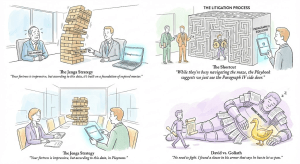
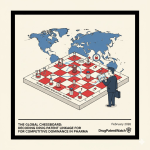
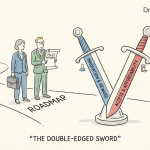
Introduction: The High-Stakes Chess Match of Pharmaceutical Patents
In the world of pharmaceuticals, there exists a fundamental, necessary tension. On one side, we have the innovator companies, who undertake the herculean task of discovering and developing new medicines. It’s a process fraught with risk and astronomical expense, with the average capitalized cost to bring a new drug to market pegged at a staggering $2.6 billion.1 To incentivize this monumental investment, the patent system grants them a period of market exclusivity—a temporary monopoly to recoup their costs and fund the next wave of innovation.
On the other side stands the societal imperative for affordable healthcare. This is where we, the generic drug manufacturers, enter the fray. Generic medicines are the bedrock of cost containment in modern healthcare, accounting for an incredible 90% of all prescriptions filled in the United States.4 By offering bioequivalent alternatives at prices often 40% to 80% lower than the brand, we save patients and the healthcare system billions of dollars annually.6
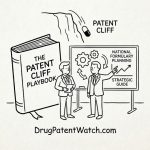
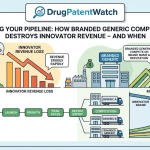
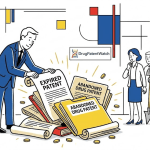
This dynamic sets the stage for a dramatic confrontation known as the “patent cliff.” When a blockbuster drug’s key patents expire, the brand-name company can see its revenues plummet by 80% to 90% in a single year as generic competition floods the market.7 The financial stakes are immense, turning the period leading up to patent expiry into a battleground where legal strategy, regulatory maneuvering, and commercial acumen collide.
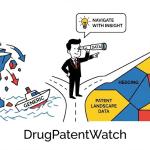
For a generic company, challenging a brand-name patent is not an occasional legal skirmish; it is the very engine of our business model. We don’t wait passively for patents to expire. We proactively seek to invalidate weak patents or design around valid ones to accelerate market entry. This report is a deep dive into the strategic and tactical playbook we use to accomplish this.
It’s crucial to understand that this entire system of conflict was, in many ways, designed by law. The landmark 1984 Drug Price Competition and Patent Term Restoration Act, better known as the Hatch-Waxman Act, didn’t just create a legal pathway for patent challenges; it created a powerful economic ecosystem. The high prices commanded by branded drugs during their monopoly period create a massive market opportunity for the first generic competitor to enter.10 The Hatch-Waxman Act then dangles a specific, highly lucrative prize for the first company to successfully challenge a patent: a 180-day period of market duopoly, shared only with the brand company.10 This prize is so valuable that it justifies the multi-million-dollar cost of patent litigation.3 Every legal maneuver, every regulatory filing, and every strategic decision detailed in the following pages is ultimately a calculated move in a high-stakes game designed to capture that specific, legislatively created economic reward. The law itself architected the conflict, and we have learned to master its rules.
Strategy 1: Mastering the Hatch-Waxman Gambit with the Paragraph IV Certification
The entire edifice of generic patent litigation rests upon a single, foundational legislative framework: the Hatch-Waxman Act. Understanding its mechanics is not just for lawyers; it’s essential for anyone involved in pharmaceutical strategy. The Act created a brilliant, if contentious, symmetry: it gave brand-name companies patent term extensions to compensate for regulatory delays, and in return, it gave generic companies a streamlined pathway to market and a powerful incentive to challenge patents. The opening move in this complex game is the Paragraph IV certification.
The Opening Move: The ANDA Filing and the PIV Notice
Before Hatch-Waxman, a generic company wanting to market a copy of a branded drug had to conduct its own expensive and duplicative clinical trials to prove safety and efficacy. The Act changed everything by creating the Abbreviated New Drug Application, or ANDA.13 The ANDA process allows a generic manufacturer to rely on the brand’s original safety and efficacy data, requiring only that the generic prove its product is bioequivalent to the brand-name drug.10 This dramatically lowers the barrier to entry.
But what about the patents? This is where the certifications come in. When filing an ANDA, a generic company must address every patent listed for the brand’s drug in the FDA’s “Approved Drug Products with Therapeutic Equivalence Evaluations,” colloquially known as the “Orange Book”.11 The generic filer must make one of four certifications for each patent:
Paragraph I: No patent information has been filed.
Paragraph II: The patent has already expired.
Paragraph III: The generic will wait to launch until the patent expires.
Paragraph IV: The patent is invalid, unenforceable, or will not be infringed by the generic product.13
The Paragraph IV (PIV) certification is the declaration of war. It is a formal, legally binding assertion that the generic company believes it has the right to come to market before the patent’s expiration date.12 The act of filing an ANDA with a PIV certification is deemed by the statute to be an “artificial act of infringement”.13 This clever legal fiction is the key that unlocks the courthouse doors. It gives the brand-name company a legal basis to sue the generic for patent infringement immediately, long before the generic product has been sold or has caused any actual financial harm.
Following the FDA’s acknowledgment that the ANDA is ready for review, the generic company has 20 days to send a formal “notice letter” to the patent holder and the New Drug Application (NDA) holder.13 This is no mere formality. The PIV notice letter must provide a detailed statement of the factual and legal basis for the generic’s assertion that the patent is invalid or not infringed. It is the opening salvo, laying out the challenger’s entire case-in-chief. A poorly drafted notice letter can have serious consequences, including supporting a brand’s later claim for attorneys’ fees if the challenge is deemed baseless.13
The Clock Starts Ticking: The 45-Day Trigger and the 30-Month Stay
Once the brand company receives the PIV notice letter, a new clock starts. It has exactly 45 days to file a patent infringement lawsuit against the generic challenger.11 This 45-day window is one of the most critical junctures in the entire process.
If the brand fails to sue within this period, the FDA can proceed with its review and approve the generic’s ANDA as soon as it is ready. If, however, the brand files suit within the 45-day window—which it almost invariably does—it triggers one of the most powerful tools in the brand’s defensive arsenal: an automatic 30-month stay of FDA approval.3
This stay means that, regardless of how quickly the FDA completes its scientific review of the ANDA, the agency is legally barred from granting final approval for up to 30 months, or until the patent litigation is resolved in the generic’s favor, whichever comes first.15 This provision was intended to give the parties a reasonable amount of time to litigate the patent dispute before the generic product could enter the market. In practice, it has become a strategic weapon. For the brand company, it guarantees a minimum period of delay, a safe harbor from generic competition. For the generic company, it represents a significant hurdle. Data shows that the median time from the expiration of the 30-month stay to the actual launch of a generic is 3.2 years, indicating that the litigation often outlasts this initial period.15
However, as we will explore in a later section, the strategic value of this 30-month stay is not what it once was. The rise of parallel challenge venues, particularly the Patent Trial and Appeal Board (PTAB), has given generics a way to attack the underlying patent during the stay period. A credible threat to invalidate the patent at the PTAB can devalue the stay, turning it from a brand’s shield into a generic’s bargaining chip in settlement negotiations.
The Ultimate Prize: The 180-Day Exclusivity Period
If the 30-month stay is the brand’s reward for acting quickly, the 180-day exclusivity period is the generic’s ultimate prize for being bold. This is the economic engine that powers the entire generic challenge ecosystem.
The Hatch-Waxman Act provides a powerful incentive for generics to be the first to challenge a brand’s patents. The first company to file a “substantially complete” ANDA containing a Paragraph IV certification is eligible for a 180-day period of marketing exclusivity.11 This means that if the first-filer successfully wins its lawsuit (or gets the brand to drop the suit), the FDA is blocked from approving any
other generic company’s ANDA for the same drug for six months.
The value of this exclusivity cannot be overstated. During this 180-day period, the market dynamic is not a monopoly, but a duopoly between the brand and the single generic first-filer. The first-filer can price its product just below the brand’s price, capturing a massive share of the market without facing the immediate, drastic price erosion that occurs when multiple generics enter.10 For a blockbuster drug, this six-month head start can be worth hundreds of millions, or in some cases, billions of dollars.
The landmark case of Barr Laboratories’ challenge to Eli Lilly’s Prozac patent is a classic example. Barr was the first to file a PIV certification and, after prevailing in court, reaped enormous economic benefits during its 180-day exclusivity period.11 This success story arguably lit the fuse for the modern era of aggressive PIV challenges, demonstrating the immense profitability of the first-to-file strategy. It’s why, behind the scenes at every generic company, there is a frantic race not just to challenge patents, but to be the very first one through the door at the FDA.
Strategy 2: Deconstructing the Patent Itself — Attacking the Pillars of Validity
Once the Hatch-Waxman process is initiated, the fight moves to the substance of the patent itself. A patent is a government-granted monopoly, but it is not an absolute right. It is granted in exchange for the inventor meeting a series of strict legal requirements. If any of these foundational pillars are weak, the entire patent can be brought down. The core of any patent challenge, therefore, is a meticulous, scientific, and legal deconstruction of the patent’s claims to prove it never should have been granted in the first place. This is where the deep technical expertise of chemists, biologists, and pharmacologists intersects with the strategic acumen of patent litigators.
The Sniper’s Shot: Lack of Novelty (Anticipation)
The most fundamental requirement for a patent is novelty. You simply cannot patent something that is already known to the public. In U.S. patent law, this concept is known as “anticipation” under 35 U.S.C. § 102.16 An attack on novelty is like a sniper’s shot: precise, targeted, and, if successful, instantly fatal to the patent claim.
To prove a patent claim is anticipated, a challenger must show that a single piece of “prior art” discloses each and every element of the claimed invention.16 This prior art can be anything that was publicly available anywhere in the world before the patent’s effective filing date. The America Invents Act (AIA) established a global standard, meaning a scientific paper published in a German journal or a product sold in Japan can be used to invalidate a U.S. patent.16 The universe of potential prior art is vast, including previously issued patents, scientific literature, conference abstracts and presentations, doctoral theses, and even public drug labels with verifiable timestamps.12
A particularly powerful tool in the challenger’s arsenal is the doctrine of inherent anticipation. This doctrine applies when a piece of prior art doesn’t explicitly spell out every feature of the invention, but that feature is a “natural and inevitable result” of what is described.16 For example, a brand might obtain a patent on a new crystalline form (a polymorph) of an existing drug, claiming it has superior stability. A generic challenger could invalidate that patent by finding an old scientific paper that describes a manufacturing process for the original drug. If the challenger can then prove, through its own experiments and expert testimony, that following that old process inherently and necessarily produces the newly “discovered” polymorph, the patent is invalid for lack of novelty. This is a crucial strategy for combating evergreening tactics where brands try to patent minor variations of known compounds.
The Artillery Barrage: Obviousness (Lack of Inventive Step)
If an anticipation challenge is a sniper’s shot, an obviousness challenge is an artillery barrage. It is, by a wide margin, the most common, most complex, and most frequently litigated ground for invalidating a drug patent.16 While an invention might be technically new—meaning no single piece of prior art discloses it completely—it may still be unpatentable if the differences between the invention and the prior art are so trivial that they would have been “obvious” to a “person having ordinary skill in the art” (a POSITA) at the time the invention was made.16
The POSITA is a legal fiction, a hypothetical person who is presumed to know all of the relevant prior art in a given field and possesses the standard knowledge and creativity of a typical practitioner in that field—a skilled chemist or formulator, for example, but not a genius. The central question is: faced with a known problem, would this skilled person have been motivated to combine or modify existing pieces of prior art to arrive at the claimed invention with a reasonable expectation of success?
The landscape of obviousness law was fundamentally reshaped by the Supreme Court’s 2007 landmark decision in KSR International Co. v. Teleflex Inc..17 Before
KSR, courts often applied a rigid “teaching, suggestion, or motivation” (TSM) test, requiring an explicit statement in the prior art that would have suggested the combination. KSR rejected this rigid approach in favor of a more flexible, common-sense analysis. This shift made it significantly easier to challenge patents based on predictable modifications, such as swapping one known chemical group for a similar one, combining known drugs to achieve a predictable effect, or optimizing a formulation using standard techniques.
A key concept that gained prominence after KSR is the “obvious to try” doctrine.16 This is particularly potent against secondary patents on new dosages or formulations. If the prior art identified a known problem (e.g., poor patient adherence due to frequent dosing) and there were only a limited number of well-known, predictable solutions to explore (e.g., creating a higher-dose, extended-release version), a court might find it was “obvious to try” that solution. This was the exact logic that led to the invalidation of Teva’s secondary patents on its blockbuster multiple sclerosis drug, Copaxone. Teva had patented a new 40mg, three-times-weekly injection to replace its original 20mg daily injection. The courts found that experimenting with a less frequent, higher-dose regimen to improve patient convenience was not an inventive leap but an obvious path for a skilled clinician to explore.17
Of course, brand companies have a defense against obviousness. They can present evidence of “secondary considerations of non-obviousness”—real-world factors suggesting the invention was not, in fact, obvious. These include the drug’s commercial success, its satisfaction of a long-felt but unsolved need, the failure of others to solve the same problem, and unexpected or superior results.16 A challenger’s job is not only to build a strong case for obviousness based on the prior art but also to dismantle the brand’s secondary considerations, typically by showing there is no “nexus” or direct link between the purported evidence (e.g., commercial success) and the novel features of the claimed invention.
The “Too Broad” Attack: Lack of Enablement & Written Description
The third pillar of patent validity rests on a simple bargain: in exchange for a 20-year monopoly, the inventor must provide the public with a full and clear instruction manual for the invention. The patent must describe the invention in enough detail to show that the inventor was truly in “possession” of what they are claiming (the written description requirement) and must teach a POSITA how to make and use the full scope of the claimed invention without “undue experimentation” (the enablement requirement).17 If the patent fails to uphold its end of this bargain, it is invalid.
For years, this was a potent but secondary line of attack. That all changed in 2023 with the Supreme Court’s seismic decision in Amgen Inc. v. Sanofi.17 This case, which centered on Amgen’s cholesterol drug Repatha, has fundamentally altered the strategic calculus for challenging patents, especially in the world of biologics.
Amgen’s patents did not just claim the specific antibodies it had developed; they claimed an entire functional class of antibodies—essentially, any and every antibody that could perform a specific function (binding to the PCSK9 protein and lowering cholesterol). The Supreme Court unanimously invalidated these claims. The court’s reasoning was elegantly simple and has become a new mantra in patent law: “the more you claim, the more you must enable”.16 Amgen had provided a few examples and a “roadmap” for scientists to discover other antibodies that did the same thing, but the Court found this was not enough. It was an invitation for “undue experimentation,” not a complete disclosure. To claim an entire continent, you must provide a map of the continent, not just the location of a few islands.
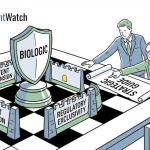
This ruling was an earthquake for the biologics industry. For decades, the standard strategy for innovator companies was to file these broad “genus” patents, claiming vast families of molecules based on their function, as a way to build an impenetrable patent fortress.18 The
Amgen decision has rendered this strategy highly vulnerable. Many existing patents on blockbuster biologics were drafted and granted under the old, more permissive standard. They are now sitting ducks for the same lack-of-enablement challenge that brought down the Repatha patents.
This has opened up a powerful new line of attack for biosimilar companies. It shifts the strategic focus. Instead of spending millions on exhaustive searches for obscure prior art to prove obviousness, a challenger can now attack the very structure of the patent’s claims. This systemic vulnerability in the patent portfolios of many of the world’s best-selling drugs has the potential to open up multi-billion-dollar markets to competition years earlier than anyone anticipated. It represents a true paradigm shift in patent challenge strategy.
Strategy 3: Changing the Battlefield — Leveraging the Power of the PTAB
For nearly three decades after Hatch-Waxman, the only place to fight a pharmaceutical patent battle was in federal district court. This was the brand’s home turf—a slow, astronomically expensive process where their patent was presumed valid and a challenger had to meet a high “clear and convincing” standard of evidence to win. Then, in 2011, Congress passed the America Invents Act (AIA), and everything changed. The AIA created the Patent Trial and Appeal Board (PTAB), an administrative tribunal within the U.S. Patent and Trademark Office (USPTO) itself. For generic and biosimilar challengers, the PTAB has become a revolutionary tool—a new battlefield with different rules, different decision-makers, and a landscape far more favorable to those seeking to invalidate weak patents.
The PTAB Revolution: A Faster, Cheaper, More Favorable Venue
The strategic advantages of challenging a patent at the PTAB versus district court are stark and numerous. Understanding these differences is key to appreciating why the PTAB has become such a disruptive force.
First, the decision-makers are different. A district court case is decided by a federal judge and, in some cases, a lay jury, who may have little to no technical background. A PTAB proceeding, by contrast, is a “mini-trial” adjudicated by a panel of three Administrative Patent Judges (APJs) who are themselves experienced patent attorneys, often with advanced technical degrees.17 They speak the language of science and patent law fluently, which is a significant advantage for a challenger with a strong technical case.
Second, the process is dramatically faster and cheaper. A final written decision from the PTAB is statutorily required within 18 months of a petition being filed (one year from institution).4 This is a world away from the 30-plus months that a typical district court patent case can take to get to trial, not including appeals.15 This speed translates directly into cost savings, as the discovery process is far more limited and the overall timeline is compressed.4
Most importantly, the legal standards are more favorable to the challenger. In district court, an issued patent is presumed to be valid, and the challenger bears the heavy burden of proving invalidity by “clear and convincing evidence”.16 At the PTAB, there is no presumption of validity.21 The standard of proof is merely a “preponderance of the evidence”—a lower, “more likely than not” standard.22 This seemingly technical legal distinction has a massive real-world impact, making it substantially easier to invalidate a patent at the PTAB than in court.
The Workhorse Weapon: Inter Partes Review (IPR)
The most common and widely used PTAB proceeding is the Inter Partes Review, or IPR. An IPR petition can be filed by a challenger for any patent that has been issued for more than nine months.22
The scope of an IPR is narrowly focused. Challenges can only be brought on the grounds of lack of novelty (anticipation) or obviousness, and the evidence is restricted to prior art consisting only of patents and printed publications.16 While this means other invalidity arguments like lack of enablement cannot be raised in an IPR, it forces the proceeding to concentrate on the most common lines of attack.
The success rate for challengers in IPRs has been remarkably high. The PTAB agrees to institute (i.e., hear the case on the merits) in roughly 62% of petitions filed on pharmaceutical patents.4 Once instituted, the odds continue to favor the challenger. Estimates of the overall success rate for IPRs—defined as invalidating at least one challenged patent claim—are in the range of 60% to 70%.12 The pharmaceutical industry’s own trade group, PhRMA, has acknowledged that about one out of every two challenges on Orange Book-listed patents that reaches a final decision results in the cancellation of at least one claim.24 These statistics speak for themselves and explain why the PTAB is often referred to, much to the chagrin of patent holders, as a “patent death squad”.26
The Early Strike: Post-Grant Review (PGR)
A second, less common but even more powerful PTAB tool is the Post-Grant Review, or PGR. The key difference between an IPR and a PGR lies in timing and scope. A PGR petition must be filed within a very narrow window: the first nine months after a patent is issued.22
In exchange for this early challenge, the PGR offers a challenger a much wider arsenal of weapons. Unlike an IPR, a PGR is not limited to novelty and obviousness. A patent can be challenged in a PGR on any statutory ground of invalidity.22 This includes lack of written description, lack of enablement, indefiniteness, and patent-ineligible subject matter under § 101.17
This makes the PGR the perfect vehicle for launching an Amgen v. Sanofi-style enablement attack against a newly issued, overly broad biologics patent. For a generic or biosimilar company that is closely monitoring a competitor’s pipeline, the nine-month PGR window provides a golden opportunity to strike a fatal blow to a threatening patent before it can ever be asserted in district court litigation.
The true strategic brilliance of the PTAB, however, is not just in its use as a standalone venue. It is in its power as a parallel threat that creates immense leverage in the district court arena. Imagine the scenario: a brand-name company sues a generic challenger in district court, triggering the 30-month stay. The generic company then turns around and files an IPR on the very same patent at the PTAB.12
Suddenly, the brand is forced to fight a two-front war. It must defend its patent in two different venues simultaneously, under two different sets of rules, effectively doubling its legal costs.24 One of those venues, the PTAB, has rules and standards that are highly unfavorable to the patent holder. Furthermore, the PTAB proceeding is almost certain to conclude
before the district court case reaches a trial. If the PTAB invalidates the patent, the district court case becomes moot, and the brand loses everything.28
Faced with this high-risk, high-cost, two-front battle, the most rational business decision for the brand is often to seek a quick settlement in the district court case. It will offer the generic favorable terms, such as an early, guaranteed market entry date, in exchange for the generic agreeing to withdraw its IPR petition. In this way, the IPR is transformed from a legal proceeding into the ultimate bargaining chip, a tool of leverage that can force a settlement and achieve the generic’s commercial goals without ever needing a final verdict in either venue.
Feature
District Court Litigation (Hatch-Waxman)
PTAB Proceedings (IPR/PGR)
Venue/Decision-Maker
Federal Judge & potentially a lay jury
Panel of 3 technically expert Administrative Patent Judges (APJs)
Standard of Proof
Clear and Convincing Evidence
Preponderance of the Evidence
Presumption of Validity
Yes, patent is presumed valid
No, patent is not presumed valid
Available Grounds
All invalidity grounds (Novelty, Obviousness, Enablement, §101, etc.)
IPR: Novelty & Obviousness only (based on patents/publications). PGR: All grounds.
Speed to Final Decision
30+ months to trial, plus appeals
~18 months from petition filing to final written decision
Median Cost
High ($2.7M – $5M+ for cases >$10M at risk)
Lower (Typically hundreds of thousands of dollars)
Strategic Use
Primary venue for infringement claims; triggers 30-month stay.
Faster, cheaper invalidity challenge; creates leverage for settlement in parallel litigation.
3
Strategy 4: Picking the Lock on the Fortress — Dismantling Patent Thickets and Evergreening
To counter the aggressive strategies of generic challengers, brand-name companies have become masters of defensive patenting. They no longer rely on a single, strong patent to protect a blockbuster drug. Instead, they construct what has become known as a “patent thicket”—a dense, tangled, and overlapping web of dozens, sometimes hundreds, of patents all covering a single product. This strategy is designed not necessarily to win on the merits of any single patent, but to win through attrition, making the prospect of litigation so daunting and expensive that would-be challengers are deterred from even trying. For a generic company, navigating this fortress requires a sophisticated strategy of its own: a methodical process of identifying and attacking the weakest links in the chain.
Understanding the Brand’s Defenses: The Anatomy of a Patent Thicket
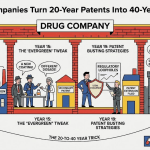
A patent thicket is a deliberate corporate strategy, a form of lifecycle management designed to extend a drug’s monopoly far beyond the 20-year term of its original, core patent.19 The building blocks of a thicket are “secondary” patents. While the “primary” patent covers the core invention—the active pharmaceutical ingredient (API) itself—secondary patents are filed later, often years after the drug is already on the market, to cover every conceivable peripheral feature.31 These can include:
New formulations (e.g., an extended-release version)
New dosages
New methods of use (i.e., treating a different disease)
Specific manufacturing processes
Crystalline forms (polymorphs)
Even packaging or drug delivery devices
This practice is often called “evergreening”—the process of making minor, incremental tweaks to an existing product and patenting them to perpetually refresh the period of exclusivity.1 The statistics are telling: a stunning 78% of all new drug-related patents are not for new, innovative medicines, but are for existing drugs.31 The goal is to create a litigation minefield. A generic challenger can’t just invalidate the primary patent; it must clear a path through every single secondary patent that the brand asserts, each one representing a costly and time-consuming legal battle.34
Case Study: The Humira Playbook
There is no more infamous or illustrative example of a patent thicket than AbbVie’s strategy for its blockbuster rheumatoid arthritis drug, Humira. Humira is the best-selling drug in history, and its commercial longevity is a direct result of one of the most aggressive and successful patent thicketing strategies ever devised.
AbbVie constructed a fortress of staggering proportions around Humira. It filed over 247 patent applications in the U.S., seeking to extend its monopoly for a total of 39 years—nearly double the standard patent term.31 The most damning statistic is that 89% of these patent applications were filed
after Humira had already received FDA approval and was on the market.35 This was a clear and deliberate evergreening strategy.
The results were devastating for competition and costly for the U.S. healthcare system. Biosimilar versions of Humira launched in Europe in 2018, where AbbVie held far fewer patents and faced stricter examination standards. But in the U.S., the patent thicket worked exactly as intended. It successfully delayed any biosimilar competition until 2023. That five-year delay is estimated to have cost the American healthcare system more than $19 billion.36
Biosimilar challengers, like Coherus and Amgen, did not simply surrender. They used the tools at their disposal, particularly IPRs, as a precision ax to chop down individual trees in the thicket. They successfully invalidated several of AbbVie’s weaker secondary patents on grounds of obviousness.17 However, the sheer volume and complexity of the thicket were overwhelming. The cost and risk of litigating hundreds of patents in parallel were simply too high. Ultimately, every single major biosimilar competitor was forced to the negotiating table, signing settlement agreements with AbbVie that dictated their delayed 2023 launch dates.17 The Humira case is a masterclass in how a patent thicket can be used to achieve a commercial victory even in the face of legal defeats on individual patents.
The Challenger’s Counter-Strategy: Identifying and Attacking the Weakest Links
So, how does a generic company confront such a formidable defense? You don’t lay siege to the entire fortress at once. You find the cracks in the walls. The strategy involves a multi-pronged approach to identify and neutralize the most vulnerable patents in the thicket.
First, the focus must be on the secondary patents. The primary composition-of-matter patent on the API is usually the strongest and most rigorously examined. The dozens of later-filed patents on formulations, methods of use, and manufacturing processes are often far weaker and more susceptible to challenge.12 These are the soft targets.
Second, a lethal prior art search is essential. This is where sophisticated patent intelligence platforms like DrugPatentWatch become indispensable. By using such tools, a challenger can meticulously sift through global patent databases and scientific literature to find the “smoking gun” that invalidates a weak secondary patent.17 The goal is to find evidence that a claimed formulation was already known or that a new method of use would have been obvious to a skilled physician.
Third, a deep dive into the patent’s prosecution history, or “file wrapper,” can yield gold. This is the official record of all communication between the patent applicant and the patent examiner at the USPTO. It contains every argument the brand made to convince the examiner to grant the patent. A challenger can often find inconsistencies, contradictions, or narrowing statements that can be used to undermine the patent’s validity or limit its scope in litigation.12 This was a key tactic in the Humira IPRs, where challengers used AbbVie’s own arguments from one proceeding to contradict its arguments in another, fatally wounding its credibility before the PTAB.17
Finally, the challenger must use the PTAB strategically. Instead of launching a massive, multi-front war in district court, the challenger can use cost-effective IPRs to pick off the weakest patents one by one.12 Each successful IPR invalidation punches another hole in the thicket, clearing the path to market and, just as importantly, increasing the pressure on the brand to settle the entire dispute.
The rise of the patent thicket has fundamentally changed the nature of pharmaceutical competition. It has created a perverse incentive structure where a company’s legal budget can be a more powerful driver of revenue than its R&D budget. The Humira case proves that a company can generate billions more in profit by investing in lawyers to build a patent fortress than by investing in scientists to discover truly novel medicines.31 This reality has forced generic companies to evolve. We are no longer just legal adversaries; we have become policy advocates. Recognizing that fighting these thickets one patent at a time is an expensive, uphill battle, the generic industry is increasingly engaging in advocacy to change the rules of the game.12 This includes lobbying Congress and petitioning the USPTO for stricter patent examination standards, reforms to better harmonize the Hatch-Waxman and IPR processes, and legislation that would limit the number of patents a brand can assert in a single lawsuit.31 The fight is no longer confined to the courtroom and the PTAB; it has expanded to a third battlefield: the political and legislative arena.
Strategy 5: The Art of the Deal — Negotiating Strategic Settlements for Early Entry
In the high-stakes world of pharmaceutical patent litigation, the public often imagines a dramatic courtroom showdown, a winner-take-all battle culminating in a decisive verdict. The reality is far more nuanced. While some cases do go the distance, the vast majority end not with a judgment, but with a deal. For a generic company, the primary objective is not necessarily to achieve a legal vindication, but to secure the fastest possible path to market. A strategically negotiated settlement is often the most rational, cost-effective, and profitable way to achieve that commercial goal.
Why Settle? The Economic Rationale for Avoiding a Verdict
From a business perspective, the logic of settlement is compelling. The numbers tell a clear story. While generic companies win approximately 48% of the Paragraph IV cases that are litigated all the way through a trial verdict, their overall “success rate”—a figure that includes cases that are settled or dropped by the brand—climbs to a much more impressive 76%.25 This 28-point gap represents the immense value of strategic settlement. It highlights that the “win” for a generic is not always a legal victory, but a commercial one: a guaranteed entry date.
There are three primary drivers behind this rationale:
Cost Avoidance: Patent litigation is brutally expensive. As the table below illustrates, a high-stakes Hatch-Waxman case where more than $25 million is at risk can easily cost over $5 million to take through trial and appeal.2 A settlement, particularly one reached early in the process, can avoid the bulk of these staggering costs, preserving capital that can be deployed to challenge other products.
Risk Mitigation: A trial is inherently unpredictable. No matter how strong your case appears, there is always a risk of an unfavorable outcome. A loss in court means a total wipeout—no market entry until the patent expires, and millions of dollars in legal fees down the drain. A settlement eliminates this binary risk. It replaces the uncertainty of a trial with the certainty of a negotiated market entry date, allowing a company to plan its manufacturing, supply chain, and commercial launch with precision.
Time Value of Money: Every day a generic is kept off the market is a day of lost revenue. A settlement that allows for market entry even one or two years before patent expiry can be worth hundreds of millions of dollars, far outweighing the potential upside of winning at trial several years later.
The Price of the Fight: A Breakdown of Pharmaceutical Patent Litigation Costs
Amount at Risk
Less than $1 Million
$1 – $10 Million
$10 – $25 Million
More than $25 Million
(Data from 2019 AIPLA Report of the Economic Survey for Hatch-Waxman Litigation 3)
The Controversial Tactic: “Pay-for-Delay” or Reverse Payment Settlements
Not all settlements are created equal, and one particular type has drawn intense scrutiny from regulators and antitrust authorities: the “pay-for-delay” or “reverse payment” agreement.1
In a typical litigation settlement, the party accused of wrongdoing (the infringer) pays the party that was harmed (the patent holder). In a reverse payment settlement, the direction of the payment is flipped: the patent holder (the brand company) pays the alleged infringer (the generic challenger) to settle the case. In exchange for this payment, the generic company agrees to delay the launch of its product for a specified period.29
Why would a brand pay a competitor to stay off the market? The economics are simple. The brand’s monopoly profits are far greater than the profits that would be available in a competitive market. By paying the generic a fraction of those monopoly profits, the brand can preserve the majority of them for itself, keeping prices high for consumers. The Federal Trade Commission (FTC) has aggressively pursued these agreements, arguing that they are a form of illegal market allocation, a collusive scheme between the brand and the generic to share monopoly profits at the expense of the public.6
The legal landscape for these deals was defined by the Supreme Court’s 2013 decision in FTC v. Actavis.38 The Court rejected the notion that these settlements were automatically legal as long as the generic’s entry was delayed no longer than the patent’s expiration date. It also rejected the FTC’s argument that they were presumptively illegal. Instead, the Court established a “rule of reason” analysis. This means that courts must conduct a full-blown antitrust analysis of each settlement, weighing its potential anti-competitive effects against any pro-competitive justifications to determine if it unreasonably restrains trade.
The Actavis decision and the subsequent wave of FTC enforcement actions have had a chilling effect on explicit cash-for-delay settlements. This has led to a sophisticated evolution in settlement structures, a cat-and-mouse game between the industry and antitrust enforcers. The strategic goal of managing generic entry remains, but the form of the “payment” has become more subtle. Instead of a direct cash transfer, the value from the brand to the generic can be disguised in other forms, such as:
A lucrative co-promotion or marketing deal for another product.
A favorable manufacturing or supply agreement.
A brand’s promise not to launch its own “authorized generic” during the first-filer’s 180-day exclusivity period. An authorized generic is an exact copy of the brand drug, sold by the brand company itself or a partner, which can severely erode the value of the first-filer’s exclusivity. A promise not to launch one is a thing of significant value.
For today’s generic strategist, negotiating a settlement requires navigating this complex and legally perilous terrain. The goal is to structure a deal that provides the certainty of an early market entry and captures significant economic value, all while minimizing the risk of a future antitrust challenge from the FTC or private plaintiffs. It is a delicate art, requiring a deep understanding of both patent and antitrust law.
Strategy 6: The Calculated Gamble — Executing the “At-Risk” Launch
In the generic drug industry, there is no more aggressive or high-stakes maneuver than the “at-risk” launch. It is the ultimate expression of confidence in a legal position and a calculated business gamble that can result in either a massive windfall or a catastrophic financial loss. An at-risk launch occurs when a generic company, having received FDA approval for its ANDA, decides to launch its product and begin selling it before all patent litigation with the brand-name company has been fully and finally resolved.9 It is a bet—a very big bet—that the company will ultimately prevail in court.
Defining the “At-Risk” Launch: High Stakes, High Reward
The “risk” in an at-risk launch is the risk of having to pay enormous damages to the brand company if the courts ultimately find that the brand’s patent is both valid and infringed.41 While the generic is on the market, it is capturing revenue and taking market share from the brand. If the final court decision goes against the generic, it will be liable for the financial harm it caused. This can include the brand’s lost profits during the at-risk period, a reasonable royalty on all of the generic’s sales, and, in cases of “willful infringement,” the court can award enhanced damages of up to three times the actual damages.9
The potential downside is vividly illustrated by one of the most famous at-risk launch cases in history: the battle over the heartburn drug Protonix. In 2007, Teva Pharmaceuticals launched its generic version of Protonix at-risk, followed shortly by Sun Pharma. They believed the underlying patent held by Pfizer and its partner was invalid. They were wrong. After years of litigation, the courts upheld the patent, and Teva and Sun were ultimately ordered to pay a staggering $2.15 billion in damages.9 It remains one of the largest patent infringement verdicts in U.S. history and serves as a sobering cautionary tale.
The potential reward, however, is equally immense. An at-risk launch allows a generic to enter the market years earlier than it would by waiting for all appeals to be exhausted. For a blockbuster drug, this can mean billions of dollars in revenue that would otherwise have been lost. It is a classic high-risk, high-reward business decision.
The Decision Framework: When Does an At-Risk Launch Make Sense?
This is not a decision made by throwing darts at a board. A responsible company will only launch at-risk after a rigorous and data-driven analysis of the potential risks and rewards. This decision framework rests on several key pillars.
The most critical prerequisite, and the most common scenario for an at-risk launch, is when the generic company has already won a favorable decision in the district court.39 A victory at the trial court level, while not final (it can be overturned on appeal), dramatically shifts the odds in the generic’s favor. It provides a strong signal that the legal arguments are sound and significantly increases the probability of ultimate success. Indeed, one study found that in cases where the generic had FDA approval and a favorable district court decision, they launched at-risk 100% of the time.40
Beyond the legal posture, the decision is driven by complex economic modeling. Companies build sophisticated, scenario-based financial models to quantify the potential upside and downside.41 These models forecast the entire market dynamic, including:
The expected revenue and profit from the at-risk launch.
The rate of generic uptake and price erosion.
The potential entry of other generics, including an authorized generic from the brand.
The calculation of potential damages (lost profits and/or a reasonable royalty) under a “losing” scenario.
The model allows the company’s leadership to evaluate the trade-offs under various scenarios and make an economically informed decision.41 This financial analysis is then combined with other strategic factors, such as the company’s overall risk tolerance, its financial capacity to absorb a potential damages award, and the strategic importance of the product to its portfolio.9
From a broader policy and social welfare perspective, the at-risk launch plays a crucial role. It is a market-based mechanism for challenging weak patents and accelerating the public benefit of lower drug prices. A generic company’s willingness to risk billions in damages is a powerful signal of its conviction that the brand’s patent is likely invalid. When a generic launches at-risk, consumers and payors immediately benefit from competition and lower prices.40 If the generic is ultimately proven right and the patent is invalidated, society has gained years of savings that would have been lost if the generic had timidly waited on the sidelines. If the generic is proven wrong, the damages award serves to compensate the innovator for the temporary infringement of its valid patent rights.40 In this sense, the at-risk launch can be viewed as a de facto “buy out” of a likely invalid patent, with favorable implications for both short-term consumer prices and the long-term efficiency of the patent system. It helps ensure that financial incentives are directed toward truly innovative research, not toward defending weak patents that needlessly block competition.
Strategy 7: Turning the Tables — Wielding Antitrust Law as a Sword
For many years, the legal battle between brand and generic was fought almost exclusively on the terrain of patent law. The central question was always: is the patent valid and infringed? But in the last decade, a second front has opened up in this war: antitrust law. Generic companies and government enforcers have realized that even if a brand’s patents have expired or been invalidated, a brand can still engage in anti-competitive conduct to unlawfully maintain its monopoly. Antitrust law provides a powerful sword for challengers to fight back against these tactics. At the same time, the generic industry itself has come under the antitrust microscope, forcing all players to be mindful of how their competitive behavior is perceived.
Countering “Product Hopping”: The Namenda Case
One of the most clever and controversial brand-side strategies to stifle generic competition is known as “product hopping” or “product switching”.29 The tactic is designed to exploit the mechanics of state pharmacy substitution laws. These laws typically allow or require a pharmacist to automatically substitute a cheaper, bioequivalent generic when a patient presents a prescription for a brand-name drug. This automatic substitution is the lifeblood of the generic business model.
In a product hop, as a brand’s drug nears patent expiry, the company will introduce a “new and improved” version with only a minor modification—for example, switching from a twice-daily immediate-release (IR) tablet to a once-daily extended-release (XR) version.42 This new version is protected by its own set of later-expiring patents. The key to the strategy is then to pull the old version off the market just before the generics are set to launch. This is called a “hard switch”.42
The effect is to short-circuit the automatic substitution laws. A generic version of the old IR tablet is not considered therapeutically equivalent to the new XR tablet, so a pharmacist cannot automatically substitute it.42 By removing the old product, the brand effectively forces doctors and patients to switch to the new, patent-protected version, stranding the incoming generics with no market to substitute into.
For years, this practice was seen as a legally untouchable form of product improvement. That changed with the landmark case involving the Alzheimer’s drug Namenda. Forest Laboratories (later acquired by Actavis) planned to execute a classic hard switch, discontinuing its twice-daily Namenda IR just before generic entry to force all patients onto its new, patent-protected, once-daily Namenda XR.42
The New York Attorney General sued Actavis, not for patent infringement, but for violating federal and state antitrust laws. The AG argued that the product hop was not a genuine innovation but a coercive and anti-competitive scheme designed solely to maintain a monopoly.44 The court agreed. It found that the “explicit purpose” of the switch was to impede generic competition, citing damning evidence from Actavis’s own CEO, who stated in an earnings call that the goal of the “forced switch” was to “protect our Namenda revenue from generic penetration”.44 The court issued an unprecedented preliminary injunction, forcing Actavis to keep the old Namenda IR on the market so that generics could compete on a level playing field.42 The Second Circuit Court of Appeals affirmed this decision, establishing that coercive product hopping can be an illegal act of monopolization.42 The
Namenda case provided generic companies with a powerful new antitrust weapon to combat this pernicious brand-side tactic.
The irony of the pharmaceutical market is that yesterday’s challenger can become today’s monopolist. In a stunning reversal of roles, the generic drug industry itself has become the target of one of the largest and most sprawling antitrust investigations in U.S. history.
The case, consolidated as In re: Generic Pharmaceuticals Pricing Antitrust Litigation (MDL 2724) in the Eastern District of Pennsylvania, alleges a massive and widespread conspiracy among dozens of generic drug manufacturers to collude on prices, rig bids for large contracts, and allocate customers and markets amongst themselves.45 The allegations, brought by state attorneys general, private plaintiffs (like pharmacy benefit managers and health plans), and the U.S. Department of Justice, claim that this collusion led to shocking and inexplicable price increases for hundreds of common generic drugs, with some prices skyrocketing by more than 1,000% or even 8,000%.47
The litigation paints a picture of a tight-knit industry where competitors routinely communicated via text messages and phone calls and met at trade association gatherings to coordinate their pricing strategies and agree not to compete with one another.47 This alleged conduct strikes at the very heart of the promise of generic drugs—that robust competition will lead to lower prices for consumers.
The Department of Justice’s parallel criminal investigation has already yielded significant results. Seven generic companies have resolved criminal charges, collectively paying more than $681 million in penalties.49 Teva Pharmaceuticals, one of the central players, agreed to pay a criminal penalty of $225 million—the largest ever for a domestic price-fixing cartel—and to divest its business for the cholesterol drug pravastatin, which was a core part of the conspiracy.48
This massive litigation, while not a challenge against brand-name patents, is a critical part of the modern competitive landscape. It demonstrates that the legal battles in the pharmaceutical industry now encompass a “second wave” of action. The first wave is the patent challenge, governed by patent law, which is necessary to enable generic entry into the market. The second wave is the antitrust challenge, governed by antitrust law, which is necessary to ensure that once generics have entered, the market actually functions competitively. The Namenda case shows that antitrust law is needed to police the anti-competitive behavior of brands, while the price-fixing MDL shows it is also needed to police the anti-competitive behavior of generics. Patent law alone has proven insufficient to guarantee a competitive market; antitrust law has become the essential enforcement mechanism to ensure that the pro-competitive goals of the Hatch-Waxman Act are actually realized.
Strategy 8: Exploiting the Regulatory Seams
The battle for generic market entry is not fought solely in the courtroom or at the PTAB. A third, equally important battlefield exists: the complex regulatory landscape of the U.S. Food and Drug Administration (FDA). A brand-name company can lose every patent case and still successfully delay a generic competitor through savvy exploitation of regulatory rules. Conversely, a sharp generic challenger can find and exploit seams in those same regulations to accelerate its path to market. Success in the modern pharmaceutical landscape requires a deeply integrated legal and regulatory strategy, where teams understand that a win in court is meaningless if you are blocked at the FDA.
Challenging the Rulebook: Orange Book Delisting
The FDA’s Orange Book is the bible of generic drug development. It is the official registry where brand-name companies list the patents they claim cover their approved drug products.11 It is the PIV challenge to an Orange Book-listed patent that serves as the trigger for the entire Hatch-Waxman litigation process, including the all-important 30-month stay of approval.13
But what if a patent is listed in the Orange Book improperly? The statutory criteria for listing are specific: the patent must claim the drug substance (API), the drug product (formulation), or a method of using the drug.13 However, brands have been known to push the envelope, listing patents that fall into a gray area or are clearly outside the scope of what is permissible. This can include patents covering:
Manufacturing processes
Metabolites of the drug
Packaging or container systems
Drug delivery devices (like an injector pen) that are sold separately from the drug itself
The strategic incentive for a brand to improperly list such a patent is enormous. Even if the patent is weak or doesn’t truly cover the drug, its mere presence in the Orange Book allows the brand to sue a generic challenger and trigger the automatic 30-month stay.12 It’s a way to get a guaranteed delay based on a potentially irrelevant patent.
A savvy generic challenger can counter this tactic by directly petitioning the FDA to “delist” the improperly listed patent. If the FDA agrees that the patent does not meet the statutory listing criteria, it will be removed from the Orange Book. Crucially, a delisted patent can no longer serve as the basis for a 30-month stay, potentially removing a major roadblock to final approval.12 This strategy has gained significant momentum recently, with the Federal Trade Commission (FTC) taking a much more aggressive stance. The FTC has begun formally challenging hundreds of what it deems to be improper Orange Book listings for products like inhalers and auto-injectors, arguing that these listings unlawfully stifle competition and keep prices high.50 This has turned Orange Book listing practices from a sleepy regulatory formality into a major new front in the war over generic entry.
Gaming the Gamers: Navigating FDA Citizen Petitions
Another regulatory tactic frequently employed by brand companies to stall generic competition is the FDA Citizen Petition. The FDA’s administrative procedures allow any “interested person”—including a corporation—to file a petition asking the agency to take or refrain from taking an administrative action.52 In the context of generic drugs, brand companies use this process to raise last-minute scientific or safety concerns about a pending generic application, asking the FDA to delay or deny its approval to “protect the public health”.53
While these petitions can, in theory, serve a legitimate public purpose by flagging genuine safety issues, the data suggests they are overwhelmingly used as a tool for delay. Brands often file these petitions in the final months or weeks before a generic’s expected launch, raising complex issues that require significant time for the FDA to review.54
The FDA denies more than 90% of these petitions, ultimately finding them to be without merit.53 However, the brand’s goal is often not to win the petition, but simply to use the review process itself to buy more time on the market. The economic impact of these delays is staggering. One academic study that analyzed just four dubious citizen petitions found that they were highly likely to have been the final obstacle to generic entry and that the resulting delays cost the U.S. healthcare system a combined $1.9 billion.53
In response to this widespread abuse, the FDA and Congress have taken steps to curb the practice. The law now requires the FDA to act on these petitions within 150 days and states that the agency cannot delay an ANDA approval unless a delay is truly “necessary to protect public health”.52 Furthermore, the FDA has issued guidance indicating that it will now assess whether a petition was submitted with the primary purpose of delay. If it makes such a finding, it can deny the petition on that basis alone and will report its determination to Congress, a “name and shame” provision designed to deter companies from filing frivolous petitions.55
For a generic company, this means that while the threat of a citizen petition remains, the landscape has shifted. A modern regulatory strategy must include proactively monitoring for potential petition arguments, preparing scientific data to rebut them quickly, and being ready to engage with the FDA to demonstrate that any petition filed by the brand is merely a tactic for delay and not a legitimate public health concern. This underscores a critical modern reality: a generic company cannot have its legal and regulatory teams operating in separate silos. A legal victory invalidating a patent is pyrrhic if the company is simultaneously blocked by a last-minute regulatory gambit at the FDA. The two teams must be fully integrated, with regulatory experts identifying improper Orange Book listings and preparing to counter citizen petitions, while the legal team litigates the patents themselves. It is a holistic, multi-front war.
Strategy 9: Data-Driven Targeting — How to Choose Your Battles Wisely
In an environment of multi-million-dollar litigation costs and complex, overlapping patent portfolios, the single most important strategic decision a generic company makes is which drugs to target for a challenge. A successful Paragraph IV challenge can be phenomenally profitable, but a failed one is a costly write-off. Consequently, the selection of challenge targets has evolved from an opportunistic legal assessment into a sophisticated, data-driven portfolio management discipline, much like investment banking or venture capital. Generic business development leaders are, in effect, portfolio managers whose asset class is patent litigation. They must use a combination of financial analysis, patent intelligence, and strategic forecasting to allocate their finite legal budgets to the targets that offer the optimal balance of risk and reward.
Following the Money: Market Size as the Primary Predictor
The first and most important filter in the target selection process is market size. A Paragraph IV challenge is a massive investment of time and resources. It only makes economic sense if the potential prize—capturing a share of the brand’s market—is large enough to justify the risk and expense.
The data on this point is unequivocal. A recent study that built predictive models to determine which drugs get challenged found that market size is the single strongest positive predictor.10 These models can predict whether a drug will face a PIV challenge within its first year of eligibility with over 80% accuracy, based largely on its sales figures.
The numbers reveal a clear tipping point. The median fourth-year market value for drugs that were challenged was over $202 million. For drugs that were not challenged, it was just $40 million.10 The likelihood of a challenge increases dramatically as sales climb. For drugs in the 9th decile of market value (with sales between roughly $483 million and $1 billion), the probability of facing a PIV challenge is a staggering 90%.10
This economic reality creates a significant blind spot in the system. The intense focus on blockbuster drugs means that nearly half of all new drugs, those with smaller market sizes, are unlikely to ever face a patent challenge.10 This allows potentially weak or invalid patents on these lower-revenue drugs to persist indefinitely, keeping prices higher than they should be for those patient populations. For a generic company, however, the message is clear: the road to profitability starts by targeting products with substantial revenue streams.
“Typically, when you evergreen something, you are not looking at any significant therapeutic advantage. You are looking at a company’s economic advantage… If the R&D is just to tweak a product to get more monopoly protection without really providing an improved medication, then maybe it doesn’t deserve a patent.”
— Dr. Joel Lexchin, Professor, York University 56
The Strategic Toolkit: Using Patent Intelligence Platforms
Once the universe of potential targets has been narrowed down by market size, the real strategic analysis begins. This is where modern generic companies leverage sophisticated data and analytics platforms to conduct deep due diligence on each potential target. Tools like DrugPatentWatch have become essential, providing a fully integrated database that brings together all the disparate pieces of the puzzle: patents, litigation history, regulatory status, clinical trial data, and commercial sales information.37
Using these platforms, a business development and IP team can execute a comprehensive strategic assessment:
Map the Fortress: The first step is to get a complete picture of the brand’s patent estate. A search on the platform will reveal not just the Orange Book-listed patents, but the entire patent family, including pending applications and international counterparts.57 This allows the team to identify the full scope of the patent thicket they will have to navigate. Particular attention is paid to the filing and issue dates of secondary patents; a flurry of late-listed patents is a red flag for an aggressive evergreening strategy and may indicate weaker, more vulnerable patents.17
Assess the Enemy: The platform’s litigation database is then used to analyze the brand’s track record in defending its patents. How has this company behaved in past Hatch-Waxman cases? Do they fight to the bitter end, or are they quick to settle? What arguments have they used successfully, and where have they failed? The database can also reveal the success rates of other generic challengers who have gone up against this particular company, providing valuable predictive insights.9
Identify the Weakest Link: The team can then drill down on individual patents, using the platform’s data to inform the invalidity analysis described in Strategy 2. They can track the prosecution history, identify potentially fatal flaws, and link patent claims to prior art references, all within an integrated environment. This data-driven approach helps to pinpoint the most vulnerable patents in the thicket, which will become the primary targets of the challenge.
Model the Outcome: Finally, all of this information—market size, patent strength, litigation history, and regulatory status—is fed into financial models to project the potential return on investment for a challenge. The company can model different scenarios: a quick settlement, a win at trial, a loss at trial, or an at-risk launch. This rigorous, quantitative process allows leadership to make a strategic capital allocation decision, deploying its legal budget against the portfolio of targets that offers the highest expected value. This is the modern face of generic strategy: less gut instinct, more data science.
Conclusion: The Future of Generic Competition
The nine strategies detailed in this playbook represent the current state of the art in the ongoing battle over pharmaceutical patents. It is a dynamic and ever-evolving conflict, a complex interplay of law, science, and commerce where the stakes could not be higher. Looking ahead, several key trends are poised to reshape this battlefield yet again.
The rise of biologics and the corresponding pathway for biosimilars under the BPCIA will continue to introduce new layers of complexity. The science is more intricate, the patent thickets are often denser, and the legal framework is less tested than the well-trodden ground of Hatch-Waxman. The Supreme Court’s Amgen v. Sanofi decision has opened a major new front in this war, and we will undoubtedly see a wave of enablement challenges that could topple the patent fortresses around some of the world’s biggest drugs.
Simultaneously, the political and public pressure over high drug prices is reaching a boiling point. This is translating into a more aggressive posture from regulators like the FTC and a greater willingness from Congress to consider legislative reforms aimed at curbing perceived abuses of the patent system. Proposals to limit the number of patents a brand can assert, to strengthen the standards at the USPTO, and to further streamline the PTAB process are all on the table. The outcome of these policy debates will directly impact the viability of the strategies discussed here.
Finally, the role of data and analytics will only grow in importance. The ability to harness big data—to analyze patent landscapes, predict litigation outcomes, and model market dynamics with ever-greater precision—will become a key competitive differentiator. The companies that can most effectively integrate legal, regulatory, and commercial data into a single, coherent strategic framework will be the ones who win the market.
Ultimately, the central theme of this playbook remains constant. In the world of pharmaceutical competition, winning is not a simple matter of winning a patent case. A legal victory is merely a means to a commercial end. True, sustainable success is achieved by mastering an integrated strategy that deftly navigates the complexities of the courts, the regulatory maze of the FDA, and the unforgiving realities of the marketplace. It is a multi-front war, and victory belongs to the strategist who can see the entire board.
Key Takeaways
Paragraph IV is the Engine: The entire generic challenge model is fueled by the economic prize of the 180-day exclusivity period for the first-to-file Paragraph IV challenger. This incentive justifies the multi-million-dollar cost of litigation.
Validity is a Multi-Pillar Concept: Patents can be invalidated on multiple grounds. While “obviousness” is the most common attack, the Supreme Court’s Amgen v. Sanofi decision has made “lack of enablement” a powerful new weapon, especially against broad biologic patents.
The PTAB is a Game-Changer: The Patent Trial and Appeal Board (PTAB) offers a faster, cheaper, and more challenger-friendly venue than district court. Its true power lies in its use as a parallel threat to create immense leverage for favorable settlements.
Thickets Require Precision, Not Brute Force: Confronting a massive “patent thicket” is not about challenging every patent. The winning strategy is to use data-driven analysis to identify and invalidate the weakest secondary patents, creating cracks in the fortress.
Settlement is Often the Smartest “Win”: Given the cost and uncertainty of litigation, a negotiated settlement that provides a certain, early market entry date is frequently the most profitable outcome for a generic company.
Antitrust is the Second Front: Patent law governs market entry, but antitrust law governs market behavior. Antitrust litigation has become a crucial tool to combat brand-side tactics like “product hopping” and to police anti-competitive collusion among all market players.
Regulatory and Legal Strategy Must Be Integrated: A win in court can be nullified by a loss at the FDA. Success requires a holistic approach that addresses both patent validity and regulatory hurdles like improper Orange Book listings and Citizen Petitions.
Data-Driven Targeting is Paramount: The decision of which drugs to challenge is the most critical strategic choice. It must be based on a rigorous analysis of market size, patent portfolio strength, and litigation history, using sophisticated intelligence platforms.
Frequently Asked Questions (FAQ)
1. How has the Supreme Court’s Amgen v. Sanofi decision truly changed the day-to-day strategy for a biosimilar company looking to challenge a patent?
The Amgen v. Sanofi decision has fundamentally altered our target assessment process. Before this ruling, when we evaluated a potential biosimilar target protected by a broad “genus” patent claiming a functional class of antibodies, our primary focus was on a difficult and expensive prior art search to build an obviousness case. Now, the first question we ask is: “Does this patent meet the enablement standard articulated in Amgen?” We now conduct an “enablement analysis” in parallel with our prior art search. This involves our scientific team assessing whether the patent’s disclosure provides a viable path to create the full scope of the claimed invention or if it’s just a few examples and a “roadmap.” If we conclude it’s the latter, the target’s risk profile changes dramatically. A lack-of-enablement challenge is often a cleaner, more powerful argument that is less dependent on finding a “smoking gun” piece of prior art. It has made previously untouchable blockbuster biologics look suddenly vulnerable and has re-prioritized our entire development pipeline.
2. Beyond the obvious red flag of a direct cash payment, what are the subtle antitrust risks in a modern settlement agreement, and how can a generic company mitigate them?
The biggest risk lies in any provision that could be construed as a “payment” from the brand in exchange for a delay in generic entry. After FTC v. Actavis, the definition of “payment” is broad. A key mitigation strategy is to ensure that any “side deals” are commercially justifiable on their own terms and valued at fair market rates. For example, if a settlement includes a manufacturing agreement, we must be able to demonstrate that the terms are consistent with what two independent parties would negotiate, rather than being an inflated price designed to transfer value. The most critical provision to scrutinize is a “no-authorized generic” clause. While valuable to the first-filer, the FTC views these with extreme suspicion. We mitigate this risk by carefully documenting the negotiation process to show that the entry date was the primary point of contention and that the no-AG clause was a secondary term, not the quid pro quo for a longer delay. We also conduct an internal antitrust review of any proposed settlement to ensure it can withstand a “rule of reason” analysis.
3. For a smaller generic firm with a limited legal budget, which challenge strategy offers the best return on investment?
For a smaller firm, the IPR process at the PTAB is unquestionably the highest-ROI strategy. A full-blown Hatch-Waxman litigation can easily run into the millions, which can be prohibitive. An IPR, while still a significant investment, is an order of magnitude cheaper and faster. The strategy is to use the limited budget to hire the best possible PTAB counsel and focus all resources on a single, powerful IPR petition targeting the brand’s weakest and most critical patent. A victory in the IPR can invalidate the patent entirely, clearing the path to market for a fraction of the cost of district court litigation. Even if the IPR petition is merely instituted, the threat it poses is often enough to bring the brand to the settlement table, allowing the smaller firm to secure a favorable entry date without having to fund a multi-year court battle. It’s a strategy of leverage, not brute force.
4. How do international patent challenges, for example in the European Union, impact a U.S. litigation strategy?
They are hugely impactful and create significant strategic opportunities. The European Patent Office (EPO) has stricter standards for patentability, particularly regarding inventive step and added matter, than the USPTO. As a result, brand companies often have fewer and weaker patents in Europe for the same drug. When a biosimilar launches successfully in Europe, it provides two key advantages for a U.S. challenger. First, it creates a powerful “social proof” argument; the fact that a major regulatory body and competitive market have embraced the biosimilar can subtly influence the perspective of U.S. judges and regulators. Second, and more concretely, any legal proceedings or patent office decisions from Europe can be used in U.S. litigation. For example, an argument or admission made by the brand company in a European patent opposition proceeding can be used to undermine its position in a U.S. court case under the doctrine of prosecution history estoppel. We closely monitor all global patent litigation involving our targets to mine for this kind of strategic ammunition.
5. Beyond sheer market size, what are the more subtle, qualitative factors that make a drug an attractive target for a Paragraph IV challenge?
While sales numbers are the first screen, the best targets often have a combination of other qualitative vulnerabilities. One key factor is the nature of the patent portfolio. Is it a true fortress built on a genuinely innovative platform, or is it a flimsy thicket of late-filed, low-quality secondary patents? A drug with a high ratio of post-approval patents is an immediate red flag and an attractive target. Another factor is the brand’s litigation history and corporate culture. Some companies have a reputation for being extremely litigious but ultimately pragmatic settlers, which can signal a favorable outcome. We also look at the scientific and clinical profile of the drug. Is it a true first-in-class breakthrough, or is it a “me-too” drug in a crowded therapeutic area? Patents on the latter are often easier to challenge on obviousness grounds. Finally, we assess the complexity of the product itself. A simple oral solid dosage form is far easier and cheaper to develop and manufacture than a complex sterile injectable or a transdermal patch, which impacts the overall ROI of a challenge. The ideal target is a high-revenue, simple-to-make drug protected by a thicket of weak, late-filed patents.