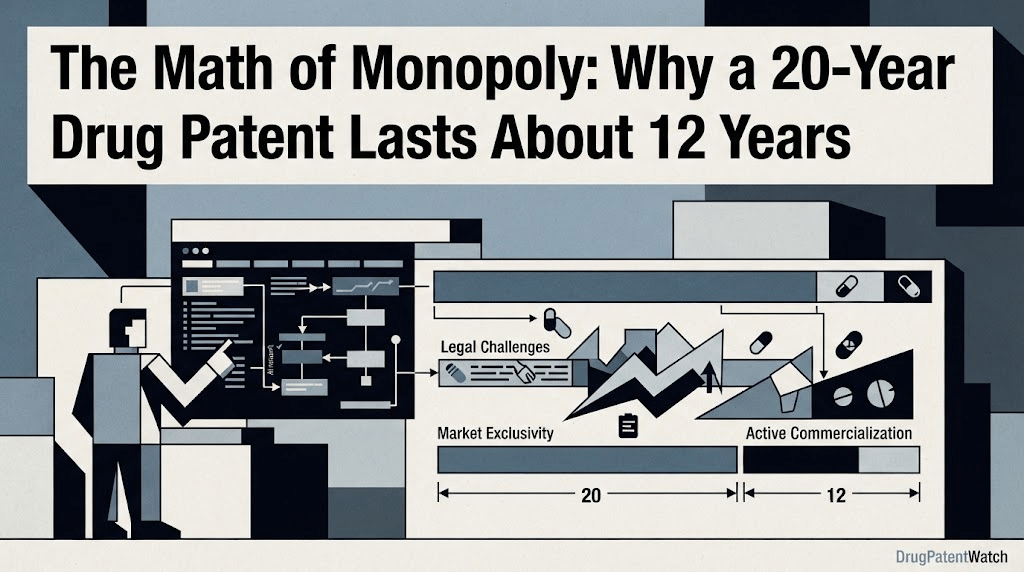
Google Patents dates the core Lipitor patent, US 4,681,893, to May 30, 1986 [1]. FDA approved Lipitor on December 17, 1996 [2]. That is 10.55 years later. More than half of the 20-year patent term was gone before the first prescription.
Pfizer told investors in 2006 that the patent protected Lipitor in the US until March 2010 [3]. That is 13.27 years after approval. Patent term restoration under the Hatch-Waxman Act explains most of the recovery. It did not return the whole 10.55 years.
This article shows where the years go, how the law returns some of them, and why published averages land near 12 years. It uses FDA Federal Register records for two drugs, five published datasets, and one original formula.
The Short Answer: Where Do the 8 Missing Years Go?
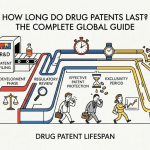
A US drug patent lasts 20 years from its filing date [4]. The filing date comes years before launch. In a study of 499 pharmaceuticals with patent extensions, mean effective patent life was 11.7 years [5].
The missing years go to three places: lab work before the first human trial, clinical testing, and FDA review. Hatch-Waxman patent term extension returns part of that time. It does not return all of it.
What Is Effective Patent Life?
Effective patent life is the time from FDA marketing approval to the expiry of the patent that protects the drug [5]. Nominal patent life is the full term on the face of the patent. The two numbers differ by the years the drug spends in development.
How Long Does a Drug Patent Last in Practice?
Published averages run from about 10.5 to 13.5 years after approval (see Table 1). In one 2024 sample, nominal patent life averaged 19.14 years and effective patent life averaged 13.35 years [6]. The difference is 5.79 years. That figure is a calculation, not a reported statistic.
The Six Findings That Matter
Five datasets put average post-approval patent life between 10.5 and 13.5 years (Table 1) [5][6][7][8][9].
In 499 pharmaceuticals with patent extensions (1984 to 2012), mean effective patent life was 8.7 years without the extension and 11.7 years with it. The standard deviation was about 7 years in both cases [5].
Lipitor used 10.55 of its 20 patent years before approval. The applicant sought 1,213 days of restoration, which is 3.32 years [2]. This is a calculation from FDA dates.
Keytruda used 6.23 years before approval [13][14]. The applicant sought only 83 days of restoration [13]. That figure equals the room left under the 14-year ceiling (analysis).
Years before the IND becomes effective never come back. When no cap binds, effective patent life equals 20 minus those pre-IND years, minus half the testing years (original analysis).
For top-selling drugs, total market monopoly time averaged 18.4 years (with patent term extension) and 19.7 years (without) in a 2023 study of 236 drugs [9]. The 12-year figure describes patent life. It does not describe blockbuster revenue life.
Methodology: How We Ran the Numbers
What data did we use?
We used three kinds of records. First, FDA notices in the Federal Register that list the exact dates for the IND, the marketing application, and approval for Lipitor and Keytruda [2][13]. Second, patent dates from Google Patents and DrugPatentWatch [1][14]. Third, published datasets on effective patent life from the period 1970 to 2024 [5][6][7][8][9][10].
DrugPatentWatch collects patent and exclusivity data from FDA sources. We used it to find the patent expiry date for Keytruda. Readers should confirm any date against FDA and USPTO records before they rely on it.
How did we calculate?
We counted calendar days between dates. We converted days to years by dividing by 365.25. We rounded to two decimals. For the extension formula, we used the statute: half the testing phase plus the full approval phase, then the five-year cap and the 14-year ceiling [11][12].
What are the limits?
Two drugs are case studies, not a sample. The five datasets define effective patent life in different ways. The sources here do not confirm what the USPTO finally granted for either drug. We treat the days the applicant sought as the intended extension. The scenario table uses stated assumptions, and it is not a forecast.
Definitions: Four Terms That Decide the Math
Nominal Patent Life vs. Effective Patent Life
Nominal life runs from filing to expiry. Effective life runs from approval to expiry [5]. A drug can have 20 years of nominal life and 9 years of effective life.
Testing Phase and Approval Phase
FDA splits the regulatory review period into two parts. The testing phase starts when the IND becomes effective. It ends when the company submits the marketing application. The approval phase starts at submission. It ends when FDA approves the product [2][13].
Patent Term Extension vs. FDA Exclusivity
Patent term extension adds time to one patent. FDA exclusivity is a separate right that starts at approval and does not depend on a patent [18]. Pediatric exclusivity adds six months to existing patents and exclusivity. FDA states that it is not a patent extension [19].
What Five Datasets Say About Effective Patent Life
Table 1 lists the datasets. The Source column points to the reference list.
Study or report
Sample
Measure
Result
Source
Canadian House of Commons submission (1997)
157 new chemical entities, Oct. 1984 to Dec. 1995
Average effective patent life with restoration
10.9 years
[10]
ISPOR 2013 abstract
499 NDAs, BLAs, and vaccines with extensions, 1984 to 2012
Average effective patent life with extension
11.7 years (8.7 without)
[5]
Grabowski and Kyle
Drug markets above $100 million in sales
Market exclusivity period
10.5 to 12.5 years
[7]
Morris and Kresh (2024)
Sample from the Hastings database
Effective patent life
13.35 years mean; 14.01 median
[6]
STAT and QuintilesIMS report, as summarized by Drug Topics
Drugs launched over a 20-year window
Exclusivity with no generic
13.5 years average
[8]
Feldman (2023)
236 top-selling drugs
Total market monopoly time
18.4 years with extension; 19.7 without
[9]
The first five rows fall between 10.5 and 13.5 years. Twelve years sits near the middle of that range (analysis). The sixth row is a different measure, and it covers a different group of drugs.
Across 499 pharmaceuticals with patent extensions from 1984 to 2012, average effective patent life was 8.7 years without the extension and 11.7 years with it. Source: ISPOR 2013 abstract [5].
The abstract reports a mean extension of 2.7 years and a gain in effective life of 3.0 years [5]. It does not explain the 0.3-year gap. We flag it so readers do not mix the two figures.
Why Do the Numbers Differ?
Different Samples
The ISPOR sample only includes products that received an extension [5]. Feldman studies top sellers [9]. Grabowski and Kyle sort markets by sales [7]. Each group has a different development history.
Different Start and End Lines
Some studies end the clock at patent expiry. Others end it at the first generic launch. Grabowski and Kyle measure market exclusivity, and the ISPOR study measures patent life [5][7]. A generic launch can come before or after the last patent expires.
Different Treatment of Extensions
The ISPOR abstract shows results with and without extensions [5]. The 2023 Feldman study does the same for total monopoly time [9]. A reader who compares a with-extension figure to a without-extension figure will see a gap that comes from the method, not from the drugs.
What Was Patent Life Before Hatch-Waxman?
A 1997 submission to a Canadian parliamentary committee reports that average effective patent life fell from about 14.5 years in 1970 to about 9.5 years in 1984 [10]. The Hatch-Waxman Act became law in 1984 to restore part of the lost time [5]. The same submission reports an average of 10.9 years with restoration for 157 new chemical entities approved from October 1984 to December 1995 [10].
How Patent Term Extension Works Under 35 U.S.C. 156
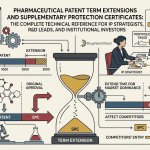
How Does the Patent Term Extension Formula Work?
The extension equals half the testing phase plus the full approval phase [11]. The statute reduces the period for any time before the patent issued [11]. The USPTO also checks that the applicant acted with due diligence [2][13].
What Is the Five-Year Cap?
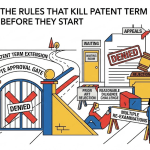
The extension cannot exceed five years [11][12]. A long testing phase can push the formula above five years. The cap then takes the rest.
What Is the 14-Year Ceiling?
The patent term left after approval, plus the extension, cannot exceed 14 years [11][12]. If a patent already has more than 14 years left at approval, the extension shrinks to zero. The base term is not cut.
Why Does the One-Patent Rule Matter?
Only one patent can be extended for the same regulatory review period of a product [11]. A company must pick one patent. The choice sets the date that most analysts treat as the core expiry. DrugPatentWatch lists patent expiry dates by drug, which helps a reader see which patent a company extended and which it did not [14].
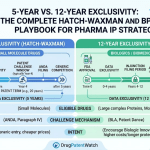
The Three-Zone Patent Clock (Original Framework)
This framework is our own. It is not an industry standard. It splits the time before approval into three zones, and each zone gets a different rate of recovery.
Zone
Time period
Counts toward extension?
Net cost per extra year (no cap binding)
Zone 1
Patent filing to IND effective date
No
1.0 year
Zone 2
IND effective date to marketing application
One half
0.5 year
Zone 3
Marketing application to approval
All of it
0 years
Source for the counting rules: [2][11][13]. The cost column is our calculation.
Zone 1: Pre-IND Years Never Come Back
The testing phase starts when the IND becomes effective [2][13]. Time before that date does not count. Each extra year between filing and IND removes one year of effective life.
Zone 2: Testing Years Come Back at Half Rate
The statute counts half the testing phase [11]. A drug with six years of testing recovers three of them. The company loses the other three.
Zone 3: Review Years Come Back in Full
The approval phase counts in full [11]. When no cap binds, FDA review time has no net effect on effective life. The review term cancels out of the math.
The result is a short formula. When no cap binds and the patent issued before the IND: effective patent life = 20 minus X minus half of T. Here X is the years from filing to IND, and T is the years of testing. This is a derived formula. It is not a reported statistic.
Case Study: Lipitor (Atorvastatin) Lost 10.55 Years Before Launch
What Does the Lipitor Timeline Show?
Event or period
Date or length
Source
Patent date listed by Google Patents
May 30, 1986
[1]
IND effective
October 31, 1990
[2]
NDA submitted
June 17, 1996
[2]
NDA approved
December 17, 1996
[2]
Zone 1 (filing to IND)
4.42 years
Calculated from [1][2]
Zone 2 (testing phase)
2,057 days (5.63 years)
[2]
Zone 3 (approval phase)
184 days (0.50 years)
[2]
Total before approval
10.55 years
Calculated
Extension sought
1,213 days (3.32 years)
[2]
FDA reported that the total regulatory review period was 2,241 days [2]. Warner-Lambert asked the USPTO to restore 1,213 days of the patent term [2].
How Did Lipitor Reach March 2010?
Where Did the 1,213 Days Come From?
Half of 2,057 testing days is 1,028.5. Add 184 approval days. The sum is 1,212.5, and it rounds to the 1,213 days that the applicant sought (analysis based on [2][11]). The patent issued in 1987, before the IND date, so the formula needed no reduction for pre-issuance time [1][2].
Twenty years from May 30, 1986 gives May 30, 2006. Add 1,213 days and the date is September 24, 2009. Add the six-month pediatric period and the date is March 24, 2010. That matches the date in Pfizer’s 2006 statement [3]. The match suggests the pediatric period applied. The sources here do not confirm that step.
On these dates, Lipitor had 9.45 years of patent life after approval before restoration. It had 12.77 years with the 1,213 days. It had 13.27 years with the pediatric period. All three figures are calculations.
What Happened to the Second Lipitor Patent?
In August 2006, the Federal Circuit held that Ranbaxy’s generic product would infringe the basic patent. The court also held that a second patent, US 5,273,995, was invalid on a technical defect [3]. Pfizer said the second patent would have expired in June 2011 [3]. The case shows that the core patent date is not always the date that sets generic entry.
Case Study: Keytruda (Pembrolizumab) and the 14-Year Ceiling
What Does the Keytruda Timeline Show?
FDA approved Keytruda on September 4, 2014 [13][15]. DrugPatentWatch lists a June 13, 2028 expiry for the core patent, US 8,354,509 [14]. The patent family includes international application WO 2008156712 [14]. The EU patent expiry is also June 13, 2028 [15]. A 20-year term ending on that date implies a June 13, 2008 start. That start date is an inference, not a reported fact.
Event or period
Date or length
Source
Patent clock start (inferred from 2028 expiry)
June 13, 2008
[14][15], analysis
IND effective
January 7, 2011
[13]
BLA submitted
February 27, 2014
[13]
BLA approved
September 4, 2014
[13]
Zone 1 (filing to IND)
2.57 years
Calculated
Zone 2 (testing phase)
1,148 days (3.14 years)
[13]
Zone 3 (approval phase)
190 days (0.52 years)
[13]
Total before approval
6.23 years
Calculated
Extension sought
83 days
[13]
Why Did Merck Seek Only 83 Days?
The formula gives 574 testing days plus 190 approval days, which is 764 days (analysis based on [11][13]). The applicant sought 83 days.
The ceiling explains the gap. On September 4, 2014, the patent had 13.77 years left. The ceiling is 14 years. The room is 0.23 years, which is 83 days. June 13, 2028 plus 83 days is September 4, 2028, which is exactly 14 years after approval (analysis). The sources here do not confirm the final USPTO grant.
What Does the Keytruda Patent Wall Add?
The core patent is one layer. I-MAK, an advocacy group, counted 129 Keytruda patent applications and 53 granted patents as of May 2021 [16]. We did not verify those counts against USPTO records. They show that the core patent date is only one input to market life.
Lipitor vs. Keytruda: What Does the Comparison Show?
Measure
Lipitor
Keytruda
Zone 1 (filing to IND)
4.42 years
2.57 years
Zone 2 (testing)
5.63 years
3.14 years
Zone 3 (review)
0.50 years
0.52 years
Total before approval
10.55 years
6.23 years
Formula extension (before caps)
1,212.5 days
764 days
Extension sought
1,213 days
83 days
Rule that set the extension
Formula
14-year ceiling
Patent life after approval, no extension
9.45 years
13.77 years
Patent life after approval, extension sought
12.77 years
14.00 years
Keytruda spent 4.32 years less time before approval than Lipitor. It ended with 1.23 years more patent life after approval (14.00 minus 12.77). Both numbers are calculations. A faster path to approval does not always add much, because the 14-year ceiling stops the gain.
Scenario Analysis: How Development Speed Changes Effective Patent Life
What Happens to a 20-Year Patent in Four Development Paths?
The table below applies the statute to four made-up drugs. The assumptions are: the patent issues before the IND; the applicant shows due diligence; and FDA review takes 1.7 years, which is the mean in the ISPOR dataset [5]. X is the years from filing to IND. T is the years of testing.
Scenario
X (years)
T (years)
Formula result: 20 – X – T/2
Result after caps
Rule that binds
A: fast path
2
3
16.5
14.0
14-year ceiling
B: standard path
4
4
14.0
14.0
Formula meets the ceiling
C: slow path
6
5
11.5
11.5
Formula only
D: very slow path
8
7
8.5
8.3
Five-year cap
In Scenario D, the formula extension is 5.2 years (3.5 testing plus 1.7 review). The five-year cap cuts 0.2 years. The result is 8.3 years.
When Does Each Cap Bind?
The 14-year ceiling binds for fast programs. A drug with X + T/2 below 6 years hits the ceiling (analysis: 20 minus 14). Keytruda is in this group, with 2.57 plus 1.57 equal to 4.14 years. Without the ceiling, its formula result would be 15.86 years.
The five-year cap binds for slow programs. Scenario D shows it. The slowest drugs lose one year of effective life for each extra year of testing once the cap binds, because the extension stops growing.
Why 12 Years Is an Average and Not a Rule
How Wide Is the Spread?
The ISPOR sample reports a mean of 11.7 years with a standard deviation of 6.8 years [5]. In plain terms, the spread is wide. The calculation 11.7 minus 6.8 gives 4.9 years, and 11.7 plus 6.8 gives 18.5 years. Those figures do not describe a single drug. They show that two drugs with the same nominal term can sit far apart.
Do Top Sellers Get More Than 12 Years?
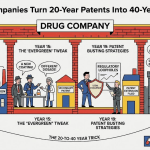
Yes, on a different measure. Feldman found that total market monopoly time for top-selling drugs averaged 18.4 years with patent term extension and 19.7 years without [9]. She also found that 91 percent of drugs that obtained extensions kept their monopolies past the end of those extensions, most often through secondary patents [9]. The STAT and QuintilesIMS report found that drugs that reached $1 billion in annual US sales had exclusivity periods about 23 months longer than the average [8].
This does not conflict with the 12-year figure. The 12-year figure describes the term of the core patent after approval. The top-seller figures include secondary patents and other exclusivities.
Do Generic Patent Challenges Shorten Market Life?
A 2012 Journal of Health Economics study found that effective market life was stable across sales categories and changed little over a decade, even as challenges rose [17]. The authors conclude that challenges maintain the historical baseline instead of cutting it [17]. A patent date and a generic launch date are two separate events.
FDA Exclusivity Clocks Run Beside the Patent Clock
Right
Length
How it works
Source
New chemical entity exclusivity
5 years
Starts at approval
[18]
Orphan drug exclusivity
7 years
Starts at approval
[18]
New clinical investigation exclusivity
3 years
For a qualifying change
[18]
Pediatric exclusivity
6 months
Added to existing patents and exclusivity
[18][19]
Reference biologic exclusivity
12 years
Runs from first licensure
[20]
Patent term extension
Up to 5 years; 14-year ceiling after approval
Adds to one patent
[11][12]
When Does the 12-Year Biologic Clock End for Keytruda?
Keytruda was first approved on September 4, 2014 [13][15]. A 12-year reference product period from that date ended on September 4, 2026 (analysis based on [20]). The 14-year patent ceiling falls on September 4, 2028, two years later. For an extended core patent, the 14-year ceiling sits at most two years after the 12-year period. A company that wants more time must rely on later patents (analysis).
What This Means for Generic Entry, Biosimilars, and Brand Manufacturers
What This Means for Generic Entry
An Orange Book date is only a starting point. FDA lists the patent number and expiry date for each listed patent [18]. A reader must then check for extension, pediatric exclusivity, and litigation. In the Lipitor case, the second patent shows how a court ruling can change the date [3].
What This Means for Biosimilars
Biosimilar developers face two clocks. The 12-year period runs from first licensure [20]. Patents run on their own schedule. For Keytruda, the 12-year period has ended, but the core patent runs to 2028 on the dates above [14]. I-MAK counts many other patents [16].
What This Means for Brand Manufacturers
The three-zone formula shows where a company can protect time. Zone 1 years cost one for one. A company can control the date of the first filing. It also controls when it starts the IND. A drug with a fast path hits the 14-year ceiling, and the extra effort in Zone 2 earns no further patent time. That shifts the focus to secondary patents and exclusivities, as the Feldman data show [9].
What This Means for Investors and Analysts
A model that assumes 20 years from filing will overstate protection. A model that assumes 12 years will understate it for fast programs and for top sellers. Use the drug’s own dates. FDA publishes them in Federal Register notices when a company applies for patent term restoration [2][13].
How to Calculate Remaining Patent Life for Any Drug
Step 1: Find the Core Patent and Its Expiry
Use the Orange Book or the Purple Book. FDA lists the patent number and expiry for each listed patent [18]. DrugPatentWatch shows the same data by drug, with the expiry date for each patent [14].
Step 2: Find the FDA Regulatory Review Dates
Search the Federal Register for “Determination of Regulatory Review Period” and the drug name. The notice lists the IND date, the application date, and the approval date [2][13].
Step 3: Apply the Formula
Take half the testing days and add the approval days. Cap the result at five years. Then check the 14-year ceiling from the approval date [11][12].
Step 4: Check What Else Applies
Look for pediatric exclusivity, orphan exclusivity, litigation, and settlements. These can move the date of generic or biosimilar entry in either direction [18][19].
Key Takeaways
A US drug patent lasts 20 years from filing [4]. Published averages for effective patent life after approval run from about 10.5 to 13.5 years (Table 1).
In 499 pharmaceuticals with extensions, the mean effective life was 11.7 years with the extension and 8.7 years without it [5].
Lipitor used 10.55 years before approval. Its applicant sought 1,213 days of restoration [2].
Keytruda used 6.23 years before approval. Its applicant sought 83 days, which equals the room under the 14-year ceiling (analysis) [13].
When no cap binds, effective patent life equals 20 minus the pre-IND years, minus half the testing years (original analysis).
Top-selling drugs average 18.4 to 19.7 years of total market monopoly time because of secondary patents and exclusivities [9].
FAQ
What is the maximum patent life a drug can have after FDA approval?
For an extended patent, the maximum is 14 years from approval [11][12]. A patent with no extension can have more than 14 years left if it was filed late in development.
Can a company extend every patent on a drug?
No. Only one patent can be extended for the same regulatory review period of a product [11].
How much patent time can a company restore?
Up to five years. The formula counts half the testing phase plus the full approval phase [11][12]. Lipitor’s applicant sought 3.32 years, and Keytruda’s applicant sought 0.23 years [2][13].
Does pediatric exclusivity extend the patent?
No. FDA states that it is an exclusivity period, and it attaches after the patent term ends [19]. It adds six months to existing patents and exclusivity [18].
How long does FDA review take?
The ISPOR dataset reports a mean review time of 1.7 years [5]. Lipitor’s approval phase was 184 days and Keytruda’s was 190 days [2][13].
Do biologics get the same patent math?
Yes. Biologics can receive patent term extension. In the ISPOR dataset, the mean extension was 2.4 years for BLAs and 2.7 years for NDAs [5]. Biologics also receive a 12-year reference product period [20].
Do top-selling drugs get more than 12 years of protection?
On total monopoly time, yes. Feldman reports 18.4 years with extension and 19.7 years without for 236 top sellers [9].
Did the Hatch-Waxman Act raise effective patent life?
The data point that way. A 1997 submission reports a fall from about 14.5 years in 1970 to about 9.5 years in 1984 [10]. The ISPOR study reports 8.7 years without extensions and 11.7 years with them [5].
Where can I find a drug’s patent expiry date?
FDA lists patent numbers and expiry dates in the Orange Book for each approved drug [18]. DrugPatentWatch shows the same data with patent-level detail [14]. For the extension dates, read the Federal Register notice [2][13].
Is 12 years the right number for my forecast?
Not by itself. The ISPOR sample has a standard deviation of 6.8 years around its 11.7-year mean [5]. Build the forecast from the drug’s own filing, IND, and approval dates.
References
Google Patents. (n.d.). US4681893A: Trans-6-[2-(3- or 4-carboxamido-substituted pyrrol-1-yl)alkyl]-4-hydroxypyran-2-one inhibitors of cholesterol synthesis. https://patents.google.com/patent/US4681893A/en
Food and Drug Administration. (1997, July 18). Determination of regulatory review period for purposes of patent extension; Lipitor. Federal Register, 62(138), 38564. https://www.govinfo.gov/content/pkg/FR-1997-07-18/html/97-18915.htm
Pfizer Inc. (2006, August 2). U.S. appeals court upholds Lipitor’s basic patent with exclusivity maintained in U.S. until March, 2010 [Press release, Exhibit 99]. U.S. Securities and Exchange Commission. https://www.sec.gov/Archives/edgar/data/78003/000007800306000191/ex99802.htm
Food and Drug Administration. (n.d.). Patents and exclusivity [Presentation]. https://fda.gov/media/92548/download
ISPOR. (2013, May). Analysis of the Waxman-Hatch Act pharmaceutical patent extensions (1984-2012) [Conference abstract]. ISPOR 18th Annual International Meeting, New Orleans, LA. https://www.ispor.org/heor-resources/presentations-database/presentation/ispor-18th-annual-international-meeting/analysis-of-the-waxman-hatch-act-pharmaceutical-patent-extensions-1984-2012
Morris, E. M., & Kresh, J. (2024, May 20). Pharmaceutical “nominal patent life” versus “effective patent life,” revisited. University of Akron Intellectual Property and Technology Law blog (Center for Intellectual Property x Innovation Policy). https://blogs.uakron.edu/ualawip/2024/05/20/pharmaceutical-nominal-patent-life-versus-effective-patent-life-revisited/
Grabowski, H., & Kyle, M. (2007). Generic competition and market exclusivity periods in pharmaceuticals. Managerial and Decision Economics. https://publications.ut-capitole.fr/3156/1/medias/doc/by/kyle/generic_competition.pdf
Drug Topics. (n.d.). More billion dollar drugs, faster approvals, and other pharmaceutical trends [Summary of a STAT and QuintilesIMS report]. https://drugtopics.com/view/more-billion-dollar-drugs-faster-approvals-and-other-pharmaceutical-trends
Feldman, R. (2023). Patent term extensions and the last man standing. Yale Law & Policy Review, 42(1), 1. https://yalelawandpolicy.org/sites/default/files/YLPR/feldman_patent_term_extensions_ylpr_2023.pdf
House of Commons of Canada, Standing Committee on Industry. (1997, March 11). Evidence, submission on effective patent life and Waxman-Hatch (Meeting 49). https://noscommunes.ca/Archives/Committee/352/indu/evidence/49_97-03-11/indu49_blk-e.html
35 U.S.C. § 156. Extension of patent term. Legal Information Institute, Cornell Law School. https://law.cornell.edu/uscode/text/35/156
U.S. Patent and Trademark Office. (2024). Manual of Patent Examining Procedure § 2758: Notice of final determination, calculation of patent term extension [R-01.2024]. https://www.uspto.gov/web/offices/pac/mpep/s2758.html
Food and Drug Administration. (2018, January 31). Determination of regulatory review period for purposes of patent extension; Keytruda. Federal Register, 83(21), 4492-4494. https://regulations.vlex.com/vid/determination-of-regulatory-review-701904621
DrugPatentWatch. (n.d.). Claims for patent: 8,354,509. https://www.drugpatentwatch.com/p/biologics/patent-claims/8354509
GaBI Online. (n.d.). Biosimilars of pembrolizumab. Generics and Biosimilars Initiative. https://gabionline.net/biosimilars/general/biosimilars-of-pembrolizumab
Initiative for Medicines, Access & Knowledge. (2021, May 18). Overpatented, overpriced: Keytruda’s patent wall [Written statement]. U.S. House of Representatives, Committee on Oversight and Reform. https://docs.house.gov/meetings/GO/GO00/20210518/112631/HHRG-117-GO00-20210518-SD005.pdf
Hemphill, C. S., & Sampat, B. N. (2012). Evergreening, patent challenges, and effective market life in pharmaceuticals. Journal of Health Economics, 31(2), 327-339. https://phlr.org/node/431
Food and Drug Administration. (n.d.). How can I better understand patents and exclusivity? https://www.fda.gov/industry/fda-basics-industry/how-can-i-better-understand-patents-and-exclusivity
Food and Drug Administration. (n.d.). Small business assistance: Frequently asked questions for new drug product exclusivity. https://www.fda.gov/drugs/developmentapprovalprocess/smallbusinessassistance/ucm069962.htm
42 U.S.C. § 262. Regulation of biological products. Legal Information Institute, Cornell Law School. https://www.law.cornell.edu/uscode/text/42/262