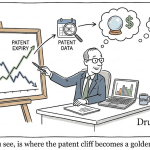
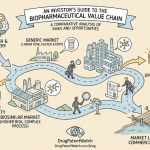
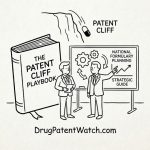
The pharmaceutical industry is approaching a singularity. Between 2025 and 2030, a wave of patent expirations—often described as the “super-cliff”—will put between $200 billion and $400 billion in annual brand-name drug sales at risk globally.1 For the retail pharmacy, this is not merely a change in inventory; it is the most significant margin expansion opportunity in a generation. The transition from a brand-name monopoly to a multi-source generic market creates a brief, volatile window where a pharmacy can capture “supranormal” profits by exploiting the lag between falling acquisition costs and the slow adjustment of reimbursement rates.4
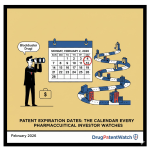
Success in this period requires more than just filling prescriptions. It demands an investigative approach to intellectual property (IP) and a forensic understanding of the pharmacy benefit manager (PBM) reimbursement engine. Pharmacies that rely on simple calendar alerts for patent expirations will lose. The winners use sophisticated data platforms like DrugPatentWatch to track litigation settlements, Paragraph IV (PIV) filings, and 180-day exclusivity forfeitures to time their inventory shifts with surgical precision.7
The 180-Day Arbitrage
The core of the margin strategy lies in the Hatch-Waxman Act’s 180-day exclusivity period. This regulatory incentive grants the first generic manufacturer to successfully challenge a brand-name patent a six-month window of near-monopoly in the generic space.4 During this time, the “first-to-file” (FTF) generic and the brand manufacturer are typically the only players in the market.
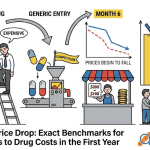
This duopoly phase is the high-water mark for pharmacy profit. Unlike the later “commodity” phase where ten or more manufacturers drive prices down by 95%, the initial generic entrant typically offers a more modest discount of 15% to 30%.4 For the pharmacy, the profit is found in the “MAC lag.” PBMs use Maximum Allowable Cost (MAC) lists to set the ceiling on what they will pay for a generic drug.13 Because PBMs often wait several weeks or months to update these lists post-launch, a pharmacy can buy the generic at a discounted price while being reimbursed at the higher, pre-generic brand rate or a legacy MAC.16
The Price Erosion Timeline
Market Phase
Competitor Count
Price Reduction vs. Brand
Margin Profile
Duopoly (180-Day)
1 Generic (+/- AG)
15% – 39%
High: Capture spread between acquisition cost and legacy MAC.4
Early Multi-Source
2 – 5 Generics
50% – 79%
Moderate: Margins compress as PBMs aggressively update MAC lists.4
Commodity Phase
6 – 10+ Generics
80% – 95%
Thin: Only high-volume, efficient buyers remain profitable.4
The presence of an Authorized Generic (AG)—the brand drug sold as a generic—can further complicate this math. AGs often launch on Day 1 of the exclusivity period to split the generic market with the independent challenger.6 While an AG can reduce the generic manufacturer’s revenue by 40% to 52%, it often benefits the pharmacy by ensuring supply and accelerating the shift away from the expensive brand-name product.6
Forensic Inventory Management
Winding down brand-name inventory is the most dangerous part of the patent cliff transition. For a blockbuster drug generating $10 million in daily revenue, carrying even 10% in excess stock as the patent expires represents a massive capital loss.1 Once a generic enters, brand-name claims are often denied or reimbursed at the new, much lower generic MAC, turning expensive inventory into “dead stock” overnight.8
Pharmacies must shift from tactical buying to a Total Cost of Ownership (TCO) model. This involves tracking not just the invoice price, but the operational costs of shortage management, potential write-offs, and administrative overhead.25 Integrating real-time patent data via DrugPatentWatch APIs allows pharmacies to automate this transition. Instead of guessing, systems can automatically reduce PAR (Periodic Automatic Replenishment) levels for brands 90 days before a “litigation-adjusted” entry date.8
Transition Benchmarks for Blockbusters
Drug Name
Indication
Expected Generic Entry
Strategic Insight
Xarelto
Anticoagulant
February 2025
90% price collapse seen at Mark Cuban Cost Plus Drugs within 6 months of entry.26
Full generic volume restrictions lifted; previous caps had artificially propped up brand use.28
Eliquis
Anticoagulant
April 2028
Complex patent thicket extends exclusivity despite earlier FDA approvals.34
The Revlimid (lenalidomide) case serves as a warning for those relying on simple patent dates. While the primary patent expired in 2019, settlements forced generic companies into volume-limited entries starting in 2022.33 Pharmacies had to manage a “bottleneck” where generic supply was capped at roughly 7% to 10% of the market, requiring them to keep expensive brand stock on hand for the majority of patients.32 Only in January 2026 will this bottleneck break, allowing for a true multi-source price collapse.28
The PBM Squeeze: GER and Reimbursement Tactics
The capture of generic margins is increasingly threatened by Generic Effective Rate (GER) contracts. Unlike a drug-specific MAC, a GER is a contractual rate where the PBM guarantees a total average reimbursement for all generic drugs—usually expressed as AWP minus a percentage, such as 85%.14
If a pharmacy identifies a high-margin generic launch and maximizes its dispensing, the PBM may still claw back those profits through a retrospective “true-up” to meet the GER target.38 This lack of transparency means a pharmacy might lose money on every fill of a high-cost new generic without realizing it until months later.40 To counter this, sophisticated operators run quarterly GER analyses and source specific NDCs with higher AWP spreads to balance their portfolio and mitigate the impact of clawbacks.39
The PBM Market Concentration
PBM Entity
Market Share (2022)
Business Model Impact
Top 6 PBMs
96%
High concentration gives PBMs ultimate leverage over pharmacy margins.42
Vertical Integration
High
PBMs often own specialty pharmacies, steering high-margin generics to their own facilities.43
The FTC’s 2025 report confirmed that PBMs mark up specialty generic drugs by thousands of percentage points when dispensed through their own affiliated pharmacies, while simultaneously squeezing independent pharmacy reimbursements to near or below acquisition costs.43 This vertical integration makes it essential for independent pharmacies to leverage “at-risk” launch data and skinny-labeling opportunities to find niches where PBMs have not yet established dominant control.
Sourcing for Reliability: The TCO Framework
In a generic market, the cheapest drug is often the most expensive to stock. Low-margin manufacturers are prone to batch failures and regulatory shutdowns, which can lead to life-critical shortages.24 A single lost batch for a manufacturer can be a six-figure event, but for a pharmacy, the resulting “failure to supply” can lead to thousands of dollars in labor costs and lost patient loyalty.25
Pharmacies should use a supplier scorecard that weights manufacturing redundancy and FDA inspection history more heavily than raw acquisition cost.7 Manufacturers that use Process Analytical Technology (PAT) and Quality by Design (QbD) are often more reliable partners, as these technologies can reduce process cycle times by 50% and batch rejection rates by 90%.47
Supplier Evaluation Matrix
Metric
Weight
Value Proposition
FDA Compliance
30%
Avoids sudden supply shocks from warning letters or 483s.7
API Sourcing
20%
Geographically diverse sources reduce geopolitical risk.25
Fill Rate History
25%
Reliability in meeting volume commitments.25
Invoice Price
25%
Important for day-to-day profit, but secondary to stability.12
By choosing “Day 1” partners carefully, pharmacies can avoid the “regulatory gauntlet” that delays secondary entrants. Those who partner with firms that engage proactively with the FDA via Question-Based Review (QbR) gain a tangible speed advantage, entering the market during the highest-margin duopoly phase.48
Complex Generics: The New Margin Frontier
As simple oral solids (tablets) become hyper-commoditized, the real margin is shifting to complex generics—sterile injectables, inhalers, and transdermal patches.2 These products have high technical and regulatory barriers to entry, which prevents the “swarm” of generic competitors that typically kills margins within months.2
Injectables held a 61.5% market share by revenue in 2024, and inhalables are projected to grow at a 9.9% CAGR through 2030.49 For pharmacies, these products offer more durable margins because price erosion is slower. A complex generic may only see a 50% to 70% price reduction over several years, compared to the 95% collapse seen in simple tablets like atorvastatin.6
Small Molecule “Cliff” vs. Complex “Slope”
Feature
Small Molecule Generic
Complex Generic / Biosimilar
Substitution
Automatic (Pharmacy Level)
Often requires physician/payer intervention.6
Price Floor
5% – 10% of Brand Price
50% – 70% of Brand Price.6
Competitor Count
High (10+)
Low to Moderate (2–5).2
Key Barrier
Simple Patent Litigation
Manufacturing & Bioequivalence (BE) complexity.9
The rise of biosimilars—generic versions of complex biologics—represents the largest value transfer in the coming years. Products like Stelara (ustekinumab) are already facing biosimilar launches in 2025 following settlements.18 Because these are not always automatically interchangeable at the pharmacy counter, the margin shift is slower, requiring more active clinical management and payer negotiation.1
The Strategic Importance of “Skinny Labeling”
A critical but underused strategy for margin optimization is understanding “Section viii” carve-outs, or skinny labeling. This allows a generic firm to launch for unpatented indications while the brand retains protection for others.7 A pharmacy that understands which indications are generic-eligible can proactively switch patients to the lower-cost alternative even before the brand loses its final patent.7
However, the legal landscape is shifting. The GSK v. Teva ruling introduced “induced infringement” liability, where marketing a generic as an “AB-rated equivalent” could be enough to incur massive damages if it encourages use for a patented indication.9 This makes real-time IP intelligence from sources like DrugPatentWatch essential for staying on the right side of the law while maximizing substitution.7
Conclusion: Data as the Definitive Edge
The next five years will see a historic transfer of wealth in the pharmaceutical sector. For pharmacies, the path to 20% or 30% gross margins is not found in volume alone, but in the strategic timing of the brand-to-generic transition. Relying on PBM-provided data is a recipe for margin compression; by the time a PBM notifies you of a change, the arbitrage opportunity is already gone.8
To survive the “Super-Cliff,” pharmacies must become data-first organizations. This means:
Integrating real-time patent APIs into inventory systems to automate brand wind-downs.7
Vetting suppliers based on manufacturing stability and FDA compliance rather than just price.25
Actively monitoring PIV filings and litigation settlements to identify the “first-to-file” duopoly windows where margins are highest.4
Calculating the TCO of every transition to avoid “dead stock” and “underwater” GER reimbursements.25
The patent cliff is only a “cliff” for those who aren’t watching the edge. For those with the right data, it’s a launchpad for the next decade of growth.
Key Takeaways
The 180-Day Window is Critical: Capture high spreads before MAC updates catch up to acquisition costs.4
Watch for Authorized Generics: They signal a “split” in the duopoly but can ensure supply stability.6
Manage Brand Wind-Down with Precision: Use litigation-adjusted dates to avoid costly dead stock.8
Leverage Complex Generics: Focus on injectables and inhalers for more durable, long-term margins.2
Audit PBM Reconciliation: Don’t let retrospective GER clawbacks wipe out your launch-day profits.38
FAQ: Navigating the Generic Transition
1. How does “Paragraph IV” certification affect my pharmacy’s inventory planning? A Paragraph IV certification is a signal that a generic company is challenging a brand-name patent. This often leads to a “30-month stay” on FDA approval, creating a definitive “floor” for when a generic could enter the market. Tracking these filings on DrugPatentWatch allows you to predict entry years before it happens.1
2. What is an “At-Risk” launch and should my pharmacy participate? An “at-risk” launch occurs when a generic launches after FDA approval but before a court has ruled on the patent. If the generic eventually loses the case, the pharmacy could be stuck with unsalable inventory or face liability for “induced infringement.” Proceed with caution and ensure your contracts include manufacturer indemnification.1
3. Why do PBMs lag in updating MAC lists for new generic launches? PBMs often use MAC lag to their advantage, either to capture “spread” from plan sponsors or to slow the financial transition. For pharmacies, this lag is the primary source of launch-day profit. By dispensing a low-cost generic reimbursed at a high legacy rate, you capture the difference before the PBM ratchets the price down.15
4. Can “Skinny Labeling” prevent me from substituting a generic at the counter? Not usually. Most state laws allow for the substitution of an AB-rated generic regardless of whether its label includes all of the brand’s indications. However, you must be aware of “inducement” risks if your marketing actively promotes the drug for a use that is still under patent protection.6
5. How does the Inflation Reduction Act (IRA) impact generic entry in 2026? The IRA allows Medicare to negotiate prices on top-selling drugs like Eliquis and Januvia. If a generic launches, the drug is no longer eligible for negotiation. This creates a massive incentive for brand companies to settle with generics to avoid the “negotiation cliff,” which could lead to more predictable entry dates for pharmacies.27
Estimating the Value of Adding 30 Days to the 180-Day Market Exclusivity of the First-to-File Generic Drug Manufacturer – PMC, accessed February 5, 2026, https://pmc.ncbi.nlm.nih.gov/articles/PMC12796020/