1. Executive Summary: The Structural Transformation of Exclusivity
The pharmaceutical sector operates on a fundamental economic premise: the patent bargain. Innovators are granted a temporary monopoly to recoup the substantial capital required for drug development, after which competition drives prices toward marginal cost. This model, codified in the Drug Price Competition and Patent Term Restoration Act of 1984 (Hatch-Waxman) and the Biologics Price Competition and Innovation Act of 2009 (BPCIA), assumes a binary transition from exclusivity to competition—a “patent cliff.”
Current market data renders this assumption obsolete. The transition from monopoly to open market is no longer a cliff but a meticulously engineered slope, constructed through a legal strategy known as serial patent litigation. By layering secondary patents over primary composition-of-matter claims and staggering lawsuits, innovator companies have successfully decoupled the concept of “market exclusivity” from the statutory term of the original patent.
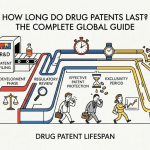
This report analyzes the mechanics of this phenomenon. It draws on litigation dockets, settlement agreements, and legislative texts from 2024 and 2025 to illustrate how brand defense strategies have evolved from simple patent enforcement into complex lifecycle management programs. The data indicates that for top-selling drugs, the effective monopoly period now frequently exceeds the statutory 20-year patent term by nearly a decade, costing the U.S. healthcare system an estimated $52 billion annually in delayed savings.1
For the strategic planner, the implications are binary: rely on public patent expiration dates and misprice the asset, or adopt a dynamic forecasting model that accounts for the “patent thicket,” the 30-month stay, and the nuances of the 505(b)(2) regulatory pathway. This document serves as a guide to the latter.
2. The Mechanics of Delay: Hatch-Waxman and the 30-Month Stay
The engine of modern pharmaceutical litigation is the “30-month stay,” a provision unique to U.S. law that links patent disputes directly to regulatory approval. Understanding its intended function versus its current application is essential for predicting generic entry.
2.1 The Statutory Trigger
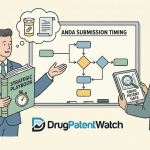
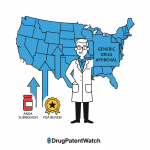
Under the Hatch-Waxman Act, a generic applicant filing an Abbreviated New Drug Application (ANDA) must certify against patents listed in the FDA’s Orange Book. A “Paragraph IV” certification asserts that a listed patent is invalid, unenforceable, or will not be infringed by the generic product. This certification acts as a highly artificial act of infringement, allowing subject matter jurisdiction for a lawsuit before the generic product is even made or sold.
If the New Drug Application (NDA) holder sues within 45 days of receiving notice, the FDA is statutorily barred from approving the generic application for 30 months, or until a court decision in favor of the generic, whichever comes first.3
2.2 The Serial Litigation Loophole
The 30-month stay was designed to preserve the status quo during litigation. However, it has evolved into a tool for serial delay through the strategic timing of patent listings.
While the Medicare Modernization Act of 2003 (MMA) limited the number of 30-month stays to one per ANDA (based on patents listed before the ANDA was filed), opportunities for serial litigation remain. Innovators frequently obtain new patents—often continuations or methods of use—and assert them in subsequent lawsuits. Although these later-filed patents may not trigger a new 30-month stay, they create a “litigation overhang.”
Preliminary Injunctions: Even without a statutory stay, a brand can seek a preliminary injunction on a newly issued patent just as the initial 30-month stay expires.
The “Launch at Risk” Deterrent: By maintaining active litigation on secondary patents, brands create an “at-risk” launch scenario. If a generic launches while litigation is pending and later loses, they are liable for treble damages based on the brand’s lost profits—a financial risk that often exceeds the potential value of the generic market opportunity.5
2.3 Data Analysis: The Duration of Disputes
Empirical data suggests that the 30-month period is often insufficient to resolve complex patent disputes. The median time to trial in major patent venues like the District of Delaware or the District of New Jersey frequently exceeds 2.5 years. Appeals to the Federal Circuit add another 12 to 18 months. Consequently, the 30-month stay often expires before a final non-appealable decision is rendered, leaving the generic in a state of regulatory approval but legal paralysis.
3. The Biologics Battlefield: The BPCIA and the “Patent Dance”
Biologic drugs, which now account for nearly half of U.S. drug spending, are governed by the BPCIA. This framework differs fundamentally from Hatch-Waxman in that it does not provide an automatic 30-month stay. Instead, it creates a structured information exchange known as the “patent dance.”
3.1 The Two-Wave Litigation Structure
The BPCIA facilitates serial litigation by design, splitting the patent dispute into two distinct phases.
Phase 1: The Initial List
Upon acceptance of a biosimilar application (aBLA), the biosimilar applicant provides its dossier to the Reference Product Sponsor (RPS). The parties negotiate a list of patents to litigate immediately. The RPS must sue on these patents within 30 days to preserve its rights to lost profits.7
Phase 2: The Notice of Commercial Marketing (NCM)
The biosimilar applicant must provide notice 180 days before commercial marketing. At this point, the RPS can seek a preliminary injunction on any listed patent that was not included in the first wave of litigation.9
3.2 Strategic Implications of the “Dance”
This structure allows the brand to “hold back” patents. An RPS might choose to litigate only a subset of patents in the first wave—perhaps the weakest ones or those requiring the longest discovery—while keeping its strongest “closer” patents in reserve for the preliminary injunction phase.
This creates perpetual uncertainty for the biosimilar developer. They may spend years litigating the first wave, only to be hit with a new, high-stakes injunction request on the eve of launch. This “second wave” is a potent mechanism for delaying entry, as courts are often hesitant to disrupt the status quo when a new patent assertion is presented.7
4. Anatomy of a Patent Thicket: The Humira Case Study
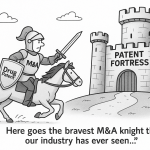
AbbVie’s defense of Humira (adalimumab) represents the apex of serial patent litigation strategy. It serves as the primary template for modern brand defense.
4.1 Construction of the Fortress
Humira was approved in 2002. Its primary patent expired in 2016. Yet, biosimilars did not launch in the U.S. until 2023. This seven-year extension was achieved not through a single patent extension, but through a “thicket” of over 100 patents.
Table 1: The Humira Patent Portfolio Composition
Patent Type
Function
Count (Approx.)
Strategic Purpose
Composition of Matter
Protects the molecule itself.
1
The “Foundation.” Expired 2016.
Formulation
Protects the specific mix of ingredients.
~20
Prevents copying the exact liquid recipe.
Manufacturing
Protects the process of making the drug.
~50+
Extremely hard to disprove without deep discovery.
Method of Treatment
Protects the use for specific diseases.
~30+
Allows carving out indications, complicating labels.
Device
Protects the pen/injector mechanism.
~20+
Targets the delivery system, separate from the drug.
Source: Derived from I-MAK and academic analysis of the AbbVie portfolio.10
4.2 The Litigation Strategy
When biosimilar competitors like Amgen, Sandoz, and Boehringer Ingelheim filed their aBLAs, AbbVie did not assert just one patent. In the case of Alvotech, AbbVie listed 63 patents and asserted 61 of them in the first wave of litigation.11
The sheer volume of asserted patents creates a “resource attrition” strategy. For a biosimilar developer, proving invalidity or non-infringement for 60+ patents is prohibitively expensive and time-consuming. Even if the challenger has a 90% success rate, losing on just one patent can result in a total market block until that patent expires.
4.3 The Settlement Outcome
Facing this thicket, every major competitor settled.
Amgen: Settled in 2017, agreeing to delay U.S. entry until Jan 31, 2023.13
Samsung Bioepis & Sandoz: Followed with similar agreements for 2023 dates.
Boehringer Ingelheim: Initially fought, arguing “unclean hands” regarding the thicket, but ultimately settled for a July 2023 entry.14
Key Insight: The disparity between the U.S. and European markets highlights the efficacy of this strategy. Humira biosimilars launched in Europe in 2018. The five-year gap represents pure “regulatory arbitrage” generated by the U.S. patent litigation system.15
5. The Volume-Limited Settlement: The Revlimid Model
If Humira represents the “blockade” model, Revlimid (lenalidomide) represents the “controlled release” model. Celgene (now BMS) utilized serial litigation to negotiate a tiered entry system that preserves pricing power.
5.1 The Patent Estate
Revlimid, a treatment for multiple myeloma, was protected by a primary patent expiring in 2019. However, Celgene obtained extensive secondary patents, including polymorphism and risk-management distribution system (REMS) patents, extending potential exclusivity to 2027.17
5.2 The Settlement Structure
Rather than a binary entry date, BMS negotiated settlements with Natco, Alvogen, Dr. Reddy’s, and Cipla that allowed for early but restricted entry.
Entry Date: March 2022 (approx. 4 years post-primary expiry).
Volume Cap: Generics were restricted to a “mid-single-digit” percentage of the total market volume in the first year.19
The Ramp: The allowed volume increases incrementally each year until January 31, 2026, when the volume restriction lifts entirely.21
5.3 Economic Implication
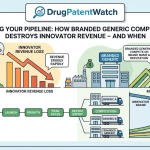
This strategy is highly accretive to the brand. By limiting generic volume to ~10-30%, the brand avoids the “commoditization spiral” where prices drop by 90%. Instead, the brand retains ~70-90% of the market volume at brand-name prices, while the “limited” generic supply also trades at a premium due to scarcity. It converts a generic entry event from a revenue collapse into a managed erosion.17
6. Product Hopping: Strategic Reformulation
When the patent thicket on the original molecule is insufficiently dense, companies may employ “product hopping”—switching the patient population to a new, patent-protected version of the drug before generic entry occurs.
6.1 Hard Switch vs. Soft Switch
Hard Switch: The manufacturer creates a new formulation (e.g., extended release vs. immediate release) and actively withdraws the old formulation from the market. This forces patients to switch to the new drug because the old one is no longer available. When generics for the old drug eventually arrive, there is no branded reference product for them to be substituted against.23
Soft Switch: The manufacturer leaves the old drug on the market but ceases all promotion, while aggressively marketing the new version to physicians. The goal is to migrate the prescription base voluntarily before the generic launch.
6.2 The Suboxone Case
Indivior’s management of the Suboxone (buprenorphine/naloxone) franchise is a seminal example. Facing generic competition for the tablet form, Indivior introduced a sublingual film version. Citing “safety concerns” regarding pediatric exposure to tablets, they attempted to withdraw the tablets from the market. This move was challenged by antitrust regulators, but it successfully migrated a significant portion of the market to the patent-protected film, delaying the impact of generic tablets.25
6.3 Legislative Response: S. 1040
The Drug Competition Enhancement Act (S. 1040), introduced in 2025, specifically targets this practice. It proposes to shift the burden of proof in antitrust cases. Under S. 1040, a “hard switch” executed within a specific window relative to generic entry would be presumptively anti-competitive. The manufacturer would be required to prove that the switch was motivated by genuine safety or efficacy improvements, rather than merely delaying competition.23
7. The “Skinny Label” Crisis: The End of Section viii Safe Harbors?
Section viii of the Hatch-Waxman Act allows a generic to carve out patent-protected indications from its label. If a drug is approved for Condition A (off-patent) and Condition B (patented), the generic can launch labeled only for Condition A. This “skinny label” strategy has been a cornerstone of generic access.
7.1 GSK v. Teva: The Inducement Trap
The legal viability of this strategy has been severely compromised by the Federal Circuit’s decision in GlaxoSmithKline v. Teva. The court reinstated a $235 million jury verdict against Teva, finding that despite Teva’s skinny label carving out the patented heart failure indication for Coreg (carvedilol), Teva “induced” infringement.27
Evidence of Inducement:
The court cited Teva’s press releases describing its product as “AB-rated” (therapeutically equivalent) to the brand. The implication is that merely claiming equivalence to a drug that is widely used for a patented indication can constitute inducement, even if the label explicitly omits that indication.
7.2 Hikma v. Amarin: The Standard Tightens
In Amarin v. Hikma, the Federal Circuit reversed a dismissal of inducement claims against Hikma. Hikma had launched a generic Vascepa with a skinny label excluding the cardiovascular risk reduction indication. However, because Hikma’s website and press releases referenced the brand product and sales figures derived from the patented use, the court found plausible inducement claims.29
Strategic Consequence:
These rulings create a “catch-22” for generics. To be substitutable at the pharmacy, a generic must be AB-rated. But advertising that AB-rating may now be evidence of inducing infringement of carved-out indications. This creates a powerful new weapon for brands to block skinny-label launches through litigation.28
8. The Device Patent Strategy: The New Frontier
As chemical patents expire, innovators increasingly rely on device patents—protections on the inhaler, injector pen, or patch mechanism—to maintain exclusivity.
8.1 The “Improper Listing” Controversy
The FTC has taken an aggressive stance that many of these device patents are improperly listed in the Orange Book because they do not claim the “drug” itself. Listing them triggers the 30-month stay, which the FTC argues is an abuse of the Hatch-Waxman framework.32
8.2 Teva v. Amneal (2024)
In a landmark December 2024 decision, the Federal Circuit affirmed the delisting of five patents covering the inhaler mechanism for Teva’s ProAir HFA. The court ruled that patents directed solely to the device components, without claiming the active ingredient, do not meet the statutory requirements for Orange Book listing.34
Market Impact:
This ruling effectively dismantles the “device wall” for many respiratory and combination products. It allows generics to design around the device or challenge the device patents without facing an automatic 30-month stay, significantly accelerating the timeline for complex generic entry.34
9. The 505(b)(2) Pathway: Innovation as Evasion
Caught between patent thickets and skinny label risks, generic companies are pivoting to the 505(b)(2) regulatory pathway. This hybrid application allows a developer to rely on the FDA’s finding of safety for a reference drug while submitting new data for a modification.
9.1 Strategic Arbitrage
The 505(b)(2) pathway allows a competitor to “innovate around” the patent thicket.
Example: If a brand has a thicket of formulation patents on an oral tablet, a competitor can file a 505(b)(2) for an oral film or a liquid suspension.
Result: Since the new product has a different dosage form, it does not infringe the brand’s formulation patents. Furthermore, the 505(b)(2) applicant acts as a “brand” in its own right, potentially gaining 3 years of market exclusivity.25
9.2 Case Study: Epinephrine
In the epinephrine market, the dominance of EpiPen was protected by device patents. Competitors used the 505(b)(2) pathway to introduce alternative auto-injectors (e.g., Adrenaclick). While not automatically substitutable generics (limiting their market share), they provided a market-entry vehicle that bypassed the specific patent claims blocking standard ANDA generics.25
9.3 The “Small Molecule Penalty”
The Inflation Reduction Act (IRA) introduced a new variable known as the “small molecule penalty.” Drugs are eligible for price negotiation 9 years after approval for small molecules, vs. 13 years for biologics. This compresses the ROI window for 505(b)(2) products, which are typically small molecules. Companies must now weigh the cost of development against a shortened period of peak pricing power before government negotiation kicks in.37
10. Legislative Horizon: The REMEDY Act (S. 4878)
The most significant legislative threat to serial litigation is the Reforming Evergreening and Manipulation that Extends Drug Years (REMEDY) Act, introduced in July 2025.
10.1 The “One Patent” Rule
The central provision of the REMEDY Act is radical: it limits the brand to one single patent eligible for the 30-month stay.
Mechanism: The innovator must designate one patent from the Orange Book to litigate for the stay.
Effect: If that patent is invalidated or not infringed, the stay lifts immediately. The brand can still sue on other patents, but they cannot use them to block FDA approval.
Outcome: This eliminates the strategy of “stacking” 30-month stays or using a weak secondary patent to delay entry while keeping stronger patents in reserve.3
10.2 Prospects for Passage
As of late 2025, the REMEDY Act has garnered bipartisan support in the Senate Judiciary Committee. However, it faces intense lobbying from the pharmaceutical industry, which argues that restricting the stay undermines intellectual property rights. Its passage is viewed as a “coin flip” by policy analysts, dependent on broader healthcare packages moving through Congress.38
11. Economic Impact Assessment
The aggregation of serial litigation strategies results in a massive transfer of wealth from payers to innovators.
11.1 The Cost of Delay
A study analyzing just 31 delayed generic products found that Medicaid overspent by $761 million over seven years due to litigation-induced delays.40 Extrapolating to the commercial market, patent thickets on top-selling drugs are estimated to cost the U.S. healthcare system $52 billion annually.1
11.2 The “Tax” on Competition
The cost of litigation itself acts as a barrier to entry. Defending a generic launch through trial and appeal costs an average of $10 million to $20 million. When a brand asserts 60 patents (as in Humira), the upfront legal spend required to “clear the path” becomes prohibitive for small-to-mid-sized generic companies.
This drives consolidation in the generic industry. The number of generic filers for major drugs has decreased, which impacts price erosion.
Market Rule: Prices drop to commoditized levels (90% off brand) only when there are 6 or more generic competitors.
Current Trend: With high litigation barriers, many markets see only 2-3 entrants (often settling for volume limits), keeping prices at 50-60% of brand levels rather than 10%.41
Table 2: Economic Impact of Generic Competitor Count
Generic Entrants
Price Reduction (vs Brand)
Market Dynamic
1 (Exclusivity)
20% – 30%
Duopoly. Brand retains rebate leverage.
2
50% – 54%
Competition begins, but price floor remains high.
3 – 5
60% – 79%
Aggressive discounting begins.
6+
80% – 95%
Commoditization. Prices near marginal cost.
Source: DrugPatentWatch & FDA Analysis.41
12. Forecasting & Intelligence: Using Data to Predict LOE
Given the complexity of serial litigation, how can stakeholders predict the actual Loss of Exclusivity (LOE)?
12.1 Beyond the Expiration Date
Relying on the patent expiration date in public databases is a fundamental error. Sophisticated forecasting requires analyzing “litigation milestones” rather than calendar dates.
The DrugPatentWatch Methodology:
Platforms like DrugPatentWatch provide the granular data necessary to build accurate models.
Paragraph IV Tracking: The filing of a PIV certification is the “starting gun.” It signals that a generic is ready to challenge.
Tentative Approvals: Tracking FDA “tentative approvals” (approvals that are scientifically complete but legally blocked) indicates that a generic is ready to launch the moment the stay lifts.
Settlement Analytics: Analyzing historical settlement patterns of specific companies (e.g., “Does BMS usually settle for volume limits?”) allows for probabilistic forecasting of entry dates.41
12.2 Predicting “At-Risk” Launches
Forecasting models must also account for the probability of an at-risk launch. This likelihood increases if:
The remaining patents are “secondary” (formulation/device) rather than “primary” (compound).
The generic company has a history of aggressive launches (e.g., Teva, Apotex).
The brand has failed to secure a preliminary injunction in the second wave of litigation.44
13. Global Disparities: The Regulatory Arbitrage
The impact of serial litigation is uniquely American. Comparing the U.S. timelines to Europe and Canada reveals the extent to which U.S. law facilitates delay.
13.1 The European Model
In Europe, the link between patent status and regulatory approval is severed. The European Medicines Agency (EMA) does not have an “Orange Book” or a 30-month stay. Generics are approved based solely on scientific merit. Patent disputes are litigated separately in national courts, often without the automatic injunctions found in the U.S.
Humira Example: Biosimilars launched in the EU in October 2018. In the U.S., they launched in January 2023.
Result: European payers saved billions of Euros over five years while U.S. payers continued to fund the monopoly.15
13.2 The SPC Waiver
Europe further accelerated competition with the Supplementary Protection Certificate (SPC) Manufacturing Waiver. This allows EU-based generics to manufacture drugs during the exclusivity period for the purpose of export to non-protected markets, or to stockpile for “Day 1” launch in the EU. This ensures that manufacturing logistics do not add an extra delay after the legal date passes.46
14. Conclusion: The Managed Decline
The pharmaceutical market has evolved from a game of “checkers” (patent vs. generic) to 3D chess. The “Clean Expiry” is dead. In its place is the Managed Decline—a strategic period where revenues are protected not by a single strong patent, but by a thicket of weak ones, settled litigation, and regulatory complexity.
For innovators, serial litigation is a rational, fiduciary response to the patent cliff. It maximizes the asset’s tail value. For generics, the path to market now requires as much legal innovation as chemical engineering. The rise of 505(b)(2) strategies and the challenge to device patents represent the market’s attempt to route around the blockage.
However, the pendulum is swinging. The 2025 legislative and regulatory environment—defined by the REMEDY Act, S. 1040, and the FTC’s Orange Book purge—suggests that the government is moving to dismantle the mechanisms of serial delay. If successful, these reforms could compress the timeline between patent expiry and competition, forcing the industry to return to a model where innovation, rather than litigation, drives value.
Key Takeaways:
Visualizing the “Slope”: Stakeholders must abandon “cliff” models. Forecasting revenue erosion requires modeling tiered entry (Revlimid style) and delayed adoption curves (Humira style).
The Inducement Hazard: Post-GSK v. Teva, generic labels are landmines. Marketing teams must rigorously audit all communications to avoid “inducing” infringement of carved-out indications.
Device Vulnerability: The “device wall” protecting older drugs is crumbling under FTC pressure. Expect rapid generic entry for inhalers and injectors previously thought secure.
Intelligence is Critical: Static data sources are insufficient. Real-time monitoring of litigation dockets and settlement terms via tools like DrugPatentWatch is the only way to maintain visibility on true market entry dates.
The Hybrid Future: The pure “copycat” generic model is fading. The winners of the next decade will be “hybrid” generics using the 505(b)(2) pathway to innovate their way around the patent thicket.
15. Frequently Asked Questions (FAQ)
Q1: How does the “volume-limited license” model used in the Revlimid settlement differ from a traditional “pay-for-delay” deal?
A1: Traditional “pay-for-delay” (reverse payment) deals involved the brand paying the generic cash to stay off the market entirely. These were effectively banned by the Supreme Court in FTC v. Actavis. The volume-limited model avoids this by allowing the generic to enter early (before the last patent expires) but restricting how much they can sell. Because no cash changes hands and the generic enters “early,” it survives antitrust scrutiny, yet it still protects the brand’s price point by preventing a market flood. It is a more legally durable form of market management.17
Q2: Why are “device patents” becoming a primary target for the FTC?
A2: Many older drugs (like insulin, epinephrine, or asthma inhalers) have no patent protection left on the active ingredient. Brands maintain monopolies by patenting the delivery device (e.g., the mechanism of the pen injector) and listing those patents in the Orange Book to trigger 30-month stays. The FTC argues these patents do not claim the “drug” as required by the Hatch-Waxman Act. Recent court victories (e.g., Teva v. Amneal) have validated the FTC’s view, forcing the delisting of these patents and removing the automatic stay barrier.32
Q3: How does the REMEDY Act (S. 4878) propose to stop serial litigation?
A3: Currently, brands can assert multiple patents over time. The REMEDY Act would force the brand to designate one single patent from the Orange Book as the “litigation patent” eligible for the 30-month stay. If that patent is invalidated or not infringed, the stay dissolves immediately. Brands could still sue on other patents, but they wouldn’t get the automatic FDA block, allowing generics to launch “at risk” much sooner. This removes the incentive to “stack” weak secondary patents to chain delays together.3
Q4: What is the “Patent Dance” in biosimilar litigation, and is it mandatory?
A4: The “Patent Dance” is a statutory information exchange under the BPCIA where the biosimilar applicant shares their application and manufacturing process with the brand (Reference Product Sponsor) to determine which patents are infringed. The Supreme Court ruled (Sandoz v. Amgen) that the dance is not mandatory. However, if a biosimilar opts out, the brand can sue immediately on all patents. Most biosimilars engage in the dance to narrow the litigation scope and gain clarity on which patents the brand will actually assert.7
Q5: How can investors accurately predict a drug’s Loss of Exclusivity (LOE) if the patent date is unreliable?
A5: Investors must ignore the “nominal” patent expiry and analyze the “effective patent life.” This requires assessing the secondary patent thicket (formulation, method of use) and the status of litigation. Tools like DrugPatentWatch are critical here because they track the filing of Paragraph IV certifications (the start of the challenge) and the details of settlement agreements (the agreed entry date). A patent might expire in 2028, but a settlement might allow entry in 2026—or a thicket might delay it to 2030. Only litigation data reveals the true date.2
The Expiry of Humira® Market Exclusivity and the Entry of Adalimumab Biosimilars in Europe: An Overview of Pricing and National Policy Measures – PubMed Central, accessed December 19, 2025, https://pmc.ncbi.nlm.nih.gov/articles/PMC7839249/