By the time a blockbuster drug’s first Paragraph IV challenger is ready to launch, the brand manufacturer has often already decided what the generic market will look like, who will profit, and by how much. The mechanism for this pre-emptive control is the authorized generic, a product that sits at the intersection of patent law, antitrust scrutiny, and lifecycle commercial strategy. Understanding how it works, why it persists, and where it is heading is essential intelligence for anyone managing pharmaceutical IP, building a generic pipeline, or modeling post-LOE revenue.
What Is an Authorized Generic and Why the Regulatory Definition Matters
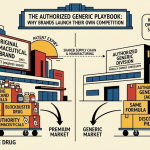
An authorized generic (AG) is the exact same drug as the brand-name product, including both active and inactive ingredients, formulation, and manufacturing process, marketed without the brand name on its label. The FDA’s definition is specific: it is an approved brand-name drug sold under the original New Drug Application (NDA), not through a separately filed Abbreviated New Drug Application (ANDA).
That distinction is not semantic. It is the foundation of the entire strategy.
Because an AG is not an ANDA product, it does not appear in the FDA’s Orange Book with a therapeutic equivalence rating. It does not require separate FDA approval. The NDA holder simply notifies the FDA that it is marketing an AG version, and the agency publishes an updated list of those notifications quarterly. No 30-month stay. No patent certification. No waiting.
The traditional ANDA generic, by contrast, must demonstrate bioequivalence to the Reference Listed Drug, survive patent challenges or outlast the 30-month stay triggered by Paragraph IV litigation, and wait for FDA approval of its own ANDA. The first generic to file an ANDA with a Paragraph IV certification earns a 180-day exclusivity period, during which the FDA cannot grant final approval to subsequent ANDA filers for the same drug.
The AG sits entirely outside that framework. Its presence during the 180-day exclusivity period is entirely legal. Courts confirmed this in Teva Pharmaceutical Industries Ltd. v. FDA, where the D.C. Circuit upheld the FDA’s interpretation that the exclusivity provision applies only to ANDA approvals, not to an NDA holder marketing its own generic version.
Feature
Authorized Generic
Traditional ANDA Generic
Regulatory pathway
Marketed under brand’s NDA
Requires separate ANDA
FDA approval
Notification only
Full ANDA review required
Composition
Identical to brand (active + inactive)
Bioequivalent; inactive ingredients may differ
Orange Book listing
Not listed
Listed with AB rating
Market entry flexibility
Any time, including during 180-day exclusivity
Blocked during first-filer exclusivity
Who manufactures
Brand company or licensed partner
Independent generic firm
How the Hatch-Waxman Act Created the AG Loophole
The Drug Price Competition and Patent Term Restoration Act of 1984 was constructed around a specific incentive architecture. Congress wanted to lower barriers to generic entry while preserving enough financial reward for innovators to continue investing in new drugs. The 180-day exclusivity period was the carrot: a first-filer generic could earn a temporary near-monopoly in exchange for bearing the litigation costs of challenging a brand’s patents.
The problem is that the law defines exclusivity as blocking subsequent ANDAs. It says nothing about the NDA holder’s own ability to market a generic version. This was not a drafting oversight that went unnoticed for decades, but its full commercial exploitation took time to develop. As brand companies watched the first generic challengers earn substantial returns from uncontested 180-day windows, they began deploying AGs to compress those returns.
The Hatch-Waxman architecture also includes several mechanisms that interact directly with the AG strategy:
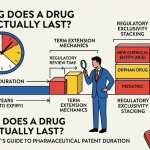
Patent term restoration allows brand companies to extend patent terms to compensate for regulatory review time lost before approval. Those extended terms set the outer boundary for generic entry, and therefore the timeline within which an AG might be deployed.
The 30-month stay, triggered automatically when a brand company files a patent infringement lawsuit within 45 days of receiving notification of a Paragraph IV filing, delays generic entry while litigation proceeds. During those months, the brand continues earning full monopoly pricing, and it also has time to prepare an AG launch timed to coincide with the first-filer’s eventual entry.
Orange Book patent listings define what the first-filer must certify against. A brand company that lists additional formulation or method-of-use patents can extend the Paragraph IV landscape, multiplying the litigation burden for generic challengers and further narrowing the expected profit window, which makes the AG threat more potent at the settlement table.
Why Brand Companies Launch Their Own Competition: The Strategic Calculus
What the Revenue Glide Path Actually Looks Like
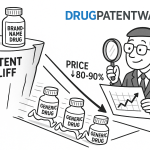
The term ‘patent cliff’ describes the sudden revenue drop a brand drug experiences when generic competition enters. For a major small-molecule product, that drop can be 60 to 80 percent within 12 months of first generic entry. An estimated $300 billion in annual revenue is at risk from patent expirations affecting 190 drugs through 2030, including 69 blockbusters.
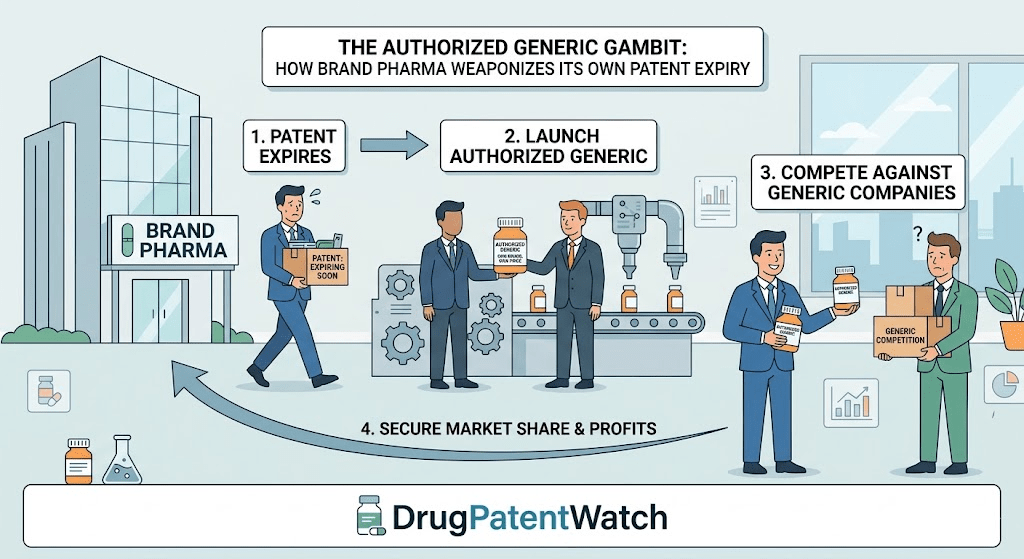
The AG strategy converts that cliff into a slope. Rather than losing the entirety of the price-sensitive prescriptions to an independent generic, the brand company captures those prescriptions through its own product in the generic channel. The margin is lower than brand pricing, but the volume is real revenue that would otherwise go entirely to a competitor.
The commercial mechanics of the generic channel amplify this effect. When a prescription is written generically, pharmacists in most states must substitute the lowest-cost therapeutic equivalent. An AG, identical to the brand, qualifies for that substitution. A company that controls both the brand and the AG effectively covers both channels simultaneously, something no pure-play brand company can do without launching an AG.
Why the Timing of an AG Launch Changes Everything
An AG launched prematurely, before any generic competitor exists, cannibalizes brand sales without any countervailing competitive pressure to justify the price differential. The strategic window opens when the first ANDA filer approaches its launch date.
Launched at the moment the first independent generic enters, the AG immediately competes for the prescriptions that would otherwise flow entirely to that challenger. During the 180-day exclusivity period, the market structure is: brand, first-filer generic, and AG. Without an AG, it is only brand and first-filer. The economic difference is substantial.
An FTC analysis found that during the 180-day exclusivity period, wholesale prices are 7 to 14 percent lower and retail prices are 4 to 8 percent lower when an AG is present than in scenarios with only one generic competitor. A study published in Health Affairs found that on-invoice prices paid by pharmacies are 13 to 18 percent lower in the presence of an AG. These are real savings, but they are smaller than the savings generated when multiple independent generics compete without an AG constraining the first-filer’s pricing.
How Brand Manufacturers Choose Between a Self-Launch and a Partnership
Some companies market AGs internally, using their existing commercial infrastructure to distribute the unbranded version. Others license the right to market the AG to an established generic company. Both approaches recur in the case record.
Pfizer’s deployment of an AG for atorvastatin (Lipitor) through Watson Pharmaceuticals, now part of Teva, is the clearest example of the partnership model. On November 30, 2011, the day Lipitor’s primary compound patent expired and Ranbaxy Laboratories launched its generic atorvastatin, Watson began marketing Pfizer’s AG through its generic distribution network. Pfizer retained a portion of the economics while Watson handled channel logistics. Watson described the arrangement as a major contribution to its Q4 2011 earnings, which reflects the revenue scale at stake for a product that had generated peak annual sales above $13 billion.
Sanofi’s approach to Arava (leflunomide) illustrates the internal model. Cary Yonce, then a Sanofi Vice President, explained that the company used its existing infrastructure to manage distribution and responded more flexibly to customer needs than an outside partner could. That agility matters when the first-filer’s exact launch timing is uncertain.
Why an AG Is a Weapon at the Settlement Table, Not Just in the Market
Brand companies rarely need to actually launch an AG to benefit from the threat of doing so. The mere credibility of an AG launch reshapes the economics of Paragraph IV litigation from the generic side.
A generic company deciding whether to file a Paragraph IV challenge must model the expected return from the 180-day exclusivity period. If the probability of an AG launch is high, that expected return falls sharply. The FTC’s 2011 study found that a first-filer’s revenues are reduced by 40 to 52 percent during the exclusivity period when an AG is present, and remain 53 to 62 percent lower during the first 30 months after exclusivity ends if AG competition persists.
Those numbers compress the return on a Paragraph IV challenge from a potential windfall to something that may not justify the litigation investment, particularly for drugs with moderate rather than blockbuster-level sales. The brand company does not need to fire the weapon to use it. The threat alone shifts bargaining leverage toward settlement terms favorable to the brand.
The No-AG Commitment: How Patent Settlements Became Exclusivity Transactions
What a No-AG Commitment Is and How It Works
A no-AG commitment is a clause in a patent settlement agreement in which the brand manufacturer promises not to launch an authorized generic during the first-filer’s 180-day exclusivity period. In exchange, the generic company agrees to delay its market entry, often for years beyond what a court might have ordered.
The economic structure is transparent. The brand ‘pays’ the generic not with cash but with guaranteed exclusivity. A first-filer that earns the 180-day window without AG competition can price its generic at a premium, since pharmacies have no alternative lower-cost generic to substitute. Depending on the market size, this can be worth hundreds of millions of dollars over six months.
The FTC’s 2011 report documented that between fiscal years 2004 and 2010, approximately 25 percent of all patent settlements with first-filing generics included explicit no-AG commitments. Those deals delayed generic entry by an average of 37.9 months beyond the settlement date, covering drugs with a combined market value exceeding $23 billion. More recent RAPS reporting suggests no-AG commitments have declined since then, likely reflecting the heightened antitrust scrutiny following FTC v. Actavis.
How FTC v. Actavis Changed the Legal Risk Calculation for Pay-For-Delay Deals
The Supreme Court’s 2013 decision in FTC v. Actavis, Inc. addressed cash reverse payment settlements, specifically Solvay Pharmaceuticals’ payments to generic manufacturers to delay a generic version of AndroGel. The Court rejected both the brand-friendly ‘scope of the patent’ test and the FTC’s proposed presumption of illegality. It established that reverse payment settlements must be evaluated under the antitrust rule of reason, requiring courts to weigh anticompetitive effects against any procompetitive justifications on a case-by-case basis.
The FTC has consistently argued in subsequent cases and amicus filings that a no-AG commitment is a non-cash form of reverse payment subject to the same analysis. The value transferred is the guaranteed profit from an uncontested exclusivity window. From an antitrust standpoint, a payment structured as withheld competition is functionally equivalent to a payment structured as cash.
Courts have accepted parts of this argument, though the rule of reason framework means outcomes remain fact-specific. Companies structuring patent settlements today must evaluate no-AG clauses against the Actavis standard and account for the possibility that a sufficiently large implied payment in the form of protected exclusivity could attract FTC enforcement or private antitrust litigation.
Most Important Ongoing Litigation Involving Authorized Generic Strategies
The legal landscape for AG-related antitrust claims has expanded beyond reverse payment settlements. Private plaintiffs, including insurance companies, PBMs, and end-payors, have brought class actions alleging that no-AG commitments constituted per se antitrust violations or were sufficient to satisfy the Actavis rule of reason standard. Courts in the Third, Eleventh, and D.C. Circuits have issued conflicting guidance on the threshold showing required to move these cases past motions to dismiss.
The predatory pricing theory, articulated in legal scholarship but less frequently litigated, argues that a brand company could price its AG below an independent generic’s cost of production to drive the challenger out of the market and deter future entry. The Supreme Court’s two-prong test from Brooke Group Ltd. v. Brown & Williamson Tobacco Corp. requires plaintiffs to show both below-cost pricing by the defendant and a reasonable probability of recoupment through future supracompetitive prices. For a brand company simultaneously selling its high-margin branded product, meeting both prongs is difficult, but the theory remains available to well-capitalized plaintiffs with sufficient discovery access.
How the AG Strategy Reshapes the Generic Business Model
What a 40-52% Revenue Reduction Means for Generic R&D Investment
The generic pharmaceutical industry runs on thin margins and relies on the 180-day exclusivity period to recover the costs of ANDA preparation, bioequivalence testing, patent litigation, and API sourcing. A first-filer losing 40 to 52 percent of its exclusivity-period revenue does not simply earn less; it may fail to recover its investment on that specific challenge.
That math has direct consequences for which drugs generic companies choose to challenge. For a $500 million annual-revenue drug, the first-filer’s expected 180-day exclusivity return, absent an AG, might justify $50 to $100 million in litigation and development costs. Introduce an AG that cuts that return by half, and the same investment becomes marginal or negative. Generic companies facing this calculus will concentrate challenges on the largest-revenue drugs, where dilution still leaves adequate returns, and deprioritize mid-tier blockbusters, exactly the drugs where the patent cliff most affects patient access to affordable medicine.
Heather Bresch, then Mylan’s Chief Operating Officer, told Congress in 2009 that the AG loophole ‘definitely serves as a huge detriment to the generic industry.’ That assessment came from one of the world’s largest generic manufacturers, with the financial resources to absorb reduced exclusivity returns better than most. For smaller generic challengers, the deterrent effect is proportionally larger.
The Association for Accessible Medicines, the principal trade organization for the U.S. generic and biosimilar industries, has repeatedly advocated for restrictions on AG launches during the 180-day exclusivity period, arguing that the current framework undermines the incentive structure Congress designed to accelerate generic entry. The Academy of Managed Care Pharmacy has taken an explicit policy position supporting efforts to prohibit authorized generics on the same grounds.
How Generic Companies Adapt When the Exclusivity Period Is Devalued
Generic companies have responded to the AG threat through several adaptations. One is increasing focus on complex generics, including products requiring specialized manufacturing, inhalation delivery devices, topical formulations, extended-release mechanisms, or drug-device combinations, where the barrier to launching a credible AG is higher. The brand company’s manufacturing platform may not be capable of producing a complex generic at the scale and quality required, reducing the AG threat.
A second adaptation is greater emphasis on first-to-file strategy for drugs with ‘clean’ Orange Book profiles, where few listed patents must be challenged and litigation costs are lower, reducing the risk that reduced exclusivity returns will eliminate profitability. A third is increased interest in 505(b)(2) applications and modified formulations that can earn their own exclusivity periods, bypassing the ANDA pathway and the AG vulnerability that comes with it.
The EpiPen Case: When an AG Becomes Crisis Management
How Mylan Used the AG Strategy to Contain Political and Reputational Damage
Mylan’s deployment of an authorized generic for EpiPen in December 2016 was structurally unlike every other AG case in this analysis. Mylan had no imminent patent challenger. It had a price controversy.
The company had raised the list price of a two-pack from roughly $100 in 2007 to more than $600 by 2016, an increase exceeding 500 percent. Congressional hearings in September 2016 focused specifically on that price trajectory. In Q3 2016, Mylan’s CEO, Heather Bresch, committed on an earnings call to an authorized generic at a $300 list price, framing it as ‘swift and unprecedented action’ providing ‘immediate and sustainable cost savings directly to patients.’
The economics of the move were more complex than the public framing suggested. The $300 AG list price was 50 percent below the brand’s list price but still many multiples above the cost of production. Because the AG carried a lower list price and was not subject to the same rebate agreements as the brand, PBMs managing Medicaid and commercial plans could access it without navigating the brand’s rebate structure. That structural simplicity drove adoption.
A retrospective analysis of Medicaid data found that the EpiPen AG captured 66 percent of the total epinephrine auto-injector market within 15 months. Medicaid saved an estimated $76 million in the first year alone. From a strictly commercial standpoint, the AG cannibalized brand volume while preserving Mylan’s overall share of epinephrine auto-injector revenue at a time when political pressure was creating genuine reimbursement risk for the brand.
The case exposes an underappreciated strategic function of the AG: it is a pricing reset mechanism that allows a manufacturer to introduce a lower-priced product without formally cutting the list price of the original brand. The brand’s list price remains intact, preserving the rebate base for channels that value the brand. The AG serves a different channel at a different price point. This two-price architecture is only possible because the AG is not a price reduction, it is a separate product with its own NDA.
The Cephalon/Provigil Precedent: How the AG Threat Functions at the Negotiating Table
Why the Threat of an AG Matters Even When No AG Is Launched
Cephalon’s management of patent challenges against Provigil (modafinil) from the mid-2000s illustrates how the AG threat shapes settlement dynamics without ever resulting in an actual AG launch.
Cephalon faced four first-filing generic challengers and recognized that its key formulation patent was vulnerable. Rather than litigate to a likely loss, the company settled with all four challengers, paying them collectively more than $200 million in exchange for agreements to delay market entry until April 2012. That six-year delay gave Cephalon time to execute a product migration strategy, moving patients to Nuvigil (armodafinil), a next-generation modafinil isomer still under patent protection.
The settlement negotiations occurred in an environment where each challenger knew that Cephalon could launch an AG during their 180-day exclusivity window. That credible threat weakened each challenger’s bargaining position. Whether explicitly discussed or simply understood, the AG loophole reduced the value of the exclusivity each challenger could expect to receive, making the financial terms Cephalon offered more attractive relative to the contested alternative.
The FTC ultimately challenged these settlements as anticompetitive reverse payment agreements. When Teva acquired Cephalon, the FTC conditioned its approval of the merger on Teva entering a supply agreement enabling a competing generic version of Provigil to enter the market in 2012. The case is now a standard reference point in antitrust analysis of pharmaceutical patent settlements, and it demonstrates that the AG strategy’s influence extends far beyond the cases where an AG is actually launched.
What Happens Financially After Loss of Exclusivity: Modeling the Post-LOE Market
Revenue at Risk: Quantifying the Cliff
The financial impact of loss of exclusivity depends on the number of generic entrants, whether an AG is present, the drug’s therapeutic class, payer mix, and the availability of a clinically differentiated follow-on product. General parameters are reasonably well established in the literature and analyst practice.
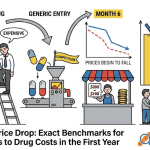
A single generic entrant, absent an AG, can drive brand market share below 10 percent by volume within 12 months, though the brand retains a revenue premium per unit sold. With an AG present during the 180-day exclusivity period, the market fragments among three competitors: brand, first-filer, and AG. Brand volume erodes faster as more channels have access to a generic-priced alternative. After exclusivity ends and additional ANDAs receive final approval, prices compress rapidly. The first generic entrant’s own price, whether a first-filer or an AG, declines as subsequent entrants compete for shelf space.
Historical patterns show that five or more generic competitors can drive prices to 85 percent below brand list price. At two competitors, meaning first-filer and AG during the exclusivity window, prices are 30 to 40 percent below brand. These gradients define the financial stakes of the AG decision for both sides.
For a drug generating $2 billion annually, the difference between an uncontested 180-day first-filer exclusivity and one that includes an AG competition may represent $200 to $400 million in forgone generic revenue. For the brand company, that same AG can recover hundreds of millions in market share it would otherwise lose entirely to the challenger.
Key Patent Expiry Dates Investors and Strategists Are Tracking Through 2030
The $300 billion patent cliff estimate through 2030 encompasses drugs across oncology, immunology, diabetes, cardiovascular, and neurology. The specific risk profile of each depends on whether the brand company has a credible AG strategy, whether biosimilars are relevant (for biologics), and whether follow-on products can capture migrating patients.
For small-molecule drugs facing ANDA competition, the AG is a well-established and legally stable tool. For biologics, the landscape is more complex. Biosimilars approved through the 351(k) pathway require demonstration of biosimilarity and potential interchangeability rather than simple bioequivalence. An innovator company launching its own ‘authorized biosimilar,’ marketed under the original Biologics License Application (BLA), faces a different regulatory structure than the AG model. The FDA’s evolving guidance on interchangeability designations, which enable pharmacist-level substitution, creates both opportunities and complications for brand-on-biosimilar strategies.
Several high-revenue small-molecule drugs with anticipated loss of exclusivity between 2025 and 2030 will test whether the no-AG commitment’s decline observed in RAPS reporting reflects durable structural change or a temporary response to regulatory pressure.
Payer Economics and the PBM Rebate Paradox
Why an AG Can Raise Net Drug Costs Even While Lowering List Prices
The most counterintuitive dimension of the authorized generic is its interaction with PBM rebate economics. List price and net price are two different numbers in U.S. drug markets. The gap between them, generated by manufacturer rebates to PBMs and health plans, can be large enough that a drug with a lower list price has a higher net cost to the payer.
Brand manufacturers typically pay PBMs rebates calculated as a percentage of wholesale acquisition cost (WAC) in exchange for preferred formulary placement. A brand drug with a WAC of $600 and a 40 percent rebate costs the payer a net $360 per unit. An AG with a WAC of $300 and no rebate costs the payer $300 per unit. The list price difference is $300. The net price difference is $60. If the plan’s formulary management prioritizes rebate revenue, it may prefer the high-WAC, high-rebate brand over the lower-WAC, zero-rebate AG.
Sumit Dutta, Chief Medical Officer of OptumRx, testified before Congress that authorized generics ‘often result in net prices higher than the brand drugs they replace.’ That statement captures the perverse incentive accurately: the rebate-dependent architecture of U.S. drug purchasing can make a nominally cheaper product more expensive after accounting for the revenue the PBM loses by switching from the rebated brand.
This dynamic creates a strategic opportunity for brand manufacturers. By launching an AG, the company can serve patients and pharmacies with a lower-list-price product, generating favorable press coverage and deflecting political scrutiny, while simultaneously protecting the rebated brand’s position on formularies managed by rebate-conscious PBMs. The AG and the brand coexist at different price points, serving different channels, without either cannibalizing the other’s primary revenue source.
Why Manufacturing Complexity Matters for AG Viability
What Makes Certain Drugs Difficult to Self-Compete Against
The AG strategy is straightforward for oral solid dosage forms: tablets, capsules, and immediate-release formulations. The brand company already manufactures the product; marketing it without the brand name requires no new manufacturing investment.
Complex dosage forms complicate this. For inhaled corticosteroids, drug-device combination products, transdermal patches, liposomal injectables, and modified-release formulations requiring specialized manufacturing platforms, the gap between what the brand company makes and what a generic firm must replicate is technically meaningful. Brand companies may lack the flexible generic-scale manufacturing infrastructure to supply an AG at generic market volumes, particularly if their primary facilities are validated for brand production at specific batch sizes.
API sourcing for AGs also presents considerations. Generic manufacturers typically source active pharmaceutical ingredients from a different supplier network than brand companies, often with lower cost structures. A brand company marketing an AG through its existing brand supply chain may face cost-of-goods disadvantages relative to an independent generic, affecting the AG’s competitive pricing flexibility.
These manufacturing constraints define one of the few sustainable competitive advantages a generic company can build against the AG threat: superior manufacturing scale and cost structure in a specialized dosage form where the brand cannot credibly self-compete.
Global Applicability: How Other Markets Handle Brand-on-Generic Competition
How the EU’s Duplicate Marketing Authorisation Pathway Differs from the U.S. AG Model
The European regulatory framework does not include an authorized generic pathway in the U.S. sense. The European Medicines Agency and the European Commission operate on a general principle of one marketing authorisation per product per applicant. Exceptions exist through what the Commission has designated ‘duplicate marketing authorisations,’ governed by Article 82(1) of Regulation (EC) 726/2004.
Historical Commission guidance interpreted the duplicate MA pathway as available when a brand company sought to launch its own generic to improve product availability, including in markets where specific indications remained under patent protection through a ‘skinnier label’ approach. More recent Commission review has tightened that interpretation. Applicants may now need to demonstrate a specific positive impact on availability rather than asserting that a brand-on-generic launch inherently benefits the public.
EU generic markets operate differently from the U.S. in other ways that affect the strategic value of a brand-on-generic move. Pharmacy substitution rules vary significantly by member state. Some countries mandate substitution of the lowest-priced equivalent; others leave it to physician or pharmacist discretion. The biosimilar interchangeability framework is also distinct: the EMA has historically been cautious about automatic substitution of biosimilars for their reference biologics, though this is evolving.
Why Japan’s Government-Driven Generic Policy Changes the AG Calculus
Japan’s Ministry of Health, Labour and Welfare has spent 15 years driving the generic volume share from under 20 percent to approximately 80 percent through explicit policy mandates. Physicians who specify brand-name drugs when a generic is available face administrative burden; patients who request brands pay additional cost. Generic prices are set initially at roughly 50 percent of the brand reference price and then reduced annually through price revisions.
In this environment, a separate brand-on-generic strategy has limited strategic logic. The policy architecture already forces substitution to generics. Annual price cuts eliminate the premium a first-to-market generic can sustain. The competitive battle in Japan is for supply chain reliability and quality certification, not for 180-day exclusivity windows. Japanese authorities have also become acutely sensitive to manufacturing quality after a series of data integrity failures at domestic generic manufacturers, creating a different kind of competitive moat that foreign generic companies must address.
The Japan comparison illustrates a general principle: the AG strategy derives its value specifically from the Hatch-Waxman Act’s exclusivity incentive architecture. In markets where that architecture does not exist, the strategy loses most of its economic rationale.
What Investors Are Watching: AG Strategy as a Signal of Commercial Confidence
How to Read AG Launch Intentions from Public Filings and Earnings Calls
A brand company preparing to launch an AG will rarely announce it explicitly until the launch is imminent. The strategic value of the AG threat depends on keeping generic challengers uncertain about whether the threat will materialize. But several observable signals precede an AG launch.
Executive comments on earnings calls about ‘managing the tail’ of a drug’s revenue curve, ‘defending our franchise’ post-LOE, or ‘maintaining market presence’ after patent expiry are qualitative indicators. Companies that have launched AGs for previous blockbusters show behavioral patterns that tend to recur. Pfizer’s use of AGs across multiple products, Watson’s history as an AG partnership counterparty, and Novartis’s experience through its Sandoz subsidiary all provide precedent for how specific companies approach the LOE transition.
Paragraph IV filings and the subsequent 30-month litigation clock provide a timeline. When a first-filer’s ANDA reaches tentative approval, the market entry clock accelerates. Companies that track tentative approvals, available through FDA’s Orange Book and platforms like DrugPatentWatch, can model the approximate window within which an AG decision must be made. An NDA holder that applies for additional patent term extensions shortly before LOE, or that files supplemental NDA submissions for manufacturing changes or label updates, may be preparing infrastructure for an AG.
Settlement agreements, when public or partially disclosed in court documents, reveal whether a no-AG commitment was granted. Absence of a no-AG clause in a settlement is itself informative: it means the brand retained the right to launch, and generic challengers settling without that protection accepted a materially weaker position.
Investment Strategy: How Patent Expiry Intelligence Creates Asymmetric Opportunities
For portfolio managers and hedge funds tracking pharmaceutical IP events, the AG decision is a recurring source of mispricing in both brand and generic company equities.
Brand company stocks facing major LOE events are typically penalized by the market well before patent expiry, as analysts model the revenue cliff. If the brand company subsequently launches an AG and captures a larger share of post-LOE volume than the market modeled, the revenue decline can be materially shallower than consensus estimates. The AG revenue is usually not fully captured in sell-side models, which often use simplifying assumptions about generic market entry.
Generic company stocks present the inverse dynamic. A first-filer with a clean Paragraph IV win and no apparent AG risk may be valued on full 180-day exclusivity economics. If an AG launches at the same time, the actual revenue outcome can miss consensus significantly. Monitoring the indicators described above, patent settlement terms, brand company historical behavior, AG notification filings at the FDA, reduces this event risk.
The no-AG commitment’s apparent decline documented in recent RAPS reporting suggests generic companies are less frequently receiving this protection in settlements. If confirmed over multiple years, that trend implies that first-filer exclusivity economics are structurally less secure than they were from 2004 to 2010, with implications for how generic pipelines should be valued.
How Biosimilar Entry Complicates the AG Model for Biologics
Why the 180-Day Exclusivity Equivalent for Biosimilars Works Differently
The Biologics Price Competition and Innovation Act (BPCIA), passed as part of the Affordable Care Act in 2010, created a biosimilar approval pathway under Section 351(k) of the Public Health Service Act. The exclusivity structure differs from Hatch-Waxman in ways that affect how the AG concept might apply.
First BPCIA applicants do not receive a 180-day exclusivity period equivalent. Instead, the Act provides 12 years of reference product exclusivity from the date of first commercial marketing of the reference biologic, during which no biosimilar can be approved. After that period, biosimilar competition can begin, but there is no single-filer exclusivity window equivalent to the Hatch-Waxman brass ring.
The patent dance provisions of the BPCIA, under which the reference product sponsor and biosimilar applicant exchange patent lists and negotiate litigation timing, create a different litigation dynamic than the Paragraph IV framework. There is no automatic 30-month stay, though injunctive relief is available. The complexity of biologics patent families, which can include dozens of process patents, formulation patents, and method-of-use patents, means that litigation timelines and outcomes are harder to predict.
Innovator companies have experimented with several approaches analogous to the AG in the biologics space. ‘Authorized biosimilar’ arrangements, under which the reference product sponsor licenses a biosimilar developer to market a version of the reference biologic under its own BLA at a lower price, have been explored. Novartis, through Sandoz, has experience as both a reference product sponsor and a biosimilar developer across different products, giving it direct insight into how this dynamic operates from both sides.
Interchangeability designation, which the FDA grants to biosimilars demonstrating that they can be substituted for the reference biologic without physician intervention, is the biosimilar-specific mechanism that most closely parallels the generic substitution that makes AGs commercially potent for small molecules. As more biosimilars receive interchangeability designations, reference product sponsors face increasing pressure to decide whether and how to position their own products in the substitutable tier.
How Forecasting an AG Launch Improves Commercial and Investment Decisions
Key Indicators for Predicting an Authorized Generic Before It Launches
Effective AG forecasting is pattern recognition across multiple data sources rather than a single decisive signal. The most reliable indicators, weighted by predictive value:
The first-filer’s ANDA reaches tentative FDA approval. This signals that the generic entry clock is running on a defined timeline and that the brand company must now decide whether to activate an AG. Tentative approval data is available through FDA systems and pharmaceutical intelligence platforms.
The brand’s patent litigation settlement does not include a no-AG clause. A settlement without this protection means the brand retained optionality and may be planning to exercise it.
Prior product history. Companies that have launched AGs for earlier LOE events have established internal commercial pathways. The organizational capability and the distributor relationships developed for past AGs lower the marginal cost of the next one.
AG-ready manufacturing readiness. If the brand company has made supplemental NDA submissions updating manufacturing sites or processes in the 12 to 18 months before patent expiry, it may be qualifying new capacity for AG production volume.
Executive language in SEC filings and earnings calls. Phrases like ‘managing the LOE transition,’ ‘maintaining volume share,’ or ‘we are evaluating all options for the post-exclusivity period’ without specifics are characteristic of companies that are preparing but not yet announcing an AG strategy.
FDA AG notification list. The FDA publishes a quarterly list of AG notifications. Monitoring this list provides a definitive confirmation of an AG launch, though by the time it is published, the market event has already occurred. It is valuable for post-hoc analysis and for tracking whether a company’s historical rate of AG deployment is increasing or decreasing.
Common Investor Questions About Authorized Generics
Does an authorized generic always launch at the moment of first generic entry?
No. Timing is a strategic variable. Some AGs launch simultaneously with the first ANDA filer. Others launch after the 180-day exclusivity period ends, when the brand company has decided that the full-exclusivity period is better used as a settlement bargaining chip. Some AGs are launched after the brand monitors market share erosion for several months and then activates the strategy reactively. The optimal timing depends on the specific market, the number of anticipated subsequent generic entrants, and whether a settlement with the first-filer is still possible.
Can a brand company launch multiple AGs for the same product?
An NDA holder can license the right to market an AG to more than one partner simultaneously, or market it through multiple channels. There is no regulatory limit on the number of AG arrangements the brand can pursue. In practice, most AG strategies involve a single AG partner or direct brand marketing, as multiple AGs competing against each other dilute the economics further.
Does the AG strategy work for controlled substances?
DEA scheduling creates additional regulatory requirements for controlled substance AGs, including quota allocations for API production. These constraints can limit the volume an AG can supply and affect the strategy’s execution. Drug Enforcement Administration quota processes operate on separate timelines from FDA approval, adding a layer of planning complexity.
What is the difference between an AG and a ‘branded generic’?
A branded generic is an independent generic company’s product sold under a proprietary name of its own, not related to the original brand. It is manufactured by a third party, approved via an ANDA, and competes with both the brand and other generics. It differs from an AG in that it requires its own ANDA approval and may have different inactive ingredients. Branded generics are common in international markets and in certain U.S. therapeutic categories.
How does an AG affect market share for payers modeling drug spend?
Payers should model post-LOE spending with three scenarios: brand only, brand plus first-filer without AG, and brand plus first-filer with AG. The third scenario produces lower list price savings than the second, but that differential is often partially offset by the AG’s exclusion from rebate calculations. The net cost impact requires market-specific analysis, not a generic rule about AGs being cheaper than alternatives.
Key Takeaways
An authorized generic is the exact same product as the brand drug, marketed under the original NDA without a separate ANDA, and legally permitted to launch during the first ANDA filer’s 180-day exclusivity period.
The strategy’s commercial purpose is to convert a steep patent cliff into a more controlled revenue slope by capturing generic-channel prescriptions that would otherwise go entirely to an independent competitor.
The FTC documented a 40 to 52 percent reduction in first-filer revenues during the exclusivity period when an AG is present, and a 53 to 62 percent reduction for the 30 months following the exclusivity period.
No-AG commitments in patent settlements, which guarantee first-filer exclusivity in exchange for delayed generic entry, represent a form of reverse payment subject to antitrust rule of reason analysis under FTC v. Actavis. Their frequency appears to be declining.
The AG’s interaction with PBM rebate structures can produce net costs higher than the rebated brand for health plans that rely on rebate revenue, creating misaligned incentives in formulary management.
Brand companies with a history of AG deployment show behavioral patterns detectable through patent settlement terms, FDA tentative approval tracking, earnings call language, and manufacturing filing history.
The biosimilar interchangeability pathway is the biologics-market analog to the small-molecule AG dynamic, and reference product sponsors are actively evaluating how to apply lifecycle management principles to the post-exclusivity biologic market.
Investment Strategy
Investors tracking pharmaceutical IP events should treat an anticipated AG launch as a material assumption in post-LOE modeling for both brand and generic company positions. For brand companies, an AG that outperforms sell-side revenue decline models creates a positive surprise catalyst. For generic companies, an AG launch against a first-filer position that lacked a no-AG commitment in its patent settlement creates a negative revenue variance that may not be priced into consensus estimates.
The structural decline in no-AG commitments reported in recent industry analysis suggests that first-filer exclusivity economics are less protected than they were a decade ago. Generic pipelines with heavy concentration in first-filer positions for large-revenue small-molecule drugs carry higher AG risk than they did in the 2004 to 2010 period. Portfolio companies in this position warrant scenario analysis that explicitly models AG competition during the exclusivity window.
The upcoming patent cliff for biologics will test whether reference product sponsors can adapt the AG principle to the BPCIA framework. Companies with dual commercial platforms across brand biologics and biosimilar development, notably Amgen, Pfizer, and Novartis/Sandoz, are better positioned to execute brand-adjacent post-exclusivity strategies than pure-play biologic innovators without generic infrastructure.
For pharma IP teams and licensing groups, the AG’s primary value as a negotiating instrument means that its deployment record should inform how counterparties price settlement terms. A brand company with a strong history of AG deployment should be assigned a materially higher probability of AG competition in any settlement model.
Tracking authorized generic filings, Paragraph IV certifications, tentative ANDA approvals, and patent expiry dates across the full U.S. drug market requires systematic data infrastructure. DrugPatentWatch maintains integrated access to FDA regulatory filings, Orange Book patent data, litigation records, and AG notification histories, enabling the pattern recognition that early commercial forecasting demands.