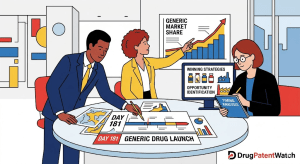
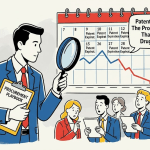
The global generic drugs market was valued at $468.08 billion in 2025 and is projected to reach $728.64 billion by 2034 (CAGR: 5.04%). The U.S. alone accounts for roughly $139 billion of that base. Within that system, no single regulatory mechanism redistributes market value faster than the expiration of the 180-day generic exclusivity period. The day after that window closes — Day 181 — is when the real competition begins.
1. What Day 181 Actually Means — and Why the Math Is Deceptive
The phrase ‘Day 181 launch’ has a clean, intuitive ring. The 180-day exclusivity period expires, and the market opens. In practice, the math is more hostile than that framing suggests, and companies that treat Day 181 as a calendar milestone rather than a competitive event consistently underperform.
The 180-day exclusivity clock does not start when the first generic applicant files its Paragraph IV-certified ANDA. It starts when the first filer actually markets the product. If the first filer wins its patent litigation in month eight but does not receive FDA approval until month fourteen, all subsequent ANDA holders wait an additional 180 days from that commercial launch date, not from the litigation resolution. The FDA confirmed this interpretation in its 2003 rulemaking under the Medicare Prescription Drug, Improvement, and Modernization Act (MMA), which also introduced forfeiture provisions that can strip first-filer exclusivity under specific conditions.
This distinction matters for second-wave entrants. Their Day 181 target date shifts with every development in the first filer’s litigation and manufacturing timeline. Companies that hard-code a projected exclusivity-end date into their launch plans without monitoring first-filer commercial activity — including tentative approval status, manufacturing readiness, and authorized generic arrangements — routinely arrive late or miss short profitability windows entirely.
There is a second deception built into the concept. ‘Day 181’ implies a starting gun. It is not. PBM formulary cycles, wholesaler stocking agreements, and hospital GPO contracts all operate on independent timelines. A company that receives final ANDA approval and launches on Day 181 may capture meaningful market share by month two, or may spend six months fighting for formulary position while burning inventory costs. The launch date and the revenue date are different things.
Key Takeaways: Section 1
The 180-day exclusivity clock starts at first commercial marketing, not at ANDA filing or patent litigation resolution.
MMA 2003 forfeiture provisions can strip first-filer exclusivity, resetting competitive dynamics for all subsequent ANDA holders.
Day 181 is a regulatory eligibility date, not a revenue date. Formulary lag, wholesaler stocking cycles, and institutional contracting determine when cash actually flows.
Second-wave entrants must monitor first-filer commercial activity continuously — not just FDA approval databases.
2. The Hatch-Waxman Architecture: Statutory Mechanics and IP Valuation Implications
The Drug Price Competition and Patent Term Restoration Act of 1984 (Hatch-Waxman) runs two systems in parallel. The first accelerates generic entry by creating the ANDA pathway and the Paragraph IV challenge mechanism. The second compensates brand manufacturers for time lost during FDA review via Patent Term Extension (PTE), which can restore up to five years of patent life, capped at 14 years of remaining exclusivity post-NDA approval.
Both mechanisms directly affect IP valuation, and both are targets of strategic manipulation by sophisticated brand manufacturers.
The ANDA system allows generic manufacturers to file an abbreviated application relying on the brand’s existing clinical data. The generic does not repeat Phase I-III trials. It demonstrates pharmaceutical equivalence (same active ingredient, dosage form, strength, and route of administration) and bioequivalence (same pharmacokinetic profile within the FDA’s 80-125% confidence interval standard for Cmax and AUC). This eliminates roughly $1-2 billion in clinical development costs per molecule, which is the economic engine that makes generic drug development viable at scale.
The Paragraph IV mechanism allows a generic applicant to challenge a listed patent before it expires by certifying that the patent is either invalid or will not be infringed by the generic product. The brand manufacturer’s automatic recourse is to file an infringement suit within 45 days of receiving notice, triggering a 30-month stay on FDA approval of the ANDA. This stay is the primary defensive tool for brand manufacturers, and its strategic deployment directly inflates the IP valuation of Orange Book-listed patents far beyond their face value as technical exclusions.
How Hatch-Waxman Created the Orange Book as an IP Weapon
The Orange Book — formally, FDA’s Approved Drug Products with Therapeutic Equivalence Evaluations — lists patents that brand manufacturers claim cover their approved drugs. Listing a patent is voluntary but strategically powerful: each listed patent independently triggers a 30-month stay when a generic files a Paragraph IV certification against it. A brand drug protected by six Orange Book patents can generate six potential stays, though courts have generally consolidated overlapping ones.
Brand manufacturers have exploited this system by listing patents of questionable scope — method-of-use patents with narrow indications, formulation patents that a generic can easily design around, and manufacturing patents covering processes no generic would replicate. The FTC documented this pattern in its 2002 study ‘Generic Drug Entry Prior to Patent Expiration,’ finding that a significant proportion of Orange Book-listed patents had no realistic blocking effect but existed primarily to trigger automatic stays.
Key Takeaways: Section 2
Patent Term Extension under Hatch-Waxman restores up to 5 years of patent life, capped at 14 years of post-approval protection. Every PTE filing is an IP valuation event analysts should track.
The Orange Book functions as a strategic IP weapon. Each listed patent generates an independent 30-month stay trigger, inflating practical exclusivity well beyond nominal patent expiration dates.
Bioequivalence approval eliminates $1-2 billion in clinical development costs per molecule, explaining why generic programs carry high ROI at low absolute development spend.
The FTC’s ‘delisting petition’ authority under 2022 Inflation Reduction Act amendments creates new downside risk for brand IP portfolios with questionable Orange Book listings.
3. Paragraph IV Certification: Legal Mechanics, Filing Strategy, and Litigation Anatomy
A Paragraph IV certification is the formal legal assertion, submitted as part of an ANDA, that one or more Orange Book-listed patents are invalid, unenforceable, or will not be infringed by the generic product. It is not an opinion. It is a legally operative statement that immediately creates standing for a patent infringement lawsuit without any product having reached the market.
There are four patent certification categories under Hatch-Waxman. Paragraph I certifies that no patents are listed in the Orange Book. Paragraph II certifies that all listed patents have expired. Paragraph III certifies that the generic will not be marketed until after the listed patents expire. Paragraph IV is the litigation trigger, and it must be accompanied by a ‘notice letter’ to both the NDA holder and the patent owner detailing the legal and factual basis for each challenge.
The notice letter is a disclosure document of significant strategic sensitivity. It must explain why each challenged patent is invalid or not infringed in sufficient detail to allow the brand manufacturer to assess its litigation risk. Generic companies spend months preparing these letters. Brand manufacturers spend equivalent time parsing them for weaknesses. The notice letter effectively sets the litigation agenda.
The 30-Month Stay: Mechanics and Strategic Implications
Once a brand manufacturer receives the notice letter, it has 45 days to file an infringement suit. If it does, FDA approval of the ANDA is automatically stayed for 30 months from the date the brand received the notice letter — not from the date of suit filing. This stay delays final FDA approval regardless of whether the infringement claim has merit.
The 30-month stay is the single most important tactical tool in Hatch-Waxman litigation. A brand manufacturer that files a bare-minimum infringement complaint — even on weak patents — locks a generic out of the market for up to 30 months. On a blockbuster drug generating $2 billion annually, a 30-month stay preserves roughly $5 billion in pre-generic revenue, net of litigation costs. No rational brand manufacturer skips filing.
What Happens When the Stay Expires
When the 30-month stay expires without a court decision, FDA can grant final approval and the generic can launch ‘at risk’ — entering the market while litigation continues. At-risk entry creates damages exposure if the generic ultimately loses on appeal. The NBER research of Drake, He, McGuire, and Ndikumana (2021) found that generics with FDA approval prior to a favorable district court decision launched at risk 100% of the time. The expected value calculation almost always favors at-risk entry, because damages are typically measured as brand lost profits, are often capped, and are frequently settled.
Litigation Settlement and Reverse Payments
Most Paragraph IV cases settle before trial. Settlements frequently include a negotiated generic entry date — often earlier than patent expiration — in exchange for the generic withdrawing its invalidity challenge. In some cases, the brand manufacturer pays the generic for delayed entry. The Supreme Court’s 2013 FTC v. Actavis decision held that reverse-payment settlements can violate antitrust law under a rule-of-reason standard. The FTC actively challenges them, and institutional investors in generic companies should treat them as contingent liabilities that may be unwound.
Section 505(b)(2) Applications: A Parallel Route
Some branded generic and reformulated products reach market via the 505(b)(2) pathway, which allows partial reliance on existing published data without the full ANDA bioequivalence framework. It is commonly used for extended-release reformulations, new dosage forms, and drug combinations. It generates its own Orange Book patent listings and three-year or five-year NCE exclusivities that interact with Day 181 timing for products in the same reference listed drug family.
Key Takeaways: Section 3
The notice letter quality determines litigation scope and settlement leverage. Generic companies that invest in thorough invalidity analysis before filing consistently achieve better settlement terms.
At-risk entry after a favorable district court decision is rational in virtually all blockbuster cases. The expected value of accelerated market entry exceeds the expected cost of damages, provided the generic won at district court.
Reverse-payment settlements trigger FTC scrutiny under FTC v. Actavis (2013) and represent contingent antitrust liabilities in any generic company’s IP portfolio valuation.
505(b)(2) applications create a separate set of Orange Book listings and exclusivity interactions that complicate Day 181 timing analysis for multi-product drug families.
4. The First-Filer Advantage: NPV Modeling, Litigation Risk, and Authorized Generic Countermoves
Being the first Paragraph IV filer is worth real money. The 180-day exclusivity period grants the first filer a temporary duopoly with the brand — two sellers in a market where dozens will eventually compete. That window compresses a disproportionate share of the generic product’s lifetime profitability into six months.
Quantifying the First-Filer Premium
During the 180-day exclusivity window, the first generic typically prices at 15-30% below the brand’s list price. This is rational pricing in a two-player market where the brand still commands strong formulary position and payer inertia. The first generic’s gross margins during exclusivity routinely run 60-80% on an incremental cost basis, compared to 15-40% after multi-generic competition erodes prices toward marginal cost.
For a drug with $1 billion in annual U.S. brand sales, the exclusivity period can generate $80-150 million in gross profit in six months, depending on launch price, market penetration speed, and authorized generic competition. That number drives the NPV of first-filer status, which drives the litigation investment decision.
NPV Modeling for First-Filer Status
A rigorous first-filer NPV model requires at minimum six inputs: projected brand revenue at generic entry, expected first-generic market penetration rate by month, pricing assumption relative to brand, probability of litigation success, litigation cost (fees, expert witnesses, potential damages exposure), and authorized generic probability with its share dilution effect.
The authorized generic variable is frequently underweighted. If the brand introduces an authorized generic (AG) during the 180-day window — a legal and common practice — the first filer no longer enjoys a true duopoly. The FTC documented in its 2011 authorized generic report that AG introduction during the exclusivity period reduced first-filer revenues by an average of 52%. Any first-filer NPV model that ignores AG probability is structurally flawed.
Authorized Generics: The Brand’s Tactical Response
An authorized generic is a branded drug sold under a generic label by the brand manufacturer or a licensee, without requiring an ANDA. It competes directly with the first filer during the 180-day exclusivity period and continues competing after Day 181. Brand manufacturers use authorized generics to capture a share of the generic market, suppress the first filer’s exclusivity revenues, and establish distribution relationships with generic-focused wholesalers before open multi-generic competition begins.
The strategic implication for first-filers: authorized generic probability should be modeled as a function of the brand drug’s remaining commercial life, the brand manufacturer’s pipeline strength, and its historical AG behavior. Large-cap brands with strong pipelines and a history of AG deployment — Pfizer, AstraZeneca, and Novartis have all used AGs extensively — present higher AG risk than smaller brands facing patent cliffs with no follow-on molecules.
Key Takeaways: Section 4
First-filer gross margins during the exclusivity window routinely run 60-80%, making this the highest-value interval in the generic product lifecycle.
Authorized generic introduction during exclusivity reduces first-filer revenues by approximately 52% on average (FTC, 2011). Model this as a probabilistic input, not a binary assumption.
First-filer status can be forfeited under MMA 2003 provisions if the applicant fails to obtain tentative approval within 30 months of ANDA filing, or fails to market the drug within 75 days of receiving final approval. Forfeiture resets competitive dynamics and benefits Day 181 second-wave entrants.
NPV modeling requires all six inputs simultaneously. Missing authorized generic probability or litigation cost contingencies produces materially incorrect valuations.
5. IP Valuation: Pricing the 180-Day Exclusivity Right as a Financial Asset
The 180-day exclusivity right is a statutory intellectual property asset. It does not appear on a balance sheet until it crystallizes into an approved ANDA with tentative or final FDA approval and first-filer status intact. At that point, its fair market value can be estimated using discounted cash flow analysis, comparable transaction data, or option-pricing models.
DCF Valuation of Exclusivity Rights
The DCF approach discounts projected exclusivity-period cash flows at a risk-adjusted rate reflecting patent litigation probability, manufacturing readiness, authorized generic risk, and FDA approval timing uncertainty. The discount rate for a pre-litigation first-filer ANDA with no tentative approval typically runs 25-35%, reflecting the high probability-weighted uncertainty of actually monetizing the right. Post-litigation, post-tentative-approval first-filer ANDAs — where the generic has won at district court and awaits appeals resolution — carry discount rates in the 12-18% range, reflecting primarily launch-timing risk.
Comparable Transaction Data
Between 2018 and 2024, ANDA portfolio acquisitions established observable price-per-ANDA ranges. For undifferentiated ANDAs in crowded therapy areas, transaction values ran $500,000 to $2 million per approved ANDA. For first-filer ANDAs against high-revenue brand drugs (annual brand sales above $500 million), transaction values ranged from $15 million to $80 million per ANDA, with outliers in the $100-200 million range for blockbuster challenges.
These multiples confirm a straightforward principle: the exclusivity right is worth a function of the addressable brand revenue it disrupts. First-filer status against a $2 billion drug is categorically different from first-filer status against a $200 million drug. Analysts who fail to segment by brand revenue size when valuing ANDA portfolios produce estimates useless for deal pricing.
Option-Pricing Models for Pre-Approval ANDAs
For ANDAs where litigation is unresolved or FDA approval is uncertain, option-pricing models (Black-Scholes adaptations or binomial tree models) provide a more theoretically consistent framework than straight DCF. The underlying asset is the exclusivity cash flow stream. The option’s expiration date is the patent expiration date. Volatility reflects patent validity uncertainty. The exercise price is the litigation and regulatory cost required to activate the right.
In practice, most ANDA valuation for M&A purposes combines a DCF scenario tree (bullish, base, bear) with comparable transaction calibration, then applies a liquidity discount for marketability of the specific product.
Investment Strategy: ANDA IP Valuation
Institutional investors should treat ANDA portfolio quality as a primary valuation driver for generic pharma equities.
Screen for the ratio of first-filer ANDAs (with tentative or final FDA approval) as a proportion of total ANDA count. A company with 120 ANDAs, 18 of which carry first-filer status against drugs with combined annual brand sales above $8 billion, has structurally different earnings quality than a company with 180 approved ANDAs but no first-filer positions.
Track the MMA 2003 forfeiture risk clock for first-filer assets. A first-filer approaching the 30-month filing anniversary without tentative FDA approval is at risk of losing its exclusivity right — and with it, a material earnings contribution. This risk is frequently not reflected in sell-side models.
Monitor authorized generic licensing agreements disclosed in brand company 10-K filings and FTC data. When a brand announces an AG agreement before its first-filer generic launches, revise the generic company’s exclusivity-period revenue estimate downward by 40-55%.
6. Day 181 Market Mechanics: Price Erosion Curves, Share Shift Velocity, and the Multi-Entrant Model
When Day 181 arrives and FDA begins approving additional ANDAs, the market transitions from duopoly to competitive generics. This transition follows a predictable but nonlinear trajectory.
Price Erosion: The Empirical Curve
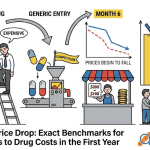
Academic and consulting literature consistently finds that generic prices follow a convex erosion curve after multi-generic entry. The first generic launches at 20-30% below the brand’s list price. By the time four to six generic competitors are active, the average generic price falls to 50-75% below brand list. When ten or more generics compete — common in high-volume, off-patent markets like statins, ACE inhibitors, and SSRIs — prices collapse to 80-95% below original brand list price.
This erosion is not linear across time. The steepest price drops occur in the first 90 days after multi-generic entry, as wholesalers negotiate backward from formulary-preferred generic contracts and GPOs run competitive bidding processes. A Day 181 entrant that prices at 40% below brand may find that its price floor is tested within three months as later entrants price more aggressively to buy formulary position.
Price erosion velocity varies by therapeutic area. Solid oral dosage forms in mature, undifferentiated therapy areas erode faster and deeper than injectables, topical products, or controlled-release formulations where manufacturing complexity limits credible entrants. Day 181 strategy must be calibrated to the specific product’s expected competitive intensity, not to industry-wide average erosion data.
Market Share Shift: The S-Curve Dynamic and Its Exceptions
Generic market share capture after Day 181 follows an approximate S-curve: slow initial uptake as payers and pharmacies adjust formularies, rapid acceleration once formulary position is secured, then a gradual plateau as the brand reaches a residual market share floor. The brand’s residual floor varies: for chronic condition medications where patient inertia and physician habit are strong, brands may retain 5-15% of unit volume indefinitely. For acute-use products, brand retention can be as low as 1-3%.
The S-curve assumption breaks down in three identifiable situations. First, when a PBM implements a step-therapy requirement mandating generic use before brand reimbursement, creating near-immediate generic adoption. Second, when the brand executes a direct-to-consumer coupon program matching the generic’s out-of-pocket cost for commercially insured patients. Third, when an authorized generic has already established distribution and payer relationships during the 180-day exclusivity window, providing it with a meaningful first-mover advantage over Day 181 entrants.
The Multi-Entrant Revenue Model
For Day 181 second-wave entrants, a realistic revenue model requires projections along four dimensions simultaneously: total market unit volume, generic penetration rate by month, company-specific market share within the generic segment, and net realized price per unit after chargebacks and rebates. Many analysts model only the first two and apply an assumed market share percentage, producing systematically overstated revenue projections because it ignores the difference between gross and net price.
In the U.S. pharmaceutical distribution system, net price after chargebacks can be 15-30% below invoice price. A generic company running its Day 181 model on gross invoice price will see materially lower actual cash receipts. This distinction drives actual P&L performance, and analysts who observe a generic company consistently missing revenue guidance in its first 12-18 months of a launch should check whether management’s guidance was built on gross or net pricing assumptions.
Key Takeaways: Section 6
Generic price erosion is convex and front-loaded. The first 90 days after multi-generic entry typically see the steepest price compression.
Therapeutic area manufacturing complexity governs erosion velocity. Injectables, extended-release formulations, and products requiring device components erode more slowly than solid oral dosage forms.
Model all four revenue dimensions simultaneously: total market volume, generic penetration, company market share within generics, and net realized price after chargebacks. Missing any one produces materially incorrect projections.
Brand residual market share ranges from 1-3% for acute-use products to 5-15% for chronic medications with high patient and physician inertia.
7. PBM Formulary Timing and Its Effect on Day 181 Revenue
The three major pharmacy benefit managers — CVS Caremark, Express Scripts (Cigna), and OptumRx — manage formularies covering roughly 270 million covered lives in the U.S. Their formulary decisions determine which generic products receive preferred placement, step-therapy requirements, and rebate-driven tier positioning. For a Day 181 entrant, PBM contracting is more commercially decisive than FDA approval timing.
PBM formulary cycles run annually, with primary contracting decisions made in the third and fourth calendar quarters for January implementation. A generic that launches in February — three months after formulary decisions are locked — faces 10 months operating at non-preferred status before the next formulary cycle creates a repositioning opportunity. During those 10 months, the company may capture unit volume but at a much lower market share than its pricing would otherwise support.
The implication for launch timing: a Day 181 date falling in January or February is mechanically advantageous for products where PBM formulary placement drives the majority of prescription volume. A Day 181 date in May or June allows time to negotiate formulary inclusion before the fall contracting cycle. A Day 181 date in October or November gives the company almost no contracting runway before formularies lock.
PBM contracting for generics typically involves a rebate-for-exclusivity arrangement, where the generic company offers a WAC discount or rebate in exchange for preferred or exclusive formulary placement over competing generic products. The rebate compresses net margins, but the volume uplift from preferred placement usually generates positive NPV on the contracting decision, particularly in the first 12 months when market share is being established.
Hospital GPO contracting operates on different cycles (often calendar year or semi-annual) and requires meeting minimum service level commitments — supply reliability, minimum order quantities, and 24-hour distribution coverage. Generic companies with manufacturing capacity constraints should model GPO contract commitments against their production forecasts before signing, because supply shortfalls generate financial penalties and permanent relationship damage.
8. The Generic Entry Opportunity Date Method: A Step-by-Step Framework
The Generic Entry Opportunity Date (GEOD) method provides a structured, reproducible protocol for estimating when generic entry into a specific drug market becomes legally and regulatorily possible. It combines patent expiration analysis with regulatory exclusivity mapping to produce a single date representing the earliest theoretical generic entry point.
The method is explicitly a floor estimate. It identifies when entry becomes possible under the most favorable scenario for generic entrants. Litigation delays, manufacturing problems, FDA review backlogs, and forfeiture events can all push actual entry later. The GEOD tells you when to start watching a market, not when to expect a generic.
Step 1: Identify All Orange Book-Listed Patents
For the target reference listed drug (RLD), pull all patents listed under the relevant NDA or BLA. Record each patent’s expiration date as listed, but recognize that these dates reflect statutory patent term before any Patent Term Extension. Search the USPTO Patent Center for any PTE certificates filed or granted on these patents. A PTE can add up to 5 years to a compound patent’s life — this is among the most frequently overlooked adjustments in entry date analysis.
Step 2: Identify Compound-Claiming Patents
Not all Orange Book patents carry equal blocking power. Method-of-use patents can be designed around by filing a ‘skinny label’ ANDA that carves out the patented indication. Formulation patents can be designed around with alternative delivery systems. The compound patent — a composition-of-matter patent claiming the active pharmaceutical ingredient itself — is the primary blocking patent. If multiple compound patents carry staggered expiration dates, the latest-expiring compound patent governs.
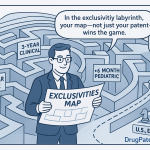
Step 3: Map All Regulatory Exclusivities
Regulatory exclusivities run independently of patents and can extend effective exclusivity beyond all Orange Book patent expirations. Key exclusivities to map include: five-year New Chemical Entity exclusivity (for drugs with no previously approved active moiety), three-year exclusivity for clinical investigations supporting a new condition of use or dosage form, seven-year Orphan Drug Exclusivity (ODE), six-month Pediatric Exclusivity Extension (appended to each patent and exclusivity listed in the Orange Book when pediatric studies are completed), and Qualified Infectious Disease Product (QIDP) exclusivity of five years.
These exclusivities stack in ways defined by statute and interact differently with ANDA versus 505(b)(2) filings. NCE exclusivity prevents FDA from accepting an ANDA for 5 years from approval (or 4 years if the ANDA includes a Paragraph IV certification). Failing to map all applicable exclusivities produces GEOD estimates that are too early.
Step 4: Calculate the GEOD
The GEOD is the later of (a) the expiration date of the latest-expiring compound patent including PTE, and (b) the expiration date of the latest regulatory exclusivity. If the compound patent expires in December 2027 and Orphan Drug Exclusivity runs through June 2028, the GEOD is June 2028.
Step 5: Adjust for Litigation Status and Paragraph IV Filing History
The GEOD is a legal minimum, not a market prediction. Adjust forward if no ANDA has been filed, because regulatory review time (18-24 months for a standard ANDA, 10-12 months for a CGT-designated product) means a company starting its ANDA today cannot reach the market on the GEOD date. Adjust backward if an ANDA with first-filer Paragraph IV status has already cleared litigation — the court may have invalidated the blocking patent, allowing earlier entry than the GEOD date suggests.
Key Takeaways: Section 8
The GEOD is a floor estimate. Model actual entry 12-36 months later for drugs with no filed Paragraph IV challenges.
Patent Term Extensions can extend a compound patent by up to 5 years. Missing PTEs is the most common analytical error in generic entry date estimation.
Regulatory exclusivities (NCE, ODE, Pediatric Extension) stack with patents and must be mapped individually. Orphan Drug Exclusivity often extends market protection 2-4 years beyond the compound patent in rare disease markets.
ANDA review timelines (18-24 months standard; 10-12 months for CGT-designated products) must be modeled as a lag between GEOD and actual market entry.
9. Orange Book Patent Taxonomy and the Compound Patent vs. Regulatory Exclusivity Matrix
Understanding what each Orange Book patent category actually blocks is the difference between accurate GEOD analysis and expensive misfires. The FDA categorizes listed patents into three types: drug substance patents (composition of matter), drug product patents (formulation), and method-of-use patents.
Drug substance patents are the primary blocking patents. They cover the active pharmaceutical ingredient’s chemical structure, including salts, esters, hydrates, and polymorphs. A generic replicating the API molecule infringes the drug substance patent regardless of its formulation or manufacturing method. These patents have the widest practical scope and are the hardest to design around.
Drug product patents cover the finished pharmaceutical product — typically the formulation, delivery system, or physical presentation. A controlled-release bead system, an osmotic pump, or a proprietary excipient blend may be protected by drug product patents independent of the API. Generics routinely develop alternative formulations achieving equivalent bioequivalence using different delivery mechanisms, allowing them to avoid these patents without contesting validity.
Method-of-use patents cover specific therapeutic applications. A generic can file a ‘Section viii statement’ (skinny label) carving out the patented indication from its labeling, rather than filing a Paragraph IV certification. This avoids triggering the 30-month stay on method-of-use patents, allowing earlier entry into non-patented indications. The skinny label strategy has been challenged on induced infringement grounds, but it remains viable for products where the dominant prescribing indication is off-patent while additional indications carry method-of-use protection.
Polymorph and Salt Patents: A High-Volume Litigation Category
Polymorphs — different crystalline forms of the same API — and pharmaceutical salts are the most commonly litigated drug substance patent subcategory. Brand manufacturers routinely file polymorph patents late in a compound’s patent life, listing them in the Orange Book to generate additional 30-month stays. Courts have invalidated many polymorph patents for lack of unexpected properties, but the stays they generate are real regardless of ultimate validity.
Analysts tracking a brand drug’s Orange Book history should note when polymorph or salt form patents were added and compare the addition date to the original compound patent filing date. Late-filed polymorph patents added 5-8 years after the original compound patent are a standard evergreening signal and carry high invalidity risk in litigation.
10. Evergreening Tactics and How They Distort Entry Date Estimates
Evergreening refers to the cluster of strategies brand manufacturers use to extend effective market exclusivity beyond the original compound patent’s natural expiration. It is not illegal. Much of it is not ethically controversial in industry practice. But it consistently produces GEOD estimates that appear earlier than actual generic entry, and any analyst who ignores it produces systematically optimistic market timing forecasts.
Formulation Patents and Extended-Release Development
The most commercially impactful evergreening tactic is developing an extended-release (ER) or modified-release (MR) version of a drug approaching compound patent expiration, then shifting prescribing and formulary position to the ER version before the immediate-release (IR) compound patent expires. Because the ER formulation has its own three-year clinical investigation exclusivity and often its own formulation patents, effective market exclusivity extends 3-7 years beyond the IR compound patent.
Wellbutrin XL (bupropion extended-release) is the canonical example. GlaxoSmithKline launched the once-daily ER formulation before the twice-daily SR compound patent expired, migrating prescription volume to the XL version. Generic SR entry provided minimal commercial impact because the SR market had been largely vacated. This tactic is now standard operating procedure for any compound approaching patent expiration with a viable ER or MR formulation.
For generic manufacturers, the correct response is to file ANDAs for both IR and ER versions simultaneously. Companies that file only against the IR version risk entering a market that has been commercially migrated to the ER version.
Filing method-of-use patents for new indications is technically straightforward for large brand manufacturers with established clinical development infrastructure. A drug approved for indication A can be studied in indication B, obtain supplemental NDA approval, and generate a new method-of-use patent. The commercial relevance depends on how much prescribing volume occurs in the newly patented indication. If 80% of prescribing is for indication A (off-patent) and 20% for indication B (patented), a generic with a skinny label carving out indication B captures 80% of the market without infringement risk.
Pediatric Exclusivity: The Six-Month Extension That Costs Almost Nothing
The Best Pharmaceuticals for Children Act allows brand manufacturers to obtain a six-month extension to all Orange Book patents and exclusivities by conducting FDA-requested pediatric studies. The cost of these studies (typically $5-20 million) is trivial compared to six additional months of exclusivity on a multi-billion-dollar drug. Every drug with annual U.S. revenues above $200 million should be assumed to carry pediatric exclusivity unless specifically confirmed otherwise. GEOD estimates that ignore pediatric exclusivity on large-market drugs are too early by six months.
Key Takeaways: Section 10
The four primary evergreening mechanisms — ER/MR reformulation, polymorph patents, method-of-use stacking, and pediatric exclusivity — together routinely extend effective market exclusivity 3-8 years beyond compound patent expiration.
Generic manufacturers filing against IR formulations only risk entering a market that has been commercially migrated to ER versions. File against both formulation types simultaneously.
Every drug with annual U.S. revenues above $200 million should be checked for pediatric exclusivity. Missing a six-month pediatric extension can cause a Day 181 entrant to launch before FDA is legally permitted to grant final ANDA approval.
Post-Day 181 authorized generics are a permanent competitive fixture, not a temporary tactic. Model them as persistent market participants when projecting open-generic market share.
11. Monitoring the Paragraph IV Litigation Pipeline: 30-Month Stays, At-Risk Entry, and Reverse Payments
Tracking the Paragraph IV pipeline is the most operationally intensive element of generic entry opportunity analysis. The FDA publishes a list of Paragraph IV patent certifications, but it is not real-time, and it does not include litigation status, tentative approval, or settlement terms. A complete monitoring system combines at least four data sources.
Data Source 1: FDA Orange Book and ANDA Status
The FDA’s Orange Book includes tentative approval dates for ANDAs. A tentative approval indicates that FDA has completed its scientific review and the application meets all approval standards, but the product cannot be marketed because patent or exclusivity protections remain in place. Tracking tentative approvals identifies which ANDAs are ‘launch-ready’ waiting only for the exclusivity clock to expire or patents to be adjudicated — typically a 6-12 month leading indicator of revenue realization.
Data Source 2: SEC Filings and Press Releases
Public generic companies disclose Paragraph IV filings and associated litigation in SEC filings — typically 10-Q and 10-K filings under litigation contingency disclosures, and 8-K filings for material new patent challenges. Monitoring SEC EDGAR for pharmaceutical company disclosures is a faster source of Paragraph IV intelligence than waiting for FDA list updates.
Data Source 3: Federal Court PACER Records
Patent infringement suits triggered by Paragraph IV certifications are filed in federal district courts and are public record, accessible through PACER. The filing itself, the parties, and the patents at issue are immediately visible. Case developments — summary judgment motions, claim construction orders, trial dates, and decisions — are filed in real-time. The district courts most frequently selected for Hatch-Waxman litigation are Delaware, New Jersey, and the Eastern District of Texas.
Data Source 4: Commercial IP Intelligence Platforms
DrugPatentWatch, Citeline (formerly Informa’s Pharma Intelligence), and IQVIA’s competitive intelligence databases aggregate FDA, court, and SEC data into structured analytics. These platforms reduce the manual monitoring burden significantly and allow systematic screening of the Paragraph IV pipeline by therapy area, patent type, expiration date, and litigation status.
At-Risk Entry Monitoring
When a generic has won at district court and is awaiting appeals resolution, at-risk entry can accelerate revenue by 12-24 months. The NBER research confirms that post-district-court at-risk entry is empirically near-universal for approved generics. Analysts tracking a generic company’s pipeline should flag any first-filer ANDA that has cleared district court but not received FDA final approval as a near-term at-risk launch candidate with meaningful upside optionality.
Reverse Payment Settlement Intelligence
The FTC publishes an annual report on pharmaceutical settlement agreements including reverse-payment data. These reports identify which settlements included ‘no-AG’ provisions — where the brand agrees not to launch an authorized generic during the first-filer’s exclusivity window — and which included cash payments from brand to generic. A generic company holding a no-AG settlement agreement on a major blockbuster is materially better positioned than one without. The absence of authorized generic competition during exclusivity can increase first-filer revenues by 50-100%. These agreements should be explicitly modeled.
12. ANDA as a Financial Asset: Portfolio Strategy and IP Valuation
An ANDA is a regulatory approval and a financial asset with a measurable fair market value, a finite useful life, and a risk profile that changes as it progresses through the regulatory and litigation process.
ANDA Value Drivers
The value of an individual ANDA is a function of five primary drivers: the reference drug’s annual U.S. market size; the number of existing and anticipated ANDA filers (competitive intensity); the ANDA holder’s first-filer status and current litigation position; manufacturing cost structure relative to expected market price; and the remaining shelf life of the commercial opportunity before the product is commoditized to near-zero margin.
The most valuable ANDAs are first-filer positions against drugs with annual U.S. brand sales above $500 million, fewer than three anticipated Day 181 entrants, and compound patents invalidated at district court level. The least valuable are approved applications for commoditized, multi-source generics in therapy areas with 15 or more entrants. These carry essentially no strategic value and generate revenue only at scale.
Portfolio Concentration Risk
Generic companies with ANDA portfolios concentrated in high-entrant, low-margin therapy areas face structural profitability pressure that cannot be resolved through operational efficiency alone. The strategic correction is acquiring or developing first-filer positions against drugs in complex formulations — injectables, inhalation products, transdermal patches, ophthalmic solutions — where manufacturing barriers limit competitive entry to fewer players.
ANDA Portfolio M&A Dynamics
When evaluating ANDA portfolios in M&A contexts, acquirers should apply a differentiated valuation framework rather than a uniform price-per-ANDA multiple. The first-filer premium is real and large. The acquisition of Sun Pharma’s generic assets, Mylan’s ANDA-heavy portfolio prior to its merger with Pfizer’s Upjohn unit, and Amneal’s integration of Impax all involved portfolio-level negotiations where first-filer ANDAs received implicitly higher per-unit valuations than standard approved ANDAs.
Investment Strategy: ANDA Portfolio Quality Screening
Screen for first-filer concentration: prioritize companies where first-filer ANDAs with tentative or final FDA approval represent at least 15% of total ANDA count, targeting drugs with aggregate annual brand sales above $3 billion.
Screen for manufacturing complexity: companies with sterile injectable, complex inhalation, or transdermal delivery capabilities have defensible competitive moats that commoditized oral solid generic competitors lack.
Monitor forfeiture clock risk: any first-filer ANDA approaching the 30-month post-filing window without tentative approval represents earnings downside that the market frequently misprices. Quantify the revenue at risk, model the probability of forfeiture, and apply a probability-weighted haircut to earnings estimates.
13. ANDA Development Technology Roadmap
Generic drug development is a sequential set of technical and regulatory activities that must be executed in a specific order, with each stage gating the next. Companies that compress this timeline through parallel-path execution achieve faster FDA approval and earlier Day 181 opportunity capture.
Stage 1: API Sourcing and Drug Master File Management (Months 1-6)
The active pharmaceutical ingredient must be sourced from an FDA-registered manufacturer with an approved Drug Master File (DMF) on record with FDA. The DMF contains proprietary manufacturing and quality information for the API. ANDA review cannot be completed until the referenced DMF is assessed.
Sourcing API from a supplier without an approved or approvable DMF is the most common cause of ANDA approval delays. Companies that qualify two or three API suppliers before filing provide insurance against DMF deficiency letters, which can add 12-18 months to ANDA review. API supplier qualification includes DMF status verification, API characterization (particle size distribution, polymorphic form, impurity profile), and manufacturing site inspection readiness.
Stage 2: Formulation Development and Pre-Bioequivalence Design (Months 4-14)
Formulation development for a generic oral solid must produce a product bioequivalent to the reference listed drug under FDA’s two one-sided t-test (TOST) procedure, demonstrating that the ratio of generic to brand geometric mean Cmax and AUC each falls within the 80.00-125.00% confidence interval, in both fasting and fed states for most immediate-release oral products.
For complex formulations — modified-release products, topical products, locally acting drugs, and inhalation products — bioequivalence cannot be demonstrated through standard pharmacokinetic studies. FDA has developed product-specific guidance documents for complex generics that specify required studies. Following these guidance documents exactly before conducting expensive biostudy work is the single most impactful risk reduction available to a generic developer.
Stage 3: Bioequivalence Study Execution (Months 12-24)
Bioequivalence studies are typically conducted at contract research organizations specializing in bioanalytical and pharmacokinetic research. Studies run in healthy adult volunteers (typically 24-48 subjects for a single-dose crossover design). For highly variable drugs (within-subject CV above 30%), FDA’s reference-scaled average bioequivalence approach requires a replicate design, where subjects receive the test and reference products twice each.
Conducting an underpowered bioequivalence study — insufficient subjects or wrong design for the drug’s variability profile — is among the most expensive mistakes in generic development. A failed bioequivalence study burns $300,000-$1.5 million in direct costs and delays ANDA filing by 12-24 months. Pilot studies or literature-informed power calculations before committing to a pivotal BE study avoid this outcome.
Stage 4: ANDA Compilation and Filing (Months 20-30)
The ANDA submission must include the bioequivalence data, chemistry manufacturing and controls (CMC) data for the drug product and API, labeling matching the reference listed drug’s prescribing information (except for design-around formulations or skinny labeling), and applicable patent certifications. GDUFA III established that FDA has 15 months to reach first action for standard ANDAs, or 10 months for CGT-designated products, from the filing date.
Stage 5: Paragraph IV Certification and Notice Letter (At Filing)
If the ANDA includes a Paragraph IV certification, the notice letter must be sent to the NDA holder and patent owner within 20 days of FDA’s acceptance of the ANDA for filing. The clock for the 45-day brand litigation window starts from this notice. Delays in sending notice letters can inadvertently defer the start of the 30-month stay clock, which can harm the generic company by reducing time pressure on the brand.
Stage 6: FDA Review, Deficiency Response, and Approval (Months 28-48)
Complete response letters (CRLs) from FDA during ANDA review require responses demonstrating resolution of all identified deficiencies. Minor CMC deficiencies — labeling revisions, stability update requests — can be resolved in 90-180 days. Major deficiencies requiring additional bioequivalence data or formulation modifications can add 12-24 months to the review timeline.
14. Supply Chain and Manufacturing Readiness
Inventory Build Strategy
The correct inventory build strategy for a Day 181 launch depends on the drug’s shelf life, the capital cost of inventory, and the probability distribution around the actual launch date. For a drug with a 24-month shelf life and a Day 181 date known within a 90-day window, building three to four months of projected demand inventory before the launch date is standard. For a drug with a 12-month shelf life or an uncertain Day 181 date, inventory build must be more conservative, accepting the risk of near-term stockouts in exchange for lower write-off exposure.
Sterile Injectable Manufacturing: A Specific Supply Chain Risk
Sterile injectables require manufacturing in ISO Class 5 or higher cleanroom environments using aseptic processing or terminal sterilization. The number of FDA-compliant sterile manufacturing sites is limited, and capacity is frequently constrained. Generic companies planning Day 181 entry in the sterile injectable space must book contract manufacturing capacity 18-24 months in advance. Last-minute CMO capacity acquisition is expensive and often unavailable at any price.
FDA inspections of manufacturing sites are required before ANDA approval, and an uninspected or OAI (Official Action Indicated) site blocks final approval regardless of ANDA completeness. For international API and drug product manufacturing sites — primarily in India and China — maintaining a VAI (Voluntary Action Indicated) or NAI (No Action Indicated) inspection status is a continuous compliance activity, not a one-time event.
15. Pricing and Contracting: Competitive Models, GPO Mechanics, and Segmented Channel Strategy
Generic drug pricing is negotiated, not set. The pricing appearing on a generic company’s invoice is the WAC (Wholesale Acquisition Cost), but net price realized after chargebacks, rebates, and distribution fees is what actually drives margin.
Pricing Architecture for Day 181 Entry
A Day 181 entrant has four realistic pricing positions. Entering below all competitors on WAC maximizes chargeback volume from wholesalers directing customers to the lowest-priced product but compresses gross margin to levels that may not sustain the commercial infrastructure required for market participation. Entering at WAC parity with the first-filer generic competes on non-price factors — supply reliability, service quality, dosage form completeness. Entering at a modest premium to other generics (5-10% above the lowest WAC) signals quality differentiation and may secure premium formulary positioning with payer segments that value manufacturer reliability over price. Entering with a tiered price structure — lower WAC for GPO and PBM channel, higher WAC for retail — captures margin from less price-sensitive channels while remaining competitive for formulary inclusion.
The optimal approach depends on cost structure, manufacturing capacity, and expected competitor response. A company with a low-cost API supply chain and large-scale manufacturing can sustain price leadership. A company manufacturing in the U.S. at higher unit cost but with superior supply reliability credentials should position on non-price factors.
GPO Contracting: Mechanics and Pitfalls
Group purchasing organizations represent institutional buyers — hospitals, health systems, long-term care facilities — and negotiate supply contracts on their behalf. Major pharmaceutical GPOs include Vizient, Premier, and HealthTrust. A GPO contract provides formulary placement and volume commitments in exchange for a contracted price and mandatory service level agreements.
GPO contracting rewards preparedness. Companies approaching GPOs without FDA approval in hand, without commercial-scale inventory committed, and without an established distribution network rarely receive preferred contract placement. The GPO’s primary concern is supply continuity. Demonstrating supply reliability through dual API sourcing, excess manufacturing capacity commitments, and a documented business continuity plan is a credible differentiator in GPO contract negotiations.
16. Biosimilar Interchangeability and the Biologic Analog to Day 181
The Biologics Price Competition and Innovation Act of 2009 (BPCIA) creates a structural analog to Day 181 for biological products. Understanding it is essential for analysts tracking the $400+ billion biologic drug market.
The BPCIA’s 12-Year Reference Product Exclusivity
Under the BPCIA, FDA cannot approve a biosimilar or interchangeable biosimilar for 12 years after the first approval of the reference biologic. This 12-year window is the biologic equivalent of NCE exclusivity under Hatch-Waxman, but it is five years longer and applies regardless of patent status. Even if all patents protecting a biologic have been adjudicated invalid or expired, FDA cannot approve a biosimilar until the 12-year reference product exclusivity has run.
IP Valuation of Reference Product Exclusivity
For biologic brand manufacturers, the 12-year exclusivity is the most durable and predictable component of their IP portfolio’s value. Unlike small-molecule patents, which can be invalidated through Paragraph IV challenges, the reference product exclusivity is a statutory grant that cannot be challenged through the BPCIA process. Its value is simply the discounted cash flow of monopoly or near-monopoly biologic revenues for the 12-year window, adjusted for the probability of competitive biosimilars entering immediately after exclusivity expiration.
For Humira (adalimumab, approved 2002), the BPCIA exclusivity expired in 2014, but patent litigation and negotiated settlements delayed actual U.S. biosimilar entry to 2023 — a nine-year gap between exclusivity expiration and market entry. Analysts modeling biologic patent cliffs must model this gap explicitly, not assume immediate post-exclusivity entry.
Biosimilar Interchangeability: The Day 181 Premium
Within the biosimilar market, interchangeability designation — granted by FDA to biosimilars meeting additional standards demonstrating that switching patients between the biosimilar and the reference product produces no clinically meaningful safety or efficacy difference — carries a statutory exclusivity period preventing other biosimilars from receiving interchangeability designation.
The interchangeability exclusivity period is the later of: one year after first commercial marketing of the interchangeable biosimilar, 18 months after final court decision in any patent infringement action, 42 months after first commercial marketing if patent litigation is ongoing, or 18 months after final approval if the applicant was not the subject of a patent infringement action.
As of 2024, all U.S. states allow pharmacist substitution of interchangeable biosimilars, creating genuine first-mover commercial advantage for interchangeability designation holders.
The Patent Dance and Biologic IP Complexity
The BPCIA’s patent dispute resolution mechanism — the ‘patent dance’ — requires biosimilar applicants to share their application and manufacturing information with the reference product sponsor, triggering a structured exchange of patent lists and negotiation over which patents to litigate. Unlike Hatch-Waxman’s automatic 30-month stay, the patent dance does not produce an automatic marketing delay. Courts must issue a preliminary injunction to block biosimilar marketing, and the standard for obtaining injunctions is high.
This structural difference means biosimilar at-risk launches are more common and commercially more impactful than small-molecule at-risk launches. Sandoz launched Zarxio (filgrastim-sndz) before all patent litigation was resolved, establishing the template. For biosimilar pipeline investors, at-risk launch probability is a positive earnings catalyst, not a risk event.
Key Takeaways: Section 16
The biologic analog to Day 181 is the 12-year reference product exclusivity expiration plus surviving patent protections. The gap between exclusivity expiration and actual market entry can exceed a decade for heavily patented biologics.
Interchangeability designation enables automatic pharmacist substitution and carries a statutory exclusivity period preventing competing biosimilars from receiving interchangeability designation.
Biosimilar at-risk launches are structurally more common than small-molecule at-risk launches because the patent dance does not produce automatic marketing delays analogous to the Hatch-Waxman 30-month stay.
Analysts modeling biosimilar revenues should explicitly model interchangeability exclusivity duration, state-level substitution law compliance, and at-risk launch probability as distinct earnings drivers.
17. Regulatory Framework: GDUFA III, Competitive Generic Therapy, and the CREATES Act
GDUFA III: Performance Goals and Review Timeline Commitments
The Generic Drug User Fee Amendments, now in their third five-year authorization cycle (GDUFA III, covering FY2023-FY2027), established that FDA would complete review of 90% of original standard ANDAs within 15 months of filing date, and 90% of priority ANDAs within 10 months. Before GDUFA, average ANDA review times exceeded 40 months. GDUFA I and II compressed those to 15-20 months for standard applications. The practical consequence: the time between ANDA filing and Day 181 opportunity capture has shortened materially, allowing generic companies to sequence ANDA filings closer to anticipated compound patent expiration without losing the launch window.
Competitive Generic Therapy Designation
The Competitive Generic Therapy (CGT) pathway, created by the FDA Reauthorization Act of 2017, expedites ANDA review for generic drugs where there is no approved generic equivalent and the market has only one approved product. CGT designation triggers a 10-month review goal and, upon approval, a 180-day first-CGT-applicant exclusivity period.
The CGT exclusivity is distinct from Hatch-Waxman first-filer exclusivity. It does not require a Paragraph IV certification. It applies in markets where the brand has no patent challenge vulnerability — for example, a brand drug where all patents have expired but no generic has been approved because the drug is low-volume or technically complex. The CGT pathway creates Day 181-type opportunity structures in market segments that Hatch-Waxman first-filer economics cannot reach. It is particularly attractive for smaller generic companies that lack the litigation resources for major Paragraph IV challenges but have technical capabilities to develop complex formulations in niche therapeutic areas.
The CREATES Act: Closing the REMS Sample Access Loophole
The Creating and Restoring Equal Access to Equivalent Samples Act (CREATES Act), signed in 2019, addressed a specific delay tactic used by brand manufacturers against generic development. For drugs subject to Risk Evaluation and Mitigation Strategies (REMS) with restricted distribution — typically drugs with serious toxicity requiring controlled dispensing — generic developers historically could not access reference product samples needed for bioequivalence testing. Brand manufacturers exploited this gap deliberately, effectively blocking generic development indefinitely.
The CREATES Act created a private right of action for generic developers unable to obtain reference product samples, enabling federal court litigation to compel access. It has most direct relevance to CNS drugs with REMS programs, oncology supportive care products, and endocrinology drugs with controlled distribution. Generic companies pursuing Day 181 opportunities in these therapy areas should assess REMS sample access status before initiating formulation development, because a REMS-related sample access dispute can add 24-48 months to development timelines even with CREATES Act recourse available.
18. Global Generic Market Data: Segments, Regional Dynamics, and the Indian CAGR Effect
Market Size and Structural Growth Drivers
The global generic drugs market, valued at $468.08 billion in 2025, grows at 5.04% CAGR, driven by pharmaceutical patent expirations on high-revenue brand drugs, government and payer cost containment mandates, expanding pharmaceutical access in middle-income countries, and increasing acceptance of generic medicines in markets where historically there was significant prescriber and patient resistance.
The U.S. generic drugs market, valued at $139.03 billion in 2024, grows at 5.24% CAGR — slightly faster than the global average — because Medicare Part D price negotiations under the Inflation Reduction Act are accelerating brand-to-generic switching in the Medicare population. The 11% decline in average Medicare Part D drug spending per claim from 2018 to 2022 reflects multi-year generic penetration effects compounding across therapy areas.
The Indian Manufacturer Effect
Indian generic manufacturers — led by Teva (with deep Indian manufacturing infrastructure), Sun Pharma, Dr. Reddy’s Laboratories, Cipla, Lupin, Aurobindo, and Zydus Lifesciences — have posted approximately 11% CAGR over the past decade in U.S. generic market revenues, triple the global market growth rate. This outperformance reflects manufacturing cost structures 30-50% below U.S. equivalents, FDA inspection-qualified capacity built through the 1990s and 2000s, and aggressive Paragraph IV filing programs targeting blockbuster brands.
The competitive consequence for Day 181 analysis: in solid oral dosage form therapy areas where Indian manufacturers have established ANDA filings, multi-generic competition intensifies faster and price erosion reaches its floor sooner than in injectable, topical, or inhalation segments where U.S. and European manufacturers dominate. ANDA filing density by therapy area — publicly trackable through FDA databases — is a reliable leading indicator of post-Day 181 price erosion velocity.
Regional Differentiation: European Reference Pricing vs. U.S. Market Access
European generic markets operate under national reference pricing or international reference pricing systems that compress generic prices administratively rather than through market competition. Countries including Germany, France, Italy, Spain, and the Netherlands use pharmacy reimbursement frameworks that set generic prices at fixed percentages below brand price, regardless of competitive intensity. This produces immediate and permanent price compression at known levels, rather than the dynamic market-driven erosion curves observed in the U.S.
North America accounts for approximately 39% of global generic drug market value despite representing a smaller share of global pharmaceutical units — a revenue concentration reflecting U.S. drug pricing levels and the depth of PBM and GPO contracting infrastructure that channels high-volume generic purchasing through centralized buyers capable of sustaining large-scale revenue.
19. Investment Strategy: How Institutional Analysts Should Model Day 181 Events
Day 181 events are among the most predictable near-term revenue catalysts in the biopharmaceutical sector. They have known dates (within ranges), known product characteristics, and known competitive dynamics. They are also among the most systematically mispriced, because analyst models frequently apply simplified assumptions that ignore authorized generic competition, PBM formulary lag, and net-versus-gross pricing mechanics.
Building a Day 181 Event Model
A rigorous Day 181 event model has the following structure.
First, identify the reference drug’s annual gross-to-net U.S. revenues, not WAC-based revenues. For most specialty brand drugs, gross-to-net rebates of 50-70% mean the economic market available to generics is substantially smaller than WAC-based analysis suggests.
Second, model the generic market penetration trajectory using historical analogues from the same therapy class and formulation type. Generic penetration in chronic small molecule oral medications reaches 85-92% of units within 12 months of multi-generic entry. In specialty injectables, penetration is slower and more payer-segment-specific. Using a single penetration assumption across diverse therapy areas is a modeling error.
Third, model the specific company’s market share within the generic segment as a function of its ANDA filing timing, manufacturing cost position, channel relationships, and number of anticipated competitors. A company entering with five other generics on Day 181 in a market with established first-filer competition faces six-way share splitting from the first day.
Fourth, apply the net price after chargebacks to all generic revenue projections. For most U.S. oral solid generic products, net realized price runs 65-80% of WAC. For injectable generics with fewer competitors, net price may run 85-90% of WAC. Model these explicitly. WAC-based generic revenue projections overstate actual cash receipts by 20-35%.
Fifth, track authorized generic probability for first-filer positions and the AG’s expected market share during exclusivity. For Day 181 second-wave entrants, model the AG as a permanent additional competitor in the open-generic phase.
Key Metrics to Monitor for Day 181 Catalysts
Tentative ANDA approval: confirms FDA has cleared the scientific review; product can market upon exclusivity resolution. This is typically a 6-12 month leading indicator of revenue realization.
First commercial marketing announcement by first-filer: starts the 180-day exclusivity clock and establishes the Day 181 date for all subsequent entrants.
Authorized generic announcement by the brand: triggers a model revision downward for first-filer exclusivity revenues by 40-55%.
Settlement agreement disclosure: establishes the negotiated generic entry date, which may be earlier or later than the GEOD depending on litigation outcome and reverse payment terms.
At-risk launch announcement: signals that a generic company has decided the expected value of immediate market entry exceeds the expected cost of potential damages. This is a strong positive signal for near-term revenue acceleration.
Portfolio-Level Risk Management for Generic Equity Exposure
Institutional portfolios with significant generic pharma exposure should diversify across three dimensions: formulation complexity (balancing oral solid generics with injectable, inhalation, and topical positions), geographic revenue source (U.S. versus European versus emerging market generic revenue), and patent challenge stage (pre-litigation Paragraph IV positions, post-district-court at-risk positions, and open-market post-Day 181 positions). Concentrating in one formulation category, one geography, or one litigation stage creates correlation risk that triggers simultaneous drawdowns when regulatory or competitive events affect the entire segment.
Key Takeaways: Section 19
Model brand net revenues post gross-to-net rebate as the addressable market. Specialty brand gross-to-net discounts of 50-70% mean the economic generic opportunity is structurally smaller than price-list analysis suggests.
Apply net-of-chargeback pricing to all generic revenue projections. WAC-based projections overstate actual cash receipts by 20-35%.
Tentative ANDA approval is a 6-12 month leading revenue catalyst. Monitor it through FDA’s ANDA database for all first-filer and CGT-designated applications in your coverage universe.
Diversify generic pharma equity exposure across formulation complexity, geographic revenue source, and Paragraph IV litigation stage to manage event-driven correlation risk.
20. Master Execution Checklist for Day 181 Launch
Pre-ANDA Filing (T-36 to T-18 months before target Day 181)
Confirm the GEOD using Orange Book data, PTE certificates, and all regulatory exclusivity layers including pediatric extensions. Map all Orange Book patents by category (compound, formulation, method-of-use). Identify design-around opportunities for formulation and method-of-use patents. Qualify at least two API suppliers with active or approvable DMFs. Conduct a pilot bioequivalence study or literature-based power calculation before committing to pivotal BE study design. Assess authorized generic probability using brand manufacturer AG history and pipeline strength.
ANDA Filing and Paragraph IV Coordination (T-18 to T-12 months)
File the ANDA with complete CMC data — no open placeholders, no missing stability time points. Send the Paragraph IV notice letter within 20 days of FDA filing acceptance confirmation. Monitor the 45-day window for brand infringement suit filing. Establish a litigation budget and outside counsel team with demonstrated Hatch-Waxman experience. File for CGT designation if the product qualifies.
FDA Review Period (T-12 months through tentative approval)
Respond to any complete response letter deficiencies within 90 days where possible. Maintain manufacturing site inspection readiness. Monitor first-filer tentative approval status through FDA databases to track the exclusivity clock. Begin GPO and wholesaler contracting discussions immediately upon tentative approval, not upon final approval.
Pre-Launch Preparation (T-6 months through Day 181)
Execute inventory build to cover three to four months of projected demand. Confirm stocking agreements with at least two major pharmaceutical wholesalers. Submit GPO contract applications with supply reliability documentation. Negotiate PBM formulary placement for the next available formulary cycle. Verify product labeling matches FDA-approved prescribing information exactly. Confirm commercial pricing WAC with trade compliance review.
Launch Execution (Day 181 and T+90 days)
Release commercial inventory to wholesalers on Day 181. Monitor chargeback processing to confirm net price realization matches model assumptions. Track competitor launch activity in the first 30 days — unexpected entrants require immediate pricing strategy reassessment. Monitor payer formulary placement confirmations. Prepare second-wave pricing adjustment if market price competition is more aggressive than modeled.
Post-Launch Monitoring (T+90 days through T+24 months)
Track market share by distribution channel monthly. Review net realized price quarterly against model assumptions — revise GPO and PBM contracting strategy if chargeback rates deviate from projections. Monitor FDA for additional ANDA approvals increasing competitive intensity. Evaluate authorized generic pricing behavior and adjust strategy if the AG is undercutting the market floor. Assess first-year commercial performance against ANDA valuation model assumptions, and update the portfolio-level valuation accordingly.
This analysis draws on the Hatch-Waxman Act (Pub. L. No. 98-418), the Medicare Prescription Drug, Improvement, and Modernization Act of 2003, the Biologics Price Competition and Innovation Act of 2009, NBER Working Paper 29131 (Drake, He, McGuire, Ndikumana, 2021), FTC data on pharmaceutical settlements and authorized generics, FDA Orange Book and ANDA database, Precedence Research generic drug market sizing (2025), and the DrugPatentWatch Generic Entry Opportunity Date methodology.