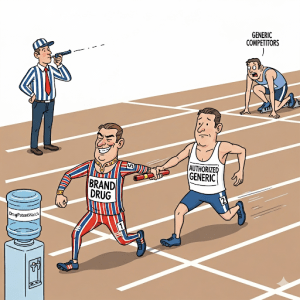
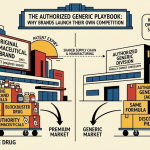
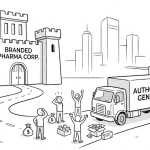
An authorized generic is a brand-name drug sold under a generic label. No new FDA approval required. No new manufacturing site. No clinical data package. The brand holder simply notifies the FDA, strips the brand name from the label, and drops an identical product into the market slot that Hatch-Waxman was designed to reserve for independent generic challengers.
That mechanic sounds straightforward. The strategic consequences are not. From 2010 through 2019, brand companies executed 854 authorized generic launches in the U.S. market. By end of 2019, the FDA had approved nearly 1,200 authorized generics in total. When a first-filer generic enters its 180-day exclusivity window, roughly 70% of authorized generic launches are already there to meet it. The financial cost to the first-filer is measurable: its revenues drop 40-52% during that exclusivity period when an authorized generic is present, compared to a first-filer monopoly.
For pharma IP teams, portfolio managers, and generic developers, this is not background information. It is the competitive reality that shapes the economics of every Paragraph IV filing decision, every patent settlement negotiation, and every loss-of-exclusivity revenue forecast.
Part I: The Regulatory Architecture That Makes Authorized Generics Possible
Hatch-Waxman’s Built-In Paradox
The Drug Price Competition and Patent Term Restoration Act of 1984 was designed to resolve a tension between two interests: brand companies needed adequate returns on R&D investment, and consumers needed timely access to lower-cost generic alternatives. The law’s solution was a negotiated structure that gave brand companies patent term extension and gave generic challengers an abbreviated approval pathway, the Abbreviated New Drug Application (ANDA). The incentive mechanism for generic companies was the 180-day first-filer exclusivity: the first company to file a Paragraph IV certification challenging a brand patent earned six months of protected generic marketing, during which no other ANDA filer could launch.
What Hatch-Waxman did not restrict was the brand company’s ability to market its own product under a generic label using the existing New Drug Application. The NDA holder has already demonstrated safety and efficacy. The product is already approved. The brand is permitted to sell that product without the brand name, either directly through its own operations or through a licensed partner, without filing a separate ANDA and without waiting for any regulatory clearance beyond an FDA notification.
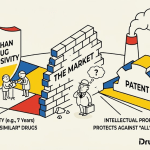
This is the structural paradox: the law that created first-filer exclusivity also left open a mechanism for brand companies to compete directly inside that exclusivity window. The 180-day period, which was meant to give the first generic challenger a protected runway to recoup its litigation and development investment, became a period in which brand companies could legally undercut that protection by selling an identical product at a generic price.
What the FDA Definition Actually Covers
The FDA defines an authorized generic as ‘an approved brand name drug that is marketed without the brand name on its label.’ The agency requires that the brand company submit a Prior Approval Supplement or letter of authorization, but review is administrative rather than scientific. The FDA does not re-evaluate safety, efficacy, or bioequivalence, because the product is chemically and pharmaceutically identical to the approved reference listed drug.
This has two practical implications. First, the authorized generic reaches market faster than any ANDA-approved competitor, since there is no regulatory queue. Second, the authorized generic is, by definition, therapeutically equivalent to the brand, which means state substitution laws treat it the same way they treat AB-rated generics. Pharmacists can substitute an authorized generic for the brand without prescriber authorization in all 50 states, which gives it the same formulary mechanics as any ANDA-approved product.
The distinction between an authorized generic and a brand product sold at a discounted price is the label and the pricing tier. Authorized generics are priced in the generic range, typically 10-30% below the brand list price at launch, and they move through the pharmacy benefit manager’s generic tier rather than the brand tier. That tier placement determines patient co-pays and PBM rebate structures, both of which are materially different from the brand tier.
The 180-Day Exclusivity Interaction: Mechanics and Legal Constraints
The 180-day first-filer exclusivity runs from the date of first commercial marketing by the qualifying ANDA holder. It blocks subsequent ANDA holders from obtaining final FDA approval during the exclusivity period. It does not block the NDA holder. Brand companies can legally launch an authorized generic on the same day as the first-filer generic and compete directly inside the exclusivity window.
Congress debated restricting this practice during the Medicare Modernization Act of 2003 and subsequent pharmaceutical pricing legislation. The restriction was not enacted. The FTC studied the competitive effects twice, publishing major reports in 2011 and updated analyses thereafter, and documented both the consumer price benefits and the competitive harm to first-filer revenues. The commission’s findings did not produce legislative change, though they informed the antitrust analysis of settlement agreements.
The legal constraint that does exist around authorized generics is antitrust law’s treatment of settlement agreements in which the brand promises not to launch an authorized generic in exchange for the generic company agreeing to delay its market entry. The FTC has characterized these ‘no-AG commitments’ as compensation in reverse-payment settlements, particularly after the Supreme Court’s 2013 FTC v. Actavis decision, which held that large reverse payments from brand to generic companies are subject to antitrust scrutiny under the rule of reason. Whether a no-AG commitment constitutes compensation of sufficient value to trigger antitrust liability under Actavis has been contested in multiple circuit courts and remains an active legal question.
Key Takeaways for Part I: Hatch-Waxman created 180-day exclusivity to reward patent challenges but left the NDA holder free to compete inside that window. An authorized generic reaches market through notification, not approval. It is automatically substitutable at pharmacy. No-AG commitments in patent settlements carry antitrust exposure under the Actavis framework, making the authorized generic a significant variable in every Hatch-Waxman litigation negotiation.
Part II: Prevalence Data – How Often Brands Actually Pull the Trigger
854 Launches in a Decade: The Scale of Authorized Generic Activity
The most comprehensive dataset on authorized generic activity comes from a 2023 Health Affairs study that linked FDA product labeling data to retail sales records and Medicaid claims for the period 2010-2019. The study identified 854 authorized generic launches across that nine-year window, averaging roughly 95 per year. Launch frequency peaked around 2013-2014 and moderated through the latter part of the decade, which researchers attributed partly to reduced generic exclusivity activity in those years and partly to growing antitrust scrutiny of settlement agreements that included AG components.
By end of 2020, the FDA’s quarterly list of authorized generics showed 1,041 distinct AG products approved since the tracking requirement was enacted, covering 528 different NDA numbers. The total continued growing. FDA reported approximately 1,200 authorized generics by end of 2019, a figure that reflects both new launches and the cumulative stock of products that had received AG authorization over their commercial histories.
To put that number in context: across the same period, the FDA approved approximately 20,000 generic products under ANDA. Authorized generics represent roughly 5-6% of total approved generic products by count, but their market impact is disproportionate to their count because they concentrate in high-revenue products facing their first generic competition.
The Health Affairs data showed that among drugs experiencing first-time generic entry between 2012 and 2017, 45% had a simultaneous authorized generic introduction. That means in nearly half of all cases where a first-filer generic exercised its 180-day exclusivity, the brand was already present as a generic competitor. For a first-filer that invested $10-50 million in patent litigation expecting a protected 180-day window, that statistic materially affects the ex-ante expected return on the Paragraph IV investment.
Therapeutic Area Distribution and Formulation Patterns
Authorized generics are not concentrated in any single therapeutic area, but they do cluster in product categories with specific characteristics: high prescription volume, established formulary position, and patient populations accustomed to brand-generic substitution at the pharmacy level.
Medicaid data from 2014-2020 identified 1,023 distinct AG formulations covering 528 NDAs. Among those, several products achieved exceptional authorized generic market penetration. Levothyroxine sodium, one of the highest-volume oral medications in the U.S. by prescription count, saw its authorized generic capture approximately 19% of Medicaid prescriptions across that period. Albuterol sulfate inhalation aerosol, following the 2019 market transition to HFA-propellant inhalers, saw authorized generic products reach 32% of Medicaid prescriptions, with one specific AG variant reaching 51% of albuterol inhaler market volume.
Both cases illustrate a pattern: authorized generics perform best in product categories where substitution is automatic (generic substitution laws apply), patient acceptance of equivalence is high, and the brand holder maintains manufacturing scale that makes AG production economically efficient.
In specialty categories, particularly biologics and complex injectables, authorized generic dynamics operate differently. The BPCIA’s regulatory framework for biosimilars does not use the ANDA-equivalent pathway in the same way, and the NDA holder’s ability to market an ‘authorized biosimilar’ is constrained by the same interchangeability designation requirements that apply to any biosimilar. This limits the authorized generic mechanic to small-molecule drugs and relatively simple biologics marketed under NDAs rather than BLAs.
ADHD medications, including methylphenidate hydrochloride and mixed amphetamine salts, have seen high authorized generic activity. When Shire’s Adderall XR faced generic entry, authorized generic activity was part of the competitive response. Statins, including atorvastatin upon Lipitor’s loss of exclusivity in 2011, saw authorized generic competition, though the atorvastatin AG captured only approximately 10% of prescriptions in the multi-source market, with independent generics dominating volume rapidly.
Authorized Generic Share in Medicaid: The 16% Rule and Its Exceptions
The Medicaid dataset provides the cleanest view of authorized generic market share because state Medicaid agencies report drug utilization at the NDC level, allowing precise identification of AG versus brand versus independent generic product codes. Across 2014-2020, authorized generics accounted for approximately 175 million of roughly 4.6 billion total Medicaid prescriptions, a 4% share of total volume. That aggregate figure understates competitive impact because it includes all periods, including those when no AG was available for a given product.
Among products where an authorized generic was available at any point during the period, the AG captured approximately 16% of prescriptions on average while active, with independent generics taking roughly 75% and the brand retaining 6-9%. The 16% average declined from approximately 20% in 2014 to 11% by 2020, excluding the albuterol inhaler outlier. That decline reflects several factors: the growing number of independent generic competitors as multi-source markets mature, increased PBM contracting that directs volume to specific generic manufacturers, and possible formulary dynamics that disadvantaged some AG products.
The 51% peak for one albuterol AG variant represents the extreme case: a product transition where the authorized generic was the only HFA-compliant inhaler available at generic pricing at the moment of market transition, effectively capturing captive volume before independent competitors had completed the regulatory process for the new propellant formulation.
Investment Strategy: For analysts modeling generic entry timing and revenue impact, the 16% average AG market share should function as a default haircut applied to first-filer exclusivity period revenue projections when the brand holder has the manufacturing capacity and economic incentive to launch an AG. For products where the NDA holder has publicly disclosed an AG partnership or has a history of AG deployment, the haircut should increase to 30-40% of exclusivity period revenue, consistent with the range documented in FTC studies.
Key Takeaways for Part II: Authorized generics appeared in 45% of first-generic entry events during 2012-2017. The average AG captures 16% of Medicaid prescriptions when active, but concentration in high-volume products like levothyroxine and albuterol pushes specific AG market shares far higher. The 5-6% share of total FDA-approved generics by count understates strategic importance because AG activity concentrates in the highest-revenue LOE events.
Part III: Timing Mechanics – When Brands Pull the AG Trigger and Why
The 70% Synchronization Rate: Racing the First-Filer
The timing of authorized generic launches is not random. Among authorized generics deployed in markets where a first-filer generic was eligible for 180-day exclusivity, approximately 70% launched before or during that exclusivity period. Brands do not wait for the competitive market to normalize. They synchronize their AG launch with the moment the first-filer generic enters, targeting the window of maximum revenue concentration.
The logic is straightforward. During the 180-day period, only the brand and the first-filer generic compete for the market. Prescriptions shift rapidly from the brand tier to the generic tier as PBMs update formularies and pharmacy systems default to the lower-cost option. In the absence of an AG, the first-filer generic captures most of that generic tier volume. With an AG present, the brand redirects a substantial portion of its own prescriptions to the AG column, maintaining revenue at generic pricing rather than ceding it entirely to the independent competitor.
The brand’s goal is not to maximize per-unit margin during this period. It is to maximize aggregate revenue by maintaining volume. A brand drug generating $3 billion annually that faces complete generic conversion loses effectively all of that revenue over 18-24 months. An authorized generic priced at a 15-20% discount to brand captures perhaps 20-30% of that volume at reduced margin, preserving $500-800 million in aggregate annual revenue that would otherwise go to competitors.
Brands that have historically deployed this timing strategy include AbbVie, Pfizer through its Greenstone subsidiary, Teva (when holding NDA rights), and multiple specialty pharma companies. Greenstone, Pfizer’s generic subsidiary, marketed authorized generics of multiple Pfizer products at their LOE dates, including atorvastatin. The Greenstone structure allows Pfizer to maintain full manufacturing economics at the brand facility while presenting a separately branded generic product to the pharmacy market.
Pre-Exclusivity Launches: The Rare Early Deployment
Approximately 30% of authorized generic launches occur outside the 180-day first-filer exclusivity window, either before any independent generic has entered or after the multi-source market has established itself. Pre-exclusivity launches, where the brand deploys an AG before any ANDA has been approved, are uncommon and typically driven by specific strategic circumstances.
The Eli Lilly insulin lispro case in 2023 illustrates a pre-competitive AG deployment. Lilly launched an authorized generic of Humalog (insulin lispro) at $35 per vial, which was approximately half the Humalog list price, well before any ANDA-approved biosimilar or interchangeable insulin lispro entered the market. The stated rationale was expanding access for uninsured patients. The commercial reality was more complex: Lilly’s net realized price for Humalog, after PBM rebates, was already close to the AG’s list price for commercially insured patients. The AG served a distinct, uninsured patient population while generating political capital on insulin pricing at a moment of intense Congressional pressure, without materially cannibalizing the core commercial book of business.
GSK’s 2023 Flovent withdrawal and authorized generic introduction represents a different pre-competitive deployment, one driven not by patent cliff dynamics but by Medicaid rebate policy. Facing punitive rebate clawbacks under the Inflation Reduction Act’s rebate reform provisions triggered by above-inflation price increases, GSK discontinued Flovent HFA (fluticasone propionate inhalation aerosol) and introduced an authorized generic of the identical product. Because the authorized generic was classified as a ‘new’ product for rebate calculation purposes, the inflation penalty did not apply to it. GSK effectively reset the rebate baseline by changing the label, not the molecule. The FDA and Congressional Democrats criticized the maneuver, and CMS moved to close the loophole, but the episode demonstrated how authorized generic mechanics extend into policy arbitrage well beyond the patent cliff.
Post-Exclusivity AG Launches: Defending Against Multi-Source Competition
The remaining fraction of authorized generic launches occurs after the first-filer’s 180-day exclusivity has expired and the market has become multi-source. These post-exclusivity AG deployments are defensive actions taken when a product’s market remains concentrated enough that an authorized generic can maintain meaningful share.
In a deeply multi-source market with 10-15 generic manufacturers competing, an authorized generic has limited additional impact. Independent generics capture 85-90% of volume at prices near marginal manufacturing cost, and the AG offers no particular advantage over the competing generics from a substitution standpoint. The brand holder’s manufacturing economics may not support pricing at that level profitably.
But in markets where only one or two generic manufacturers have entered, typically because the product has a complex formulation, narrow patient population, or limited commercial attractiveness for generics at scale, an authorized generic can maintain 20-35% market share well into the multi-source period. In these cases, the AG functions less as a competitive deterrent and more as a sustained revenue stream from a product that retains commercial viability without requiring the brand’s full pricing and rebate structure.
Key Takeaways for Part III: The 70% synchronization rate between AG launches and 180-day exclusivity entry is not coincidence. It reflects deliberate brand strategy targeting the window of maximum revenue concentration. Pre-exclusivity AG deployments are less common but serve specific purposes: access pricing, policy arbitrage, or political positioning. Post-exclusivity AGs work best in thin-competition markets where generic penetration has not reached commodity pricing levels.
Part IV: Financial Impact – What the Data Says About Prices and First-Filer Economics
The FTC’s Core Findings: Price Effects Are Real but Bounded
The Federal Trade Commission has studied authorized generic competitive effects more rigorously than any other regulatory body, publishing its definitive report in 2011 and updating analyses in subsequent years. The core quantitative findings, which have held across multiple studies with different methodologies, are consistent: authorized generics lower prices during the 180-day exclusivity period, but the magnitude is modest relative to the competitive harm they impose on first-filer revenues.
On retail prices, the FTC found that prices during the 180-day exclusivity period are 4-8% lower when an authorized generic is present versus a first-filer monopoly. On wholesale prices, the differential is 7-14% lower. These are statistically significant reductions, but they are not the price reductions that occur when a true multi-source market develops. Once 4-5 independent generics are present in a market, prices typically fall to 20-40% of brand list price. The authorized generic’s contribution to price reduction during exclusivity is a fraction of what full competition would eventually deliver.
The first-filer revenue effect is more substantial and is the primary reason generic companies and their investors care about AG timing. During the 180-day exclusivity period, first-filer revenues are 40-52% lower when an authorized generic is present compared to a first-filer monopoly. That is not a marginal impact. For a generic company that invested $30-50 million in patent litigation and ANDA development expecting a six-month protected revenue period, a 40-52% revenue reduction eliminates much of the expected return.
The effect persists after exclusivity ends. Over the 30 months following the expiration of the 180-day exclusivity period, first-filer revenues remain 53-62% lower compared to scenarios without an authorized generic. The mechanism is market structure: when the AG claims 20-30% of volume during exclusivity, it establishes distribution relationships, formulary positions, and pharmacy contract pricing that persist into the multi-source period. The first-filer never fully recovers to the volume it would have held in an AG-free scenario.
IP Valuation Implications: The First-Filer Option Loses Value
The financial impact of authorized generics on first-filer economics has a direct effect on the implicit option value of Paragraph IV challenges. A Paragraph IV filing is, at its core, an investment in the option to become the first generic entrant with a protected revenue period. The expected value of that option depends on the probability of winning the patent challenge multiplied by the projected revenue during the exclusivity period, discounted for litigation cost and timeline risk.
When authorized generic probability increases, that expected value declines. If a first-filer expects a 40-52% reduction in exclusivity period revenues due to AG competition, the hurdle rate for a Paragraph IV investment rises correspondingly. Generic companies must either have higher confidence in their invalidity case, lower litigation costs, or access to a larger product market to justify the same investment.
This dynamic has two observable consequences for the pharma IP ecosystem. First, it concentrates Paragraph IV activity in blockbuster products where the absolute revenue opportunity is large enough that a 40-50% revenue haircut still leaves an acceptable return. A product generating $500 million annually at brand pricing, where the first-filer might capture $200-250 million in generic revenue during a six-month exclusivity window even with AG competition, remains an attractive target. A product generating $150 million annually, where the exclusivity window might yield only $30-40 million after AG competition and litigation costs, becomes economically marginal.
Second, it increases the value of no-AG commitments as settlement currency. If a brand company promises not to launch an authorized generic as part of a Paragraph IV settlement, it is offering something with quantifiable value: restoration of 40-52% of first-filer exclusivity period revenue. This is compensation in economic terms, even if no cash changes hands. The Actavis decision’s scrutiny of reverse payments extends to this form of compensation, and multiple courts have held that no-AG commitments can constitute the ‘large and unjustified’ payment that triggers antitrust liability under the rule of reason standard.
Investment Strategy: For investors in publicly traded generic companies, the presence or absence of authorized generic risk for a specific first-filer product is a material factor in revenue modeling for the exclusivity period. Methodology: identify the NDA holder for each first-filer product in a generic company’s portfolio; assess whether the NDA holder has a history of AG deployment (search FDA quarterly AG lists and prior LOE events for that brand company); check whether the Paragraph IV settlement, if applicable, includes a documented no-AG commitment; then apply the appropriate revenue haircut to exclusivity period projections. Companies that front-run this analysis using patent and ANDA intelligence tools have a systematic advantage over those relying on company guidance alone.
The Profitability Math for Brand Companies: $50 Per Dollar Invested
Research firm Cutting Edge Information, drawing on industry interviews and financial modeling, estimated that authorized generics return approximately $50 for every dollar invested in their launch. That figure reflects the unique economics of the strategy: the product is already manufactured at scale, the regulatory authorization requires minimal incremental cost, the sales force is repurposed rather than expanded, and the primary investment is in distribution and pricing adjustments.
Contrast that return ratio with other LOE defensive strategies. A lifecycle management program developing a new extended-release formulation requires 3-5 years of clinical development, a 505(b)(2) or full NDA regulatory package, and a separate marketing launch. A patent litigation defense in district court for a blockbuster product costs $5-7 million per case. A Supplementary Protection Certificate extension in Europe requires demonstrating regulatory delay and navigating national filing requirements. The authorized generic offers a return that none of these alternatives approach on a per-dollar-invested basis, which explains why brands with the manufacturing capacity to execute it do so consistently.
The caveat is that the return calculation is sensitive to the product’s remaining commercial life and the depth of generic price erosion. For a product in a therapeutic area that will see rapid multi-source competition, the AG’s revenue contribution may be a temporary bridge of 12-18 months before volume collapses to commodity generic pricing regardless. For a product in a niche therapeutic area with limited generic competition, the AG can maintain viable margins for several years.
Key Takeaways for Part IV: AG presence cuts first-filer exclusivity period revenues by 40-52% and the effect persists 53-62% lower revenues in the 30 months after exclusivity. Price benefits to consumers are real but bounded, 4-8% retail price reduction during exclusivity, well below the price reductions that follow full multi-source competition. No-AG commitments in patent settlements constitute economic compensation under Actavis. Brand companies generate returns of approximately $50 per dollar invested in AG launches, explaining their persistent use wherever manufacturing economics allow.
Part V: Case Studies in AG Strategy – EpiPen, Humalog, Flovent, and Tekturna
Tekturna (Aliskiren): Profit Maximization in Textbook Form
PDL BioPharma’s management of aliskiren’s loss of exclusivity is the cleanest example of authorized generic deployment as pure profit optimization. Aliskiren (branded as Tekturna for hypertension) was approaching its patent cliff when PDL, which held U.S. rights, made a deliberate decision to dissolve the Tekturna sales force and substitute an authorized generic for the brand.
PDL’s CEO stated publicly that the plan was to ‘maximize profit at this point,’ noting that the economics remained ‘very favorable’ even with the brand’s prescription volume declining. PDL calculated that maintaining the full Tekturna commercial infrastructure against generic competition was uneconomic, but that an authorized generic capturing 30-40% of residual volume at a modest discount to brand pricing would generate positive cash flow at near-zero incremental cost. The sales force disbandment reduced fixed operating costs while the AG preserved variable revenue from the installed patient base.
The IP valuation dimension: Tekturna’s commercial royalty stream was the primary asset backing PDL’s royalty monetization model. When the composition of matter patent expired and generic entry became imminent, the remaining IP value in the Tekturna franchise was not zero. The authorized generic extracted that residual value without the cost of litigating secondary patents or launching a new formulation. For a company whose business model was royalty acquisition and monetization, the AG was the most efficient exit mechanism from the brand phase of the product’s life.
EpiPen (Epinephrine Autoinjector): The PR-Driven AG
Mylan’s EpiPen pricing controversy, in which the company raised the two-pack price from approximately $100 in 2009 to $600 by 2016, generated Congressional hearings, FTC inquiry, and significant consumer backlash. Mylan’s response in 2017 was to launch an authorized generic EpiPen at $300, a 50% discount to the brand.
The authorized generic was structurally identical to EpiPen in device and formulation. It used the same auto-injector mechanism, the same epinephrine concentration, and the same Mylan manufacturing operations. From a regulatory standpoint, it was the same product with a different label.
The strategic purpose was crisis management rather than market defense against a patent challenger. Adrenaclick (a competing epinephrine auto-injector) existed but had limited formulary coverage. The Paragraph IV generic threat to EpiPen was not imminent at the time of the AG launch. Mylan deployed the AG to demonstrate responsiveness to public pressure on drug pricing, giving uninsured and underinsured patients access to a lower-priced equivalent while maintaining the brand’s position on commercial insurance formularies.
The IP valuation implication: Mylan’s epinephrine device patents and formulation patents were the primary barriers to generic competition. A fully competing ANDA-approved product would have required bioequivalence demonstration for the device delivery characteristics, a technically complex and time-consuming process. The authorized generic bypassed that barrier entirely, allowing Mylan to present a lower-priced option without undermining the device patent portfolio or creating a pathway for competitors. The AG was, in this context, a defensive patent strategy disguised as a consumer access initiative.
Flovent (Fluticasone Propionate): Policy Arbitrage at Its Most Aggressive
GSK’s 2023 management of Flovent HFA is the clearest example of authorized generic mechanics being applied to regulatory arbitrage rather than generic competition defense. Flovent had been subject to above-inflation price increases that triggered the Medicaid Drug Rebate Program’s inflation rebate penalty under the Inflation Reduction Act. The penalty applies to the reference brand product. It does not, at the time of GSK’s maneuver, apply to a newly classified product.
GSK discontinued Flovent HFA and simultaneously introduced an authorized generic of the identical fluticasone propionate inhalation aerosol. Because the authorized generic was coded as a new product for Medicaid rebate purposes, the inflation penalty did not carry over. The rebate baseline reset to zero. GSK maintained the identical product in the market, at effectively the same net economics, while eliminating a growing Medicaid rebate liability.
The FTC and CMS characterized this as an attempt to circumvent the statute’s intent. Congress had designed the inflation rebate to create financial consequences for price increases that outpaced inflation, and the GSK maneuver preserved revenue without modifying pricing behavior. The episode triggered regulatory action to close the loophole and prompted proposals to establish clear rules defining when an authorized generic constitutes a ‘new’ product for rebate purposes versus a continuation of the reference brand’s rebate obligations.
For brand IP and regulatory teams, the Flovent case demonstrates that authorized generic mechanics operate across multiple regulatory systems simultaneously, patent law, FDA drug approval, and Medicaid rebate policy, and that actions taken to optimize one system can create liabilities in another. GSK’s short-term rebate savings came with Congressional scrutiny, FTC attention, and reputational exposure that carried its own costs.
Lipitor (Atorvastatin): The Greenstone Model
When atorvastatin lost exclusivity in November 2011, it represented the largest single-product patent cliff in U.S. pharmaceutical history at that point. Lipitor’s peak annual U.S. sales exceeded $7 billion. Pfizer’s response included both an aggressive contracting strategy to maintain brand prescriptions and the deployment of an authorized generic through Greenstone, Pfizer’s wholly owned generic subsidiary.
Greenstone’s atorvastatin authorized generic entered the market simultaneously with first-filer generic Ranbaxy’s atorvastatin, competing directly inside the 180-day exclusivity window. Greenstone held distribution agreements with major pharmacy chains and PBMs, giving the authorized generic formulary access that an independent generic might take months to achieve. The atorvastatin AG captured approximately 10% of prescriptions in the multi-source market, modest relative to the total volume, but at atorvastatin’s scale that represented billions of dispensed tablets and hundreds of millions in annual revenue.
The Greenstone structure illustrates the organizational model that large pharma companies have developed to deploy authorized generics systematically. By operating a dedicated generic subsidiary with established distribution relationships and a track record of regulatory compliance, Pfizer could execute AG launches across multiple products at LOE without building a separate commercial operation for each. The subsidiary model amortizes the fixed cost of generic distribution infrastructure across multiple product launches, improving the economics of each individual AG.
Investment Strategy: When evaluating a brand company’s LOE defense capacity, examine whether it operates a dedicated generic subsidiary (Greenstone/Pfizer, Par Pharmaceutical/Endo before divestiture, Prasco through licensing arrangements with multiple innovators). A company with an established generic distribution subsidiary can deploy authorized generics with materially lower incremental cost and faster execution than one building the capability ad hoc. This operational readiness is a qualitative factor in LOE revenue retention modeling that is rarely captured in consensus estimates.
Key Takeaways for Part V: The four case studies illustrate four distinct AG deployment rationales: profit optimization at LOE (Tekturna), crisis management under pricing pressure (EpiPen), Medicaid rebate policy arbitrage (Flovent), and systematic portfolio management through a generic subsidiary (Lipitor/Greenstone). Each required different IP, regulatory, and commercial analysis before execution. All four were legal at the time of deployment, though Flovent’s approach subsequently triggered regulatory response.
Part VI: The Generic Company Perspective – Paragraph IV Economics After the AG Threat
How AG Risk Changes the ANDA Investment Calculus
Generic pharmaceutical companies file Paragraph IV certifications to challenge patents and earn first-filer exclusivity. The decision to file is an investment decision: expected return from the exclusivity period minus litigation costs, ANDA development expenses, and a probability-weighted litigation loss scenario. AG risk is a multiplicative downside factor in this model.
A simplified version of the first-filer return model works as follows. A brand drug generates $600 million in annual U.S. revenue. The generic company estimates that first-filer exclusivity will capture 35% of volume at a 20% discount to brand list price, yielding approximately $100 million in gross profit during the six-month exclusivity period. Litigation costs are $15 million. Expected return before AG risk is $85 million.
Apply a 40% revenue haircut for AG competition during exclusivity, consistent with FTC data. Expected exclusivity period gross profit drops to $60 million. Subtract litigation costs of $15 million. Expected return is $45 million, a 47% reduction from the AG-free scenario. If the probability of an AG launch is 60%, the probability-weighted expected return is ($85M x 0.40) + ($45M x 0.60) = $34M + $27M = $61M, a 28% reduction in expected return from the no-information baseline.
Generic companies that do not explicitly model AG probability and impact into their Paragraph IV investment decisions are systematically overestimating their expected returns on a portfolio basis.
The No-AG Commitment as Deal Currency
In Paragraph IV patent litigation, the most common resolution is not a courtroom verdict. It is a negotiated settlement that grants the generic company a specific entry date in exchange for withdrawing the invalidity challenge. The components of that settlement have evolved substantially since FTC v. Actavis limited cash reverse payments.
A no-AG commitment from the brand company functions as non-cash compensation in these settlements. Its value can be calculated directly from the FTC’s documented revenue impact: restoring 40-52% of first-filer exclusivity period revenue. For a first-filer exclusivity window expected to generate $100 million in gross profit with AG competition, a no-AG commitment is worth $40-52 million in incremental value.
Courts have increasingly treated no-AG commitments as compensation subject to antitrust scrutiny. The Third Circuit in King Drug v. Smithkline held that a no-AG commitment in a settlement could constitute a large payment under Actavis if it exceeded what could be explained as saved litigation costs. The Eleventh Circuit’s analysis in subsequent cases has required courts to weigh the value of the no-AG commitment against the brand’s litigation risk to determine whether the overall settlement is anticompetitive. This analysis is fact-intensive and product-specific, making case-by-case antitrust assessment by both brand and generic legal teams essential before settling.
For brand companies, the no-AG commitment is a concession that has quantifiable cost: the revenue that the authorized generic would have generated during the exclusivity period. A brand must weigh that revenue against the litigation risk of losing the patent challenge entirely, which would permit generic entry before the agreed settlement date and at no settlement-negotiated entry date guarantee. The strategic calculation is whether the patent is strong enough that giving up the AG revenue is an acceptable price for locking in a delayed entry date that protects more total revenue than the AG would have generated.
Authorized Generic Intelligence as a Competitive Signal
For generic companies building Paragraph IV pipelines, tracking brand companies’ historical authorized generic behavior is a form of competitive intelligence that directly informs ANDA investment decisions. The FDA publishes a quarterly list of authorized generics, which allows systematic analysis of which brand holders deploy AGs consistently and which do not.
Companies with generic subsidiaries (Pfizer’s Greenstone, Novartis’s Sandoz before its spinoff as an independent company, Teva’s brand-to-generic transition products) have structural incentives to deploy authorized generics systematically. Their AG deployment history is close to 100% for products where they retain NDA rights and manufacturing capacity. Generic companies targeting Paragraph IV challenges against these brand holders should price in the AG haircut as a near-certainty.
Companies without generic subsidiary infrastructure are less consistent AG deployers. Some license AG rights to third-party generic companies (Prasco is a specialized AG licensing company that partners with brand holders to market AGs), while others forgo the AG entirely, particularly when the product’s remaining commercial life is short or the manufacturing economics do not support a low-price generic formulation.
Drug patent intelligence platforms that track ANDA filings, Paragraph IV certifications, and authorized generic histories allow generic companies to build a product-specific AG risk profile before committing Paragraph IV litigation budgets. This intelligence function should be a standard component of the ANDA pipeline prioritization process, not an afterthought.
Key Takeaways for Part VI: AG risk reduces first-filer exclusivity period gross profit by 40-52% per FTC data, which directly compresses the expected return on Paragraph IV investment. No-AG commitments in settlements are quantifiable economic concessions with documented antitrust exposure under Actavis. Generic companies that do not build AG risk into Paragraph IV investment models systematically overestimate their ANDA portfolio’s expected returns.
Part VII: International Comparison – Why Authorized Generics Are a U.S.-Specific Phenomenon
EU Regulatory Structure: Why the AG Mechanic Does Not Transfer
The authorized generic strategy is structurally unavailable in the European Union for a reason that is fundamental to the EU’s pharmaceutical regulatory design. Under Directive 2001/83/EC and its subsequent amendments, generic medicines can only receive marketing authorization after the reference medicinal product has been authorized for at least 8 years (the ‘data exclusivity’ period) and can only be placed on the market after 10 years (the ‘market exclusivity’ period, which extends to 11 years if a new therapeutic indication demonstrating clinical benefit is added during the first 8 years).
The NDA holder cannot market a generic version of its own product before these exclusivity periods expire, because doing so would constitute a second marketing authorization for the same product before the regulatory exclusivity has run. The EU does not have a notification-only pathway equivalent to the U.S. authorized generic mechanism. Any generic must go through the abbreviated marketing authorization procedure under Article 10 of Directive 2001/83/EC, which requires demonstrating that the data exclusivity period has elapsed.
This structural difference means that European brand companies cannot use authorized generics as a competitive weapon during the period when the reference product has market exclusivity. Instead, European brand strategies for LOE management focus on supplementary protection certificates, pediatric exclusivity extensions, development of new therapeutic indications, and formulary contracting to maintain brand preference against generic competition after the exclusivity periods run.
European originator companies do compete in the generic market through affiliated generic subsidiaries and licensing arrangements, but these products must go through the standard abbreviated marketing authorization process and wait for the applicable exclusivity periods to expire. Novartis’s Sandoz, AstraZeneca’s Generics, and similar originator-affiliated generics companies operate in the EU market under the same regulatory constraints as independent generic manufacturers.
Japan: Authorized Generics Without the Legal Category
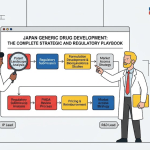
Japan does not have a formal authorized generic regulatory category equivalent to the U.S. definition. However, Japanese brand holders have long engaged in practices that achieve similar commercial outcomes through different legal mechanisms. A brand holder can license manufacturing and marketing rights for its product to a domestic Japanese company, which then sells the identical product under a different product name and at a lower price point after the brand’s market exclusivity has expired.
These licensed products are classified as generic drugs by Japan’s Ministry of Health, Labour and Welfare (MHLW) but are manufactured by or under the supervision of the originator, with identical specifications. They function commercially as authorized generics in the U.S. sense, but they are regulated as standard generics and must meet the same bioequivalence requirements as any other generic applicant.
Japan’s National Health Insurance annual price revision system creates a commercial context that is fundamentally different from the U.S. market. Price revisions are applied uniformly and compress margins across the board, regardless of whether a product is a brand, a licensed generic, or an independent generic. The financial incentive to deploy an authorized-generic-equivalent in Japan is therefore smaller than in the U.S., because the price protection that makes the U.S. AG economically valuable (the 10-30% discount to brand list price) is compressed by the NHI system over time regardless.
India and Emerging Markets: Branded Generics as the Structural Equivalent
In India, Brazil, and other major emerging pharmaceutical markets, the concept most closely equivalent to a U.S. authorized generic is the ‘branded generic,’ an off-patent compound sold under a proprietary brand name by any manufacturer, including the originator. These markets have limited data exclusivity periods and, in some cases, compulsory licensing provisions that further constrain originator IP rights.
Major innovator companies maintain revenue in these markets after patent expiry primarily through brand equity, physician relationships, and manufacturing quality differentiation rather than regulatory exclusivity. Companies like GSK, Sanofi, AstraZeneca, and Pfizer operate substantial branded generic portfolios in emerging markets, where their products sell under company brand names at premium prices relative to local generic competitors, despite being off-patent.
This branded generic model is the commercial equivalent of the authorized generic in terms of preserving originator market share after exclusivity, but it operates through brand positioning rather than regulatory mechanics. The IP valuation implication differs: in emerging markets, the value of an off-patent originator product depends primarily on brand equity and manufacturing reputation, whereas in the U.S., an authorized generic’s value derives from the regulatory mechanics that allow it to compete inside the first-filer exclusivity window at a cost and speed that independent generic competition cannot match.
Key Takeaways for Part VII: The authorized generic mechanic is U.S.-specific because it depends on the FDA’s notification-only pathway and the absence of market exclusivity restrictions on NDA holders marketing their own product as a generic. EU market exclusivity prevents this for 10-11 years. Japan’s regulatory system classifies originator-licensed generics as standard generics with full bioequivalence requirements. Emerging markets achieve similar commercial outcomes through branded generic positioning rather than regulatory mechanics, with IP value concentrated in brand equity rather than exclusivity periods.
Part VIII: Antitrust, Policy Evolution, and the Future Regulatory Landscape
The Actavis Framework and Its Application to No-AG Commitments
The Supreme Court’s 2013 FTC v. Actavis decision established that patent settlement agreements in Hatch-Waxman litigation are subject to antitrust rule-of-reason analysis when they include large and unexplained payments from brand to generic companies. The decision transformed Paragraph IV settlement strategy. Cash reverse payments became legally precarious, driving brands and generics toward non-cash forms of compensation, of which no-AG commitments became the most commercially significant.
Post-Actavis circuit court decisions have generally held that no-AG commitments are subject to the same rule-of-reason analysis as cash reverse payments, particularly when their value is large relative to the generic company’s litigation risk-adjusted expected return. The Third Circuit’s King Drug v. Smithkline Beecham decision in 2015 explicitly included no-AG commitments within the Actavis framework. The Eleventh Circuit and Second Circuit have addressed similar issues in subsequent cases with consistent results.
The antitrust analysis of a no-AG commitment requires quantifying its value, which depends on the specific product’s market size, the likely AG market share during the exclusivity period, and the brand company’s demonstrated history of AG deployment. This analysis is fact-intensive and product-specific. Brand and generic legal teams must commission economic analyses of the value transferred through a no-AG commitment before executing any settlement agreement that includes one.
The FTC continues to monitor Paragraph IV settlements that include AG provisions and has challenged settlements it views as effectively anticompetitive. Brand companies that use no-AG commitments as standard settlement currency across their Paragraph IV litigation portfolio, rather than in specific cases where litigation risk justifies the concession, face heightened FTC scrutiny of their overall settlement practices.
Inflation Reduction Act Interactions and the Flovent Precedent
The Inflation Reduction Act of 2022 introduced pharmaceutical provisions that interact with authorized generic mechanics in ways that Congress did not fully anticipate. The Medicaid inflation rebate penalty, which applies when a brand’s price increases exceed the rate of general inflation, created a financial incentive to reclassify existing brand products as authorized generics, effectively resetting the rebate baseline.
GSK’s Flovent maneuver tested this interaction and generated a regulatory response. CMS and Congress moved to establish that an authorized generic of an existing brand product inherits the brand’s rebate history for inflation penalty calculation purposes, rather than being treated as a new product. The precise regulatory language is still being finalized, but the direction is clear: the policy arbitrage that Flovent exploited is being closed.
Separately, the IRA’s Medicare drug price negotiation provisions affect products with large Medicare market shares. For a product under Medicare price negotiation, the authorized generic’s list price is constrained by the negotiated maximum fair price, which applies to both the brand and any version of the same active ingredient and formulation that the NDA holder markets. This reduces the authorized generic’s pricing flexibility in the Medicare channel and may limit its financial benefit in markets where Medicare is the dominant payer.
Medicaid Managed Care and PBM Formulary Dynamics
Authorized generics navigate formulary placement and Medicaid rebate structures differently from branded products and independently approved generics. Under Medicaid, authorized generics are covered automatically as generic versions of the brand, but the rebate structure depends on how the AG is classified. If classified as a brand product (which some states have done historically based on pricing), it triggers brand rebate requirements. If classified as a generic, it is subject to the generic alternative rebate structure.
The classification question has financial consequences for both manufacturers and state Medicaid agencies. A state that classifies an authorized generic as a brand and demands brand rebates may make the AG economically unattractive for the manufacturer, potentially removing it from the market. A state that classifies it as a generic loses the brand rebate but benefits from lower acquisition prices. State Medicaid programs have varied in their classification approaches, creating inconsistent market conditions across geographies.
PBM formulary decisions further complicate the picture. Large PBMs operating commercial plans assign drugs to formulary tiers based on therapeutic alternatives and negotiated rebate economics. An authorized generic that sits on the generic tier generates no rebate for the PBM from the manufacturer (AGs typically do not pay PBM rebates as brands do), which may make the PBM prefer a competing independent generic that pays administrative fees and rebates. In some cases, PBMs have excluded authorized generics from preferred formulary positions, directing volume to independent generics despite the AG’s regulatory equivalence to the brand.
This formulary dynamic is a commercial risk factor for brands deploying authorized generics: if the major PBMs choose not to list the AG on preferred formulary tiers, the AG’s expected market share drops significantly from the 20-30% range documented in studies that include all-payer data.
Key Takeaways for Part VIII: Post-Actavis antitrust law treats no-AG commitments as economic compensation subject to rule-of-reason analysis, requiring quantitative valuation before settlement execution. The IRA’s Medicaid inflation rebate provisions created incentives for regulatory arbitrage that the Flovent case exploited and that CMS is now closing. PBM formulary decisions can materially reduce AG market share if commercial plans do not include the AG on preferred tiers, a risk factor that is product- and contract-specific and is often absent from generic entry models.
Part IX: Execution Framework – How to Deploy an Authorized Generic or Defend Against One
The Brand Company Deployment Checklist
Deploying an authorized generic requires coordination across manufacturing, regulatory, commercial, legal, and government affairs functions. Companies that treat it as a simple label change frequently underestimate the operational complexity and the downstream policy consequences.
The manufacturing dimension is the starting point. An authorized generic uses the same NDA, the same specifications, and ideally the same manufacturing facility as the brand. The brand company must confirm that its manufacturing contracts and facility agreements permit production for generic label sale, and that existing third-party manufacturing agreements do not contain brand-exclusivity provisions that would prohibit AG marketing.
The regulatory notification to FDA requires submission of a Prior Approval Supplement or a letter of authorization identifying the licensed AG marketer (if a third-party licensee is involved), the product’s NDA number, and the proposed labeling. This is administrative and typically processed within weeks. The timing of this submission relative to the first-filer generic’s expected approval date should be calculated to ensure the AG can enter the market simultaneously rather than weeks later.
Commercial deployment requires establishing distribution agreements with wholesalers and pharmacy chains under the generic product code rather than the brand code. This involves separate NDC registration, generic pricing agreements with the major drug wholesalers (McKesson, AmerisourceBergen, Cardinal Health), and separate retail and institutional contracts distinct from the brand’s commercial contracting. If the brand does not have an existing generic subsidiary with these relationships, it must build them quickly or partner with an established AG marketer like Prasco.
The legal review must assess Paragraph IV settlement exposure: does any existing or pending settlement agreement with a generic company include a no-AG commitment for this product? Deploying an AG in violation of a no-AG commitment is both a breach of contract and potentially an antitrust violation. Legal teams must audit all settlement agreements for AG restrictions before authorizing any AG deployment.
Government affairs must assess the policy risk: does the product have above-inflation price increases that trigger Medicaid rebate issues? Is it under IRA Medicare price negotiation? Has the brand’s pricing behavior already attracted Congressional attention? A product already under political scrutiny requires different public communication around the AG launch than a routine LOE event.
The Generic Company Defense Playbook
For first-filer generic companies, the authorized generic threat requires proactive intelligence and commercial planning before the 180-day exclusivity period begins.
The first step is building the AG probability assessment for each first-filer product. This requires: checking the FDA quarterly AG list for any existing AG authorizations for the NDA; reviewing the brand company’s historical AG deployment record across prior LOE events; checking the Paragraph IV settlement agreement for no-AG commitments or absence thereof; and assessing the brand company’s generic subsidiary infrastructure and distribution capabilities.
Where AG probability is high (brand company has a generic subsidiary, no no-AG commitment exists, prior AG deployments documented), first-filer revenue models for the 180-day exclusivity period should apply the 40-52% revenue haircut to gross profit projections. This lower projection should inform the settlement negotiation posture: the value of a no-AG commitment in exchange for an earlier entry date may be worth negotiating explicitly.
Where AG probability is moderate (brand company has no dedicated generic subsidiary but has deployed AGs through licensing in the past), assess whether partnering with the brand on an AG-authorized copromotion arrangement could convert the competitive threat into a revenue sharing opportunity. Some generic companies have negotiated authorized generic distribution agreements with brand holders, where the generic company markets the AG while sharing a portion of revenue with the NDA holder. This converts the AG from a competitive weapon against the first-filer into a partnership arrangement.
Formulary contracting during the exclusivity period is the most important commercial defense against AG competition. If the first-filer generic secures preferred formulary placement with major PBMs before the AG enters distribution, it can establish volume commitments that protect market share regardless of the AG’s listing. Speed of formulary contracting, starting 90-120 days before the expected first commercial marketing date, is the primary commercial advantage a first-filer can build against an AG.
Key Takeaways for Part IX: Authorized generic deployment requires coordinated execution across manufacturing, regulatory, commercial, legal, and government affairs functions. The most common failure mode is inadequate settlement agreement review, leading to AG deployment that violates no-AG commitments. For generic companies, formulary contracting speed during the exclusivity period is the primary defense against AG market share capture, and it should start 90-120 days before first commercial marketing.
Part X: The Future of Authorized Generics – Biosimilars, IRA Dynamics, and the Next Decade
Can Authorized Generics Apply to Biologics?
The authorized generic mechanic as it operates for small molecules depends on the NDA holder’s ability to market the reference product without a new regulatory submission. For biologics regulated under the Public Health Service Act, the equivalent pathway is different.
A biologic licensed under a Biologics License Application (BLA) can be marketed by the BLA holder under a different trade name or without a brand name, but it is still regulated as a biologic product, not as a generic. The BPCIA created the interchangeable biosimilar designation, which requires a biosimilar to demonstrate it can be expected to produce the same clinical result as the reference product in any given patient, and (for products administered more than once) that the risk of alternating between the reference and biosimilar is not greater than using the reference product alone. An NDA holder’s own product marketed without a brand name does not need to meet the interchangeability standard because it is the reference product, not a biosimilar.
This creates a theoretically available mechanism: a BLA holder could market its own biologic product under a different label (potentially at a different price point) without meeting biosimilar or interchangeability standards. Whether this constitutes an ‘authorized biosimilar’ equivalent or simply an authorized generic of a biologic is a regulatory classification question that has not been definitively resolved. The FDA’s current guidance does not explicitly address this scenario.
The practical relevance grows as major biologics approach their BPCIA exclusivity expirations. Adalimumab biosimilars are now fully in the U.S. market. Pembrolizumab (Keytruda) faces biosimilar development timelines converging on its 2028 patent expiration. If the BLA holder of a major biologic could deploy an ‘authorized generic biosimilar’ at a lower price point ahead of interchangeable biosimilar approvals, it could significantly alter the biosimilar market dynamics, compressing the price premium that biosimilar developers need to justify their development investments. This is an evolving regulatory frontier that brand companies, biosimilar developers, and their investors should track closely.
IRA Price Negotiation and the AG’s Shrinking Economics
The Inflation Reduction Act’s Medicare drug price negotiation provisions directly affect the economics of authorized generics for products with large Medicare market shares. When a product subject to Medicare price negotiation has its Maximum Fair Price established, that price applies to the drug irrespective of how it is labeled. An authorized generic of a negotiated product does not escape the MFP requirement if the AG is sold under the same NDA.
For products where Medicare is the dominant payer (oncology supportive care, cardiovascular drugs, certain diabetes medications), the MFP constrains the authorized generic’s list price to the negotiated level. This eliminates the pricing flexibility that makes the AG financially attractive: if the MFP is already set at a level similar to what the AG would have priced at anyway, the AG offers no additional margin benefit over the brand under Medicare while still requiring the commercial and regulatory overhead of a separate generic listing.
This dynamic will increasingly affect AG economics for the drugs added to Medicare price negotiation each year. Brand companies must model the MFP impact on AG margins before committing to AG deployment for negotiated products. For some products, the calculation will conclude that the AG adds administrative complexity without meaningful incremental revenue.
Investment Strategy: Over the next 5-7 years, the authorized generic playbook will face pressure from two directions: the IRA’s MFP provisions constraining AG pricing flexibility for negotiated products, and the emerging regulatory question about authorized generic equivalents for biologics. Investors modeling LOE revenue retention for brand companies should apply progressively smaller AG-driven retention assumptions for products subject to Medicare price negotiation and larger uncertainty ranges for biologics where the regulatory framework for AG-equivalent strategies remains undefined.
Key Takeaways for Part X: The authorized generic mechanic does not transfer cleanly to biologics under the BPCIA, but the regulatory boundary is not definitively settled. IRA price negotiation constrains AG pricing flexibility for Medicare-heavy products, reducing the financial benefit for an expanding list of drugs. The next decade will produce authorized generic activity concentrated in small-molecule products outside the Medicare negotiation list, with slower AG deployment for negotiated drugs and unresolved regulatory questions for biologic products.
Conclusion: Reading the AG Signal in Real Time
Authorized generics are not a niche tactic. They appear in roughly half of first-generic entry events for significant brand products. They cut first-filer exclusivity period revenues by 40-52%. They return $50 per dollar invested for the brand that deploys them. They carry antitrust exposure when embedded in patent settlements. They interact with Medicaid rebate policy, IRA price negotiation, and PBM formulary contracting in ways that vary by product and change with each new regulatory development.
For pharma IP teams, the authorized generic risk assessment belongs in every Paragraph IV investment analysis, every patent settlement negotiation, and every LOE revenue model. It requires data: the FDA quarterly AG list, ANDA filing histories, brand company subsidiary structures, and the specific settlement agreements that govern each first-filer competitive situation.
For portfolio managers and institutional investors, the authorized generic is a systematic source of modeling error in generic company revenue estimates and a systematic source of upside in brand company LOE retention models, for any analyst who tracks it precisely and applies it consistently.
The companies that price the AG variable correctly before an LOE event, not afterward, are the ones whose financial models hold when the quarter closes.
This analysis draws on FTC authorized generic studies (2011, subsequent updates), the 2023 Health Affairs study of 2010-2019 AG launches, FDA quarterly authorized generic lists, public regulatory filings, and company disclosures. It does not constitute legal advice or investment advice. Patent litigation and antitrust strategy requires qualified legal counsel in the relevant jurisdiction.