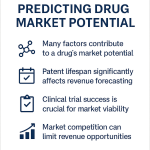
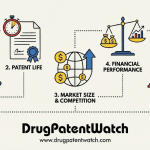
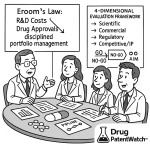
The pharmaceutical industry operates on economic principles that make standard financial valuation models inadequate. The average cost to bring a single prescription drug to market reaches $2.6 billion, a figure that includes the direct costs of successful development and the financial burden of failed candidates.1 Statistics indicate that 90% of drugs entering clinical trials fail.1 Sunk costs for failed Phase III trials range from $200 million to $500 million.1 Specialized valuation approaches, such as risk-adjusted net present value (rNPV) models, account for the probabilities of success and failure at each development stage.1 The valuation of a drug candidate can increase from $45.8 million at Phase I to $312.1 million at the time of New Drug Application submission, reflecting the progressive de-risking of the asset.1 If scientific and regulatory risks define the early life of a drug, intellectual property risk dictates its commercial endgame.1 The entire R&D gamble relies on the temporary monopoly conferred by patent protection.1
The mathematical failure of linear forecasting
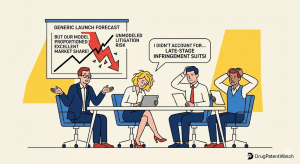
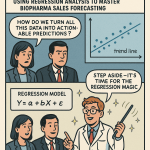
Standard econometric models fail to capture the nuances of a generic launch because they assume continuity.2 A generic launch is a singularity where historical brand performance becomes irrelevant as a predictor of future volume.2 Generic entry uncertainty is a pain point in pharma valuations.1 Naive moving average models that look backward at stable growth trends project success right over the cliff’s edge.2 Industry analysts project a patent cliff between 2025 and 2030 that puts $236 billion in annual branded revenue at risk.2 Forecasters must understand the economic physics of the event. Standard models assuming a slope may invest in patient loyalty programs or complex delivery devices to retain share, but the error bars on these forecasts are expensive.2
Probability weighted present value mechanics
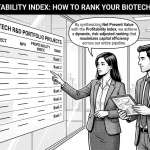
The rNPV method is the industry standard because it decouples technical risk from financial risk.3 Standard Discounted Cash Flow models attempt to capture the high risk of a biotech startup by inflating the discount rate to 50%, which is mathematically lazy.3 The rNPV uses a standard Weighted Average Cost of Capital (WACC) and weights each future cash flow by the probability that it occurs.3 This model sums the probability-weighted present values of all future cash flows.3
In this formula, $CF_t$ represents the net cash flow in period $t$, $P(Success_t)$ is the cumulative probability the project reaches period $t$, and $r$ is the discount rate for the systematic risk of the asset.4 The model is split into an investment phase for R&D costs and a commercial phase for revenues.4 The integrity of an rNPV valuation rests on the accuracy of Probability of Success assumptions grounded in empirical data stratified by therapeutic area.4
Why the 30-month stay is not a deadline
The 30-month stay acts as a provisional floor for the generic launch date.2 The FDA is legally barred from approving a generic until this stay expires or a district court rules in favor of the generic.2 The stay is rarely the final word.2 Paragraph IV certifications are filed a median of 5.2 years after brand approval, but the median time between stay expiration and actual launch is 3.2 years.2 Litigation or settlements often delay entry well past the statutory stay.2 For high-value drugs, courtroom outcomes and settlements matter more than clinical data.2
The 45-day litigation trigger
The brand company has a 45-day defense window after receiving a notice letter.1 Filing a patent infringement lawsuit within this window triggers the automatic 30-month stay on FDA approval.1 This stay protects the innovator monopoly while the court adjudicates the patent dispute.6 For the generic firm, the 180-day exclusivity period is the prize that justifies the expense of this litigation.6 Legal costs for a Paragraph IV challenge range from $1.5 million to $10 million per suit.6
The economic physics of generic entry
The severity of revenue erosion correlates with the intensity of generic competition.1 The initial entry of a single generic leads to a significant but contained price drop.1 As the number of competitors increases, pricing pressure intensifies dramatically, leading to a precipitous decline in price and brand market share.1
Number of Competitors
Price Decline Relative to Pre-Generic Price
1
Modest decline, often less than 20% 1
3
Approximately 20% decline 1
10 or more
70% to 80% decline 1
Multiple (>1)
50% to 80% decline in the first year 1
Branded drugs typically lose over 75% of their prescriptions in the three months following generic entry.7 This loss can exceed 80% in six months.7 Pravachol and Zoloft lost 80% of prescriptions within three weeks of generic entry.7 Allegra lost 80% after five weeks.7 First generic entrants price products 15-30% below the brand.8 Within 12 months, multiple generics drive prices down 50-80%.8 Brand products lose 80-90% of market share within one year of multiple generic entry.8
The 180-day exclusivity reward
The 180-day exclusivity period is the primary profit engine for the generic industry.9 Being the first filer allows a generic to price its product just below the brand, capturing hundreds of millions in margin before the price collapses.9 This window allows the first generic challenger to operate in a high-margin duopoly with the brand innovator.10 The first filer often captures up to 80% of the generic product’s lifetime profits during these six months.6 180-day exclusivity is triggered by the earlier of first commercial marketing or a court decision finding the patent invalid or not infringed.6
Authorized generic market dilution
Brand manufacturers use authorized generics (AG) to reduce the 180-day exclusivity prize.6 An AG is the brand drug sold under a generic label.11 Launching an AG transforms the exclusivity period from a duopoly into a three-player market.9 This can reduce first-filer revenue by more than 50%.6 Analysis shows that AG launches cause first-filer revenue to drop by 40-52% due to immediate price competition.9
Modeling the at-risk launch decision
An at-risk launch occurs when a generic manufacturer begins selling its product before patent litigation concludes.8 This decision reveals internal confidence in legal positions and risk tolerance.8 Generics that do not settle and receive FDA approval prior to a favorable district court decision launch at risk 100% of the time in certain data sets.12 The willingness to launch at risk correlates with the strength of non-infringement arguments and the financial capacity of the company.8
Damages in the Protonix and Tarka cases
The Protonix case demonstrates the substantial risks of at-risk launches.8 Teva and Sun launched generic versions of Protonix at risk in December 2007 and January 2008.8 A jury rejected their claims of invalidity in April 2010.8 The parties eventually settled for $2.15 billion in damages, one of the largest patent settlements in pharmaceutical history.8 This case shows how litigation data reveals early signals of generic confidence, even if courts ultimately disagree.8
In the Tarka case, Glenmark launched a generic version at risk in June 2010.8 A jury ruled against Glenmark and awarded $16 million in damages, with an additional $9 million potentially added for sales during the appeal.8 The smaller damages in Tarka reflect the smaller market size and demonstrate how economic factors influence at-risk launch decisions.8
Treble damages and lost profit calculations
Potential damages in pharmaceutical patent cases include lost profits for the brand manufacturer during the infringement period.8 Courts can also award reasonable royalties on generic sales.8 Enhanced damages for willful infringement can reach up to triple the lost profits.6 For a blockbuster drug generating $10 million in revenue per day, every day of delay represents a permanent loss of high-margin sales.6 At-risk generic launches often involve claims of lost profits, asserting the brand would have earned additional sales but for the infringement.13 In AstraZeneca v. Apotex, damages were assessed based on reasonable royalties alone.13 The district court found AstraZeneca entitled to 50% of Apotex’s gross margin on omeprazole sales from 2003 to 2007 as a reasonable royalty.13
Patent thickets as defensive moats
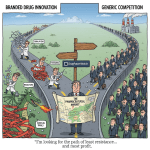
A patent thicket is a complicated, overlapping system of patents on one drug.14 These thickets cover composition, manufacturing processes, formulations, and indications.14 They prevent generics from entering the market due to the risk of infringement and high litigation costs.15 Brand manufacturers file numerous patents on the same product to create these barriers.15 This strategy builds layers of protection around a profitable drug, creating a fortress difficult and expensive for challengers to breach.16
The Humira case study in lifecycle management
AbbVie’s defense of Humira is the archetype of a patent thicket strategy.17 While the primary compound patent for adalimumab expired in 2016, AbbVie delayed biosimilar competition in the U.S. until 2023.17 The manufacturer created a thicket of over 100 patents on the formulation, manufacturing process, and delivery devices like auto-injectors.16 This delay in U.S. market entry resulted in an excess cost of $14.4 billion to the American healthcare system.16 AbbVie generated over $200 billion in cumulative sales by leveraging these patents.18
Secondary patents and evergreening tactics
Evergreening involves filing for new patents on minor modifications of old drugs to keep generic competitors away.16 These modifications include new dosages, release mechanisms, or combinations.16 Secondary patents protect subsequent modifications to the drug.16 While individually minor, they collectively form the building blocks of an evergreening strategy.16
Evergreening Tactic
Description
Example
New Formulations
Extended-release versions or time-release capsules 11
Adderall XR launched 4 months before immediate-release generic 16
Chiral Switch
Isolating and patenting a single enantiomer 16
AstraZeneca’s Nexium (esomeprazole) isolated from Prilosec 16
New Administration Routes
Orally dissolving tablets, patches, or inhaled versions 16
Switching from pill to capsule or pill to inhaled 14
Method of Use
Patents for new therapeutic uses discovered post-launch 11
Patenting a drug for Condition B after Condition A patent expires 19
Drug companies use product hopping to strategically discontinue a brand drug before generic entry and switch patients to a new, patent-protected version.14 A hard switch removes the original product from the market, while a soft switch markets the new version alongside the old.14 Copaxone’s manufacturer used product hopping to move patients to a newer version, costing consumers between $4.3 billion and $6.5 billion over 30 months before the secondary patent was invalidated.16
Regulatory shocks and the Inflation Reduction Act
The Inflation Reduction Act (IRA) of 2022 introduces provisions that disrupt the financial sustainability of the generic drug industry.20 The law grants the Centers for Medicare & Medicaid Services authority to set drug prices.21 These price controls reduce incentives for biopharmaceutical innovation and production.21 The IRA distinguishes between small-molecule drugs and biologics in its price-setting timeline.21
The nine-year small molecule negotiation window
Small-molecule drugs are eligible for price negotiation seven years after FDA approval, with prices taking effect at year nine.20 Biologics are allowed 13 years of market pricing before negotiation takes effect.20 This four-year discrepancy is the pill penalty.20 This discrepancy creates an economic disadvantage for small-molecule development.20 It disincentivizes investment in pills because the period of market-based returns is shorter than for biologics.20 Funding for small-molecule drug development declined by 70% after the IRA’s drug pricing provisions were first drafted in 2021.17
Impact on generic manufacturer ROI
The IRA undermines the generic drug market by forcing generics to compete with government-determined Maximum Fair Prices (MFP).20 This reduces the financial incentive for generic companies to enter the market.20 If MFPs are already deeply discounted by the time a generic could launch, the return on investment during market exclusivity is diminished.22 Lower brand drug prices reduce incentives for generic entry.20 Reduced brand market share from fewer brand indications further reduces generic entry incentives.20
“Phase II is the graveyard for most therapeutic areas. It is where weak biology and weak endpoints finally get exposed. Operational error often looks like ‘biology failure,’ where poor rater training or underpowered sample sizes erase a real treatment effect.” 3
The law’s pill penalty discriminates against small-molecule medicines, shifting investment away from them.22 This means fewer brand drugs will be developed and fewer generics will follow.22 The IRA’s disruption of the generics market will weaken supply chain resilience and increase the risk of disruptions in supply.22
The 2025 PTAB discretionary denial landscape
The Patent Trial and Appeal Board (PTAB) maintained discretion to deny institution of inter partes review (IPR) proceedings.23 In FY25, 1,433 petitions were filed, with 95% for IPR.24 Bio or pharma petitions accounted for 7% of the total.24 The percentage of petitions denied institution increased by at least 10% over the last five years, while final written decisions decreased by at least 10%.24
Settled expectations and the six-year rule
In 2025, the new administration implemented changes to the discretionary denial of IPR petitions.25 A major impact came from the settled expectations factor.25 This consideration looks at the length of time a challenged patent has been in force.26 In defining settled expectations, the USPTO indicated that the longer a patent has been in force, the more settled expectations should be.25 As of October 2025, 80% of petitions involving patents at least six years old were denied.25 Only 39% of petitions involving patents less than six years old were denied.25
Patent Age
Institution Denial Rate (2025 Data)
Less than 6 years
39% 25
6 years or older
80% 25
Acting Director Coke Morgan Stewart applied settled expectations to deny institution in iRhythm Technologies v. Welch Allyn.26 Although factors like trial dates weighed against denial, the patent’s length in force justified discretionary denial.26 In Dabico Airport Sols. v. AXA Powers, institution was denied because the patent had been in force almost eight years.26 This approach compares the settled expectations to the six-year statutory limit on damages for filing infringement lawsuits.26
The Stewart Memo and bifurcated process
On March 26, 2025, Acting Director Coke Morgan Stewart established a bifurcated process for IPR and post-grant review (PGR) proceedings.25 The first phase consists of discretionary considerations.26 The Director, with at least three PTAB judges, determines if discretionary denial is appropriate.26 Only if no discretionary basis is found is the petition referred to a three-member panel for the second phase of merits considerations.26 This shift redefined the framework for evaluating discretionary considerations and resulted in a significant reduction in the institution rate.25 The bifurcated process remained in place until October 2025, when the newly confirmed Director John Squires announced he would decide both discretionary and merits issues.25
Forensic auditing of the Orange Book
The Orange Book is the regulatory skeleton of generic competition.5 Brand manufacturers list patents in the Orange Book to trigger the 30-month stay.5 The FDA does not verify the accuracy of the information submitted by manufacturers.5 This allowed brand companies to populate the registry with patents that stretched the definition of a drug to secure billions in revenue through administrative friction.5
FTC delisting strategies for device patents
The Federal Trade Commission (FTC) scrutinized Orange Book-related practices and tactics that delay generic competition.28 In 2023, the FTC challenged more than 100 patents held by 10 companies, alleging they were improperly listed.28 In 2024, this list expanded to more than 300 listings.28 The FTC focused specifically on delisting medical device-related patents.29 These efforts led to the delisting of patents across 22 different brand-name products.28 In May 2025, the FTC issued warning letters challenging more than 200 patents, urging manufacturers to delist improper patents.28
The Federal Circuit ruling in Teva v. Amneal
In Teva v. Amneal, the Federal Circuit affirmed an order for Teva to delist device patents for an asthma inhaler.28 The court reasoned that a patent does not properly claim a drug without at least claiming the drug’s active ingredient.28 Teva requested the removal of more than 200 patent listings from the Orange Book in December 2025.5 This delisting affected over 30 different products, including treatments for asthma, diabetes, and COPD.5 The ability to identify which patents will fall determines the winners of the next decade in an industry facing a 350 billion dollar loss-of-exclusivity wave.5
The future of skinny labeling
Section viii of the Hatch-Waxman Act allows generic manufacturers to carve out patent-protected indications from their labels.19 This skinny label strategy lets generics market products for unpatented uses only.30 If a drug is approved for Condition A (off-patent) and Condition B (patented), the generic can launch labeled only for Condition A.19
Inducement risks in Hikma v. Amarin
The Federal Circuit’s decision in GSK v. Teva made the skinny labeling strategy more dangerous.31 In Hikma Pharmaceuticals v. Amarin Pharma, the Supreme Court is considering if a generic can face induced infringement liability even if they fully carve out patented uses.30 The petition challenges a decision that permitted inducement claims even when Hikma’s label omitted direct references to Amarin’s patented method.30 Hikma argues that allowing inducement liability based on generic labeling and reference to the brand product would nullify the statutory skinny label mechanism.30 The Supreme Court requested the Solicitor General’s views in June 2025, indicating potential cert-worthiness.30
Competitive intelligence as a profit driver
The function of competitive intelligence has transcended traditional boundaries to become the central nervous system of the biopharmaceutical enterprise.32 manual monitoring of millions of patents and regulatory filings is obsolete.32 Modern functions leverage agentic AI to execute tasks and synthesize disparate data points into coherent insights.32 This shift from static observation to dynamic simulation is critical as industry data indicates 56% of drug launches fail to meet pre-launch expectations.33
DrugPatentWatch allows strategists to perform deep analytics beyond simple expiration dates.33 It helps firms identify vulnerabilities by tracking patent expiration dates and litigation history to find white spaces in innovators’ defenses.6 Professionals use DrugPatentWatch to track NCE-1 milestones to ensure they are ready to file the moment the window opens.6 missing this window allows a competitor to park the exclusivity.6
CI Metric in 2026
Definition
ROI Impact
The Kill Metric
Providing data to terminate an internal program early 32
Avoided sunk costs in high-risk Phase II assets 32
Forecast Accuracy
Accuracy of competitor launch and erosion projections 32
Reduced volatility in portfolio valuation 32
Filing Velocity
Rate of new patent filings in specific technology clusters 11
Early warning of competitor lifecycle management shifts 11
Loss Avoidance
Preventing investment in areas with dense patent thickets 33
Capital preservation and R&D productivity 33
Companies implementing comprehensive patent intelligence strategies consistently outperform peers in R&D productivity and return on investment.33 DrugPatentWatch enables firms to decipher drug patent data into rigorous financial valuation.35 Curated and calculated patent expiry dates account for extensions like Patent Term Extension.35 Leveraging such platforms is a non-negotiable step in rigorous analysis because getting a date wrong by a single year can shift a multi-billion dollar valuation by 10 to 15 percent.34
Key Takeaways
The date of generic entry is a distribution rather than a single point on the calendar. Analysts relying on a single Orange Book patent expiration date fail to model the litigation drivers that determine market entry. In high-value markets, courtroom outcomes and settlements matter more than clinical data.
Risk-adjusted net present value is the gold standard for valuation. Models must decouple technical risk from financial risk and adjust cash flows by the probability of trial success and patent survival. Standard DCF models are inadequate for the discontinuous shock of a generic launch.
The prize of 180-day exclusivity captures up to 80% of a generic’s lifetime profit. First-to-file status on the NCE-1 date is mandatory to secure this prize. Authorized generics can reduce this revenue by more than 50% by diluting the duopoly.
At-risk launches carry massive financial liability. Settlements like the $2.15 billion Protonix deal highlight the cost of miscalculating patent strength. Damages can include lost profits for the brand and treble damages for willful infringement.
Patent thickets and evergreening tactics extend monopoly periods past the statutory 20-year term. Strategies like chiral switches, new formulations, and product hopping create layers of protection that are expensive to challenge.
The Inflation Reduction Act’s pill penalty shortens the market-based return window for small molecules to nine years. This has shifted R&D investment toward biologics and reduced funding for small-molecule drugs by 70%.
PTAB shifts in 2025 toward discretionary denials protect older patents. The settled expectations factor resulted in an 80% denial rate for patents at least six years old.
FTC delisting efforts are clearing improper device patents from the Orange Book. This prevents brands from using mechanical component patents to trigger 30-month stays and delay competition.
Skinny labeling is under legal threat in cases like Hikma v. Amarin. A ruling against generic manufacturers would effectively nullify the statutory mechanism for early market entry for unpatented uses.
Competitive intelligence is a profit driver. Using platforms like DrugPatentWatch to monitor NCE-1 milestones, litigation tracking, and white space analysis transforms raw patent data into a competitive advantage and defensible valuation.
FAQ
How does the 30-month stay impact generic approval?
When a brand manufacturer sues an ANDA applicant within 45 days of a Paragraph IV notice, the FDA is prohibited from granting final approval to the generic for 30 months. This stay preserves brand revenue while the court adjudicates the patent dispute.
What is the difference between a hard switch and a soft switch in product hopping?
A hard switch occurs when a drug company removes the original product from the market before generic entry, forcing patients to choose the new version. A soft switch leaves the original product on the market but focuses marketing on the new, patent-protected version.
Why is the NCE-1 date critical for generic manufacturers?
The NCE-1 date is exactly four years after the approval of a New Chemical Entity. It is the first day a generic can submit an ANDA with a Paragraph IV certification. Filing on this day is necessary to secure first-to-file status and the 180-day exclusivity reward.
How does the Inflation Reduction Act’s “pill penalty” affect the generic market?
The pill penalty allows government price negotiation for small-molecule drugs after 9 years, compared to 13 years for biologics. This reduces the revenue potential for brand drugs, which in turn reduces the financial incentive for generic manufacturers to develop competing versions.
What are “settled expectations” in PTAB litigation?
Settled expectations is a factor used by the PTAB to discretionarily deny petitions challenging older patents. The board assumes that the longer a patent has been in force, the more the owner has relied on its validity, making challenges to patents over six years old much more likely to be rejected.