As the global pharmaceutical sector traverses the turbulent landscape of 2026, the function of competitive intelligence (CI) has transcended its traditional boundaries. No longer a siloed support activity focused on quarterly earnings and conference coverage, CI has evolved into the central nervous system of the biopharmaceutical enterprise. This transformation is driven by a convergence of existential threats and unprecedented technological capabilities: the looming “patent super-cliff” threatening hundreds of billions in revenue, the aggressive price negotiation mandates of the Inflation Reduction Act (IRA), and the rapid maturation of agentic artificial intelligence (AI) capable of autonomous reasoning.1
In this new era, the distinction between market strategy, regulatory foresight, and R&D prioritization has dissolved. Executives are grappling with a complex matrix of variables where a single regulatory decision in Washington or a licensing deal in Shanghai can instantly alter the commercial viability of a multi-billion-dollar asset. The industry has moved from a state of “static observation” to “dynamic simulation,” where the primary deliverable is not a report, but a probabilistic forecast of competitor behavior under uncertainty.
This comprehensive report synthesizes data from over 200 sources to establish a rigorous framework for navigating the patent cliffs of 2026–2030, leveraging the next generation of AI tools, and mastering the art of high-stakes war gaming. By integrating deep second-order insights with granular operational data, this document serves as a blueprint for building an intelligence function capable of securing long-term dominance in a hyper-competitive market.
Chapter 1: The Strategic Crucible of 2026 – Macro-Trends and Existential Threats
The pharmaceutical industry in 2026 is defined by a “polycrisis” of expiring intellectual property, regulatory pricing pressure, and geopolitical fragmentation. Understanding these macro-forces is the prerequisite for any effective competitor analysis.
1.1 The “Super-Cliff”: Quantifying the 2026–2030 Revenue Erosion
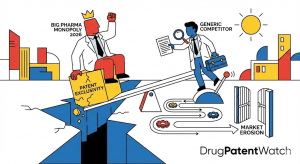
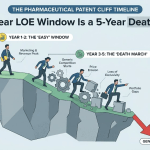
The industry is currently standing at the precipice of a “super-cliff” of patent expirations, a period of exclusivity loss that dwarfs the generic waves of the early 2010s. Between 2026 and 2030, a cluster of mega-blockbuster biologic and small-molecule assets will lose market exclusivity, placing approximately $180 billion to $400 billion in annual revenue at risk.2 This is not merely a financial correction; it is a structural upheaval that will force a redistribution of market share and catalyze a frantic wave of consolidation.
The Anatomy of Exposure
The sheer magnitude of the revenue at risk forces a re-evaluation of portfolio sustainability. Unlike previous cliffs, which were often concentrated in primary care small molecules (e.g., Lipitor), the 2026 super-cliff impacts complex biologics and specialized oncology therapies that form the bedrock of modern pharmaceutical profitability.
Table 1: Detailed Loss of Exclusivity (LOE) Forecast & Strategic Impact (2025–2029)
Drug Name (Brand)
Innovator
Primary Indication
2023/24 Sales (Est.)
Critical LOE Year (US)
Strategic Implication & Competitor Response
Keytruda (pembrolizumab)
Merck & Co.
Oncology (PD-1)
~$29.5B
2028
The largest LOE event in history. Merck is aggressively pivoting to a subcutaneous formulation (launching ~2026) to retain patient share before IV biosimilars flood the market.4
Eliquis (apixaban)
BMS / Pfizer
Anticoagulant
~$12.2B
2026–2029
Generic entry is staggered by settlements. Competitors in the Factor Xa class face pricing pressure as generic apixaban sets a new, lower floor.5
Stelara (ustekinumab)
J&J
Immunology
~$10.9B
2025–2026
A “price war” has already begun as PBMs leverage biosimilars to extract massive rebates. This signals the end of high-margin immunology dominance for older biologics.7
Opdivo (nivolumab)
BMS
Oncology (PD-1)
~$9.0B
2028
Following closely behind Keytruda, Opdivo’s erosion will reshape the immuno-oncology landscape, forcing BMS to rely heavily on its newer portfolio (e.g., cell therapies).8
Trulicity (dulaglutide)
Eli Lilly
Diabetes (GLP-1)
~$7.0B
2027
Facing double pressure: generic entry and obsolescence driven by superior dual/triple agonists (Mounjaro, Zepbound) from within its own house and competitors.6
Xarelto (rivaroxaban)
Bayer / J&J
Anticoagulant
~$4.5B
2026
Loss of exclusivity removes a key competitor to Eliquis, potentially accelerating the commoditization of the oral anticoagulant market.9
Strategic Responses: The “Defensive Innovation” Playbook
Competitor analysis in this environment requires dissecting how innovators attempt to delay or mitigate this erosion. The primary strategy observed in 2026 is “defensive innovation,” particularly the shift from intravenous (IV) to subcutaneous (SC) administration.
The Subcutaneous Shield: Merck’s strategy for Keytruda is the archetype. By launching a subcutaneous version (Keytruda SC) roughly two years before the IV patent expiration, they aim to switch a significant portion of the patient population to the more convenient form. Analysts project Keytruda SC could generate nearly $1 billion in 2026 alone, ramping to over $7 billion by 2032.4 For competitors developing biosimilars, this moves the goalposts: a biosimilar of the IV version is less valuable if the standard of care has shifted to the SC version. CI teams must track “conversion rates” of patients from IV to SC in real-time to assess the addressable market for biosimilars.
1.2 The Regulatory Vise: The Inflation Reduction Act (IRA)
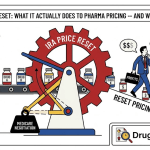
The Inflation Reduction Act has fundamentally altered the pricing algorithms of the industry. As of January 1, 2026, the “Maximum Fair Prices” (MFP) for the first ten drugs selected for Medicare negotiation have taken effect.10 This is no longer theoretical; it is a realized market constraint that ripples through every therapeutic class.
The “Negotiation Contagion” Effect
The impact of the IRA extends beyond the specific drugs negotiated. It creates a “negotiation contagion” that CI teams must model using game theory.
Price Compression in Classes: If a market leader like Eliquis or Xarelto has its price capped by the CMS, competing drugs in the same class (even if not selected) face immense pressure to lower their net prices to maintain formulary positioning. PBMs will use the MFP as a benchmark, effectively creating a price ceiling for the entire therapeutic category.3
The Small Molecule Penalty: The IRA’s differential treatment of small molecules (negotiable after 9 years) versus biologics (13 years) has distorted R&D incentives. Analysis suggests a chilling effect on small molecule investment, with capital flowing disproportionately toward biologics to capture the longer exclusivity window. CI teams are observing this in early-stage pipeline shifts, where competitors are prioritizing antibody-based modalities over oral small molecules for similar targets.11
The Biosimilar Paradox
A critical, counter-intuitive insight for 2026 is the “Biosimilar Paradox” created by the IRA. Historically, biosimilars thrived by offering a discount to the high-priced brand. However, if the brand’s price is already suppressed by government negotiation, the “spread” available for the biosimilar to undercut shrinks. Matrix Global Advisors estimates that this could lead to unrealized savings of billions, as biosimilar manufacturers may cancel programs that are no longer economically viable.3
Strategic Implication: When analyzing a competitor’s biosimilar pipeline, CI analysts must now factor in the reference product’s negotiation status. A biosimilar targeting a drug likely to be negotiated in 2027 carries a significantly higher risk profile than one targeting a non-negotiated biologic.
1.3 The Geopolitical Pivot: Innovation Sourcing from China
While Western markets face pricing headwinds, the source of innovation has shifted East. In the first half of 2025, U.S. firms completed 14 licensing deals worth $18.3 billion with Chinese biotechs—a staggering increase from just two deals in the same period of 2023.1
The “In-Licensing” Race: Global pharma leaders are aggressively in-licensing assets from China to fill revenue gaps. These assets often come with robust Phase I/II data and lower development costs. For CI teams, this necessitates a capability to monitor the Chinese biotech ecosystem—tracking assets in local registries and understanding the nuances of the National Medical Products Administration (NMPA) regulatory pathways.1
Competitor Signal: A competitor opening a business development office in Shanghai or engaging in multiple “option deals” with Chinese entities is a leading indicator of a strategy to externalize R&D risk.
Chapter 2: The Next-Generation Intelligence Architecture
The operational reality of CI in 2026 bears little resemblance to the practices of the early 2020s. The sheer volume of data—spanning millions of patents, clinical trial updates, and regulatory filings—has rendered manual monitoring obsolete. The modern CI function is built on a “hybrid intelligence” architecture that leverages Agentic AI.
2.1 From Passive Search to Agentic AI
The shift from “Generative AI” (which creates content) to “Agentic AI” (which executes tasks) is the defining technological leap of 2026.13 These AI agents do not merely answer questions; they function as autonomous analysts capable of pursuing complex goals.
The Agentic Workflow in Action
Consider a CI team tasked with monitoring a competitor’s oncology pipeline. In the past, this involved manual searches of ClinicalTrials.gov and PubMed. In 2026, an Agentic AI workflow operates as follows:
Goal Definition: The human analyst sets a goal: “Monitor Competitor X’s PD-1 inhibitor for any signs of delayed recruitment or safety signals.”
Autonomous Execution: The AI agent, utilizing Model Context Protocols (MCPs) to interact with external databases, continuously scans registry updates.15 It detects a subtle change: the “Estimated Completion Date” for a key Phase III trial has slipped by six months.
Cross-Referencing: The agent doesn’t just flag the delay. It autonomously searches investor transcripts for mentions of “enrollment challenges” and checks PubMed for recent publications from the principal investigators.
Synthesis: The agent synthesizes these disparate data points into a coherent insight: “Competitor X’s trial is likely delayed due to enrollment competition from a new standard-of-care entry, not just operational issues. Probability of launch in 2026 has dropped from 80% to 45%.”
Human Review: The analyst reviews this synthesized intelligence, verifies the sources, and elevates the strategic implication to leadership.16
2.2 The Tech Stack: Tool Selection in 2026
The vendor landscape has consolidated, with platforms differentiating based on their depth of data and AI integration. A comparative analysis of the leading tools reveals distinct strengths:
Table 2: Comparative Analysis of Top Pharmaceutical Intelligence Platforms (2026)
Platform
Core Strength
Ideal Use Case
Limitations
IQVIA
Commercial & Sales Data
Deep market share tracking, prescription (Rx) data analysis, and commercial forecasting.18
Can be expensive and complex for pure R&D intelligence; often requires separate modules.
Cortellis (Clarivate)
R&D & Regulatory Depth
“Gold standard” for pipeline tracking, regulatory milestones, and chemistry/patent data.20
User interface can be dense; legacy data structures sometimes make integration with modern AI tools challenging.
AlphaSense
Unstructured Text Search
Searching broker reports, earnings call transcripts, and expert network libraries.18
Lacks the structured, granular clinical trial data of Cortellis or Citeline.
Northern Light SinglePoint
Enterprise Knowledge Management
Aggregating internal and external data into a single “intelligence engine” for the whole enterprise.1
Primarily a platform for synthesis rather than a primary data generator itself.
Dataiku / Custom Agents
Bespoke AI Workflows
Building custom AI agents (e.g., using Python/LLMs) to monitor specific niche sites or automate unique workflows.16
Requires significant internal technical expertise to build and maintain.
2.3 Managing the “Hallucination” Risk
The deployment of AI in high-stakes environments introduces the risk of “hallucinations”—plausible but false information generated by LLMs. In pharma, a hallucinated adverse event report or patent expiration could lead to disastrous strategic errors.
Retrieval-Augmented Generation (RAG): The industry standard for mitigation is RAG. This architecture restricts the AI to answering questions only using information retrieved from a verified document set (e.g., downloaded FDA PDFs), preventing it from fabricating facts from its training data.21
Human-in-the-Loop (HITL) Verification: Protocols now mandate that any AI-generated insight impacting capital allocation (e.g., “The competitor has abandoned this indication”) must be verified by a human expert. The AI provides the “pointer,” but the human provides the “judgment”.22
Chapter 3: Advanced Competitive Methodologies – War Gaming 2.0
As the cadence of market change accelerates, static analysis fails. The industry has embraced “Competitive Simulations” (War Games) as the primary method for stress-testing strategy. These are no longer annual off-sites but continuous, rigorous exercises designed to generate actionable tactical plans.23
3.1 War Gaming 2.0: The Continuous Simulation Model
Traditional war games suffered from the “Monday Morning Problem”—teams would have great insights during the workshop but fail to implement them upon returning to their desks. The “War Gaming 2.0” model solves this by focusing on actionable outputs and continuous monitoring.23
The Methodology
Preparation (Pre-Lock): This phase uses the AI tools described in Chapter 2 to build a comprehensive “dossier” on the competitor. This includes not just product data, but behavioral profiles of their leadership (e.g., “Is the CEO risk-averse or aggressive?”).
The Workshop (Simulation): Teams are divided into “Home Team” and “Competitor Teams.” They engage in multiple rounds of moves and counter-moves.
Role Fidelity: Participants are often chosen for their past experience working at the competitor company to ensure psychological realism.25
Injects: The facilitator introduces “injects”—unexpected events that force teams to adapt.
Action Planning (Post-Lock): The workshop concludes with the creation of a “Battle Book”—a prioritized list of 3–5 specific actions (e.g., “Initiate a contracting strategy with PBMs X and Y immediately to block the competitor’s entry”).26
3.2 Developing High-Impact “Injects”
The quality of a war game depends on the realism of the “injects.” In 2026, these scenarios must reflect the complex macro-environment.
Table 3: Sample Pharmaceutical War Game Injects & Strategic Objectives
Scenario Theme
Sample Inject Narrative
Strategic Objective Tested
IRA Negotiation Shock
“CMS announces the selection of the Competitor’s drug for price negotiation two years earlier than expected due to a change in the selection algorithm.”
Test the resilience of the Home Team’s pricing strategy and contracting leverage if the market floor drops suddenly.
Cross-Border Disruption
“The Competitor announces a surprise licensing deal with a Chinese biotech for a Phase III asset that is bio-better than our lead candidate, with a launch timeline accelerated by 18 months.”
Assess the agility of the R&D and Business Development teams to pivot or acquire a counter-asset.1
Biosimilar Ambush
“A biosimilar manufacturer files an Inter Partes Review (IPR) successfully invalidating the Competitor’s key formulation patent, advancing generic entry by 3 years.”
Test the Commercial team’s readiness for a rapid loss of market value and erosion of the price anchor.7
AI-Driven Clinical Success
“The Competitor reveals they used an AI-driven patient finding algorithm to complete enrollment for their outcome study 12 months ahead of schedule.”
Evaluate the Medical Affairs team’s ability to accelerate their own timelines or differentiate based on data quality rather than speed.
3.3 Game Theory in Pricing Strategy
With the IRA and PBM consolidation, pricing is a classic game theory problem.
The Prisoner’s Dilemma of Rebates: In the immunology space (e.g., Stelara biosimilars), manufacturers face a dilemma. If everyone maintains high list prices and high rebates, the PBM system remains stable. If one player breaks ranks and offers a low-list-price / low-rebate product (like Cost Plus Drugs or specific biosimilar launches), they risk destabilizing the revenue model for everyone. CI teams must model the “payoffs” for each competitor to predict who will defect first.7
Chapter 4: The Intellectual Property Battlefield
In the era of the patent super-cliff, IP analysis is the bedrock of competitive intelligence. It is not enough to know when a patent expires; one must understand the “patent thicket” that surrounds the asset and the probability of it withstanding a challenge.
4.1 Advanced Patent Landscape Visualization
Communicating IP risks to non-legal executives requires sophisticated visualization. The “bar chart of patent counts” is useless in 2026. Instead, best practices involve:
Filing Velocity Heatmaps: Visualizing the rate of new patent filings in specific technology clusters (e.g., “mRNA delivery lipids”). A sudden spike in filing velocity by a competitor in a specific sub-field is a leading indicator of a strategic pivot, often visible 18 months before clinical trials begin.28
White Space Analysis: Using AI to map existing claims and identify “white spaces”—areas of the chemical or biological landscape that are unclaimed. This informs R&D where they can operate with “freedom to operate” (FTO) or where they can file blocking patents to box in a competitor.29
Quality Metrics: Utilizing “Patent Quality Scores” based on forward citations (how often the patent is cited by others) and family size (how many countries it is filed in). A competitor may have only five patents in a space, but if they are high-quality foundational patents, they pose a greater threat than 50 low-quality incremental patents.30
4.2 The “Thicket” Defense and Biosimilar Strategy
Biologic innovators continue to construct “patent thickets”—dense webs of secondary patents covering formulations, manufacturing processes, and delivery devices—to delay biosimilar entry.
The Humira Legacy: The defense of Humira (adalimumab) remains the case study for this strategy. AbbVie successfully delayed US biosimilar entry for years after the primary patent expired by enforcing hundreds of secondary patents. In 2026, companies like Merck (Keytruda) and BMS (Opdivo) are deploying similar strategies, filing specifically on subcutaneous formulations and dosing regimens.31
The Counter-Strategy: Biosimilar developers are becoming more aggressive with “skinny labeling” (carving out patent-protected indications) and challenging weak secondary patents via the IPR process. CI teams must monitor the litigation docket as closely as the clinical docket, as a single court ruling can shift a launch date by years.
4.3 Navigating Non-English IP
The rise of China as an innovation hub means that critical IP intelligence is often hidden in Chinese-language filings (CNIPA).
The Language Barrier: Relying on English translations of PCT filings often results in a 12-to-30-month lag in intelligence.
The AI Solution: Advanced CI teams use AI agents equipped with neural machine translation to monitor CNIPA and JPO (Japan) filings in real-time. This allows for the detection of novel compounds or platforms originating in Asia long before they appear in Western databases, providing a crucial “early warning” of emerging low-cost competitors.32
Chapter 5: Therapeutic Area Deep Dives – The 2026 Battlegrounds
The macro-trends and methodologies discussed above manifest differently across therapeutic areas. A granular analysis of three key battlegrounds illustrates the application of these principles.
5.1 The Obesity Market (GLP-1/GIP): From Duopoly to Crowded Field
By 2026, the obesity market has evolved from the Novo Nordisk/Eli Lilly duopoly into a fiercely competitive arena with multiple new entrants and modalities.
The Oral Frontier: The critical competitive pivot in 2026 is the transition from injectable to oral formulations. Lilly’s orforglipron (projected approval ~2026) represents a massive disruption. An oral, small-molecule GLP-1 removes the manufacturing bottleneck of sterile injectables and offers a lower price point. CI teams are intently focused on its tolerability profile (nausea/vomiting) compared to Novo’s oral semaglutide, as this will determine patient adherence and market share.34
Payer coverage: With obesity medications entering Medicare formularies, the battle has shifted to market access. CI analysis must track payer behavior—specifically, the implementation of “step edits” requiring patients to fail cheaper generic alternatives before accessing premium GLP-1s. The “game” here is predicting which manufacturer will offer the deepest discounts to secure “preferred” status.35
5.2 Oncology: The Post-Checkpoint Era
As the PD-1/L1 backbone therapies (Keytruda, Opdivo) approach their patent cliffs, the oncology market is defined by “lifecycle management” and the rise of Antibody-Drug Conjugates (ADCs).
Subcutaneous Races: The primary defensive strategy is the switch to subcutaneous (SC) administration. This is not just a convenience play; it is a “stickiness” play. By moving patients to an SC formulation (which takes minutes to administer versus hours for IV), innovators create a high barrier to switching for biosimilars, which will launch primarily as IV. CI teams track “conversion metrics”—the percentage of new starts initiated on SC versus IV—as the key indicator of portfolio durability.4
ADC Integration: The “next wave” is the integration of ADCs. Companies are racing to combine PD-1 inhibitors with ADCs to create new standards of care that extend patent protection through new combination patents. The CI focus is on the safety profiles of these combinations (e.g., interstitial lung disease rates) which often differentiate otherwise similar assets.36
5.3 Cell & Gene Therapy (CGT): The Manufacturing Bottleneck
In the CGT space, the primary competitive constraint is not biological, but industrial. Manufacturing capacity is the bottleneck.
Capacity Intelligence: CI in this sector involves tracking “steel in the ground.” A competitor reserving large-scale viral vector manufacturing capacity at a major CDMO is a stronger signal of an impending launch than a press release.
Process Analytics: The integration of real-time analytics in manufacturing is a competitive advantage. Companies that can use AI to optimize cell yields and reduce batch failures can significantly lower their Cost of Goods Sold (COGS). In a market where therapies cost millions, a 20% reduction in COGS provides massive pricing flexibility. CI teams monitor job postings for “process engineers” and “automation specialists” to gauge a competitor’s maturity in this domain.37
Chapter 6: Operationalizing Intelligence – Structure, Budget, and ROI
Building a world-class CI function requires more than just tools; it requires the right organizational design and a culture of accountability.
6.1 The Hybrid Team Structure
The “lone wolf” CI manager is extinct. The effective CI team of 2026 is a cross-functional unit.
Roles: The team includes Strategic Intelligence Leads (who synthesize insights and interface with leadership), Data Engineers (who maintain the AI pipelines and data lakes), and Prompt Engineers (who specialize in querying AI agents for maximum accuracy).
Integration: CI is no longer a sub-function of Marketing. It is often a standalone function reporting to the Chief Strategy Officer (CSO) or integrated into a “Commercial Operations & Strategy” hub that bridges R&D and Commercial. This ensures that intelligence reaches the R&D leadership (for early pipeline decisions) and the Commercial leadership (for launch tactics) simultaneously.13
6.2 Budgeting Benchmarks
Benchmarks for 2025–2026 indicate a shift in spending. While headcount growth is modest, investment in technology has surged.
Tech vs. Talent: High-performing organizations allocate approximately 40% of their CI budget to data subscriptions and AI platforms (e.g., IQVIA, Cortellis, Custom AI Agents), 40% to internal headcount, and 20% to external consulting (for specific war games or deep-dive projects).38
6.3 Measuring ROI: The Holy Grail
Demonstrating the value of CI is critical for sustaining budget. In 2026, ROI is measured through specific “avoided costs” and “revenue protection” metrics.
The “Kill” Metric: One of the highest-ROI activities for CI is providing the data to kill an internal program early. If CI identifies that a competitor is 2 years ahead with a superior asset, stopping the internal program saves tens of millions in futile R&D spend. This “avoided cost” is a direct contribution to the bottom line.39
Forecast Accuracy: CI teams are evaluated on the accuracy of their competitor forecasts. “Predicted vs. Actual” market share analysis is conducted quarterly to refine models. A CI function that accurately predicted a competitor’s supply chain failure (allowing the home team to capture share) can directly attribute that revenue gain to its intelligence.40
Automated Triggers (e.g., rapid repricing alerts); Continuous War Gaming loops.
Immediate market response; first-mover advantage in tactical skirmishes.
7.2 Advanced FAQ: Addressing the Hard Questions
Q1: How do we effectively monitor competitors who are also using “Agentic AI” to obscure their activities?
A: This is the emerging “counter-intelligence” challenge. Competitors using AI may file patents in obfuscated clusters or use AI to optimize trial sites to avoid detection. The counter-strategy is to monitor velocity and proxy signals. You may not see the AI, but you can see its effects: a sudden, unexplained acceleration in recruitment rates (implying AI-driven patient finding) or a rapid burst of patent filings in a previously dormant area. Analyzing the derivative of their activity (the rate of change) often reveals the hidden hand of AI acceleration.
Q2: With the IRA negotiating prices, does competitor pricing analysis still matter?
A: It matters more than ever, but the metric has changed. Tracking “List Price” (WAC) is increasingly irrelevant for negotiated drugs. The focus must shift to modeling Net Price and Gross-to-Net dynamics. For drugs not yet selected for negotiation, competitors may aggressively raise list prices to establish a higher baseline before the negotiation window opens. For selected drugs, the analysis shifts to “non-price” competition: analyzing their patient support programs, hub services, and bundling strategies, which become the primary levers for differentiation when price is fixed.
Q3: How do we validate AI-generated insights to prevent hallucinations in high-stakes decisions?
A: Implement a rigorous “Trust but Verify” Protocol.
Source Linking: Ensure your AI platform uses RAG (Retrieval-Augmented Generation) and provides direct hyperlinks to the source document (e.g., the specific FDA letter or patent PDF) for every claim.
Triangulation: Never rely on a single data point. An AI insight about a trial delay should be cross-referenced with investor transcripts, registry updates, and recruitment site data.
Human Gatekeepers: For any intelligence that triggers a strategic decision (e.g., “Kill project X”), a subject matter expert must manually review the primary sources. The AI is the scout; the human is the commander.
Q4: What is the best way to visualize patent landscapes for non-technical executives?
A: Abandon complex citation trees. Use Heat Maps that overlay “Technology Cluster” vs. “Revenue Risk.” Color-code the patent landscape not just by the number of patents, but by the dollar value of the drugs they protect. This immediately draws executive attention to the areas of highest financial exposure. Additionally, use Filing Velocity Charts to show momentum—executives understand “acceleration” as a proxy for competitor investment focus.28
Q5: How early should we start war gaming for a Loss of Exclusivity (LOE) event?
A: In 2026, the best practice is T-minus 5 years. The complexity of the IRA, the potential for pediatric exclusivity extensions, and the need to develop defensive formulations (like subcutaneous versions) requires a multi-year runway. Waiting until T-minus 2 years is essentially conceding the market to biosimilars. Early war gaming allows you to test long-term strategies, such as signing 5-year contracting deals with payers to lock in access across the LOE cliff.24
Conclusion: The Imperative of Foresight
The pharmaceutical industry of 2026 is unforgiving. The convergence of the patent super-cliff, the regulatory pricing vise, and the relentless pace of technological change has eliminated the margin for error. Competitive Intelligence is no longer a passive exercise in information gathering; it is the active pursuit of foresight.
By adopting the advanced methodologies outlined in this report—integrating Agentic AI, institutionalizing continuous war gaming, and mastering the nuances of the new IP and regulatory landscape—pharmaceutical leaders can do more than just survive the coming cliffs. They can transform volatility into advantage, securing their organization’s future in an era of unprecedented challenge. The tools are available; the mandate is clear. The only remaining variable is the will to execute.