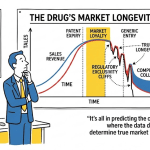
The pharmaceutical industry has a billion-dollar blind spot. Every year, revenue projections contain time bombs in the form of misread patent expiration dates. These dates are not single markers on a calendar; they are a cascade of overlapping intellectual property protections, regulatory exclusivities, and litigation settlements. Between 2025 and 2030, an estimated $200 billion to $400 billion in annual branded revenue is at risk as nearly 200 blockbuster drugs approach the end of their exclusivity.2 For a company with a blockbuster asset, the loss of market rights triggers an 80% to 90% revenue drop within the first year of generic competition.2
Business development professionals and intellectual property analysts use patent data as a leading indicator of these shifts. Litigation is not a legal sideshow; it is the primary engine of market valuation. When a generic manufacturer challenges a patent, investors recalibrate their cash flow models, pricing in the probability that market exclusivity will end sooner than expected. Identifying the signals of a settlement before the market reacts provides a significant competitive advantage.
Revenue erosion math
The value of a pharmaceutical company depends on the discounted sum of its future cash flows, which rely almost entirely on the legal strength of its patent portfolio. For a drug with annual sales exceeding $1 billion, the “patent cliff” is not a gentle slope. It is an abrupt decline. Branded drugs often lose 80% of their revenue within 12 months of facing generic or biosimilar competition. This erosion is tied to the intensity of competition and the regulatory structure of the Hatch-Waxman Act.
The mechanics of price collapse
Price erosion is a function of competitive density. The entry of a single generic competitor leads to a modest price drop, as the first-filer typically offers a 15% to 25% discount to capture market share while maintaining high margins. As more competitors enter, the pressure on pricing intensifies.
Number of Generic Entrants
Price Decline (Relative to Pre-Generic Price)
Market Share Erosion
1 (First-to-File)
20% – 40%
30% – 40% 7
2 Competitors
50% – 55%
50% – 60%
3 – 5 Competitors
60% – 70%
70% – 80% 7
10 or more Competitors
80% – 95%
90% – 98% 7
When six or more generic competitors enter the market, price erosion often exceeds 95%. This extreme commoditization makes the pursuit of the 180-day market exclusivity period the primary goal for generic manufacturers.7 This window allows a generic company to price its product just below the brand name, generating hundreds of millions of dollars in windfall profits before full-scale competition begins.7
Impact on mid-cap valuations
For mid-cap pharmaceutical firms with market capitalizations between $2 billion and $10 billion, revenue concentration makes patent challenges an existential threat. These companies often have one or two flagship assets that account for more than 70% of their total revenue.
Ticker
Company
Key Asset
Revenue Reliance (H1 2024)
EXEL
Exelixis
Cabometyx
~77%
NBIX
Neurocrine
Ingrezza
~$2.51B (FY 2025)
SUPN
Supernus
Trokendi XR
High (Historical)
In the case of Exelixis, its stock rose 8.6% in a single day after a court rejected a generic challenge to its “malate salt” patents, securing exclusivity through 2030. Conversely, a single year’s error in forecasting the loss of exclusivity date can shift a mid-cap company’s valuation by 10% to 15%.
Regulatory triggers for early entry
The legal framework of the Hatch-Waxman Act creates catalysts on a knowable schedule. The act balances the interests of drug innovators with the need for price competition. It allows generic manufacturers to file an Abbreviated New Drug Application (ANDA) by proving bioequivalence to the branded drug rather than repeating expensive clinical trials.11
The NCE-1 window
Innovators receive a five-year quiet period for New Chemical Entities (NCE), during which the FDA cannot accept an ANDA. If the generic application includes a Paragraph IV certification—claiming the brand’s patents are invalid or not infringed—the generic company can file after only four years.12 This date is the NCE-1 trigger. It channels all competitive pressure into a predictable event. Monitoring NCE-1 dates allows business development teams to identify when a drug is first vulnerable to a challenge.
The 30-month statutory shield
When an innovator receives a Paragraph IV notice, it has 45 days to file an infringement lawsuit.11 Filing this suit triggers an automatic 30-month stay of FDA approval for the generic product.12 This stay provides the brand company with a 2.5-year window of revenue certainty while the case proceeds through court.3 This statutory injunction requires no proof of patent validity or infringement to activate. For a drug with $1 billion in annual sales, this 30-month window represents $2.5 billion in protected revenue.
Paragraph IV success rates
The incentives for generic companies are high. A successful Paragraph IV challenge grants 180 days of generic market exclusivity.4 While innovators prevail in district courts on specific issues roughly 20% of the time, the success rate for generic challenges—including settlements and dropped cases—is approximately 76%.6
Phase of Litigation
Innovator Success Rate
Generic Success Rate
PTAB (IPR) Institution
38%
62%
Federal Circuit Reversal
19% – 27% (Affirmance: 73% – 81%)
Low
Final Court Resolution (1992-2002)
27%
73%
Orange Book listing warfare
The FDA Orange Book is the registry of patents that protect approved drugs and dictate the cash flow of the global pharmaceutical industry.15 Branded manufacturers often list multiple patents to create a “patent thicket,” making a challenge prohibitively complex and expensive.5 The number of patents per drug has tripled over the past two decades.
The device patent purge
A significant shift in 2024 and 2025 involved the Federal Trade Commission (FTC) targeting improper Orange Book listings.17 The FTC issued warning letters to companies for listing patents that cover only mechanical components—such as dose counters, inhaler springs, or epinephrine autoinjector mechanics—without claiming the active pharmaceutical ingredient (API).15
In the case of Teva v. Amneal, the U.S. Court of Appeals for the Federal Circuit affirmed that a patent must claim at least the active ingredient of the approved product to be listable in the Orange Book.17 This ruling led to a massive delisting event. In December 2025, Teva Pharmaceuticals requested the removal of more than 200 patent listings under FTC pressure.
Delisting as a market signal
The removal of a patent from the Orange Book is an early-warning signal for generic entry. Under “use it or lose it” rules, if a brand delists a patent, the first generic applicant must market their drug within 75 days or risk forfeiting their 180-day exclusivity. Delisting signals that the brand no longer believes the patent can withstand a challenge or that a settlement is imminent.
Patent Type
Status for Orange Book Listing
Active Pharmaceutical Ingredient (API)
Required
Drug Product / Finished Dosage Form
Permissible
Device Components (No API)
Improper 20
Manufacturing Intermediates
Improper
Distribution Software / Packaging
Improper
Settlement architecture shifts
Approximately 40% of all patent litigation cases are settled before trial. In the context of Hatch-Waxman, settlements are the primary method of case resolution. These agreements have shifted from direct cash payments, which often trigger antitrust scrutiny, to more complex commercial arrangements.11
The Revlimid case study
Celgene and Bristol Myers Squibb utilized a strategy known as “Litigate, Settle, Repeat” to manage the patent cliff for the cancer drug Revlimid (lenalidomide).18 The primary patent for Revlimid expired in 2019, but generic competition was delayed through 2022 and restricted through 2026.
The settlement architecture for Revlimid involved volume-limited licenses.18
Date
Event
Outcome
March 2022
First generic entry (Natco)
Volume limited to ~7% of the market
2022 – 2025
Phase 1 entry
Sequential entry with single-digit market caps 15
January 31, 2026
Full entry
Unlimited generic sales permitted 15
This volume-limited approach allows the brand company to avoid the “nuclear option” of at-risk generic launches while maintaining a substantial share of monopoly profits.18 Generic competitors accept these terms to avoid the risk of losing millions in legal fees on a patent thicket that included 206 filings and 117 granted patents.
The No-AG commitment
A common feature in settlements is the “No-Authorized Generic” (No-AG) commitment. An authorized generic is a product sold by the brand company under a different label, intended to compete with the first generic challenger during its 180-day exclusivity period.23 By agreeing not to launch an authorized generic, the brand effectively grants the generic challenger a duopoly. According to the FTC, agreements with compensation—including No-AG commitments—prohibit generic entry for nearly 17 months longer on average than agreements without payments.11
PBM economics and net price shifts
The Federal Trade Commission’s focus on lowering healthcare costs extends to pharmacy benefit managers (PBMs). A landmark 2026 settlement with Express Scripts is changing the foundational economics of the supply chain.27
The Express Scripts settlement
The FTC targeted the “rebate trap,” where PBMs favored high-list-price drugs over lower-priced versions to capture larger rebates.27 The 10-year settlement requires Express Scripts to overhaul its business practices.28
Prohibited Practice
Required Change
Favoring high-list-price drugs
Must stop favoring high-WAC drugs over lower-priced equivalents 27
Retaining rebates
Transition to “net price” model with flat service fees 27
Spread pricing
Eliminate spread in pharmacy reimbursement 27
Opaque reporting
Increase transparency through drug-level data for plan sponsors 27
This shift toward net pricing reduces the effectiveness of traditional rebate walls used by innovators to maintain market share after a generic launch. PBMs are now incentivized to actively promote biosimilars and low-cost generics, which will accelerate revenue erosion during the patent cliff.
Predictive litigation analytics
The convergence of big data and machine learning allows patent analysis to move from a subjective art to a predictive science. Judicial analytics tools can now predict case outcomes with up to 85% accuracy by analyzing patterns in judge rulings, motion grant rates, and jurisdictional tendencies.
Modeling judicial behavior
Algorithms analyze millions of global patent documents and court dockets to identify trends.34 Platforms like Lex Machina and Pre/Dicta score patent strength and quantify invalidity risk.6
Firms using these analytics report a 15% to 25% improvement in motion practice success and 10% to 20% increases in favorable settlements. For business development, these models assign a probability to early generic entry, allowing for more accurate valuation of pipeline assets.
Key predictive variables
To forecast litigation outcomes, predictive models use dozens of dynamic data points.6
Category
Variables / Features
Economic Factors
Drug’s annual sales, market value at risk
Patent-Intrinsic Factors
Patent family size, number of backward citations, type of patent (API vs. formulation) 6
Litigation-Contextual Factors
Jurisdiction (e.g., District of Delaware), assigned judge, law firm track record 6
Regulatory Status
Exclusivity type (NCE vs. Orphan), pediatric extensions
Drugs in the highest revenue brackets ($1 billion to $9.4 billion) have the highest likelihood of a challenge within the first year of eligibility. Conversely, drugs for smaller therapeutic classes or anti-infective properties are less likely to be targeted.
Valuation and the risk-adjusted NPV
The gold standard for valuing pharmaceutical assets is the Risk-Adjusted Net Present Value (rNPV) framework. This method decouples technical risk—the probability of trial failure—from financial risk.
The rNPV equation
The rNPV calculation adjusts expected cash flows based on the cumulative probability of reaching the commercial phase.
In this formula, $CF_t$ represents net cash flow, $P(Success_t)$ is the probability of success for a given phase, and $r$ is the discount rate. The probability of success from Phase I to approval is less than 14%, and for oncology, it drops to 3.4%.
Modeling the erosion curve
A common linear limitation of NPV is that it assumes a set path. Real Options Valuation (ROV) captures managerial flexibility, such as the option to abandon a drug, expand into new indications, or out-license the asset. When modeling the terminal value, analysts must factor in the intensity of generic competition. A blockbuster drug that has ten or more competitors will face a price decline of 70% to 80% relative to its pre-generic price.
Global enforcement trends
Litigation strategy is increasingly global. Action in one jurisdiction often foreshadows events in another. The introduction of the Unified Patent Court (UPC) in Europe has created a new front for pharmaceutical patent battles.38
The Unified Patent Court (UPC) impact
The UPC allows for central revocation of patents across multiple European countries in a single action.38 For generic and biosimilar makers, the UPC is a “powerful sword” to identify and clear blocking patents.38 In the case of Sanofi v. Amgen, the UPC revoked a patent after applying the problem-solution reasoning used by the European Patent Office (EPO).38 This signals that the UPC will closely scrutinize biologics patents for inventive step and sufficiency.38
China’s shrinking timelines
China has significantly reduced its patent examination timelines.40 By 2021, high-value patents were being processed in just 13.3 months.40 China also implemented a Patent Term Extension (PTE) mechanism for chemical drugs, biologics, and traditional medicines to compensate for regulatory review time.40 In early 2025, Chinese companies accounted for 42% of licensing deals with upfront payments over $50 million, up from only 5% in 2022.41
Strategic business development ROI
The average cost of bringing a single drug to market is an estimated $2.6 billion, including the cost of failed candidates.2 Given this massive investment, the ability to secure even six months of additional market exclusivity is worth hundreds of millions of dollars.43
ROI of patent intelligence automation
Automated patent intelligence tools provide a clear return on investment by reducing manual labor and avoiding catastrophic losses.43
ROI Category
Metric
Outcome
Financial ROI
NPV Uplift
AI acceleration of 6 months adds significant terminal value 43
Operational ROI
Cycle Time
Reduction in lead discovery from 4.5 years to 12 months 45
Scientific ROI
Hit Rates
AI-guided screening hit rates of 22% – 46% vs. 2% random 43
Cost Avoidance
Capital Freed
$8M – $12M freed by cutting batch release time by one week 46
By using platforms like DrugPatentWatch to monitor biweekly FDA lists of ANDA applications, business development teams can identify high-value drugs vulnerable to challenge and model the commercial value of potential litigation.13
The “Clinically Proven Effective” risk
A 2025 ruling by the Federal Circuit in Bayer v. Mylan highlighted a significant risk for biopharma companies.48 The court held that adding “clinically proven effective” language to patent claims does not make an otherwise obvious dosing regimen patentable.48 This approach carries risks if trial protocols are published before the patent application is filed.48
Companies are now advised to plan filings before any clinical disclosures and draft claims where efficacy metrics actually limit the composition or regimen rather than just reciting success.48 This shift in strategy is essential for insulating portfolios against global competition.49
Key Takeaways
The pharmaceutical patent cliff is a $400 billion revenue challenge that redefines the competitive landscape for the next five years. Success for business development professionals depends on transforming complex patent data into a predictive financial advantage. Monitoring NCE-1 dates and Paragraph IV filings provides the earliest signal that a drug’s monopoly is under attack.
Regulatory shifts, particularly the FTC’s purge of device patents from the Orange Book, are clearing the path for generic entry in high-volume categories like asthma and diabetes. The settlement architecture is also evolving, with volume-limited licenses and No-AG commitments replacing simple cash payments. These complex deals require sophisticated modeling to understand the true entry dates of generic competitors.
Predictive analytics and judicial modeling now allow firms to forecast litigation outcomes with high accuracy, enabling better capital allocation and risk management. For mid-cap firms, these insights are essential for survival, as revenue concentration makes every patent ruling a defining event for shareholder value.
FAQ
What is the “NCE-1” date, and why does it matter?
The NCE-1 date is the earliest day a generic manufacturer can file a Paragraph IV challenge against a drug approved as a New Chemical Entity. This occurs four years after the branded drug’s approval. It is a critical signal because it marks the start of potential litigation and the end of the innovator’s “quiet period.”
How do volume-limited settlements benefit brand-name companies?
Volume-limited settlements allow a brand to admit generic competition while strictly controlling their market share. This avoids a sudden revenue collapse (the patent cliff) and replaces it with a manageable decline (a slope). This was famously used to protect Revlimid revenues through 2026.
Why did the Federal Circuit order the delisting of inhaler patents in 2024?
In Teva v. Amneal, the court ruled that patents covering only the delivery device—like a dose counter—do not “claim the drug” because they do not recite the active pharmaceutical ingredient. Therefore, they do not meet the statutory requirements for listing in the Orange Book.
What is the impact of the Express Scripts settlement on generic entry?
The settlement forces PBMs to move to a “net price” model and stops them from favoring high-list-price drugs just to capture rebates. This removes the “rebate wall” that often blocks low-cost generics and biosimilars from entering the market, accelerating the revenue erosion of branded drugs.
How does rNPV differ from standard DCF in pharmaceutical valuation?
Standard DCF often uses high discount rates to account for risk, which can mathematically fail for binary events. rNPV decouples financial risk from technical risk by adjusting the expected cash flows based on the specific probability of a drug successfully passing each clinical phase or surviving a patent challenge.