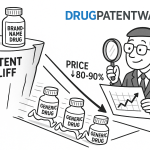
1. The Structural Economics of Generic Affordability
1.1 The Arithmetic Behind the 80-85% Discount
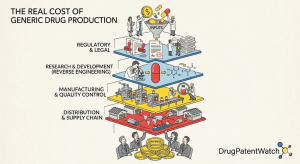
Generic drugs fill roughly 90% of U.S. prescriptions while accounting for 13-18% of total prescription drug spending. That ratio is not a market anomaly. It is the designed output of a regulatory framework that explicitly separates the cost of drug discovery from the cost of drug production.
The brand-name drug manufacturer spends $1-3 billion over 10-15 years to move a molecule from synthesis to approval. That expenditure covers thousands of failed compounds, multi-phase clinical trials across thousands of patients, and the regulatory submissions required to prove safety and efficacy for the first time. Patents and regulatory data exclusivity then grant the innovator a limited monopoly window, during which the company prices the drug to recover that sunk cost and generate the returns that fund the next discovery cycle.
When the relevant patent and exclusivity protections expire, a generic manufacturer enters the picture. It does not replicate the discovery process. It replicates the product. The FDA’s Abbreviated New Drug Application pathway, created under the Drug Price Competition and Patent Term Restoration Act of 1984 (the Hatch-Waxman Act), allows the generic applicant to rely entirely on the innovator’s established safety and efficacy record. The generic applicant’s job is to prove that its product delivers the same active pharmaceutical ingredient at the same rate and extent as the Reference Listed Drug (RLD). That proof, bioequivalence, costs a fraction of what the original clinical program cost.
Average generic drug development expenditure runs $2-10 million, depending on product complexity. For a standard oral solid targeting a molecule with a clean IP landscape, total ANDA development costs, including bioequivalence studies, regulatory fees, and formulation work, can stay below $5 million. Contrast that with a novel biologic NDA at $1-2 billion, and the structural source of the 80-85% discount becomes obvious. The generic manufacturer has eliminated the most expensive item in the pharmaceutical production budget.
1.2 The Bioequivalence Standard: What ’80-125%’ Actually Means
Bioequivalence is defined as the absence of a statistically significant difference in the rate and extent of absorption of the active ingredient between the generic (test) product and the RLD when administered at the same molar dose under the same conditions. The FDA evaluates bioequivalence using two primary pharmacokinetic parameters: AUC (area under the plasma concentration-time curve, representing total drug exposure) and Cmax (peak plasma concentration, representing absorption rate). Both must satisfy the same statistical criterion.
The criterion is the ’80-125% Rule’: the 90% confidence interval for the geometric mean ratio of the test-to-reference AUC and Cmax must fall entirely within 80.00-125.00%. This is a statistical boundary on the confidence interval, not a statement that individual generic doses can vary by 45%. A comprehensive analysis of approved bioequivalence studies found the mean difference in AUC between test and reference products was 3.5%. In practice, approved generics are pharmacokinetically nearly identical to their reference products.
The standard is deliberately asymmetric on a logarithmic scale: the 80% lower bound is equidistant from 100% on a log scale as the 125% upper bound (log 0.80 = -0.097, log 1.25 = +0.097). That symmetry is intentional. The regulatory design treats under-exposure and over-exposure as equivalent risks, which is the correct statistical posture for most systemic drugs.
For narrow therapeutic index (NTI) drugs, where the therapeutic window is tight enough that the standard 80-125% interval introduces meaningful clinical risk, the FDA requires tighter equivalence criteria. Products like tacrolimus, cyclosporine, warfarin, and levothyroxine fall under reference-scaled average bioequivalence (RSABE) methods or tighter fixed limits that effectively shrink the acceptable confidence interval. A 2023 FDA case study on levothyroxine (Synthroid) provided direct data on how reference-product switching affects patient outcomes, reinforcing the scientific rationale for NTI-specific standards.
Key Takeaways: Section 1
The fundamental cost advantage for generic manufacturers is the regulatory permission to skip preclinical and Phase I-III clinical programs, reducing development spend from $1-3 billion to $2-10 million. Bioequivalence studies, the primary remaining scientific hurdle, typically cost $500,000-$3 million per study. The 80-125% rule is a statistical confidence interval standard, not a product potency tolerance, and approved generics average 3.5% difference in AUC from their reference products.
2. API Cost Architecture: Chemistry, Geography, and Geopolitical Risk
2.1 API as the Primary Variable Cost
The active pharmaceutical ingredient is the largest and most volatile line item in a generic drug’s cost of goods sold. Its proportion of total manufacturing cost varies by product category: for simple oral solids with commodity APIs (metformin, lisinopril, simvastatin), the API may represent 25-40% of the cost of goods. For specialty APIs with complex synthesis routes (vancomycin, tacrolimus, certain oncology small molecules), the API can exceed 70% of total manufacturing cost.
API price is determined by synthesis complexity, raw material inputs, regulatory compliance burden, production scale, and the competitive structure of the supplier market. A molecule requiring a six-step synthesis with low-yield steps and expensive chiral reagents will cost orders of magnitude more per kilogram than a two-step synthesis from commodity petrochemicals. The number of approved API manufacturers for any given molecule also drives price: a molecule with two approved suppliers trades at a premium to one with twelve.
Synthesis complexity has a direct IP dimension. When an innovator company patents not just the active compound but specific synthesis routes, intermediates, or starting material specifications, generic API manufacturers must develop non-infringing synthetic routes before they can legally produce that API. That route development costs $500,000-$2 million per molecule and adds 12-24 months to the API qualification timeline. IP teams at generic companies conducting freedom-to-operate (FTO) analysis on a new ANDA target must include API synthesis route mapping as a step in that analysis, not just a review of Orange Book-listed product patents.
2.2 The China-India Axis: Cost Concentration and Its Consequences
The pharmaceutical industry’s offshoring of API production to China and India over the prior three decades was economically rational. Chinese chemical manufacturing infrastructure, built initially to serve agrochemical and industrial chemical markets, offered labor costs, precursor chemical availability, and environmental compliance cost structures that domestic manufacturers in the U.S., Germany, and Japan could not match. Indian generic companies absorbed that Chinese API output and converted it into finished dosage forms at competitive labor rates with growing regulatory sophistication.
The result: China now controls approximately 80% of global API supply for generic drugs, with India sourcing roughly two-thirds of its API requirements from Chinese manufacturers. More specifically, China dominates production of key starting materials (KSMs) and advanced intermediates, not just finished APIs. The distinction matters for supply chain risk analysis. A disruption to Chinese chemical production does not just affect Chinese API output; it affects the entire Indian generic manufacturing sector simultaneously, because Indian API producers share the same upstream dependency.
The U.S. is not insulated from this concentration. A Health Affairs analysis of the generic API supply chain found that for a substantial share of FDA-designated critical drugs, API production was concentrated at one or two foreign facilities. The FDA’s own shortage data shows that manufacturing and quality problems at single facilities trigger supply crises with predictable frequency.
Concentration creates a cost structure that is efficient in normal operating conditions and catastrophic when disrupted. The COVID-19 pandemic illustrated this: Indian export restrictions on paracetamol and its intermediates, enacted in March 2020, sent immediate price signals through the entire global generic supply chain. Companies that had been sourcing at spot prices suddenly faced supply gaps with no qualified backup supplier. The per-kilogram price of several critical APIs tripled within weeks before supply stabilized.
IP Valuation Sub-Section: API Supplier DMF as a Gatekeeper Asset
An API manufacturer’s Drug Master File (DMF), filed with the FDA under 21 CFR Parts 314 and 601, is the regulatory authorization that allows ANDA applicants to reference that supplier’s manufacturing process. A DMF is a proprietary asset: its contents are confidential to the supplier, and ANDA applicants must obtain a Letter of Authorization (LOA) from the DMF holder to reference it in their submission.
For a generic manufacturer, the availability of qualified, FDA-accepted DMFs for the target API is a critical pre-ANDA checklist item. Where only one or two suppliers hold active, inspection-compliant DMFs for a specific molecule, those suppliers hold significant commercial leverage. Their DMF is functionally an entry permit for the U.S. generic market for that molecule.
The FDA’s GDUFA fee schedule charges DMF holders $95,084 per DMF filing for FY2025. That fee, combined with the ongoing cost of maintaining an FDA-inspected API facility (domestic: $41,580/year; foreign: $56,580/year), creates a financial barrier that discourages small API suppliers from maintaining U.S. regulatory standing. The practical effect is that the set of FDA-compliant API suppliers for any given molecule is smaller than the raw global production capacity would suggest, which reinforces supply concentration risk.
Investors evaluating generic companies should treat active, inspection-compliant API DMF availability as a pipeline-level risk factor. A company citing a large ANDA pipeline should be able to demonstrate that qualified DMF holders exist for each target API, and that the company holds LOAs or supply agreements with those holders.
2.3 Raw Material Volatility: Petrochemicals, Energy, and Biosynthetic Precursors
Most small-molecule APIs trace their synthesis back to petrochemical feedstocks: benzene, toluene, xylene, and their derivatives form the precursor inputs for the majority of synthetic pharmaceutical chemistry. Crude oil price volatility therefore has a second-order effect on API prices, mediated through the cost of aromatic and aliphatic chemical precursors. When Brent crude moved from $40/bbl in late 2020 to $120/bbl in mid-2022, the cost of several critical synthesis precursors increased by 30-60% over the same period.
For fermentation-derived APIs (antibiotics, certain amino acid derivatives, some steroids), the relevant input costs are energy (for fermentation reactor operation), carbohydrate fermentation media, and downstream purification reagents. Energy cost increases in Europe following 2022 geopolitical events compressed margins for European API producers significantly, accelerating the competitive advantage of Chinese and Indian manufacturers whose energy costs remained lower.
The practical implication for generic manufacturers: API procurement is a commodity trading function that requires active market intelligence and forward contracting, not just periodic vendor RFPs. Companies that treat API sourcing as a once-a-year purchasing exercise rather than a continuous market management function are systematically exposed to input cost volatility that can compress margins below viability on specific products.
Key Takeaways: Section 2
API costs represent 25-70% of total generic drug cost of goods sold, depending on synthesis complexity. China controls approximately 80% of the global generic API supply chain, with most Indian generic manufacturers dependent on Chinese KSMs and intermediates. API DMF availability and FDA inspection compliance determine which suppliers a generic ANDA applicant can legally reference, creating gatekeeper leverage for qualified suppliers. Petrochemical input costs drive API synthesis costs with a 3-6 month lag, requiring active procurement management rather than static contracts.
Investment Strategy: Section 2
When evaluating generic company ANDA pipelines, analysts should ask: for each pending ANDA, how many active, FDA-compliant API DMF holders exist for the target molecule? Products with one or two DMF holders carry supply risk and margin squeeze risk simultaneously. Companies with proprietary API synthesis capabilities, or long-term supply agreements with multiple qualified API suppliers, carry a structural cost advantage that is not visible in standard P&L analysis.
3. The Formulation Layer: Excipients as a Strategic and IP Asset
3.1 What Excipients Actually Do
Excipients are every component of a finished drug product that is not the API. That definition covers a wide functional territory. Diluents (microcrystalline cellulose, lactose, mannitol, calcium phosphate) provide the physical bulk that allows accurate tablet manufacture. Binders (hydroxypropyl methylcellulose, polyvinylpyrrolidone, starch) provide granule and tablet cohesion. Disintegrants (croscarmellose sodium, sodium starch glycolate, crospovidone) control the rate and mechanism by which a solid dosage form disperses in the gastrointestinal tract. Lubricants (magnesium stearate, stearic acid, talc) prevent powder adhesion to punch faces during tableting. Coatings provide moisture protection, taste masking, UV protection, or modified drug release. Glidants improve powder flow for consistent tablet weight uniformity.
Each function affects the final product’s pharmacokinetic profile. Disintegrant selection and level directly control tablet dissolution rate, which in BCS Class I drugs (high solubility, high permeability) is rarely the rate-limiting step for absorption, but in BCS Class II drugs (low solubility, high permeability) can be the primary determinant of AUC. A formulation scientist who changes the disintegrant type or level in a BCS Class II product without running parallel dissolution testing is gambling with the bioequivalence profile of the final product. That bet can cost the company a complete response letter (CRL) at a cost of $2-5 million and 18-24 months in lost time.
The global pharmaceutical excipients market was valued at just over $9.3 billion in 2025 and is projected to reach $15.6 billion by 2034. That growth reflects both rising drug production volumes and the increasing technical complexity of dosage forms, as modified-release products, inhaled formulations, and injectables require more specialized excipient functionality than conventional oral tablets.
3.2 Excipient Selection as a Cost Management Lever
Because the API in a generic product is fixed by the bioequivalence requirement, the formulation, meaning the excipient blend, manufacturing process, and dosage form design, is where a generic manufacturer has its primary cost management freedom. Switching from a patented specialty excipient to a pharmacopeial-grade commodity equivalent can reduce per-unit material cost by $0.05-$0.30, which at high production volumes translates to millions of dollars annually. Selecting an excipient that improves powder flow reduces tablet press downtime and rejection rates, lowering manufacturing cost per batch. Choosing excipients compatible with high-speed wet granulation or direct compression reduces the number of processing steps and associated labor cost.
Excipient price volatility itself became a material risk factor after 2020. Between 2019 and 2021, prices for common pharmaceutical excipients including microcrystalline cellulose, magnesium stearate, and certain grades of HPMC increased by 30-40%, driven by energy cost increases in Chinese manufacturing, COVID-related logistics disruptions, and a surge in demand from vaccine and injectable drug production. For a generic manufacturer running 50 million tablets per month of a low-margin oral solid, a 35% increase in the cost of microcrystalline cellulose (typically 30-40% of tablet weight) directly compressed product-level gross margin by 3-5 percentage points.
3.3 Formulation IP: When Excipients Become a Competitive Moat
Excipient combinations and formulation processes can be patented, and for generic manufacturers this cuts both ways. An innovator company that patents a specific excipient blend, a co-processed excipient system, or a drug-excipient interaction that confers a therapeutic advantage creates a secondary IP barrier that a generic manufacturer must design around. Extended-release mechanisms built on proprietary matrix-forming polymer systems (osmotic pump tablets, erodible hydrophilic matrices using specific grades of HPMC) are frequently patent-protected independently of the active compound patent.
The generic formulation team’s job, when targeting such a product, is to develop an excipient system that achieves a matching dissolution and pharmacokinetic profile through a non-infringing mechanism. That work is genuine R&D, requiring dissolution method development, formulation screening studies, and iterative optimization against the RLD’s in vitro and in vivo performance. The cost of this de-formulation and re-formulation cycle is $500,000-$2 million for complex modified-release products, separate from the bioequivalence study cost.
The converse is also true: a generic manufacturer that develops a novel excipient system achieving superior manufacturing efficiency or stability, and patents that system, has created a formulation IP asset that raises barriers for subsequent generic entrants targeting the same molecule. Several large generics companies hold substantial formulation patent portfolios covering specific excipient combinations for their highest-volume products, which provides a degree of protection against commoditization even after multiple ANDA approvals target the same RLD.
Key Takeaways: Section 3
Excipients function as the pharmacokinetic engineering layer of a generic product; disintegrant selection for BCS Class II drugs can be the primary determinant of bioequivalence success or failure. Excipient cost management is a primary formulation R&D objective, with commodity substitution generating $0.05-$0.30 per unit savings at high production scale. Innovator companies frequently patent modified-release excipient systems independent of the API patent, creating secondary IP barriers that require non-infringing formulation engineering to clear. Excipient price volatility of 30-40% is achievable over 24-month cycles, requiring active input cost monitoring and multi-supplier qualification.
4. Manufacturing Quality Costs: The COQ Framework Applied to Generics
4.1 What cGMP Actually Costs
The term ‘cGMP compliance’ is regularly cited as a cost driver in generic drug economics. What is less regularly specified is what that compliance actually requires in dollar terms and how those costs distribute across the production operation.
The FDA enforces current good manufacturing practices for finished pharmaceuticals under 21 CFR Parts 210 and 211. The ‘current’ qualifier is not rhetorical: it signals that the regulatory standard evolves with technology, meaning a facility operating paper batch records and manual HPLC data review while a validated electronic batch record system is the industry standard is technically exposed to GMP deficiency findings even if its products have never failed release testing. The FDA’s 2018 guidance on data integrity made the expectation explicit: electronic data systems require 21 CFR Part 11-compliant audit trails, and paper-only systems for computerized instrument data are not acceptable in 2026.
A 2017 FDA regulatory impact analysis estimated that a medium-sized pharmaceutical firm (20-500 employees) spends approximately $184,000 annually on cGMP compliance activities at the system-maintenance level, not including the cost of major capital improvements, process validation campaigns, or remediation of inspection findings. For a large multi-site manufacturer, facility-level quality system operating costs run $5-20 million per site annually, covering quality control laboratory operations, stability program management, batch disposition activities, and regulatory inspection preparation. Quality control laboratory operations alone (analytical testing of raw materials, in-process controls, and finished product release) account for more than 20% of total production cost for many generic manufacturers.
4.2 The Cost of Quality Framework: Prevention vs. Failure
The Cost of Quality (COQ) methodology, formalized by the American Society for Quality, divides quality-related expenditure into four categories: prevention costs, appraisal costs, internal failure costs, and external failure costs. The first two constitute the Cost of Good Quality (COGQ). The latter two constitute the Cost of Poor Quality (COPQ).
Prevention costs include process design, validation studies, equipment qualification, cGMP training programs, and quality management system infrastructure. These are upfront investments made to prevent defects from occurring. Appraisal costs include incoming raw material testing, in-process sampling and analysis, finished product release testing, and regulatory audit preparation. These are the ongoing verification activities that confirm product quality before distribution.
Internal failure costs include batch rejections, rework operations, investigations into out-of-specification (OOS) results, and the direct cost of destroyed non-conforming product. External failure costs include product recalls, field alert reports, regulatory penalties, and litigation. These represent failure that has already reached the distribution system or the patient.
Pharmaceutical sector estimates of COPQ (internal plus external failure costs) range from 25-40% of annual turnover for companies with poorly developed quality cultures, compared to 3-8% for companies with mature, proactive quality management systems. A single product recall, depending on product volume and market penetration, can cost $10-$500 million in direct costs (product destruction, logistics, customer credits), entirely apart from regulatory remediation costs and reputational consequences. The economics are straightforward: a company that invests an additional $10 million per year in prevention and appraisal activities and thereby reduces its internal failure rate by 50% can eliminate $30-100 million in annual COPQ. The return on quality investment is not marginal.
IP Valuation Sub-Section: cGMP Compliance Status as a Manufacturing Asset Metric
In M&A transactions involving generic manufacturers, the cGMP compliance status of manufacturing facilities is a first-order due diligence item with direct asset valuation implications. A site holding an active FDA registration with no outstanding Warning Letters, no pending consent decree obligations, and a clean multi-year inspection record carries a premium to a site with deferred remediation obligations or an active enforcement relationship with the FDA.
The premium is calculable in revenue terms. A facility under FDA import ban cannot supply the U.S. market. During the remediation and reinstatement timeline, which typically runs 18-36 months from Warning Letter issuance to import ban resolution, the facility’s U.S. revenue contribution goes to zero. For a facility that represents 40% of a company’s U.S. ANDA portfolio revenue, the present value of that revenue gap, discounted at a pharma-sector WACC of 10-12%, is a material reduction in enterprise value.
Acquirers in generic manufacturer M&A transactions should demand: a comprehensive list of FDA Form 483 observations issued to target facilities in the prior five years, the status of responses to those observations, copies of any Warning Letters, and the cGMP consultant’s assessment of remediation completeness. A target company that resists providing this documentation should be treated as carrying undisclosed regulatory liability.
4.3 The Capital Investment Imperative for Quality Infrastructure
Generic manufacturers operating on 15-20% gross margins face a structural challenge in funding the capital investments that quality improvement requires. Validated electronic batch record systems, certified pharmaceutical cleanrooms, continuous environmental monitoring infrastructure, and modern analytical laboratory equipment all require capital outlays of $5-50 million per facility that are difficult to justify against the per-unit economics of commodity generics.
The consequence is documented: the FDA’s own analysis of drug shortage root causes identifies manufacturing quality failures at single-source facilities as the primary supply disruption mechanism. The underlying cause of those manufacturing quality failures is frequently deferred capital investment. Facilities operating with aging HVAC systems, legacy data systems, and out-of-calibration equipment generate more GMP deviations per batch, more OOS results, and more Form 483 findings per inspection than facilities that have sustained infrastructure investment.
The Advanced Manufacturing Technologies (AMT) program at the FDA’s Center for Drug Evaluation and Research was created partly to address this: by providing regulatory pathways and technical support for manufacturers adopting continuous manufacturing, process analytical technology (PAT), and real-time release testing (RTRt), the FDA is attempting to simultaneously improve quality and reduce per-unit production costs at facilities that would otherwise have insufficient margin to fund quality upgrades. Manufacturers that have adopted continuous manufacturing with integrated PAT sensors report 20-40% reductions in per-batch quality control testing cost and a material reduction in OOS investigation frequency.
Key Takeaways: Section 4
Annual cGMP system maintenance costs run $184,000 for medium-sized firms and $5-20 million per site for large manufacturers. COPQ in poorly managed pharmaceutical operations can reach 25-40% of turnover. Every dollar invested in prevention and appraisal typically eliminates $3-10 in internal and external failure costs. FDA import bans on non-compliant facilities eliminate that facility’s U.S. revenue contribution for 18-36 months, with direct enterprise value consequences. Continuous manufacturing with PAT integration reduces per-batch quality costs by 20-40% while simultaneously reducing GMP deviation frequency.
5. Packaging and Labeling: Scale Economics and Regulatory Liability
5.1 Primary and Secondary Packaging Cost Drivers
Primary packaging, the container in direct contact with the drug product, ranges from HDPE bottles to aluminum blister foil-PVC laminate to Type I borosilicate glass vials. Material selection is a technical decision driven by the drug product’s stability requirements: moisture-sensitive APIs require low-water vapor transmission rate (WVTR) packaging. Light-sensitive APIs require amber glass or opaque polymer containers. Oxygen-sensitive APIs require packaging with oxygen barrier properties or nitrogen purge protocols.
Each material specification carries a cost. High-barrier foil blister packaging (aluminum-aluminum cold-form blister) costs roughly 3-5 times more per unit than standard PVC-foil blister, but may be the only viable option for hygroscopic drugs. The cost differential must be evaluated against the cost of inadequate barrier properties: a stability failure attributable to moisture ingress can force a shelf-life reduction or a formulation change, both of which require additional regulatory submissions and generate delays. Regulatory stability commitments in an ANDA specify the packaging configuration under which the approved shelf-life applies. Substituting a cheaper package component without prior FDA approval via a Changes Being Effected (CBE) or Prior Approval Supplement (PAS) filing is a compliance violation, not a cost optimization.
The scale economics of packaging are severe. Custom-printed secondary packaging (cartons, package inserts) has significant setup costs, whether for offset printing plates or digital printing. At 10,000-unit production runs, per-unit packaging material costs can exceed $1.00. At 10 million units, the same packaging can cost $0.02-0.05 per unit. This scale effect creates a competitive dynamic that disadvantages small-volume generic launches: a company entering a market with an initial volume forecast of 100,000 units faces packaging economics that fundamentally differ from an established manufacturer producing 50 million units of the same drug annually.
5.2 Labeling as Regulatory Document: The Compliance Cost of Getting It Wrong
Pharmaceutical labeling is a regulatory document, not a marketing artifact. FDA-approved labeling specifies the exact text, format, and placement of all information on the container label, carton, and package insert, including indication language, dosage instructions, contraindications, warning statements, and storage conditions. Labeling for an ANDA must match the RLD labeling with only the specific differences permitted under 21 CFR 314.94(a)(8): omission of indications or conditions of use protected by patents or exclusivities, and differences required by the generic applicant’s different product characteristics.
When the FDA requires labeling revisions as part of a post-market safety action, all approved ANDA holders for that molecule must implement the change on a defined timeline or face enforcement action. Managing a labeling revision across a portfolio of 50 ANDAs requires coordinated regulatory submissions, inventory management to exhaust old-labeled stock or quarantine it for relabeling, and reprinting across potentially dozens of package configurations. Large generic companies dedicate entire regulatory teams to ongoing labeling revision management.
Labeling errors, from a typographic error in a dosing table to an out-of-date warning statement, can render manufactured batches non-distributable, requiring physical relabeling operations at a cost of $50,000-500,000 per batch depending on batch size, label complexity, and the scope of the correction required.
Key Takeaways: Section 5
Primary packaging material selection is technically constrained by drug stability requirements; cost optimization within those constraints requires documented stability data supporting any material substitution. Per-unit packaging costs at 10,000 units can be 20-50 times higher than at 10 million units, making initial launch volume forecasting a packaging economics decision as much as a market access one. Labeling management across a large ANDA portfolio is a material ongoing compliance cost that scales with portfolio size and FDA post-market safety action frequency.
6. GDUFA User Fees: The Full Fiscal Picture for FY2025
6.1 The GDUFA Architecture and Its Strategic Logic
The Generic Drug User Fee Amendments, first enacted in 2012 and currently operating under the GDUFA III reauthorization, fund the FDA’s Office of Generic Drugs review operations through direct fees on ANDA applicants and manufacturing facility operators. Before GDUFA, the Office of Generic Drugs operated exclusively on congressional appropriations, generating a review backlog that reached 2,900 applications and a median approval timeline of 28 months by the early 2010s. GDUFA’s fee stream allowed the FDA to hire approximately 1,400 additional reviewers and reduce median standard ANDA approval time to roughly 14 months.
The fee structure has three components: application fees (paid per ANDA submission and per Drug Master File), facility fees (paid annually per manufacturing facility registered with the FDA), and program fees (paid annually by each ANDA applicant company, scaled by company size).
GDUFA III FY2025 Fee Schedule
Fee Category
Sub-Category
FY2025 Amount (USD)
Application
ANDA (new)
$321,920
Application
Drug Master File
$95,084
Facility – Annual
API, Domestic
$41,580
Facility – Annual
API, Foreign
$56,580
Facility – Annual
Finished Dosage Form, Domestic
$231,952
Facility – Annual
Finished Dosage Form, Foreign
$246,952
Facility – Annual
Contract Manufacturing Org., Domestic
$55,668
Facility – Annual
Contract Manufacturing Org., Foreign
$70,668
Program Fee
Large Size Operation
$1,891,664
Program Fee
Medium Size Operation
$756,666
Program Fee
Small Business
$189,166
Source: FDA Federal Register Notice, Generic Drug User Fee Rates for Fiscal Year 2025
6.2 The Strategic Interpretation of GDUFA Fees
A large generic company with 10 pending ANDA submissions, three FDF manufacturing facilities (two foreign, one domestic), two API facilities (both foreign), and large-size program status faces the following annual GDUFA commitment: $3,219,200 in ANDA fees, $493,904 in facility fees, and $1,891,664 in program fees. Total annual GDUFA liability: approximately $5.6 million. That is before any DMF filing fees for API suppliers.
For the right product, that cost is immaterial. A company that files a first-to-file Paragraph IV ANDA on a drug with $4 billion in annual U.S. revenues and achieves 180-day market exclusivity generates $500 million-$1 billion in exclusivity-period revenue. Against that figure, $5.6 million in GDUFA fees is rounding error. For a small company with a narrow portfolio targeting low-revenue molecules, the same $5.6 million is a potentially non-viable overhead that forces portfolio prioritization.
GDUFA’s real cost is not the fee schedule. It is what the fee schedule implies about the minimum viable scale for a U.S. generic drug business. A company needs sufficient ANDA revenue to absorb both the program fee and the per-application costs and still generate a positive return on its portfolio. That minimum viable scale has risen with each GDUFA reauthorization, accelerating industry consolidation toward larger companies with broader portfolios.
GDUFA III also introduced completeness assessments: the FDA now performs a completeness check before the 90-day filing date, and applications with deficiencies are rejected as incomplete, not filed. A rejected ANDA returns the application fee minus a $15,000 administrative processing charge. The completeness assessment was intended to reduce garbage-in submissions that wasted reviewer time. Its effect has been to put additional pre-submission burden on applicants, who must invest more rigorously in application quality before submission to avoid fee forfeiture.
Key Takeaways: Section 6
GDUFA III program fees for large companies reach $1.9 million annually, with per-ANDA submission fees at $321,920. A large generic company filing 10 ANDAs per year across three FDF facilities faces $5-6 million in annual FDA user fee obligations. GDUFA’s completeness assessment requirement effectively raises the minimum quality bar for ANDA submissions, penalizing inadequate pre-submission investment with fee forfeiture. The fee structure’s scale structure accelerates consolidation by creating fixed cost overheads that disadvantage small single-ANDA players.
7. Paragraph IV Litigation: Cost Mechanics and Return on Investment
7.1 What a Paragraph IV Challenge Actually Costs
When a generic company files an ANDA containing a Paragraph IV certification, asserting that one or more Orange Book-listed patents are invalid, unenforceable, or not infringed, it must notify the patent holder within 20 days of the FDA’s filing acknowledgment. The patent holder has 45 days to sue for infringement. If it sues, the FDA cannot issue final ANDA approval for 30 months from the date the patent holder received the notice. That automatic 30-month stay is the mechanism that makes Paragraph IV litigation so costly and consequential: the generic challenger sits on an approved but unlaunched product while the litigation runs.
The American Intellectual Property Law Association’s survey data places the median cost of a patent infringement case with more than $25 million at risk at approximately $4 million through trial and appeal. Specific analyses of Hatch-Waxman litigation cluster the average cost range at $2.7-4.5 million per case. That range is per defendant, per patent case. A generic challenging a brand with 12 Orange Book-listed patents and eight patent holders may face multiple parallel cases or sequential litigation waves.
Legal fees, however, are a fraction of the total economic cost of a Paragraph IV challenge. The opportunity cost of the 30-month stay on approval is frequently larger. If a generic’s market entry is delayed by 24 months because the 30-month stay runs its full course before a court ruling, the lost revenue during that delay period, calculated at the market entry price the generic would have captured, represents the true economic cost of the litigation delay. For a drug with $2 billion in annual U.S. revenues and a projected 40% generic market share at a 20% brand price, each delayed month costs the generic challenger approximately $13 million in lost revenue opportunity.
7.2 The Asymmetric Stakes: Brand vs. Generic
Academic analysis of the economics of Paragraph IV litigation has quantified the asymmetry between brand-name and generic challengers’ stakes. The average economic exposure for the brand-name company in a Paragraph IV case has been estimated at $4.3 billion, reflecting the present value of revenues lost to early generic entry if the patent is invalidated. The average stake for the generic challenger has been estimated at $204.3 million, reflecting the revenue opportunity from early market entry plus first-to-file exclusivity.
That 21:1 asymmetry in stakes does not mean the brand company will always spend more on litigation, but it does mean the brand company has a greater financial interest in prolonging litigation, filing continuation patents mid-case to introduce new infringement theories, or negotiating settlements that limit generic entry timing. Generic challengers, by contrast, are trading a capped litigation cost against an expected value calculation based on the probability of winning and the revenue benefit of early entry. With Paragraph IV challengers prevailing in over 75% of cases that go to judgment (though many settle before judgment), the expected value calculation has historically supported filing challenges on most large-market drugs with commercially vulnerable patent portfolios.
IP Valuation Sub-Section: Quantifying the 180-Day Exclusivity Asset
The 180-day market exclusivity period granted to the first Paragraph IV filer that either prevails in litigation or is not sued within 45 days is the most financially consequential asset in the U.S. generic drug market. Its value varies by market size, the number of potential ANDA applicants waiting to enter, and the speed of price erosion after exclusivity ends.
A first-filer entering a market with $5 billion in annual brand revenues can expect to capture 40-55% market share at a price 20-30% below brand during the exclusivity window. At $5 billion annual brand revenue, that translates to roughly $200-330 million in exclusivity-period quarterly revenue for the first-filer, assuming the exclusivity window begins promptly after litigation resolution or 30-month stay expiration.
Three variables determine the precise exclusivity asset value: the brand revenue base at time of generic entry (eroded by patient switching to other therapies or step therapy changes), the number of ANDA applicants waiting for the first-filer exclusivity to expire (determining the speed and depth of post-exclusivity price erosion), and whether the brand company launches an authorized generic (AG) during the exclusivity window. As analyzed in the previous article in this series, AG deployment during the exclusivity window reduces first-filer revenue by approximately 40-50%.
For investors evaluating generic companies with pending Paragraph IV litigation, the 180-day exclusivity asset should be modeled as a probability-weighted net present value incorporating: win probability (baseline 75% for first-filers based on historical data, adjusted for specific patent strength assessment), timing risk (30-month stay extension versus early settlement resolution), AG deployment probability, and post-exclusivity erosion rate by ANDA applicant count.
Key Takeaways: Section 7
Total Paragraph IV litigation costs run $2.7-4.5 million per case, but the opportunity cost of a 30-month stay on a drug with $2 billion in annual revenues can exceed $13 million per delayed month. Brand companies face an average $4.3 billion economic stake per Paragraph IV case; generic challengers face a $204.3 million average stake. First-filers prevail in over 75% of cases that reach judgment. The 180-day exclusivity asset on a $5 billion annual revenue market is worth $200-330 million in exclusivity-period revenue before adjustments for AG deployment and timing risk.
Investment Strategy: Section 7
Analysts covering generic companies should build a Paragraph IV litigation tracker for each pending case in the portfolio company’s pipeline, covering: filing date, 30-month stay expiration date, litigation status (pre-trial, post-trial, appeal), win probability assessment from patent counsel, brand revenue at stake, number of co-pending ANDA applicants for the same product, and known or probable AG deployment intent by the brand company. This tracker converts the litigation pipeline from a qualitative narrative into a probability-weighted NPV schedule with defined catalysts.
8. Pay-for-Delay Settlements: The FTC v. Actavis Decade in Review
8.1 The Mechanics of Reverse Payment Settlements
A pay-for-delay (reverse payment) settlement, in its canonical form, involves the brand-name patent holder paying the generic challenger to dismiss its Paragraph IV challenge and agree to delay market entry until a future agreed date, typically some time before the patent’s natural expiry. The payment flows in the opposite direction from a normal litigation settlement: the defendant (generic) receives money from the plaintiff (brand). The FTC’s term ‘reverse payment’ captures this structural inversion.
The economic rationale for both parties is transparent. The brand company faces a 75% probability that its patent will be invalidated at trial. A judgment of invalidity destroys the monopoly profit stream that funded the patent portfolio in the first place. Paying the generic challenger a sum below the value of the monopoly profits preserved eliminates the litigation risk entirely. The generic company receives a guaranteed payment exceeding its expected litigation ROI while also securing a defined, risk-free entry date that provides planning certainty.
The FTC has characterized these settlements as costing American consumers and taxpayers $3.5 billion annually in elevated drug prices. That estimate reflects the differential between the price patients pay under delayed generic entry versus the lower price achievable under immediate competitive entry. The FTC’s analysis of individual cases supports that order of magnitude: for high-revenue drugs with delayed generic entry timelines of 3-7 years, the per-consumer cost of the settlement is calculable and substantial.
8.2 FTC v. Actavis: The Legal Framework and Its Practical Effect
The Supreme Court’s 2013 decision in FTC v. Actavis (formally Federal Trade Commission v. Actavis, Inc., 570 U.S. 136) established that reverse payment settlements are not immune from antitrust scrutiny simply because the agreed delay period falls within the patent’s remaining term. The Court applied the ‘rule of reason’ standard, under which the settlement’s anticompetitive effects must be weighed against its procompetitive justifications. A large, unjustified reverse payment is itself evidence of the patent’s weakness, the Court held, because a company with a strong patent would litigate to enforce it rather than pay a challenger to stay out of the market.
The case involved AndroGel (testosterone gel 1%), where Solvay Pharmaceuticals had paid Paddock Laboratories, Par Pharmaceutical, and Watson Pharmaceuticals to delay their generic entries. AbbVie acquired Solvay in 2010 and continued defending the settlement arrangements. The FTC’s enforcement action against AbbVie and the AndroGel settlements ran from 2017 through a settlement in 2023, during which AbbVie executed a product-hopping strategy to shift the AndroGel patient base to a new 1.62% concentration formulation before the original 1% formulation faced generic competition.
IP Valuation Sub-Section: AndroGel’s Product Hop and the Value of Transition IP
AbbVie’s product-hopping strategy on AndroGel is textbook lifecycle management. The original 1% testosterone gel, approved in 2000, generated peak annual U.S. revenues exceeding $1 billion. As the Paragraph IV challenges to the underlying patents resolved and generic entry became inevitable, AbbVie launched AndroGel 1.62% in 2011, a formulation requiring a lower application volume per dose. AbbVie then shifted its detail force entirely to the 1.62% formulation and allowed sampling and promotional support for the 1% formulation to fall to zero.
The transition IP driving this strategy was a combination of a new NDA for the 1.62% formulation (conferring 3 years of new clinical investigation exclusivity under Hatch-Waxman), a new set of Orange Book-listed patents covering the 1.62% formulation, and formulary dynamics that made switching cost-effective for pharmacy benefit managers. By the time generic 1% testosterone gel entered the market, the prescription base had migrated substantially to 1.62%, and the first-entry generic faced a market that was much smaller than the historical peak-revenue figure suggested.
For IP teams assessing the defensibility of a product facing Paragraph IV challenges, the AndroGel transition model demonstrates that product-hopping is not just a delay tactic; it is a revenue preservation strategy when executed with sufficient advance planning and investment. The key inputs are: a sufficiently differentiated new formulation that prescribers accept as clinically preferable, new Orange Book-listable patents covering that formulation, and a regulatory timeline that allows the transition to be substantially complete before first generic entry on the original product.
The counter-strategy for generic manufacturers is to file ANDAs on both formulations simultaneously, pursue Paragraph IV challenges on both patent sets in parallel, and plan market entry on both at the same time, eliminating the revenue refuge the brand company is building.
8.3 Post-Actavis Settlement Landscape
Actavis made overt large cash reverse payments less common but did not eliminate reverse payment economics. Settlements now more frequently take the form of ‘non-monetary’ consideration: supply agreements where the brand company supplies the generic with product for resale (an authorized generic arrangement during the Paragraph IV exclusivity window), co-promotion agreements, or royalty-bearing patent licenses that allow generic entry at a premium price point rather than commodity pricing. The FTC and private plaintiffs have brought cases challenging these structures as functional equivalents of the cash reverse payments that Actavis addressed.
The settlement landscape in 2025-2026 has been further complicated by the Inflation Reduction Act’s drug price negotiation provisions, which alter the revenue calculations that drive settlement economics for Medicare Part D products. When the government can now negotiate price caps on high-cost brand drugs, the net present value of delayed generic entry changes for both parties, potentially shifting the settlement range in ways that affect both the generic’s negotiating leverage and the brand’s willingness to pay for delay.
Key Takeaways: Section 8
Reverse payment settlements cost U.S. consumers an estimated $3.5 billion annually in above-market drug prices, per the FTC. FTC v. Actavis (2013) established rule-of-reason antitrust scrutiny for large reverse payments but did not eliminate non-monetary equivalent settlement structures. AbbVie’s AndroGel product-hop demonstrates how lifecycle management via new formulation NDA and Orange Book patent migration can substantially reduce the revenue impact of first generic entry. Generic manufacturers should model product-hop risk when forecasting exclusivity-period revenue for ANDAs targeting products with active lifecycle management programs.
9. The Price Erosion Curve: Market Competition as the Dominant Pricing Variable
9.1 The Mechanics of Multi-Competitor Price Erosion
The relationship between the number of generic competitors for a single drug and the price per unit is one of the most consistent empirical patterns in pharmaceutical economics. It is steep, predictable, and largely irreversible once multiple entrants are established.
The first generic entrant, often operating under 180-day first-to-file exclusivity, competes only against the brand-name product, not other generics. In that window, the generic can price at 20-30% below brand and still capture most of the cost-sensitive prescription volume. Average price reduction at first generic entry: approximately 39% below brand price. The first entrant’s gross margins during exclusivity frequently reach 60-80% on high-revenue molecules.
After exclusivity ends, the second through sixth competitors enter simultaneously or in rapid succession. Each entrant needs market share to cover its ANDA development, regulatory, and manufacturing costs. The only available lever is price. Average price with two competitors: 54% below brand. With four competitors: 69% below brand. With six or more: 95% below brand. Studies using IQVIA transaction data from multiple time periods have confirmed that this erosion pattern has been stable across 2007-2011 and 2016-2019 market entry cohorts; the competitive dynamics have not changed despite consolidation at the manufacturer level.
Generic Price Erosion by Competitor Count
Competitor Count
Average Price vs. Brand (%)
Average Discount from Brand (%)
1 (first generic)
61%
39%
2
46%
54%
3
39%
61%
4
31%
69%
5
27%
73%
6+
5% or less
95%+
Source: HHS ASPE Drug Competition Series; FDA Office of Generic Drugs data; Association for Accessible Medicines
The implication for generic business models is that the entire revenue story for a given molecule concentrates in the first 6-18 months after launch. An oral solid with 10 ANDA approvals pending at the time of first generic entry will reach full commodity pricing within a year. The manufacturer that captures the first-filer exclusivity window captures the only period of elevated margins that product will ever see.
9.2 Portfolio Economics: Managing the Lifecycle Across Multiple ANDAs
Because individual products go through a rapid margin erosion cycle, generic drug companies with large ANDA portfolios must manage the aggregate portfolio as a pipeline of time-limited revenue opportunities, continuously replenished by new first-to-file challenges and complex generic launches. The portfolio strategy requires maintaining a sufficient volume of ANDAs in different lifecycle stages: some in exclusivity providing high-margin revenue, some in the early competitive phase providing moderate margins, and a large base of commodity products generating low-margin volume revenue that absorbs manufacturing overhead.
Companies that have concentrated their ANDA portfolios in oral solid commodities with 10+ competitor markets are essentially operating price-taker businesses with minimal pricing power and exposure to any cost increase that cannot be offset by scale. Companies that have invested in first-to-file Paragraph IV strategies and complex generic development maintain margin by continuously refreshing the high-margin early-lifecycle portion of their portfolio.
The correlation between R&D investment in complex generics and litigation strategy on the one hand, and long-run portfolio gross margin on the other, is well-established among the top-10 generic manufacturers. Companies in the top quartile for ANDA-weighted gross margin systematically have higher proportions of first-to-file exclusivity products and complex generics in their revenue mix than companies in the bottom quartile.
Key Takeaways: Section 9
Price erosion from brand level reaches 95%+ when six or more generic competitors are active, a pattern stable across multiple market entry cohorts. First-to-file exclusivity captures the only elevated-margin window in a generic product’s lifecycle, making Paragraph IV challenge success the primary portfolio gross margin driver. Companies with high proportions of first-to-file exclusivity products and complex generics in their revenue mix systematically outperform commodity oral solid players on portfolio gross margin.
Investment Strategy: Section 9
In evaluating generic company revenue quality, analysts should stratify ANDA portfolio revenue by lifecycle stage: exclusivity-period revenue (highest margin, time-limited), early competitive market revenue (1-4 competitors, moderate margin), and mature commodity market revenue (6+ competitors, minimal margin). A company whose reported gross margin is concentrated in exclusivity-period revenue faces a cliff risk when those products enter the commodity phase without replacement from new first-filers or complex launches. Revenue quality analysis requires the pipeline stage breakdown, not just the total ANDA count.
10. Supply Chain Intermediaries: Where the Savings Go
10.1 The Generic Drug Intermediary Paradox
Generic drug manufacturing has achieved extraordinary cost efficiency at the factory gate. At six or more competitors, the price of a standard oral solid generic can reach $0.01-0.05 per tablet. That is the price the manufacturer receives. The price a patient without insurance pays at the pharmacy counter can be $20-$150 for the same quantity of the same product. The gap between factory gate and consumer purchase price is not explained by logistics costs. It is explained by the economic structure of pharmaceutical distribution.
Three drug wholesale distributors (AmerisourceBergen, now Cencora, Cardinal Health, and McKesson) collectively handle approximately 90% of U.S. pharmaceutical distribution. Three pharmacy benefit managers (CVS Caremark, Express Scripts under Cigna, and OptumRx under UnitedHealth) collectively manage pharmacy benefits for the majority of commercially insured Americans. Their respective market positions are oligopolistic in the technical economics sense: each faces limited competitive pressure from the small number of direct alternatives.
Data on generic drug supply chain value capture shows that manufacturers retain only approximately 36% of the total revenue generated by a generic prescription. The remaining 64% is distributed across wholesalers, pharmacies, and PBMs. For comparison, brand-name drug manufacturers retain approximately 76% of the revenue on a brand prescription. The inversion is striking: the companies that make the lowest-cost drugs capture the smallest share of the consumer spending those drugs generate.
10.2 Spread Pricing: The PBM Margin Mechanism for Generics
Spread pricing is the primary mechanism through which PBMs extract margin on generic drugs. In a spread pricing arrangement, the PBM reimburses the dispensing pharmacy at one rate and charges the health plan (its client) a higher rate for the same prescription, retaining the difference. The pharmacy and the health plan are each unaware of what the other party is paying or being charged, because PBM contract terms with both parties are proprietary.
The spread is not modest. A 2018 Ohio Medicaid audit by Navigant identified an average spread of 31.4% on generic drug prescriptions, costing Ohio taxpayers $208 million in a single year on those prescriptions. Individual product-level spreads can be orders of magnitude larger. The Association for Accessible Medicines documented the omeprazole example: the manufacturer’s average manufacturer price (AMP) for a standard quantity was $0.90. The consumer cash price at the pharmacy counter could reach $74, a markup of more than 8,000%.
That omeprazole example is extreme, involving the cash market where no insurance adjusts the retail price. But even within the insured market, PBM-negotiated pharmacy reimbursement rates frequently exceed the actual acquisition cost of a generic product by multiples, and the plan is billed the same inflated reimbursement rate. The mechanism works because neither the health plan nor the pharmacy typically has visibility into the full chain of prices, and PBM contracts with both parties include confidentiality provisions that prevent either from using price disclosure as a negotiating tool.
Estimated Generic Drug Revenue Distribution by Supply Chain Participant
Participant
Approximate Revenue Share (%)
Primary Margin Mechanism
Manufacturer
36%
Low-cost production, scale
Wholesaler
Variable, est. 40%+ gross margin on generics
Distribution logistics, inventory financing
Pharmacy
Variable, est. 35%+ gross margin on generics
Dispensing fee plus ingredient cost markup
PBM
Variable, est. 50%+ gross margin via spread
Spread pricing, retained administrative fees
Source: USC Schaeffer Center analysis; HHS ASPE pharmaceutical supply chain intermediary margins report (2024); Commonwealth Fund PBM explainer
10.3 Copay Clawbacks and the Patient-Level Impact
A second PBM margin practice with direct patient impact is the copay clawback. When a patient’s insurance copay for a generic drug is higher than the price the PBM reimburses the pharmacy for that drug, the PBM contractually requires the pharmacy to remit the excess to the PBM. The patient pays more than the drug costs, the pharmacy passes the overpayment to the PBM, and the PBM retains it as margin.
Copay clawbacks were common enough by 2018-2020 that several states passed ‘anti-clawback’ legislation prohibiting PBMs from preventing pharmacists from telling patients that paying out-of-pocket would cost less than using their insurance. The practice illustrated that a patient could in some cases reduce their out-of-pocket cost by not using their insurance benefit on a generic prescription, a counterintuitive outcome that revealed the depth of the pricing inversion created by PBM contract structures.
Key Takeaways: Section 10
Generic drug manufacturers capture only 36% of consumer spending on their products; the remaining 64% flows to distributors, pharmacies, and PBMs. Spread pricing by PBMs can generate markups on individual generic products exceeding 8,000% from AMP to consumer cash price, with typical insured-market spreads documented at 30%+ by state Medicaid audits. Copay clawbacks allow PBMs to capture the difference when a patient’s insurance copay exceeds the actual drug acquisition cost. Reducing the retail cost of generics to patients requires PBM market structure reform, not further manufacturing cost reduction.
Investment Strategy: Section 10
For investors in pharmacy benefit manager stocks, the structural advantage on generic drug margin is the inverse of the manufacturer’s margin challenge: PBMs generate higher gross margins on cheap generics than on expensive brands. Any regulatory action reducing PBM spread pricing transparency requirements is a direct PBM earnings risk. State anti-clawback laws, currently enacted in 40+ states, and federal transparency legislation pending in Congress as of 2026 represent the primary regulatory risk to PBM generic drug profitability.
11. Geopolitical Headwinds: Tariffs, Reshoring, and the Cost of Resilience
11.1 The Tariff Arithmetic for Generic Drug Inputs
Pharmaceutical tariff policy accelerated materially after 2018 under Section 301 actions targeting Chinese imports. APIs, KSMs, and pharmaceutical intermediates sourced from China fell under various tariff schedules, with some categories subject to 25% import duties. Under executive orders issued in 2025 as part of a broader pharmaceutical national security review, additional tariff actions on finished pharmaceutical products and API imports were proposed or implemented, with potential rates reaching 25% on certain imported pharmaceutical categories.
A 25% tariff on pharmaceutical inputs sourced from China translates to a roughly 10-14% increase in consumer-level drug prices for affected products, based on modeling by several trade economics groups and pharmaceutical industry analysts. That estimate assumes manufacturers absorb the tariff cost and pass it through at market prices. In the generic market, where manufacturers face multi-year formulary contracts with PBMs and pharmacy chain purchasing agreements at fixed or formula-based prices, the ability to pass through input cost increases is severely constrained in the near term.
The practical short-term effect: tariff cost increases on Chinese-sourced inputs compress generic manufacturer gross margins by 5-15 percentage points on affected products, depending on the Chinese input share in the product’s cost structure. For commodity oral solids already running 10-15% gross margins, a 10-percentage-point compression is existential. The rational response is product discontinuation, which is exactly what several specialty chemical and API manufacturers announced following 2018-2019 tariff escalations.
11.2 Reshoring Economics: Why Domestic Manufacturing Costs More
The political and strategic appeal of domestic pharmaceutical manufacturing is clear. The economic barriers to achieving it at scale are equally clear. The cost differentials that drove API manufacturing to China and India in the first place have not disappeared:
U.S. manufacturing labor costs for pharmaceutical production workers average $35-55/hour in wages and benefits. Chinese API production labor costs are approximately $8-15/hour at equivalent skill levels. Indian API production labor costs are $5-12/hour. Even accounting for automation, a modern U.S. greenfield API plant has a higher labor cost floor that is not fully offset by productivity advantages.
Environmental compliance costs for chemical synthesis operations in the U.S. are substantially higher than in China or India. Solvent waste treatment, air emission controls, and wastewater management requirements under EPA regulations add $20-50 per kilogram of API produced relative to Chinese manufacturing cost structures that have historically operated under less stringent enforcement.
Capital construction costs for a new API manufacturing facility in the U.S. are $200-500 million for a mid-scale plant capable of producing 50-100 APIs, depending on chemistry complexity and scale. The timeline from site selection to first commercial production approval is typically 5-7 years, including construction, equipment qualification, process validation, and FDA inspection and approval. That is 5-7 years of capital deployed without revenue, during which existing low-cost offshore supply continues to serve the market.
Federal incentives have helped at the margin. The CARES Act, passed in 2020, included $1.5 billion for domestic drug manufacturing investment. The Bipartisan Infrastructure Law and subsequent manufacturing-focused legislation added additional incentives. But the total federal investment in pharmaceutical reshoring through 2025 is well below the capital required to replicate the scale of Chinese or Indian API production infrastructure that has been built over four decades.
11.3 The Hybrid Resilience Model
A viable middle path between pure offshore cost optimization and full domestic reshoring is a tiered supply architecture that reserves domestic or near-shore (Mexico, Canada, Caribbean) production for the most shortage-prone and strategically critical medicines, while continuing to source standard-volume commodity APIs from the most cost-competitive global suppliers with active redundancy programs.
The FDA’s Essential Medicines List and the draft National Drug Shortage Prevention Plan both point toward this structure. The practical implementation requires defining which products merit the premium cost of diversified or domestic supply, accepting that some portion of the generic drug portfolio will carry a higher cost structure than the pure offshore model, and incorporating that cost differential into pricing strategy and formulary negotiations.
For manufacturers willing to invest in domestic API capability, the competitive advantage is not price, it is supply security. A company that can guarantee domestic sourcing for shortage-prone sterile injectables can negotiate premium pricing with hospital systems and government purchasers that are willing to pay above commodity price for reliable supply. The trade-off between price optimization and supply security is, at the system level, a decision about how much the healthcare system values resilience relative to cost minimization.
Key Takeaways: Section 11
A 25% tariff on Chinese pharmaceutical inputs increases consumer-level drug prices by an estimated 10-14%, with generic manufacturers absorbing 5-15 percentage points of gross margin compression in the short term before contract repricing. U.S. API manufacturing labor costs are $35-55/hour versus $5-15/hour in Asian markets; full reshoring of commodity API production to domestic manufacturing is not economically viable without sustained price premium acceptance by the healthcare system. A tiered supply architecture reserving domestic or near-shore production for shortage-critical molecules while maintaining offshore sourcing for commodities offers a viable resilience-cost balance that the pure domestic manufacturing mandate does not.
12. The Drug Shortage Paradox: When Price-Minimization Destroys Supply
12.1 The Economics of the Shortage Cycle
Drug shortages in the U.S. are concentrated in a specific product category: older, off-patent sterile injectables, including chemotherapy agents (cisplatin, doxorubicin, vincristine), anesthetics (propofol, ketamine, lidocaine), and electrolytes (sodium bicarbonate, potassium chloride). These are not obscure specialty products; they are fundamental to routine hospital operations, cancer treatment, and emergency medicine. Their shortage status is not explained by inadequate manufacturing technology or insufficient global capacity. It is explained by the economics of sustained price erosion beyond the margin required to sustain quality manufacturing.
A 2022 study found that 44% of sterile injectable drugs in shortage at the time of analysis had a market price below $5 per unit. When the price of a sterile injectable vial is $1-3, the per-unit contribution to covering manufacturing overhead, quality control, and regulatory compliance costs is minimal. Sterile injectable manufacturing is capital-intensive (cleanroom infrastructure, aseptic fill-finish lines, terminal sterilization validation) and labor-intensive (aseptic technique training, environmental monitoring, batch disposition documentation). The economics of producing a $2 vial at a facility that costs $40 million per year to operate require volume that the concentrated purchaser environment for hospital injectables may not sustain.
When margins go negative or approach zero, manufacturers exit the market. The FDA’s shortage tracking database documents this pattern: when one of the two or three remaining manufacturers of a critical injectable experiences a GMP-related production halt, there is no reserve capacity to cover the gap. The shortage begins immediately and can persist for 12-24 months while the affected manufacturer remediates or a new entrant qualifies.
12.2 The Healthcare System Cost of Shortages
Drug shortages are not free. The Office of Health Economics (OHE) and HHS ASPE have both published analyses documenting the system-level costs of pharmaceutical shortages. These include: the pharmacist and nursing time cost of shortage management (identifying alternatives, documenting therapeutic substitutions, counseling patients on changes), the premium price cost of emergency procurement from grey-market suppliers that hoard and resell scarce products at markups of 1,000-5,000%, the patient safety cost of medication errors when clinical staff are unfamiliar with substitute drugs, and the outcome cost when therapeutic substitutes are less effective than the shortage product.
HHS estimates that a major drug shortage event (defined as affecting a product with widespread hospital use) generates $2-5 million in direct management and procurement premium costs per hospital system per shortage year. Across a hospital network of 50 facilities, a single major shortage event costs $100-250 million in documented direct costs. The healthcare system, in aggregate, spends substantially more managing the consequences of drug shortages than the investment required to maintain quality manufacturing capacity at higher price points would have cost.
12.3 Structural Solutions: Shared Utilities, QSEHRA, and Advanced Manufacturing Incentives
Several policy mechanisms have been proposed or partially implemented to address the shortage-economics cycle. The FDA’s Critical Drug Shortage Prevention and Access Act provisions allow the FDA to designate certain products as ‘critical medications’ subject to enhanced manufacturer reporting and contingency supply requirements, providing advance notice of potential shortages. The EPSDT (Essential Pharmaceutical Strategic Drug Tier) framework proposed in several congressional bills would establish a tiered pricing and purchasing structure for essential medicines, allowing higher reimbursement for manufacturers demonstrating domestic or qualified-source production with verified quality systems.
On the manufacturing side, shared utility models for sterile injectable production, where multiple generic manufacturers pool capital to fund a common sterile fill-finish facility at a scale that justifies the quality investment, have been piloted in Europe and proposed for U.S. implementation. The capital barrier to entry for a single-company sterile injectable manufacturing operation is $150-400 million; a shared facility among five manufacturers distributes that capital while maintaining competitive independence at the product level.
Key Takeaways: Section 12
44% of drugs in active shortage have market prices below $5 per unit, establishing the direct linkage between price erosion and shortage risk. System-level hospital costs from managing a single major shortage event run $100-250 million across a typical multi-site hospital network. Policy mechanisms addressing shortage economics include tiered pricing for critical medicines, shared manufacturing infrastructure models, and enhanced manufacturer reporting requirements. The core problem is not manufacturing capacity; it is the absence of a price signal that sustains the quality infrastructure required to maintain that capacity.
13. U.S. vs. European Generic Pricing: A Structural Comparison
13.1 Why the U.S. Has the Cheapest Generics and the Most Expensive Brands
A 2024 RAND analysis using 2022 data found that U.S. prescription drug prices across all drug types were 2.78 times higher than the average for 33 OECD comparison countries. For brand-name drugs specifically, the U.S. was 4.22 times higher even after accounting for rebates. For unbranded generic drugs, the picture reversed: U.S. prices were 67% of the comparison country average, making the U.S. the cheapest major market for generics globally.
This pattern reflects the structural difference between the two systems. The U.S. system imposes no direct price controls on pharmaceutical products at any lifecycle stage. Brand-name drugs are priced by the manufacturer and negotiated by private PBMs and, since the Inflation Reduction Act, by the government for a defined set of Medicare Part D drugs. The absence of a government-imposed price ceiling during the patent period allows U.S. brand prices to reach levels 4-10 times the prices of the same drug in Germany, France, or the UK. When the patent expires and the Hatch-Waxman competitive framework activates, the U.S. market generates the most intense generic competition of any major market, driving prices to commodity levels that European reference pricing systems do not reach.
U.S. vs. European Generic Market: Structural Comparison
Metric
United States
European Union (Average)
All drugs price vs. EU baseline
2.78x higher
1.0x (baseline)
Brand-name drug prices vs. EU
4.22x higher
1.0x (baseline)
Unbranded generic prices vs. EU
33% lower
1.0x (baseline)
Generic prescription volume share
~90%
~41%
Primary generic price mechanism
Post-exclusivity market competition
Reference pricing; tendering; government negotiation
First-to-file exclusivity incentive
180-day exclusivity (Hatch-Waxman)
No equivalent mechanism
Source: RAND Prescription Drug Price Comparison report (2024); HHS ASPE International Price Comparisons (2022 data); EMA generic marketing data
13.2 The European Reference Pricing and Tendering Architecture
European markets use a combination of international reference pricing, national tendering, mandatory rebates, and direct government price negotiation to control generic drug prices throughout their market lifecycle. The mechanisms vary by country:
Germany’s reference pricing (Festbetrag) system groups therapeutically equivalent products and sets a reimbursement ceiling for each group. Manufacturers selling above the ceiling price face the full cost exposure to patients (who pay the difference above the ceiling), creating a strong commercial incentive to price at or below the reference. The system produces moderate generic prices that are above U.S. commodity levels but below brand-name prices.
France uses mandatory rebates and price-volume agreements negotiated between the National Health Insurance system and manufacturers. Generic substitution is required by law at the point of dispensing, with pharmacists obligated to substitute the lowest-priced generic unless the prescriber explicitly bars substitution.
The Netherlands, Sweden, and Denmark use national tendering for pharmacy dispensed generics, awarding exclusive or preferred supplier status to the lowest bidder in a competitive tender. The winning manufacturer captures essentially all of the national market share for that product during the tender period. This system produces the lowest generic prices in Europe but also the highest concentration of supply, as losing manufacturers exit the market entirely when they lose a tender.
The absence of a Hatch-Waxman-style first-filer 180-day exclusivity incentive in Europe means generic entry is less aggressively contested by early challengers. The commercial incentive structure is different: European generic companies compete on manufacturing efficiency and price rather than patent challenge timing.
Key Takeaways: Section 13
The U.S. has the world’s cheapest unbranded generic drugs (67% of OECD average prices) because its post-exclusivity market competition is more intense than any other major market. European generic prices are higher because direct government price controls moderate both the upside (brand pricing) and the downside (generic commodity pricing). The 180-day exclusivity incentive that makes U.S. generic markets so competitive has no equivalent in European regulatory systems. Global generic companies require distinct pricing and market access strategies for U.S. and European markets, with U.S. strategy centered on patent timing and first-to-file execution and European strategy centered on tendering efficiency and reference pricing compliance.
14. IP Valuation: Integrating Cost Intelligence into Asset Pricing Models
14.1 The Full-Stack ANDA NPV Model
The net present value of a generic ANDA is determined by the interaction of all cost factors analyzed in this document. A complete ANDA NPV model requires inputs across five cost layers and two revenue layers:
Cost Layer 1: Development costs. ANDA development for a standard oral solid: $2-5 million. ANDA development for a complex generic (inhaled, liposomal, transdermal): $30-100 million. Paragraph IV litigation (if applicable): $2.7-4.5 million per case. GDUFA fees: $321,920 per ANDA plus annual facility and program fees.
Cost Layer 2: API cost and supply chain risk. API cost per unit, including input volatility adjustment and supply disruption risk premium. DMF holder qualification status and switching cost risk.
Cost Layer 3: Manufacturing cost. Per-unit COGS including API, excipients, manufacturing overhead, and quality system allocation. Continuous manufacturing adoption discount (20-40% quality cost reduction).
Cost Layer 4: Packaging and distribution. Per-unit packaging cost adjusted for production volume. Supply chain intermediary margin (manufacturer retains 36% of gross revenue at commodity pricing).
Cost Layer 5: Regulatory maintenance. Post-approval annual facility fees, labeling revision management, stability program continuation, ANDA supplement filing for manufacturing changes.
Revenue Layer 1: Exclusivity period revenue. If first-to-file, model exclusivity window revenue as: (brand annual revenue x expected market share capture 40-55%) x (exclusivity period duration in months / 12) x (1 – AG deployment probability x 0.45 margin reduction).
Revenue Layer 2: Post-exclusivity revenue. Model competitor count trajectory (based on pending ANDA count at time of entry), apply price erosion curve to determine per-unit revenue at 6, 12, 24, and 60 months post-exclusivity end.
The resulting NPV varies enormously by product profile. A first-to-file oral solid targeting a $4 billion annual revenue market with no AG and three pending competitor ANDAs generates an NPV of $200-500 million. A standard oral solid targeting a $200 million market with eight pending competitor ANDAs generates an NPV of $3-15 million. The same ANDA filing fee applies to both.
14.2 Manufacturing Compliance as an NPV Discount Factor
As established in Section 4, a manufacturing site under FDA Warning Letter action faces an 18-36 month timeline from Warning Letter issuance to import ban resolution and reinstatement. For a company with 30% of its ANDA portfolio manufactured at a non-compliant site, the present value of that revenue gap, discounted at 11% WACC over 24 months, is a direct reduction in enterprise value.
In M&A transactions, buyers typically apply a 20-40% discount to the ANDA portfolio NPV attributable to a facility with an active Warning Letter or consent decree obligation, reflecting both the revenue gap during remediation and the uncertainty about remediation timeline and cost. Companies with multi-site manufacturing and cross-site validation for their highest-revenue products carry lower compliance risk discounts than single-site manufacturers, because a GMP failure at one site can be remediated while other sites continue production.
Key Takeaways: Section 14
A complete ANDA NPV model requires five cost layers and two revenue layers; the dominant NPV drivers are exclusivity-period revenue (for first-to-file products) and post-exclusivity competitor count (for commodity products). Manufacturing compliance status at the facility level directly discounts ANDA portfolio NPV in M&A transactions by 20-40% for sites with active enforcement actions. Complex generic ANDAs carry higher development costs ($30-100 million) but also higher exclusivity-period revenue potential, with a probability of technical success that requires honest risk adjustment in portfolio models.
15. Investment Strategy: What the Cost Stack Tells Analysts
15.1 The Generic Drug Company Valuation Framework
Standard sell-side models for generic drug companies apply EV/EBITDA multiples (typically 8-14x for large generic manufacturers, 5-9x for smaller players) against forward EBITDA projections based on organic revenue growth assumptions. The limitations of this approach are visible in the frequency with which consensus estimates miss earnings on generic drug stocks, particularly in quarters following FDA enforcement actions, supply chain disruptions, or litigation outcomes.
A cost-stack informed framework improves accuracy on three fronts. First, it weights EBITDA projections by the revenue quality of the underlying portfolio: first-to-file exclusivity-period revenue, which is high-margin and time-limited, should be valued differently than commodity market revenue, which is low-margin and persistent. A company with 40% of trailing EBITDA from exclusivity-period products is a fundamentally different risk profile than one with 40% from products that have 10 competitors.
Second, it incorporates manufacturing compliance risk as a portfolio-level discount. A company with 60% of its FDF manufacturing volume concentrated at two foreign sites with no Warning Letter history carries lower compliance risk than a company with the same volume at sites that have received multiple Form 483 observations in the past three years. That risk differential should translate to a discount rate differential in NPV-based valuation models.
Third, it treats API supply chain concentration as a cost risk rather than a stable input. A company sourcing 70% of its API requirements from two Chinese suppliers carries supply chain risk that is not visible in historical COGS data but is material in any scenario involving tariff escalation, export restrictions, or geopolitical disruption.
15.2 Event-Driven Catalysts in Generic Drug Stocks
Generic drug equity pricing responds to a predictable set of event-driven catalysts, each of which connects directly to the cost and revenue factors analyzed in this document. Monitoring these catalysts systematically is more valuable than tracking earnings revisions:
FDA tentative approval: Signals that a pending ANDA has cleared the scientific review and is held only by patent or exclusivity barriers. Defines the potential launch timing for exclusivity-period revenue.
Paragraph IV litigation outcome: A judgment of patent invalidity or non-infringement triggers the countdown to final ANDA approval and launch. A judgment for the brand extends the delay. Stock price responses to Paragraph IV judgments on large-market first-to-file cases have historically been 15-40% in the 30-day window following the decision.
FDA Warning Letter issuance: Signals elevated risk of import ban at the cited facility. Historical stock price response: -15 to -30% in the 30-day window. Facility revenue concentration analysis converts the Warning Letter risk into a revenue impact estimate.
FDA import ban action: Converts Warning Letter risk into realized revenue impact. For stocks not already fully discounting the Warning Letter, import bans generate additional downside of 10-20%.
API supply disruption event: Triggers cost-of-goods revisions for products dependent on the disrupted supply. Severity depends on API concentration (single-source vs. multi-source) and hedging/inventory positions.
Generic drug tariff policy actions: The executive order cycle on pharmaceutical tariffs generates periodic pricing events. Companies with higher Chinese input dependency face larger margin impact per tariff dollar than those with diversified or domestic sourcing.
Key Takeaways: Section 15
Portfolio revenue quality stratification (exclusivity-period vs. commodity) is a stronger predictor of future EBITDA resilience than trailing EBITDA multiples. Manufacturing compliance risk and API supply concentration are unpriced in standard valuation multiples and require explicit risk-adjustment. Five event-driven catalyst categories (tentative approvals, Paragraph IV outcomes, Warning Letters, import bans, tariff actions) generate the majority of material price movements in generic drug stocks and can be monitored systematically against a portfolio company’s specific facility and litigation profiles.
16. Appendix: Generic Drug Cost Reference Data
Table A: ANDA Development Cost Ranges by Product Category
Source: Federal Register, Vol. 89, No. 148, July 31, 2024
Table C: Generic Price Erosion Schedule
Competitors Active
Average Price vs. Brand
Average Discount
Typical Time to This Stage
1 (first generic, exclusivity)
~61%
~39%
Day 1 post-launch
2
~46%
~54%
Month 6-12 post-exclusivity
3-4
~31-39%
~61-69%
Month 12-18 post-exclusivity
5-6
~27%
~73%
Month 18-24 post-exclusivity
6+
~5% or less
95%+
Month 24-36 post-exclusivity
Source: HHS ASPE Drug Competition Analysis; FDA Office of Generic Drugs data; AAM reports
Table D: Key Paragraph IV Litigation Economic Data
Variable
Estimate
Source
Median litigation cost (>$25M at stake)
$4 million
AIPLA Economic Survey
Average Hatch-Waxman specific litigation cost
$2.7-4.5 million
Academic analysis of Paragraph IV cases
Average economic stake for brand company
$4.3 billion
Distribution of Surplus study, UNC
Average economic stake for generic challenger
$204.3 million
Distribution of Surplus study, UNC
Historical generic challenger win rate
>75% of cases reaching judgment
FTC and academic tracking
Pay-for-delay consumer cost estimate (annual)
$3.5 billion
FTC estimate
This document is prepared for informational purposes for pharmaceutical IP teams, R&D strategy groups, and institutional investors. It does not constitute legal, regulatory, or investment advice. All regulatory data, fee schedules, and case references are drawn from publicly available FDA and FTC records, published academic studies, federal agency reports, and publicly filed legal documents.
Primary sources: FDA Federal Register GDUFA Fee Schedule FY2025; HHS ASPE Drug Competition Analysis Series; RAND Prescription Drug Price Comparison Report (2024); HHS ASPE International Price Comparisons (2022 data); USC Schaeffer Center pharmaceutical supply chain intermediary margins analysis; AIPLA Report of the Economic Survey; FTC pay-for-delay enforcement records; FTC v. Actavis, Inc., 570 U.S. 136 (2013); Health Affairs API supply chain concentration analysis; OHE Drug Shortage Dynamics report; Association for Accessible Medicines generics market data; ICH Q8 Pharmaceutical Development guideline; 21 CFR Parts 210, 211, and Part 11.