How to quantify pharmaceutical patent assets, structure patent-backed financing, and convert exclusivity data into investment-grade capital strategies
1. Why Pharma Patents Are Financial Instruments, Not Just Legal Documents
In almost every sector, intangible assets have overtaken tangible ones as the primary source of corporate value. In pharmaceuticals, that shift is total. A molecule’s structure can be reverse-engineered. Without the government-granted right to exclude competitors from making, using, or selling a patented invention, the economic logic of drug development collapses entirely.
The Tufts Center for the Study of Drug Development puts the total capitalized cost of bringing a new prescription drug to market at approximately $2.6 billion, a figure that accounts for the cost of the many failed candidates that precede any approval. The development timeline stretches past a decade. During that time, a company deploys capital without revenue. The only credible promise to investors is a period of legally enforced market exclusivity on the other side. That exclusivity is what the patent grants.
This is why the patent is the core financial asset of any pharmaceutical enterprise, not a supporting document. It defines the duration of the monopoly pricing window. It anchors every revenue forecast. Its expiry date triggers the patent cliff, when generic entry compresses branded revenue by 80 to 90 percent within 12 to 18 months of first generic launch. A one-year miscalculation on a blockbuster drug’s expiry date can shift a valuation model by hundreds of millions of dollars.
The companies that consistently outperform on IP value, whether AbbVie’s multi-decade Humira exclusivity strategy, Novo Nordisk’s GLP-1 patent estate, or Gilead’s long-run HIV formulation portfolio, do so because their IP teams and finance teams operate from the same data. Patent attorneys inform the revenue forecast. Portfolio managers understand claim scope. That integration is the discipline this playbook is built around.
Key Takeaways: Section 1
The patent is the primary driver of pharmaceutical revenue. Its effective life, legal robustness, and claim scope determine the quality and duration of the revenue stream. Every financial model for a pharma or biotech asset is, at its core, a patent valuation.
2. The Hatch-Waxman Mechanics That Move Markets
The Drug Price Competition and Patent Term Restoration Act of 1984, universally known as Hatch-Waxman, is the regulatory architecture that governs the transition from branded to generic drug competition in the U.S. market. No pharma analyst can build a credible valuation without understanding it at a mechanical level.
Hatch-Waxman created two things that operate in tension. First, the Abbreviated New Drug Application (ANDA) pathway, which allows generic manufacturers to file for FDA approval by demonstrating bioequivalence to a reference listed drug rather than repeating full efficacy trials. Second, it required the FDA to maintain what became known as the Orange Book, the official list of approved drug products with their associated patents and regulatory exclusivities. Every patent a brand manufacturer lists in the Orange Book becomes a potential target for a generic challenger.
When a generic manufacturer files an ANDA and certifies that a listed patent is invalid, unenforceable, or will not be infringed by its proposed product, that is a Paragraph IV certification. The filing itself is treated as an act of patent infringement under the statute, which automatically entitles the brand company to sue and triggers a 30-month stay of FDA approval while litigation proceeds. That 30-month clock is one of the most consequential dates in pharmaceutical finance. If the brand wins, the generic stays off the market until the patent expires. If the generic wins, the patent cliff arrives years early.
The first generic filer that prevails on a Paragraph IV challenge gets 180 days of exclusivity, during which no other generic can enter the market. That exclusivity is itself a significant financial asset for the generic company, and it creates a complex negotiation dynamic with the brand, which sometimes leads to pay-for-delay or ‘reverse payment’ settlements that have drawn antitrust scrutiny from the FTC.
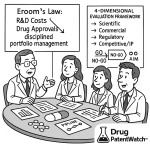
For brand company valuation models, the key question is always: what is the realistic date of generic entry? The legal term on a patent is only the starting point. Analysts must layer in the probability of Paragraph IV challenge, the historical success rate of similar validity challenges at PTAB and in the relevant district courts, the strength of the Orange Book patent list, and the potential for authorized generics launched by the brand itself to limit the damage. All of these inputs come from patent data.
Key Takeaways: Section 2
Hatch-Waxman litigation outcomes, specifically Paragraph IV challenge results and 30-month stay mechanics, are among the highest-impact variables in brand drug revenue forecasting. Analysts who treat the stated patent expiry as the effective exclusivity date, without modeling litigation probability, systematically overvalue branded pharmaceutical assets.
Investment Strategy Note
Generic company analysts should track ANDA filings and Paragraph IV certifications by therapeutic area. A cluster of Paragraph IV filings against a brand’s Orange Book patents in a given quarter is an early indicator of anticipated generic entry and a potential short signal for the brand’s revenue line. Platforms like DrugPatentWatch make this litigation data searchable at scale.
3. The Biologics IP Stack: BPCIA, Purple Book, and the Patent Dance
Small molecule drugs and biologics are governed by separate regulatory frameworks, and the IP valuation implications differ materially. The Biologics Price Competition and Innovation Act of 2009, enacted as part of the ACA, created the abbreviated pathway for biosimilar approval and the corresponding patent resolution process. Unlike Hatch-Waxman, which has a binary, relatively predictable structure, the BPCIA process involves a sequential information exchange between the reference product sponsor and the biosimilar applicant known colloquially as the ‘patent dance.’
The patent dance proceeds in waves. The biosimilar applicant shares its manufacturing and product information with the reference product sponsor. The sponsor identifies patents it believes are infringed. The parties exchange lists and negotiate which patents will be litigated in an initial wave and which will be reserved for later assertion. If the parties cannot agree, the sponsor can choose up to the number of patents the applicant identified for immediate litigation. After the initial litigation wave resolves or a specified period passes, a second wave of litigation can proceed on reserved patents.
The FDA’s Purple Book, formally the lists of licensed biological products, is the equivalent of the Orange Book for biologics, though its patent linkage mechanism differs. There is no automatic 30-month stay tied to a biosimilar application in the same way. The interaction between the BPCIA, the Purple Book, and the specific patents a reference product sponsor asserts creates a more complex and fluid exclusivity calculation than the small molecule framework.
For IP valuation purposes, this complexity means biologic patent estates must be assessed across multiple layers: the primary protein composition of matter patent, any subsequent formulation patents covering concentration, stabilizers, or delivery device, manufacturing process patents covering the cell line and purification process, and method-of-use patents covering specific indications. A biologic with patents in each of these categories creates genuine, layered exclusivity that is expensive and time-consuming to challenge comprehensively.
Humira’s experience is instructive. AbbVie constructed a patent thicket of more than 130 U.S. patents around adalimumab, covering not just the antibody but formulations, dosing regimens, methods of manufacturing, and the autoinjector device. By the time its composition of matter patent expired, the thicket had successfully delayed broad biosimilar entry in the U.S. market until 2023, nearly a decade after biosimilar entry in Europe. The IP value of that delay, measured in revenue protected, is measured in tens of billions of dollars. The cost of building that thicket is measured in millions.
Key Takeaways: Section 3
Biologic IP valuation requires a full-stack analysis of composition, formulation, manufacturing process, and device patents. A single composition of matter expiry date tells an analyst almost nothing about true effective market exclusivity for a complex biologic. The AbbVie/Humira precedent demonstrates that a well-constructed biologics patent thicket can extend effective U.S. exclusivity by a decade beyond the primary composition patent’s expiry.
4. What ‘Drug Patent Data’ Actually Means for a Financial Model
‘Patent data’ is a phrase that covers a range of information with vastly different levels of analytical utility. Understanding what is actually needed for financial modeling versus what patent databases often provide by default is essential before building any valuation.
A patent number and an expiry date from a basic search engine are essentially useless for serious financial modeling. The inputs a valuation model actually requires are more granular and require active assembly.
The composition of matter patent is the most valuable single document in a drug’s patent estate. It covers the specific molecular structure of the active pharmaceutical ingredient. For small molecules, this is typically one or a small number of patents, and its expiry defines the ceiling on effective exclusivity. For antibody-based biologics, the composition of matter patent protects the specific antibody sequences and may extend to related antibodies with similar binding profiles, depending on claim scope.
Method-of-use patents cover specific therapeutic applications of the molecule. A drug initially approved for one indication may generate method-of-use patents for subsequent indications, each with its own filing date and potential term. These patents are listed in the Orange Book and can delay generic entry for specific uses even after the primary composition patent expires, though a generic may still be approved for non-patented uses, and physicians may substitute off-label.
Formulation patents cover specific pharmaceutical preparations: the salt form, the extended-release mechanism, the co-crystal, the nanosuspension. These are the classic tools of lifecycle management, or what critics call evergreening. Their valuation requires careful analysis of how much commercial volume is tied to the specific formulation versus the underlying molecule, and whether a generic can commercially substitute a different formulation without meaningful clinical disadvantage.
The Orange Book listing status is critical. A patent can be valid and in force without being Orange Book-listed, in which case it provides no Hatch-Waxman protection (i.e., it does not trigger the automatic 30-month stay). Conversely, an Orange Book-listed patent that is successfully invalidated in litigation removes its protection entirely. Analysts need to distinguish between the nominal patent estate and the operative, Orange Book-listed portfolio.
Patent prosecution histories (the file wrapper) reveal how the claims were shaped during examination. If an applicant made arguments or amendments to overcome prior art rejections, those statements can create prosecution history estoppel, legally limiting the scope of the claims beyond what the text alone would suggest. A claim that looks broad in the patent’s abstract may be effectively narrowed by concessions made during prosecution. This distinction between nominal and effective claim scope is one of the most underappreciated variables in patent-backed investment analysis.
Key Takeaways: Section 4
Financial analysts need to work with structured patent data covering Orange Book linkage, claim type (composition/formulation/method-of-use), prosecution history flags, and calculated expiry dates inclusive of PTA and PTE, not raw patent filings. The gap between nominal and effective claim scope, revealed in the prosecution history, is a frequent source of valuation error.
5. Patent Term Arithmetic: PTA, PTE, Pediatric Extensions, and Terminal Disclaimers
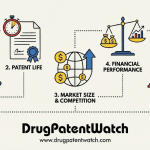
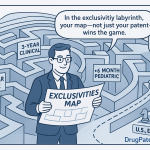
The most mechanically important number in pharmaceutical IP valuation, the final expiry date, is a calculated output, not a field you can read directly from a patent document. Getting this calculation right requires understanding four distinct adjustment mechanisms, each of which can add or subtract meaningful duration from the exclusivity window.
Patent Term Adjustment compensates patent holders for delays caused by the USPTO during examination. Under 35 U.S.C. 154(b), the patent office must respond to applications within specified timeframes. When it fails to meet those deadlines, the patent’s term is extended day-for-day. PTA commonly adds six months to three years to a patent’s nominal 20-year term. For a blockbuster drug generating $5 billion per year, a single year of PTA-derived exclusivity is worth billions in protected revenue.
Patent Term Extension under Hatch-Waxman compensates for the regulatory review period at the FDA. It works differently from PTA. The calculation is: half the time spent in clinical trials plus the full time spent under FDA review from submission to approval, with a cap of five years of total extension and a ceiling of 14 years of effective post-approval protection. Only one patent per approved drug can receive PTE, and the patent holder must apply within 60 days of FDA approval. Choosing which patent to extend, the composition of matter versus a key formulation patent, is itself a strategic decision with material financial implications.
Pediatric exclusivity, granted under the Best Pharmaceuticals for Children Act, adds six months to all existing patents and regulatory exclusivities for a drug when the sponsor completes FDA-requested pediatric studies. The six months attaches to the expiry of whatever protection is already running. For a blockbuster drug at peak sales, six months of additional exclusivity can be worth hundreds of millions to over a billion dollars, making pediatric study costs essentially irrelevant relative to the return.
Terminal disclaimers are less commonly understood but can be significantly negative for patent term. When a later patent is challenged by the USPTO as being obvious over an earlier patent by the same inventors, the applicant can file a terminal disclaimer to overcome the rejection. This disclaimer links the new patent’s expiry to the earlier patent’s expiry, eliminating any additional term the later patent would otherwise have had. Analysts reading a patent estate should flag any terminal disclaimers, as they can significantly compress the effective exclusivity window relative to what the patent’s filing date would suggest.
The interaction among these four mechanisms, on top of the base 20-year term from the priority filing date, means that final expiry calculations require systematic, verified assembly of data from the USPTO’s patent term records, the FDA’s regulatory exclusivity databases, and any PTAB or court records that may have affected the term. Dedicated pharmaceutical data platforms automate much of this assembly, but the analyst needs to understand the mechanics to catch errors.
Key Takeaways: Section 5
Patent term calculations for pharmaceutical assets involve at minimum four adjustment mechanisms: PTA, PTE, pediatric exclusivity, and terminal disclaimers. A valuation model that uses the raw 20-year term from the filing date without these adjustments can be off by multiple years. Multi-year errors at this stage propagate through the entire discounted cash flow model.
6. The Three Valuation Approaches, Ranked by Reliability
Asset valuation methodology recognizes three standard approaches, and they perform very differently when applied to pharmaceutical patents. Ranking them by usefulness for this specific asset class saves analysts significant time and prevents methodological errors.
The income approach, specifically the discounted cash flow model in its risk-adjusted form, is the primary method for pharma patent valuation. It values the patent by projecting the future cash flows the exclusivity period will generate and discounting those cash flows to their present value at a rate that reflects the riskiness of the asset. For approved, marketed drugs, the discount rate approximates the company’s weighted average cost of capital, typically 8 to 12 percent. For pre-approval assets, clinical stage risk is incorporated either through the discount rate (often 25 to 50 percent for early-stage assets) or by applying probability-of-success weights to each year’s cash flows, producing what is called a risk-adjusted net present value, or rNPV. The rNPV method is preferred by most sophisticated practitioners because it makes the risk assumptions transparent and auditable.
The market approach values a patent by reference to comparable transactions. For pharmaceutical patents, this means mining databases of licensing deals for royalty rates paid for analogous assets, and examining deal values from mergers, acquisitions, and asset sales involving similar-stage drug candidates. The GlobalData and Citeline deal databases, among others, provide searchable records of thousands of licensing transactions with disclosed deal terms. The challenge is comparability: disease area, mechanism of action, stage of development, patent quality, competitive landscape, and market size all affect deal value. The market approach provides a useful cross-check on rNPV outputs and can anchor a valuation range, but it rarely produces a precise point estimate.
The cost approach values a patent based on the cost to create or replace it. For pharmaceutical patents, this is the least useful primary method. There is no correlation between R&D spending and patent value. Pfizer spent years and billions developing a failed Alzheimer’s drug candidate while a serendipitous observation about a failed angina drug gave them sildenafil. The cost approach establishes a floor, nothing more. It may have limited use in litigation contexts where reasonable royalty calculations reference the cost to design around a patent, but for investment analysis, it belongs in a footnote.
Key Takeaways: Section 6
The rNPV/DCF income approach is the primary valuation method for pharmaceutical patents. The market approach is a useful cross-check. The cost approach establishes only a theoretical minimum and has no direct role in investment-grade IP valuation.
7. Building a Defensible rNPV Model: Step-by-Step
The rNPV model is the operating standard for pharmaceutical IP valuation across venture capital, royalty finance, and M&A. Its credibility depends on the quality of its inputs and the transparency of its assumptions. A model with precise discount arithmetic but sloppy epidemiology is worthless.
The revenue forecast starts with epidemiology. The analyst needs the total patient population with the target condition in each major market, the diagnosed and treated subsets of that population, and the likely eligible patient pool for the specific drug based on its clinical profile. This builds the total addressable market in patient terms. From there, peak market share assumptions are derived from clinical data relative to the existing standard of care, competitive analysis, and pricing studies. A drug that is modestly superior in efficacy to an existing generic standard of care will capture a different share than one that offers a meaningfully differentiated safety profile or a route-of-administration advantage.
Net price per patient is the most politically sensitive input in drug valuation today. The gap between list price and net realized price, after payer rebates, co-pay assistance, and international reference pricing, can be 30 to 70 percent in a competitive therapeutic class. Analysts who model list price as net price consistently overvalue branded pharmaceutical assets. Realistic net price estimates require payer analysis, formulary tier assumptions, and reference to comparable drugs’ realized price-to-list ratios.
Patent data enters the model through the revenue duration assumption. The year of generic entry ends the branded product’s peak market share period. After generic entry, a standard assumption is an 80 to 90 percent revenue decline within 18 to 24 months. The precision of this assumption depends on knowing the correct effective exclusivity end date, a figure that requires the full PTA/PTE/pediatric exclusivity calculation described in Section 5.
Cost inputs come from the commercial team (SG&A projections, which can run 30 to 40 percent of revenue for a specialty drug launch) and manufacturing (COGS, which varies widely from under 5 percent for small molecules to 20 to 30 percent for complex biologics). Tax rate assumptions matter at the cash flow level, though in practice many biopharma companies structure IP ownership through jurisdictions that produce effective rates below statutory levels.
Clinical stage adjustments use probability-of-success data segmented by therapeutic area and development stage. The BIO industry analysis covering 2011 to 2020 puts overall Phase I to NDA/BLA approval rates at approximately 7.9 percent, with significant variation by disease area: oncology runs below 6 percent overall, while hematology and infectious disease run meaningfully higher. Applying therapeutic-area-specific probability weights rather than industry averages produces materially more accurate rNPV outputs.
The discount rate synthesizes clinical risk, regulatory risk, market risk, and capital market conditions. For an asset awaiting Phase III readout, a rate of 20 to 30 percent is typical. For an approved drug with strong patent coverage and growing revenues, 10 to 15 percent is more appropriate. The rate selection is the single most judgment-intensive input in the model.
Sensitivity analysis, then Monte Carlo simulation, converts a point estimate into a probabilistic range. Sensitivity tables showing how rNPV moves with peak market share and discount rate at minimum give investors a sense of the model’s leverage. Monte Carlo runs of 10,000 or more iterations, distributing key inputs across defined probability distributions, produce a full valuation distribution. The result is that the analyst can present not just a base case but a confidence interval, a meaningful improvement on false precision.
Key Takeaways: Section 7
A credible rNPV model requires accurate patent expiry dates, realistic net price assumptions (not list price), therapeutic-area-specific probability-of-success data, and sensitivity analysis that quantifies how the valuation responds to changes in each key variable. Models that omit any of these elements should not be used as the basis for financing decisions.
8. Real Options Analysis for Early-Stage Pipeline Assets
Standard DCF treats a development program as a committed sequence of investments. The model forecasts all future cash flows, discounts them back, and produces an NPV. If the NPV is negative under conservative assumptions, the standard model suggests abandoning the project. That conclusion misses something important.
Drug development is a sequence of decisions, not a single commitment. After Phase I data, management can advance the program, modify it, partner it, sell it, or stop it. After Phase IIb data, the same menu applies. These choices have real economic value that a static DCF ignores. Real Options Analysis (ROA) captures the value of managerial flexibility by modeling each decision point as a financial option.
In the ROA framework, advancing a program from Phase II to Phase III is analogous to exercising a call option. The strike price is the cost of the Phase III trial. The underlying asset value is the present value of the drug’s future cash flows if it succeeds. The time to expiration is the period over which the decision can be made. Volatility, the most critical input in option pricing, reflects the uncertainty in the drug’s potential value and is typically estimated from the distribution of outcomes for similar assets.
The Black-Scholes model provides a closed-form option price, but binomial trees or decision tree analysis are often more intuitive and transparent for pharmaceutical applications, as they can incorporate multiple decision nodes corresponding to each clinical stage. The key output is an option value that is additive to the static NPV. An asset with a negative or near-zero static NPV may have a substantial real option value if the potential upside in the success scenario is large and the program can be abandoned if early data disappoint.
ROA is particularly relevant for platform technology valuations. A company with a delivery technology platform is not just developing one drug; it holds a collection of options on the applications of that platform. The value of the platform equals the sum of the option values across its potential applications, each adjusted for the probability that the platform itself works as claimed. Investors in platform-stage companies who rely solely on the DCF value of the lead candidate systematically underpay for the optionality in the broader technology.
Key Takeaways: Section 8
Real Options Analysis is the appropriate primary valuation framework for pre-Phase II assets and platform technologies. It captures the value of the development pathway’s decision points, which static DCF ignores. Companies and investors that value early-stage assets using DCF alone consistently arrive at artificially low numbers that understate the strategic value of the portfolio.
9. Monte Carlo Simulations and Bayesian Updating in IP Valuation
A single-point rNPV is a useful summary statistic, but it disguises the actual distribution of outcomes. For investment decisions involving patent-backed assets, the distribution matters as much as the mean.
Monte Carlo simulation addresses this by running the rNPV model thousands of times, each time drawing input values from their specified probability distributions rather than using single-point estimates. Peak market share might be modeled as a triangular distribution ranging from 15 to 35 percent, with a mode of 25 percent. Net price might follow a normal distribution centered on a base case with a standard deviation reflecting payer uncertainty. The probability of Phase III success might be drawn from a beta distribution parameterized to fit historical data for the relevant therapeutic area.
After 10,000 iterations, the analyst has 10,000 modeled NPV outcomes. These are plotted as a distribution, revealing the full range of possible values and the probability of achieving any given outcome threshold. The 10th, 50th, and 90th percentile values give investors a structured picture of the downside, base case, and upside scenarios. For patent-backed financing, the 10th percentile is often the most relevant number for a lender assessing collateral risk, as it represents the value the asset is likely to exceed nine times out of ten.
Bayesian updating complements Monte Carlo by providing a structured method for revising valuation assumptions as new information arrives. The framework starts with a prior probability distribution over the drug’s potential value, derived from base rates for similar assets. When new clinical data arrives, Bayes’ theorem is applied to update the prior into a posterior distribution. If Phase II results are stronger than the median expectation for drugs at that stage, the posterior valuation distribution shifts up and narrows relative to the prior. If results are disappointing, it shifts down.
The practical power of Bayesian methods in pharma valuation is that they force explicit documentation of how new evidence changes the investment case. A portfolio manager using Bayesian updating can calculate the expected change in asset value from a Phase III readout and use that to determine the appropriate position size ahead of the data release. The method also naturally accommodates platform technology valuation, where early clinical success in one program updates the probability-of-success priors for all programs on the same platform.
Key Takeaways: Section 9
Monte Carlo simulation converts a point estimate rNPV into a probability distribution of outcomes, which is the appropriate input for risk-managed investment decisions. Bayesian updating provides a principled method for revising valuations as clinical and market data accumulate. The combination of these two methods produces IP valuations that are more informative, more honest about uncertainty, and more useful for financing negotiations.
10. Patent-Backed Debt: Structuring Loans Against IP Collateral
The structural problem for patent-backed lenders is the same one that has historically kept traditional banks away from pharma IP: in a default scenario, the lender must be able to identify, value, seize, and monetize the collateral. For a manufacturing company, this means selling physical assets to a buyer who can operate them. For a pharmaceutical patent, it means understanding what the patent is worth, who would buy it, and how to convey ownership in a legally defensible way.
Specialist lenders who operate in this space, firms like Hercules Capital, Runway Growth Capital, and SWK Holdings at various points in their histories, have built the internal capability to do this. Their teams include patent attorneys alongside credit officers. Their diligence processes are explicitly designed to stress-test both the legal durability of the IP and its commercial value in a liquidation scenario.
The loan structure typically begins with a security agreement granting the lender a perfected security interest in the patent portfolio under Article 9 of the Uniform Commercial Code, supplemented by a collateral assignment of the patents recorded with the USPTO. The perfection of the security interest against subsequent lien holders and bankruptcy trustees requires both filings, and errors in this recordation process have created disputes in past insolvency proceedings.
Loan-to-value ratios in patent-backed lending are deliberately conservative, typically 20 to 35 percent of the lender’s estimated asset value. At a 25 percent LTV, a patent portfolio valued at $400 million supports a $100 million loan, giving the lender a 4x collateral cushion. Interest rates are materially higher than traditional secured lending, typically in the range of SOFR plus 8 to 12 percent, reflecting the specialized risk. Lenders also routinely negotiate success fees, equity warrants, and royalties on future sales as additional compensation.
For the borrowing company, the cost-benefit analysis compares the interest cost and any equity kickers against the dilution that an equivalent equity raise would require. At a company with a pre-commercial drug valued at $400 million, a $100 million equity raise might require issuing shares at a 20 to 30 percent discount to fair value given execution risk, while patent-backed debt at 12 percent annually costs roughly $12 million per year. At peak patent value just before a commercial launch, the debt option is frequently less expensive on a dilution-adjusted basis.
Key Takeaways: Section 10
Patent-backed debt structures require perfected security interests recorded at both the UCC and USPTO levels. LTV ratios of 20 to 35 percent against verified IP valuations provide lender protection. For pre-commercial biotechs with strong IP, the all-in cost of patent-backed debt is often lower than the cost of dilutive equity at the same stage.
Investment Strategy Note
Lenders entering patent-backed lending without dedicated IP legal and technical due diligence capabilities are exposed to collateral risk that traditional credit analysis cannot detect. The Vaxinova case study in Section 16 illustrates the consequence.
11. Royalty Monetization Structures: How Royalty Pharma Changed the Game
Royalty financing is the purchase of a future revenue stream. The investor pays cash upfront; the company agrees to pay a percentage of future product sales back to the investor for a defined period or up to a defined cumulative cap. The investor’s return depends on how much the drug actually sells.
Royalty Pharma, the largest royalty aggregator in the industry with a portfolio including royalties on drugs like crizanlizumab, tafasitamab, and cabozantinib, went public in 2020 at a valuation above $15 billion, demonstrating that this is now a legitimate, scaled institutional asset class. Its model is straightforward: acquire royalty rights from universities, research institutions, and drug developers at a discount to the present value of the expected royalty stream, then receive royalty payments as the underlying drugs sell.
The royalty rate negotiated in a financing deal is a direct function of the rNPV model. If a company’s drug is projected to generate $200 million per year in peak sales for 10 years, and the investor wants to deploy $50 million at a 3x return cap, the royalty rate is set so that $150 million in cumulative royalties are paid before the obligation terminates. At $200 million per year in sales, a 1.5 percent royalty generates $3 million annually, requiring 50 years to reach the cap, which is not commercially viable. At 10 percent, the royalty generates $20 million annually, reaching the 3x cap in 7.5 years. The negotiation centers on agreeing on peak sales projections and what royalty rate, given those projections, produces the investor’s target return.
Tiered royalty structures are common in large deals. A royalty might be structured at 6 percent on first $100 million in annual sales, 8 percent on sales between $100 million and $500 million, and 10 percent on sales above $500 million. This aligns the investor’s upside with the best-case commercial scenario while reducing the burden on the company if sales disappoint. Royalty caps, after which the obligation terminates regardless of time, protect companies from royalty obligations that outlast the commercial relevance of the asset.
For companies with royalty rights they hold rather than pay, the royalty stream itself is an asset that can be sold or used as collateral. Mid-stage companies that have out-licensed rights to a drug and retained royalties on future sales can monetize those royalties immediately by selling them to Royalty Pharma or similar buyers, converting an uncertain future stream into immediate, deployable capital.
Key Takeaways: Section 11
Royalty financing is non-dilutive capital whose cost scales directly with commercial success, creating natural alignment between company and investor. Royalty rates are derived directly from the parties’ respective rNPV models. Companies holding future royalty rights on out-licensed drugs can sell those rights to royalty aggregators, converting contingent future value to current capital.
12. Hybrid Instruments: Convertible Debt, Warrants, and SPV Structures
Between straight debt and pure equity sits a range of hybrid instruments, each suited to different risk profiles and company circumstances.
Convertible notes secured by a patent portfolio give the lender downside protection through the collateral and equity upside through conversion rights. The conversion feature typically activates at a future equity financing round, converting the debt into shares at a discount to the round price. From the lender’s perspective, if the company performs well, conversion captures the upside. If it struggles or defaults, the patent collateral provides recovery. The conversion discount, typically 15 to 25 percent, and the valuation cap on conversion are the key negotiating points.
Debt with warrants pairs a patent-backed term loan with warrants to purchase equity at a predetermined strike price. The warrant is the ‘equity kicker’ that compensates the lender for the complexity and risk of the underlying IP collateral relative to traditional secured lending. Warrants typically cover 1 to 5 percent of a company’s fully diluted shares and are priced at the current fair market value at the time of closing. Their exercise is dilutive to existing shareholders but is often acceptable given the otherwise non-dilutive nature of the debt component.
Special purpose vehicle structures allow large pharmaceutical companies to ring-fence specific IP assets and raise capital against them without encumbering the corporate balance sheet. A company might transfer rights to a specific drug’s patent estate into an SPV, which then issues royalty-linked notes or takes on patent-backed debt. The parent company retains operational control and economic upside, while the SPV structure provides bankruptcy remoteness, protecting the IP from claims against the parent in a financial distress scenario. This structure requires careful legal design but can access institutional investors who prefer the cleaner collateral structure that an SPV provides.
Key Takeaways: Section 12
Hybrid structures provide flexibility to match a company’s risk profile and financing needs. Convertible patent-backed notes suit companies approaching near-term value inflection points. SPV structures suit large companies that want to monetize specific IP assets without affecting corporate credit ratings or broader balance sheet covenants.
13. Investor Due Diligence: Prosecution History, PTAB Risk, and FTO
IP due diligence for investment purposes is a fundamentally different exercise from the prosecution support work that patent attorneys do for their clients. The investor is asking: ‘If I give this company capital and they default, or if a competitor attacks this patent, what is the realistic probability that the IP holds its value?’
Claim scope analysis starts with the issued claims but does not end there. The investor’s IP counsel reads the prosecution history to identify every argument made and every claim amendment filed to overcome prior art rejections. Each such concession creates potential prosecution history estoppel that narrows the enforceable scope of the claim beyond what its text appears to allow. A claim that recites ‘a compound of formula X’ may have been narrowed by prosecution arguments to exclude certain subclasses of compounds that a generic could target.
PTAB inter partes review (IPR) risk is now a central component of IP due diligence. Since the America Invents Act created IPR in 2012, generic manufacturers and hedge funds running short positions have used IPR petitions extensively to challenge pharmaceutical patent validity. PTAB institution rates for pharma patents have historically run around 60 to 70 percent for petitioned patents, and institution is itself a negative signal for patent robustness. A patent that has already survived an IPR challenge is meaningfully more durable than one that has not been tested.
Analysts can estimate IPR risk for un-challenged patents by reviewing PTAB petition filings in the same technology class, the prior art landscape (particularly post-KSR obviousness doctrine), and the claim drafting quality relative to patents that have survived review. Firms specializing in patent analytics have built predictive models using historical IPR data to score patents for validity risk.
Freedom-to-operate analysis determines whether the company can commercialize its product without infringing third-party patents. FTO failures can be as commercially damaging as IP invalidity. A company with a valid, strong composition of matter patent on its drug may still face an injunction if a competitor holds a valid patent on the manufacturing process required to produce it at commercial scale. Complete FTO analysis covers the full commercialization pathway, from synthesis to formulation to packaging to the specific approved method of use.
Key Takeaways: Section 13
PTAB IPR risk, prosecution history estoppel, and FTO analysis are the three components of IP due diligence most likely to reveal hidden value destruction in a patent-backed investment. Investors who conduct only nominal patent validity reviews without these deeper analyses are exposed to collateral impairment risk that the rNPV model will not capture.
14. Evergreening, Lifecycle Management, and the Patent Thicket Playbook
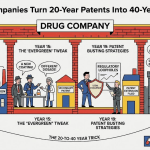
Evergreening refers to the strategic accumulation of secondary patents around a drug to extend effective market exclusivity beyond the expiry of the primary composition of matter patent. It is simultaneously one of the most important defensive strategies in pharma IP management and one of the most scrutinized practices by regulators, payers, and generic manufacturers.
The core toolkit for lifecycle management includes six categories of secondary patents, used in various combinations depending on the drug’s characteristics.
Formulation patents cover specific pharmaceutical preparations that offer clinical or commercial advantages over the original formulation. An extended-release capsule that reduces dosing frequency from twice daily to once daily improves patient adherence and justifies a reformulated product with its own patent coverage. The value depends on whether patients and physicians adopt the new formulation before the original’s exclusivity expires, shifting volume to the reformulated product before generic entry.
Salt and polymorph patents cover specific physical forms of the active molecule. Different polymorphs of the same molecule can have different solubility, bioavailability, and stability profiles. A patent on the specific polymorph used in the commercial product can block generic manufacturers who must demonstrate pharmaceutical equivalence to the same form. Amlodipine besylate, Pfizer’s formulation of the calcium channel blocker amlodipine, is the textbook example: the besylate salt was patented separately from the base compound, extending Norvasc’s effective exclusivity.
Metabolite patents cover the active metabolite produced when the body processes a prodrug. If the prodrug itself converts in vivo to an active species, and that metabolite can be separately patented, the metabolite patent provides a separate basis for infringement claims against generics using the same prodrug. The enforceability of metabolite patents has been the subject of litigation, and their value depends on claim scope and the specific facts of the conversion pathway.
Combination product patents cover fixed-dose combinations of two existing drugs. By combining an established drug with a new partner compound in a single tablet, manufacturers can obtain new patent protection on the combination while benefiting from existing brand recognition for each component. The HIV treatment market has used combination product patents extensively, with combinations like Atripla and Triumeq extending franchise value well beyond any individual component’s exclusivity.
Pediatric exclusivity, discussed in Section 5, provides six months of additional market exclusivity in exchange for completing FDA-requested pediatric studies. Unlike most lifecycle management tools, pediatric exclusivity is granted by the FDA and cannot be challenged by generic manufacturers through patent litigation.
Dosing regimen and method-of-use patents cover specific treatment protocols: a specific dosing interval, a specific patient population, a specific combination with another therapy. Their enforceability against generic manufacturers is limited in the U.S. by the concept of ‘skinny labeling,’ which allows generics to be approved for non-patented uses while carving out the patented use from their label. However, if the generic’s label effectively requires physicians to use the drug in the patented manner, infringement claims are possible under inducement theory.
For analysts evaluating a drug’s IP profile, the practical question is: how much commercial volume is protected by which patents, and how durable is that protection against realistic legal challenges? A drug with 100 percent of its volume in a once-daily formulation protected by a formulation patent expiring in 2032, where the base molecule goes off-patent in 2026, has a defensible but legally contested exclusivity runway through 2032. A drug where 80 percent of volume is in a formulation that will almost certainly face generic equivalents within two years of the base patent’s expiry has a much shorter effective exclusivity.
Key Takeaways: Section 14
Lifecycle management through secondary patent generation is standard practice and commercially rational, but its value depends entirely on whether the secondary patents can be distinguished from the prior art and whether they cover formulations or methods that represent the actual commercial product. Analysts should model the effective exclusivity date as the date by which a commercially equivalent generic can enter the market across the relevant patient population, not the last patent expiry date in a thicket.
15. Case Study: Building a Patent-Backed Financing Package from Scratch
A mid-stage neurology biotech, call it NeuroGenova, has a Phase III-ready candidate for a rare neurological condition with limited existing treatment options. Their core composition of matter patent filed in 2015 will expire in 2041 after PTA, and they have four pending method-of-use applications covering the target indication and two potential line extensions. The company needs $60 million to run its pivotal trial. Its last equity round, 18 months prior, priced shares at a valuation the management team considers materially below fair value given intervening clinical data.
Step one is data assembly. NeuroGenova’s IP team builds a verified patent data file: all issued and pending applications, calculated expiry dates incorporating PTA scenarios, Orange Book listing candidates, FTO status relative to competitor patents in the space, and PTAB risk scores from their IP counsel. This file is the single source of truth for all downstream modeling.
Step two is the rNPV model. The commercial team develops a peak sales projection based on the rare disease patient population (approximately 40,000 diagnosed and eligible patients in the U.S.), a pricing analysis informed by comparable rare neurological drugs (net price of $180,000 per patient per year), and a penetration ramp reaching 45 percent market share by year five post-launch. The probability of Phase III success is set at 62 percent, reflecting the drug’s strong Phase II data and the specific indication’s historical success rates. The discount rate is set at 22 percent, reflecting pre-approval stage risk. The core composition patent expiry of 2041 defines the end of the primary revenue period, with an assumed 85 percent revenue step-down in the first year of generic entry.
The model produces a base case rNPV of $310 million, with a Monte Carlo confidence interval of $180 million to $520 million at the 10th and 90th percentiles. The mean valuation anchors the financing negotiation.
Step three is the financing structure. NeuroGenova approaches three potential structures. A patent-backed term loan of $60 million at 25 percent LTV against the $240 million 10th percentile valuation (the conservative floor) is mathematically supportable and would give a lender a 4x collateral cushion at the downside case. Alternatively, a royalty sale of 4.5 percent of future net U.S. sales, capped at 2.5x of the upfront amount ($150 million total), monetizes the future revenue stream with no equity dilution. A third option, convertible debt with warrants, combines $60 million in patent-backed debt with warrants covering 2 percent of shares at the current round price.
Management chooses the royalty structure, pricing it against an investor who independently models peak sales at $300 million per year (versus NeuroGenova’s $350 million base case), resulting in a negotiated royalty rate of 5 percent capped at $180 million. The company receives $60 million immediately; the investor receives 5 percent of all U.S. net sales until cumulative payments reach $180 million. The deal closes without issuing a single new share.
Key Takeaways: Section 15
The sequence for building a patent-backed financing package is: verified IP data, credible rNPV model with Monte Carlo distribution, financing structure selection based on cost-benefit analysis of dilution versus debt service versus royalty burden. Each structure suits different circumstances. For a company with strong IP, near-term Phase III data, and reluctance to dilute, royalty financing often produces the best risk-adjusted outcome.
16. Case Study: When Weak Patents Destroy Collateral Value
The inverse of Section 15 illustrates why IP due diligence cannot be a compliance exercise.
A vaccine developer, Vaxinova, secures a $45 million patent-backed debt facility from a lender whose IP review was limited to confirming the patent was issued and checking the stated expiry date. The patent covered a specific adjuvant formulation used in Vaxinova’s lead vaccine. Its composition of matter claims were narrow, covering only the specific adjuvant and not the antigen or the combination’s mechanism of action. The prosecution history showed that broader claims had been rejected by the examiner as anticipated by prior art, and the applicant had narrowed the claims substantially to achieve allowance.
A large pharmaceutical competitor identified the narrow claim scope and the specific prior art reference that had forced the narrowing. They filed an IPR petition at PTAB arguing the remaining claims were obvious over the prior art combined with the prosecution history. PTAB instituted the review. The institution decision noted a ‘reasonable likelihood’ that the petitioner would prevail.
Vaxinova’s stock fell 40 percent on the institution news. Their lender triggered the material adverse change clause in the loan agreement and issued a notice of default. Vaxinova, whose cash runway assumed the availability of the full loan facility, could not cure the default. It filed for bankruptcy protection. PTAB ultimately invalidated the patent. The lender recovered approximately 15 cents on the dollar from the bankruptcy estate, the primary asset of which was the invalidated patent, which had no meaningful market value.
The avoidable errors here were specific and identifiable. A proper due diligence review of the prosecution history would have identified the forced claim narrowing and the specific prior art reference used against the application. An IPR risk assessment would have flagged the same prior art as a substantial risk. A proper FTO analysis would have revealed the narrow claim scope. Any one of these three reviews, conducted properly before the loan closed, would have prevented the investment.
Key Takeaways: Section 16
Patent existence is not patent value. A lender or investor who equates the two will suffer the Vaxinova outcome. Prosecution history review, IPR risk scoring, and FTO analysis are not optional due diligence items for patent-backed financing; they are the core of the underwriting. Deals without this analysis are not conservatively underwritten; they are inadequately underwritten.
17. AI/ML Tools Reshaping Patent Analysis and Valuation
Machine learning applications in pharmaceutical patent analysis have moved from theoretical to operational. Several distinct capability areas are now commercially deployed.
Prior art search quality has improved substantially with AI tools trained on the full corpus of global patent literature and scientific publications. Where a human searcher conducting a freedom-to-operate analysis might review several hundred patent documents in a day, AI-assisted tools index millions of documents and rank them by semantic relevance to the target claims. The output is not a replacement for expert judgment, but a significantly more complete and efficient input to that judgment. Companies like Patsnap, Derwent, and several newer entrants have built natural language processing models specifically for patent text that outperform keyword-based search on coverage and recall.
PTAB outcome prediction is an area where early machine learning models have shown promising, if imperfect, results. Models trained on the full corpus of IPR petition filings and outcomes have identified features correlated with institution and with cancellation rates: technology class, claim word count, the specific examiner who allowed the original claims, the law firm that prosecuted the patent, the number of prior art references the examiner considered. These models produce a probabilistic score, not a binary prediction, and they are most useful for portfolio-level triage, identifying which patents in a large estate deserve the deepest human review.
Automated claim scope benchmarking uses natural language processing to compare the scope of a target patent’s claims against the claim landscape in the same technology area. This provides a quantitative proxy for claim breadth and helps identify patents that are outliers relative to the norm in their class, either unusually broad (and therefore potentially more vulnerable) or unusually narrow.
Valuation model automation is the frontier application. Several startups are attempting to build models that generate rNPV estimates directly from patent data and public clinical and commercial databases, without human analyst input. The current state of these tools is that they can generate rough benchmark valuations for screening purposes but cannot replicate the qualitative judgment that experienced analysts apply to net price assumptions, competitive positioning, and clinical risk. They are useful for generating initial filters across large universes of assets but require human review before any capital deployment decision.
Key Takeaways: Section 17
AI tools are most useful in patent analysis for expanding prior art search coverage, generating PTAB risk scores for portfolio triage, and automating claim scope benchmarking. Fully automated valuation tools exist but are not yet reliable substitutes for expert rNPV modeling. The appropriate use case is screening and prioritization, with human expert review on prioritized assets.
18. The Unified Patent Court and Global Portfolio Valuation
Drug development is a global enterprise. For most branded pharmaceuticals, the U.S. generates 45 to 55 percent of global revenue, but Europe, Japan, China, and emerging markets collectively account for the balance. A patent portfolio that protects only the U.S. market leaves significant revenue exposed to generic competition in other jurisdictions.
The Unified Patent Court, which opened in June 2023, changed the enforcement landscape for European patents in a way that directly affects global IP valuation. Prior to the UPC, asserting a European patent required parallel litigation in each national court system, with different procedural rules, different judges, and potentially different outcomes. A patent that survived challenge in the UK might be invalidated in Germany. The UPC creates a single court with jurisdiction over unitary patents and conventional European patents that have not opted out, covering most EU member states. A single UPC judgment can revoke a European patent across the entire jurisdiction, or confirm its validity across the same territory.
For IP valuation purposes, the UPC’s introduction has two counteracting effects. It increases the efficiency of patent enforcement for brand companies, reducing the cost of asserting patents against European generic challengers across multiple markets simultaneously. However, it also creates a single point of failure: a successful invalidity action at the UPC can eliminate pan-European protection in a single proceeding, a risk that would previously have been distributed across multiple national systems.
The practical implication for portfolio valuation is that European patent assets now require more careful invalidity risk assessment than they did pre-UPC. A patent with material revenue exposure across Germany, France, Italy, and Spain, previously subject to four separate invalidity proceedings, now faces a single UPC invalidity challenge that can strip protection from all four markets at once. The concentration of risk warrants a more conservative treatment of European patent value in valuation models for assets with borderline validity profiles.
China’s growing pharmaceutical market adds a third major variable to global patent strategy. China’s NMPA drug approval process has historically lagged U.S. approval timelines, and patent linkage mechanisms in China are still evolving. For drugs where Chinese approval is several years after U.S. approval, composition of matter patent expiry in China may arrive before the drug reaches peak penetration in that market. Lifecycle management strategies using formulation and method-of-use patents, which may have later filing dates and therefore later expiries, become more important for preserving exclusivity in China over the product’s commercial prime.
Key Takeaways: Section 18
Global patent portfolio valuation must account for jurisdiction-specific expiry dates, patent linkage mechanisms, and litigation environments. The UPC creates both enforcement efficiency and concentration of invalidity risk for European assets. China’s growing market requires dedicated analysis of NMPA timing relative to patent expiry. Analysts who use only U.S. patent data for pharmaceutical IP valuation are systematically mismeasuring assets with significant ex-U.S. revenue.
19. Investment Strategy for Portfolio Managers and Institutional Analysts
Patent data generates quantifiable trading and investment signals across multiple time horizons. The analysts who integrate this data into their investment process have access to information that is systematically underweighted in conventional equity research.
Patent expiry dates are public information that generates predictable competitive entry events. Generic entry following primary patent expiry is among the most reliable revenue inflection events in any industry. It is well-documented, legally structured, and time-stamped. The mechanics of ANDA filing timelines, 30-month stays, and first-filer exclusivities mean that for many drugs, the likely date of commercial generic entry can be estimated with reasonable precision two to four years in advance. Analysts who build explicit patent cliff timelines for all holdings in a pharmaceutical portfolio are better positioned to manage exposure ahead of these events than those who rely on consensus revenue estimates, which frequently underestimate the speed and magnitude of generic erosion.
Paragraph IV certification filings are the most actionable early warning signal for patent cliff acceleration. When a generic manufacturer files an ANDA with a Paragraph IV certification against a branded drug’s Orange Book patents, the brand company is required to disclose the certification. This disclosure, combined with tracking ANDA filings at the FDA, alerts analysts to the generic industry’s assessment that a patent is vulnerable and that a challenge is imminent. A cluster of Paragraph IV certifications against a specific drug’s patent estate is a high-conviction signal to reduce branded revenue estimates for the relevant period.
Royalty asset valuation provides a cleaner IP exposure than drug company equity. A royalty position on a specific drug, structured as described in Section 11, has a return profile that depends primarily on the drug’s sales and the patent’s effective term, with less exposure to corporate overhead, pipeline failures, or management decisions outside the specific asset. For investors who want pharmaceutical IP exposure without multi-program company risk, royalty funds provide the cleaner instrument. Royalty Pharma’s public equity is one vehicle; direct royalty participation deals, accessible to larger institutions, provide customized exposure.
PTAB filing activity as a short signal is an established strategy among a subset of hedge funds specializing in pharma. When a credible generic manufacturer or an activist patent challenger files an IPR petition against a key branded drug’s Orange Book patent, the potential for early generic entry represents a negative catalyst for the brand’s revenue. Funds that can independently assess the merits of the IPR petition, using the prosecution history analysis and prior art landscape review described in Section 13, can take positions ahead of PTAB institution decisions and any related stock price moves.
For long-term portfolio construction, the breadth and quality of an innovation company’s patent portfolio, measured by claim scope, family size, prosecution history quality, and Freedom-to-Operate clearance, is a leading indicator of durable competitive advantage. Companies with deep, validated IP estates demonstrate both technical innovation and operational discipline in IP management. Companies with thin, narrow, or vulnerable patent protection are exposed to earlier-than-modeled generic competition and warrant lower valuation multiples on their near-term revenue streams.
Key Takeaways: Section 19
Patent data generates actionable signals for equity investors, including: patent cliff timing for position sizing ahead of generic entry, Paragraph IV certification filings as early generic challenge indicators, PTAB IPR filings as potential negative catalysts, and portfolio IP quality as a leading indicator of revenue durability. Analysts who integrate patent data into their investment process have access to information that is underweighted in most conventional pharmaceutical equity research.
20. Key Takeaways by Segment
For IP Teams and Patent Counsel
The composition of matter patent is your primary asset. Secondary patents covering formulations, metabolites, dosing regimens, and combination products extend effective exclusivity, but their value depends on how much commercial volume they protect and how durable they are against realistic legal challenges. Build prosecution history documentation proactively with the understanding that your arguments will be scrutinized in both litigation and PTAB proceedings. Terminal disclaimers shorten patent life; flag them in your internal IP management system. Pediatric exclusivity is one of the highest-return investments in lifecycle management.
For Portfolio Managers and Business Development
rNPV is the right primary valuation framework. Use therapeutic-area-specific probability-of-success data, not industry averages. Model net price, not list price. Calculate patent expiry dates with PTA, PTE, and pediatric exclusivity incorporated. Run Monte Carlo simulations to build a valuation distribution rather than relying on a single point estimate. Cross-check rNPV outputs against comparable licensing deal data for sanity. For platform technologies, add Real Options value on top of the lead program’s rNPV.
For Corporate Development and Finance
Patent-backed debt, royalty monetization, and hybrid structures each suit different financing circumstances. Royalty financing is most attractive for companies with approved, growing products that want non-dilutive capital without balance sheet debt covenants. Patent-backed debt is most useful for pre-commercial companies approaching a value inflection point who want to avoid dilutive equity at a trough valuation. SPV structures are appropriate for large companies that want to monetize specific IP without encumbering corporate credit.
For Institutional Investors and Analysts
Patent expiry timelines generate predictable competitive events. Paragraph IV certification filings are the first quantifiable signal of accelerated patent cliff risk. PTAB IPR filings are potential negative catalysts for brand revenue estimates. The quality of a company’s patent estate, assessed through claim scope and prosecution history, is a durable predictor of competitive moat strength that conventional earnings-based equity analysis does not capture.
21. Frequently Asked Questions
How does biologics patent valuation differ from small molecule patent valuation?
The core methodology is the same, rNPV with probability-of-success and patent term adjustments, but the patent landscape is structurally different. For biologics, the composition of matter patent often expires earlier relative to clinical development timelines, making formulation, process, and device patents more important for effective exclusivity. The BPCIA patent dance creates a more extended and complex litigation timeline than Hatch-Waxman for small molecules. Biosimilar market penetration has also historically been slower in the U.S. than small molecule generic penetration, so post-expiry revenue haircuts for biologics are typically less severe in the near term, though this is changing as more biosimilars gain interchangeability designations.
Can a company with only pending patent applications get patent-backed financing?
It requires a specialized investor willing to underwrite the risk that the patent may not issue or may issue with narrow claims. The investor will conduct exhaustive prior art analysis to assess the probability that the pending claims survive examination. If the technology has been demonstrated at a reputable institution and the pending claims are defensible over the prior art, royalty financing conditioned on patent issuance, or convertible instruments that convert from debt to equity if the patent issues, can bridge the gap. The cost of capital is higher, reflecting the binary risk of claim allowance.
What is the most common mistake companies make when preparing a patent portfolio for financing?
Treating the legal patent list as the financial model input. A list of patent numbers and nominal expiry dates tells an investor nothing about claim scope, prosecution history quality, IPR risk, or effective exclusivity coverage of the commercial product. Companies that can present a structured patent data file with calculated expiry dates, claim-type mapping to commercial product attributes, prosecution history summaries, and FTO clearance documentation compress the investor’s due diligence timeline and signal operational sophistication. Those that hand over a patent counsel’s portfolio spreadsheet with raw filing dates force the investor to do the analytical work themselves, extending timelines and introducing interpretive errors.
How should a portfolio manager think about royalty fund equity as a pharmaceutical IP investment?
Royalty fund equity, such as Royalty Pharma’s public shares, provides exposure to a diversified pool of pharmaceutical royalty streams with characteristics of predictable cash flow and limited exposure to clinical stage risk. The primary valuation driver is the weighted average remaining royalty term across the portfolio and the growth of underlying drug sales. The key risk is portfolio concentration in drugs approaching patent expiry and the company’s ability to redeploy capital into new royalty acquisitions at attractive rates as existing royalties terminate.
What does the UPC mean for pharmaceutical patent valuations today?
It increases the risk-concentration in European patent assets. A successful UPC invalidity action can eliminate pan-European protection in a single proceeding, whereas pre-UPC, brand companies had the benefit of distributed risk across national courts. For drugs with borderline invalidity profiles and significant European revenue, this warrants a discount to European patent asset value relative to pre-UPC assumptions. For drugs with strong, validated patents, the UPC increases enforcement efficiency, which is a modest positive.
What data sources are required to build an investment-grade pharmaceutical patent valuation?
At minimum: USPTO assignment and prosecution records (file wrapper access), FDA Orange Book with confirmed Orange Book listing status, PTAB docket for any IPR petition filings against the target patents, FDA regulatory exclusivity database (new chemical entity, orphan drug, pediatric exclusivity records), a verified expiry date calculation incorporating PTA, PTE, and pediatric exclusivity, and a commercial database of licensing transactions for the relevant therapeutic area. Dedicated pharmaceutical intelligence platforms aggregate most of this data and make it accessible through structured search interfaces and API feeds, which can reduce data assembly time from weeks to hours.