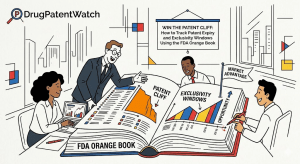
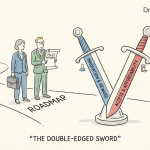
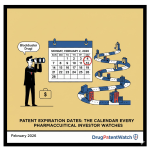
The pharmaceutical market is a system of state-sanctioned monopolies and sudden, catastrophic revenue collapses. At the center of this system is the FDA Orange Book. Formally known as Approved Drug Products with Therapeutic Equivalence Evaluations, this database is the map for every high-stakes investment and competitive entry in the industry. For the business professional, the Orange Book is not a list of drugs; it is a ledger of when billion-dollar revenue streams will vanish.
We use the Orange Book to track two distinct timelines: patent expiry and regulatory exclusivity. Patents are property rights granted by the U.S. Patent and Trademark Office (USPTO). Exclusivities are marketing rights granted by the FDA. They often overlap, but they follow different rules. Understanding these rules is how we turn complex patent data into a competitive advantage.
The Architecture of the Orange Book
The database serves a ministerial role. The FDA does not verify the validity of the patents that companies submit; it simply publishes them.3 This creates a system where brand-name manufacturers can list patents that might be weak or improper to delay competition.4
We find three primary sections in the Orange Book. The first covers prescription drug products with therapeutic equivalence evaluations. The second lists over-the-counter (OTC) drugs that required an NDA. The third contains a list of discontinued products.6
Search Mechanics for Analysts
To extract value from the database, you must search by more than just the brand name. The proprietary name search is the starting point for identifying the active ingredient. Once you have the ingredient, the ingredient search reveals the entire competitive landscape, including every approved generic version, its dosage form, and its strength.8
Field
Description
Strategic Intelligence Value
Proprietary Name
The brand name (e.g., Prozac)
Identifies the target and its sponsor
Active Ingredient
The chemical molecule (e.g., fluoxetine)
Reveals all competitors and dosage forms
Application Number
The NDA or ANDA number
Tracks the specific regulatory history of the drug
Applicant
The company holding the approval
Identifies the owner of the revenue stream
TE Code
Therapeutic Equivalence rating
Determines if the drug is substitutable 9
Tracking the application number is vital. It allows us to distinguish between the original innovator (NDA) and the generic challengers (ANDA). DrugPatentWatch uses these numbers to link regulatory filings directly to litigation records in district courts.11
Therapeutic Equivalence as a Substitution Engine
The Orange Book utilizes a coding system to communicate whether a generic drug is interchangeable with the brand name. These codes, known as Therapeutic Equivalence (TE) codes, dictate the return on investment (ROI) for generic manufacturers. An “A” rating allows for automatic substitution at the pharmacy, which drives rapid market share.
The Dominance of the AB Rating
An “A” code means the FDA considers the product therapeutically equivalent. The most common and strategically vital code is AB. This code means the drug meets bioequivalence requirements, which we measure through two primary parameters: Area Under the Curve (AUC) and Maximum Plasma Concentration (Cmax).
Code
Dosage Form or Evidence
Strategic Implications
AA
Conventional dosage forms
Assigned to drugs with no bioequivalence issues
AB
Oral solids (tablets/capsules)
Most important for high-volume substitution
AN
Aerosolization (solutions/powders)
Critical for the inhaler market
AO
Injectable oil solutions
Limited by the specific vehicle used
AP
Injectable aqueous solutions
Standard for most hospital-administered drugs
AT
Topical products
Includes creams, gels, and ointments
If a market has multiple reference drugs, the FDA uses three-character codes like AB1 and AB2.6 This ensures a generic is only substituted for the specific brand it was tested against. For example, generic levothyroxine must target specific “AB” groups to be substitutable for brands like Synthroid or Unithroid.
B-Ratings as Market Barriers
A “B” code means the FDA does not consider the drug therapeutically equivalent. This is a commercial death sentence for a generic. A product with a BC code (extended-release) or a BD code (documented bioequivalence problems) cannot be automatically substituted. We see this in complex generics where manufacturers struggle to meet the strict standards for “A” ratings, leading to lower ROI because they must market the drug to doctors rather than relying on pharmacy substitution.
The Dual Shield of Patents and Exclusivities
We must distinguish between the 20-year USPTO patent and the shorter, fixed-term FDA exclusivities. Patents can be issued at any time and cover anything from the drug substance to the manufacturing process. Exclusivity attaches only upon FDA approval and acts as a separate block on competition.2
USPTO Patent Life vs. Effective Market Life
While the statutory patent term is 20 years from the filing date, the effective market life is much shorter.13 Clinical trials and regulatory reviews can consume 10 to 15 years of that term.13 This is why the industry focuses on “effective exclusivity,” which usually lasts between 7 and 12 years for a new drug.13
Patent Type
Strategic Purpose
Orange Book Listing Status
Composition of Matter
Protects the core molecule
Always listed; the “Crown Jewel” 12
Method of Use (MOU)
Protects specific medical indications
Always listed; target for skinny labels 16
Formulation
Protects the specific recipe/delivery
Frequently listed; forms the “Thicket” 16
Process
Protects the manufacturing method
Not listed in the Orange Book 9
Packaging
Protects the container
Not listed in the Orange Book
Manufacturing and packaging patents are not listed in the Orange Book. This means a generic can launch even if a brand holds a process patent, provided the generic uses a different method to make the drug. DrugPatentWatch tracks these unlisted patents to provide a complete view of a competitor’s defensive moat.11
Regulatory Exclusivity Durations
Exclusivity is designed to balance innovation with public access. It provides an impermeable barrier to market entry during its term.
Exclusivity Type
Duration
Description
New Chemical Entity (NCE)
5 Years
For drugs with an active moiety never approved before 2
Orphan Drug (ODE)
7 Years
For drugs treating rare diseases (<200k people) 2
New Clinical Investigation
3 Years
For changes to an existing drug (new dose/form) 2
Pediatric (PED)
6 Months
Added to existing patents and exclusivities 2
GAIN Exclusivity
5 Years
Added to certain antibiotics for infectious diseases 2
Pediatric exclusivity is the most valuable because it does not stand alone.2 It extends every existing patent and exclusivity listed for a drug by six months. We see this in the Orange Book when a patent is listed twice—once with the original date and once with the additional six months.2
The Paragraph IV Playbook
Generic entry is an aggressive legal process. When a company files an Abbreviated New Drug Application (ANDA), it must make one of four certifications for every patent listed in the Orange Book.10
The Four Certification Tiers
Certification
Legal Meaning
Commercial Impact
Paragraph I
Patent info hasn’t been filed
Rare; usually for very old drugs 10
Paragraph II
The patent has expired
Allows for immediate generic entry 10
Paragraph III
Generic will launch upon expiry
Generic agrees to wait; no litigation 10
Paragraph IV
Patent is invalid or not infringed
Triggers immediate litigation and bounty 10
Filing a Paragraph IV (PIV) certification is an artificial act of infringement.24 It grants the brand-name manufacturer subject matter jurisdiction to sue the generic company before any commercial harm has occurred.24
The 30-Month Stay
If the brand manufacturer files a lawsuit within 45 days of receiving a notice letter from the generic, the FDA automatically stays the generic’s approval for up to 30 months.23 This stay acts as a critical defensive shield for innovators. It preserves their monopoly while the court adjudicates the patent dispute.24
The stay can be shortened or lengthened by the court, but it generally provides a period of revenue certainty for the brand.11 In some cases, the FDA has granted a second 30-month stay if the generic company amends its application significantly.22
The 180-Day Bounty and the Forfeiture Minefield
To encourage companies to challenge weak patents, Congress created the 180-day exclusivity window for the first applicant to file a substantially complete ANDA with a PIV certification.21 This window is the most profitable period in a generic’s lifecycle, often capturing 60% to 80% of the product’s total lifetime value.24
Forfeiture Triggers under the MMA 2003
Before 2003, generic companies could “park” their exclusivity indefinitely, blocking all other competitors.24 The Medicare Prescription Drug, Improvement, and Modernization Act (MMA) introduced forfeiture triggers to clear these bottlenecks.24
Forfeiture Trigger
Mechanism of Action
Failure to Obtain Tentative Approval
Missing the 30-month window for scientific approval 24
Failure to Market
Missing the 75-day launch window after court win 24
Withdrawal
Voluntarily pulling the ANDA or certification 24
Anticompetitive Agreement
A court or FTC finding of “pay-for-delay” 24
Patent Expiration
All patents in the PIV certification expire naturally 24
Missing the 30-month tentative approval window is the most common path to forfeiture.24 A generic must have its manufacturing and science ready even if it is legally blocked from selling the drug.24 DrugPatentWatch tracks these windows to help companies identify when a first-filer might lose its bounty, allowing subsequent filers to enter the market sooner.
The Authorized Generic Moat
Brand manufacturers often bludgeon the 180-day bounty by launching their own “authorized generic” (AG).24 Since an AG is sold under the brand’s original NDA, it does not need its own ANDA and is not blocked by the generic company’s 180-day window.24 Brands use AGs to capture generic market share immediately and reduce the first-filer’s revenue by as much as 50%.24
The Section viii Carve-Out and Skinny Labels
When a brand-name drug has multiple uses, generic companies can try to sidestep method-of-use patents. This is the Section viii carve-out, or the “skinny label”.26
The Statutory Mechanism
Under 21 U.S.C. § 355(j)(2)(A)(viii), a generic can omit a patented use from its label.26 This allows the generic to enter the market for unpatented uses while the brand retains a monopoly on newer, patented indications.27 We see this as a way to launch years before the final method-of-use patent expires.
The Erosion of the Safe Harbor
Complying with FDA labeling regulations no longer provides immunity from patent infringement. Recent Federal Circuit decisions in GSK v. Teva and Amarin v. Hikma have established a new doctrine: “silence is liability”.27
Courts now look at the totality of circumstances beyond the label. If a generic company’s press releases call the drug a “generic version” or cite the brand’s total annual sales, a court can find that the generic is “inducing” doctors to use the drug for the patented indications.27
The Amarin v. Hikma Precedent
In the Amarin case, Hikma carved out a cardiovascular indication for the drug Vascepa but cited Vascepa’s total sales of $1 billion in its marketing materials.27 Because those sales were driven primarily by the patented cardiovascular use, the court found Hikma could be liable for induced infringement.27 The Supreme Court is scheduled to hear this case in April 2026, a decision that will redefine generic marketing for the next decade.28
FTC vs. The Device Patent Thicket
A major shift in Orange Book regulation is the crackdown on “tertiary” patents. These are patents on the delivery device—such as an inhaler cap or an injector pen—rather than the drug substance itself.3
The Ministerial Gap
The FDA historically has played a ministerial role, meaning it does not review whether a company has the right to list a patent in the Orange Book.3 Manufacturers have exploited this to list device patents, triggering 30-month stays and blocking generic competition for asthma and diabetes drugs.5
The FTC’s Third Wave of Challenges
In May 2025, the Federal Trade Commission (FTC) issued its third round of warning letters to companies including Novartis, Teva, and Novo Nordisk.4 The FTC argues that listing device patents that do not claim the drug substance is an unfair method of competition.4
Company
Impact of FTC Challenge
Result
Teva
ProAir HFA inhaler patents
Delisted five patents after court order 31
Boehringer
Respimat inhaler patents
Requested removal of several patents 3
Novo Nordisk
Ozempic delivery devices
Delisted patents on semaglutide pens 3
GSK
Inhaler pricing caps
Committed to $35 out-of-pocket caps
Delisting these patents is a critical event. It removes the legal basis for the 30-month stay, allowing generic competitors to enter the market much sooner.11
The 2025-2030 Super-Cliff
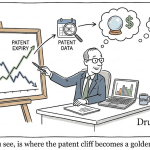
The pharmaceutical industry is entering what analysts call a “super-cliff.” Between 2025 and 2030, a cluster of mega-blockbuster drugs will lose market exclusivity.34 This is not a typical cycle; the volume of revenue at risk is unprecedented, with estimates reaching $400 billion by 2033 when factoring in the Inflation Reduction Act.35
Blockbuster Exposure Table
Drug Name
Innovator
Therapeutic Area
Annual Revenue
Primary Threat
Keytruda
Merck
Oncology
$29.5 Billion
LOE in 2028 35
Eliquis
BMS / Pfizer
Anticoagulant
$12.2 Billion
IRA Negotiation 2026 34
Stelara
J&J
Autoimmune
$10.9 Billion
Biosimilars 2025/2026 34
Opdivo
BMS
Oncology
$9.0 Billion
LOE in 2028 34
Jardiance
Lilly / BI
Diabetes/CVD
$7.0 Billion
IRA Negotiation 2026 34
Januvia
Merck
Diabetes
$4.0 Billion
IRA Negotiation 2026 35
We see a shift in the nature of the cliff. In the early 2010s, the cliff affected primary care small molecules. The 2026 wave targets complex biologics and specialized therapies.35 This requires innovators to use “defensive innovation,” such as transitioning Keytruda from an intravenous to a subcutaneous formulation protected by newer patents.35
Small Molecule Attrition vs. Biologic Managed Slopes
Small molecule drugs face a precipitous drop in revenue. Upon generic entry, a branded drug typically loses 80% to 90% of its sales within the first year.38 In some cases, market share falls by 73% within just two weeks of generic entry.38
Biologics follow a more managed slope. Because biosimilars are more difficult to manufacture and require clinical data, price erosion is slower.34 However, as the biosimilar market matures, we expect price compression to accelerate once a second or third competitor enters.37
The Real Price of Competition: 95% Erosion
Greater competition from generic drugs is the primary driver of affordability in the U.S. market. FDA economic analyses show that the entry of a single generic producer leads to a 31% to 39% reduction in price compared to the brand.39
Erosion by Number of Competitors
Number of Generic Producers
AMP Median Price Ratio
Net Price Reduction
1
0.614
39% 39
2
0.465
54% 39
4
0.212
79% 39
6
0.061
94% 39
10+
0.010
99% 39
Generic prices collapse to marginal cost when six or more entrants launch. We see median generic discounts reaching 90.1% for six competitors and 97.3% for nine competitors.39 This intense competition leads to average price declines of 8% to 10% annually even after the initial cliff.41
As John Murphy III, President and CEO of the Association for Accessible Medicines, states:
“The significant price deflation of the last 30 years can lead to unsustainable market conditions for generic drug manufacturers.” 42
This deflation creates a sustainability crisis. While generics account for 90% of all prescriptions filled in the U.S., they represent only 12% of total drug spending.42 This imbalance puts certain products at risk of shortages or market exits.42
Market Access Barriers: The PBM Gatekeepers
A generic’s success depends on more than just an FDA approval. It requires formulary placement. In 2025, an average of only 24% of Medicare Part D plans covered first generics launched in 2024.43 Plans often have a multi-year “phase-in” period before they cover lower-cost generics.43
Pharmacy Benefit Managers (PBMs) often extract sizable rebates from brand-name manufacturers in exchange for limiting generic market share.43 We see this in case studies of drugs like Restasis and Lyrica, where Part D plans blocked generic substitutes through point-of-service rejections at a rate of 62% even six months after the loss of exclusivity.42
Lifecycle Management: Building the Fortress
Innovators do not let their blockbusters fall without a fight. They build “patent thickets”—a strategically constructed portfolio of different patent types designed to protect the asset from every angle.12
The Layers of the Fortress
Composition of Matter: The “gold standard” or “crown jewel” that protects the core molecule.12
Formulations: Protects unique combinations of ingredients, such as time-release capsules or novel delivery systems.16
Method of Use: Protects new therapeutic uses discovered during the drug’s life.16
Polymorph Patents: Protects specific crystalline structures of the drug molecule.17
Chiral Switches: Developing a single mirror-image molecule (enantiomer) of an existing drug.17
By filing secondary patents late in the development cycle, companies create a minefield for generic competitors. A generic company doesn’t just have to invalidate one patent; they may have to confront dozens.17 This increases legal risk and financial cost, transforming patent strategy from a legal function into a form of economic warfare.15
Using DrugPatentWatch for Competitive Intelligence
Effective patent portfolio management requires proactive intelligence. We use DrugPatentWatch to align IP efforts with business objectives and de-risk investments.11
Extracting Signals for PIV Strategy
We monitor several regulatory and legal triggers to predict competitive moves:
NCE-1 Trigger: For new chemical entities, we monitor the date exactly four years after approval. This is the first day a generic can file a PIV certification to secure 180-day exclusivity.
Filing Velocity Heatmaps: We visualize the rate of new patent filings in specific technology clusters to see where competitors are investing.45
Markman Hearings: These are leading indicators of litigation outcomes. If a judge’s interpretation of patent claims favors a generic challenger, the brand’s monopoly value often collapses.
White Space Analysis: We identify areas of the chemical or biological landscape that are unclaimed by existing patents to find opportunities for new drug development.16
By integrating Orange Book listings, litigation records, and clinical trial info, professionals can make data-driven decisions that define a company’s trajectory for years to come.12
Key Takeaways
The FDA Orange Book is the foundational document of the pharmaceutical business model. It provides the only official map of patent expiry and exclusivity windows, but it requires expert analysis to navigate.
The distinction between patents and exclusivities is critical. Exclusivities like NCE and ODE provide an impermeable barrier to competition that remains even if patents are invalidated. We must monitor the addition of pediatric exclusivity, which provides a valuable six-month extension to every listed protection.
The Paragraph IV certification remains the primary engine of generic entry. Securing and maintaining the 180-day exclusivity bounty requires precision, as missing a tentative approval deadline can lead to immediate forfeiture.
The industry is entering a $400 billion “super-cliff.” This transition will reshape the market as innovators move from small molecules to complex biologics and utilize the Inflation Reduction Act to manage price erosion.
Finally, the collapse of the Section viii safe harbor and the FTC’s crackdown on device patents have changed the rules of engagement. Generic manufacturers must now adopt a strategy of silence in their marketing, while innovators must ensure their Orange Book listings meet strict statutory criteria or face antitrust lawsuits.
FAQ
What is the “NCE-1” date and why is it important for generic strategy? The NCE-1 date is exactly four years after a new chemical entity (NCE) is approved by the FDA. It is the first day a generic company can submit an ANDA with a Paragraph IV certification if they challenge a patent. Filing on this day is essential for a generic company to be eligible for the 180-day market exclusivity bounty.11
Can a generic company launch if the brand holds a manufacturing process patent? Yes. Manufacturing process patents are not listed in the Orange Book. A generic company can launch if its own manufacturing process does not infringe on the brand’s patented method, even if the core molecule is the same.9
How does “skinny labeling” differ from a Paragraph IV challenge? In a Paragraph IV challenge, the generic claims the brand’s patent is invalid or not infringed. In a Section viii “skinny label” carve-out, the generic does not challenge the patent; it simply omits the patented indication from its label to avoid the patent entirely.27
Why does price erosion reach 95% only after six generic competitors enter? The entry of the first generic typically results in a 31% to 39% discount. As more competitors enter, they must compete on price to win market share from the brand and each other. By the time six competitors are in the market, they have usually bid the price down to near the marginal cost of production.39
What happens if a brand-name company delists a patent after an FTC challenge? If a patent is delisted, it can no longer be used as the basis for a Paragraph IV litigation that triggers an automatic 30-month stay. This effectively removes the legal barrier that prevents the FDA from approving a generic competitor.32
FDA. (2025). Approved Drug Products with Therapeutic Equivalence Evaluations (Orange Book). U.S. Food and Drug Administration.
Association for Accessible Medicines. (2025). 2025 U.S. Generic & Biosimilar Medicines Savings Report.
DrugPatentWatch. (2026). Decoding the FDA Orange Book’s Therapeutic Equivalence (TE) Codes for Generic Drug Substitution Strategy.
Federal Trade Commission. (2025). FTC Renews Challenge of More Than 200 Improper Patent Listings.
IQVIA Institute. (2025). Understanding the Use of Medicines in the U.S. 2025.
FDA. (2022). Frequently Asked Questions on Patents and Exclusivity. U.S. Food and Drug Administration.
Mordor Intelligence. (2026). Global Generic Drugs Market Trends and Insights.
DrugPatentWatch. (2026). The Use-It-or-Lose-It Rule: Decoding 180-Day Generic Exclusivity Forfeiture.
Grabowski, H., et al. (2021). Continuing Trends in Pharmaceutical Lifecycle Management. Journal of Medical Economics.
Finnegan, Henderson, Farabow, Garrett & Dunner, LLP. (2024). Intricacies of the 30-Month Stay in Pharmaceutical Patent Cases.
DrugPatentWatch. (2026). Paragraph IV Strategy: Extracting Litigation Signals from the FDA Orange Book.
FDA. (2019). Generic Competition and Drug Prices. U.S. Food and Drug Administration.
DrugPatentWatch. (2026). The Data-Driven Guide to Winning the 2026 Patent Cliff.
McGuireWoods. (2026). Skinny Facts May Limit Supreme Court’s Decision in Skinny Label Case.
Amneal Pharmaceuticals v. Teva Branded Pharmaceutical Products. (2024). U.S. Court of Appeals for the Federal Circuit.
Teva: Drugmaker Requests Delisting of Inhaler Patents from Orange Book in Response to Court Order; Boehringer Ingelheim, Novo Nordisk Have Also Asked FDA to Pull Disputed Drug-Device Patents – The Capitol Forum, accessed February 28, 2026, https://thecapitolforum.com/teva-inhaler-patents-orange-book/