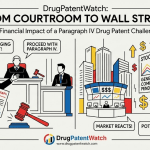
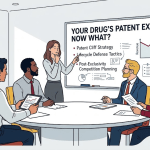
The pharmaceutical industry is entering a historic super-cycle of patent expirations between 2025 and 2030.1 During this window, an estimated $236 billion to $400 billion in annual branded revenue is at risk as nearly 200 blockbuster drugs approach the end of their exclusivity.1 For institutional investors and intellectual property strategists, this is not a distant concern but a present-day reality dictated by the filing of Paragraph IV certifications.1 These filings act as the ignition switch for high-stakes litigation, triggering 30-month stays and a race for 180 days of market exclusivity that can shift billions of dollars in market capitalization overnight.1
The valuation of a modern pharmaceutical enterprise often rests less on the efficacy of its molecules than on the strength of its legal barriers.1 For the skeptical professional, the U.S. Food and Drug Administration (FDA) publication known as the Orange Book serves as the primary map for competitive intelligence.1 Within this registry lies the Paragraph IV certification, a statutory declaration that a brand-name drug’s patent is invalid, unenforceable, or will not be infringed.1 Decoding these signals requires a nuanced understanding of the Hatch-Waxman framework, where the very act of filing an application constitutes a technical act of infringement.4
The Statutory Chassis of Generic Competition
The modern regulatory environment for approving generic versions of branded drugs originated with the 1984 Hatch-Waxman Act.6 This legislation sought to balance the incentives for pharmaceutical innovation with the need for affordable medication.7 Before this act, the path to market for generic manufacturers was largely inhospitable, with generics accounting for only 19% of prescriptions filled in the United States.7 Generic firms were previously required to conduct their own independent clinical trials to prove safety and efficacy, an economic barrier that made the development of most generics financially unviable.7
The Hatch-Waxman Act introduced the Abbreviated New Drug Application (ANDA), which allows a generic manufacturer to rely on the safety and efficacy data of the reference listed drug (RLD).7 Instead of repeating clinical trials, the applicant must demonstrate bioequivalence, proving that the generic product delivers the same amount of active ingredient to the bloodstream at the same rate as the branded version.7
The Four Tiers of Patent Certification
Every ANDA must address each patent listed in the Orange Book for the targeted drug.7 The type of certification chosen dictates the timing and risk profile of market entry.10 Paragraph IV represents the most aggressive stance and the primary tool for competitive disruption.10
Certification Type
Statutory Basis
Commercial Implication
Paragraph I
Patent information not filed
Immediate approval possible if other requirements are met.
Paragraph II
Patent has expired
Approval allowed once the FDA completes its technical review.
Paragraph III
Entry after patent expiry
The generic waits for the natural end of the patent term.
Paragraph IV
Patent is invalid or not infringed
Initiates litigation and sets the 180-day exclusivity prize in motion.
4
A Paragraph IV certification is more than a regulatory box to check; it is a declaration of war.12 It transforms a generic manufacturer from a passive market follower into an active challenger seeking to dismantle an innovator’s intellectual property.12 Under U.S. patent law (35 U.S.C. § 271(e)(2)), the filing of an ANDA with a Paragraph IV certification is defined as an artificial act of infringement.3 This legal construct allows the brand-name company to sue for patent infringement immediately, resolving the dispute before the generic product actually hits the market.3
The 180-Day Exclusivity and Duopoly Economics
The primary economic incentive for a generic company to undertake the risk of Paragraph IV litigation is the 180-day exclusivity period.13 This prize is awarded to the first applicant or group of applicants to submit a substantially complete ANDA with a Paragraph IV certification.1 During this six-month window, the FDA is prohibited from approving subsequent generic applications, creating a temporary duopoly between the brand and the first generic entrant.1
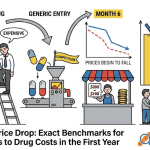
This period is the financial jackpot of the generic business model.8 With only one other competitor on the market, the first generic entrant can price its product at a moderate discount to the brand, typically 15% to 40% below brand pricing.1 This yield is substantially higher than in the post-exclusivity market, where multiple competitors may drive prices down by 95%.1
Competitive Phase
Price Erosion Range
Market Dynamic
180-Day Exclusivity
15% – 40%
High-margin duopoly; generic captures volume at premium pricing.
2 Competitors
50% – 55%
Pricing cracks; duopoly breaks down as second entrant enters.
3 – 5 Competitors
60% – 79%
The commoditization cliff starts; margins compress rapidly.
6 – 10+ Competitors
80% – 95%
Pure commodity market; profits depend on manufacturing efficiency.
1
The 180-day exclusivity typically accounts for 60% to 80% of a generic product’s total lifetime profits.1 For a drug with $2 billion in annual U.S. sales, a first-filer can generate $200 million to $400 million in revenue during this short window, while its legal costs rarely exceed $30 million.16 This math explains why the pipeline of Paragraph IV challenges remains robust regardless of the technical strength of the underlying patents.16
Forfeiture and the BLOCKING Act
The 180-day exclusivity is no longer a guaranteed right but a conditional incentive.13 Under the Medicare Prescription Drug, Improvement, and Modernization Act (MMA) of 2003, a first applicant can forfeit its exclusivity if it fails to meet specific regulatory milestones.13 One critical trigger is the failure to obtain tentative approval within 30 months of filing.1
The BLOCKING Act further complicates this by allowing the FDA to approve subsequent generic applications if the first applicant is hovering in a state of tentative approval but not moving toward a final launch.21 This prevents first-filers from using their exclusivity as a bottleneck to delay overall market competition through settlements with brand manufacturers.21 If a subsequent applicant receives a court judgment of invalidity, they can trigger the forfeiture of the first applicant’s exclusivity if the first applicant does not launch within 75 days.22
The 30-Month Stay: A Statutory Defensive Shield
Once a brand manufacturer receives a Paragraph IV notice letter, it has 45 days to initiate a patent infringement lawsuit.2 If the suit is filed within this window, it triggers an automatic 30-month stay of FDA approval for the generic product.3 This stay is not a court-ordered injunction based on the merits of the case but a statutory pause that provides the brand with revenue certainty while the case proceeds through the courts.2
For a blockbuster drug generating $10 million in daily sales, a 30-month stay preserves approximately $900 million in revenue, regardless of the ultimate validity of the patents in question.22 Brand companies treat filing suit as a reflexive strategic necessity for any drug generating more than a few hundred million dollars in annual sales.16 The stay effectively creates a floor for the timeline of generic entry, often serving as a multi-billion dollar defensive moat.1
The NCE-1 Trigger: Timing the Starting Gun
For drugs classified as New Chemical Entities (NCEs), generic manufacturers cannot submit an ANDA for five years following the brand drug’s approval.1 However, the statute allows the submission of a Paragraph IV ANDA exactly four years after approval—the NCE-1 date.1 This date represents the earliest predictable signal of a future patent cliff.1
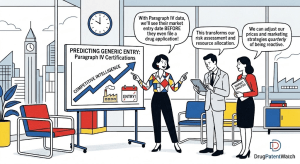
Skeptical professionals use tools like DrugPatentWatch to monitor NCE-1 dates as they represent the starting gun for litigation.1 A flurry of filings on the NCE-1 date indicates that the market is highly contested and that the brand will likely face a multi-challenger environment upon the expiration of the stay.1
Regulatory Event
Statutory Timing
Strategic Significance
NCE-1 Date
4 years post-approval
First possible window for PIV filing and litigation trigger.
Notice Receipt
Within 20 days of filing
Signals the start of the brand’s 45-day defense window.
Suit Filing
Within 45 days of notice
Activates the automatic 30-month stay on FDA approval.
Stay Expiry
30 months post-filing
Earliest date for at-risk launch or final approval.
1
The Litigation Battlefield: Where Success is Measured in Months
The landscape of Paragraph IV litigation has evolved into a specialized arena shaped by statistical trends and concentrated legal expertise.17 Success in this field is rarely about a definitive courtroom victory but about creating leverage to secure an early market entry date.17
District Court Success Rates and Settlement Dynamics
Innovator companies prevail on the merits in district court trials approximately 20% of the time, while generic companies win a mere 2% of the time in final verdicts.17 However, these statistics hide the reality that the vast majority of ANDA disputes never reach a final verdict.16 They are instead resolved through settlement agreements negotiated in the shadow of the courthouse.16
When settlements and dropped cases are factored into the analysis, the picture of success flips dramatically.17 One comprehensive analysis found that while generic firms win only 48% of trials that go to a final decision, their overall success rate—which includes favorable settlements—soars to 76%.2 For the brand, any loss in court means the immediate onset of the patent cliff, wiping out billions in revenue.3 This tail risk makes brand manufacturers highly motivated to settle.17
The PTAB: A Death Squad for Patents
The Patent Trial and Appeal Board (PTAB) provides a faster and cheaper mechanism for reviewing the validity of patents compared to district court litigation.23 With technically sophisticated Administrative Patent Judges (APJs), the PTAB has been branded as a death squad for patents due to its high invalidation rates.23
In December 2024 and January 2025, the PTAB cancelled 77% to 80% of instituted claims across dozens of decisions.24 The cumulative average cancellation rate for instituted claims remains around 74%.24 For generic challengers, the PTAB represents a powerful offensive tool, particularly for attacking weaker secondary patents covering formulations or methods of use.17
Forum
Adjudicator
Success Driver
Average Outcome
District Court
Generalist Judge/Jury
Legal precedent and expert testimony
76% generic success (incl. settlements)
PTAB (IPR)
Technical APJ Panel
Scientific evidence and prior art
74% claim cancellation rate
2
The FTC Counter-Offensive Against Improper Listings
A successful defensive strategy for brand manufacturers often involves building patent thickets—a web of secondary patents covering formulations, crystalline polymorphs, and delivery devices.1 However, the Federal Trade Commission (FTC) has launched an aggressive campaign to purge improper listings from the Orange Book.19
The Teva v. Amneal Precedent
In December 2024, the U.S. Court of Appeals for the Federal Circuit provided the legal foundation for the FTC’s offensive.19 The court established that for a patent to be listable in the Orange Book, it must claim the drug or a method of using it for an approved indication.19 This ruling invalidated the practice of listing broad device patents, such as inhaler caps or mechanical components, that do not recite the specific drug molecule.19
Following this pressure, Teva Pharmaceuticals requested the removal of over 200 improper patent listings in December 2025.19 This move paved the way for generic competition for over 30 drug products by removing the legal basis for the 30-month stay.1 The FTC continues to target what it defines as unfair methods of competition, sending warning letters to companies that list secondary patents that do not meet statutory criteria.16
Skinny Labeling: The induced Infringement Tightrope
Generic manufacturers often employ a Section viii statement as a tactical alternative or supplement to a Paragraph IV certification.1 This pathway allows a generic company to omit patented indications from its labeling, seeking approval only for indications that are no longer protected by patents.27 This is colloquially known as skinny labeling.27
From 2015 to 2019, 43% of new generic drugs entered the market with skinny labels.27 This mechanism is intended to allow generic entry for older indications while encouraging innovators to seek genuine label expansion for new uses.27 However, the legal status of skinny labeling is currently in flux due to theories of induced infringement.26
The Induced Infringement Challenge
In cases like Amarin v. Hikma and GlaxoSmithKline v. Teva, brand manufacturers have argued that generic companies induce infringement by promoting their products as therapeutic equivalents even when their labels omit certain uses.7 If a generic manufacturer’s marketing materials or public statements suggest its drug can be used for the carved-out indication, it may face liability for patent infringement.26 This has transformed skinny labeling from a purely regulatory tactic into an enterprise-wide compliance imperative.7
A 2024 analysis of terminated Hatch-Waxman cases found that innovator companies prevailed on the merits 20% of the time, whereas generic companies won a mere 2% of the time. However, when settlements and other outcomes are factored in, the Picture of success flips; the generic overall success rate—which includes favorable settlements and cases where the brand drops the suit—soars to a staggering 76%.17
Quantitative Modeling: rNPV and Real Options
For the investment professional, a Paragraph IV filing transforms a brand-name drug’s patent portfolio from a static legal asset into a dynamic financial instrument with a fluctuating risk profile.3 Predictive intelligence requires the synthesis of litigation dockets and econometric modeling.22
Risk-Adjusted Net Present Value (rNPV)
Standard models often fail because they assume continuity, but a generic launch is a singularity—a discontinuity where historical brand performance becomes irrelevant.30 Professionals instead use Risk-Adjusted Net Present Value (rNPV) to price the probabilistic outcomes of litigation.5 The inputs for this model are derived from case-specific factors:
P(Validity): The probability the brand’s patent is found valid.
P(Non-Infringement): The probability the generic product does not infringe.
Price Erosion Curve: Modeling the cliff based on the forecasted number of competitors.
A Paragraph IV filing forces an immediate downward revision of the probability of success for all years post-litigation.5 The rNPV formula integrates these probabilities to determine a weighted average of two disparate futures: a high-margin monopoly or a catastrophic revenue collapse.5
Real Options Analysis (ROA)
Real Options Analysis provides a more nuanced view by capturing managerial flexibility.5 This includes the ability of a brand manufacturer to switch patients to next-generation products or to settle litigation based on emerging signals from the court.5 ROA helps value pipeline assets under uncertainty, treating litigation as a series of decision gates rather than a single event.18
Archetypes of Market Entry: 2026-2030
Analyzing recent blockbuster loss of exclusivity (LOE) events reveals archetypes that serve as templates for forecasting the upcoming patent super-cycle.22
The Revlimid Model: Volume-Limited Ramp
The launch of generic Revlimid (lenalidomide) introduced a new standard for managing soft landings.22 Instead of an immediate 90% revenue collapse, settlements allowed generic manufacturers to enter with capped market shares that escalate over time.19 This preserves value for the innovator by preventing a total cliff while guaranteeing market share for the generic challengers.22
The Eliquis Model: Formulation Fortress
The defense of Eliquis (apixaban) relies on a combination of litigation settlements and the enforcement of secondary formulation patents.22 By reinforcing its patent thicket with additional protections, the brand manufacturer has successfully delayed the primary cliff, with key entry projected for April 2028 despite earlier challenges.22
The Keytruda Model: Subcutaneous Pivot
Merck’s strategy for Keytruda involves transitioning patients to a subcutaneous formulation (Qlex) before the original intravenous version loses protection in 2028.10 By changing the standard of care to a version protected by newer patents, the brand creates commercial obsolescence for biosimilars bioequivalent only to the older version.10
Competitive Intelligence Workflow for Professionals
Effective pharmaceutical competitor analysis operates across four time horizons simultaneously.31 The objective is to identify what competitors will do next and what the IP and commercial consequences will be for the portfolio.31
The 6-Step CI Process
The process of conducting competitive intelligence is a structured cycle designed to inform decision-making 32:
Identify Intelligence Needs: Defining the specific business questions, such as how a rival’s Paragraph IV filing will affect market share.32
Develop a Collection Plan: Determining which internal and external sources, such as Orange Book updates and litigation dockets, will be targeted.32
Gather Secondary Intelligence: Using platforms like DrugPatentWatch to monitor NCE-1 dates and biweekly FDA Paragraph IV lists.1
Conduct Primary Research: Interviewing experts to gather human intelligence not available in the public domain.32
Processing and Analysis: Converting granular data into business implications, such as rNPV adjustments.32
Dissemination: Delivering analyzed intelligence to stakeholders to support strategic choices.32
Skeptical professionals must look beyond simple patent expiration dates.22 Accuracy in forecasting requires decoding use codes, exclusivity flags, and tracking tentative approvals.22 A surge in tentative approvals for a specific molecule is a leading indicator that a crowded, high-erosion launch is imminent.22
Daily Monitoring Protocols
Daily operations for an IP analyst in Washington D.C. involve monitoring three distinct signal types 14:
Paragraph IV Filings: Identifying when a competitor has fired the starting gun on litigation.14
Litigation Outcomes: Watching for “quiet periods” in court dockets, which often precede settlement announcements.14
Regulatory Signaling: Observing a spike in Citizen Petitions filed under Section 505(q), which are often used as a hostile defense strategy to cause administrative delays.22
Key Takeaways
The Paragraph IV certification is the single highest-value early-warning signal in pharmaceutical competitive intelligence.31 A single filing can shave $3 billion to $8 billion from a branded company’s market capitalization within days.31 For generic manufacturers, the 180-day exclusivity period is the engine of profitability, allowing for supranormal margins during a temporary duopoly with the brand.14
The 30-month stay functions as a billion-dollar defensive moat, preserving the brand’s monopoly while litigation proceeds.1 However, the landscape is shifting due to the FTC’s crackdown on improper Orange Book listings, which has already led to the delisting of hundreds of device-related patents.19 Professionals must utilize advanced modeling techniques like rNPV and Real Options Analysis to account for the probabilistic nature of these outcomes.5
Successful strategic defense, such as the subcutaneous pivot seen with Keytruda, focuses on creating commercial obsolescence for generic challengers.10 For the challenger, success is increasingly found in attacking weaker secondary patents and leveraging the PTAB for faster claim cancellation.17 Monitoring the NCE-1 milestone remains the mandatory first step for any credible forecasting effort.1
FAQ
What is the 30-month stay in Hatch-Waxman litigation?
The 30-month stay is a statutory pause on the FDA’s ability to approve an ANDA.4 It is triggered when a brand manufacturer files a patent infringement lawsuit against a generic applicant within 45 days of receiving a Paragraph IV notice.2 This stay provides the brand with continued market exclusivity while the legal dispute is adjudicated in court.3
Why is the 180-day exclusivity period so important for generics?
The 180-day exclusivity period is the primary profit engine for the generic industry.14 It grants the first generic entrant a temporary duopoly with the brand, allowing it to price its product just 15% to 40% below the branded drug.1 This period typically accounts for up to 80% of a generic product’s lifetime profits before prices collapse by 95% due to multi-competitor entry.1
How does the FTC influence Orange Book patent listings?
The FTC has launched an aggressive campaign to purge improper patent listings that do not claim the drug substance or an approved method of use.16 By using the FDA’s patent listing dispute process, the FTC has forced companies like Teva and others to delist hundreds of patents, particularly those covering mechanical device components, thereby removing the legal basis for the 30-month stay on those products.1
What is the NCE-1 date and why does it matter?
The NCE-1 date is exactly four years after the FDA’s approval of a New Chemical Entity.1 It is the first legal window where generic manufacturers can submit an ANDA with a Paragraph IV certification.1 This date is critical for analysts because it marks the starting gun for litigation and is the earliest signal of a future patent cliff.1
What is skinny labeling and induced infringement?
Skinny labeling is a regulatory pathway where a generic carves out patent-protected indications from its label, seeking approval only for unpatented uses.26 Induced infringement is a legal theory used by brands to sue these generic companies, alleging that their marketing or public statements encourage doctors to prescribe the generic for the omitted indications.7