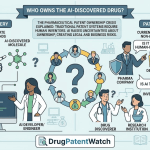
On November 28, 2025, the USPTO rescinded its 2024 guidance on AI-assisted inventions and reaffirmed that only a natural person can conceive a patentable invention [4][5]. Six months earlier, in a Merck 10-Q filed with the SEC, the company confirmed that generic sitagliptin — the active ingredient in Januvia — can enter the U.S. market in May 2026 under settlements with more than two dozen generic manufacturers [11]. Both facts are dated, sourced, and verifiable. The claim that “China accounts for nearly 70% of global AI-driven drug discovery patent filings,” by contrast, is not a drug-discovery statistic at all. It is a general AI patent-filing statistic, repurposed.
That distinction matters to anyone using patent-filing share as a proxy for where pharmaceutical AI innovation is actually happening. Below is where the 70% figure originates, what the pharma-specific data shows instead, and a fact-checked run-through of the regulatory and patent-cliff events that are actually scheduled for 2026.
The 70% Figure: A Generative-AI Statistic, Not a Drug-Discovery Statistic
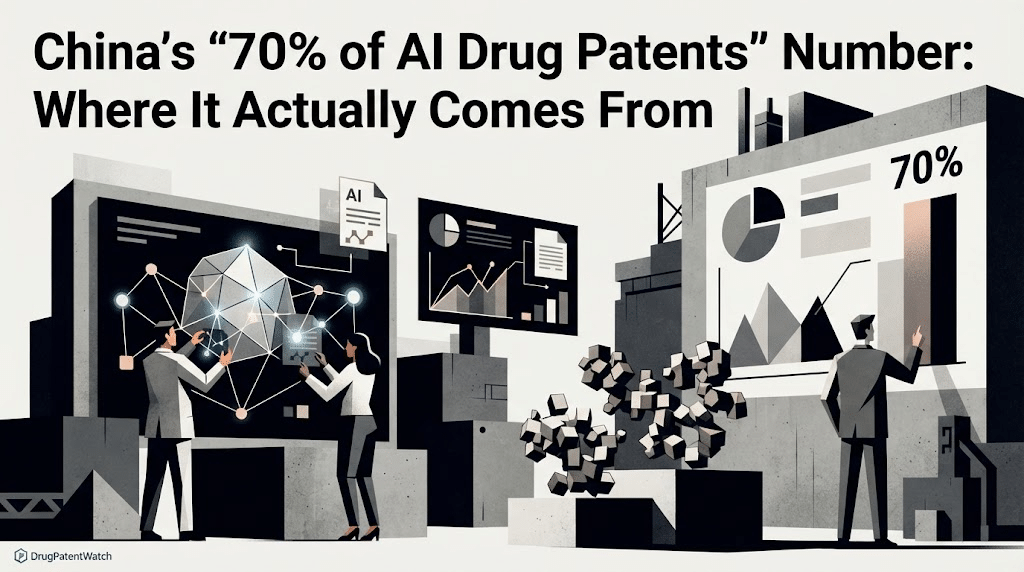
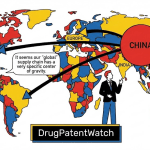
The widely circulated claim traces to patent-analytics commentary on generative AI patents across all industries — image generation, natural language processing, industrial automation, and drug discovery combined — filed since 2014, with China accounting for close to 70% of that total volume and the U.S. around 18% [2]. It is a real number. It is not, however, a measurement of pharmaceutical AI patents specifically, and treating it as one overstates China’s position in the drug-discovery sub-domain.
When analysts isolate AI patents filed by pharmaceutical and biotech entities specifically, the geographic split looks different. One 2025 review of AI-patent activity in the pharmaceutical sector put the United States at roughly 50% of filings since 2020, with China around 17% and Japan around 12% [7]. A separate landscape review covering AI drug-discovery filings from 2017–2026 found South Korea as the largest single-jurisdiction filer among the records retrieved, ahead of Japan, with China and the U.S. roughly tied [8]. Neither dataset supports a 70% Chinese share of drug-discovery-specific AI patents; both suggest a more fragmented landscape than the generative-AI-wide number implies.
Metric
What It Measures
Reported China Share
Reported U.S. Share
Source
Global generative AI patents, all industries, filed since 2014
Broad AI patent volume across every application, not pharma-specific
~70%
~18%
PatentPC analysis of global filings [2]
AI patents filed by pharma/biotech entities since 2020
Pharma-sector AI patents specifically
~17%
~50%
IntuitionLabs pharma AI patent review [7]
AI drug-discovery patent records, 2017–2026 (retrieved dataset)
Drug-discovery AI filings in a bounded search set
~13% of retrieved records (tied with U.S.)
~13% of retrieved records
PatSnap AI drug-discovery landscape [8]
The gap between these datasets is a methodology problem, not a conspiracy: “AI patent” is not a single defined patent classification, and analysts draw the boundary differently — by CPC code, by keyword search, by applicant industry, or by some blend of the three. A page that repeats the 70% figure as a drug-discovery statistic without naming its actual source is passing along a category error.
What the deal-value data shows instead
Where China’s position is better supported is licensing deal value, not patent counts. Jefferies data cited in a 2025 market report put Chinese biotech at 32% of global licensing deal value in Q1 2025, up from 21% in the two prior years [1]. Separately, HSBC’s Linda Shu was quoted reporting that the value of Chinese biotech out-licensing deals with global pharmaceutical companies reached roughly $75 billion in the first five months of 2026 alone [3]. In January 2026, AstraZeneca signed a collaboration and licensing agreement with CSPC for an AI-driven peptide discovery platform worth up to $18.5 billion [3]. These are deal-value and deal-count metrics, not patent-filing metrics, and they measure something real: Western pharma is increasingly paying to license Chinese-originated drug candidates rather than developing equivalent assets internally.
USPTO Reversed Its AI-Inventorship Guidance in November 2025 — Not the Other Way Around
One area where precision matters more than volume: the actual state of U.S. patent policy on AI-assisted inventions, which shifted materially in late 2025.
On November 28, 2025, the USPTO issued Revised Inventorship Guidance for AI-Assisted Inventions, rescinding its prior February 2024 guidance [4][5]. The 2024 guidance had applied the Pannu v. Iolab three-factor test — originally designed to determine “significant contribution” among multiple human co-inventors — to questions of whether a human contributed enough to an AI-assisted invention to qualify as its inventor. The 2025 guidance eliminates that approach entirely. Citing Thaler v. Vidal, 43 F.4th 1207 (Fed. Cir. 2022), the Office reaffirmed that only a natural person can be an inventor, that AI is treated as a tool analogous to laboratory equipment, and that the Pannu factors apply solely to joint inventorship among multiple humans — never to a human-AI relationship, because “AI systems are not persons and therefore cannot be ‘joint inventors'” [6].
Practically, this means: no separate, more permissive legal standard exists for AI-assisted pharmaceutical inventions. A human inventor must still independently satisfy the traditional “conception” standard — forming a definite and permanent idea of the complete invention — for every claimed feature, regardless of how much of the discovery work an AI platform performed. For R&D teams running AI-heavy discovery pipelines, this raises the practical bar for inventorship documentation: teams need contemporaneous records showing which human formed which specific inventive concept, because after November 2025 there is no fallback “significant contribution” test to lean on if conception is contested.
“Only natural persons can be inventors. AI systems, including generative AI or other computational models, are explicitly treated as tools comparable to lab equipment, software, or research databases” — Womble Bond Dickinson summary of the USPTO’s November 28, 2025 Revised Inventorship Guidance [5].
CNIPA’s Actual 2025 Numbers
Separate from the inventorship question, China’s patent office has published concrete metrics worth citing directly rather than paraphrasing loosely.
China’s 14th Five-Year Plan (2021–2025) targeted 12 high-value invention patents per 10,000 people by 2025, up from 6.3 in 2020 [reference 19]. As of March 2025, the actual figure had already reached 14 [reference 19]; by June 2025, CNIPA reported it at 15.3 per 10,000 people, alongside 5.01 million valid domestic invention patents, a 13.2% year-on-year increase [reference 20].
CNIPA’s 14th Five-Year Plan for patent examination set a target of reducing invention-patent examination time from 20 months (2020 baseline) to 15 months by 2025 [reference 21]. For comparison, the same analysis cited average USPTO examination timelines around 23.3 months and EPO timelines around 23.2 months in the same period [reference 21] — though examination-time comparisons vary by methodology and application backlog year over year.
CNIPA defines a “high-value patent” as one in a strategic emerging industry, one with an overseas patent family, one maintained more than 10 years post-grant, one used for pledge financing, or one that has won a national or CNIPA patent award [reference 19] — a materially different bar than raw filing counts, and useful context for anyone comparing China’s patent statistics to Western counts that don’t apply an equivalent quality filter.
The FDA’s Biosimilar Interchangeability Reform: Status, Not Just Direction
The FDA’s move to drop the “switching study” requirement for interchangeable biosimilars is real and well documented — but it originated as draft guidance, not a finalized rule, and reporting on its current status should reflect that.
On June 20, 2024, the FDA published draft guidance, “Considerations for Demonstrating Interchangeability with a Reference Product: Update,” proposing to eliminate the switching-study requirement [6]. The draft cites the agency’s experience approving 13 interchangeable biosimilars through 2024 and current analytical characterization technology as justification, and states that applicants may instead submit a written assessment explaining why their existing analytical and clinical data already support interchangeability [6]. Because interchangeability is the designation that allows pharmacy-level substitution without prescriber sign-off, removing the switching-study hurdle is a meaningful reduction in the cost and timeline for biosimilar developers pursuing that designation specifically — not for biosimilar approval generally, which never required switching studies.
Definitions: biosimilar vs. interchangeable
A biosimilar is a biologic shown to be highly similar to an FDA-licensed reference product with no clinically meaningful differences in safety or efficacy. An interchangeable biosimilar meets that same standard and additionally may be substituted for the reference product at the pharmacy without the prescriber’s involvement, subject to state pharmacy law. Until this guidance, interchangeable status required a dedicated switching study on top of standard biosimilarity data.
The 2026 Patent Cliff: Eliquis and Januvia, With Verified Dates and Patent Numbers
Two franchise drugs face real, dated exclusivity events in 2026 — and the underlying patents, court decisions, and settlement dates are publicly documented.
Eliquis (apixaban)
Eliquis’s core composition-of-matter patent, US 6,967,208, and its formulation patent, US 9,326,945, were both upheld as valid and infringed by the U.S. District Court for Delaware in August 2020, a decision affirmed by the Federal Circuit on September 3, 2021 [9][10]. That decision set the earliest permitted U.S. generic apixaban launch at April 1, 2028, “subject to additional appeals and challenges” [9]. Separately, on the payer side, Eliquis was one of the first ten drugs selected for Medicare price negotiation under the Inflation Reduction Act; its negotiated Maximum Fair Price for a 30-day supply is $231, down from a 2023 list price of $521 — a 56% reduction — effective January 1, 2026 [13][14]. That creates two distinct 2026 events for Eliquis: a list-price cut from Medicare negotiation on January 1, 2026, and continued patent protection against U.S. generic entry until April 2028.
Januvia and Janumet (sitagliptin)
Merck’s own FY2026 10-Q filing with the SEC confirms the terms directly: the company has settled with more than two dozen generic manufacturers, allowing generic Januvia and Janumet to launch in the U.S. in May 2026, and generic Janumet XR in July 2026 or earlier under certain conditions [11]. The underlying patents are U.S. 7,326,708 (the dihydrogen phosphate salt of sitagliptin), expiring November 24, 2026 with pediatric exclusivity to May 24, 2027, and U.S. 8,414,921 (the sitagliptin-metformin co-formulation used in Janumet), expiring January 21, 2029 with pediatric exclusivity to July 21, 2029 [12]. A West Virginia district court ruled both patents valid and infringed in litigation against Viatris, a decision that was under appeal [12]. Januvia’s Medicare-negotiated price for 2026 is $113, down from a 2023 list price of $527 — a 79% reduction, the largest cut among the first ten negotiated drugs [13][14].
Drug
Active Ingredient
Key Patent(s)
Patent Expiration
Earliest U.S. Generic Entry
2026 Medicare Negotiated Price
Source
Eliquis
Apixaban
US 6,967,208 (composition); US 9,326,945 (formulation)
Nov. 2026 (COM); 2031 (formulation, per GreyB tracking)
April 1, 2028 (settlement/court-set floor)
$231 (from $521 list, -56%)
[9][10][13][14]
Januvia / Janumet
Sitagliptin
US 7,326,708 (salt); US 8,414,921 (co-formulation)
May 2026 (Januvia/Janumet); July 2026 (Janumet XR)
$113 (from $527 list, -79%)
[11][12][13][14]
What this means for procurement and payer strategy
Because the Medicare negotiated price and the generic-entry date are governed by entirely separate legal mechanisms — IRA price negotiation versus Hatch-Waxman patent litigation and settlement — a drug can face a steep list-price cut in 2026 while remaining branded-only for another one to two years. Eliquis is the clearer example: its Medicare price drops 56% on January 1, 2026, but no generic apixaban reaches the broader U.S. market until April 2028 at the earliest. Modeling “patent cliff” exposure on patent expiration alone, without separately tracking IRA negotiation dates, will misstate the timing of margin compression for any of the ten drugs on the first negotiation list.
AI Drug Discovery Platforms Actually in Clinical Development
Separating verified platform and company facts from promotional framing:
AlphaFold 3
Google DeepMind published AlphaFold 3 in May 2024, extending AlphaFold 2’s single-protein structure prediction to full biomolecular complexes — proteins bound to DNA, RNA, small-molecule ligands, ions, and modified residues — using a diffusion-based architecture in place of AlphaFold 2’s structure module [22]. DeepMind open-sourced the model’s code and weights for academic use on November 11, 2024, roughly six months after the original publication, not in “early 2025” as sometimes reported [22]. AlphaFold’s developer, Demis Hassabis, received the 2024 Nobel Prize in Chemistry for the AlphaFold body of work [22].
Insilico Medicine
Insilico Medicine listed on the Hong Kong Stock Exchange in December 2025, raising approximately HKD 2.28 billion (about $293 million) — the largest Hong Kong biotech IPO of the year, and the first AI-focused drug discovery company to list on the HKEX Main Board under the revenue/profit-based Chapter 8.05 listing rules rather than the pre-revenue Chapter 18A route typically used by biotech listings [15][16]. Cornerstone investors included Eli Lilly and Tencent [16]. Insilico’s lead asset, rentosertib (formerly ISM001-055, a TNIK inhibitor for idiopathic pulmonary fibrosis), had completed Phase 2a trials with results published in Nature Medicine and Nature Biotechnology by the time of the IPO — a later stage than “entering Phase II,” and the correct compound identifier is ISM001-055, not “ISM018_055” [15][16].
XtalPi
XtalPi’s own interim report confirms 1H2025 revenue of RMB 517.1 million, up 403.8% year-on-year, with the company reaching half-year profitability for the first time (adjusted net profit of RMB 141.6 million) [17]. Its full-year 2025 results, released March 2026, show revenue of RMB 802.6 million (up 201.2% year-on-year) and the company’s first full-year net profit of RMB 134.6 million [18]. XtalPi’s drug discovery solutions segment alone grew 418.9% for the full year [18]. The company combines quantum-physics-based first-principles calculation with AI and automated robotics for crystal structure prediction and molecular design services, and counts Pfizer among its long-term partners [17][18].
Company
Core Technology
2025/2026 Milestone
Source
Insilico Medicine
Generative AI platform (Pharma.AI); lead asset rentosertib for IPF
HKEX IPO, Dec. 2025, ~$293M raised; Phase 2a data published in Nature Medicine
[15][16]
XtalPi
Quantum-physics-based crystal structure prediction + AI + robotics
FY2025 revenue RMB 802.6M (+201.2% YoY); first full-year profit
Published May 2024; code/weights open-sourced for academic use Nov. 11, 2024
[22]
FAQ
Does China really file 70% of the world’s AI drug discovery patents?
No — that figure describes generative AI patents across all industries, not pharmaceutical AI patents specifically. Pharma-sector-specific analyses put the U.S. ahead, at roughly 50% of AI patents filed by pharmaceutical and biotech entities since 2020, versus around 17% for China [7].
Can AI be listed as an inventor on a U.S. drug patent?
No. Under both the rescinded 2024 guidance and the current November 2025 guidance, only a natural person can be named as an inventor. The 2025 guidance removed the intermediate “significant contribution” test that some practitioners had used to argue for AI-assisted co-inventorship credit [4][5][6].
When can generic Eliquis enter the U.S. market?
April 1, 2028 at the earliest, per the Federal Circuit’s September 2021 decision affirming the validity of Eliquis’s core patents and the resulting settlement terms with generic challengers [9][10].
When can generic Januvia enter the U.S. market?
May 2026 for Januvia and Janumet, and July 2026 for Janumet XR, under settlements Merck disclosed in its FY2026 SEC filing — independent of the underlying salt patent’s November 2026 expiration [11].
Has the FDA finalized the removal of switching-study requirements for biosimilars?
The FDA issued this as draft guidance in June 2024, based on its experience with 13 approved interchangeable biosimilars. Confirm current finalization status directly against FDA.gov before relying on it for a submission strategy, since guidance documents can remain in draft status for extended periods [6].
What’s the difference between a biosimilar and an interchangeable biosimilar?
A biosimilar is highly similar to its reference biologic with no clinically meaningful differences. An interchangeable biosimilar meets that bar and can additionally be substituted at the pharmacy without prescriber authorization, subject to state law — historically the higher bar because it required switching-study data.
What is a “high-value invention patent” under CNIPA’s classification?
A patent in a strategic emerging industry, one with an overseas patent family, one maintained more than 10 years post-grant, one used for pledge financing, or a national/CNIPA award winner — a quality filter CNIPA applies on top of raw filing counts [19].
How much did Insilico Medicine raise in its Hong Kong IPO?
Approximately HKD 2.28 billion, or about $293 million, in December 2025 — the largest Hong Kong biotech IPO that year [15][16].
What did AlphaFold 3 add beyond AlphaFold 2?
AlphaFold 2 predicted single-protein structures. AlphaFold 3 uses a diffusion-based architecture to predict the joint structure of full biomolecular complexes — proteins bound to DNA, RNA, small-molecule ligands, ions, and modified residues [22].
Is XtalPi profitable?
Yes, as of full-year 2025: XtalPi reported its first full-year net profit (RMB 134.6 million) on revenue of RMB 802.6 million, up 201.2% year-on-year, according to its own annual results release [18].
Key Takeaways
The “China leads with 70% of AI drug discovery patents” claim conflates broad generative-AI patent volume with pharma-specific AI patenting; pharma-sector-specific data instead shows the U.S. ahead at roughly 50% [2][7].
The USPTO reversed its more AI-permissive 2024 inventorship guidance on November 28, 2025, reaffirming that only human conception — not AI contribution — establishes inventorship [4][5][6].
China’s CNIPA has published verifiable, quality-filtered patent metrics (15.3 high-value invention patents per 10,000 people as of June 2025) that are more defensible than raw filing-volume comparisons [19][20].
The FDA’s removal of switching-study requirements for interchangeable biosimilars originated as June 2024 draft guidance; its finalization status should be confirmed independently before being cited as settled policy [6].
Eliquis and Januvia face two separate and differently timed 2026 events each: an IRA Medicare price cut effective January 1, 2026, and a patent-driven generic-entry date that is later (April 2028 for Eliquis) or earlier (May–July 2026 for Januvia/Janumet) depending on the drug [9][10][11][13][14].
Among AI-native drug discovery companies, Insilico Medicine and XtalPi both reached public-market and profitability milestones in 2025 on documented, company-reported financials — not just platform potential [15][16][17][18].
Methodology
This analysis draws on primary sources where available — SEC filings, CMS negotiated-price data, USPTO guidance documents, company interim/annual reports, and Federal Circuit litigation records — supplemented by secondary industry reporting where primary documents were not publicly accessible. Patent expiration and generic-entry dates reflect the most recent settlement or court-ruling information located as of this writing and are subject to further appeal or amendment. Patent-share statistics are presented with their measurement scope stated explicitly, given the wide variance across methodologies noted above; readers modeling exposure to any single figure should verify the underlying dataset definition before relying on it. DrugPatentWatch’s Orange Book and generic-entry tracking tools provide ongoing monitoring for exactly this kind of settlement-driven date, which shifts as litigation and settlement terms evolve.
References
Global Market Insights. Artificial Intelligence in Drug Discovery Market Size & Share, 2026-2035. https://www.gminsights.com/industry-analysis/ai-in-drug-discovery-market
Tran, B. AI Patent Boom: The Latest Stats on Global AI Patent Filings. PatentPC, March 21, 2026. https://patentpc.com/blog/ai-patent-boom-the-latest-stats-on-global-ai-patent-filings
South China Morning Post. China AI drug-design deals swell as US scrutiny mounts. https://www.scmp.com/business/china-business/article/3359182/china-ai-drug-design-deals-swell-us-scrutiny-mounts
Davis Wright Tremaine. USPTO Issues Revised 2025 Inventorship Guidance for AI-Assisted Inventions. Dec. 3, 2025. https://www.dwt.com/insights/2025/12/uspto-revises-ai-assisted-inventions-guidance
Womble Bond Dickinson. USPTO Replaces AI Inventorship Guidance. Dec. 1, 2025. https://www.womblebonddickinson.com/us/node/17358
Koblitz, S. The Interchangeables Are A-Changin’: New FDA Guidance Proposes Eliminating Switching Studies Requirements. FDA Law Blog, June 26, 2024. https://www.thefdalawblog.com/2024/06/the-interchangeables-are-a-changin-new-fda-guidance-proposes-eliminating-switching-studies-requirements/
IntuitionLabs. AI Patents in Pharma: Ranking the Top 25 Companies (2025). https://intuitionlabs.ai/articles/pharma-ai-patent-leaders
PatSnap Insights. AI-Accelerated Drug Discovery Technology Landscape 2026. https://www.patsnap.com/resources/blog/articles/ai-drug-discovery-patent-landscape-2026-60-records/
Pfizer. The Bristol-Myers Squibb-Pfizer Alliance is Pleased with the Decision by the U.S. Court of Appeals for the Federal Circuit Upholding the Eliquis Patents. Sept. 3, 2021. https://www.pfizer.com/news/announcements/bristol-myers-squibb-pfizer-alliance-pleased-decision-us-court-appeals-federal
Merck & Co. Form 10-Q, Fiscal Year 2026. U.S. Securities and Exchange Commission. https://www.sec.gov/Archives/edgar/data/0000310158/000162828026029802/mrk-20260331.htm
Merck & Co. U.S. District Court Rules In Favor of Merck in Sitagliptin Phosphate Patent Lawsuit. BusinessWire. https://www.businesswire.com/news/home/20220922005340/en/U.S.-District-Court-Rules-In-Favor-of-Merck-in-Sitagliptin-Phosphate-Patent-Lawsuit
Medicare Rights Center. Negotiated Prices Take Effect for Ten Drugs in 2026. https://www.medicarerights.org/?p=36783
Morse, S. Eliquis, Jardiance and Xarelto lead CMS list of drugs subject to negotiation. Healthcare Finance News. https://www.healthcarefinancenews.com/news/eliquis-jardiance-and-xarelto-lead-cms-list-drugs-subject-negotiation
Pharmaphorum. Insilico ends 2025 with $293m Hong Kong IPO. https://pharmaphorum.com/news/insilico-ends-2025-293m-hong-kong-ipo
BiopharmaTrend. Insilico Medicine Raises US$290 Million in Hong Kong’s Largest Biotech IPO of 2025. https://www.biopharmatrend.com/news/insilico-medicine-raises-us290-million-in-hong-kongs-largest-biotech-ipo-of-2025-1438/
XtalPi Holdings Limited. Announcement of Full Year 2025 Annual Results. https://www.itiger.com/news/2622747110
Wininger, A. China’s National Development and Reform Commission: High-Value Invention Patents per 10,000 People Reached 14. National Law Review / China IP Law Update, March 11, 2025. https://www.chinaiplawupdate.com/2025/03/chinas-national-development-and-reform-commission-high-value-invention-patents-per-10000-people-reached-14/
China National Intellectual Property Administration. China Sees Robust IP Progress, Fueling High-Quality Development. https://english.cnipa.gov.cn/art/2025/7/21/art_3090_200717.html
Marks & Clerk. China Focuses on Accelerating Patent and Trade Mark Examinations During 14th Five-Year Plan. https://www.marks-clerk.com/insights/latest-insights/102juya-china-focuses-on-accelerating-patent-and-trade-mark-examinations-during-14th-five-year-plan/
Kasianov, R. AlphaFold3 Goes Open Source. BiopharmaTrend, Nov. 11, 2024. https://www.biopharmatrend.com/news/alphafold3-goes-open-source-1017/