An investigative deep-dive for commercial leads, market access directors, and C-suite executives who negotiate with OptumRx, Express Scripts, and CVS Caremark — and need to understand the full system before the next contract cycle.
1. The Market You’re Actually Selling Into
If your commercial team’s mental model of the U.S. pharmaceutical market still centers on prescribers and patients, you’re selling into a system you don’t fully understand. The real buyers — the entities with direct control over whether your drug gets used at all — are three companies you may never have a face-to-face meeting with: CVS Health’s Caremark, Cigna’s Express Scripts (ESI), and UnitedHealth Group’s OptumRx.
As of 2025, Cigna’s Express Scripts is the largest PBM in the United States by market share, after overtaking CVS Caremark. The three together process approximately 80% of all prescription drug claims on behalf of roughly 270 million Americans — a number that makes them, collectively, the largest buyer of pharmaceutical products in human history.
That 80% figure deserves a second look. It means that when you launch a drug, negotiate a contract renewal, or model a gross-to-net assumption, you are, in material terms, negotiating with three buyers. Every rebate lever, every utilization management edit, every formulary exclusion threat comes from a market structure that more closely resembles a utility oligopoly than a competitive market.
The global pharmacy benefit management market was estimated at USD 747 billion in 2024 and is projected to reach USD 1,726 billion by 2033, growing at a compound annual rate of 9.9%. That growth rate reflects the PBM model’s structural advantage: as drug spending rises and therapeutic complexity increases, PBM leverage over formulary decisions only compounds.
This article covers the mechanics you need to understand — how formularies get built, how rebate contracts work in practice, what PBMs do with the money they extract, and how the regulatory climate of 2025–2026 is forcing a renegotiation of those mechanics. It draws on publicly available litigation records, regulatory filings, and the kind of industry data sources that commercial teams actually use, including DrugPatentWatch.
2. What a PBM Actually Does (and How It Makes Money)
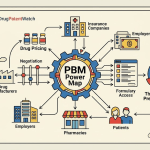
PBMs act as intermediaries between drug manufacturers and insurance companies that offer drug benefits to employer health plans, Medicare Part D prescription drug plans, state Medicaid programs, and other payers. Their core functions include negotiating rebates and price discounts with drug manufacturers, processing and adjudicating claims, reimbursing pharmacies for drugs dispensed to patients, structuring pharmacy networks, and designing drug benefit offerings — including developing formularies, determining utilization management rules, and establishing cost-sharing requirements.
That description is accurate but not complete. It describes what PBMs were designed to do. What they have evolved into is a more layered and financially complex entity.
2.1 The Four Revenue Streams
PBMs generate revenue through four distinct mechanisms, and pharma executives need to understand all of them — not just rebates — because each creates a different incentive structure that affects how your drug gets treated on the formulary.
The first stream is administrative fees. These are straightforward: the employer or health plan pays the PBM a per-member-per-month fee for running the pharmacy benefit. This revenue stream is largely stable and relatively transparent.
The second stream is rebate retention. PBMs negotiate rebates with drug manufacturers in exchange for preferred placement of rebated drugs on a health insurance plan formulary, and they may retain a portion of the drug rebates they negotiate, though this is more common in the commercial employer market than in the Medicare Part D market. The specific percentage retained has been the subject of intense regulatory scrutiny — and, in at least one case, a federal lawsuit.
The third stream is spread pricing. Spread pricing — retaining the difference between what a PBM charges a health plan and what it pays a pharmacy for the same drug — is most prevalent in Medicaid managed care and state employee benefit programs, where oversight has historically been weakest. A 2023 House Oversight Committee report documented cases where PBMs charged state Medicaid programs prices that were hundreds of percent above the pharmacy acquisition cost.
The fourth — and newest — stream is Group Purchasing Organization (GPO) fees. PBMs have been purchasing GPOs and using them to provide administrative services to pharmaceutical companies and, in some cases, conduct formulary negotiations. These GPOs tack on fees paid by pharmaceutical manufacturers for administrative services in addition to the rebates they negotiate. The FTC’s September 2024 complaint against the Big Three specifically targeted these GPO arrangements, alleging that they were used to obscure the true amount of manufacturer payments flowing to PBMs.
2.2 Vertical Integration: Why the Conflict of Interest Is Structural
All the top PBMs own mail order pharmacies, specialty drug pharmacies, and rebate aggregators, and four own health care provider groups. CVS Caremark’s parent company also owns Aetna, one of the largest health insurers in the country. Express Scripts is owned by Cigna. OptumRx is owned by UnitedHealth Group.
This vertical integration is not incidental — it is the defining structural feature of the modern PBM market, and it creates conflicts of interest that are difficult to resolve through disclosure alone. When a PBM decides which drug gets preferred formulary status, that decision affects not just manufacturer revenue but also the revenues of the PBM’s affiliated pharmacy and the medical loss ratio of the PBM’s affiliated insurer.
A study published in early 2025 found clear evidence that the share of prescriptions filled at PBM-owned pharmacies was substantially higher among patients enrolled in PBM-owned health plans, compared to patients covered by other insurers. For manufacturers of specialty drugs, this creates a specific problem: even if your drug achieves preferred formulary status, channel direction toward PBM-owned specialty pharmacies may affect patient access and data visibility simultaneously.
3. Formulary Architecture: The Rules of the Game
A formulary is, at its most basic, a list of covered drugs organized into tiers that correspond to cost-sharing levels for the patient. But the formulary is also the PBM’s primary source of leverage over manufacturers. Understanding its architecture is prerequisite to understanding why rebate negotiations work the way they do.
3.1 Open vs. Closed Formularies
Open formularies cover essentially any FDA-approved drug, with cost-sharing differences used to steer patient behavior. Closed formularies exclude drugs outright — if your drug is not on the formulary, prescriptions for it will not be covered, period. In 2012, Express Scripts and CVS Caremark transitioned from using tiered formularies to those that excluded drugs from their formulary. That shift — from open to increasingly closed formularies — is the moment when the modern rebate-for-access dynamic was institutionalized.
Before 2012, a manufacturer who lost a formulary negotiation still had coverage; patients might pay more out of pocket, but the drug was covered. After 2012, losing a formulary negotiation meant no coverage at all. That change in stakes restructured the entire negotiation dynamic: PBMs suddenly had a credible threat they could use to extract larger rebates, and manufacturers — to avoid the catastrophic alternative of formulary exclusion — had a compelling incentive to raise list prices so they could offer larger rebates while protecting net revenue.
3.2 Tiering and How It Works
The group health plan’s drug formulary identifies the drugs that are covered and organizes the drugs into tiers with different cost-sharing requirements imposed on participants. The tiers often distinguish between generic drugs and brand-name drugs, and may have a separate tier for ‘specialty drugs.’
In practical terms, a standard commercial formulary today has four to six tiers:
Tier 1 covers generic drugs with the lowest copay (typically $0–$10).
Tier 2 covers preferred brand-name drugs, usually with a moderate copay ($25–$50).
Tier 3 covers non-preferred brand-name drugs with a higher copay ($65–$100 or more).
Tiers 4–6 cover specialty drugs, biologics, and non-formulary drugs, often with coinsurance rather than a flat copay — meaning patient out-of-pocket costs can reach thousands of dollars per fill.
The distinction between Tier 2 and Tier 3 placement for a brand-name drug is not merely about patient cost. It directly determines market share. Formulary research consistently shows that a move from preferred (Tier 2) to non-preferred (Tier 3) status can reduce prescription volume for the affected drug by 25–40%, depending on the therapeutic class and the availability of formulary alternatives.
3.3 Utilization Management: The Second Layer of Control
Formulary tier placement is the first lever. Utilization management (UM) is the second. UM tools include prior authorization (PA), step therapy (also called “fail first”), and quantity limits. Each adds friction to the prescribing process — and each can be used either for legitimate clinical management purposes or as a commercial lever to steer patients toward preferred alternatives.
Prior authorization requires physicians to submit a request form — and sometimes detailed patient records — before a drug is covered. The administrative burden this imposes on prescribers is substantial. Studies have consistently found that PA requirements reduce prescribing rates for affected drugs, not only because some PA requests are denied but because some physicians simply decline to navigate the paperwork for non-formulary drugs when covered alternatives exist.
Step therapy requires patients to try (and “fail”) a preferred, usually lower-cost drug before accessing the originally prescribed medication. When a PBM places your drug in a step therapy requirement behind a competitor’s drug that offers a higher rebate, the commercial effect is direct: every patient who “fails” on the competitor drug is a potential convert to your product, but the hurdle creates substantial lag and attrition along the way.
As rebate reforms constrain some of their revenue streams, PBMs will expand formulary placement and utilization management tactics to maintain an advantage in manufacturer access negotiations. Barring excluding drugs from their formularies completely, PBMs will play more with tier placement, slotting some drugs within a class into higher tiers with higher copays to discourage their uptake.
3.4 The Pharmacy and Therapeutics Committee: Clinical Cover or Commercial Theater?
The Pharmacy and Therapeutics (P&T) committee is often an external body of experts who ‘evaluate clinical and medical literature to select the most appropriate medications for individual disease states and conditions.’ These committees are staffed with health-care providers including physicians, pharmacists, and patient representatives. Following their analyses, the P&T Committee makes recommendations for the PBM’s template formulary or for an individual client’s custom formulary. Notably, this is only one of several PBM committees with influence over final formulary outcomes.
The P&T process provides the clinical framework within which commercial negotiations operate — but it does not determine formulary outcomes by itself. A drug with strong clinical evidence can still end up on a non-preferred tier or excluded from formulary if its manufacturer does not offer competitive rebates. Conversely, a drug with a marginally differentiated clinical profile can achieve preferred status if it offers a higher rebate per covered life.
This is not a theoretical observation. It is the factual basis of the FTC’s September 2024 lawsuit against the Big Three PBMs, which alleged that insulin products with lower list prices — and therefore smaller rebates available — were systematically excluded from formularies in favor of higher-list-price alternatives that generated larger rebate payments to PBMs and their affiliated GPOs.
4. How Rebate Contracts Actually Work
Rebate contracts between manufacturers and PBMs are among the most commercially sensitive documents in the pharmaceutical industry. They are typically confidential, heavily negotiated, and structured to create compounding financial incentives that are not always visible to plan sponsors, patients, or even regulators.
4.1 The Basic Contract Structure
PBMs typically initiate negotiations with manufacturers for a discount on the list price of prescription drugs. Often, the discount takes the form of a rebate paid by the manufacturer back to the PBM for every unit of the drug dispensed to patients who receive prescriptions in compliance with the contract terms. Manufacturers typically negotiate for favorable coverage on the formulary, which may include preferred tier status and few or no utilization management restrictions.
The rebate is usually expressed as a percentage of the drug’s Wholesale Acquisition Cost (WAC), and it is paid periodically — typically quarterly or annually — after the prescriptions are filled. This timing creates an important asymmetry: the manufacturer invoices at list price and then sends the rebate check weeks or months later. The net price only exists in the accounting; what the distribution chain sees and transacts at is the list price.
Like all contract negotiations, both the PBM and the manufacturer have goals they expect the contract to satisfy. For the PBM, the goal may be to meet price guarantee terms in contracts with their health plan customers, to achieve the lowest net price for covered drug products, or to attract clients based on comprehensive formulary and contracting services. Simply stated, PBMs seek to minimize net unit price for prescription drugs, whereas manufacturers seek to maximize net unit price and volume of units dispensed.
4.2 Market Share Thresholds: The Compounding Incentive
The most commercially significant feature of modern rebate contracts is the market share threshold structure. Rather than a flat per-unit rebate, most contracts in competitive therapeutic classes include tiered rebate percentages that increase as the drug achieves higher market share within the PBM’s covered lives.
The market share tranches create a compounding incentive structure: once a drug crosses a specified market share threshold, the per-unit rebate increases retroactively for all units dispensed in that period. This makes it financially rational for a PBM to aggressively promote a rebated drug even if a competitor drug has a lower net cost.
For manufacturers, this structure has two implications. The first is that achieving the next market share tier can deliver a retroactive rebate rebate increase across an entire quarter’s worth of dispensing — a significant non-linear incentive to push for volume. The second is that competitors who cannot match the rebate structure face a compounding disadvantage: the more market share the incumbent gains, the larger the retroactive rebate it earns, the more the PBM is financially motivated to protect that incumbent’s formulary position.
4.3 The Gross-to-Net Bubble
The gross-to-net bubble reflects all of the supply chain deductions between list price and the net revenue a manufacturer actually receives: PBM rebates negotiated in exchange for formulary placement, mandatory Medicaid rebates calculated as a percentage of WAC, 340B Drug Pricing Program discounts for covered entity purchasers, distribution fees, prompt-pay discounts, and chargebacks from wholesalers. Wall Street models manufacturer revenue using net pricing; the list price is essentially a negotiating construct.
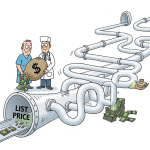
Rebates are a contributing factor to rising list prices, because a manufacturer is incentivized to start negotiations with a high list price and then negotiate down to the net price so it can offer PBMs a higher rebate (but with a more profitable net price) and receive favorable formulary treatment. This incentive structure is one of the factors contributing to increasing list prices for brand-name drugs, which has ultimately led to out-of-pocket costs that have risen significantly for patients, even as net prices for brand-name drugs have fallen.
This is the core dysfunction of the rebate system, and it is the mechanism at the heart of the FTC’s regulatory action. High list prices generate large rebates that PBMs use to attract plan sponsor clients. Plan sponsors receive rebates that reduce their net drug spend and allow lower premiums. But patients — particularly those with deductibles or coinsurance — pay out of pocket based on list price, not net price. The system transfers money from sick patients to healthy plan members.
“Rebate-adjusted spending on brand drugs with rebates increased just 4% instead of the 19% price increases that would have occurred without rebates.” — Pharmaceutical Care Management Association (PCMA), citing U.S. Government Accountability Office data on Medicare Part D [18]Source: PCMA, citing GAO analysis of Medicare Part D rebate data.
4.4 How Much Do PBMs Actually Pass Through?
The question of rebate pass-through rates is politically charged and empirically contested. PBMs argue they pass through the vast majority of rebates to plan sponsors; critics argue the GPO fee structures obscure how much is actually retained.
The data, where it exists, is mixed. A U.S. GAO report and a U.S. Department of Health and Human Services Office of Inspector General report both confirmed that 99.6% of prescription drug rebates negotiated by PBMs with drug manufacturers in Medicare Part D were passed through to drug plan sponsors. That figure refers specifically to Medicare Part D, where pass-through requirements are stricter and disclosure is greater than in the commercial market.
The commercial market is a different story. In a 2023 survey by Pharmaceutical Strategies Group, 59% of employers reported receiving 100% of rebates for traditional drugs, and 57% reported the same for specialty drugs, while a further 16% received guaranteed percentage shares of rebates back from their PBMs for both traditional and specialty drugs. That means roughly 25% of employers are receiving something less than a guaranteed full pass-through on traditional drugs — and the arrangement for that 25% is often governed by contracts that do not disclose the actual rebate amount received from manufacturers.
The GPO fee structure further complicates these figures. A former Optum executive who helped set up Emisar, Optum’s GPO, stated that ‘the intention of the GPO is to create a fee structure that can be retained and not passed on to a client.’ That quote, sourced directly from the FTC’s September 2024 complaint, illustrates why pass-through statistics at the PBM level do not capture the complete revenue picture.
5. Portfolio Contracting: The Tactic That Changes Everything
If there is a single commercial development in PBM–manufacturer relations over the past five years that pharma executives must understand, it is portfolio contracting. The practice has moved from a niche tactic used by large, diversified pharmaceutical companies to a central feature of how access is negotiated across entire therapeutic classes.
5.1 What Portfolio Contracting Is
Portfolio contracting involves bundling multiple products from a manufacturer’s portfolio — existing marketed products, sometimes alongside pipeline assets — into a single negotiation with a PBM. Rather than negotiating drug-by-drug, the manufacturer offers a package: favorable rebates across the bundle in exchange for preferred formulary placement and favorable UM treatment across all covered products.
Both PBMs and pharmaceutical companies have already been using portfolio contracting to establish the most favorable arrangements for formulary inclusion and profitability. Under heightened employer scrutiny, PBMs may ramp up strategies including increasing cross-product concessions, negotiating entire classes or indications of drugs separately, and requiring more economic and utilization data from manufacturers to justify formulary inclusion to employers.
For large manufacturers with broad portfolios, this creates leverage: a PBM that wants to exclude a competitor’s oncology drug, for example, may find the decision complicated if that competitor also supplies a dozen other products for which the PBM’s plan sponsors have strong utilization. For smaller manufacturers with single-product portfolios, the dynamic is reversed: they cannot bundle, which means they negotiate from a fundamentally weaker position than a large pharma company offering a portfolio package.
5.2 The GLP-1 Case Study
The GLP-1 agonist class — led by Novo Nordisk’s Ozempic and Wegovy and Eli Lilly’s Mounjaro and Zepbound — provides the clearest recent example of how portfolio contracting reshapes market dynamics in a competitive therapeutic area.
As part of portfolio-level contracting with major PBMs like CVS Caremark and Express Scripts, Novo saw the net price of Ozempic fall by approximately 40% from its list price, with the company reporting a 69% gross-to-net rebate adjustment across its GLP-1 franchise. CVS publicly stated it negotiated a lower net price for Wegovy versus Eli Lilly’s Zepbound for standard formularies. Simultaneously, Novo Nordisk also offered a $499/month cash price (versus $1,349 list cost). Cigna’s Express Scripts’ GLP-1 programs report $200 million in health plan savings since 2024, with member copay caps at or below $200 per month as of mid-2025.
The GLP-1 market illustrates a specific dynamic: when two large manufacturers with comparable product efficacy compete for formulary position, the rebate competition between them drives gross-to-net discounts to levels that compress both manufacturers’ net revenue while primarily benefiting the PBMs’ plan sponsor clients. Both Novo and Lilly are giving away a substantial share of gross revenue in exchange for the formulary access that drives volume. The PBMs, sitting in the middle, extract value from both sides of the competition.
5.3 The Biosimilar Case Study: Humira and What Happened Next
The adalimumab (Humira) biosimilar market provides a more complicated — and commercially instructive — case. By 2023, more than a dozen adalimumab biosimilars had received FDA approval, priced at discounts of 5% to 85% below Humira’s list price. The conventional economic prediction was clear: biosimilars would achieve rapid market penetration and substantially reduce PBM rebate revenue from AbbVie.
That prediction was wrong. When biosimilars entered the market with prices up to 85% lower than brand-name Humira, PBMs were slow to adopt the cheapest options. Instead, the largest PBMs — including Express Scripts — launched their own private-label biosimilars through subsidiaries like Quallent Pharmaceuticals, effectively replacing one revenue stream with another they controlled directly.
CVS Caremark, Express Scripts, and OptumRx jointly excluded Humira and nearly all branded biosimilars from their standard formularies, opting instead to promote their own private-label biosimilars under portfolio agreements. By removing Humira and competing biosimilars from coverage, these PBMs forced manufacturers to offer deeper rebates to regain placement or accept exclusion entirely. In effect, bargaining turned from individual drugs to a restructured class-level negotiation, advantaging PBM-owned products and reshaping the competitive landscape.
This outcome has direct implications for manufacturers planning launches in biosimilar-adjacent markets. If the PBMs own the competing product, formulary negotiation is not a standard commercial exercise — it is a negotiation with a counterparty that has a direct financial stake in your product’s failure.
5.4 The Amgen v. Regeneron Verdict: Bundling’s Legal Limits
Portfolio contracting has legal limits, as a 2025 federal jury verdict made clear. In May 2025, a federal jury found that Amgen violated antitrust laws by bundling its cholesterol drug Repatha with unrelated anti-inflammatory drugs Enbrel and Otezla to secure preferential formulary placement with major PBMs. This strategy practically excluded Regeneron’s competing product, Praluent, from formularies. The jury awarded Regeneron $135.6 million in compensatory damages and $271.2 million in punitive damages.
The Amgen verdict establishes that using a cross-therapeutic portfolio bundle to achieve exclusionary formulary outcomes can constitute unlawful anticompetitive conduct. Commercial teams at large manufacturers — particularly those considering bundling unrelated drugs to protect a key product — need to have this verdict in front of legal counsel before structuring their next PBM negotiation.
6. The Regulatory Siege: FTC, IRA, and State-Level Reform
The regulatory environment surrounding PBMs shifted substantially between 2022 and 2026. Three distinct pressure vectors are reshaping the market simultaneously: federal antitrust action, Medicare pricing reform under the Inflation Reduction Act, and a wave of state-level legislation.
6.1 The FTC Lawsuit: September 2024 Through Today
The Federal Trade Commission brought action against the three largest prescription drug benefit managers — Caremark Rx, Express Scripts, and OptumRx — and their affiliated GPOs for engaging in anticompetitive and unfair rebating practices that have artificially inflated the list price of insulin drugs, impaired patients’ access to lower list price products, and shifted the cost of high insulin list prices to vulnerable patients.
The complaint’s insulin focus was deliberate. Insulin is the clearest example of the perverse rebate dynamic because the clinical products are largely interchangeable — the difference between Novolog, Humalog, and their biosimilar equivalents is not clinically meaningful for most patients — which makes it straightforward to demonstrate that formulary placement decisions were driven by rebate size rather than clinical value.
Insulin list prices started rising in 2012 with the PBMs’ creation of exclusionary drug formularies. Before 2012, formularies generally covered all approved medications. That changed when PBMs, leveraging their size, began threatening to exclude certain drugs from the formulary to extract higher rebates from drug manufacturers in exchange for favorable formulary placement. One Novo Nordisk Vice President described PBMs as being ‘addicted to rebates.’
The timeline of the FTC case through early 2026 reflects the political volatility of PBM regulation. Following a temporary pause beginning on April 1, 2025 of the FTC’s administrative action — caused by the removal of FTC Commissioner Slaughter and Commissioner Bedoya, which left the commission without the necessary members to proceed — on July 7, 2025, the FTC moved to lift the stay as new Commissioners were appointed. On August 27, 2025, the Administrative Law Judge granted the FTC’s motion and lifted the stay.
On February 4, 2026, the Federal Trade Commission secured a settlement with Express Scripts, Inc. and its affiliated entities. The settlement requires ESI to adopt fundamental changes to its business practices that increase transparency, are expected to drive down patients’ out-of-pocket costs for drugs like insulin by up to $7 billion over 10 years, bring millions of dollars in new revenue to community pharmacies each year, and advance the Trump Administration’s key healthcare priorities. CVS Caremark and OptumRx have not settled as of this writing, and proceedings continue against them.
The FTC’s requested relief in the underlying complaint goes significantly beyond insulin. The Commission’s requested relief seeks to regulate PBM activity for all types of drugs — specifically prohibiting PBMs from disadvantaging lower-cost drugs on their formularies, accepting compensation based on a drug’s list price, and designing any benefit plan that bases patients’ cost-sharing on list price. If those remedies survive to a final order, they would restructure the entire rebate economy.
6.2 The January 2025 FTC Specialty Generics Report
In January 2025, the FTC released a staff report documenting PBM markups on specialty generics. It found that from 2017 to 2022, the Big Three had marked up dozens of generics — commonly for HIV and cancer — ‘by thousands of percent,’ and collectively profited $7.3 billion in excess revenue.
For manufacturers of specialty generic and generic drugs, this finding reframes the channel incentive structure. PBMs that own affiliated specialty pharmacies benefit financially from high acquisition-cost generics dispensed through those pharmacies — creating a parallel version of the brand rebate problem, but at the generic and biosimilar tier where manufacturers have limited ability to contract for formulary access.
6.3 The Inflation Reduction Act: Direct Price Negotiation Arrives
The Inflation Reduction Act’s Medicare Drug Price Negotiation Program represents the most structurally significant change to pharmaceutical pricing since the creation of Part D in 2003. Its effects on formulary economics are only beginning to be understood.
For the first time, the law provides Medicare the ability to directly negotiate the prices of certain high-expenditure, single-source drugs without generic or biosimilar competition. CMS selected ten drugs covered under Medicare Part D for the first cycle of negotiations, with negotiated prices taking effect on January 1, 2026. When these prices go into effect, people enrolled in Medicare prescription drug coverage are projected to save an estimated $1.5 billion.
The ten drugs selected for the initial 2026 negotiation cycle include Eliquis (apixaban), Xarelto (rivaroxaban), Jardiance, Januvia, Farxiga, Entresto, Enbrel, Imbruvica, Stelara, and Fiasp/NovoLog insulin products. These are not marginal products — they include some of the highest-revenue branded drugs in the U.S. market.
Ozempic and Wegovy will see negotiated prices effective January 1, 2026, and a second group of 15 drugs will see prices effective in 2027. PBMs and plans are also responding to shifting rebate demand and formulary decisions tied to negotiated prices. Stakeholders are recalibrating rebate strategies, formulary placement, launch sequencing, and patient support services while updating claims and reimbursement systems to accommodate new liability structures and price timelines.
The IRA’s price negotiation program does not simply reduce revenue for manufacturers of selected drugs. It restructures the entire rebate negotiation dynamic for those drugs. When CMS sets a Maximum Fair Price (MFP), that price establishes a floor below which the drug cannot be purchased in Medicare — but it also signals to PBMs the net cost at which they can access the product. For drugs where PBMs previously extracted large rebates to bring net cost to an acceptable level, the MFP may effectively compress the rebate that manufacturers need to offer for commercial formulary placement in non-Medicare channels, since the MFP provides a market benchmark for net pricing.
The downstream formulary risk, however, runs in the opposite direction. If the three largest PBMs shifted costs onto patients by moving all apixaban and rivaroxaban prescriptions to the highest formulary tier, patients’ copay amounts could increase by $235 to $482 million for apixaban and $105 to $206 million for rivaroxaban. Such an increase could lead to 169,000 to 228,000 patients abandoning apixaban and 71,000 to 93,000 abandoning rivaroxaban — with resulting morbidity and mortality including up to an additional 145,000 major cardiovascular events and up to 97,000 more deaths. That finding illustrates the real-world clinical stakes of formulary tier decisions and the reason that IRA implementation deserves as much attention from market access teams as the negotiated price itself.
6.4 State-Level Reform: The 50-State Pressure Campaign
Between 2017 and 2024, all 50 states passed a combined 186 laws that contained PBM-related provisions. While no major comprehensive federal legislation has yet passed, the threat of such legislation will impact how PBMs plan for the future as they hedge against potential new restrictions.
The oligopolistic PBM triad prompts policy activism, evident in 170 state bills introduced in 2024 alone to curb spread pricing and clawbacks. State-level regulations have already produced mandatory spread pricing disclosure in multiple states, pass-through contracting requirements for Medicaid, and limits on network restrictions for independent pharmacies.
For manufacturers, state-level PBM reform creates a patchwork compliance environment. As states require more transparency in PBM contracting — particularly around rebate disclosure and spread pricing — the data that has historically been confidential begins to surface in regulatory filings and legislative testimony. That data can then be used by manufacturers to benchmark their own contracts, assess competitive rebate levels, and identify where they are systematically disadvantaged.
6.5 The 2026 Consolidated Appropriations Act: Federal Reform Finally Passes
With the passage of the 2026 Consolidated Appropriations Act (CAA), measures to increase PBM transparency became law. These restrictions represent a turning point for PBMs — but not in the way many pharma leaders might expect.
The CAA requires PBMs to pass through 100% of rebates to employer health plans and increases oversight of PBM services for Part D plans and employer health plans through transparency and data reporting requirements. Separately, the Trump administration issued a proposed rule to require greater transparency from PBMs regarding their compensation in service contracts and arrangements with self-insured group health plans. This rule follows from an April 2025 Executive Order directing reevaluation of the role of ‘middlemen’ to ‘promote a more competitive, efficient, transparent, and resilient pharmaceutical value chain.’
The 100% pass-through requirement for employer plans changes the commercial calculus substantially. If PBMs can no longer retain a portion of manufacturer rebates in the commercial market, their incentive to favor high-rebate drugs shifts. The question is what it shifts toward — and the most likely answer is increased reliance on administrative fees, GPO fees, and the kind of utilization management tools (prior authorization, step therapy, quantity limits) that generate value through channel direction rather than direct rebate retention.
As part of the CAA, delinking PBM compensation from the price of a drug — or any rebates or discounts they negotiate for drug plans under Medicare Part D — and instead basing compensation on a ‘bona fide service fee’ will take effect beginning January 1, 2028. Establishing transparency and reporting requirements for PBMs will include data on utilization, pricing, and revenues for formulary covered drugs; PBM-affiliated pharmacies; contracts with drug manufacturers; and other PBM business practices, beginning July 1, 2028.
7. What Pharma Executives Must Do Differently
Understanding the PBM system is table stakes. Acting on that understanding — adapting launch strategies, contract structures, and patient access programs to the current environment — is the actual competitive advantage.
7.1 Rebuild Your Gross-to-Net Model
Every brand team at a pharmaceutical company runs a gross-to-net analysis. The problem is that many of these models are built on historical rebate rates, templated assumptions, or competitive benchmarks that were accurate two or three years ago but no longer reflect current market conditions.
The gross-to-net landscape has changed in several simultaneous ways: GLP-1 portfolio contracting has established new benchmarks for rebate depth in metabolic disease; Humira biosimilar economics have reset expectations in immunology; the FTC’s February 2026 Express Scripts settlement has introduced new constraints on rebate retention structures; and IRA MFP pricing has created direct price benchmarks for ten major Medicare drugs.
Tools like DrugPatentWatch provide market access teams with the patent cliff timelines, competitive landscape data, and regulatory filing histories that form the foundation of a realistic gross-to-net model. Understanding when competitor drugs face generic or biosimilar entry — and how that entry will reshape PBM formulary economics in your therapeutic class — is as commercially important as understanding the clinical differentiation of your own product.
A gross-to-net model built without accurate patent exclusivity data, competitive pipeline data, and current rebate benchmarks is not just analytically incomplete — it produces launch pricing decisions that can be structurally wrong. If your net price assumption is off by 10 percentage points because you’ve underestimated the rebate depth required for formulary access, the commercial consequences are not recoverable in year one.
7.2 Segment Your PBM Strategy by Channel
Not all PBM relationships are the same, and not all channels require the same strategy. The commercial market, Medicare Part D, Medicaid managed care, and state employee benefit programs each have different PBM contracting rules, different pass-through requirements, and different formulary management incentives.
Channel
Primary PBM Leverage
Rebate Pass-Through
Key Regulatory Development (2025–2026)
Commercial / Employer
Formulary exclusion threat
59% report 100% pass-through (PSG 2023)
CAA mandates 100% pass-through, effective 2026
Medicare Part D
Tier placement and UM restrictions
99.6% passed through (GAO)
IRA MFP for 10 drugs effective Jan 1, 2026; delinking by Jan 2028
Medicaid MCO
Spread pricing, supplemental rebates
Varies by state contract
CMS spread pricing transparency guidance, 2024
State Employee Plans
Network restrictions, spread pricing
Varies; subject to state reform
170+ state bills in 2024 targeting spread pricing
Manufacturers can immediately adjust their gross-to-net strategies for this more transparent environment, modeling how their products perform on net cost to employers. They may also explore segmenting their strategies by channel, since the CAA affects Medicare differently from self-funded employer arrangements. They can shift their portfolio strategies to emphasize predictability and negotiate across franchises, and undergird these agreements with real-world performance data to document the true value of each drug within larger bundles.
7.3 Use Value-Based Contracting — Seriously
Value-based contracts (VBCs) — arrangements where the manufacturer’s net payment to a PBM or payer adjusts based on clinical outcomes — have been discussed in pharmaceutical market access circles for over a decade. They are more operationally complex than standard rebate contracts, and their uptake has historically been limited by data access challenges and Medicaid best price rules.
Value-based contracts have become more common in Medicaid programs as states update their plans with CMS to allow participation in VBCs with manufacturers. As of September 2022, 15 state Medicaid plans were participating in VBC arrangements. CMS is now allowing manufacturers to report multiple best prices to avoid the risk of a single VBC generating a new best price or discouraging participation in these contracts.
For manufacturers of drugs with strong real-world effectiveness data, VBCs offer a specific advantage in the post-CAA environment: they tie manufacturer payments to outcomes rather than rebates, which means they are less vulnerable to the delinking provisions that take effect in 2028 for Medicare Part D. A contract where the manufacturer pays more if the drug fails clinically — and keeps more revenue if it succeeds — is structurally different from a rebate contract, even if the average net payment ends up similar.
VBCs also provide a competitive positioning advantage. When a PBM is evaluating two drugs with comparable clinical profiles in a given class, the manufacturer offering outcomes-based payment terms is offering the payer a form of insurance against clinical underperformance. That is a differentiated offer — not merely a higher rebate percentage.
7.4 Rethink Patient Support Programs in the Formulary Context
Manufacturer-sponsored patient support programs — copay assistance cards, free trial offers, patient assistance programs — are designed to reduce patient out-of-pocket costs and support adherence. They interact with the formulary system in ways that are not always obvious and that have been subject to increasing PBM scrutiny.
Accumulator adjustment programs (AAPs), now standard practice at most large PBMs, allow the PBM to prevent manufacturer copay card payments from counting toward a patient’s deductible or out-of-pocket maximum. This means a patient using a copay card may still face full-cost exposure after the card runs out — and may abandon therapy at that point, even if the manufacturer believed the support program was covering their cost-sharing obligation.
The use of accumulator programs has spread substantially since 2020. Estimates from benefit consultants suggest that more than 60% of commercial covered lives are now subject to accumulator or maximizer programs that affect how copay card payments are processed. For manufacturers launching specialty products with high patient cost-sharing burdens, this dynamic can undermine the commercial value of an otherwise well-funded patient support program.
Understanding which PBMs are deploying accumulator and maximizer programs — and at what scale — requires granular formulary and utilization management data of the kind that market access intelligence platforms are designed to provide. Assuming your copay card program works as designed without auditing its actual performance against PBM accumulator policies is a commercially significant error.
7.5 Understand the Patent-to-Formulary Connection
Patent expiration and the arrival of generic or biosimilar competition is the single most significant formulary event in any drug’s commercial lifecycle. When a branded drug loses exclusivity, PBMs have an immediate financial incentive to shift covered lives to the generic or biosimilar alternative — and the rebate structure that previously gave the brand preferred formulary status dissolves, because the brand can no longer offer competitive net pricing against a commodity generic.
For drugs still in the exclusivity window, tracking competitive patent cliffs is a core market access function. If a competing brand in your therapeutic class is approaching loss of exclusivity, that event will reshape the formulary landscape — potentially creating an opportunity for your product if the competing brand currently occupies a preferred position that it cannot maintain post-LOE.
Platforms like DrugPatentWatch provide systematic tracking of Orange Book patent listings, paragraph IV challenges, FDA approval timelines, and pediatric exclusivity periods — all of which affect the timing of competitive entry and the formulary dynamics that follow. For market access teams negotiating multi-year PBM contracts, this data is not optional background context. It is the foundation on which contract duration and rebate step-down terms should be structured.
For biologic manufacturers, the biosimilar entry question is more complex but equally critical. The Humira biosimilar experience demonstrated that PBM formulary behavior at biosimilar entry is not mechanically predictable — it depends heavily on whether the PBMs themselves have a financial stake in any of the biosimilar products. That variable, in turn, depends on whether the originator manufacturer or any biosimilar entrant has a private-label or supply arrangement with a PBM-affiliated entity.
7.6 Engage the Formulary Review Process Proactively
Formulary decisions are not made at a single moment in time. The P&T committee review cycle at major PBMs operates on a quarterly or semi-annual basis, and formulary exclusion decisions typically go through multiple rounds of internal analysis before they become final. Manufacturers who wait for a formulary exclusion notice to begin their response are already behind.
Proactive formulary engagement means: submitting health technology assessment (HTA) dossiers before the P&T review cycle that will cover your drug; providing real-world evidence of outcomes and cost-effectiveness; making rebate proposals that reflect current competitive benchmarks; and maintaining ongoing relationships with formulary committee staff at the medical affairs level, not only at the commercial contracting level.
PBMs may accelerate their shift to outcomes-based contracting from value-based arrangements. By tying manufacturer payments to real clinical results, outcomes-based contracting will further insulate PBMs from the risks of an underperforming drug and give them an additional avenue to increase revenue. PBM private labeling will also shift power dynamics. In 2025, all three major PBMs launched their own biosimilars for Johnson and Johnson’s Stelara, following their success with Humira biosimilars. The implication is clear: for manufacturers of drugs in biosimilar-adjacent markets, the PBM is no longer simply a distributor of your competitive position. It may also be your competitor.
8. The Specialty Drug Problem
Specialty drugs — broadly defined as biologics, gene therapies, and complex small molecules requiring special handling or administration — now represent a disproportionate share of pharmaceutical revenue and an equally disproportionate share of the PBM market access challenge.
8.1 Specialty’s Scale
Specialty medicines accounted for 54% of hospital drug spend in 2025, pressuring payers to adopt PBM models that integrate clinical expertise with utilization controls. The popularity of GLP-1 agonists for diabetes and obesity may lift that therapeutic class toward USD 100 billion within five years, requiring tighter formulary rules and step-therapy edits. Oncology pipelines and orphan drugs compound complexity, while multimorbidity drives polypharmacy across age cohorts.
Specialty drugs are disproportionately subject to non-formulary management tools — prior authorization, step therapy, quantity limits, and specialty tier placement with coinsurance — because their list prices are high enough to make patient cost-sharing significant and PBM utilization management economically meaningful. A specialty drug with a $10,000 monthly list price and a 20% coinsurance requirement generates a $2,000 monthly out-of-pocket obligation for a patient in a deductible year — enough to cause a material share of patients to abandon or delay therapy.
8.2 The Specialty Pharmacy Channel
Most specialty drugs are not dispensed through retail pharmacies. They flow through specialty pharmacy channels — either through PBM-affiliated specialty pharmacies (like CVS Specialty, Accredo at Express Scripts, or Optum Specialty Pharmacy) or through limited distribution pharmacy networks that manufacturers designate for clinical management reasons.
The choice between an exclusive or limited distribution specialty pharmacy network and an open distribution model is one of the most commercially consequential decisions a specialty manufacturer makes at launch. Exclusive distribution gives the manufacturer tighter data visibility and patient management control, but it creates a direct channel conflict with PBM-affiliated specialty pharmacies — and PBMs have demonstrated willingness to respond to limited distribution models by placing the relevant drug on higher formulary tiers or adding more restrictive prior authorization requirements.
The manufacturer’s dilemma is structural: the channel that provides the best patient management outcomes (exclusive specialty pharmacy) is also the channel most likely to generate PBM retaliation in formulary negotiations. The commercially optimal solution — if one exists — requires a channel strategy that is built into the rebate contract structure from the outset, not bolted on after the formulary placement battle has been lost.
8.3 Gene Therapy and the Formulary Edge Case
Gene therapies present a formulary management problem for which the current PBM infrastructure has no good answer. A one-time treatment priced at $2–4 million — like Hemgenix for hemophilia B, or Zolgensma for spinal muscular atrophy — does not fit into a rebate-based formulary system designed around monthly prescription claims.
PBMs have responded to gene therapies through a combination of prior authorization requirements (which serve as the primary utilization management tool), outcomes-based payment arrangements with manufacturers, and in some cases, carve-out arrangements where gene therapy coverage is managed separately from the standard pharmacy benefit. CMS’s January 2024 Cell and Gene Therapy Model for sickle cell disease, under which state Medicaid programs could enroll to participate in outcomes-based payment arrangements, signals the regulatory direction for this segment.
For manufacturers of gene therapies and cell therapies, the PBM access challenge is less about formulary tiers and more about prior authorization policy and plan sponsor willingness to cover the upfront cost of a one-time treatment. Market access strategy in this segment requires direct engagement with the plan sponsor (the employer or health plan) as well as the PBM — because the financial decision about whether to cover a gene therapy at all is often made at the plan sponsor level, not by the PBM’s formulary committee.
9. The Data Asymmetry Problem — and How to Close It
Perhaps the most persistent structural disadvantage that manufacturers face in PBM negotiations is informational. The Big Three PBMs process 80% of all prescription claims in the United States. The data they see — utilization rates, therapeutic switching patterns, market share by plan type, the commercial outcome of every formulary decision they make — is comprehensive and near-real-time. Manufacturers see a fraction of this data, filtered through their own sales tracking systems, specialty pharmacy dispensing reports, and third-party market research that is always lagged and always partial.
9.1 What You Don’t Know That PBMs Do
When a PBM sits across the table from a manufacturer to negotiate a rebate contract, it has already modeled the full financial outcome of every formulary option. It knows exactly how many covered lives are in each relevant therapeutic class. It knows the current market share split between competing drugs. It knows the current rebate rates offered by competitors. It knows which employer clients will push back on formulary exclusions and which will accept them passively. The manufacturer, in most cases, knows its own sales data and what it can piece together from market research.
This asymmetry is commercially significant and not primarily solvable by internal data collection. No manufacturer has access to plan-level claims data at the granularity PBMs command. The practical answer is a combination of external intelligence sources — formulary databases, patent analysis platforms, utilization management tracking, and competitive rebate benchmarking — that together provide a partial but meaningful picture of the formulary landscape.
9.2 DrugPatentWatch and the Patent-Formulary Connection
Patent intelligence is foundational to formulary strategy in ways that are not always understood by commercial teams whose focus is on rebate rates and coverage decisions. The patent status of every drug in your competitive landscape directly affects formulary economics: a branded competitor that is 18 months from patent expiration cannot credibly commit to a three-year preferred formulary arrangement, because the PBM knows that a generic competitor will reset the pricing dynamic entirely within the contract period.
DrugPatentWatch provides pharmaceutical companies with real-time tracking of FDA Orange Book patent listings, paragraph IV certification challenges, inter partes review proceedings, and pediatric exclusivity extensions — all of which affect the timing of generic or biosimilar entry and, therefore, the competitive formulary dynamics that manufacturers must model in their contract negotiations.
The intelligence value of this data extends beyond tracking your own patents. Understanding when your key therapeutic competitors face patent cliffs — and whether those cliffs have been extended by secondary patents, formulation patents, or pediatric exclusivity — is directly commercially relevant to formulary strategy. A competitive brand whose exclusivity you had modeled as ending in 2025 that successfully obtained an extended pediatric exclusivity period is a meaningfully different formulary competitor than one facing near-term generic entry.
9.3 Formulary Position Monitoring
Real-time formulary monitoring across the major commercial, Medicare, and Medicaid PBM tiers is now a practical commercial capability. Market access intelligence platforms aggregate formulary data across hundreds of plan formularies — tracking tier placement, prior authorization requirements, step therapy edits, and quantity limits — and alert commercial teams to changes in formulary status as they occur.
The commercial value of real-time formulary monitoring is clearest in two situations. The first is when a competitor drug achieves a formulary upgrade (e.g., moves from non-preferred to preferred status) — which signals that the competitor has offered a more competitive rebate or otherwise improved its contract terms, and which requires a commercial response before covered lives begin switching. The second is when your own drug receives a formulary downgrade or utilization management addition — which may indicate that a PBM is repositioning coverage in advance of a contract renewal negotiation.
10. The Next Frontier: Private-Label Biosimilars, Outcomes Contracting, and AI in Negotiations
The PBM market of 2026 looks structurally different from the PBM market of 2020, and the trajectory of change is accelerating in several specific directions that manufacturers need to anticipate.
10.1 PBM-Owned Biosimilars: A New Competitive Threat
The Humira and Stelara biosimilar experiences established a precedent that is likely to expand: major PBMs are now willing to launch private-label biosimilar products through affiliated subsidiaries, then use their formulary and network position to drive covered lives toward their own products and away from both reference biologics and independently manufactured biosimilars.
In 2025, all three major PBMs launched their own biosimilars for Johnson and Johnson’s Stelara, following their success with Humira biosimilars. With more vertical integration, this practice is likely to accelerate in therapeutic classes where biosimilars are available or approaching entry.
For manufacturers of reference biologics, the entry of a PBM-owned biosimilar changes the competitive calculus fundamentally. You are no longer negotiating a rebate against an independent biosimilar entrant whose interest is aligned with achieving formulary access. You are negotiating against an entity that owns both the competing product and the formulary decision — and whose vertical integration creates an incentive to exclude your product regardless of the rebate you offer.
The legal constraints on this behavior are being tested. The FTC’s ongoing investigation into PBM market practices — and the Amgen verdict establishing limits on bundling — suggest that fully exclusionary formulary policies favoring PBM-owned products may face antitrust scrutiny. But the legal timeline for resolving those questions extends well beyond the next formulary cycle.
10.2 Outcomes-Based Contracts: Where the Market Is Moving
Looking ahead, multi-year, multi-asset agreements are expected to become more common, with value-based elements layered on top of traditional rebate structures. The inclusion of pipeline assets before launch may become routine. As contracts grow in complexity, so too will regulatory interest, particularly around competition and patient access.
The shift toward outcomes-based contracting is driven by several forces converging simultaneously: PBM clients (employers and health plans) demanding greater accountability for drug spend; the CAA’s pass-through requirements reducing the financial value of traditional rebates to PBMs; the IRA’s MFP pricing creating direct benchmarks for high-spend drugs; and increasing availability of real-world evidence data that makes outcomes measurement more feasible than it was five years ago.
For manufacturers with strong real-world outcomes data — particularly in conditions where treatment adherence and clinical outcomes are measurable — outcomes-based contracting offers a way to differentiate from competitors who can only compete on rebate size. A manufacturer that can credibly show a reduction in downstream hospitalization rates, emergency department visits, or disease progression markers has a commercial argument that a pure rebate contract cannot express.
10.3 AI in Negotiations: The New Analytical Toolkit
For PBM contract negotiators on the manufacturer side, AI tools can model the market share impact of different rebate tiers, identify formulary precedents for drugs with similar clinical profiles, and simulate PBM responses to proposed contract structures. These capabilities are increasingly available through commercial market access analytics platforms and are being adopted by leading manufacturers’ market access functions.
The practical application of AI in PBM negotiations does not currently extend to autonomous contract negotiation — the stakes and complexity are too high for that. What it does extend to is scenario modeling: running thousands of simulations of different rebate structures, formulary tier outcomes, and market share trajectories to identify the contract terms that maximize net present value of the brand across its commercial lifecycle.
The manufacturers that gain a sustained advantage in PBM negotiations over the next five years will be those that deploy this analytical capability systematically — not as a one-time exercise at launch, but as an ongoing commercial intelligence function that monitors formulary changes, competitive developments, and regulatory shifts in real time and translates that monitoring into contract renegotiation triggers.
11. What Employers Are Doing — and Why It Matters for Manufacturers
The employer health plan is the PBM’s primary client in the commercial market. Understanding what employers want — and how those preferences are shifting — is as commercially relevant as understanding PBM incentive structures, because employer preferences directly shape the formulary policies that PBMs adopt.
Large self-insured employers have historically been passive consumers of PBM formulary decisions, primarily focused on the aggregate drug spend line in their benefits budget. That passivity is changing, driven by three converging forces: rising drug spend driven by specialty and GLP-1 products; increasing sophistication about the rebate economics that govern PBM incentives; and the CAA’s pass-through mandate, which will give employers direct visibility into the rebates being generated on their behalf.
The shift toward employers demanding more or all of the rebate being passed through to them is already visible in Pharmaceutical Strategies Group data, which showed 59% of employers received 100% of rebates. However, the shift in revenue sources is also because of state and federal statutory and regulatory developments over the last decade that have attempted to regulate how PBMs generate revenue.
As employers gain greater visibility into rebate flows — and as the CAA’s requirements produce more granular disclosure — a subset of large self-insured employers are likely to use that information to challenge PBM formulary decisions that they believe prioritize PBM revenue over employee health outcomes. Manufacturers of drugs that are currently disadvantaged on formulary due to lower rebate offers — but which have strong clinical profiles and real-world outcomes data — may find a receptive audience among employers who now have the data to evaluate the trade-off.
This employer-direct dynamic creates an emerging market access pathway that bypasses the PBM formulary negotiation entirely, or supplements it. Manufacturers who invest in employer-direct education — health economic analyses, formulary recommendation packages, real-world outcomes presentations — are building a commercial capability that will become more valuable as employers gain more formulary decision-making authority.
12. Preparing for the 2028 Inflection Point
The regulatory timeline established by the CAA and the IRA creates a specific planning horizon that pharmaceutical manufacturers’ commercial strategies must be built around: January 1, 2028.
That date is when Medicare Part D delinking takes effect — when PBMs are prohibited from being compensated based on rebates or drug list prices for drugs covered under Medicare Part D, and must instead receive flat bona fide service fees. It is also when the IRA’s second round of negotiated prices takes effect for Part B drugs, extending government price negotiation beyond the retail pharmacy channel into the physician-administered injectable market.
For manufacturers, the 2028 inflection point requires answering a specific commercial question: in a world where PBM compensation in Medicare Part D is decoupled from rebate size, what determines formulary placement? The answer, almost certainly, is net cost-effectiveness — the clinical outcomes delivered per dollar of net cost to the plan. That is a very different competition than the current rebate-size competition, and it rewards manufacturers with strong health economics data over manufacturers with high list prices and correspondingly large rebates.
The Congressional Budget Office estimated that delinking PBM compensation from drug list prices could save taxpayers over $1 billion over ten years. The real momentum for reform has been at the state level, with 2025 being dubbed ‘the year of PBM reform.’ Frustrated by federal inaction, states have been aggressively passing their own laws to regulate the industry.
The manufacturers who will perform best in the post-2028 formulary environment are those who invest now in building health economic evidence, outcomes-based contracting infrastructure, and direct relationships with plan sponsors and employers. The manufacturers who will struggle are those who have built their market access strategy around the ability to offer large rebates from inflated list prices — a strategy that delinking specifically targets.
13. Practical Checklist: 12 Actions for Market Access Teams
This section consolidates the article’s analysis into specific commercial actions organized by timeline urgency.
Immediate (0–6 months): Audit your current gross-to-net model against current competitive rebate benchmarks in your therapeutic class. Map the formulary tier placement and utilization management status of your drug across all major PBM plans, and track month-over-month changes. Review your patient support programs for accumulator and maximizer program exposure and model the financial impact on patient out-of-pocket costs and adherence rates.
Near-term (6–18 months): Conduct a patent landscape review — for both your own portfolio and your key competitors — using platforms like DrugPatentWatch to identify exclusivity cliffs and paragraph IV challenges that will affect formulary dynamics. Build health economic models that quantify the clinical and economic value of your drug relative to formulary alternatives, designed for P&T committee submission. Evaluate whether a value-based contracting pilot in any channel can demonstrate the outcomes data that will be competitively differentiating in the post-delinking environment.
Strategic (18 months and beyond): Develop your portfolio contracting strategy, including which pipeline assets can be bundled with marketed products to create more competitive formulary packages. Build employer-direct educational content for large self-insured employers who will have new formulary influence under CAA pass-through requirements. Stress-test your commercial model under the 2028 delinking scenario — modeling what formulary placement looks like when rebate size is no longer the primary PBM compensation driver. Consider whether any GLP-1 or biologic assets in your portfolio warrant outcomes-based contract structures that pre-position you for the post-2028 formulary environment.
Key Takeaways
Three companies — CVS Caremark, Express Scripts, and OptumRx — control 80% of U.S. prescription claims. Every commercial strategy that does not explicitly account for their formulary economics is incomplete.
The rebate system’s core dysfunction is that it incentivizes manufacturers to raise list prices to generate larger rebates for formulary access, while patients with deductibles pay out of pocket at list price — not net price.
The gross-to-net bubble reached a record $356 billion in 2024. For most branded drugs in competitive therapeutic classes, net price is 40–70% below list price once all rebates and supply chain deductions are accounted for.
Portfolio contracting has become the dominant access strategy in competitive therapeutic areas. Manufacturers without portfolio leverage — typically single-product companies — negotiate from a structurally weaker position.
The FTC’s February 2026 settlement with Express Scripts, the 2026 Consolidated Appropriations Act’s 100% rebate pass-through requirement, and the IRA’s Medicare price negotiation program are reshaping the commercial landscape simultaneously. Market access strategies built for 2022 need to be rebuilt for 2026.
The January 2028 delinking of PBM compensation from drug list prices in Medicare Part D is the single most significant structural change in the formulary economics horizon. Manufacturers who build health economic evidence and outcomes-based contracting capabilities now will be commercially advantaged when that change takes effect.
Patent intelligence — tracking your own exclusivity and your competitors’ — is foundational to formulary strategy. Platforms like DrugPatentWatch provide the real-time patent landscape data that market access teams need to model competitive formulary dynamics accurately.
PBMs now launch their own biosimilars. In Humira and Stelara class dynamics, the PBM is simultaneously the formulary gatekeeper and your product’s direct competitor. That conflict of interest is structural and will expand as more biologics face biosimilar entry.
Frequently Asked Questions
Q: If my drug is a first-in-class with no therapeutic alternatives, do I still need to negotiate rebates for formulary access?
A: Yes, and you may face higher utilization management restrictions as a substitute for the rebate leverage PBMs exercise in competitive classes. When PBMs cannot threaten to prefer a competing drug, they use prior authorization and step therapy — requiring patients to document clinical criteria before getting covered — as their primary tool to manage utilization and cost. First-in-class drugs routinely face extensive PA requirements that can materially delay patient access and suppress commercial uptake in the first 12–18 months after launch. Rebate negotiations for first-in-class drugs typically focus on UM terms — minimizing prior authorization criteria and eliminating step therapy requirements — in exchange for a rebate offer that gives the PBM adequate net cost justification to defend the formulary placement to plan sponsors. The absence of a competitive threat does not mean the absence of a formulary negotiation; it means the negotiation shifts from tier placement to access barriers.
Q: How do manufacturer copay assistance programs interact with PBM accumulator programs, and what can manufacturers do about it?
A: Accumulator adjustment programs (AAPs) allow PBMs to prevent manufacturer copay card payments from being credited toward a patient’s deductible or out-of-pocket maximum. This means a patient using a copay card may exhaust their card benefit mid-year and then suddenly face full-cost exposure — at which point a significant share of patients abandon therapy. Maximizer programs go further, extracting the full value of the copay card benefit even when the patient does not have full coverage. Manufacturers have responded in several ways: designing patient assistance programs as direct-to-patient grants rather than card-based benefits (which may be harder to intercept); filing legal challenges arguing that AAPs violate state insurance regulations; and working with employer plan sponsors directly to remove accumulator provisions from plan benefit designs. Several states have enacted laws restricting accumulator programs, creating a legal patchwork that market access teams need to monitor by state and plan type.
Q: What does the February 2026 FTC–Express Scripts settlement actually require of ESI, and what does it mean for other PBMs?
A: The settlement requires Express Scripts to adopt practices that increase formulary transparency, give plan sponsors more visibility into rebate flows, and reduce patients’ out-of-pocket cost exposure on formulary drugs — with projected savings of up to $7 billion in patient costs over 10 years. It also includes provisions expanding community pharmacy reimbursement rates. Critically, it does not include a monetary penalty for ESI and does not compel CVS Caremark or OptumRx to change their practices. Those two PBMs remain defendants in the ongoing FTC administrative proceeding, which was reinstated in August 2025 and continues through the PBMs’ pending motion to dismiss. The settlement establishes a template — not a binding standard — for what PBM reform looks like in practice, and manufacturers should watch whether the proceeding against Caremark and OptumRx produces similar or broader remedies.
Q: How should a mid-size pharmaceutical company — without a portfolio to bundle — approach PBM negotiations for a new specialty launch?
A: Single-product companies negotiating specialty formulary access need to compete on dimensions other than portfolio leverage. The most effective approaches include: building the strongest possible health economic evidence package before the first P&T cycle — cost-effectiveness analyses, budget impact models, real-world outcomes data from clinical trials or expanded access programs; structuring an outcomes-based contract offer that links rebate payments to clinical results, which both differentiates the offer and pre-positions the product for the post-2028 delinking environment; targeting employer direct engagement alongside PBM negotiation, particularly for therapeutic areas where employers have strong employee utilization interest; and pursuing transparent net pricing strategies that make the product’s value proposition legible to plan sponsors who now have CAA-mandated visibility into rebate flows. Small and mid-size manufacturers should also consider whether any partnership or co-promotion arrangement with a larger company provides the portfolio leverage that solo negotiation cannot.
Q: What specific data should a pharma executive be reviewing every quarter to stay current on formulary and PBM dynamics affecting their product?
A: A quarterly market access intelligence review should cover four specific categories. First, formulary status: current tier placement and utilization management requirements for your product and key competitors across the major commercial, Medicare Part D, and Medicaid managed care formularies — tracked through a real-time formulary database. Second, competitive patent landscape: any new paragraph IV certifications filed against competitors, inter partes review proceedings affecting key secondary patents, and pediatric exclusivity status for competing brands — tracked through DrugPatentWatch or equivalent patent intelligence platforms. Third, regulatory and litigation developments: FTC administrative proceeding status, state PBM legislation enacted or passed committee, CMS guidance on IRA implementation and MFP pricing, and any significant court decisions affecting PBM business practices. Fourth, real-world utilization data: specialty pharmacy dispensing reports, patient support program performance by channel, and any available claims-based data on market share shifts driven by formulary changes. Taken together, this data set provides the commercial intelligence foundation for a market access function that operates proactively rather than reactively.
References
KFF. (2026, February 9). What to know about pharmacy benefit managers (PBMs) and federal efforts at regulation. https://www.kff.org/other-health/what-to-know-about-pharmacy-benefit-managers-pbms-and-federal-efforts-at-regulation/
Federal Register. (2026, January 30). Improving transparency into pharmacy benefit manager fee disclosure. https://www.federalregister.gov/documents/2026/01/30/2026-01907/improving-transparency-into-pharmacy-benefit-manager-fee-disclosure
CSG South. (2025, December 19). Just what the doctor ordered: How states are reforming pharmacy benefit manager regulations. https://csgsouth.org/policies/just-what-the-doctor-ordered-how-states-are-reforming-pharmacy-benefit-manager-regulations/
IntuitionLabs. (2026, March 12). The Big 3 PBMs: An analysis of market share and dominance. https://intuitionlabs.ai/articles/big-three-pbms-market-share
Grand View Research. (2024). Pharmacy benefit management market report. https://www.grandviewresearch.com/industry-analysis/pharmacy-benefit-management-market-report
Mordor Intelligence. (2025, August 13). Pharmacy benefit management market size, share, trends and forecast report 2030. https://www.mordorintelligence.com/industry-reports/pharmacy-benefit-management
Paragon Institute. (2026, January 29). PBM 101: What they are and how they affect drug prices. https://paragoninstitute.org/private-health/pbm-101-what-they-are-and-how-they-affect-drug-prices/
PharmExec. (2026, April 30). New federal market access restrictions: Optimizing manufacturer strategies as PBMs gain power. https://www.pharmexec.com/view/new-federal-market-access-restrictions-optimizing-manufacturer-strategies-pbms-gain-power
Kenney, J., & Keast, S. (2024). A primer on brand-name prescription drug contracting. Journal of Managed Care and Specialty Pharmacy, 30(5), 507–513. https://doi.org/10.18553/jmcp.2024.24035
DrugPatentWatch. (2026, March 19). Pharmaceutical negotiations decoded: Lessons from the trenches. https://www.drugpatentwatch.com/blog/pharmaceutical-negotiations-decoded-lessons-from-the-trenches/
MMIT. (2026, January 29). Portfolio contracting: The power move reshaping pharma access. https://www.mmitnetwork.com/thought-leadership/power-move-reshaping-pharma-access/
NBER. (2024, August 5). Contracting over pharmaceutical formularies and rebates. Working Paper No. 32790. https://www.nber.org/papers/w32790
Federal Trade Commission. (2024, September 20). FTC sues prescription drug middlemen for artificially inflating insulin drug prices. https://www.ftc.gov/news-events/news/press-releases/2024/09/ftc-sues-prescription-drug-middlemen-artificially-inflating-insulin-drug-prices
Federal Trade Commission. (2026). Pharmacy benefit managers (PBM) — FTC settlement with Express Scripts. https://www.ftc.gov/terms/pharmacy-benefits-managers-pbm
Buchanan Ingersoll and Rooney. (2025, October 14). Update: Status of FTC case against three largest PBMs. https://www.bipc.com/update-status-of-ftc-case-against-three-largest-pbms
Pharmaceutical Care Management Association (PCMA). (2023). Prescription drug rebates. https://www.pcmanet.org/prescription-drug-rebates/
Centers for Medicare and Medicaid Services. (2024). Medicare drug price negotiation program: Negotiated prices for initial price applicability year 2026. https://www.cms.gov/newsroom/fact-sheets/medicare-drug-price-negotiation-program-negotiated-prices-initial-price-applicability-year-2026
Pharmaceutical Commerce. (2026, March 5). FAQ: Inflation Reduction Act and Medicare drug pricing. https://www.pharmaceuticalcommerce.com/view/faq-inflation-reduction-act-medicare-drug-pricing
Journal of Health Economics and Outcomes Research. (2025). Could the Inflation Reduction Act maximum fair price hurt patients? JHEOR. https://jheor.org/article/125251-could-the-inflation-reduction-act-maximum-fair-price-hurt-patients
Managed Healthcare Executive. (2026). The FTC insulin case is about access — and rebates. https://www.managedhealthcareexecutive.com/view/the-ftc-insulin-case-is-about-access-and-rebates
HLTH. (2026, April). The FTC and PBM settlement: What’s actually changing in drug pricing? https://hlth.com/insights/articles/the-ftc-just-settled-with-a-pbm-what-s-actually-changing-in-drug-pricing
DrugPatentWatch. (2025, September 27). PBMs, formularies, and rebates: What investors should know. https://www.drugpatentwatch.com/blog/pbms-formularies-and-rebates-what-investors-should-know/
Academy of Managed Care Pharmacy (AMCP). Pharmaceutical manufacturer rebates. https://www.amcp.org/legislative-regulatory-position/pharmaceutical-manufacturer-rebates