The Drug Price Competition and Patent Term Restoration Act of 1984 — the Hatch-Waxman Act — is the single piece of legislation that determines when a $4 billion drug franchise ends and when a generic industry player makes its decade. Forty years after passage, it still governs every major small-molecule patent dispute in the U.S. market, and its strategic logic — force innovators and challengers into a structured legal arena before a product launch, not after — has produced an industry-specific form of combat that rewards preparation, data, and precise IP valuation above all else.
This guide covers the full architecture of Paragraph IV (PIV) strategy, from the mechanics of the Hatch-Waxman framework to the financial modeling behind at-risk launch decisions, from evergreening roadmaps to post-‘Actavis’ settlement structuring. It is written for pharma IP teams, generic portfolio managers, brand lifecycle strategists, institutional investors with biopharma exposure, and M&A counsel who need to price PIV risk into deal models.
H1: Paragraph IV Patent Challenges: The Complete Strategic Playbook for Generic Entry, Brand Defense, and Settlement Arbitrage
The Hatch-Waxman Architecture: How a 1984 Compromise Built a $445 Billion Savings Machine and an Arms Race
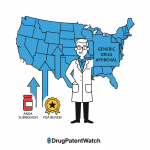
The Hatch-Waxman Act resolved a specific market failure: generic manufacturers were legally required to repeat clinical trials for drugs that had been proven safe and effective for years, which made generic entry prohibitively expensive and meant that in 1984, generics accounted for just 19% of U.S. prescriptions dispensed. The Act’s drafters struck a deal. Generic manufacturers got an abbreviated approval pathway and a statutory safe harbor under 35 U.S.C. § 271(e)(1) that shields development and submission activities from infringement claims. Brand manufacturers got Patent Term Extensions (PTEs) to recapture regulatory review time and a suite of data exclusivities that operate independently of patent status.
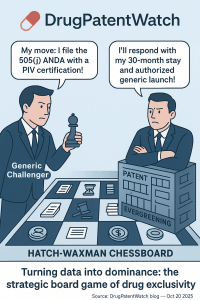
The system’s genius — and its antagonism — comes from one specific design feature: under 35 U.S.C. § 271(e)(2), the act of submitting an Abbreviated New Drug Application (ANDA) containing a Paragraph IV certification is itself defined as an ‘artificial act of patent infringement.’ This legal fiction allows a brand to sue before a single generic tablet is manufactured, forcing resolution of patent validity and infringement questions on a predictable pre-commercialization timeline. Every structural element downstream flows from that single statutory choice.
The ANDA Pathway: Bioequivalence as the Scientific Threshold
An ANDA applicant’s scientific burden is demonstrating bioequivalence to the Reference Listed Drug (RLD), not reproving safety and efficacy. Bioequivalence studies typically measure pharmacokinetic parameters — AUC (area under the curve) and Cmax (peak plasma concentration) — ensuring the generic’s absorption rate and extent fall within an 80-125% confidence interval relative to the RLD. The FDA’s acceptance of the original sponsor’s safety and efficacy data is what makes the abbreviated pathway legally valid. That reliance on prior art, so to speak, is also why the Orange Book listing of the RLD’s patents is so consequential: it defines the exact legal claims the generic must address before FDA can grant final approval.
The safe harbor under § 271(e)(1) is not unlimited. Courts have interpreted it to cover only activities ‘reasonably related’ to FDA submissions. Manufacturing commercial inventory before ANDA approval — as opposed to conducting bioequivalence studies — falls outside the harbor. The line between protected pre-launch preparation and infringing commercial activity is contested territory that resurfaces regularly in at-risk launch disputes.
The Orange Book: What Gets Listed, What Shouldn’t, and the FTC’s Growing Patience Problem
The FDA’s Orange Book lists every patent that ‘claims the drug substance, drug product, or an approved method of using the drug for which a claim of patent infringement could reasonably be asserted.’ Brand manufacturers self-certify these listings; the FDA publishes them without independent patent validity review. That creates a strategic vulnerability the FTC has increasingly targeted: improper Orange Book listings.
The FTC’s 2023 enforcement actions specifically targeted listings of device patents for drug-device combination products — situations where the patent covers the delivery device rather than the drug itself. Listing a device patent can trigger a 30-month stay that protects the drug franchise, even though the patent has no direct claim on the active ingredient. The FDA began sending delisting request letters in 2023, and brands that resist face formal challenges. For generic challengers, monitoring improper listings via quarterly FDA docket reviews is now a routine part of PIV target screening.
The Orange Book’s exclusivity section is equally critical. It distinguishes between four exclusivity types: New Chemical Entity (NCE) exclusivity at five years (during which the FDA generally cannot accept an ANDA for filing at all, not just grant approval), New Clinical Study exclusivity at three years for drugs requiring new clinical investigations to support labeling changes, Pediatric exclusivity adding six months to existing patents and exclusivities, and Orphan Drug exclusivity at seven years for rare disease indications. A generic company that confuses exclusivity types in its filing timeline model is starting from the wrong base date.
The Four Certifications and Why Only One Matters Commercially
When an ANDA filer addresses Orange Book patents, it chooses from four certification types. Paragraph I certifies no patent information has been filed. Paragraph II certifies the patent has expired. Paragraph III certifies the generic will not seek to market until patent expiration. Paragraph IV — the PIV certification — asserts the patent is invalid, unenforceable, or will not be infringed.
Paragraph III is sometimes mistakenly treated as a passive strategy. It can be a deliberate choice, particularly when a formulation challenge is technically difficult or when the development timeline makes earlier-than-expiry entry uneconomic. The more nuanced decision is whether to file a PIV on every listed patent or to carve around certain patents using a skinny label or non-infringing formulation, avoiding litigation on patents where invalidity arguments are weak. Most experienced generic filers work through a patent-by-patent matrix before deciding which certifications to include.
Key Takeaways: Hatch-Waxman Architecture
The ANDA pathway’s economics depend entirely on the quality of bioequivalence data and the accuracy of the exclusivity analysis. Misreading an NCE exclusivity period by even a quarter can send a development program to ANDA filing six months early, only to have FDA refuse to accept it. The improper Orange Book listing issue is no longer theoretical — it is active FTC enforcement territory, and generic companies that identify potentially improper listings now have a formal mechanism to challenge them before filing PIV certifications.
The Mechanics of a PIV Challenge: From Filing Through 30-Month Stay
The PIV Notice Letter: Why Drafting Quality Determines Settlement Leverage
Within 20 days of FDA’s acknowledgment that an ANDA containing a PIV certification is sufficiently complete for review, the generic applicant must notify the brand and each patent holder of its challenge. The statute requires the notice letter to include a ‘detailed statement of the factual and legal basis’ for the invalidity or non-infringement position. Courts have held that a deficient notice letter — one that is cursory on claim construction or omits key prior art — can have procedural consequences, including potential limitations on the arguments available in subsequent litigation.
A well-structured PIV notice letter does several things simultaneously. It lays out the claim construction theory, identifies all prior art supporting invalidity (organized by anticipation under 35 U.S.C. § 102 and obviousness under § 103), and presents the non-infringement argument if applicable. It also functions as a strategic document: it signals to the brand’s legal team the strength and specificity of the generic’s position. A notice letter that is technically thorough and narrowly constructed gives brand counsel less room to maneuver in the initial litigation phase and frequently accelerates settlement discussions, since the brand’s lawyers can immediately see the depth of the prior art problem they face.
Some generic legal teams treat the notice letter as pro forma. That is a mistake the Plavix case history underlines: Apotex’s confidence in its legal position was high enough to support an at-risk launch, but the foundation of that confidence — the quality and completeness of the invalidity argument — turned out to be insufficient.
The 45-Day Window and the Automatic 30-Month Stay: IP Valuation in Real Time
If the brand files a patent infringement lawsuit within 45 days of receiving the PIV notice, FDA approval of the ANDA is automatically stayed for 30 months, unless a court grants an earlier resolution, patent expires, or a court rules that the stay should be terminated. For the brand, the decision to sue within 45 days is straightforward on high-revenue products: the stay is effectively free insurance worth months of protected revenue.
To quantify what that protection is worth: a drug generating $3 billion in annual U.S. net sales with a 70% gross margin produces roughly $175 million per month in gross profit. A 30-month stay is worth, in foregone cannibalization, upward of $5.25 billion in protected gross profit before litigation costs, provided no other patent or exclusivity barrier extends protection beyond 30 months anyway. That calculation changes dramatically for drugs already facing multiple PIV filers, where the stay’s value depends on how many first-to-file exclusivities will overlap and whether the brand’s defensive IP portfolio can extend beyond the stay period.
The stay is not a guarantee of continued exclusivity. A cohort study published in PMC covering 46 drugs found a median of 3.2 years between 30-month stay expiration and actual generic launch. That gap reflects the compounding effect of patent thickets, manufacturing scale-up delays, and settlement agreement terms — all of which can extend practical exclusivity well past the stay’s end date.
IP Valuation of the Stay as a Core Brand Asset
For brand portfolio managers and the investment analysts covering them, the 30-month stay must be treated as a quantifiable IP asset in any sum-of-the-parts (SOTP) model. The standard approach is to build a probability-weighted net present value (NPV) model that discounts peak-year revenues by the litigation outcome probability. A drug with a 65% probability of sustaining its primary composition-of-matter (CoM) patent through PIV litigation, with a $3 billion peak net revenue, and a discount rate of 10%, has a materially different protected revenue NPV than one with a 40% probability. The 30-month stay is the denominator that defines the window in which that probability plays out at brand pricing.
The 180-Day Exclusivity: The First-Filer’s Economics in Detail
The ‘first applicant’ to file a substantially complete ANDA with a PIV certification against any listed patent wins a 180-day period during which FDA cannot grant final approval to any subsequent ANDA for the same drug. The legal trigger for the exclusivity clock was revised by the Medicare Modernization Act of 2003 (MMA) to be the earlier of either: first commercial marketing of the generic, or a court decision holding the challenged patent invalid or not infringed. The MMA also created ‘forfeiture’ provisions that strip exclusivity from first filers who fail to meet specific milestones, ensuring the exclusivity doesn’t sit unused as a blocking mechanism.
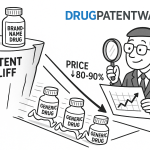
The financial case for pursuing first-filer status is clearest in the blockbuster category. During the 180-day period, the first generic typically prices at a 15-25% discount to the brand, sustaining margins that are impossible to maintain once the fully competitive market opens and generic prices collapse by 80-90%. Barr Laboratories’ generic fluoxetine (Prozac) is the canonical data point: in the first two months after August 2001 launch, Barr captured 65% of the fluoxetine market at near-duopoly pricing, and in Q4 2001, its gross profit margin nearly doubled from 16.8% to 28.7%.
For an investor, the 180-day exclusivity converts into a unique event-driven opportunity. A generic company that is confirmed first-to-file on a $5 billion brand is sitting on a contingent asset whose value depends on three variables: litigation outcome probability, the brand’s decision on an authorized generic, and the extent to which No-AG agreement terms are baked into any settlement.
The Generic Challenger’s Playbook: Target Selection, Invalidity Strategy, and the PTAB Weapon
Freedom-to-Operate Analysis and Patent Thicket Deconstruction
A PIV strategy begins 18 to 36 months before any legal document is filed, with a multi-layer patent landscape analysis. Market size is the primary filter — academic research consistently shows high-revenue drugs face PIV challenges at significantly higher rates than moderate-revenue ones. But market size alone determines only whether a challenge is worth attempting. The critical question is whether the challenge is winnable.
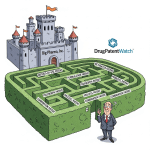
That requires deconstructing the brand’s entire Orange Book portfolio for the target drug, classifying each patent by type and filing date. A typical brand portfolio for a mature blockbuster contains four distinct layers: the original composition-of-matter (CoM) patent protecting the active molecule, formulation patents (extended-release matrix, particle size parameters, excipient ratios), method-of-use patents covering specific approved indications, and process patents covering the manufacturing synthesis route.
CoM patents are typically the strongest; they are filed earliest and have the broadest claims. Secondary formulation and method-of-use patents — filed years or decades after the CoM — are the more productive targets because they are more vulnerable to prior art attacks and prosecution history estoppel arguments. A 2022 study of brand responses to PIV challenges found that brand manufacturers list an average of 0.34 additional patents per challenged drug following a PIV filing, a 13% increase. That reactive listing behavior confirms the strategic logic: brands build their thicket partly in anticipation of challenge, and partly in response to one.
Prior Art Search: Beyond Keyword Matching
The core of any invalidity argument is a prior art search that meets the ‘clear and convincing evidence’ standard for district court challenges (and the lower ‘preponderance of the evidence’ standard at the PTAB). The search must be exhaustive across patent literature (using both USPTO and EPO classification systems like the Cooperative Patent Classification, not just text searches), non-patent literature (peer-reviewed journals, academic theses, conference proceedings), and foreign patent filings (particularly Japanese, European, and PCT applications that may predate a U.S. filing).
Classification searches are often more productive than keyword searches because different inventors describe the same concept with different terminology. Citation searches — mapping both what a patent cites and what later patents cite it — reveal the technical family tree of an invention and often surface prior disclosures that the original examiner missed. For polymorphic forms, which are a common evergreening vehicle, the prior art search must extend to crystallography databases, pharmacopoeial publications, and even internal research disclosures that became publicly available through academic publications.
Prosecution History Estoppel: The Brand’s Self-Inflicted Wounds
Prosecution history estoppel is often the most efficient line of attack in a non-infringement case, because the relevant admissions are already in the public record. Every narrowing amendment or argument-based limitation made during prosecution creates an estoppel that prevents the patent owner from later using the doctrine of equivalents to expand claim scope back to cover what was surrendered. A generic that files a formulation designed to operate outside a pH range that the brand’s attorneys explicitly limited to during prosecution is, in the absence of other claims, legally insulated from infringement under the Federal Circuit’s application of the Warner-Jenkinson standard.
The prosecution file history also frequently reveals enablement and written description vulnerabilities. If a patent’s specification fails to disclose a working example across the full scope of a broad claim, the claim may be invalid for failure to enable. This argument has been increasingly available to generic challengers after the Federal Circuit’s 2023 decision in Amgen v. Sanofi, which applied a rigorous enablement standard to broad functional antibody claims — a decision whose reasoning some ANDA litigators have begun adapting for small-molecule formulation patents with overbroad scope claims.
The PTAB as Parallel Battlefield
The America Invents Act’s creation of the PTAB in 2011 gave generic challengers an administrative alternative to district court invalidity arguments. An Inter Partes Review (IPR) at the PTAB operates under the ‘preponderance of the evidence’ standard rather than district court’s ‘clear and convincing’ threshold, making it structurally easier to win. Average IPR cost through appeal runs approximately $350,000, compared to $2.7 million to $4.5 million for a full Hatch-Waxman trial. PTAB claim invalidation rates on instituted IPRs have historically run in the 60-70% range for all patent types, though rates for pharmaceutical formulation and method-of-use patents specifically vary by claim type.
The dual-front strategy — filing a PIV certification concurrent with an IPR petition — creates maximum pressure on the brand. If the PTAB institutes review, it signals to the district court that the invalidity arguments have enough merit to warrant formal administrative review, which often prompts the court to stay the litigation pending PTAB resolution. A stay saves the generic company the cost of parallel litigation and forces the brand to defend on the administrative record rather than in front of a jury. For brand companies, this means that building a robust prosecution record during patent prosecution — anticipating and pre-responding to likely IPR arguments — is now standard practice at top pharma IP shops.
Key Takeaways: Generic Challenger Strategy
The threshold decision in any PIV program is whether the target’s secondary patent portfolio is genuinely weak or merely appears weak. Rushed prior art searches that miss a key crystallography publication or a foreign patent application can produce a false positive on invalidity confidence, leading to an at-risk launch decision built on incomplete analysis. Budget for a three-month prior art search on any target generating over $1 billion in annual U.S. revenues. Run the prosecution history analysis concurrently. File the IPR petition and the ANDA on parallel timelines where the invalidity case supports both.
Investment Strategy for Generic Portfolio Managers
When evaluating a generic company’s pipeline, weight first-to-file positions on drugs with annual U.S. revenues above $2 billion as high-value contingent assets. Discount those positions by (a) the probability of first-to-file status holding — determined by whether the ANDA has been confirmed as substantially complete by FDA, (b) the litigation outcome probability derived from patent type analysis and comparable case outcomes, and (c) the No-AG risk, which the FTC’s authorized generic report quantifies as a 40-52% reduction in 180-day period revenues. A first-to-file position on a $4 billion drug with a No-AG agreement in place and 70% litigation win probability is worth materially more than a first-to-file position on the same drug without the No-AG protection.
The At-Risk Launch Decision: Economic Model, Legal Threshold, and the Plavix Autopsy
When a District Court Win Isn’t the End
An at-risk launch occurs when a generic company begins commercial sales after FDA final approval but before appellate resolution of the patent case. It is legally permissible — the FDA has issued approval, satisfying the regulatory requirement — but commercially dangerous if the district court verdict is overturned on appeal. The Federal Circuit reverses district court findings of invalidity and non-infringement at a non-trivial rate; precise reversal rates vary by technology type and claim construction issue, but estimates of 20-35% reversal rates on patent issues are consistently cited in the litigation economics literature.
The economic model for an at-risk launch requires estimating four variables with precision: expected revenue during the at-risk period, the probability of appellate reversal, the damages exposure if reversed (calculated based on the brand’s lost profits at brand-price margins), and the legal cost of continuing through appeal. NBER working paper analysis of at-risk launch economics found that, following a district court victory, launching at risk is generally expected-value positive for the generic company — but that expected-value calculation assumes accurate probability estimates for reversal. Systematic overconfidence in legal position quality is the mechanism through which at-risk launches turn catastrophic.
The Plavix Case: $442.2 Million and What the Post-Mortem Reveals
Plavix (clopidogrel bisulfate) was generating roughly $6.2 billion in annual global sales for Sanofi-Aventis and Bristol-Myers Squibb in 2006. Apotex had a settled agreement with the brand companies, then watched regulators — the New Jersey Attorney General and the FTC — signal they would challenge the settlement as anticompetitive. With the settlement unwound, Apotex launched its generic at risk.
The underlying patent validity argument concerned the clopidogrel bisulfate salt form. Apotex argued the salt was an obvious modification of the prior art compound clopidogrel free base. The courts disagreed, finding the sulfate salt’s unexpected superior properties — a key doctrine in obviousness analysis that allows patentees to overcome prima facie obviousness by demonstrating unexpected results — were adequately supported. The final damages award of $442.2 million reflected BMS and Sanofi’s actual lost profits during the at-risk period, calculated at brand-price margins rather than generic margins.
The Plavix post-mortem teaches a specific lesson beyond ‘at-risk launches are risky.’ It illustrates that the obviousness analysis for polymorph and salt form patents requires particular caution. Courts give substantial weight to ‘unexpected results’ evidence, which brand companies routinely generate during late-stage development. Any invalidity argument built primarily on structural similarity — without specifically rebutting the unexpected results data — is structurally incomplete.
Post-Plavix Calculation Framework
Before authorizing an at-risk launch, a generic company’s cross-functional review should answer the following questions with documented analysis: What is the specific grounds of appeal the brand will pursue, and what is the Federal Circuit’s historical reversal rate for that type of argument? What does the brand’s peak annual gross profit loss equal, and does that exceed the generic’s projected at-risk period revenue? Is there a realistic path to a bond or escrow arrangement that limits downside? Has outside appellate counsel specifically reviewed — not the district court trial team — the strength of the grounds on appeal? If any of those questions produce uncertain answers, the launch authorization should be conditioned on additional analysis, not approved on schedule pressure.
The Brand Defender’s Counter-Playbook: Patent Thickets, Authorized Generics, and Product Switching
Evergreening Roadmaps: From CoM to Terminal Disclaimer
‘Evergreening’ is the term critics apply to what brand IP teams call ‘lifecycle management.’ The practice involves filing sequential waves of secondary patents that extend effective market exclusivity beyond the original CoM patent term. A well-constructed evergreening program for a typical oral small-molecule drug follows a predictable architecture over 15-20 years.
In the first phase, the CoM patent issues, typically claiming the active ingredient’s chemical structure and its pharmaceutically acceptable salts. Patent Term Extension under 35 U.S.C. § 156 can add up to five years to the CoM patent term to compensate for FDA regulatory review time, subject to a cap of 14 years of effective post-approval patent protection. Concurrently, brands file polymorph patents (alternative crystalline forms), anhydrate/hydrate patents (different water content forms with distinct physical properties), and particle size patents relevant to solubility or bioavailability. These early secondary patents are filed when the compound’s physical chemistry is being characterized for scale-up, meaning the R&D work generates natural IP opportunities.
In the second phase, as the drug approaches clinical approval, formulation patents cover controlled-release technology (matrix systems, osmotic pumps, enteric coatings), specific excipient combinations that improve stability or bioavailability, and dosage form innovations. These patents typically have filing dates 5-10 years after the CoM and correspondingly extend the exclusivity timeline.
The third phase involves method-of-use patents filed as the drug’s clinical profile expands — new approved indications, new dosing regimens, new patient populations. Method-of-use patents are the most vulnerable to skinny-label carve-outs by generics, but they complicate the freedom-to-operate analysis and increase litigation complexity. Each additional method-of-use patent that a generic company must address with a separate PIV certification, or must carve from its label, increases the cost and regulatory complexity of generic entry.
The terminal disclaimer mechanism — used when a patent’s claims overlap with an earlier patent from the same family — creates interdependencies within a patent portfolio that sophisticated challengers exploit. If a terminal disclaimer ties the enforceability of a 2030 patent to a 2025 patent, invalidating the 2025 patent can collapse both.
The Authorized Generic as a Financial Weapon
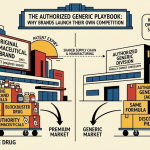
An authorized generic (AG) is chemically and pharmacologically identical to the brand-name drug, marketed under a generic label either by the brand itself or through a licensing partner. The brand can launch an AG during the first-filer’s 180-day exclusivity period because that period only restricts FDA from approving additional ANDAs — it does not restrict the brand’s NDA holder from self-competing.
The FTC’s empirical analysis found that an AG’s presence during the 180-day period reduces first-filer revenues by 40-52% on average. The mechanism is straightforward: pharmacists and PBMs actively substitute toward the AG when its price is comparable to or below the first generic, since the AG carries the brand’s manufacturing provenance without the brand’s price. That substitution effect is amplified when the brand has established dispensing relationships with specialty pharmacies or mail-order operations that can quickly route prescriptions to the AG channel.
The AG’s strategic value is not limited to revenue impact during the exclusivity period. Brands use AG commitments as settlement currency: a ‘No-AG agreement’ — a covenant not to launch an authorized generic during the first-filer’s exclusivity — is a valuable non-monetary transfer that courts post-Actavis treat as a form of ‘payment’ subject to antitrust rule-of-reason analysis. The FTC has found No-AG agreements are common in settlements that delay generic competition, precisely because they make the delayed entry bargain financially worthwhile for the generic company.
IP Valuation: What the AG Option Is Worth to a Brand
A brand holding the AG option has two distinct asset values to weigh. The first is the AG’s contribution to brand revenue during the 180-day period — maintaining 40-52% of first-filer revenue that would otherwise go entirely to the challenger. For a $2 billion drug, that is $400-520 million in protected revenue across the 180-day window. The second is the settlement leverage value: offering to withhold the AG can persuade a first-filer to accept a later entry date that maintains brand monopoly for a period worth considerably more than the AG’s revenue contribution during the exclusivity window. Running both calculations and comparing them against the litigation cost and uncertainty of going to trial is standard practice in brand settlement valuation analysis.
Product Hopping: The Mechanics and the Legal Risk
Product switching, or ‘product hopping,’ involves reformulating a drug — from immediate-release tablet to extended-release capsule, from racemic mixture to single enantiomer (the ‘chiral switch’), or from twice-daily to once-daily dosing — then discontinuing the original formulation before generic versions of it can displace the market. The pharmaceutical chiral switch executed by AstraZeneca with omeprazole (Prilosec) to esomeprazole (Nexium) is the canonical example: the S-enantiomer of omeprazole was filed, patented, and marketed as a distinct new molecule with modestly improved pharmacokinetics, resetting the patent clock and extending exclusivity by over a decade.
The legal risk in product hopping accelerated after the Second Circuit’s 2016 decision in New York v. Actavis PLC (the Namenda case), where the court found that a hard switch — withdrawing the original formulation from the market specifically to prevent generic substitution — could constitute anticompetitive conduct under Section 2 of the Sherman Act if the reformulation’s benefits did not justify eliminating the original product. The practical lesson: brands pursuing product switches should accumulate and preserve clinical evidence supporting the reformulation’s genuine advantages, document that market withdrawal decisions were not driven by generic entry timing, and phase transitions gradually rather than executing a hard cutover.
Citizen Petitions: Tactical Use and FDA’s Response Threshold
A brand company can file a citizen petition with FDA raising scientific or regulatory objections to a specific ANDA or class of generics. The FDA is required to respond before granting approval when a petition presents genuinely substantive issues. However, the FDA Safety and Innovation Act of 2012 requires FDA to deny any petition whose primary purpose is delay, and the agency has become increasingly aggressive in denying petitions filed within 30 days of expected ANDA approval. Citizen petitions retain genuine utility for scientifically complex products — complex generics like inhalers or transdermal systems — where manufacturing equivalence standards remain unresolved. Using them as delay-only instruments on straightforward oral solid dosage forms attracts both FDA skepticism and FTC attention.
Key Takeaways: Brand Defense
The strongest brand defenses are built before the first PIV notice letter arrives. A patent portfolio that requires a generic company to litigate six separate patents across three different claim types — CoM, extended-release formulation, and two method-of-use patents — is materially more expensive and uncertain to challenge than a single-patent fortress. The AG option is worth calculating explicitly before any settlement discussion begins; brands that enter settlement negotiations without a precise AG value estimate routinely under-price the concession they are offering.
Investment Strategy for Brand Company Analysts
For institutional investors, a brand’s resilience to PIV challenge is a direct function of the depth and quality of its secondary patent portfolio. Evaluate: How many Orange Book patents are listed? What percentage are CoM versus secondary? What are the filing dates (later is weaker)? Are any patents subject to terminal disclaimers that create interdependency risk? A drug with a single CoM patent expiring in 2027 and no secondary patents is a revenue cliff. A drug with a CoM expiring in 2027, three formulation patents extending to 2032, and two method-of-use patents extending to 2034 is a revenue ramp with managed decline — a fundamentally different asset for portfolio modeling.
Settlement Strategy and Post-Actavis Antitrust Architecture
Why 76% of PIV Cases Settle Before Trial
The economic logic behind settling PIV litigation is compelling from both sides. For the brand, a trial loss on a primary CoM patent means instantaneous, permanent loss of monopoly pricing on a drug that may be generating $3-5 billion annually. The market capitalization impact is immediate and severe. A settlement that allows generic entry in three years — even if the patent term extends five more years — at least provides a predictable revenue decline curve for financial planning, investor guidance, and pipeline reinvestment decisions.
For the generic company, litigation through trial costs $2.7 million to over $5 million depending on complexity, and the true trial win rate — excluding settlements counted as generic ‘wins’ — runs approximately 48%, essentially a coin flip. A settlement guaranteeing entry in two years on favorable terms is frequently worth more than a 48% chance of immediate entry offset by a 52% chance of zero revenue from that molecule for years.
The gap between the 76% overall ‘success rate’ when settlements are counted as wins and the 48% trial success rate is the most important statistical fact in PIV economics. It explains why settlement occurs: both parties are selling uncertainty at a price that reflects a rational assessment of the litigation’s expected value.
Reverse Payments: The Full Economic Picture
In a standard settlement, the brand grants the generic a licensed entry date and pays nothing. In a reverse payment (or ‘pay-for-delay’) settlement, the brand pays the generic — in cash, services, or valuable non-monetary consideration — to accept a later entry date. The counterintuitive direction of payment reflects the underlying economics: the brand’s monopoly profits during the delayed period exceed the litigation cost plus the payment to the generic, while the generic receives a guaranteed revenue stream without litigation risk.
The FTC’s January 2010 staff study estimated that pay-for-delay agreements cost U.S. consumers $3.5 billion per year, with average entry delays of approximately 17 months beyond what agreements without payments would have produced. More recent analyses from academic researchers extend this estimate: one 2023 actuarial study placed the annual system cost at between $6.2 billion and $37.1 billion, with the wide range reflecting methodological assumptions about what the counterfactual generic entry date would have been absent the payment.
The critical structural variable is why the payment exists. In true patent cases, a large reverse payment is the legal literature’s proxy for patent weakness: a rational brand only pays a large sum to delay generic entry if it believes its patent would not survive litigation. A strong patent does not require a payment; the threat of infringement damages is itself sufficient deterrent.
FTC v. Actavis: The Rule of Reason Established
The Supreme Court’s 2013 decision in FTC v. Actavis resolved a circuit split and established that reverse payment settlements are neither automatically immune from antitrust law nor presumptively illegal. They must be evaluated under the antitrust ‘rule of reason,’ with the key trigger for scrutiny being a ‘large and unjustified’ payment from the brand to the generic.
‘Large’ in the Actavis framework refers to size relative to the generic’s litigation costs — a payment that exceeds what litigation costs could justify signals that the brand is paying for delayed competition, not for settling a legitimate dispute. ‘Unjustified’ means not offset by independent business justification (e.g., a legitimate services agreement, a co-promotion deal with real commercial value).
Post-Actavis litigation has generated several important downstream rulings. Courts have confirmed that No-AG agreements are a form of ‘payment’ subject to Actavis scrutiny. They have also recognized that other non-monetary value transfers — co-promotion agreements priced above fair market value, favorable licensing terms for unrelated products, supply agreements with below-market pricing — can constitute reverse payments. Structuring a settlement to avoid Actavis scrutiny now requires antitrust counsel working in parallel with IP counsel throughout the negotiation.
Settlement Structuring in the Post-Actavis Environment
The safest PIV settlement from an antitrust standpoint is a pure entry-date license with no additional consideration flowing from brand to generic. That structure still raises no red flags under Actavis. Once any additional consideration is added — a No-AG covenant, a cash payment, a services agreement — the settlement requires a documented justification that accounts for the consideration’s fair market value and tethers it to a legitimate business purpose independent of the patent dispute.
Experienced PIV counsel on both sides now build settlement documents to include (a) an explicit representation of the parties’ assessment of patent strength, (b) valuation documentation for any non-patent consideration, and (c) an antitrust sign-off from independent outside counsel. That documentation does not guarantee immunity from FTC challenge or class action antitrust suits from direct purchasers and end-payors, but it is essential evidentiary foundation for any rule-of-reason defense.
Key Takeaways: Settlement Strategy
No PIV settlement should be executed without a documented antitrust analysis of every element of consideration exchanged. The Lipitor litigation’s $93 million settlement with no admission of wrongdoing resolved a dispute that consumed over a decade of legal resources and generated substantial management distraction. The FTC’s enforcement posture is not softening; its 2023 and 2024 enforcement actions show continued focus on both reverse payments and improper Orange Book listings as independent antitrust theories.
Landmark Cases: Four PIV Archetypes That Define Strategic Thinking
Prozac (Fluoxetine): Barr Laboratories and the Commercial Template for First-Filer Success
Barr Laboratories filed its PIV certification against Eli Lilly’s Prozac (fluoxetine) in 1996, targeting secondary patents protecting the blockbuster antidepressant. After five years of litigation, Barr won, invalidating a key patent. The August 2001 launch produced two months of 65% market share capture and Q4 2001 gross profit margins nearly doubling from 16.8% to 28.7%, on $360 million in product sales during that quarter alone.
The Prozac case established the commercial template that has driven PIV filings ever since. The drug was generating over $2 billion annually, the secondary patent was vulnerable to prior art attack, and Barr had the resources and legal preparation to sustain five years of litigation. That three-factor template — high revenue target, patent vulnerability, and organizational capacity for multi-year litigation — remains the baseline filter every generic company applies in target screening.
Eli Lilly’s post-Prozac response is equally instructive. The company was not caught entirely without a plan; it had been developing duloxetine (Cymbalta) as a successor antidepressant and pivot product. But the speed and depth of generic penetration after Barr’s launch — generic fluoxetine captured over 80% of the market within a year — demonstrated that product switching plans require execution well ahead of the primary patent cliff, not concurrent with it.
Plavix (Clopidogrel): The At-Risk Launch Benchmark and the Salt Patent Lesson
The Plavix litigation between Sanofi/BMS and Apotex is covered in detail in the at-risk launch section above, but its IP valuation implications deserve separate treatment. Sanofi’s clopidogrel bisulfate salt patent had an estimated IP value — measured as the NPV of the monopoly revenue it protected — exceeding $10 billion at the time of the 2006 dispute, based on Plavix’s annual revenues approaching $6 billion globally. That valuation is what made the litigation worth fighting, the settlement worth attempting, and the at-risk launch worth risking from Apotex’s perspective.
The salt patent’s survival rested on a well-documented ‘unexpected results’ argument: the bisulfate salt showed substantially superior bioavailability and stability compared to the free base and other salt forms, a property that was not predictable from the prior art. Generic challengers pursuing polymorph or salt form patents should treat any brand with strong clinical stability data as requiring an elevated obviousness threshold — ‘unexpected results’ is not a marginal doctrine in pharmaceutical obviousness litigation.
Lipitor (Atorvastatin): The Pfizer-Ranbaxy Settlement and the Antitrust Long Tail
Lipitor was the world’s best-selling drug at the peak of its franchise, generating over $13 billion in annual global sales in 2006. Pfizer’s settlement with Ranbaxy, the confirmed first-to-file PIV challenger, allowed generic entry in late 2011, years before some listed patents expired. Plaintiffs in subsequent antitrust litigation alleged the settlement was structured to also delay competing generic challengers, not merely resolve the Pfizer-Ranbaxy dispute.
The antitrust case dragged through more than a decade of class certification battles, discovery, and evidentiary disputes before Pfizer agreed to pay $93 million to resolve claims from direct purchasers and end-payors. The payment included no admission of wrongdoing, but the legal cost in time, management attention, outside counsel fees, and reputational friction was substantially higher than $93 million.
The Lipitor antitrust litigation has a specific lesson for settlement architects: settlements that resolve the lead PIV case while structurally disadvantaging follow-on ANDA filers — through most-favored-entry clauses, first-filer consent requirements, or AG deployment timing tied to follow-on launch triggers — carry antitrust risk that extends beyond the primary Actavis analysis. Independent outside antitrust counsel who have reviewed the follow-on filer impact is now a settlement structuring requirement at leading pharma companies, not a recommendation.
Nexium (Esomeprazole): The Skinny Label Problem and Induced Infringement
AstraZeneca’s Nexium (esomeprazole) was the commercial product of one of the pharmaceutical industry’s most documented chiral switch strategies. By patenting the S-enantiomer of omeprazole, AstraZeneca extended its proton pump inhibitor franchise by over a decade after Prilosec’s CoM patent expired. Generic challengers — Ranbaxy, Teva, and Dr. Reddy’s — pursued skinny-label strategies, carving out the patented method-of-use claims and seeking approval for non-patented indications only.
The core legal issue in the ensuing antitrust litigation was whether AstraZeneca’s settlements with the generics constituted pay-for-delay, and whether the skinny-label strategy adequately insulated generics from induced infringement claims even after the carve-out. The First Circuit ultimately found that while the Ranbaxy settlement showed the characteristics of an anticompetitive payment, the plaintiffs had not proven antitrust injury — they could not establish that a generic would have launched earlier absent the settlement.
The Nexium case produced a specific downstream implication for skinny-label strategy that is still being worked through in courts: labeling that carves out a patented indication must do so cleanly. If the remaining label language, prescribing information, or patient population description effectively directs clinicians to use the drug in a way that infringes the patented method, the ‘carve-out’ may not insulate the generic from an induced infringement claim under the standard established in Warner-Lambert v. Apotex. Generic legal teams filing skinny-label ANDAs now routinely obtain a formal legal opinion on induced infringement risk for every patented indication in the carve-out before ANDA submission.
Competitive Intelligence Infrastructure: Patent Data as a Strategic Asset
Why Manual Monitoring Fails at Scale
The data universe relevant to PIV strategy spans the FDA’s Orange Book (updated weekly), ANDA patent certifications published quarterly, USPTO patent prosecution records, federal court PACER dockets, PTAB petition filings, and FTC enforcement records. A mid-size generic company tracking 50 active development targets across all these sources manually requires dedicated analyst capacity that is both expensive and error-prone. The compounding problem is that PIV timing windows are unforgiving: the 45-day deadline for a brand to file suit, the 20-day notice letter window, PTAB petition filing deadlines, and ANDA filing timing relative to competitor first-to-file status all require real-time monitoring, not weekly batch reviews.
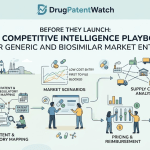
Platforms like DrugPatentWatch address this by aggregating and structuring these disparate data streams into searchable, alertable intelligence. The practical value is not just convenience — it is the ability to conduct the multi-layer analysis that connects a new PIV filing in FDA’s ANDA database to the filer’s historical litigation win rate, the patents being challenged (with their prosecution history flags), and the drug’s revenue profile, all in a single analytical interface.
Orange Book Patent Expiration Modeling
The most fundamental use case for pharmaceutical IP intelligence platforms is accurate exclusivity timeline modeling. This requires tracking not just nominal patent expiration dates but Patent Term Extensions (PTEs) awarded under § 156, pediatric exclusivity add-ons (the six months that attaches to existing patents), and Orange Book delisting activity — where brands remove patents from the Orange Book either voluntarily or under FDA pressure following an improper listing challenge. A model that misses a pediatric exclusivity extension miscalculates the ANDA approval date by six months, which can mean the difference between capturing first-to-file exclusivity and being the second filer with no exclusivity at all.
Litigation Analytics: Building Predictive Launch Models
The most sophisticated analytical application of PIV data is building predictive models for generic launch timing. This requires integrating four data dimensions: patent type (CoM vs. formulation vs. method-of-use) and its historical invalidation rate at both district court and PTAB, the specific district and judge assigned to the case (certain districts, particularly Delaware, have faster resolution timelines and specific procedural requirements like Judge Connolly’s standing order limiting assertable claims), the law firms representing each party and their historical PIV win rates, and settlement frequency patterns for the brand company defendant.
This multi-dimensional analysis is what separates a generic company that enters a market 18 months before its competition from one that enters 6 months after. For a $3 billion drug, that 24-month difference in entry timing represents hundreds of millions of dollars in revenue captured or missed.
Key Takeaways: Competitive Intelligence
Competitive intelligence in the PIV context is not a research function — it is a core strategic input for portfolio management, capital allocation, and litigation budgeting decisions. The companies that win consistently in PIV competition have built data infrastructure that turns FDA, USPTO, and court data into real-time decision support. The companies that struggle are making portfolio decisions based on analysis that is six weeks stale.
The Biosimilar Battleground: How the BPCIA Differs from Hatch-Waxman and Why It Matters
The Patent Dance: Optional, Consequential, and Strategically Complex
The Biologics Price Competition and Innovation Act of 2010 created the abbreviated pathway for biosimilars — follow-on versions of biologic reference products — modeled loosely on Hatch-Waxman. But several structural differences make the BPCIA a fundamentally distinct competitive environment.
The most operationally significant difference is the ‘patent dance.’ Under BPCIA, biosimilar applicants share their full application with the reference product sponsor (RPS) within 20 days of FDA’s acceptance notification, allowing the RPS to identify relevant patents. The parties then exchange patent lists, identify which patents will be litigated in a ‘first wave,’ and negotiate which additional patents can be added. This creates a negotiated discovery process rather than the Orange Book’s public, mandatory listing system.
The Supreme Court’s 2017 decision in Sandoz v. Amgen held that the patent dance is optional for the biosimilar applicant. Opting out removes the structured patent identification process but does not prevent patent litigation — it simply changes the procedural posture. An RPS whose biosimilar applicant skips the dance can file a declaratory judgment action for all potentially relevant patents immediately, rather than waiting for the dance’s staged disclosure sequence. For biosimilar applicants with strong freedom-to-operate analysis and confidence in their non-infringement position, opting out and forcing the RPS to identify and assert its patents quickly can compress the litigation timeline in their favor.
BPCIA vs. Hatch-Waxman: The Structural Comparison
The absence of an automatic stay under BPCIA fundamentally changes the brand defense calculus. Under Hatch-Waxman, the 30-month stay is the brand’s first and most reliable defensive tool; it buys 30 months of litigation time at no incremental cost beyond filing the lawsuit. Under BPCIA, there is no automatic stay. An RPS seeking to prevent biosimilar market entry pending litigation must affirmatively seek a preliminary injunction, meeting the standard four-factor test: likelihood of success on the merits, irreparable harm, balance of equities, and public interest. That is a substantially higher burden than a Hatch-Waxman lawsuit that automatically triggers a stay.
The exclusivity structure also differs materially. Biologic reference products receive 12 years of market exclusivity under BPCIA — more than double the five-year NCE exclusivity for small molecules. Biosimilar applicants receive no general exclusivity period comparable to the 180-day first-filer prize. A 12-month exclusivity period is available only for the first biosimilar to be designated ‘interchangeable’ by FDA — a higher regulatory standard than mere biosimilar approval that requires additional data demonstrating the biosimilar can be substituted without prescriber intervention. The interchangeable designation has strategic implications for state pharmacy substitution laws; only interchangeable biosimilars are automatically substitutable at the pharmacy level in most states, making interchangeability a critical commercial objective in addition to a regulatory one.
Biologic IP Valuation: The $400 Billion Reference Product Market
The commercial stakes in the biosimilar space are substantial. AbbVie’s adalimumab (Humira) generated U.S. revenues of approximately $21 billion in 2022, making its patent cliff one of the most valuable IP valuation events in pharmaceutical history. AbbVie’s strategy — filing over 250 patents related to adalimumab and entering into a web of settlement agreements with biosimilar developers that delayed U.S. entry until January 2023, years after European biosimilar entry — is the BPCIA-era equivalent of the Hatch-Waxman patent thicket, executed at biologic scale.
Amgen’s etanercept (Enbrel), Roche/Genentech’s trastuzumab (Herceptin), and Janssen’s infliximab (Remicade) represent similarly high-value biologic franchises where biosimilar entry timing was determined not primarily by the primary biologic patent but by the secondary patent web and settlement structure. For investors, the lesson from the Humira model is that biologic IP portfolios should be evaluated not by patent count alone but by the strategic coherence of the settlement architecture — how many biosimilar developers have entered into authorized biosimilar agreements (ABA’s) that delay at-risk market entry, and how many have remained outside that structure and are actively litigating.
Emerging Fronts: Skinny Labels, PTAB Reform, and AI in PIV Strategy
The Skinny Label Battleground in 2024-2026
The Federal Circuit’s decision in GSK v. Teva (the Coreg case) created substantial uncertainty around skinny-label strategy by allowing a jury to find induced infringement even where the generic had carved out the patented indication. The court found that Teva’s promotional materials and label language, taken together, could support a finding that Teva intended to induce infringement of the patented heart failure indication even though that indication was nominally absent from the label. The decision sent a chill through the generic industry, which had relied on skinny labels as a reliable mechanism for launching before all method-of-use patents expire.
Post-GSK v. Teva, generic companies must be meticulous not just about label language but about the full body of promotional communications, prescribing information footnotes, and any marketing materials that reference the off-label use. The standard is intent-based: did the generic company know or have reason to know its product would be used to infringe? Documentation of deliberate, affirmative efforts to avoid directing use toward the patented indication is now a litigation requirement, not just a compliance exercise.
The legislative response is pending. The ‘Skinny Labels, Big Savings Act’ has been introduced in Congress with bipartisan support. It would provide clearer safe harbor for skinny-label generics, limiting induced infringement liability in cases where the generic made genuine, documented efforts to carve out patented indications. The bill’s passage would meaningfully reduce the method-of-use patent’s defensive value for brands and accelerate the adoption of partial-indication generic entry strategies.
AI in Prior Art Search and Litigation Prediction
AI-powered legal analytics tools are beginning to change the economics and time-investment of prior art searches. Machine learning models trained on patent classification data can identify structurally and functionally related prior art across global patent databases — including JPO, EPO, CNIPA, and PCT filings — with a speed that human search teams cannot match. The practical benefit is not replacing expert patent attorneys but compressing the timeline from 12 weeks to 4-6 weeks for an initial landscape analysis, while surfacing non-English-language prior art that would be missed in English-only searches.
Litigation prediction models — using case outcome data from thousands of district court and PTAB proceedings — are being deployed by larger generic companies to inform portfolio targeting and at-risk launch decisions. These models are most accurate for questions with large historical datasets (claim construction disputes in specific technology areas, PTAB institution rates by technology type) and least reliable for predicting outcomes in cases with novel legal theories or unconventional technology. They should be treated as probability-weighting tools that inform expert judgment, not replace it.
Judge-Specific Procedural Requirements and Their Strategic Implications
The concentration of Hatch-Waxman litigation in the District of Delaware — where a majority of large pharmaceutical companies are incorporated — has made Delaware’s judiciary disproportionately influential in setting PIV precedent. Judge Connolly’s standing order, which requires parties to narrow assertable patent claims and prior art references early in litigation, has materially changed litigation economics in Delaware cases. Brands can no longer assert a full patent portfolio through trial; they must identify and commit to their strongest patents early. Generics face symmetric pressure to identify their best prior art arguments upfront rather than maintaining optionality through discovery.
This judicial pressure benefits whichever party has done the most thorough pre-litigation analysis. A generic company that has completed a comprehensive prosecution history analysis and constructed a detailed claim chart before ANDA filing is in a strong position to comply with Connolly-style narrowing orders. A brand that enters litigation with a broad assertable claim set but weak analysis of each patent’s individual strength will be forced to make difficult prioritization choices under time pressure.
Key Takeaways for Pharmaceutical IP Teams and Portfolio Managers
PIV litigation is not a legal event that happens to a pharmaceutical business — it is a structural feature of the pharmaceutical business lifecycle. Every drug with annual U.S. revenues above $500 million should have a documented PIV risk assessment in its brand lifecycle plan within three years of approval.
For brand companies, the most durable protection comes not from any single patent but from portfolio depth. A generic company facing six patents across four different IP types — with different expiration dates, different legal theories required for challenge, and at least two requiring expensive bioequivalence study designs to demonstrate non-infringement — is facing $15-25 million in litigation investment before the first revenue dollar. That friction is not absolute protection, but it screens out undercapitalized challengers and forces better-capitalized ones to make tighter portfolio allocation decisions.
For generic companies, the systematic failure mode is overconfidence in invalidity arguments built on incomplete prior art analysis. The Plavix case’s $442.2 million outcome was not the result of a reckless company ignoring risk — it was the result of a technically detailed legal analysis that turned out to miss the commercial and clinical depth of the brand’s ‘unexpected results’ evidence. Every at-risk launch authorization needs independent appellate counsel review, not just trial counsel review.
For institutional investors, PIV risk and PIV opportunity are both systematically underpriced in pharmaceutical company valuations at the early-to-mid litigation stage, before district court decisions produce hard data. The 48% generic trial win rate means that a brand’s stock market pricing often underestimates loss probability during the litigation phase, and a generic company’s valuation often underestimates upside from first-to-file positions that have not yet been fully priced. The data infrastructure to resolve that pricing uncertainty — patent portfolio analysis, prosecution history quality assessment, litigation analytics — is available and increasingly accessible through specialized platforms. Investors who build that analysis into their process have an informational advantage over those relying on binary ‘win or lose’ scenarios.
Frequently Asked Questions
What determines whether a Paragraph IV challenge is commercially viable?
Market size is the primary threshold filter: the 180-day exclusivity is only financially transformative on drugs generating $500 million or more annually, with the economics improving sharply above $1 billion. Secondary filters are patent portfolio vulnerability (number of listed patents, patent types, filing dates relative to CoM) and technical feasibility of bioequivalence demonstration. A drug with a single weak formulation patent, $3 billion in revenues, and a straightforward oral solid dosage form is a far more attractive target than a $4 billion drug protected by a dense patent thicket including three method-of-use patents and a complex delivery system requiring specialized bioequivalence methodology.
How should a brand company prioritize its defensive patent filings?
Prioritize patents that create maximum litigation complexity for a generic challenger, not just maximum number of patents. A single polymorph patent that requires the generic to reformulate its active ingredient is more defensively valuable than three method-of-use patents that can all be skinny-labeled around. Focus formulation patent investments on innovations that have genuine commercial value (improved stability, dosing convenience, reduced food effect) because those patents simultaneously generate revenue through product switching and provide credible non-obvious differentiation in litigation.
What has changed in post-Actavis settlement structuring?
The default settlement structure is now a pure licensed entry date, with any additional consideration documented at independently assessed fair market value and tied to a legitimate business purpose. No-AG agreements require explicit NPV quantification and antitrust review before inclusion. Settlements involving co-promotion or service agreements require arms-length pricing analysis. Large cash payments from brand to generic now require a formal legal opinion on Actavis compliance before execution. Independent antitrust counsel — separate from IP litigation counsel — should review every settlement that includes consideration beyond the entry license itself.
Is an at-risk launch ever strategically appropriate?
At-risk launches can be value-positive on an expected-value basis when the generic company has a district court win, an independent appellate opinion that the grounds for reversal are weak, brand damages exposure that does not exceed the present value of at-risk revenues, and the financial capacity to sustain a damages award without business disruption if wrong. All four conditions must be present simultaneously. If any is absent, the authorization process should require additional analysis or should be declined.
How do biosimilar IP strategies differ from small-molecule PIV strategies?
The primary structural differences are: no automatic 30-month stay in BPCIA (requiring affirmative preliminary injunction motion for brand protection), optional patent dance that affects litigation posture rather than patent validity, 12-year reference product exclusivity instead of 5-year NCE exclusivity, no equivalent 180-day first-filer prize for biosimilar applicants generally, and a 12-month interchangeability exclusivity available only to the first designated interchangeable biosimilar. Biologic IP portfolios are also typically larger, with more manufacturing process patents and more structure-of-the-molecule complexity. Biosimilar challengers must invest substantially more in analytical characterization of the reference product’s molecular attributes before filing, making the pre-litigation analytical costs higher than for small-molecule ANDA programs targeting comparable revenue opportunities.