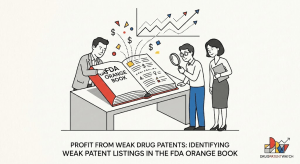
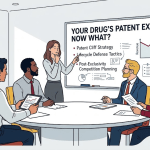
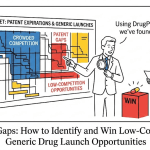
The U.S. Food and Drug Administration (FDA) maintains a registry that dictates the cash flow of the global pharmaceutical industry. This registry, known as the Orange Book, functions on an honor system that brand-name drug manufacturers have exploited for decades.1 When a company lists a patent in this book, it gains the power to trigger an automatic 30-month stay against any competitor attempting to bring a lower-cost version to market.4 This stay is a statutory injunction that requires no proof of patent validity or infringement to activate. It is a purely administrative mechanism that preserves monopolies.4
Identifying weak or improper listings in this registry is the most effective way for generic manufacturers to bypass these stays and capture market share years ahead of schedule. The landscape of this registry is changing because of aggressive enforcement by the Federal Trade Commission (FTC) and a strict new legal standard established by the U.S. Court of Appeals for the Federal Circuit.8 Manufacturers that once relied on broad device patents to block competition now face a reality where a patent must claim the active ingredient to remain in the Orange Book.6
The Ministerial Loophole and the Honor System
The FDA does not have the resources or the legal mandate to verify the patents submitted for listing in the Orange Book.1 The agency describes its role as ministerial. It accepts the patent information provided by the New Drug Application (NDA) holder, provided the submission includes the required declaration forms.1 This lack of oversight created an environment where companies list patents for secondary features, such as dose counters, springs, or distribution software, to extend the life of a monopoly long after the primary chemical patent expires.6
Drug-patent owners are given wide latitude in their ability to list patents.17 While the statute governing the Orange Book only permits patents that claim the drug or a method of using the drug, the definition of those terms has been stretched by corporate legal departments.6 The result is a registry filled with patents that do not meet the statutory criteria for listing but nonetheless block the introduction of lower-cost generic alternatives.3
The 30-Month Statutory Shield
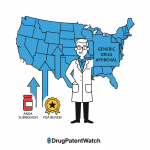
The power of an Orange Book listing resides in the 30-month stay provision of the Hatch-Waxman Act.4 When a generic manufacturer files an Abbreviated New Drug Application (ANDA) with a Paragraph IV certification, it is asserting that the listed patents are invalid or not infringed.1 The brand-name company then has 45 days to file a lawsuit.1 If they sue, the FDA is barred from approving the generic drug for 30 months while the litigation proceeds.4
Statutory Provision
Mechanism
Economic Impact
Paragraph IV Certification
Asserts patent invalidity or non-infringement 18
Triggers 45-day window for brand to sue 1
45-Day Litigation Trigger
Suit must be filed within this window 4
Activates the automatic stay 1
30-Month Stay
FDA approval is frozen for 2.5 years 4
Guarantees monopoly revenue during litigation 6
Ministerial Listing
FDA accepts patent without review 1
Shifts burden of proof to generic challengers 11
This stay protects the innovator’s revenue regardless of the strength of the patent.6 For a drug generating $\$1$ billion in annual revenue, each day of delay is worth approximately $\$2.7$ million.19 The cost of a lawsuit is a negligible fraction of the revenue preserved by the stay.19
Statutory Listing Requirements under 21 C.F.R. § 314.53
The rules for what can be listed are found in 21 C.F.R. § 314.53. These regulations were intended to limit listings to patents that directly cover the drug product or its approved uses.20 The law divides listable patents into three categories: drug substance, drug product, and method of use.7
Drug Substance and Active Ingredient Criteria
A patent must claim the drug substance, which is the active ingredient in the approved product.20 This includes patents that claim specific polymorphic forms of the drug, such as different crystalline structures.20 If a company claims only a polymorph, they must provide test data demonstrating that the drug product containing that polymorph performs identically to the drug described in the NDA.21 Patents that claim only an intermediate used in the manufacturing process are not eligible for listing.21
Drug Product and Finished Dosage Forms
Drug product patents must claim the formulation or composition of the drug as it is described in the NDA.20 This category is frequently where weak listings appear. The FDA defines a drug product as a finished dosage form, such as a tablet, capsule, or solution.23 The 2003 Final Rule explicitly states that patents for bottles, containers, and packaging should not be submitted, as these are not dosage forms.23
Method-of-Use and Labeling Constraints
Method-of-use patents are only eligible if they claim an approved indication or condition of use.20 The NDA holder must identify the specific sections and subsections of the approved labeling that describe the patented method.20 If a patent claims a use that is not in the FDA-approved label, it cannot be listed.20 Generic firms use this requirement to their advantage by carving out patented uses from their labels, a strategy known as the Section viii statement.2
The API Mandate: Teva v. Amneal
In December 2024, the U.S. Court of Appeals for the Federal Circuit established a strict new standard for Orange Book eligibility in Teva Branded Pharm. Prods. R&D, Inc. v. Amneal Pharms. of N.Y., LLC.6 The court addressed whether Teva could list patents for its ProAir HFA inhaler that covered the mechanical components of the device but did not mention the drug itself.8
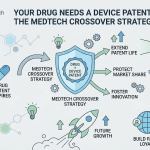
Teva argued that the term drug should be interpreted broadly to include any component that assists in treating a disease.8 The court rejected this, holding that for a patent to claim the drug, it must claim at least the active pharmaceutical ingredient (API) of the approved product.6 Because Teva’s patents were directed at dose counters and inhaler mechanics without reciting albuterol sulfate, they were ordered to be delisted.10
Standard for Listing Eligibility
The Federal Circuit ruling clarified that a patent is not listable simply because the finished product would infringe it.6 The court instituted a restrictive standard where the patent must particularly point out and distinctly claim the drug as the invention.28 This ruling prevents manufacturers from using broad hardware patents to block competitors whose products use the same off-patent drug but different delivery mechanics.6
Case Detail
Teva’s Argument
Court’s Holding
Definition of Drug
Includes any component used for treatment 8
Must claim the active pharmaceutical ingredient 8
Claim Scope
Device patents cover the drug product 8
Hardware-only claims do not claim the drug 28
Infringement vs Listing
If it infringes, it is listable 6
Infringement does not equal listability 6
Remedy
Maintain listing during litigation 10
Ordered immediate delisting of five patents 27
The implications extend to high-value assets like Ozempic and EpiPens, where the primary molecule patents are expiring but secondary device patents remain in the Orange Book.6
The FTC Counter-Offensive: 2023–2025
The FTC, under the leadership of Chairs Lina Khan and Andrew Ferguson, has launched an aggressive campaign to purge improper listings.8 In September 2023, the agency issued a policy statement declaring that improper Orange Book listings may constitute an unfair method of competition under Section 5 of the FTC Act.28
The Three Rounds of Warning Letters
The FTC has used the FDA’s patent listing dispute process provided in 21 CFR 314.53(f) to challenge hundreds of patents.29
November 2023: The FTC challenged more than 100 patents for asthma inhalers, epinephrine autoinjectors, and multi-dose bottles.15 Companies were given 30 days to withdraw the listings or certify their correctness under penalty of perjury.28
April 2024: The list expanded to more than 300 listings for diabetes, weight loss, asthma, and COPD drugs.28 This round targeted blockbuster weight loss medications like GLP-1 agonists.11
May 2025: The FTC renewed its challenge against more than 200 listings that remained in the Orange Book despite previous warnings.8 This round followed the Teva v. Amneal decision, which provided the legal foundation for the FTC’s arguments.8
In December 2025, Teva Pharmaceuticals requested the removal of more than 200 improper patent listings following these challenges.35 This initiative has paved the way for generic competition for more than 30 distinct drug products.35
REMS Patents: Systems as Barriers
Risk Evaluation and Mitigation Strategies (REMS) are programs required by the FDA to ensure that the benefits of a drug outweigh its risks.36 Innovator companies have frequently listed patents covering these distribution systems in the Orange Book to block generic entry.2
The Xyrem Case Study
In Jazz Pharms., Inc. v. Avadel CNS Pharms., the court addressed the listing of a REMS patent for Xyrem, a drug for narcolepsy.2 The patent claimed a system for controlling access to the drug through a central pharmacy and a computer database.2 The court ruled that this was a system patent, not a method-of-use patent.2 Because the statute only permits the listing of method-of-use patents, the system patent for the REMS was ordered to be delisted.2
This case established that if a REMS patent does not claim a specific medical indication or a condition of drug use, it is ineligible for the Orange Book.2 This prevents manufacturers from using database architecture to block competitors who are required by the FDA to use similar distribution safety protocols.16
The Economic Reward of the Paragraph IV Challenge
Generic manufacturers do not challenge every patent. They focus their resources on drugs where the potential profit exceeds the cost of litigation, which averages between $\$3$ million and $\$5$ million through trial.37 The primary driver for these challenges is the 180-day market exclusivity period.18
“This 180-day exclusivity blocks the FDA from approving any subsequent generic application for the same drug during that window. This period typically accounts for 60% to 80% of a generic product’s total lifetime profits.” 18
ROI Calculations and Price Erosion
The value of being first is massive. A first-to-file generic can capture a high-margin duopoly with the brand, often pricing at a 20% to 40% discount to the original brand price.18
Market State
Average Price Reduction
Strategic Dynamic
First Generic Entry
20% – 40%
High-margin duopoly; “brass ring” phase 18
2 Competitors
50% – 55%
Prices begin to crack; margins compress 18
3 – 5 Competitors
60% – 70%
The commoditization cliff begins 18
6+ Competitors
> 95%
Pure commodity market; volume-dependent profit 18
Analysts use DrugPatentWatch to monitor these entries and the resulting price erosion. In markets with six or more competitors, prices often fall by 95% from the original brand price.39 This competitive collapse saved the U.S. healthcare system over $\$2.9$ trillion in the last decade.39
Forfeiture Triggers and the Use It or Lose It Rule
The 180-day exclusivity is a tradable and forfeitable asset.18 The Medicare Prescription Drug, Improvement, and Modernization Act (MMA) of 2003 introduced mandatory forfeiture triggers to prevent first filers from parking their exclusivity to block all other generic competition.18
Failure to Market: If the first applicant fails to market their drug within 75 days of a final court decision or the delisting of the patent, they forfeit their exclusivity.18
Failure to Obtain Approval: Missing the 30-month window for tentative FDA approval leads to automatic forfeiture.18
Anticompetitive Agreements: If the FTC or a court determines that the first applicant entered into an illegal pay-for-delay settlement, the exclusivity is lost.18
Withdrawal of Application: Amending or withdrawing the ANDA results in forfeiture.18
Analysts use DrugPatentWatch to mark red-zone dates for these triggers, allowing competitors to predict when a stalled generic market might suddenly open.18
Patent Thickets and the Move to the Patent Slope
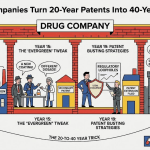
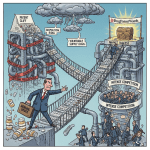
Innovator companies have replaced the traditional patent cliff with the patent slope.43 Instead of a single patent expiration leading to a 90% revenue drop, they construct a dense web of secondary patents on formulations, manufacturing processes, and secondary uses discovered years after launch.37
Case Study: The AbbVie Fortress
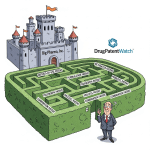
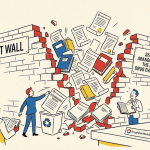
AbbVie’s defense of Humira (adalimumab) is the definitive example of a patent thicket.43 The company built a wall of over 130 patents covering the drug’s formulation and manufacturing.26 Most of these patents were non-patentably distinct and were linked by terminal disclaimers.26
The result was a two-phase entry strategy:
Phase 1 (2022 – 2026): Select generic manufacturers launched with market share caps in the single digits.26
This staggered entry ensures that generic prices remain high during the first phase because manufacturers have no incentive to cut prices if they cannot capture more volume.44 This strategy preserves billions in revenue for the brand manufacturer even after the primary patent has expired.44
Modeling Loss of Exclusivity with DrugPatentWatch
Mastering LOE strategies requires integrating legal data with predictive analytics.18 Analysts use DrugPatentWatch to identify vulnerabilities in competitor fortresses years before statutory expiration.18 The platform tracks litigation dockets, tentative approvals, and the submission of Drug Master Files (DMFs) by API vendors.18
Analytical Metric
Definition
Practical Application
Paragraph IV Monitoring
Real-time tracking of PIV certifications 19
Provides early warning of generic interest 19
Tentative Approval Window
30-month clock for FDA approval 18
Identifies risks of exclusivity forfeiture 18
RORC
Return on Research Capital formula 37
Measures effectiveness of replacing cliff revenue 37
Price Erosion Curve
Historical data on generic price drops 40
Models market dynamics for new entrants 18
The most important predictor of a patent challenge is the annual market value of the drug.37 Blockbusters with multi-billion dollar revenues are almost certain to face challenges within the first year of eligibility.37
The Impact of the Inflation Reduction Act (IRA)
The IRA has introduced a negotiation cliff that acts as a de facto loss of exclusivity.18 Small-molecule drugs are eligible for government price negotiation nine years after approval, while biologics have a 13-year window.18 This has led to a significant shift in funding toward biologics, as the negotiation window for small molecules is shorter than the average time it takes to recoup R&D costs.18
Generic manufacturers must now calculate their ROI based on pre-shrunk negotiated prices rather than the original launch price.18 This makes the 180-day exclusivity even more critical, as it may be the only period in which the generic can capture high margins before the government-mandated price reductions take effect.18
Case Study: The Atorvastatin Bottleneck
The Ranbaxy-Atorvastatin (Lipitor) crisis illustrates how regulatory assets can be traded even when a company faces manufacturing failures.18 Ranbaxy held the first-to-file status for Lipitor, but its manufacturing facilities were frozen by the FDA.18 Because no other generic could launch until Ranbaxy’s 180-day clock ran out, the entire market was paralyzed.18
The solution was a collaboration where the first-to-file status was monetized through a partnership, allowing the generic version to launch despite the primary manufacturer’s regulatory issues.18 This proves that exclusivity is a tradable commodity that can be leveraged to manage market entry.18
The Safe Harbor Provision and Induced Infringement
Generic companies are protected from infringement suits for activities related to developing an ANDA, such as conducting bioequivalence studies, under the safe harbor provision of 35 U.S.C. § 271(e)(1).18 However, branded companies have successfully argued that generic manufacturers induce infringement by promoting a drug for patented uses, even if those uses are carved out of the label.26
This legal uncertainty can delay generic entry even after primary patents expire.26 Success in the Paragraph IV playbook requires winning the battle of experts at the District Court level, as factual findings there are difficult to overturn on appeal.18
Policy Solutions: The 2020 Transparency Act
The Orange Book Transparency Act (OBTA) of 2020 codified requirements for NDA holders to submit patent information no later than 30 days after approval or patent issuance.25 It also mandates that the FDA specify all applicable exclusivity periods in the Orange Book, including the 180-day window for first filers.25
A critical addition is the 14-day rule. NDA holders must notify the FDA within 14 days of a final decision from the Patent Trial and Appeal Board (PTAB) or a court that invalidates a claim in a listed patent.24 The FDA then amends or removes the listing, although it cannot remove a patent before the expiration of any 180-day exclusivity that relies on that patent.25
Key Takeaways
The strategic battlefield for pharmaceutical market share has shifted from the chemistry lab to the Orange Book registry. Identifying a weak patent listing is the fastest route to lifting the 30-month statutory stay that preserves brand monopolies.
The primary vulnerabilities for Orange Book listings are:
Device hardware patents that do not recite the active pharmaceutical ingredient.
REMS patents that claim a computer system or database rather than a method of use.
Packaging and multi-dose bottle patents that do not represent a finished dosage form.
Process and manufacturing patents that are explicitly prohibited by 21 C.F.R. § 314.53.
The 180-day exclusivity remains the highest-leverage asset in the generic industry. It accounts for up to 80% of total lifetime profits for an ANDA product. Using platforms like DrugPatentWatch to monitor forfeiture triggers and Paragraph IV filings allows manufacturers to predict when a competitor’s monopoly will fail and when a stalled market will open.
The Federal Circuit’s API mandate and the FTC’s 2023–2025 enforcement rounds have provided a clear legal framework for challenging these listings. Companies that proactively audit their listings and challenge those of their competitors will gain a significant competitive advantage in an era of unprecedented loss-of-exclusivity.
FAQ
Does a delisted patent still have legal effect? Yes. Delisting a patent from the Orange Book does not invalidate the patent itself.6 The patent holder can still sue for infringement in federal district court under standard patent law. However, they lose the statutory 30-month stay of FDA approval, which is the primary tool used to block competitors from entering the market during litigation.6
What happens if a generic manufacturer misses the 30-month tentative approval window? Missing this window generally leads to the forfeiture of the 180-day exclusivity period.18 This trigger was designed to ensure that first filers do not intentionally delay their approval to extend the period in which no other generic can enter the market.18
Can the FTC sue a company for an improper Orange Book listing? The FTC has warned that improper listings may violate Section 5 of the FTC Act as an unfair method of competition or constitute illegal monopolization under the Sherman Act.29 While the FTC has primarily used the FDA’s dispute process to date, it retains the right to bring enforcement actions that can result in civil penalties and court-ordered delisting.9
Are all REMS patents ineligible for the Orange Book? No. If a REMS patent claims a specific method of using the drug that is described in the approved labeling, it may be eligible for listing.2 However, if the patent only claims the administrative or technological system used to distribute the drug, such as a database or pharmacy network, it is ineligible.2
How does an authorized generic impact the profits of a first-to-file generic? An authorized generic (AG) is a brand-name drug sold as a generic, often through a subsidiary or partner.18 Because AGs do not require an ANDA, they are not blocked by the 180-day exclusivity period.18 The presence of an AG during the exclusivity window typically reduces the first filer’s revenue by approximately 50%.18
Estimating the Value of Adding 30 Days to the 180-Day Market Exclusivity of the First-to-File Generic Drug Manufacturer – PMC, accessed February 26, 2026, https://pmc.ncbi.nlm.nih.gov/articles/PMC12796020/