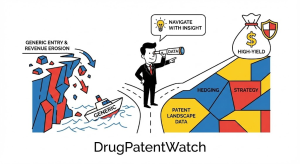
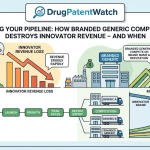
The Revenue Cliff Is Predictable — And Yet Companies Keep Falling Off It
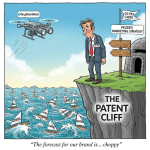
In 2011, Pfizer watched approximately $10.7 billion in annual Lipitor revenue evaporate within eighteen months of generic entry. The company had known for years that this day was coming. The patent expiry dates were public record. The ANDA filings from Ranbaxy, Watson, and others were visible in regulatory databases. Analysts had modeled the cliff repeatedly in earnings calls. And still, the speed and severity of erosion caught almost everyone off guard.
This is the central paradox of pharmaceutical patent management: the single most consequential financial event in a branded drug’s commercial life — the moment a generic competitor enters the market — is also the most telegraphed. Every relevant date, filing, and legal challenge exists in public databases. The information is not hidden. What is missing, for most investors, corporate strategists, and finance teams, is a systematic framework for reading that information and converting it into actionable financial positions.
This article gives you that framework.
The approach relies on patent landscape analysis — the discipline of mapping, interpreting, and forecasting based on the full constellation of intellectual property protections surrounding a pharmaceutical product. Done well, this analysis tells you not just when a drug loses patent protection, but which patents will face challenge, how likely those challenges are to succeed, what a realistic revenue erosion timeline looks like, and where countermeasures — authorized generics, life cycle management strategies, new formulation patents — can blunt the impact.
For investors, this is a direct input into financial models. For business development teams, it shapes deal timing and deal structure. For generic manufacturers, it identifies entry windows and litigation risk. For anyone with a material interest in pharmaceutical revenues, patent landscape data is one of the few sources of genuine, durable analytical edge that remains available to those willing to do the work.
What the Numbers Actually Show
The scale of revenue at stake across the pharmaceutical patent landscape at any given moment is staggering. According to IQVIA data, branded drugs facing generic entry between 2022 and 2026 represent over $200 billion in cumulative global revenues at risk. That figure is not an abstraction — it corresponds to specific molecules, specific expiry dates, and specific litigation timelines that are knowable today. <blockquote> “Patent cliffs represent the single largest source of value destruction in the pharmaceutical sector. Between 2022 and 2030, drugs with combined annual sales exceeding $250 billion are expected to lose exclusivity globally.” — IQVIA Institute for Human Data Science, “The Outlook for Medicines Through 2026,” 2022 [1] </blockquote>
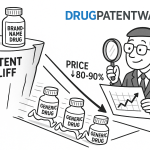
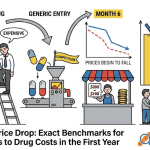
The mechanics of revenue erosion after generic entry follow a predictable curve, though the slope of that curve varies considerably based on therapeutic category, the number of generic entrants, and the presence or absence of authorized generics. In a market with a single generic entrant (which happens when a first-filer earns 180-day exclusivity under the Hatch-Waxman framework), the branded product typically retains 20-30% of unit volume but at deeply discounted prices. When exclusivity expires and multiple generics enter simultaneously, price erosion can exceed 90% within 12 months.
The averages, though, obscure important variation. Specialty drugs with complex formulations, biologics with no approved biosimilar pathway, and drugs with strong patient preference programs can defy the standard erosion model. The patent landscape analysis must account for these variables rather than relying on sector-wide averages.
Why Forecasters Get This Wrong
The failures in pharmaceutical revenue forecasting almost always trace back to one of four analytical errors.
The first is treating the primary composition-of-matter patent as the only relevant protection. A well-constructed pharmaceutical patent estate can include dozens of patents covering formulation, method of use, manufacturing process, metabolites, polymorphic forms, and dosing regimens. Each of these is a potential source of additional exclusivity, and each can be the subject of separate litigation. An analyst who models generic entry at the composition-of-matter expiry date and ignores the remaining patent estate is, in many cases, wrong by several years.
The second error is ignoring ANDA filing patterns as a leading indicator. When a generic manufacturer files an Abbreviated New Drug Application with a Paragraph IV certification — asserting that one or more patents in the Orange Book are invalid or will not be infringed by the generic product — that filing triggers a 30-month stay on FDA approval and initiates patent litigation. These filings are publicly available and typically precede actual generic entry by three to five years. A systematic review of ANDA filings gives an investor or strategist advance warning of impending challenges long before they appear in earnings call commentary.
The third error is treating patent expiry dates as deterministic rather than probabilistic. Patents can be invalidated through inter partes review (IPR) proceedings at the Patent Trial and Appeal Board (PTAB), through district court litigation, or through reexamination. The historical grant rate for IPR petitions at PTAB hovers around 60-70%, and when a PTAB proceeding is initiated against a pharmaceutical patent, it deserves attention as a material threat to projected exclusivity. Conversely, not all Paragraph IV challenges succeed. Branded companies win a meaningful percentage of Hatch-Waxman litigation, and failed challenges can actually confirm and extend the effective exclusivity period.
The fourth error is overlooking regulatory exclusivity as distinct from patent protection. The FDA grants several forms of market exclusivity that run independently of patents: five years of new chemical entity (NCE) exclusivity, three years of new clinical investigation exclusivity, seven years of orphan drug exclusivity, and six months of pediatric exclusivity added to existing patent terms. These protections can create exclusivity windows that extend well beyond the patent estate, or that protect a drug even when its patents have been successfully challenged. Conflating patent expiry with loss of exclusivity misses these regulatory tools entirely.
Understanding the Patent Landscape: What You’re Actually Reading
Composition of Matter Patents: The Keystone
Composition of matter patents, which cover the chemical compound itself, are the most commercially valuable intellectual property in pharmaceutical development. They are also the most difficult to obtain, given the requirement for genuine novelty and non-obviousness in chemistry, and the most aggressively challenged when a molecule becomes commercially successful.
A composition of matter patent on a small molecule drug typically issues with a 20-year term from the date of filing. Because filing typically occurs early in the development process, before clinical trials establish commercial value, the effective market life of a composition of matter patent is substantially shorter than 20 years — often 10 to 12 years when adjusted for the average time from filing to FDA approval. Patent term restoration under the Hatch-Waxman Act allows for some recovery of this lost time, up to a maximum of five additional years, with an overall cap of 14 years of effective patent protection post-approval.
For an investor or analyst, the composition of matter patent is the starting point, not the endpoint, of a patent landscape analysis. Its expiry date establishes a theoretical floor for generic entry — the earliest date at which generic competition becomes legally possible absent other protections. Everything else in the analysis adjusts that date upward or downward.
Formulation and Method of Use Patents: The Defensive Layer
After the composition of matter patent, branded manufacturers typically construct a layered defense consisting of formulation patents (covering specific dosage forms, delivery systems, or excipient combinations) and method of use patents (covering specific therapeutic indications or treatment protocols).
These secondary patents have a complicated history in pharmaceutical litigation. Critics, including generic manufacturers and many academics, characterize them as “evergreening” — a strategy of extending exclusivity through incremental patents that do not represent genuine innovation. Courts have been sympathetic to challenges against thin formulation patents, and the FTC has studied the practice extensively. The agency’s 2002 report on barriers to generic entry specifically identified formulation and method patents as tools for extending effective market exclusivity beyond what the underlying innovation justifies [2].
Defenders of these patents argue that improvements to drug formulations — extended-release mechanisms, reduced side effect profiles, improved bioavailability — represent genuine clinical advances that warrant intellectual property protection. The empirical record is mixed: some formulation patents survive challenge because they do cover meaningful improvements, while others fall quickly under scrutiny.
For the analyst, the key question is not the moral valence of these patents but their litigation durability. A formulation patent that has survived multiple IPR challenges and multiple Paragraph IV litigations is a materially different asset from one that has never been tested. DrugPatentWatch, a comprehensive patent intelligence platform, tracks both the patent filings and the litigation history associated with pharmaceutical intellectual property, giving analysts the ability to assess not just what patents exist but which ones have withstood adversarial scrutiny.
Process Patents: The Underappreciated Asset
Process patents cover methods of manufacturing a pharmaceutical compound rather than the compound itself or its formulation. Because the generic product does not need to be made by the same process as the brand product, process patents generally do not block generic entry — but they are not worthless.
Process patents matter in three contexts. First, if a generic manufacturer’s ANDA relies on a manufacturing process that infringes a branded company’s process patent, litigation risk applies. Second, process patents can affect the competitive landscape for active pharmaceutical ingredient (API) suppliers and contract manufacturers, with downstream effects on generic entry timelines and pricing. Third, in international markets with different patent regimes, process patents sometimes provide protection where composition of matter patents are unavailable or have been invalidated.
An analyst building a comprehensive patent landscape map includes process patents not because they are primary barriers to generic entry, but because they affect the cost structure and legal exposure of generic manufacturers and can, at the margin, influence entry timing.
Polymorph and Salt Form Patents: The Stealth Extensions
Many pharmaceutical compounds can exist in multiple crystalline forms (polymorphs) or as different salts. In some cases, a specific polymorph or salt form offers meaningful clinical advantages — better stability, improved bioavailability, fewer impurities. In other cases, the selection of a particular form is primarily a matter of protecting market position.
Polymorph patents are among the most commonly challenged in Hatch-Waxman litigation, and they have a relatively poor survival rate in IPR proceedings, particularly when the original composition of matter patent described the compound without limiting it to a specific crystalline form. Courts have been skeptical of polymorph patents that seem designed primarily to extend exclusivity rather than to protect a genuinely improved product.
That said, several commercially important drugs have benefited from polymorph protection that survived challenge. Citalopram (Celexa) and its successors, as well as various proton pump inhibitors, have had polymorph patent disputes that materially affected generic entry timelines. Understanding the polymorph patent landscape around a specific drug requires chemical expertise that goes beyond standard patent reading, but the investment is warranted for high-value molecules.
The Patent Thicket: Strategy or Symptom?
The term “patent thicket” describes the accumulation of multiple overlapping patents around a single pharmaceutical product, creating a dense legal barrier that makes generic entry expensive and uncertain even after primary patent expiry. Whether a particular thicket constitutes a legitimate defensive strategy or an anticompetitive barrier to entry is a question that regulators, courts, and academics continue to debate.
From an analytical standpoint, the question is secondary. What matters is the thicket’s economic effect: how many patents are there, when do they expire, what is their litigation history, and how much does a potential generic entrant have to spend on legal challenges before it can enter the market?
AbbVie’s defense of adalimumab (Humira) is probably the most discussed example in recent pharmaceutical history. AbbVie built a patent estate of over 130 U.S. patents around the biologic, with expiry dates stretching from 2016 into the mid-2030s. The composition of matter patent expired in 2016, but biosimilar competition in the United States was delayed until 2023 through a combination of patent litigation settlements and formulation patents covering the high-concentration, citrate-free version of the drug that became the dominant commercial form. During those seven years, Humira generated roughly $140 billion in global revenue.
The Humira example illustrates both the power and the limits of thicket-based analysis. The thicket was genuinely formidable — AbbVie won or settled most of its litigation on favorable terms. But the strategy also attracted intense regulatory and legislative scrutiny, and the settlements that delayed U.S. biosimilar entry are now the subject of ongoing antitrust litigation. For an analyst modeling future scenarios, both outcomes — sustained exclusivity and antitrust-driven disruption — deserve probability weighting.
How Generic Entry Actually Works: The Hatch-Waxman Mechanics
The ANDA Process and Paragraph IV Certifications
The Drug Price Competition and Patent Term Restoration Act of 1984, known as Hatch-Waxman, created the modern framework for generic drug approval in the United States. Under this framework, a generic manufacturer can submit an ANDA referencing the branded product’s clinical data (the “reference listed drug”) rather than conducting its own clinical trials. The ANDA must contain a certification regarding each patent listed in the Orange Book for the reference listed drug.
A Paragraph I certification states that there is no relevant patent. A Paragraph II certification states that the listed patent has expired. A Paragraph III certification states that the generic manufacturer will not seek approval until after the listed patent expires. And a Paragraph IV certification — the strategically significant one — asserts that the listed patent is either invalid or will not be infringed by the proposed generic product.
A Paragraph IV certification triggers multiple consequences. It must be accompanied by a notice to the patent holder, who then has 45 days to file a patent infringement lawsuit. If the patent holder files suit within that window, the FDA automatically imposes a 30-month stay on approval of the ANDA, during which the patent litigation proceeds. The first generic manufacturer to file a Paragraph IV ANDA for a given reference drug and patent combination earns 180 days of marketing exclusivity upon approval — a valuable right that effectively makes the first generic the only generic for six months.
This 180-day exclusivity period is the economic engine of generic pharmaceutical development. Because it creates a temporary duopoly between the branded product and a single generic, it supports generic prices significantly above the post-exclusivity competitive floor. Generic manufacturers routinely earn margins in the 40-60% range during the exclusivity window, compared to margins of 5-15% in fully competitive multi-generic markets.
For the analyst, ANDA filings with Paragraph IV certifications are primary intelligence. The FDA’s Paragraph IV database lists these certifications, and the number of Paragraph IV filers for a given drug is a direct signal of how aggressively the generic industry views the entry opportunity. High-value drugs with legally vulnerable patent estates attract the most filers, driving up the probability of at least one successful challenge.
The 30-Month Stay: Litigation as Intelligence
The 30-month stay is not just a delay mechanism — it is a source of strategic intelligence. When a branded manufacturer files a patent infringement lawsuit in response to a Paragraph IV ANDA, the litigation record becomes public. Court filings reveal which specific patents the branded company considers most important, what prior art it is worried about, and sometimes what internal analysis it has conducted about the strength of its own intellectual property.
Similarly, the generic manufacturer’s invalidity contentions and claim construction positions give analysts insight into the weakest points in the branded company’s patent estate. Patent litigations in which the generic manufacturer has filed extensive prior art charts and invalidity arguments are more serious threats to the branded company’s exclusivity than litigations where the generic’s legal theory is thin.
Tracking the progression of Hatch-Waxman litigations — district court rulings, appeals to the Federal Circuit, petition for certiorari at the Supreme Court — provides a running probability-weighted estimate of exclusivity survival. The Federal Circuit’s track record of upholding or invalidating pharmaceutical patents in specific legal categories (obviousness, written description, enablement) creates a base rate against which specific litigation outcomes can be evaluated.
First-Filer Exclusivity and the Race to File
The 180-day marketing exclusivity available to the first Paragraph IV ANDA filer creates strong incentives for generic manufacturers to file ANDAs as early as possible, before competitors can establish prior filer status. This race to file means that ANDA filing activity accelerates significantly as a drug’s primary patent approaches a date that generic manufacturers believe is near the end of its defensible life.
Monitoring ANDA filing activity over time — both the total number of filings and the date pattern of filings — gives an analyst useful information about the generic industry’s collective assessment of patent vulnerability. A sudden increase in ANDA filings for a particular drug is a signal worth investigating. It suggests that generic manufacturers have conducted their own patent analysis and concluded that the entry window is opening.
DrugPatentWatch maintains extensive databases of ANDA filings, Orange Book patent listings, and Paragraph IV certifications, organized to support exactly this kind of competitive intelligence. The platform’s data allows analysts to track the full history of ANDA activity around a specific drug and compare it against patent expiry timelines, litigation outcomes, and revenue data. For a practitioner building financial models around pharmaceutical revenues, this type of integrated database is substantially more useful than reviewing raw FDA filings in isolation.
Eliquis: When Multi-Layer Protection Works as Designed
Apixaban (Eliquis), developed through a collaboration between Bristol Myers Squibb and Pfizer, illustrates how a multi-layered patent estate can function as designed when the legal strategy is well-constructed and the patents themselves cover genuine innovations.
Eliquis received FDA approval in 2012 for stroke prevention in atrial fibrillation and subsequently for additional indications including treatment of deep vein thrombosis and pulmonary embolism. The primary compound patent was set to expire in 2023. However, Bristol Myers Squibb and Pfizer also held method of use patents extending protection for specific treatment uses, and the drug benefited from pediatric exclusivity that added six months to certain protections.
Multiple generic manufacturers, including Mylan, Sigmapharm, and others, filed Paragraph IV ANDAs beginning in 2017. The resulting litigation was extensive. The branded companies successfully defended the compound patent and key method patents in district court, though the litigation proceeded through multiple rounds before final resolution [15]. The practical effect was that generic entry was delayed past the original compound patent expiry date while litigation resolved.
The Eliquis litigation history illustrates a point often missed in simplified patent analysis: the branded company’s willingness to litigate aggressively, and its ability to fund that litigation across multiple challengers simultaneously, is itself a commercial asset. A generic manufacturer deciding whether to file a Paragraph IV ANDA must weigh not just the legal merits of its invalidity case but the time and cost of litigation against a well-resourced opponent. For some potential challengers, the economics of a multi-year litigation against a combined BMS-Pfizer legal team may be unattractive even if the patent challenge itself is meritorious.
This suggests that patent strength and litigation willingness are partially substitutable in protecting commercial exclusivity. A branded company with modest patents but deep resources and a credible reputation for aggressive litigation deters some challenges that a purely patent-strength analysis would predict. Conversely, a company that signals willingness to settle early — through its behavior in previous litigations — attracts more challenges even when its patents are strong.
The First Generic Advantage
When the first generic enters the market — whether through successful litigation, expiry of the 30-month stay without a court ruling, or natural patent expiry — it typically enters at a price 15-30% below the branded product’s price. This is not enough price differential to capture significant unit volume in most markets; managed care organizations and pharmacy benefit managers expect more aggressive discounting before they will substitute the generic for the branded drug on formulary.
The first generic’s pricing strategy is a balancing act. Price too high and the generic fails to gain formulary position, capturing little volume. Price too low and it sacrifices the margin opportunity that the 180-day exclusivity window exists to support. The optimal price is typically in the range where the generic captures 60-80% of the branded product’s unit volume while maintaining prices that generate substantial profit before multi-generic competition begins.
For the branded manufacturer, the first generic period is manageable in revenue terms compared to what follows. The branded product retains a meaningful share of the market, often supported by co-pay assistance programs, patient loyalty cards, and formulary negotiations. Volume loss is real but not catastrophic.
Multi-Generic Market Dynamics
When the 180-day exclusivity expires and multiple generic manufacturers enter the market, the pricing dynamic changes fundamentally. With three or more generics competing, pharmacy benefit managers have the leverage to extract dramatic price concessions through preferred formulary status. Generic prices in competitive markets can fall to 10-20% of the branded price within 24 months of multi-generic entry.
The branded product’s response options at this point are limited. Competing on price against a commodity generic product is economically unattractive for a branded manufacturer. Some branded companies launch authorized generics — generic versions of their own products sold through subsidiary arrangements — which allows them to participate in the generic market and capture some volume share at post-patent pricing. Others focus investment on the successor product that the life cycle management strategy was designed to establish.
The quantitative model most commonly used in pharmaceutical revenue forecasting assumes the following trajectory after generic entry: 30-40% volume loss in year one as the first generic captures market share, 60-80% volume loss in year two as the generic price stabilizes, and 85-95% volume loss in years three through five as the fully competitive generic market develops. Actual outcomes vary substantially from this model depending on the factors described above.
Price Erosion vs. Volume Erosion: A Critical Distinction
Most simplified analyses of generic entry focus on volume erosion — the loss of prescription share to generic substitution. But branded manufacturers face two separate and largely simultaneous value destruction forces: volume erosion and price erosion.
Even before generic entry, the announcement of impending generic competition (often triggered by successful Paragraph IV litigation) causes managed care payers to renegotiate rebate contracts with branded manufacturers. Rather than lose the entire book of business to the generic on day one, a managed care organization will offer to maintain the branded product on a preferred tier in exchange for rebates that may increase the effective manufacturer price discount to 40-60% below list price.
This pre-entry price erosion is captured in gross-to-net adjustments on branded manufacturers’ income statements, but it is not always clearly visible in top-line revenue figures. An analyst who models generic entry risk using only post-entry revenue figures systematically underestimates the total economic cost of patent expiry.
The gross-to-net problem has become increasingly significant in the U.S. pharmaceutical market as managed care consolidation has given a small number of pharmacy benefit managers enormous pricing leverage. For a drug in the final years of branded exclusivity, effective net revenue may be 40-50% of gross revenue before a single generic prescription is written.
Reading the Orange Book: A Field Guide
What the Orange Book Actually Contains
The FDA’s Approved Drug Products with Therapeutic Equivalence Evaluations, universally known as the Orange Book, is the primary public reference for understanding the patent and exclusivity landscape around approved pharmaceutical products. It lists every patent the brand manufacturer has identified as covering the approved drug product, along with use codes describing what each patent covers.
The Orange Book is not a comprehensive list of all patents related to a pharmaceutical product. It contains only those patents that the manufacturer has chosen to list, subject to FDA regulations requiring listing of patents that claim the drug product or a method of using the drug product. Process patents, for example, are not listed in the Orange Book and cannot be the basis for a 30-month stay. This selective nature means that the Orange Book understates the full patent estate protecting most drugs.
Reading the Orange Book requires attention to several fields beyond the obvious patent numbers and expiry dates. The use code is particularly important for method of use patents: it describes the specific indication covered, which determines whether a generic manufacturer seeking approval for a different indication can avoid the patent through a “carve-out” label. An analyst who understands use codes can identify which method patents provide commercial coverage across all relevant indications and which can be designed around by a generic seeking a different label.
Orange Book Gaming: Listing Strategy
Pharmaceutical manufacturers have significant discretion in deciding which patents to list in the Orange Book and when to list them. New patents can be added to the Orange Book after initial approval if they relate to the approved product, which means that a drug’s Orange Book listing can grow over time as the manufacturer obtains additional formulation, method, and salt patents and chooses to list them.
This listing strategy interacts directly with the Paragraph IV certification process. Each patent added to the Orange Book after a generic manufacturer has already submitted a Paragraph IV ANDA certification requires the generic to submit an amended certification, potentially triggering additional 30-month stays and additional rounds of litigation. The FDA has tried to limit this through regulations requiring that Orange Book listings occur within 30 days of patent issuance, but the timing rules have been imperfectly enforced.
The FTC has scrutinized Orange Book listing practices as a potential anticompetitive strategy, and recent legislative proposals have included provisions to streamline the process for challenging improper Orange Book listings. An analyst monitoring a specific drug’s Orange Book entries over time gains insight into the manufacturer’s IP strategy and can anticipate future litigation triggers.
Therapeutic Equivalence Ratings and Their Commercial Impact
The Orange Book’s therapeutic equivalence (TE) ratings — most importantly, the “AB” rating that designates a generic as therapeutically equivalent to the reference listed drug — determine whether pharmacists can automatically substitute the generic for the branded product at the point of dispensing. A generic with an AB rating can be substituted by pharmacists in all 50 states under substitution laws without explicit prescriber authorization.
The AB rating is the commercial gateway through which generic manufacturers access the unit volume that makes generic entry economically attractive. A generic without an AB rating (which can happen with complex formulations, modified-release products, and certain specialty dosage forms) cannot be automatically substituted and must be specifically prescribed, dramatically reducing its market penetration.
For analysts modeling complex drug products — inhalers, transdermal patches, injectable formulations — the TE rating question is central to the revenue erosion model. A drug that is technically off patent but whose generic competitors lack AB ratings may experience much slower and more limited erosion than a standard solid oral dosage form. This distinction accounts for why some off-patent products maintain surprisingly durable revenue streams long after primary patent expiry.
Patent Intelligence Platforms: The Data Infrastructure
DrugPatentWatch: The Practitioner’s Reference
For practitioners who need to work systematically with pharmaceutical patent data, building a complete picture from primary sources alone — the Orange Book, the USPTO patent database, the FDA’s Paragraph IV certification database, PACER for litigation records — is time-consuming and requires specialized knowledge to navigate correctly.
DrugPatentWatch addresses this by aggregating and cross-referencing data across these primary sources in a format designed for pharmaceutical industry use. The platform covers U.S. Orange Book listings, international patent data across major markets, ANDA filing information, litigation histories, exclusivity records, and biosimilar development pipelines. Its alerting functionality allows users to receive notifications when new patents are listed, new ANDAs are filed, or litigation outcomes are recorded for monitored drugs.
For a pharmaceutical company’s competitive intelligence team, DrugPatentWatch provides the kind of systematic coverage that prevents the analytical gaps — a newly listed Orange Book patent, a quietly filed Paragraph IV certification, an IPR petition granted against a key asset — that can cause a company to be surprised by a competitive development it should have anticipated. For an investor or financial analyst, it provides a structured way to model the patent landscape without building the research infrastructure from scratch.
The platform is particularly useful for comparing drugs across a therapeutic category — seeing at a glance which compounds are approaching patent expiry, which face active Paragraph IV litigation, and where the generic pipeline is deepest. This kind of comparative view supports portfolio-level analysis that would be extremely labor-intensive using only primary sources.
USPTO and EPO Patent Databases
The USPTO’s patent database (patents.google.com for the commercial interface, or the USPTO’s own Patent Full-Text Databases for bulk research) is the authoritative source for the text of U.S. patents. For analysts who need to read actual patent claims — to assess their breadth, their likely vulnerability to specific invalidity arguments, or their coverage relative to a specific product formulation — primary source access is essential.
The European Patent Office’s Espacenet database provides similar access to European patent filings, including applications published under the Patent Cooperation Treaty (PCT) that reveal a branded manufacturer’s international patent strategy before individual national patents issue. Monitoring PCT applications from branded manufacturers can give analysts 18-30 months of advance notice on new patent positions before they are reflected in national patent databases or Orange Book listings.
Reading patent claims is a specialized skill that requires some legal and technical training, but the analytical payoff is high. The scope of a patent claim — specifically, how broadly or narrowly the claim is drafted — determines how difficult it is for a generic manufacturer to design around the patent without infringing it. A narrowly drafted claim covering one specific salt form of a compound is far less commercially potent than a broadly drafted claim covering the compound in any form.
PTAB and the IPR Process
The Patent Trial and Appeal Board, established by the America Invents Act of 2011, has become one of the most important forums for pharmaceutical patent challenges. Inter partes review allows any party — including generic manufacturers, patient advocacy groups, and hedge funds — to petition PTAB to review a granted patent on the grounds that it is invalid in light of prior art.
IPR has several features that make it more attractive than district court invalidity litigation for patent challengers. The burden of proof standard is preponderance of evidence rather than the clear and convincing evidence required in district court. Proceedings are conducted by technically trained administrative patent judges rather than generalist Article III judges. Discovery is limited, reducing costs. And the timeline from petition to final written decision is approximately 18 months, compared to several years for district court litigation.
The IPR grant rate for pharmaceutical patents has been substantial. Between 2012 and 2022, PTAB instituted review of approximately 67% of pharmaceutical patent IPR petitions, and of those instituted, a significant portion resulted in cancellation of at least some claims [3]. These statistics create a meaningful prior probability that an IPR petition against a commercially important pharmaceutical patent will result in some degree of claim cancellation.
Monitoring the PTAB docket for IPR petitions against pharmaceutical patents is therefore an important component of patent landscape analysis. When a petition is filed, the 18-month resolution timeline creates a predictable window for modeling the outcome’s probability and impact. When the final written decision issues — either upholding the patent or canceling claims — it immediately updates the exclusivity model.
Case Studies in Patent Landscape Navigation
Lipitor: The Anatomy of a Cliff
Atorvastatin (Lipitor) provides the textbook case of primary patent expiry-driven revenue erosion. The compound patent, held by Warner-Lambert (subsequently acquired by Pfizer), expired in November 2011. Prior to that date, Lipitor had sustained annual U.S. revenues of approximately $7.7 billion, making it the best-selling drug in history at the time.
The Lipitor patent story is not simple, despite the narrative of a clean cliff. The compound patent was subject to multiple Paragraph IV challenges beginning in the late 1990s. Ranbaxy filed the first Paragraph IV ANDA in 2002, earning 180-day first-filer exclusivity rights. Pfizer successfully won a preliminary injunction blocking Ranbaxy’s launch, and the subsequent district court litigation produced a finding of patent infringement in 2006 on narrower patents that extended effective exclusivity.
The settlement between Pfizer and Ranbaxy, ultimately executed in 2008, allowed Ranbaxy to enter the U.S. market with a generic in November 2011 and gave Pfizer advance visibility into the exact date of generic entry. Pfizer used this lead time to negotiate an authorized generic arrangement with Watson Pharmaceuticals, which entered the market simultaneously with Ranbaxy’s generic, effectively splitting the first-filer exclusivity window.
The revenue erosion after November 2011 was severe but followed a predictable model. U.S. Lipitor revenues fell from approximately $7.7 billion in 2011 to approximately $3.9 billion in 2012 (reflecting partial-year branded revenues) and continued to decline sharply thereafter as multi-generic competition developed. The branded Lipitor product retained a residual market — largely composed of patients with strong brand preference or formulary situations that created no financial incentive to switch — but this residual was a fraction of peak revenues.
What Pfizer’s analysts had correctly modeled, and what the company used its lead time to execute against, was the authorized generic strategy. By keeping Pfizer itself (through Watson) in the generic market from day one, the company captured some of the generic-market economics that would otherwise have gone entirely to Ranbaxy. This is a structural response to the patent cliff that requires advance planning and is visible to analysts who monitor authorized generic arrangements.
Revlimid: The Extended Thicket
Lenalidomide (Revlimid) provides a contrasting case study — a drug where the patent thicket strategy, combined with carefully structured litigation settlements, extended effective exclusivity far beyond what a simple analysis of primary patent expiry dates would suggest.
Revlimid’s composition of matter patent was set to expire in 2019. By rights, a simple patent expiry model would have placed generic entry in 2019 or shortly thereafter. The actual outcome was substantially different. Celgene (subsequently acquired by Bristol Myers Squibb) entered into a series of settlement agreements with generic manufacturers — including Natco Pharma, Mylan, and others — that delayed U.S. generic entry until January 2026, contingent on volume limitations. Generic entry began in limited quantities in March 2022 under these agreements, with volumes allowed to increase on a step-up schedule.
The Revlimid settlements were structured to allow generic manufacturers eventual entry in exchange for agreement not to challenge the remaining patent estate. The deals drew significant antitrust scrutiny, with critics arguing they constituted reverse payment settlements (also known as “pay-for-delay”) in violation of the FTC v. Actavis framework established by the Supreme Court in 2013 [4]. Bristol Myers Squibb maintained that the settlements were legitimate given the litigation risk involved.
From an analyst’s perspective, the Revlimid case illustrates the need to distinguish between patent expiry and commercial exclusivity expiry. The settlement structure was visible in public litigation records well before its commercial impact materialized. An analyst monitoring Celgene’s litigation docket from 2014-2018, when the key settlement agreements were reached, had access to the information needed to model a significantly delayed erosion timeline relative to the naive patent expiry date.
The Revlimid case also illustrates the limits of thicket-based exclusivity extension. Despite the settlements’ volume limitations, Bristol Myers Squibb’s Revlimid revenues declined from approximately $12.8 billion in 2021 to approximately $7.9 billion in 2022 and continued to erode as the volume ramp-up schedule proceeded [5]. The settlements delayed the cliff but did not eliminate it.
Humira: Biologic Complexity and the Biosimilar Lag
Adalimumab (Humira) adds a layer of complexity that smaller molecules do not present: the biologic patent landscape and the biosimilar approval pathway. Biologic drugs — large-molecule proteins produced through living cell systems — are not approved through the ANDA process. Instead, biosimilar manufacturers use the 351(k) pathway under the Biologics Price Competition and Innovation Act of 2009 (BPCIA), and the patent dispute framework is different from Hatch-Waxman.
AbbVie’s Humira patent estate was extraordinarily large even by pharmaceutical standards. The company listed over 130 patents in the Purple Book (the biologic equivalent of the Orange Book) covering not just the original adalimumab molecule but high-concentration formulations, devices, manufacturing processes, and dosing regimens. The primary biological compound patents, covering adalimumab itself, expired in 2016.
Biosimilar manufacturers — Amgen, Sandoz, Mylan, and others — filed for 351(k) approval beginning in 2016. AbbVie engaged in the patent dance procedures required under BPCIA and subsequently litigated extensively with multiple biosimilar manufacturers. The litigation settlements, reached between 2018 and 2019, allowed biosimilar entry in the United States in January 2023.
This delay — seven years from the expiration of the primary biologics patents to actual biosimilar competition in the U.S. market — cost patients and payers an enormous sum. During those seven years, Humira’s U.S. list price increased from approximately $19,000 per year to over $77,000 per year. The cumulative U.S. revenue during the delay period was roughly $85 billion [6]. Whether this outcome was legal, ethical, or justified by AbbVie’s intellectual property is a question that courts, regulators, and legislators continue to assess. That it was predictable, for analysts who were reading the settlement agreements and monitoring the biosimilar pipeline, is not in question.
The post-2023 Humira market illustrates another feature of biologics competition: the slower-than-expected price erosion relative to small molecule generic entry. Multiple biosimilars received approval, but market penetration was initially slow due to the interchangeability designation process (which is required for pharmacist-level substitution for biologics), formulary negotiations, and the complex contracting relationships between branded companies, PBMs, and payers. AbbVie responded with a high-rebate strategy, offering massive discounts to payers willing to keep Humira on preferred formulary, effectively using its incumbent scale to limit biosimilar market penetration.
The Humira biosimilar experience has recalibrated analyst expectations for the small-molecule analogy in biologics markets. Biosimilar erosion curves are shallower and more protracted than small-molecule generic entry, at least in the U.S. market. This has significant implications for models of other major biologics approaching loss of exclusivity.
Life Cycle Management: The Offense to the Generic Defense
What Life Cycle Management Actually Is
Life cycle management (LCM) is the set of strategies pharmaceutical companies use to extend the commercial productivity of branded drug franchises beyond the primary patent expiry date. It encompasses reformulation, new indication development, combination products, pediatric studies, and successor molecule programs.
The most commercially significant LCM strategy is the development of a next-generation formulation that offers genuine clinical advantages over the primary product. Where such improvements exist — extended-release formulations that reduce dosing frequency, combination pills that simplify regimen adherence, novel delivery mechanisms that improve tolerability — they can support meaningful patient and prescriber preference for the new formulation even after generic versions of the original product are available.
AstraZeneca’s conversion from omeprazole (Prilosec) to esomeprazole (Nexium) is the most cited example, though its circumstances have been extensively debated. Omeprazole is a racemic mixture of two enantiomers; esomeprazole is the pure S-enantiomer, which has a somewhat different pharmacokinetic profile. AstraZeneca marketed Nexium as a clinical improvement over Prilosec and invested heavily in transitioning prescribers to the new compound before Prilosec went off-patent. While Nexium generated substantial revenues, its clinical differentiation from generic omeprazole remained contested, and a significant fraction of prescribers continued to recommend generic omeprazole for appropriate patients.
The LCM question that matters for patent landscape analysis is: when a company pursues a next-generation formulation strategy, how durable are the new product’s patents? If the new formulation represents genuine innovation — particularly if it achieves clinical benchmarks that generate new regulatory data and exclusivity — its patents may be more defensible than a thin reformulation designed primarily to shift market share.
An analyst who identifies that a company has secured a 505(b)(2) approval (a hybrid NDA pathway that references existing clinical data but includes new data supporting the reformulation) and has obtained robust Orange Book listings for the new product can model a more gradual primary-product erosion curve alongside growth in the successor product.
Authorized Generics: Competing Against Yourself
An authorized generic (AG) is a generic version of a branded drug manufactured by or licensed from the brand manufacturer and sold under the generic label. Because it is made by the brand manufacturer, it typically uses the same formulation, manufacturing process, and quality standards as the branded product. It does not require the brand manufacturer to concede any patent rights — it simply elects to participate in the generic market rather than cede it entirely to independent generic manufacturers.
AGs are most commercially valuable during the 180-day first-filer exclusivity period, when they allow the brand manufacturer to capture part of the market that would otherwise belong entirely to the first-filer generic. By competing with the first filer during the exclusivity window, AGs reduce the first filer’s effective profit from the exclusivity period, which in turn reduces the incentive for future generic manufacturers to invest in Paragraph IV challenges against other drugs.
The extent to which AGs actually deter future Paragraph IV challenges is a debated empirical question. The FTC has studied the issue and found evidence of a deterrent effect, though the magnitude varies by drug value and expected exclusivity period [7].
For analysts, AG announcements — which typically come within the two years preceding patent expiry as the brand manufacturer assesses its options — are a signal about the company’s strategic posture. A company that announces an AG strategy has accepted the inevitability of generic entry and is optimizing for revenue retention rather than exclusivity extension. That implies the remaining patent estate is not considered strong enough to support successful Paragraph IV litigation defense.
Pediatric Exclusivity: Six Months of Revenue
Under the Best Pharmaceuticals for Children Act and its predecessors, the FDA can request that manufacturers conduct pediatric studies for drugs that may be used in children. If the manufacturer conducts qualifying studies — regardless of whether the results are positive or negative — it receives six months of pediatric exclusivity added to existing patent protections and regulatory exclusivity.
For a drug generating $1 billion per year in U.S. revenues, six months of pediatric exclusivity is worth approximately $500 million, assuming relatively modest erosion during the exclusivity period. The cost of the required pediatric clinical studies is a fraction of that figure in most cases. Pediatric exclusivity is therefore one of the most economically efficient regulatory strategies available to branded manufacturers.
From an analytical standpoint, pediatric exclusivity requests and completions are public information available through the FDA’s Pediatric Exclusivity Reporting database. Tracking whether a drug has earned, applied for, or had outstanding pediatric exclusivity is a routine component of complete patent landscape analysis. An expiry date model that omits pediatric exclusivity is wrong by six months for every drug that has earned it — which, for the highest-value drugs, is a material modeling error.
Orphan Drug Exclusivity: Seven Years and No Generics
The Orphan Drug Act grants seven years of market exclusivity to drugs developed for diseases affecting fewer than 200,000 people in the United States. Unlike patent protection, orphan drug exclusivity specifically bars the FDA from approving a competitor’s application for the same indication during the exclusivity period, regardless of patent status.
Orphan drug exclusivity has become an important component of the pharmaceutical IP toolkit for companies developing drugs in rare diseases. Because rare disease drugs often command premium prices and treat patient populations that are less price-sensitive (or whose payers have fewer alternatives), orphan exclusivity can generate extremely valuable protection. A drug with orphan exclusivity, patent protection, and NCE exclusivity is protected by three independent layers that must each be exhausted before generic or biosimilar entry is legally possible.
Monitoring orphan drug designations and exclusivity grants through the FDA’s Orphan Drug database is therefore an important component of any analysis of rare disease pharmaceutical assets.
The Investor’s Framework: Patent Data in Financial Models
Building the Exclusivity-Adjusted Revenue Model
A pharmaceutical revenue model that does not incorporate patent landscape data is a model that cannot accurately estimate peak revenues, the timing of peak, or the duration of branded exclusivity. These omissions produce errors that compound over the modeling period and lead to systematically wrong conclusions about deal value, pipeline NPV, and portfolio risk.
A complete exclusivity-adjusted revenue model incorporates four inputs: the intellectual property exclusivity schedule (patent expirations, regulatory exclusivity periods, and any extensions through lifecycle management); the litigation probability adjustment (the probability that key patents survive challenge, derived from the litigation history, claim breadth analysis, and PTAB statistics); the market-specific erosion curve (derived from comparable drugs in the same therapeutic class and dosage form); and the authorized generic or lifecycle management offset (the revenue contribution expected from the brand’s competitive responses to generic entry).
Building this model requires assembling patent data that is not readily available in financial databases. Bloomberg and CapIQ report patent expiry dates for the primary composition of matter patent, but they do not provide the complete patent estate, the litigation history, the regulatory exclusivity schedule, or the LCM status. That information must be sourced from the Orange Book, DrugPatentWatch, PTAB records, and FDA exclusivity databases. The analysis is labor-intensive the first time a drug is modeled, but the inputs are updated by specific events — new patent listings, court rulings, PTAB decisions — that are predictable in their timing and interpretable when they occur.
Quantifying the Model Error: Where Consensus Gets It Wrong
Before identifying specific opportunities, it is worth understanding the magnitude of systematic error in consensus pharmaceutical financial models as they relate to patent landscape. A 2019 study published in the Journal of Health Economics examined analyst forecast errors for drugs facing generic entry across a ten-year period and found that consensus forecasts systematically overestimated branded revenues in the 12-36 months following generic entry by an average of 23% [12]. The primary driver of this overestimation was inadequate modeling of gross-to-net erosion — the pre-entry price discounting that occurs as payers renegotiate contracts in anticipation of generic availability.
A secondary source of model error was the reliance on primary patent expiry dates rather than complete exclusivity timelines. For drugs whose effective exclusivity ended earlier than the primary patent suggested — due to successful patent challenges or regulatory exclusivity that expired first — consensus models overstated the branded product’s protected revenue period. For drugs with secondary patent estates that extended exclusivity beyond the primary patent — through formulation patents, pediatric exclusivity, or regulatory exclusivity periods — consensus models understated the revenue runway.
The systematic nature of these errors creates a structural opportunity for analysts willing to build patent-informed models. The error is not random — it has a direction (toward overestimating branded revenues through the generic entry window) and a source (inadequate patent landscape data). Correcting for it produces models that are, on average, more accurate than consensus, particularly for drugs in the final three years of effective exclusivity.
Identifying Short Opportunities: The Patent Cliff Trade
The most straightforward application of patent landscape analysis in investment management is identifying drugs approaching patent cliffs where the equity market price inadequately reflects the magnitude and timing of revenue erosion. This is harder than it sounds, because the pharmaceutical equity market is sophisticated and in most cases has already priced well-known patent expiries into current valuations.
The edge in patent cliff analysis comes from three sources. First, correct identification of the precise generic entry date, which requires detailed analysis of the complete patent estate and litigation history rather than reliance on the primary patent expiry date. A drug whose composition of matter patent expires in 2026 but whose secondary patent estate extends defensible exclusivity to 2028 is priced at the wrong date if the equity market is modeling 2026 entry.
Second, accurate modeling of the erosion curve’s slope and duration, which requires drug-specific analysis rather than application of a generic sector average. The difference between a drug that loses 80% of revenues in 24 months and one that retains 40% of revenues after three years is enormous in NPV terms, and the drivers of the difference — dosage form complexity, therapeutic equivalence rating prospects, patient population characteristics — are analyzable in advance.
Third, identification of catalysts — court decisions, PTAB rulings, FDA approval dates for ANDAs — that will force the market to update its exclusivity model on a specific, predictable timeline. A short position established before a PTAB final written decision that cancels key patent claims can generate returns that are both large (because the patent cancellation forces an immediate repricing of the exclusivity schedule) and have a reasonably predictable timing window.
The risks in patent cliff short positions are significant and should not be minimized. Litigation outcomes are genuinely uncertain. PTAB petitions that seem strong on paper can be denied institution or resolved in the patent holder’s favor. Courts can issue preliminary injunctions that delay generic entry beyond what litigation timelines would suggest. And the 30-month stay mechanism, combined with the Federal Circuit’s de novo review standard for patent claim construction, creates a legal process that can extend much longer than anticipated.
Long Positions on Generic Entrants
For investors in generic pharmaceutical companies, patent landscape analysis supports timing entry into or exit from positions based on the expected commercial value of the generic entry opportunity. The 180-day exclusivity period represents the highest-value window for generic manufacturers, and the financial significance of a specific first-filer opportunity depends on the drug’s revenue, the number of competing first filers (an ANDA can have multiple Paragraph IV filers, all of whom may earn shared exclusivity), and the expected exclusivity period length.
Tracking ANDA filings for a specific generic manufacturer against the patent landscape for high-value drugs identifies the company’s pipeline of first-filer opportunities and the expected timing of their commercial realization. This analysis supports bottom-up valuation of generic manufacturers that is more granular and forward-looking than P/E-based comparisons.
The generic pipeline also has strategic implications for branded companies’ LCM decisions. If multiple generic manufacturers have filed ANDAs for a drug and at least one has established first-filer status, the probability of generic entry within the next three to five years is very high regardless of remaining patent protection. That changes the branded company’s rational strategy away from litigation and toward authorized generic preparation, switch strategies, or negotiated settlements.
Regulatory Exclusivity vs. Patent Protection: The Dual Track
New Chemical Entity Exclusivity
Five years of NCE exclusivity, granted by the FDA upon approval of a new molecular entity, is one of the most important protections available to branded drug manufacturers. Unlike patent protection, NCE exclusivity is not subject to challenge through litigation. A generic manufacturer cannot even submit an ANDA referencing a drug under NCE exclusivity until the fifth year, at which point a Paragraph IV ANDA can be filed with appropriate notice.
NCE exclusivity runs from the date of FDA approval, not from the date of filing. For a drug approved relatively late in the development cycle — ten to twelve years after initial patent filing — the NCE exclusivity period may overlap almost entirely with remaining patent protection, adding limited incremental coverage. For drugs approved on accelerated timelines, NCE exclusivity can add meaningful protection beyond the patent estate.
An analyst building a complete exclusivity model needs to track NCE exclusivity independently of patent protection and ensure that both are incorporated into the ANDA filing timeline. The interaction between NCE exclusivity, the five-year filing bar, and the 30-month stay mechanism can produce effective exclusivity periods that are several years longer than a patent-only analysis would suggest.
Data Exclusivity for Biologics
The BPCIA grants twelve years of reference product exclusivity to biologic drugs, with an additional four years of exclusivity for data submissions, creating a minimum 12-year window before a biosimilar can be approved. This is substantially longer than the five years available for small molecule NCEs, and it reflects both the greater complexity of biologic development and the lobbying power of the biologic industry during the BPCIA’s passage.
For analysts modeling biosimilar competition, the twelve-year data exclusivity is often the binding constraint rather than patent expiry. Many biologic drugs have primary patents that expire before the twelve-year exclusivity period ends, meaning the earliest possible biosimilar entry is set by the regulatory exclusivity rather than the patent estate. However, patent challenges under the BPCIA “patent dance” procedure can, in principle, be resolved before the exclusivity period ends, allowing biosimilar manufacturers to prepare commercially while waiting for exclusivity expiry.
The distinction between patent protection and data exclusivity becomes particularly important for biologic drugs whose patents are at risk of early invalidation. If a biologic’s key patents are successfully challenged through the patent dance procedure but data exclusivity remains intact, the biologic retains full protection from biosimilar entry until the exclusivity period expires regardless of the patent outcome.
The Pediatric Exclusivity Extension Mechanics
Six months of pediatric exclusivity is added to the end of all existing patent and exclusivity protections, not just to the primary composition of matter patent. If a drug has a composition of matter patent expiring in 2026, three formulation patents expiring in 2028, and NCE exclusivity expiring in 2025, the six months of pediatric exclusivity is added to the last-expiring protection — the formulation patents — moving their effective expiry to mid-2028.
This “stacking” effect of pediatric exclusivity on top of the last-expiring protection is not always correctly modeled. An analyst who adds six months to the composition of matter patent expiry date and treats that as the pediatric exclusivity end date is wrong whenever secondary patents or regulatory exclusivities extend beyond the composition of matter patent.
The FDA’s Pediatric Exclusivity database tracks which drugs have requested, been granted, and completed pediatric studies, allowing analysts to determine the current status of pediatric exclusivity for any covered drug.
Patent Litigation as Strategic Intelligence
Pay-for-Delay Economics: What Payments Reveal About Patent Strength
The Federal Trade Commission’s annual reports on brand-generic settlement agreements under the MMA of 2003 provide aggregate data on the incidence and structure of pay-for-delay settlements across the industry. This data has been studied extensively by academic economists and has produced a clear finding: the size of a reverse payment is positively correlated with the patent challenger’s probability of success, as assessed by both the parties and subsequent litigation outcomes [13].
The mechanism is straightforward. A branded company that genuinely believes its patents are valid and infringed has no economic reason to compensate a generic challenger for delaying entry — the courts will provide that delay through the 30-month stay and subsequent litigation. When a brand company does pay a generic to delay, it is implicitly placing a value on the risk that courts will not provide adequate delay, which means it is implicitly acknowledging that it might lose the litigation.
For analysts, the presence of a reverse payment settlement is therefore a signal to revisit the branded drug’s exclusivity timeline and apply a lower probability weight to the full patent protection period. A drug protected by a combination of settled-down challengers (who have been paid to stop fighting) and an untested secondary patent estate warrants a different risk distribution than a drug whose primary patent estate has survived multiple adversarial challenges.
This analysis requires identifying which settlement agreements contain reverse payments — disclosure in FTC filings and in the companies’ own SEC filings makes this possible — and comparing the settlement’s authorized entry date against the background patent expiry dates. The gap between what was settled and what the patents alone would have provided is a rough measure of the patent risk the company was trying to eliminate.
Reading Settlement Agreements
Patent infringement settlements between branded manufacturers and generic manufacturers are disclosed in public filings and are a rich source of strategic intelligence. The structure of a settlement — specifically, whether it includes any form of compensation from the branded manufacturer to the generic, and what the authorized entry date is relative to the patent expiry date — reveals the respective parties’ private assessments of patent strength.
Under the FTC v. Actavis framework established by the Supreme Court, reverse payment settlements (in which the branded manufacturer pays the generic to delay entry) are subject to antitrust scrutiny under the rule of reason. The size of the payment is evidence of the parties’ assessments of the patent’s vulnerability: a branded company would not pay a large sum to a generic challenger unless it believed the challenger had a meaningful probability of winning the underlying patent litigation.
An analyst who observes a large reverse payment settlement can reasonably infer that the branded company’s own assessment of its patent’s validity is less confident than its public statements suggest. This information is directly relevant to modeling the exclusivity timeline: a branded company that has paid generics to delay entry is implicitly acknowledging that the natural endpoint of litigation might have been earlier than the settlement date.
Conversely, settlement agreements that grant early entry rights at near-patent-expiry dates without any reverse payment suggest that the generic’s challenge was not compelling, and that the brand company negotiated an entry date close to what its legitimate patent protection would have provided anyway.
IPR Petitions as Buy/Sell Signals
When an IPR petition is filed at PTAB against a pharmaceutical patent — particularly a petition that targets a commercially important secondary patent rather than the primary composition of matter patent — it deserves immediate analytical attention. IPR petitions are filed by parties who have conducted their own prior art analysis and concluded that the patent is vulnerable. The petitioner’s identity provides additional context: a petition filed by the generic manufacturer with the closest-to-approval ANDA is more commercially significant than a petition filed by an academic institution or an unrelated party.
PTAB institution decisions — the decision on whether to take up an IPR petition for full review — come approximately six months after petition filing and provide an early read on the patent’s survival prospects. A granted institution does not guarantee cancellation, but it does mean that PTAB’s technically trained judges found the petition meritorious enough to proceed. PTAB’s base rate statistics create a conditional probability distribution for the final written decision given institution.
For an investment analyst, the 18-month IPR timeline from petition to final written decision creates a defined window for modeling the outcome’s impact and, if the position warrants it, for establishing or adjusting equity positions before the decision date.
Biosimilar Patent Dance: Strategic Disclosure and Counter-Disclosure
The BPCIA’s patent dance procedure requires biosimilar applicants to disclose their manufacturing information to the reference product sponsor and to engage in a structured process of patent identification and negotiation before litigation commences. This procedure was designed to streamline patent disputes in the biologic context, but it has proven more complicated in practice.
Reference product sponsors — the branded biologic manufacturers — have used the patent dance as both a defensive and offensive tool. The disclosure requirements give the branded company early visibility into the biosimilar’s manufacturing approach, which it can use to identify relevant process patents. Biosimilar manufacturers have sometimes elected to skip portions of the patent dance, triggering the alternative litigation procedures provided in the BPCIA.
For analysts monitoring a biologic’s competitive exposure, the patent dance filings and any associated litigation provide earlier visibility into the biosimilar’s development stage and patent risk assessment than the ANDA process provides for small molecules. A reference product sponsor who has received the biosimilar applicant’s manufacturing disclosure and identified specific patents for assertion has revealed, through its selection, which patents it considers most commercially important and legally defensible.
Building Your Own Patent Monitoring System
The Core Data Sources
A systematic patent monitoring program for pharmaceutical assets requires coverage across six primary data sources. These are: the FDA Orange Book (daily updates available for patents and exclusivities added, expired, or modified); the FDA Paragraph IV certifications database (for ANDA-based generic challenges); the PTAB dockets database (for IPR and post-grant review proceedings); the PACER federal court system (for district court patent infringement litigation); the USPTO patent database (for newly issued patents that may be added to the Orange Book); and the FDA ANDA approvals database (for first-generics approvals and the start of 180-day exclusivity periods).
For international coverage, the EPO’s Register and Espacenet provide European patent application and grant data. The USPTO’s Patent Center allows bulk download of patent data for systematic analysis. National patent offices in the world’s other major pharmaceutical markets — Japan, China, Canada, Australia, and the major EU member states — each have their own publicly accessible databases.
The challenge in building a monitoring system is not data access — all of these sources are publicly available — but systematic integration. A patent that issues from the USPTO becomes commercially relevant only when it is listed in the Orange Book, which requires a separate filing by the manufacturer. A court ruling in a district court case affects the exclusivity timeline only when it is either final or stays pending appeal. Tracking the full path from patent issuance to commercial exclusivity expiry requires monitoring events across multiple databases on different timelines.
Translating ANDA Data Into Probability Distributions
The conversion of ANDA filing data into actionable probability estimates requires a base rate framework calibrated to historical litigation outcomes. The pharmaceutical patent litigation literature provides several useful inputs. Studies by Keyhani and colleagues found that generic manufacturers prevailed in approximately 73% of completed Paragraph IV litigations between 1992 and 2002, though this figure includes cases that proceeded to judgment rather than settlement and may overstate the win rate for the full population of challenges [14]. More recent analyses that include the PTAB era suggest an effective patent vulnerability rate — the probability that a challenged patent either loses in court or is subject to successful IPR — somewhere in the 55-65% range for pharmaceutical patents with at least one Paragraph IV challenge filed.
These base rates are then adjusted based on patent-specific characteristics: claim breadth (narrow claims are more vulnerable to design-around but broader claims are more vulnerable to prior art challenges), prosecution history (patents with extensive prosecution history limiting claim scope are often more vulnerable), litigation history (patents that have survived previous challenges are stronger than unchallenged ones), and the identity and resources of the challenging party (well-funded generic manufacturers with experienced patent litigation counsel have better outcomes than underfunded challengers).
Building these adjustments into a structured probability model takes discipline and calibration, but it produces outputs that are meaningfully more accurate than simple binary modeling (either the patent holds, or it falls). For high-value drugs, the expected value difference between a 50% patent survival probability and an 80% survival probability can be measured in hundreds of millions of dollars of present value — more than enough to justify the analytical investment.
ANDA Filing Pattern Analysis
Analyzing the aggregate pattern of ANDA filings against a drug over time reveals the generic industry’s collective assessment of entry opportunity and patent vulnerability. The pattern has several analytically useful features.
The timing of the first ANDA filing relative to patent expiry reflects the generic industry’s confidence that the primary patent can be successfully challenged. If the first ANDA with Paragraph IV certification comes five years before the composition of matter patent expires, the generic manufacturer believes it has a strong invalidity case. If the first ANDA waits until two years before expiry, the generic industry may have concluded that the primary patent is sound but that the time remaining is short enough to justify filing.
The clustering of ANDA filings — whether multiple generic manufacturers file within a short window — indicates the level of competitive interest in the entry opportunity. High-value drugs with seemingly vulnerable patent estates attract many filers quickly; lower-value drugs or drugs with apparently strong patents attract fewer filers more slowly.
The conversion rate between ANDA filings and actual court action provides information about the strength of the generic challenger’s legal position. A generic manufacturer who files a Paragraph IV certification but then declines to defend the resulting patent infringement lawsuit (by defaulting or seeking an early settlement) has implicitly acknowledged that its invalidity arguments were weaker than it initially believed.
Integrating Patent Data with Financial Models
The practical challenge in integrating patent landscape data with pharmaceutical financial models is translating qualitative legal assessments into quantitative probability adjustments. This requires making explicit the assumptions that are often implicit in qualitative analyses.
A defensible approach uses a decision-tree structure with explicit probability nodes at each key uncertainty point: probability of IPR institution given a petition; probability of claim cancellation given institution; probability of generic litigation win given claim survival; probability of settlement at various entry dates given a generic win probability in a particular range. Each branch of the decision tree produces a different revenue trajectory, and the probability-weighted average of all branches is the expected revenue stream.
The inputs to this decision tree — the individual probabilities at each node — can be calibrated against historical base rates from the pharmaceutical patent litigation literature. Research by Hemphill and Sampat, among others, has produced empirical statistics on litigation outcomes that can serve as prior probabilities, updated by the specific characteristics of the patent and litigation at issue [8].
This structured approach produces an output that is both more accurate than a simple “the patent expires in year X, so revenue falls in year X” model and more transparent about its assumptions. It allows analysts to perform sensitivity analysis on the key probability inputs, identifying which uncertainty dominates the range of revenue outcomes and therefore which legal development deserves the most monitoring attention.
Competitive Intelligence: Reading Your Competitor’s IP Strategy
What Patent Filing Patterns Reveal About Pipeline Strategy
A pharmaceutical company’s patent filing activity is a continuous signal of its strategic priorities and pipeline progress. Patent applications become publicly available 18 months after filing under the Patent Cooperation Treaty’s automatic publication rules, and national patent grants become public upon issuance. By systematically monitoring a competitor’s patent filings, a company can identify:
The therapeutic areas where the competitor is actively building intellectual property, which signals where it expects to compete commercially in the next five to ten years. A sudden increase in patent filings covering a specific target class or disease area often precedes an announcement of a major clinical program in that area by 12-24 months.
The specific molecular modifications or formulation improvements the competitor is pursuing, which provides insight into how it is attempting to extend the commercial life of existing products. A series of patent filings covering extended-release formulations for an off-patent drug, or novel salt forms showing improved bioavailability, signals a life cycle management program aimed at maintaining market share after primary patent expiry.
The manufacturing process innovations the competitor has developed, which reveal cost-reduction strategies and potential sources of supply chain advantage. For biosimilar manufacturers, process patents are particularly informative: they show which cell lines and purification methods the company has developed and validated, providing insight into the maturity of the manufacturing platform.
Patent landscape monitoring for competitive intelligence purposes requires the same data sources as patent landscape analysis for exclusivity modeling — the USPTO database, EPO Espacenet, and aggregation platforms like DrugPatentWatch — but applied with a different analytical lens. The goal is not to model a specific drug’s exclusivity timeline but to build a comprehensive map of a competitor’s IP strategy across its entire pipeline.
Freedom-to-Operate Analysis and Its Financial Implications
Freedom-to-operate (FTO) analysis — assessing whether a proposed commercial activity would infringe any in-force patents — is a standard precaution before product launch and before major capital commitments in pharmaceutical development. A negative FTO opinion (finding that the activity would infringe existing patents) can require redesign of a formulation, a new manufacturing process, or, in the worst case, abandonment of a program.
For investors in pharmaceutical companies, FTO risk is an underappreciated source of value destruction. A company that has advanced a drug candidate to Phase 3 clinical trials and is preparing for commercial launch without resolving an FTO issue is carrying a material contingent liability that may not be reflected in its financial disclosures. When the FTO problem surfaces — either through the company’s own analysis or through a competitor’s assertion of its patents — it can trigger a sudden repricing of the asset.
Patent landscape analysis in the FTO context requires reading not just the target drug’s own patent position but the broader landscape of patents held by third parties that might bear on the proposed commercial activity. This is inherently a forward-looking exercise: the relevant patents are not those that have been asserted today but those that could be asserted when the drug reaches commercial scale and generates the revenues that make patent litigation economically attractive.
An investor who has done the FTO analysis on a drug candidate’s patent landscape before the company has resolved those issues carries information that is not fully reflected in consensus financial models, particularly for pre-commercial stage companies where the risk is greatest.
European Patent Office and the Supplementary Protection Certificate
The European patent system operates differently from the U.S. system in ways that materially affect exclusivity analysis for globally marketed drugs. European patents are granted by the EPO but must be validated in each EU member state, where they are enforceable as national patents. Revocation proceedings can be initiated at the EPO (as opposition proceedings within nine months of patent grant) or at national patent offices and courts in individual member states.
The Supplementary Protection Certificate (SPC) is the European equivalent of patent term extension and pediatric exclusivity. An SPC can extend the protection of a specific patent for a product by up to five years, compensating for the time lost to regulatory review, and an additional six months can be added if pediatric studies are completed. Unlike U.S. patent term extension, which extends the patent itself, an SPC is a separate right that can be independently challenged and invalidated.
The SPC Regulation has been the subject of significant litigation in Europe, with major cases at the Court of Justice of the European Union establishing the criteria for SPC eligibility. Analysts monitoring European pharmaceutical exclusivity need to track both the underlying patent estate and any SPCs that have been granted, including their challenge status.
The European pharmaceutical market’s generic entry dynamics differ from the U.S. in several important ways. There is no direct equivalent of the Orange Book/Paragraph IV system — European generic manufacturers can challenge patents through national courts without the structured pre-entry process that Hatch-Waxman provides. This means that generic entry challenges in Europe are less predictable in their timing and can occur simultaneously with commercial launch rather than in a structured pre-launch litigation window.
Japan: A Market With Its Own IP Logic
Japan’s pharmaceutical patent system has historically been more hospitable to branded manufacturers than the U.S. system, with a regulatory environment that has limited generic substitution and protected branded markets. The Japanese government has actively pushed to increase generic substitution rates over the past decade, reaching a target of 80% generic usage, but the dynamics of Japanese generic penetration still differ significantly from Western markets.
Japan does not have an equivalent to the U.S. Orange Book’s patent linkage system. Generic manufacturers cannot be blocked by a pre-approval stay triggered by patent challenge — generic approval by the Pharmaceuticals and Medical Devices Agency (PMDA) can proceed independently of patent litigation. However, the lack of automatic substitution at the pharmacy level and the traditional relationship between Japanese physicians and branded pharmaceutical companies have historically limited generic penetration even after patent expiry.
An analyst modeling global pharmaceutical revenues needs to apply market-specific penetration curves rather than assuming U.S.-style erosion rates in international markets. Japan, China, and emerging markets each have distinct generic penetration dynamics that require country-specific modeling.
Developing Markets: Compulsory Licensing and TRIPS Flexibilities
In low-income countries, the relationship between patent protection and pharmaceutical access is mediated by the flexibilities provided in the Agreement on Trade-Related Aspects of Intellectual Property Rights (TRIPS) and subsequent Doha Declaration. These flexibilities allow governments to issue compulsory licenses — authorizing local manufacturers to produce a patented drug without the patent holder’s consent in exchange for payment of a royalty — when necessary to protect public health.
Compulsory licensing is not primarily a concern for high-value commercial markets in developed economies, but it has significant implications for multinational pharmaceutical companies’ emerging market strategies. A country that issues a compulsory license creates competitive dynamics in its domestic market that can spill over into neighboring markets through cross-border trade.
For an analyst modeling global revenues for a drug with significant emerging market exposure, monitoring compulsory licensing activity and TRIPS dispute proceedings provides early warning of market access disruptions that may not appear in standard financial reporting until they have already significantly reduced revenues.
The Governance of Patent Intelligence: Who Should Own This Function
The Patent Intelligence Calendar: Scheduling Your Monitoring
Systematic patent landscape monitoring is most effective when it is structured around a regular review calendar tied to the event types that generate material updates. The highest-frequency monitoring should cover ANDA filings and first generic approvals — the FDA typically provides near-real-time notification through its Orange Book updates and generic drug approval announcements. PTAB institution decisions and final written decisions have predictable timing (six months and eighteen months after petition filing, respectively) that can be calendared in advance once a petition is filed.
District court litigation timelines are less predictable but still structured around scheduled events: claim construction hearings (typically 12-18 months after complaint filing), summary judgment rulings (typically 18-30 months), and trial dates. Tracking docket milestones through PACER provides advance notice of these events and allows the analyst to focus attention when outcomes are imminent.
Annual events that warrant systematic review include: updates to the Orange Book for all tracked drugs (new patents listed or delisted), the FTC’s annual report on brand-generic agreements (providing aggregate data on settlement patterns), and FDA annual reports on ANDA approval activity. Quarterly corporate earnings calls for branded manufacturers often contain disclosures about patent litigation status, settlement discussions, or life cycle management developments that update the model inputs.
Building a monitoring calendar around these event types, and routing the resulting intelligence to the financial modeling team rather than only to the legal team, is the organizational design change that converts patent data from a legal risk management tool into a financial planning asset.
The Organizational Structure Problem
Patent landscape analysis sits awkwardly at the intersection of legal, commercial, and financial functions in pharmaceutical organizations. Legal counsel owns the active management of the patent portfolio and litigation strategy. Commercial operations own revenue forecasting. Corporate finance owns the financial models that inform capital allocation. But the analysis that converts patent data into revenue implications requires expertise from all three functions simultaneously.
In many pharmaceutical organizations, this cross-functional requirement produces analytical gaps: the legal team knows the patent landscape but does not translate it into financial models; the finance team builds financial models but relies on simplified legal inputs; and the commercial team forecasts revenues without systematic incorporation of either.
Building an effective patent intelligence function requires explicit ownership of the translation task. Some organizations have created dedicated IP strategy teams that sit between legal and commercial and take responsibility for maintaining the patent landscape database, monitoring competitive ANDA and IPR activity, and translating legal developments into financial model updates. This structure produces better financial models and faster response to competitive intelligence, but it requires meaningful investment in specialized talent.
For organizations without the scale to justify a dedicated team, external platforms like DrugPatentWatch provide much of the aggregated data that a dedicated team would otherwise need to assemble, reducing the marginal cost of building patent intelligence into standard financial processes.
The Investor Due Diligence Application
For investment firms analyzing pharmaceutical companies, patent landscape analysis is a standard component of due diligence but is often executed at an insufficient level of detail. The common approach — reviewing disclosed patent expiry dates, noting any disclosed litigation, and applying sector-average erosion assumptions — misses the specific factors that drive material differences between company forecasts and actual outcomes.
A more rigorous approach reviews the complete Orange Book listing for every drug representing more than 10% of revenues, assesses the litigation history and current litigation status for each, checks for pending ANDA filings and their Paragraph IV status, reviews the PTAB docket for recent or pending IPR petitions, and compares the resulting exclusivity timeline against what is embedded in consensus financial models.
Where the rigorous analysis produces a meaningfully different exclusivity timeline than consensus, there is a potential investment opportunity — whether in the company’s equity, its credit instruments, or derivative positions that benefit from the expected catalyst when the litigation or regulatory event forces consensus to update. The identification of this divergence between rigorous patent analysis and consensus financial models is one of the more reliable sources of actionable investment insight in the pharmaceutical sector.
What Comes Next: Regulatory and Legislative Risks to the Patent System
The IRA and Direct Price Negotiation
The Inflation Reduction Act of 2022 introduced Medicare price negotiation for a select number of high-expenditure pharmaceutical products and changed the economic landscape for patent exclusivity extension strategies. Under the IRA, drugs that have been on the market for a minimum period — nine years for small molecules, thirteen years for biologics — become eligible for price negotiation if they lack generic or biosimilar competition and represent significant Medicare expenditure [9].
The IRA’s price negotiation provisions create a direct financial incentive for branded manufacturers to encourage generic or biosimilar competition before the negotiation eligibility window opens, in order to demonstrate that market competition (rather than government negotiation) sets the price. This perverse incentive has been noted by several pharmaceutical policy analysts, though its practical significance depends on whether manufacturers can credibly structure authorized generic arrangements that satisfy the IRA’s competition criteria.
For patent landscape analysts, the IRA adds a new dimension to the effective value of extended exclusivity. A composition of matter patent that has been extended by secondary patents and litigation to year 11 of market life may put the drug precisely in the window where IRA negotiation risk is highest. The value of that final year or two of exclusivity is discounted by the probability that the drug is selected for negotiation and that the negotiated price represents a significant discount from current list price.
CREATES Act: Forcing Sample Access for Bioequivalence Studies
The Creating and Restoring Equal Access to Equivalent Samples (CREATES) Act of 2019 addressed a specific tactic by which some branded manufacturers had limited generic development: refusing to provide the drug samples that generic manufacturers need to conduct bioequivalence studies. Without samples, a generic manufacturer cannot complete the bioequivalence testing required for ANDA approval.
The CREATES Act gave generic manufacturers a private right of action to sue branded manufacturers who refuse to provide samples at commercially reasonable prices. It has been used in a number of cases, with courts generally ordering sample access where the refusal appeared to be motivated by competitive protection rather than legitimate safety concerns [10].
The CREATES Act is relevant to patent landscape analysis because it affects the practical timeline for generic development. A branded manufacturer who successfully delayed sample access by one or two years effectively extended its commercial exclusivity by that period, regardless of patent status. With the CREATES Act in effect, this tactic is less viable, and analysts should be more skeptical of aggressive estimates that sample access barriers will delay generic entry beyond what the patent landscape supports.
Orange Book Reform: The FTC’s Ongoing Campaign
The FTC has pursued a multi-year campaign against what it characterizes as improper Orange Book listings — patents that do not meet the legal criteria for listing but are included to trigger unwarranted 30-month stays. In September 2023, the FTC sent notices challenging hundreds of Orange Book listings and has filed amicus briefs in patent cases arguing for narrower interpretation of listing criteria [11].
If the FTC’s Orange Book reform efforts succeed through litigation or legislation, they would reduce branded manufacturers’ ability to generate automatic 30-month stays through secondary patent listings and would accelerate effective generic entry timelines for some drugs. For analysts, monitoring the FTC’s Orange Book delisting campaigns and their outcomes provides advance warning of exclusivity schedule changes that could affect revenue models for specific drugs.
Key Takeaways
Patent landscape analysis is a financial tool, not just a legal one. The data that governs pharmaceutical exclusivity — Orange Book listings, ANDA filings, IPR petitions, litigation outcomes, regulatory exclusivity periods — is entirely public. Converting it into financial models is a matter of analytical discipline, not privileged access.
The composition of matter patent expiry is a starting point, not a conclusion. The full patent estate surrounding a commercial pharmaceutical product typically includes dozens of patents with different expiry dates, different legal strengths, and different commercial significance. A complete analysis incorporates all of them.
ANDA filing patterns are leading indicators. The number and timing of Paragraph IV ANDA filings tells you what the generic industry thinks about a branded manufacturer’s patent estate. High filer counts and early filing dates signal perceived patent vulnerability.
PTAB has materially changed the risk calculus for pharmaceutical patents. IPR proceedings provide a relatively fast, technically sophisticated forum for patent challenge with high cancellation rates. Any commercially important patent facing an IPR petition deserves immediate modeling attention.
Regulatory exclusivity and patent protection are independent. NCE exclusivity, orphan drug exclusivity, pediatric exclusivity, and biologic reference product exclusivity each run independently of patents and can provide or extend protection even when patents have been successfully challenged. A complete exclusivity model tracks both.
Authorized generics and life cycle management strategies are visible. These strategies, which brands use to defend revenue through and after generic entry, are disclosed in public filings and product approvals. Including them in the revenue erosion model produces materially more accurate forecasts.
Biosimilar erosion curves are shallower than small-molecule generic curves. Interchangeability requirements, formulary contracting dynamics, and the branded company’s ability to deploy high-rebate retention strategies create persistently slower market penetration for biosimilars. Small-molecule generic erosion rates are the wrong model for biologics.
The gap between consensus patent analysis and rigorous patent analysis is where investment opportunity lives. Equity prices for pharmaceutical companies embed specific assumptions about exclusivity timelines. Where systematic patent landscape analysis produces a materially different conclusion, there is a potential position — long or short — with a defined catalyst timeline.
FAQ
Q1: How do I quickly identify which drugs in a large pharmaceutical portfolio face the most near-term patent risk?
Start with the Orange Book’s last patent expiry date for each drug — this is available through the FDA’s electronic Orange Book or through platforms like DrugPatentWatch that aggregate and organize this data. Focus first on drugs where the last-expiring patent is within five years and where Paragraph IV ANDAs have already been filed. The intersection of near-term last patent expiry and active Paragraph IV litigation is where near-term revenue risk is highest. Then filter further by drugs where PTAB petitions have been filed against key patents, since those create the most compressed uncertainty timelines.
Q2: What is the practical difference between an IPR proceeding and a Paragraph IV litigation from a forecasting standpoint?
IPR proceedings at PTAB resolve in approximately 18 months from petition to final written decision, they are decided by technically trained administrative patent judges under a preponderance of evidence standard, and they have historically shown high claim cancellation rates. Paragraph IV district court litigations resolve in three to five years, are subject to the full complexity of federal civil procedure, use a higher clear-and-convincing evidence standard for invalidity, and have historically shown lower invalidity rates. From a forecasting standpoint, an IPR petition creates a defined 18-month decision window with a prior probability of claim cancellation that can be calibrated to historical PTAB statistics, while district court litigation creates a longer, more uncertain window. When both are pending simultaneously for the same patent — which is common — the IPR outcome typically informs or moots the district court proceeding.
Q3: How significant is the “pay-for-delay” issue, and how do analysts identify settlements that may be subject to antitrust challenge?
Reverse payment settlements — in which a branded manufacturer compensates a generic challenger for agreeing to delay market entry — are subject to antitrust scrutiny under FTC v. Actavis. The FTC actively pursues these cases, and the Commission’s litigation track record post-Actavis has been mixed but has established that large, unexplained payments from brand to generic create a meaningful antitrust risk. Analysts identify potentially problematic settlements by comparing the authorized entry date in the settlement against the patent expiry date (large gaps suggest the generic received significant value for delay) and by looking for non-monetary compensation such as authorized generic arrangements, co-promotion deals, or cash payments. Settlements where the generic receives no compensation from the brand and the authorized entry date is near patent expiry are generally not antitrust-vulnerable; settlements where the gap is large and the compensation is significant are higher risk. The FTC’s annual report on branded manufacturer-generic manufacturer agreements, published under the Medicare Prescription Drug, Improvement, and Modernization Act, is the primary public data source for monitoring settlement patterns across the industry.
Q4: How do biosimilar exclusivity dynamics differ from small-molecule generic dynamics for an investor building a biologic company model?
Four structural differences matter most for modeling. First, the 12-year reference product exclusivity under the BPCIA creates a floor below which biosimilar entry cannot occur regardless of patent outcomes, whereas NCE exclusivity for small molecules is only five years. Second, biosimilar developers face much higher development costs than small-molecule ANDA filers — $100 million to $300 million compared to $1-5 million — which limits the number of competitors who enter even after exclusivity expires. Third, the interchangeability designation process (required for automatic pharmacist substitution) adds an additional regulatory step that small-molecule AB-rated generics do not face, slowing commercial penetration. Fourth, branded biologic manufacturers have demonstrated that high-rebate retention strategies can limit biosimilar penetration even when multiple biosimilars are approved, as the Humira case illustrates. Taken together, these differences produce biosimilar erosion curves that are shallower and more protracted than small-molecule generic curves — analysts who apply small-molecule erosion assumptions to biologic revenue models systematically overestimate the speed of revenue loss.
Q5: Can retail investors practically use patent landscape data, or is this analysis only accessible to institutional players with dedicated IP research teams?
Retail investors with the interest and analytical patience to work through patent data can access the same primary sources that institutional analysts use — the Orange Book, the PTAB docket, PACER for court records, and the FDA Paragraph IV database are all publicly available at no cost. For organized aggregation and analysis, platforms like DrugPatentWatch provide substantial data on pharmaceutical patent estates, litigation histories, and ANDA pipelines at subscription price points that are accessible outside institutional research budgets. The practical constraint for retail investors is time and legal/technical background needed to interpret patent claims and litigation documents accurately. The most practical approach for investors without deep patent expertise is to focus on the structured outputs — Paragraph IV filing counts, PTAB institution decisions, district court final rulings — rather than conducting primary claim analysis, and to use those outputs as flags that a deeper review (whether through professional consultation or additional research) is warranted. The analytical edge from patent landscape data does not require reading claim language; it requires systematic monitoring of the structured legal events that flow from patent disputes, which is accessible to any analytically rigorous investor.
References
[1] IQVIA Institute for Human Data Science. (2022). The outlook for medicines through 2026: A global analysis. IQVIA.
[2] Federal Trade Commission. (2002). Generic drug entry prior to patent expiration: An FTC study. U.S. Federal Trade Commission.
[3] Patent Trial and Appeal Board. (2023). Patent Trial and Appeal Board statistics. United States Patent and Trademark Office.
[4] Federal Trade Commission v. Actavis, Inc., 570 U.S. 136 (2013).
[6] Feldman, R., & Frondorf, E. (2018). Drug wars: How big pharma raises prices and keeps generics off the market. Cambridge University Press.
[7] Federal Trade Commission. (2021). Agreements filed with the Federal Trade Commission under the Medicare Prescription Drug, Improvement, and Modernization Act of 2003: Overview of agreements filed in FY2019. FTC Bureau of Competition.
[8] Hemphill, C. S., & Sampat, B. N. (2012). Evergreening, patent challenges, and effective market life in pharmaceuticals. Journal of Health Economics, 31(2), 327-339.
[9] Inflation Reduction Act of 2022, Pub. L. No. 117-169, 136 Stat. 1818 (2022).
[10] Creating and Restoring Equal Access to Equivalent Samples Act, 21 U.S.C. § 355-2 (2019).
[12] Branstetter, L., Chatterjee, C., & Higgins, M. J. (2016). Starving (or fattening) the golden goose? Generic entry and the incentives for early-stage pharmaceutical innovation. RAND Journal of Economics, 47(4), 1048-1082.
[13] Hemphill, C. S. (2009). Paying for delay: Pharmaceutical patent settlement as a regulatory design problem. New York University Law Review, 81(5), 1553-1623.
[14] Keyhani, S., Diener-West, M., & Powe, N. (2006). Are development times for pharmaceuticals increasing or decreasing? Health Affairs, 25(2), 461-468.
[15] In re Apixaban (Eliquis) Patent Litigation, MDL No. 2754 (D. Del. 2017-2022).