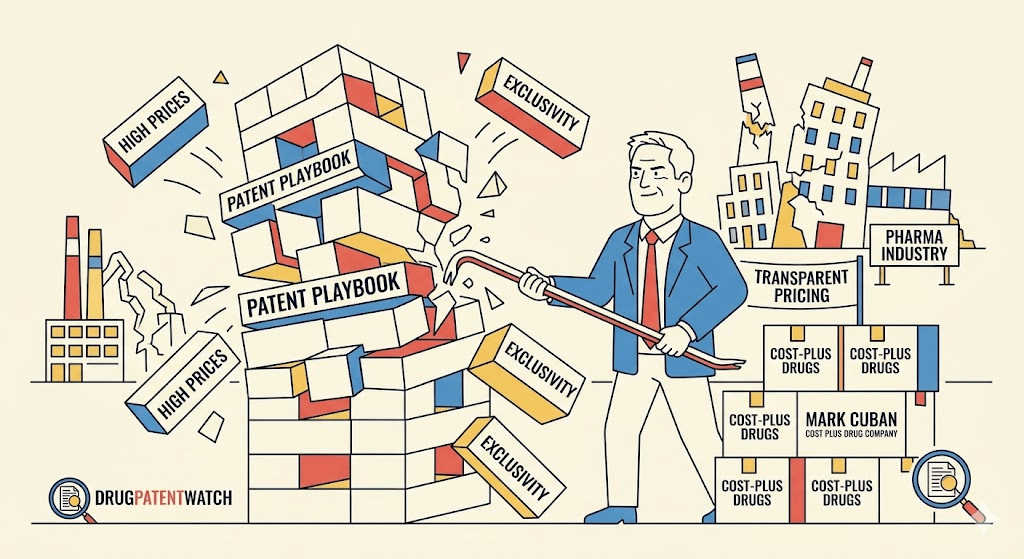
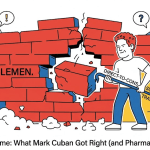
The pharmaceutical industry’s patent defense system is a machine built on a single assumption: that the price of a drug under exclusivity is whatever the market will bear. Patent thickets, product hopping, serial litigation, and pay-for-delay settlements all flow from that premise. Remove the assumption, and the entire architecture wobbles.
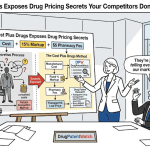
Mark Cuban’s Cost Plus Drug Company has spent four years doing exactly that. Its pricing model — acquisition cost plus a flat 15% markup, a $5 pharmacy service fee, and standard shipping — does not negotiate, lobby, or litigate. It just publishes a number. That number is often 90% or more below what the same molecule costs through a pharmacy benefit manager’s formulary. When a cancer patient can buy a 30-day supply of imatinib for $13.40 at Cost Plus instead of paying $2,500 at a retail chain, the patent defense that Novartis spent years constructing around that molecule stops mattering to that patient [1].
This is not a story about one quirky pharmacy. It is a story about structural pressure on the mechanics that make pharmaceutical patents worth what the industry says they are worth.
The Patent Defense Machine: How It Was Supposed to Work
To understand what Cost Plus threatens, you need to understand what traditional patent defense was designed to do — and why it has been so financially effective for so long.
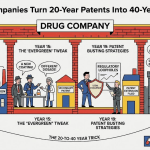
A pharmaceutical patent, at its core, grants a 20-year monopoly in exchange for public disclosure of an invention. The problem for brand manufacturers is that the effective commercial life of most drugs, after accounting for the years spent in clinical trials and regulatory review, is substantially shorter. The average small-molecule drug loses 7 to 10 years of exclusivity before it even reaches a pharmacy shelf. What the patent system grants in law, drug development timelines partially take back in practice.
The pharmaceutical industry’s response was a body of legal and regulatory tactics designed to stretch exclusivity beyond the original patent term. Collectively, these tactics are called lifecycle management. Critics call it evergreening. The distinction depends on how much clinical benefit accompanies the reformulation.
The Classic Toolkit: From Thickets to Product Hops
The four pillars of the traditional patent defense playbook are well documented in regulatory and academic literature. Each one exploits a different feature of the U.S. patent and drug approval system.
Patent evergreening involves filing secondary patents on minor modifications to an approved drug — a new dosage form, a new salt, a new formulation — near the expiration of the original compound patent. These secondary patents can extend effective market exclusivity by years, often without delivering measurable clinical improvements. Novartis used this approach to extend imatinib’s U.S. exclusivity by six years, applying for patent term restoration, pediatric exclusivity, and secondary formulation patents to push the original May 2013 expiration out to November 2019 [2].
Patent thickets take the same logic and scale it. Rather than filing a handful of secondary patents, a company files dozens or hundreds, covering every conceivable aspect of the drug: its formulation, its manufacturing process, its dosing device, its method of administration, specific patient subpopulations. The goal is not necessarily to win every patent in court. The goal is to impose litigation costs so high that a potential generic entrant decides the economics do not work. AbbVie executed this strategy with Humira to near-perfection. The company filed 311 patent applications for adalimumab in the United States, 90% of them after FDA approval in 2002. The primary compound patent expired in 2016. Biosimilars did not reach U.S. patients until 2023 — a seven-year gap that, according to PharmExec analysis, generated over $114 billion in additional revenue for AbbVie after the primary patent expired [3].
Product hopping shifts patient prescriptions to a new, patented version of a drug before generics can enter on the old formulation. A manufacturer launches an extended-release or subcutaneous version of the original molecule, invests heavily in physician detailing to shift prescribing patterns, and then either withdraws the old formulation or allows it to wither. By the time the generic arrives for the original molecule, the relevant patient population has moved on. The generic captures a fraction of the market it was designed to contest. The tactic worked particularly well against biosimilar competition in immunology: as a biologic faces loss of exclusivity on its intravenous formulation, the manufacturer launches a subcutaneous version, wraps it in new device patents, and executes a clinical repositioning campaign to make the original formulation commercially obsolete [4].
Pay-for-delay settlements — formally known as reverse payment settlements — allowed brand manufacturers to pay generic companies to stay off the market past the date a generic might otherwise launch. The Supreme Court’s 2013 decision in FTC v. Actavis opened these agreements to antitrust scrutiny, but it did not eliminate them. The FTC estimates these arrangements cost consumers approximately $3.5 billion annually even after Actavis [5].
Serial patent litigation, a more recent evolution, involves filing new suits based on newly issued continuation patents even after an initial case concludes. In the case of Astellas’s mirabegron (Myrbetriq), an initial Hatch-Waxman case settled in 2020 with generic entry expected in 2024. Astellas then pursued four additional lawsuits built on new but substantively similar patents, resulting in only two firms launching in 2024 while facing the threat of large damages claims [6].
The Economics of Delay
Every week of delayed generic entry has a defined dollar value. For a drug doing $5 billion per year in U.S. sales, a single additional month of exclusivity is worth approximately $420 million in gross revenue. The cost of prosecuting a patent, filing a citizen petition, or funding a pay-for-delay settlement is trivial relative to that number. This arithmetic is why the industry spends so heavily on IP strategy, and why the tactics above persist despite regulatory pressure and academic criticism.
What the arithmetic did not account for — what it still struggles to account for — is an actor whose pricing model does not depend on the exclusivity window at all.
Cost Plus: A Fundamentally Different Economic Logic
Cost Plus Drugs launched in January 2022 as an online pharmacy selling generic drugs at cost plus a flat 15% markup [7]. It was co-founded by Alex Oshmyansky, a radiologist who had spent years studying pharmaceutical supply chain economics, and Mark Cuban, who provided capital and public visibility. The underlying thesis was simple: the list price of a drug in the United States is not a market price. It is a negotiated fiction, constructed through a system of rebates, fees, and formulary placement arrangements between manufacturers and pharmacy benefit managers that is deliberately opaque.
By bypassing that system entirely — buying directly from manufacturers or their distributors, adding a transparent markup, and shipping to patients — Cost Plus could reveal what generic drugs actually cost when stripped of the intermediary layer. The results were startling enough to generate significant attention from the medical and public health communities.
What the Numbers Actually Show
The price differences Cost Plus revealed were not marginal. They were diagnostic of a system with a structural pricing problem.
Generic imatinib — the same molecule Novartis had extended exclusivity on for six years through secondary patents — listed at approximately $2,500 per 30-day supply at retail pharmacies in 2022. Cost Plus offered it for $13.40 [1]. A study published in The Journal of Clinical Oncology estimated that if seven common self-administered generic oncology drugs were purchased through Cost Plus instead of Medicare Part D, the program could have saved $661.8 million — a 78.8% reduction — based on 2020 spending and Q3 2022 prices [8]. Individual Medicare beneficiaries could have saved nearly $25,200 annually on abiraterone or between $17,500 and $20,500 on imatinib [8].
A Harvard-affiliated study examining 89 generic drugs found that Medicare Part D could have saved more than $3 billion in 2020 alone at Cost Plus prices. Among those drugs, aripiprazole — a widely used psychiatric medication — cost Medicare more than $2 per pill under Part D, versus $0.24 at Cost Plus [9].
For context on what this means to the traditional patent defense playbook: the entire premise of an extended exclusivity strategy is that patients and payers will pay the protected price because there is no viable alternative. Cost Plus is the alternative.
“We demonstrate that Cost Plus Drugs has the potential to improve access to essential cancer medications through reduced out-of-pocket costs for patients, even if they have insurance coverage in or out of Medicare.” — Dr. Ruchika Talwar, Urologic Oncology Fellow, Vanderbilt University Medical Center, Journal of Clinical Oncology, 2023 [8]
From Generics to Biologics: The Expansion Phase
The company’s original catalog was limited to generic small-molecule drugs. That scope excluded the most financially consequential patent defense territory in the industry: biologics. AbbVie’s Humira, Merck’s Keytruda, Bristol Myers Squibb’s Opdivo — the drugs surrounded by the densest patent thickets — are all biologics. By restricting itself to generics, Cost Plus initially left the most sensitive patent real estate untouched.
That changed in 2023 when Cost Plus partnered with Coherus BioSciences to offer YUSIMRY (adalimumab-aqvh), a biosimilar of Humira, for $569.27 — far below Humira’s list price of approximately $7,000 per month [10]. It was the company’s first biologic product, and the choice of Humira as the entry point was deliberate. No drug in American pharmaceutical history had been more aggressively protected through patent thickets and settlement agreements. Offering a Humira biosimilar at cost-plus pricing was as direct a challenge as the company could construct to the patent defense model.
In late 2025, Cost Plus signed an agreement to sell a biosimilar of Johnson & Johnson’s Stelara (ustekinumab) at a price below both the brand and competing biosimilars [11]. Specialty biologic drugs are expensive. They represent about 5% of total U.S. prescriptions but accounted for more than half — 51% — of all drug spending in 2024, per the FDA. The company’s entry into this segment is no longer a footnote. It is a direct assault on the segment where patent defense spending is most concentrated and where the revenue stakes are highest.
As of mid-2026, the company carries over 2,300 prescription products delivered by mail to patients nationwide, and is actively working with trade name manufacturers to add both single-source brands and specialty biologics to its pharmacy.
The scale and ambition of Cost Plus’s latest partnership illustrate how rapidly the model is maturing. In April 2026, Cost Plus announced a partnership with Humana’s CenterWell Pharmacy to develop new end-to-end employer prescription solutions, combining Cost Plus Drugs’ pricing model with Humana’s scale in insurance and distribution. U.S. employer healthcare costs are projected to rise more than 9% this year to roughly $17,000 per employee, according to Aon, a figure driven in part by the surge in GLP-1 spending. Employers looking at that number are a natural audience for a model built on eliminating the rebate layer.
How Patent Defense Depends on Price Opacity
The conventional account of pharmaceutical patent defense focuses almost exclusively on legal mechanics: which patents get filed, how litigation proceeds, whether courts uphold or invalidate specific claims. That account is correct, as far as it goes. But it understates how much of the system’s effectiveness depends on something more basic: the patient and payer not knowing what a drug actually costs to produce.
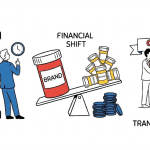
Price opacity is not a byproduct of the pharmaceutical pricing system. It is a feature. When a PBM negotiates a rebate from a manufacturer, both parties benefit from not disclosing the net price. The manufacturer can maintain a high list price (which anchors copays, coinsurance calculations, and out-of-pocket maximums); the PBM captures spread between the rebate it receives and the amount it passes through to plan sponsors. The patient sees a copay that often reflects the list price rather than the negotiated net price. The plan sponsor receives periodic rebate checks but rarely has the data infrastructure to connect those checks to individual drug transactions.
In this environment, patent defense works because payers accept the premise that the list price is the real price, or close to it. A generic entrant challenges that price; a brand manufacturer defends it through delay tactics. The entire contest takes place within a pricing framework that neither party questions.
Cost Plus questions it. The company’s CEO Alex Oshmyansky has been explicit about the mechanism: for a drug like imatinib, a highly expensive chemotherapy, 99% of the sticker price goes directly to PBMs, not to the manufacturer. By publishing its actual acquisition cost plus its markup, Cost Plus makes visible what has previously been invisible: the gap between manufacturing cost and list price is not a reflection of R&D investment recovery. It is, in many cases, a function of the rebate architecture around the drug.
When that gap is visible, patent defense becomes a harder sell to employers and plan sponsors. If a plan sponsor can route its covered lives to a Cost Plus-affiliated pharmacy network and save 50% to 90% on generic spending — as the company claims based on employer program data — the question is no longer whether the brand manufacturer’s patents are valid. It is whether the plan sponsor is willing to keep paying the brand price when a cost-plus alternative is available.
The Orange Book Under Pressure
While Cost Plus works at the market level, regulatory action has been working at the legal level to constrain the same patent defense tactics from a different direction. The FTC’s Orange Book enforcement campaign, which began in earnest in 2023, represents the most aggressive government challenge to pharmaceutical patent listings in decades.
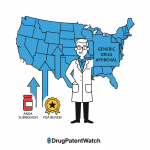
The Orange Book — formally the FDA’s publication of approved drug products and their patent and exclusivity information — is the mechanism through which Hatch-Waxman patent defense operates. When a generic manufacturer files an Abbreviated New Drug Application (ANDA), it must certify with respect to each Orange Book-listed patent. If it certifies that a patent is invalid or will not be infringed (a Paragraph IV certification), the brand manufacturer can file a patent infringement suit within 45 days, automatically triggering a 30-month stay on FDA approval of the generic. That automatic stay is worth months to years of additional exclusivity, entirely independent of whether the brand manufacturer ultimately wins in court.
In 2024 and 2025, the FTC launched a coordinated enforcement campaign against improper Orange Book listings. The Commission sent warning letters to major pharmaceutical companies, including Teva, GSK, and AstraZeneca, challenging over 300 patent listings it deemed improper. The distinctive feature of the campaign was that it targeted Orange Book listings directly — arguing that listing a non-qualifying patent violates the FTC Act’s prohibition on unfair or deceptive practices — rather than attacking downstream settlement agreements, as earlier enforcement actions had done.
In December 2025, following sustained FTC pressure, Teva Pharmaceuticals requested the removal of more than 200 patent listings from the Orange Book. These patents covered asthma, diabetes, and COPD treatments. By removing these patents from the register, Teva effectively dismantled the mechanism for triggering a 30-month stay on those specific grounds, clearing a path for generic competitors to file ANDAs without facing an automatic 2.5-year delay based on device mechanics.
This enforcement trend operates in parallel with Cost Plus, not in coordination with it, but the cumulative effect is the same: the tools available to brand manufacturers for delaying generic entry are becoming less reliable. Patents that were previously used as automatic stay triggers are being delisted. Settlement agreements face antitrust scrutiny. The regulatory and market pressures are converging on the same structural weakness in the patent defense playbook.
As DrugPatentWatch has documented in its ongoing Orange Book analysis, the FTC’s campaign has materially changed the device patent landscape for inhaler and injector products. Brand companies that had assumed Orange Book listings were immune from FTC challenge have learned otherwise, and the compliance burden on companies relying on device-related patents to trigger 30-month stays has increased substantially [5].
The $236 Billion Patent Cliff and What It Changes
The context for all of this is a patent expiration wave that makes the 2012 “patent cliff” — when blockbusters like Plavix, Lipitor, and Singulair lost exclusivity — look modest. Between 2025 and 2030, approximately 65 drugs with over $100 million each in annual sales are set to lose exclusivity. That represents $187 billion in global revenue up for grabs from those drugs alone, with broader estimates reaching $236 billion.
The drugs at the center of this cliff are not obscure products. The U.S. market alone is projected to lose more than $230 billion in branded revenue between 2025 and 2030, with key expirations concentrated in oncology immunotherapy, cardiovascular medicine, and metabolic disease. Merck’s pembrolizumab (Keytruda) — the world’s best-selling drug at $29.5 billion in 2024 revenue — faces its core U.S. loss of exclusivity around 2028. Bristol Myers Squibb faces simultaneous cliffs on Eliquis (2026) and Opdivo (2028), representing approximately $22 billion in combined annual revenue. BMS faces what analysts describe as the largest growth gap among large-cap pharmaceutical peers, estimated at approximately $38 billion in future at-risk revenue.
The standard industry response to a patent cliff is lifecycle management: launch a successor product, file secondary patents on the original, shift prescribing, and delay the effective date of generic competition. These tactics work, and the industry has executed them well. But they work within a pricing environment that allows the protected product to maintain premium pricing during the transition period.
What the Cliff Looks Like with Cost Plus in the Market
Here is the relevant question that pharmaceutical IP strategists are now grappling with: what happens to the value of a lifecycle management strategy when the drug it is designed to protect can be supplied at manufacturing cost?
Consider a hypothetical drug doing $8 billion annually. Its primary compound patent expires in 2027. The manufacturer has executed a standard lifecycle management playbook: it has a new extended-release formulation protected until 2031, a new subcutaneous version with device patents running until 2033, and a pediatric exclusivity extension on one indication. These secondary patents are worth, collectively, several years of additional exclusivity — billions of dollars of revenue protection.
Now add a Cost Plus-model competitor offering the original formulation at cost plus 15% the day the compound patent expires. The formulary management strategy that was designed to shift patients to the extended-release version before generic entry runs headlong into a pharmacy offering the original molecule at 90% below list price. Employers who have cost-plus network arrangements will route covered lives to the generic. Plan sponsors with transparent pricing programs will see the gap between the extended-release product’s list price and the cost-plus generic price and ask hard questions about clinical differentiation.
The lifecycle management strategy does not fail entirely. Patients for whom the extended-release formulation offers genuine clinical benefit — better tolerability, improved adherence, reduced side effects — will continue to be prescribed it, and insurers will cover it for those indications. But the population that lifecycle management strategies historically depended on to maintain revenue — patients for whom the original formulation would have been adequate, shifted to the successor product through formulary manipulation rather than clinical necessity — shrinks significantly in a cost-plus pricing environment.
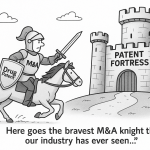
DrugPatentWatch’s analysis of this dynamic notes that Cost Plus’s expansion into biosimilars and complex generics provides a ‘release valve’: if a manufacturer launches a subcutaneous version of a biologic to avoid competition, but Cost Plus offers the original IV version as a low-cost biosimilar, the evergreening fortress is breached.
The IRA as Parallel Pressure
The Inflation Reduction Act of 2022 added a second mechanism of structural pressure on the patent defense playbook, operating through Medicare rather than the retail pharmacy market. For the first time, the law granted Medicare the authority to negotiate prices directly with manufacturers for high-expenditure single-source drugs without generic or biosimilar competition.
The statute requires the Secretary to negotiate Maximum Fair Prices for 10 drugs taking effect in 2026, 15 additional drugs for 2027 and 2028, and 20 additional drugs for 2029 and each following year. The drugs selected are precisely the ones that the traditional patent defense playbook was designed to protect: single-source branded products with high Medicare expenditure and no off-patent competition. Being successfully patent-defended, in other words, now makes a drug more likely to be selected for government price negotiation — not less.
The first ten drugs subject to negotiation, including blockbusters like Eliquis, Jardiance, and Januvia, saw prices reduced by an average of 38% to 60% below their 2023 list prices for the 2026 price applicability year. That is not Cost Plus economics — the IRA negotiated prices are still above manufacturing cost by a substantial margin — but the signal it sends to the patent defense model is unmistakable: the longer a drug maintains exclusivity and the higher its list price, the larger the target it becomes for mandatory price negotiation.
The IRA creates what analysts at DrugPatentWatch have called a “forward cliff effect”: the revenue protection conferred by patent defense is now eroded not just at the moment of generic entry, but years earlier, when the drug’s high spending qualifies it for selection into the negotiation program [12]. A drug that maintained a $15,000 annual list price for seven years through evergreening tactics might face government negotiation in year five, eliminating a significant portion of the financial return that made the evergreening investment worthwhile.
The Small-Molecule Penalty
One consequence of the IRA that has drawn less public attention than it deserves is the differential treatment of small-molecule drugs and biologics. Under the IRA, a small-molecule drug becomes eligible for Medicare price negotiation seven years after FDA approval; a biologic becomes eligible after eleven years. The difference is four years of additional protection for biologics — protection that applies regardless of the drug’s actual patent situation.
This creates an odd incentive structure. The industry has historically invested in biologics partly because their manufacturing complexity makes biosimilar development harder and slower than ANDA-based generic entry. The BPCIA’s more permissive patent listing rules — which enabled strategies like Humira’s 250-plus patent portfolio — added another layer of protection. Now the IRA adds a statutory protection gap on top of both.
For small-molecule drugs, the combined pressure of Cost Plus retail competition, Medicare negotiation, and IRA inflation rebate penalties creates a revenue environment that erodes the value of traditional lifecycle management well before exclusivity expires. The patent itself may still be valid. It just does not generate the revenue it would have generated a decade ago.
How Specific Lifecycle Tactics Now Fail
Rather than generalizing, it is useful to trace how Cost Plus’s model disrupts each of the four classic patent defense tactics individually.
Evergreening
Secondary patents on reformulations create value when the reformulation can be placed on preferred formulary tiers while the original formulation is removed or disadvantaged. The commercial logic requires PBMs to cooperate in formulary management, typically in exchange for rebates on the reformulated product. PBMs are willing to do this because the rebate stream compensates them for shifting market access.
Cost Plus bypasses the formulary entirely. It is not a plan-sponsored network; it is a direct-to-consumer pharmacy that fills prescriptions at a publicly listed price. An employer that has integrated Cost Plus pricing into its benefit design — through the company’s employer program or through the CenterWell partnership announced in April 2026 — is not subject to formulary tier placement decisions by a PBM. The reformulated product can still get onto formularies at other plans, but a growing segment of the commercially insured population is migrating to pricing models where the reformulation premium cannot be captured.
Patent Thickets
Patent thickets are a legal defense designed to raise the cost and risk of generic entry so high that potential ANDA filers calculate the investment will not pay off. They work best when the expected revenue available to a successful generic entrant is large enough to justify the litigation cost — but the uncertainty and duration of that litigation consumes most of the margin.
Cost Plus changes the cost structure for generic competition by proving out the market. When Cost Plus offers imatinib for $13.40 per 30-day supply and demonstrates patient and payer demand, it provides market intelligence that a generic manufacturer might not have been able to generate independently. It shows that cost-plus distribution economics are viable. It reduces uncertainty about whether patients will switch. The generic entrant’s risk assessment looks different when there is an established comparable product on the market at a similar price point.
This effect is nascent but real. It is easier to model generic entry economics when a public benefit corporation has already demonstrated the market will accept cost-plus pricing.
Pay-for-Delay
Pay-for-delay settlements depend on the value of exclusivity being large enough that both the brand manufacturer and the generic challenger benefit from an agreement that delays competition. The brand pays the generic to stay out; both parties capture more value than they would from competitive entry.
When cost-plus alternatives exist at competitive prices, the value of exclusivity that a brand manufacturer is trying to protect through the settlement declines. If a drug is available at near-manufacturing cost through a cost-plus channel, the brand price premium that drives the settlement calculus is already compromised. The economics of a settlement that delays generic entry are less compelling when a significant patient population is already accessing a comparable molecule at cost-plus pricing.
This does not eliminate pay-for-delay. For drugs without established cost-plus alternatives — particularly complex biologics and specialty products with no comparable molecule on the Cost Plus formulary — the settlement economics remain intact. But as Cost Plus’s catalog expands and its biosimilar portfolio grows, the segment of the market where delay settlements capture their full value is narrowing.
Serial Litigation
Serial patent litigation, as documented in the mirabegron case, delays generic entry by imposing repeated rounds of litigation cost on generic entrants. The tactic works when the expected payoff for the generic entrant, discounted by the probability and duration of litigation success, falls below the cost of continuing to fight [6].
The calculation changes if a cost-plus pharmacy can serve the relevant patient population during the litigation period. If a substantial share of patients who would have switched to a generic shifts instead to a cost-plus alternative during the years that serial litigation delays market entry, the generic entrant’s commercial opportunity at the end of the litigation tunnel is smaller. Perversely, this can make serial litigation less effective as a strategic delay: it delays the generic but accelerates cost-plus adoption in the patient population.
The Stelara Case: A Real-Time Illustration
Johnson & Johnson’s ustekinumab (Stelara) is one of the most instructive cases for watching how Cost Plus interacts with the patent defense system in real time. Stelara generated $10.8 billion in 2022 revenue and was a significant contributor to J&J’s immunology franchise. Its biologic patent protection allowed J&J to maintain a U.S. list price of approximately $20,000 per month.
Biosimilars began entering the U.S. market in 2025 after settlement agreements J&J had reached with biosimilar manufacturers. The entry of multiple biosimilar versions at significant price discounts to the original was expected to erode Stelara’s revenue substantially — the standard patent-to-biosimilar transition.
What was not anticipated in the standard model was Cost Plus’s decision to carry a Stelara biosimilar at a price below both the brand and competing biosimilars [11]. This compresses the pricing floor. In the legacy model, biosimilar entry occurs at, say, 30% below the brand list price, with multiple biosimilar entrants eventually driving prices down further over two to three years. Cost Plus introduces cost-plus pricing at day one. The pricing transition that historically took years now has a floor set by the acquisition cost of the biosimilar plus 15%.
The patent defense investment J&J made in Stelara — years of litigation strategy, settlement negotiations, regulatory tactics — did not fail entirely. It delivered years of protected revenue. But the revenue associated with the post-settlement competitive phase, which has historically been the “soft landing” period before prices reach their floor, is now compressed. The floor is lower and arrives faster.
What Patent Strategy Teams Are Actually Doing About It
The pharmaceutical industry is not passive in the face of these pressures. IP strategy teams at major manufacturers have spent the past two years assessing what the combined pressure of Cost Plus, IRA negotiation, and Orange Book enforcement means for lifecycle management economics. Several responses are emerging.
Genuine Clinical Differentiation as a Defense
The most durable response to cost-plus pricing is clinical differentiation that cannot be replicated by a generic or biosimilar. If a reformulated drug demonstrably improves patient outcomes — reduced side effects, better adherence, fewer hospitalizations — that clinical benefit justifies a price premium even in a Cost Plus environment. Formulary placement for that premium product is easier to defend to employers and plan sponsors when the differentiation is quantified in clinical terms.
This was always supposed to be how lifecycle management worked. The industry’s problem is that decades of product hopping strategies based on marginal reformulations — dosing frequency changes, salt modifications, device tweaks — have trained payers to be skeptical of clinical differentiation claims. Manufacturers that actually invest in delivering meaningful improvements will be able to price and defend those improvements. Those relying on the same product hopping logic that worked in 2010 will find the environment more hostile.
Vertical Integration Into Manufacturing
One response to cost-plus pricing is to build a cost structure that can compete with it. A small number of pharmaceutical companies have explored whether they can manufacture their own generic versions at sufficient scale to price comparably to cost-plus models while maintaining quality and margin. This is difficult: the manufacturing infrastructure, regulatory compliance requirements, and distribution logistics that Cost Plus has assembled represent real barriers. But the company’s Dallas manufacturing facility — which opened in 2023 and produces epinephrine, norepinephrine, and related injector products — demonstrates that vertical integration at meaningful scale is achievable [7].
Brand manufacturers watching that facility understand what it implies: if a startup can build pharmaceutical manufacturing infrastructure sufficient to supply a national patient population at 15% above cost, the capital investments required to do so are not prohibitive for companies with existing manufacturing assets.
Employer Engagement Before Cost Plus Captures the Channel
The most immediately actionable strategic response is direct engagement with self-insured employers before they integrate Cost Plus into their benefit design. Employers are the most price-sensitive payers in the system and the least loyal to any particular pharmacy channel. A brand manufacturer that can offer an employer a direct-pricing arrangement — net of rebates, with transparent pass-through — at competitive pricing relative to Cost Plus retains the formulary relationship and the prescribing data that comes with it.
Several manufacturers have already launched direct employer programs modeled on this logic. The effectiveness of these programs depends on the employer’s sophistication, the drug’s clinical differentiation, and whether Cost Plus has a comparable molecule at competitive pricing. For drugs where Cost Plus cannot match on price or availability, direct employer deals remain viable. For drugs where Cost Plus is already competitive, these arrangements are defensive at best.
The Role of Patent Intelligence in a Cost-Plus World
In this environment, the analytical tools that pharmaceutical companies, investors, and generic manufacturers use to track patent status and competitive exposure become more valuable, not less — but they need to track different things than they did five years ago.
Historically, patent tracking focused on expiration dates, litigation status, and Orange Book listings. That data remains essential. But the question it needs to answer has expanded: given a drug’s cost of goods, what is the viable cost-plus price at which a competitor could enter? How does that compare to the brand’s current list price? How quickly could a Cost Plus-type entrant access the active pharmaceutical ingredient at commercial scale? Which employer and health plan contracts have the flexibility to route covered lives to a cost-plus channel?
DrugPatentWatch maintains one of the most comprehensive pharmaceutical patent databases available, tracking patent expiration dates, ANDA filings, litigation outcomes, Orange Book listings, and market exclusivity periods across thousands of molecules [13]. In the current environment, that data has taken on a new dimension: it maps not just when exclusivity expires, but which drugs are most exposed to cost-plus disruption once exclusivity does expire — or even before it does, in cases where cost-plus channels access comparable molecules legally through existing generic or biosimilar markets.
For generic manufacturers assessing ANDA filing economics, the Cost Plus pricing data provides a useful market signal. A molecule that Cost Plus is already offering at $15 per 30-day supply suggests a competitive cost structure that a new generic entrant needs to match or beat. A molecule not yet on Cost Plus’s formulary but with comparable API costs may represent an opportunity to enter ahead of Cost Plus.
For brand manufacturers managing lifecycle transitions, the analytical priority is identifying which drugs in the portfolio are Cost Plus-vulnerable — meaning they have generic or biosimilar competitors with APIs available at manufacturing cost that Cost Plus could list at prices far below current protected pricing — and which drugs have genuine clinical differentiation that would withstand direct cost-plus price competition.
The Biosimilar Interchangeability Wrinkle
The expansion of Cost Plus into biosimilars introduces a complication specific to the biologics market: interchangeability. A biosimilar that achieves an FDA interchangeability designation can be substituted by a pharmacist for the reference product without a new prescription from the physician. This is functionally similar to the automatic substitution that occurs with generic small-molecule drugs at the pharmacy counter.
Without interchangeability, a biosimilar requires a physician to write a new prescription or explicitly authorize substitution. This requirement protects brand biologics from automatic cost-plus substitution at the dispensing level. Physicians who have existing prescribing relationships with the brand are not automatically interrupted.
The FDA has been expanding the interchangeability pathway, and a growing number of biosimilars are achieving that designation. As interchangeable biosimilars become available for more molecules — and as Cost Plus lists them — the automatic-substitution protection that brand biologics have relied on in addition to patent protection begins to erode. A patient whose physician wrote a Humira prescription but whose pharmacy carries only YUSIMRY at a fraction of the cost, and whose pharmacist can legally substitute the interchangeable biosimilar, faces a simple economic choice.
Patent defense strategy in biologics has historically been calibrated for a market where automatic substitution is not the default. The increasing availability of interchangeable biosimilars, combined with Cost Plus’s entry into the biosimilar market, is changing that calibration.
The Orphan Drug Hedge and Its Limits
One corner of the pharmaceutical market where the Cost Plus model has limited immediate reach is the orphan drug segment. Orphan designations — FDA approvals for drugs treating diseases affecting fewer than 200,000 Americans — confer seven years of market exclusivity separate from patent protection. More significantly, patient populations are small enough, and alternative treatments often scarce enough, that the pricing leverage available to a Cost Plus-type entrant is limited.
Some manufacturers have responded to the broader pricing pressure environment by explicitly shifting their R&D portfolios toward orphan indications. If Cost Plus cannot serve a patient population of 8,000 patients with a rare metabolic disorder because there is no viable generic API available, the strategic relevance of cost-plus pricing is zero for that product.
But the orphan drug hedge has a structural ceiling. The number of commercially viable rare disease indications is finite. The FDA and FTC have both shown increasing skepticism toward what critics call “orphan drug evergreening” — applying for orphan designations for common drugs with large existing markets by focusing on a narrow subpopulation, then using the orphan exclusivity to shield the broader product from cost-plus competition.
Under the IRA, the orphan drug exemption from Medicare negotiation is limited: a drug is only exempt if it has exactly one orphan designation and is approved only for that indication. If it gains a second orphan designation or an approval for a non-orphan indication, it loses its IRA exemption [12]. This constraint limits the effectiveness of orphan drug strategies as a hedge against both IRA negotiation and cost-plus competition.
The GLP-1 Exposure
One class of drugs is conspicuously absent from Cost Plus’s current formulary: GLP-1 receptor agonists. Semaglutide (Ozempic, Wegovy) and tirzepatide (Mounjaro, Zepbound) remain under active patent protection, and no generic or biosimilar versions are available in the United States. Cost Plus cannot offer a drug it cannot legally source. For now, the GLP-1 manufacturers — Novo Nordisk and Eli Lilly, primarily — are operating in a space where cost-plus disruption has no immediate reach.
That will change. The compound patents on semaglutide are scheduled to expire in 2031 and 2032. Tirzepatide’s core patents have varying expiration dates, but the key U.S. exclusivity period is finite. When those patents expire and generic or biosimilar versions become available, the cost-plus pricing model will apply to the highest-expenditure drug category in the United States with a vengeance.
DrugPatentWatch’s analysis notes that the GLP-1 sector is the next in line for the scrutiny that has already transformed inhaler and oncology drug markets. The patent defense strategy Novo Nordisk and Lilly have built around their GLP-1 portfolios — multiple delivery mechanisms, new indications, device patents, pediatric extensions — is being constructed in full knowledge that a cost-plus market will eventually exist for these molecules. The question is how much of the current revenue stream those strategies can protect before the cost-plus floor arrives.
It is worth noting that both Novo Nordisk and Eli Lilly have been included in executive-level drug pricing initiatives under the Trump administration’s most-favored-nation pricing program (TrumpRx.gov, launched February 2026), which is applying pricing pressure from the government direction even while Cost Plus approaches from the market direction [14]. The GLP-1 franchise is being squeezed from two sides simultaneously, and neither squeeze has fully landed yet.
What the Next Five Years Look Like
Several trends are converging in a way that makes the 2026 to 2031 window the most consequential period for pharmaceutical patent strategy since the Hatch-Waxman Act was passed in 1984.
The patent cliff places $230 billion or more in branded U.S. revenue at risk from generic and biosimilar competition. The IRA creates mandatory price negotiation for the highest-expenditure drugs that survive the cliff on their own — meaning patent defense that successfully delays generic entry now accelerates IRA selection. The FTC’s Orange Book enforcement campaign has removed a significant automatic-stay mechanism from the patent defense toolkit. And Cost Plus, through its employer programs and biosimilar expansion, is creating a pricing floor that anchors patient and payer expectations at manufacturing cost plus margin.
None of this kills pharmaceutical patent defense. Patents will remain the primary mechanism through which pharmaceutical innovation is commercially rewarded. Companies that develop genuinely novel molecules will continue to benefit from the exclusivity those patents confer. The industry’s capacity to pursue the next generation of oncology therapeutics, gene therapies, and precision medicine applications depends on that reward structure.
What changes is the value of defense strategies that generate exclusivity without generating clinical value. Evergreening tactics that produce years of revenue from minor reformulations without improving patient outcomes are becoming economically less interesting: the IRA selects for the resulting high-priced drugs as negotiation targets; the FTC challenges the device patents used to trigger automatic stays; and Cost Plus offers a cost-plus alternative that employers can access without navigating formulary management games.
Analysis of the current pharmaceutical environment suggests a clear strategic directive: R&D investment must be directed toward first-in-class therapies and significant therapeutic advances that can justify their prices based on clinical value, not just patent protection. That prescription is easier to write than to execute for companies that have spent decades optimizing revenue through lifecycle management rather than clinical advancement. But the math no longer works the old way.
The Structural Argument: Price Transparency as a Systemic Threat
Step back from the individual tactics and the strategic responses, and what Cost Plus represents is a challenge to price opacity as a foundational premise of pharmaceutical pricing. Every mechanism that makes pharmaceutical patent defense financially rewarding — the rebate architecture, the formulary management system, the PBM intermediary layer — depends on no one knowing exactly what a drug costs to produce and distribute.
Cost Plus publishes that number. Every drug on its formulary comes with an acquisition cost disclosure and a margin disclosure. This transparency does not just enable lower prices for patients. It generates a reference point against which every other price in the market can be evaluated.
Employers who see that imatinib costs $13.40 at Cost Plus ask why their PBM-managed formulary charges $200 for the same molecule. Health plans that see the Stelara biosimilar available at cost-plus pricing ask whether their rebate arrangements with J&J still justify the net price they’re paying for the brand. Patients who discover that their out-of-pocket cost at a cost-plus pharmacy is lower than their insurance copay ask what exactly their insurance is providing for its premium.
Each of these questions destabilizes, at the margin, the revenue assumptions that pharmaceutical patent defense strategies were built to protect. The legal machinery — the Orange Book listings, the Hatch-Waxman stays, the BPCIA litigation — remains in place. The financial logic that made it worth operating is narrowing.
The pharmaceutical industry has always known that a fully transparent pricing market would compress margins. What it did not anticipate was a public benefit corporation founded by a billionaire using that transparency not as a political argument but as a business model.
Key Takeaways
Cost Plus Drugs’ 15% markup pricing model bypasses PBMs entirely and establishes a reference price at or near manufacturing cost for over 2,300 drugs, including an expanding biosimilar portfolio covering products like Humira and Stelara biosimilars.
Traditional patent defense tactics — evergreening, patent thickets, product hopping, and serial litigation — depend structurally on price opacity. Each tactic generates financial value in proportion to the gap between the cost-plus price and the list price the tactic protects. That gap is now publicly visible.
The FTC’s Orange Book enforcement campaign, which forced Teva to delist over 200 patents in December 2025, has materially reduced the availability of automatic 30-month stay protection for drug-device combinations — removing one of the most reliable components of the patent defense toolkit.
The IRA’s Medicare negotiation program selects for exactly the drugs that successful patent defense produces: high-expenditure, single-source drugs without generics or biosimilars. Being well patent-protected now accelerates a drug’s path into mandatory government price negotiation.
The 2026 to 2031 patent cliff — estimated at $230 billion or more in U.S. branded revenue at risk — arrives in a market where cost-plus competitors can establish a pricing floor on the day exclusivity expires, compressing the “soft landing” period that historical lifecycle management strategies depended on.
GLP-1 drugs are currently insulated from cost-plus competition but carry compound patent expiration dates in the early 2030s. The patent defense architecture being built around semaglutide and tirzepatide is being constructed with full knowledge that a cost-plus market for these molecules is forthcoming.
Patent intelligence tools, including those provided by DrugPatentWatch, now need to answer a different question: not just when does exclusivity expire, but what is the viable cost-plus entry price for this molecule, and how does that price compare to current protected pricing?
Frequently Asked Questions
1. Does Cost Plus Drugs actually threaten drugs that are still under active patent protection, or only post-exclusivity generics?
Directly, Cost Plus can only sell drugs whose exclusivity has expired or that are otherwise legally off-patent. It cannot sell a patented brand drug at a lower price without a licensing agreement from the patent holder. But the indirect effect on in-patent drugs is real: Cost Plus demonstrates what post-exclusivity pricing looks like for a given molecule, sets patient and payer price expectations, and accelerates demand for cost-plus alternatives the moment exclusivity expires. The company’s expansion into biosimilars — products that are already legally available as alternatives to branded biologics — extends this indirect pressure to biologic drugs that remain under patent protection, because the reference biologic and the biosimilar share a patient population.
2. If Cost Plus only does generics and biosimilars, why should brand manufacturers care about it right now rather than waiting until their patents expire?
Three reasons. First, the pipeline management decisions manufacturers make now — which lifecycle management investments to fund, which reformulations to patent — will produce returns in a market five to seven years from now when Cost Plus will be significantly larger and more embedded in employer benefit designs. Second, the employer-facing expansion of Cost Plus, particularly through the CenterWell/Humana partnership announced in April 2026, is changing plan sponsor expectations about drug pricing in ways that affect formulary negotiations for in-patent drugs today. Third, Cost Plus’s growth in the biosimilar market is directly competing with manufacturers trying to use product hopping strategies to shift patient populations from expiring-exclusivity reference biologics to new, patented successor products.
3. How does the Inflation Reduction Act’s Medicare negotiation program interact with the Cost Plus model?
They operate through different mechanisms but produce converging pressure on the same drugs. The IRA selects for Medicare negotiation the highest-expenditure single-source drugs without generic or biosimilar competition — exactly the drugs that successful patent defense produces. The IRA negotiated prices (38% to 60% below 2023 list prices for the first ten drugs) remain substantially above cost-plus manufacturing prices, but they establish a government-sanctioned maximum price that undercuts the list price premium that patent defense was designed to maintain. Cost Plus, meanwhile, establishes a market floor at manufacturing cost. Together, they compress the price band from both ends: government negotiation sets a ceiling and cost-plus sets a floor, reducing the effective premium available to patent-defended drugs.
4. What does the Cost Plus model mean specifically for the 2026 to 2030 patent cliff?
Historically, when a blockbuster drug lost exclusivity, the transition from brand pricing to generic pricing took time. Multiple generic entrants would enter sequentially; formulary substitution would take quarters or years to complete; manufacturers would execute lifecycle management strategies to shift patients to successor products. The “soft landing” period generated significant revenue for brand manufacturers even after exclusivity expired. Cost Plus compresses that soft landing. The day Eliquis’s compound patent expires and a generic entrant files an ANDA that results in approval, a Cost Plus affiliate can list apixaban at manufacturing cost plus 15%. Employers integrated into Cost Plus networks will route covered lives to that generic immediately. The brand price premium that Bristol Myers Squibb and Pfizer could historically maintain for two to three years post-exclusivity is no longer structurally guaranteed.
5. Can pharmaceutical manufacturers compete directly with the Cost Plus model, and are any of them doing so?
Some manufacturers have launched authorized generic programs and direct-to-employer pricing arrangements intended to compete at closer to cost-plus price points. These programs are real but limited: they typically apply to a narrow set of molecules where the manufacturer calculates that direct pricing retains more revenue than ceding the market to a cost-plus competitor. The structural challenge is that a manufacturer accustomed to capturing a significant share of its revenue through rebate arrangements has a very different cost infrastructure than a company like Cost Plus that was designed from scratch around a 15% margin model. A brand manufacturer competing on cost-plus terms is implicitly acknowledging the price illegitimacy of its existing rebate-dependent pricing — something most manufacturers are reluctant to do publicly for the rest of their portfolio.
References
Medical University of South Carolina Health. (2024, September 19). Mark Cuban is making medication costs an easier pill to swallow. MUSC. https://www.musc.edu/content-hub/news/2024/09/19/easier-pill-to-swallow
Grignolo, A., & Pretorius, S. (2019). Clinical implications of generic imatinib entry. The Lancet Regional Health – Americas. https://www.thelancet.com/journals/lanam/article/PIIS2667-193X(22)00134-X/fulltext
PharmExec Editorial Staff. (2026, April). The new era of U.S. pharmaceutical pricing: From policy upheaval to strategic adaptation. Pharmaceutical Executive. https://www.pharmexec.com/view/pharmaceutical-pricing-policy-strategic-adaptation
DrugPatentWatch. (2025, November 4). The thicket maze: A strategic guide to navigating and dismantling drug patent fortresses. https://www.drugpatentwatch.com/blog/the-thicket-maze-a-strategic-guide-to-navigating-and-dismantling-drug-patent-fortresses/
DrugPatentWatch. (2026, March 22). Drug patent evergreening works, until it doesn’t. https://www.drugpatentwatch.com/blog/does-drug-patent-evergreening-prevent-generic-entry/
Rajan, R., et al. (2025). Serial patent litigation: An emerging strategy to delay entry of generic competition. JAMA. https://www.ncbi.nlm.nih.gov/pmc/articles/PMC12757684/
Mark Cuban Cost Plus Drug Company. (2026). About MCCPDC. https://www.markcubancostplusdrugcompany.com/
Talwar, R., et al. (2023). Projected savings for generic oncology drugs purchased via Mark Cuban Cost Plus Drug Company versus in Medicare. Journal of Clinical Oncology, 41(18). https://pubmed.ncbi.nlm.nih.gov/37290029/
Hernandez, I., et al. (2022). Variation in the cost of medications purchased at the Mark Cuban Cost Plus Drug Company versus Medicare Part D. Annals of Internal Medicine. https://www.medscape.com/viewarticke/977398
Coherus BioSciences. (2023). Mark Cuban Cost Plus Drug Company joins forces with Coherus to make YUSIMRY, a HUMIRA biosimilar, available to patients. https://investors.coherus.com/news-releases/news-release-details/mark-cuban-cost-plus-drug-company-joins-forces-coherus-make
eMarketer. (2025, November 7). Mark Cuban’s Cost Plus pharmacy takes aim at biosimilar drug market. https://www.emarketer.com/content/mark-cuban-s-cost-plus-pharmacy-takes-aim-biosimilar-drug-market
DrugPatentWatch. (2026, February 2). The data-driven guide to winning the 2026 patent cliff. https://www.drugpatentwatch.com/blog/the-data-driven-guide-to-winning-the-2026-patent-cliff/
DrugPatentWatch. (2026). Patent expirations: Seizing opportunities in the generic drug market. https://www.drugpatentwatch.com/blog/patent-expirations-seizing-opportunities-in-the-generic-drug-market/
Sheridan, L. (2026, April 28). Mark Cuban’s Cost Plus Drugs has a new plan to cut employer healthcare costs. Inc. https://www.inc.com/leila-sheridan/mark-cubans-cost-plus-drugs-has-a-new-plan-to-cut-employer-healthcare-costs/91337062
Commonwealth Fund. (2025, November 13). How drugmakers use the patent process to keep prices high. https://www.commonwealthfund.org/publications/explainer/2025/nov/how-drugmakers-use-patent-process-keep-prices-high
Congressional Research Service. (2024). The role of patents and regulatory exclusivities in drug pricing (R46679). https://www.congress.gov/crs-product/R46679
KFF. (2025, January). FAQs about the Inflation Reduction Act’s Medicare Drug Price Negotiation Program. https://www.kff.org/medicare/faqs-about-the-inflation-reduction-acts-medicare-drug-price-negotiation-program/
GEN. (2025, November 25). Top 20 drugs heading for the patent cliff, 2026-2029. https://www.genengnews.com/topics/drug-discovery/top-20-drugs-heading-for-the-patent-cliff-2026-2029/
DrugPatentWatch. (2026, January 16). Evergreening by lawsuit: Strategic patent actions and generic entry stagnation. https://www.drugpatentwatch.com/blog/evergreening-by-lawsuit-strategic-patent-actions-and-generic-entry-stagnation/