The pharmaceutical patent landscape in Europe has shifted in ways that most of the industry’s public commentary has missed. The conversation tends to fixate on the obvious levers: supplementary protection certificates, data exclusivity, and the evergreening of formulation patents. These tactics exist and they matter. But a quieter, more technically elegant strategy has been running beneath that noise for years — one that exploits not the substance of the patent system, but its procedural architecture.
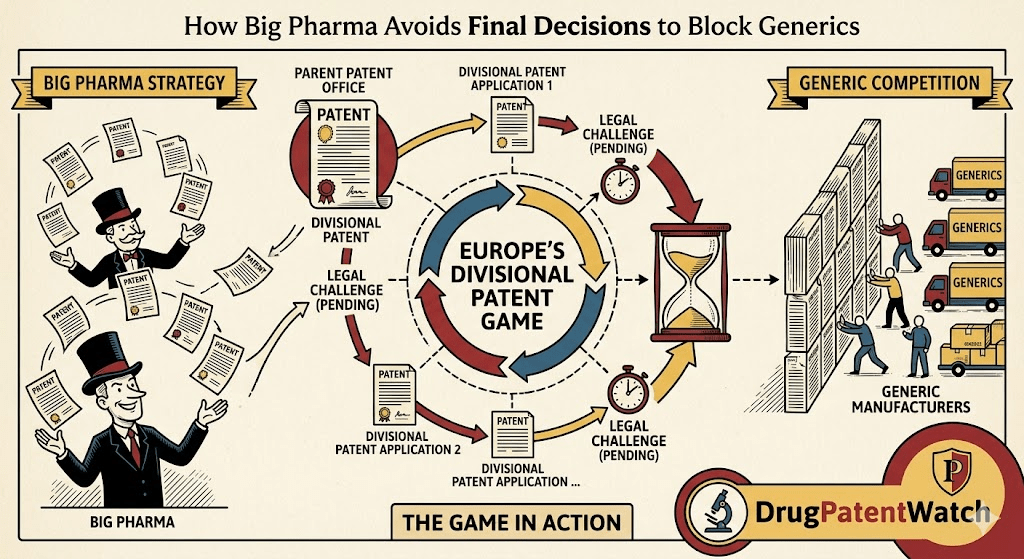
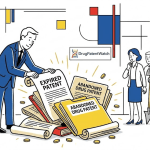
The strategy is the divisional patent cascade. A pharmaceutical company files a divisional application derived from a parent, then files another divisional derived from that divisional, then another. The filings multiply. Opponents challenge each patent in turn at the European Patent Office (EPO). The originator enforces them through national courts — seeking interim injunctions that freeze generic market entry while the EPO considers the application. Then, when the EPO signals that a patent is likely to be revoked, the originator withdraws it before a final decision is issued. No invalidity ruling goes on record. No precedent propagates to the remaining divisionals. The clock resets. Competitors must start the entire challenge process over. And a new divisional, already prepared, enters the queue.
The European Commission called this the ‘divisionals game’ in its October 2024 decision against Teva Pharmaceutical Industries. That decision imposed a fine of €462.6 million — the largest antitrust penalty ever levied against a pharmaceutical company in the EU — and for the first time formally labelled this specific patent procedure pattern as an abuse of dominance under Article 102 of the Treaty on the Functioning of the European Union.
But the Teva case is not the end of the story. It may be closer to a beginning. Generic manufacturers and patent analysts across Europe see the same pattern operating at other companies, with GlaxoSmithKline’s Ellipta franchise the most recent subject of public accusations. The procedural mechanics exploited in these cases are not fringe tactics; they are rational responses to the EPO’s own procedural rules, which offer no explicit prohibition on filing divisionals with known weaknesses, no penalty for strategic withdrawal before adverse rulings, and no accelerated clearance pathway for generics that need legal certainty before they can invest in market entry.
This article examines the mechanics of the divisional patent cascade in forensic detail, documents the documented cases and their outcomes, and explains why — despite the Teva fine — the game has not ended. It also maps the structural reforms that could change the rules, assesses the competitive intelligence tools available to generic manufacturers and investors, and evaluates what regulators and courts must still resolve before legal certainty replaces strategic ambiguity as the governing principle of European pharmaceutical patent law.
What a Divisional Patent Actually Is
A divisional patent application is a mechanism designed to solve a legitimate technical problem: an applicant files a patent application that covers multiple inventions, and the EPO objects on unity of invention grounds. The applicant then ‘divides’ the application, filing one or more divisional applications each directed to a different aspect of the invention. Each divisional derives its priority date from the original parent, preserves the disclosure as filed, but proceeds independently through examination. This is the textbook rationale — and for many applicants in complex technical fields, it accurately describes what they are doing.
The European Patent Convention does not restrict voluntary divisionals filed without any unity objection. An applicant can file a divisional at any time while the parent application remains pending, and a divisional can itself serve as the parent of a further divisional. The result is that a single original application can generate a family tree of individually prosecuted patents, each sharing the same priority date and disclosure, each theoretically covering a different aspect of the original invention.
For pharmaceutical companies, the strategic opportunity this creates is significant. A compound patent expires. The company files secondary patents on manufacturing processes, dosage regimes, formulations, and polymorphs. Some of those secondary patents face opposition proceedings at the EPO. The company responds to each opposition with a new divisional application covering related subject matter. The EPO’s opposition division must examine each divisional independently, because divisionals are treated as independent applications. A finding of invalidity on one does not automatically invalidate the others. The opponents must open fresh opposition proceedings on each one, paying fees, submitting evidence, and waiting for the EPO’s examination queue — which can span years.
As the journal IIC – International Review of Intellectual Property and Competition Law documented in 2022, the European Commission’s 2009 Pharmaceutical Sector Inquiry found that the number of divisionals filed per original patent application in the pharmaceutical sector ranged from one up to thirty. [1] The cumulative effect of that cascade is a legal landscape where, as one legal scholar writing in the Journal of Intellectual Property Law & Practice put it, the current EPO opposition procedure is far too slow to clear a thicket commercially and amounts almost to chopping trees with a pen-knife.[2]
The key feature that makes the cascade more than just a complexity burden is the withdrawal option. EPO procedural rules allow an applicant to withdraw an application at any time, including after opposition proceedings have begun. If the EPO’s opposition division or a Board of Appeal signals in a preliminary opinion that a patent is likely to be revoked, the applicant can withdraw the application before the ruling is issued. The EPO then closes the proceedings without a substantive decision on validity. No precedent is set. Opponents who challenged the now-withdrawn patent have spent years and hundreds of thousands of euros achieving nothing of legal consequence for the remaining family members.
“Once the rival product entered the market, the price of glatiramer acetate products decreased by roughly 40% to 80% across the relevant EU member states.” — European Commission, Teva Copaxone Decision, October 2024 [3]
That 40-80% price reduction figure is the economic stake of the divisional game. The gap between the patented originator price and the generic market price, multiplied across seven EU member states and several years of delayed generic entry, generated hundreds of millions of euros in monopoly-level revenues that Teva retained precisely because competitors could not achieve legal certainty through the patent system. It is against that backdrop that the Commission’s €462.6 million fine must be understood: it is an attempt to price the abusive exploitation of procedural rights above the revenue those procedural rights protected.
How the Cascade Actually Runs: The Mechanics in Practice
The operational sequence of a divisional cascade in the pharmaceutical sector follows a recognizable pattern. Understanding that pattern is essential for any generic company, biosimilar developer, or investor trying to time a market entry decision.
Step One: The Basic Patent Expiry Approaches
The compound patent protecting the active ingredient approaches its expiry, typically around year 17 or 18 of its 20-year term, allowing for prosecution time. The originator’s IP team has already filed secondary patents covering manufacturing processes, specific dosage forms and regimens, particle size distributions, particular polymorphic forms, and treatment protocols. Some of these are genuinely novel; others are incremental filings that, as independent analysts have noted, would struggle against rigorous examination. Regardless, they are filed, and they create a portfolio.
Step Two: The Divisional Web Begins
From each secondary patent application, while it remains pending (i.e., before grant), the originator files divisional applications. Those divisionals may cover the same or closely related subject matter described in slightly different claim language. In many cases, the divisionals themselves generate further divisionals. The EPO’s procedural architecture permits this cascading structure without restriction. Each divisional inherits the priority date of the original filing, so the technical disclosure stays anchored to the point of genuine invention — even though the patent applications themselves are filed years later.
As Herbert Smith Freehills Kramer noted in its analysis of the Teva decision, multiple divisional patents can be derived from a single parent application, and further divisional patents can then be filed that stem from those divisional patents, resulting in ‘cascading divisionals’… resulting in a large family of patents, often covering closely related inventions.[4]
Step Three: Enforcement and the Interim Injunction Window
Once divisionals are granted, the originator begins enforcement proceedings in national courts against generic companies that have announced market entry plans. In the European system, interim injunctions are available in most member states, and courts often apply a low threshold for granting them in pharmaceutical patent cases. The rationale is that once a generic is on the market, the price depression is difficult to reverse. So courts err toward injunctions pending a full validity determination.
This creates a tactical opportunity. A granted divisional patent — even one the originator’s own counsel privately assesses as unlikely to survive full examination — can be enforced to obtain an interim injunction. The generic company is frozen out of the market. The EPO opposition runs in parallel, but EPO proceedings are not fast. An EPO first-instance opposition hearing might take two to three years from filing. An appeal to the Technical Board of Appeal adds another two to four years. During all of that time, the interim injunction keeps the generic off the shelves.
Step Four: The Strategic Withdrawal
This is the operative core of the game. The EPO Board of Appeal issues a preliminary opinion. The preliminary opinion signals that the patent in question lacks inventive step, or that the claims cannot be maintained in any form that would survive opposition. The originator has a choice: accept the substantiated revocation ruling that is about to come, or withdraw the application before the ruling is issued.
If the originator accepts the ruling, the EPO issues a formal decision with legal reasoning. That reasoning, while not formally binding on other EPO panels, constitutes significant prior art and persuasive authority. Opponents challenging related divisionals in the same family can cite it. The cascade accelerates toward a conclusive resolution.
If the originator withdraws, the EPO closes proceedings without a substantiated decision. In the GSK Ellipta case, as JUVE Patent reported in March 2026, the Boards of Appeal stated in a preliminary opinion that once-daily administration of vilanterol did not constitute an inventive step. GSK withdrew all auxiliary requests. The EPO consequently revoked the patent, but critically, without a substantiated decision on inventive step. [5] The revocation is on the record, but the reasoning that would propagate as precedent is absent. Remaining divisionals in the family are not legally contaminated by a reasoned invalidity finding.
Step Five: The Refile, or the Wait
Depending on the timing, the originator may have already filed further divisionals from the now-withdrawn application. If those divisionals were filed while the parent was still pending — which the EPO’s rules require — they survive the withdrawal. Opponents must now open fresh opposition proceedings on each one. In some cases, the originator may also appeal the EPO’s formal revocation decision to the Board of Appeal, which keeps the contested patent nominally in force during the appeal period. As Baker Botts noted in its analysis of the Boehringer Ingelheim case, the Commission found that appealing an EPO revocation decision would have ‘kept the contested patent in force until the appeal had been decided,’ and that dormant divisionals ‘could have been reactivated and thus prolonged the patent dispute.’ [6]
The net effect is that a single original family of secondary patents, through the combination of cascading divisionals, strategic enforcement, selective withdrawal before adverse rulings, and appeals of actual revocations, can sustain market uncertainty for a decade or more after the basic compound patent expires. Competitors cannot plan. Investors cannot model launch timing. Health systems cannot budget for price reductions that the entry of generic competition would deliver.
Teva and Copaxone: The Commission Draws a Line
The full sequence of events in the Teva Copaxone case runs from 2015 to 2024 and constitutes the most thoroughly documented example of the divisional game in European pharmaceutical history.
Teva’s basic patent protecting glatiramer acetate — the active ingredient in Copaxone, its blockbuster multiple sclerosis drug — expired in 2015. [7] At that point, the market logic should have been straightforward: generic manufacturers had been preparing for years, the active ingredient was well characterized, and production processes were not novel. The price of glatiramer acetate should have fallen toward competitive levels.
It did not. Instead, Teva had already filed multiple secondary patents covering the manufacturing process and the dosing schedule of glatiramer acetate. When the basic patent expired, Teva filed a series of divisional applications from those secondary patents, creating what the Commission described as ‘a web of secondary patents around Copaxone.’ [8] Rival companies — most importantly Synthon, which had developed a competing glatiramer acetate product — challenged these patents at the EPO and sought to enter the market.
Pending EPO review, Teva started enforcing the divisional patents against competitors to obtain interim injunctions in national courts. The injunctions worked. Generic entry was frozen in key markets. Then, when EPO proceedings reached a point where the patents seemed likely to be revoked, Teva withdrew them to avoid a formal invalidity ruling. As the Commission put it, Teva did this specifically to avoid ‘a formal invalidity ruling, which would have set a precedent threatening other divisional patents to fall like dominos.’ [9]
Teva then moved the goalposts again. In parallel with the patent strategy, Teva pursued a large-scale conversion of its patient base from a daily 20 mg dose to a three-times-per-week 40 mg dose — the so-called ‘product hop.’ The Commission found that this conversion was not primarily driven by clinical need, but served to shift the market’s reference point before generics could arrive. By the time Synthon’s glatiramer acetate 20 mg product was ready for market, most patients had already migrated to Teva’s 40 mg formulation. The original market had, in effect, been emptied of patients. [10]
Separately, Teva ran what the Commission characterized as a ‘systematic disparagement campaign’ — spreading misleading information to physicians and pricing and reimbursement authorities in multiple EU member states about Synthon’s competing product’s safety, efficacy, and therapeutic equivalence, despite the fact that the product had received full marketing authorization from competent authorities. [11]
The Commission found that all three components — the divisional game, the product hop, and the disparagement campaign — constituted a single and continuous infringement of Article 102 TFEU. The fine of €462.6 million surpassed the €330.1 million penalty levied on Servier a decade earlier, making it the highest antitrust fine ever imposed in the EU pharmaceutical sector. [12]
On the day the decision was announced, Teva stated it would ‘vigorously defend its position on appeal’ and described the Commission’s theories of harm as ‘extreme, untested and factually unsupported.’ The appeal before the EU General Court remains pending. Given the typical pace of EU court proceedings, a General Court judgment is unlikely before 2027 or 2028, and further appeal to the Court of Justice of the European Union could extend the process beyond 2030.
The timing matters. As Cooley’s analysis noted, the AstraZeneca case — the previous landmark in pharmaceutical patent abuse of dominance — took ten years from the Commission’s decision to a final appellate ruling. [13] During the entire period of Teva’s appeal, other originators will be watching to see whether the General Court upholds the Commission’s novel theory of harm, narrows it, or rejects it. The ‘divisionals game’ as a prohibited category under Article 102 TFEU will not be settled law until that appeal resolves.
GSK’s Ellipta: The Pattern Continues
In March 2026, JUVE Patent reported that generic drug companies accused GlaxoSmithKline of ‘evergreening by playing the divisional game’ in proceedings before the EPO Boards of Appeal relating to the Ellipta franchise. [14]
The Ellipta franchise — comprising Trelegy Ellipta, Breo Ellipta, and Anoro Ellipta — is a significant business for GSK. According to the company’s own annual report, global turnover for the three products in 2025 reached £4.5 billion, with European sales of £922 million. [15] The active ingredient at the center of the dispute is vilanterol, a long-acting beta-agonist used in combination with other active ingredients for asthma and COPD.
The patent at the center of the proceedings, EP 2 400 950, covers vilanterol in dosages of 25µg and 50µg daily for the treatment of respiratory diseases. Eight opponents challenged the patent. In auxiliary requests before the Board of Appeal, GSK focused primarily on the once-daily administration of vilanterol. The Board issued a preliminary opinion that once-daily administration did not constitute an inventive step. GSK then withdrew all auxiliary requests. The EPO revoked the patent — but, critically, without issuing a substantiated decision on the inventive step question. [16]
The practical consequence is precisely what the Teva framework identified as problematic: the revocation is on record, but the reasoning that would constitute persuasive authority in proceedings against the remaining divisionals in the same family is absent. Opponents who spent years challenging EP 2 400 950 have achieved a formal revocation without achieving the legal certainty that a reasoned opinion on inventive step would have provided. GSK’s other Ellipta-related patents from the same family remain in proceedings where the absence of that reasoning leaves the opposition ground less legally pre-determined than it would otherwise be.
GSK has not been subjected to a Commission investigation, and no finding of abuse of dominance has been made. The case illustrates that the same procedural pattern documented in Teva continues to operate in live disputes. The Teva decision has increased scrutiny and public attention, but it has not eliminated the incentive structure that makes strategic withdrawal rational for any dominant originator whose patent faces likely revocation.
Why the EPO’s Architecture Enables This
Understanding why the divisional game persists requires understanding the specific features of the EPO system that make it possible — and the reforms that have been attempted but have not resolved the underlying problem.
No Penalty for Strategic Withdrawal
The EPO’s procedural rules contain no mechanism to penalize withdrawal of an application after an adverse preliminary opinion. An applicant may withdraw at any time. The EPO does not issue a reasoned decision when proceedings close by withdrawal. Opponents receive no costs award for the examination they forced. The only consequence of withdrawal is that the specific application ceases to exist. Divisional offspring, if already filed, survive.
Slow Opposition Timelines
EPO opposition proceedings are substantively rigorous but operationally slow. A first-instance opposition hearing typically occurs two to four years after a patent’s grant. An appeal to the Technical Board of Appeal adds further years. The full process from patent grant to final Board of Appeal decision can easily take six to eight years. For a generic company evaluating whether to invest in manufacturing capacity and regulatory submissions for a product launch, that timeline creates nearly impossible planning constraints. The rational response is often to wait for certainty — which is precisely what the cascade strategy exploits.
No Accelerated Clearance for Generics
The EPO has no procedure equivalent to the U.S. inter partes review’s accelerated timeline or the U.S. system’s statutory estoppel provisions that limit serial challenges. In Europe, a generic company cannot obtain a binding determination of patent validity from the EPO on an accelerated basis, even where it can demonstrate imminent and significant market harm from the delay. The EPO’s role is to examine patents, not to adjudicate market access disputes.
The 2010 Time-Limit Experiment and Its Repeal
The EPO attempted one structural intervention. In 2010, it introduced a two-year time limit for filing voluntary divisional applications, measured from the first official communication from the Examining Division. The rationale was to prevent open-ended cascading by capping the period during which new divisionals could be filed. The result was an immediate surge in divisional filings before the deadline hit — a filing rush that increased the very caseload the rule was designed to reduce. The EPO scrapped the time limit in 2014, reverting to permitting divisionals at any time during pendency of the parent. [17]
That reversal reflects the EPO’s structural constraints. The EPO is funded primarily by patent fees. A policy that reduces the volume of divisional applications directly reduces fee income. There is no independent public-interest mandate that would force the EPO to absorb that revenue reduction in the name of downstream market access outcomes. As a PMC paper on pharmaceutical patent reform observed, the EPO is ‘entirely funded by patent fees, thus fully prone to financial conflicts of interest’ when it comes to policies that reduce filing volume. [18]
The Double-Patenting Limitation and Its Modest Impact
The EPO prohibits double patenting — two patents to the same applicant claiming the same invention. The 2025 edition of the EPO’s Guidelines for Examination tightened this prohibition somewhat, noting that when the subject matter of a divisional’s claim is the same as that of a dependent claim in an already-granted parent patent, a double-patenting objection will be raised. [19] But as patent attorneys at J A Kemp have noted, the EPO in practice permits substantial overlap between parent and divisional claims where there is any practical difference between the subject matter. A parent claiming a compound per se and a divisional claiming the same compound in a specific dosage form are treated as sufficiently distinct to avoid a double-patenting objection — even where the commercial value of both lies in the same market exclusivity effect. [20]
The Competition Law Framework: What Article 102 TFEU Does and Doesn’t Resolve
The European Commission’s decision in Teva is, in formal terms, an Article 102 TFEU abuse of dominance finding. It does not change EPO procedural rules. It does not create a new patent law doctrine. It imposes antitrust liability on a particular company for a particular pattern of conduct in particular markets during a particular period. Understanding what that means — and what it does not mean — requires working through the Article 102 framework with some precision.
The Dominance Prerequisite
Article 102 TFEU only prohibits abusive conduct by a dominant firm. A company that lacks dominance in a relevant product market can engage in the same divisional game without Article 102 exposure. The Commission found Teva dominant in the markets for glatiramer acetate in seven EU member states: Belgium, Czech Republic, Germany, Italy, Netherlands, Poland, and Spain. [21] That finding was grounded in Teva’s very high market shares in those markets at the time of the conduct.
For many pharmaceutical originators pursuing divisional strategies, the dominance question will be contested. A company with a large-molecule biologic, or a drug facing therapeutic-class competition from multiple alternatives, may argue persuasively that it is not dominant in any relevant market. The Commission’s willingness to find dominance in a market defined by specific active ingredient — glatiramer acetate specifically, not multiple sclerosis treatments generally — was consistent with prior ECJ case law in Generics UK and Servier, but it is not a universally applicable template. Originators whose drugs face significant therapeutic substitution will have a reasonable dominance defense.
The Novel Theory of Harm
Before the Teva decision, the settled framework for antitrust liability involving patents in the EU was the AstraZeneca model: deceptive conduct before regulatory or patent authorities that went beyond legitimate use of the system. In AstraZeneca’s case, the abuse involved submitting misleading information to patent offices to obtain supplementary protection certificates to which AstraZeneca was not entitled. The conduct was characterized as fraudulent misrepresentation, not mere exploitation of procedural rules. [22]
The Teva decision extends the theory of harm. Teva did not submit false information to the EPO. It filed divisional applications — a right explicitly available under the EPC — and withdrew them before adverse decisions — also a right explicitly available. The Commission found that exercising these rights in a specific pattern, with the specific intent and effect of prolonging legal uncertainty and preventing generic entry, crossed the line from legitimate use of the patent system to abusive exploitation of it.
As A&O Shearman noted in its analysis, this theory of harm is ‘novel and will attract the attention of many originators who are seeking to manage divisional patent application strategies.’ [23] The boundary between lawful lifecycle management and unlawful abuse remains unresolved until the General Court rules on Teva’s appeal. The Commission’s decision is not final; Teva’s appeal suspends its binding force for purposes of direct deterrence on other originators.
The Intent Evidence Problem
The Commission relied heavily on documents from Teva’s in-house counsel in building its case. Those documents, the Commission maintained, showed that Teva’s legal team was involved in designing the strategy specifically to protect Copaxone through procedural means. The Commission emphasized that in-house lawyer communications are not privileged under EU law — a significant point of difference from U.S. attorney-client privilege doctrine, which would protect most such communications from disclosure. [24]
This evidential approach has significant practical implications. Originator companies operating in Europe that maintain internal documentation explicitly linking their divisional filing strategies to competitive objectives — particularly if that documentation frames generic delay as a goal rather than a consequence — are creating Article 102 exposure that formal legal advice cannot protect. The rational response to the Teva decision may be less about changing patent strategy than about changing how internal strategy decisions are documented.
The ‘Domino Effect’ Logic
The Commission’s reasoning identified the core harm precisely: by withdrawing patents when they seemed likely to be revoked, Teva avoided a formal invalidity ruling that ‘would have set a precedent threatening other divisional patents to fall like dominos.’ [25] This framing identifies the structural mechanism. The value of the strategic withdrawal is not in preserving the specific patent that is withdrawn — that patent is going to be revoked regardless. The value lies in quarantining the reasoning of the imminent revocation decision so it cannot propagate to related family members. The withdrawal converts a substantiated invalidity ruling into a simple procedural closure. Opponents must re-litigate the same inventive step or added matter question against each remaining divisional as if no prior findings had been made.
The Commission’s characterization of this as abuse depends on the cumulative intent and effect. Filing one divisional and withdrawing it once is not the same as filing multiple divisionals in a staggered sequence specifically designed to ensure that as each one is challenged to conclusion, a new one enters the queue. The Teva fact pattern involved systematic serial conduct. Whether a single strategic withdrawal by a dominant firm — without a pattern of cascading filings — would meet the Commission’s threshold is not answered by the Teva decision. That ambiguity will likely produce cautious reformulations of divisional strategy among originators, rather than outright abandonment of the tactic.
The UPC’s Complicated Role
The Unified Patent Court, which became operational in June 2023, changes the litigation dynamics around European patents in ways that interact with the divisional game in complex and not entirely predictable directions.
Central Revocation Is a Double-Edged Development
The UPC has jurisdiction to revoke Unitary Patents and opted-in classic European patents with effect across all participating member states in a single proceeding. For generic challengers, this represents a theoretical efficiency gain: a successful UPC revocation action eliminates the patent everywhere in the participating states simultaneously, rather than requiring duplicative national court proceedings. The expected costs of challenging a patent are, in principle, lower relative to the geographic scope of the protection removed.
But the UPC also has jurisdiction to grant pan-European preliminary injunctions. A single UPC panel can issue an injunction freezing generic market entry in 18 EU member states simultaneously. For generic companies that currently benefit from the fragmented national court landscape — where winning in Germany does not directly translate to legal exposure in France — the UPC creates a single point of vulnerability. A valid patent enforced through the UPC is considerably more powerful than the same patent enforced state by state.
For divisional patent strategy, the UPC creates a new dimension. An originator that files a divisional and chooses to register it as a Unitary Patent can use the UPC to enforce it pan-European. If the UPC grants a preliminary injunction based on a divisional patent, the generic is locked out of 18 markets simultaneously pending EPO opposition proceedings on that divisional. When the originator then withdraws the divisional before a final EPO ruling, the generic has been excluded from 18 markets for the duration of the UPC injunction without a final determination of validity ever being issued.
The Opt-Out Option and Strategic Splitting
Originators can opt classic European patents out of UPC jurisdiction during a transitional period, preserving the right to litigate them in national courts where judicial outcomes and costs vary by jurisdiction. This creates an incentive for sophisticated portfolio splitting: keep the patents most likely to survive challenge within the UPC system for the benefit of pan-European injunction access; opt out the patents most vulnerable to central revocation to preserve the right to fight nationally-bifurcated proceedings where infringement and validity are often heard in separate courts and on different timelines.
The interaction between the UPC’s central revocation mechanism and the EPO’s divisional filing regime has not yet been tested in live proceedings involving a divisional cascade. The UPC’s first years of operation have produced decisions on relatively straightforward patent disputes. The procedural complexity of a cascading divisional family — with some members opted in to UPC jurisdiction and others opted out — remains to be litigated.
What Generic Companies and Biosimilar Developers Actually Face
For a generic pharmaceutical company evaluating entry into a product market where an originator has run a divisional cascade, the decision tree is genuinely difficult. The analytical challenge is not determining whether the patents are weak — specialist IP counsel and tools like DrugPatentWatch can give a reasonably accurate read on that. The challenge is determining when, and in what legal configuration, the market will actually clear.
The Timing Problem
A generic company can build manufacturing capacity, submit a marketing authorization application to the EMA, and obtain approval in a time frame measured in two to four years. But if the originator has a divisional in EPO opposition proceedings that will not resolve for another four years, and a further divisional already filed that will not even reach first-instance EPO opposition for another three years after that, the generic may have regulatory approval and manufacturing capacity standing ready for six or seven years before it can enter the market without meaningful litigation risk.
During that waiting period, the generic company is incurring financing costs on its manufacturing investment and losing contribution margin it could have earned in other markets. The opportunity cost is real and material. Some generic manufacturers simply abandon entry plans for markets where divisional cascades create excessive timeline uncertainty, concentrating their entries on markets with cleaner patent landscapes. This is precisely the competitive exclusion the divisional strategy aims to achieve, even for patents that would not survive examination.
The ‘At Risk’ Launch Calculus
Some generic manufacturers consider ‘at-risk’ launches — entering the market while divisional patents remain pending or active, calculating that even if they face interim injunctions in some markets, the revenue from markets where injunctions are not sought or not granted will generate positive expected value, and that a final invalidity ruling (if it eventually comes) will open all markets fully. This calculus depends on jurisdiction-specific injunction thresholds, the strength of the specific patents at issue, the financial resources of both parties, and the originator’s appetite for litigation costs.
The risk of an at-risk launch in Europe is asymmetric in the originator’s favor when divisional patents are involved. The originator can seek injunctions on a country-by-country basis, potentially obtaining them in major markets (Germany, France, Italy) while the generic earns limited revenue in smaller markets. The generic faces potential damages claims based on the originator’s sales that would have occurred but for the generic’s market entry, during the period before the divisional is ultimately revoked. Those damages can be significant.
Intelligence Tools: The DrugPatentWatch Use Case
For generic companies, biosimilar developers, and institutional investors, the practical intelligence question is which divisional families are likely to cascade, which are genuinely defensible, and which originator strategies map to the pattern the Commission identified in Teva. Platforms like DrugPatentWatch serve exactly this function — providing consolidated patent family data, expiry tracking, litigation history, and opposition proceedings data that allow users to map the complete divisional landscape for a given drug before committing capital to an entry decision.
The value of that intelligence is not merely in identifying which patents exist, but in understanding the procedural posture of each one: which are in opposition proceedings, which have received preliminary opinions from the EPO, which have been withdrawn before final decisions, and whether those withdrawals form a pattern consistent with the strategic sequence the Commission documented in Teva. A generic company that identifies a recurring pattern of filing, enforcement, withdrawal, and refile on a single drug’s divisional family has both a competitive intelligence advantage and, potentially, evidentiary material for a competition law complaint.
The Pharmaceutical Sector and the Competition Policy Ratchet
The European Commission’s pharmaceutical enforcement posture has tightened substantially over the fifteen years since the 2009 Sector Inquiry. The Servier decision in 2014 addressed pay-for-delay settlements and patent acquisitions used to block generic entry. The Boehringer Ingelheim settlement in 2011 resolved concerns about divisional filings without a full decision. The Vifor settlement in July 2024 addressed a disparagement campaign against a rival product. The Teva Copaxone decision in October 2024 tied all three threads together — patent strategy, product conversion, and disparagement — into a single combined theory of harm.
The Commission under Executive Vice President Vestager, who characterized the Teva decision as confirming that ‘Teva disrupted the patent process and delayed a final decision on the validity of its patent claims,’ has used pharmaceutical sector enforcement to develop competition law doctrine incrementally. Each case builds on the previous, extending Article 102’s reach into new categories of conduct. [26] The post-Teva enforcement environment signals that the Commission, or its successor under current competition leadership, will continue to scrutinize pharmaceutical patent strategies that share the Teva fact pattern — dominant position, secondary patents with questionable validity, systematic filing and withdrawal before final decisions, and documented internal intent to delay generic competition.
The Servier Precedent in Context
The Servier case, which resulted in a fine of €330.1 million and was confirmed by the EU General Court in 2018 (though somewhat modified on the market definition issues), addressed a different set of tactics: acquiring patents from third parties specifically to prevent generic companies from using alternative synthesis routes, and entering pay-for-delay settlement agreements with generic challengers. But the underlying theory — that a dominant originator may not use the patent system’s procedural opportunities as a tool for generic exclusion beyond the legitimate protection of genuine innovation — runs through both decisions.
AstraZeneca, Servier, Boehringer, Teva. The Commission has now constructed a substantial body of practice covering deceptive patent office conduct, pay-for-delay agreements, patent acquisitions for exclusionary purposes, and divisional patent misuse. The practical question for originator companies in 2026 is whether any of their current divisional filing strategies, if subjected to the same document review that the Commission applied to Teva’s in-house counsel communications, would reveal the kind of internal framing that the Commission treated as decisive.
What Structural Reform Would Actually Change This
The competition law enforcement approach — fining dominant companies after years of investigation, followed by multi-year appeals — is a blunt instrument for addressing a structural problem rooted in EPO procedural rules. Several reform proposals have been identified in the academic and policy literature, and some are gaining traction in the EU’s ongoing pharmaceutical legislation review.
Mandatory Reasoned Decisions on Withdrawal
The most targeted reform would require the EPO to issue a substantiated decision when proceedings close following a withdrawal that occurs after a preliminary opinion has been issued. If the Board of Appeal has already assessed inventive step and concluded it is absent, that reasoning should be recorded in a formal decision regardless of whether the applicant withdraws. The resulting decision would not have the same precedential weight as a contested ruling, but it would provide documented reasoning that opponents in related family proceedings could cite.
This reform faces significant EPO internal resistance because it would increase the Board of Appeal’s workload and reduce the finality-through-settlement efficiency that the current withdrawal system provides in non-abusive cases. Many patent disputes are legitimately resolved through withdrawal without full decisions, and requiring substantiated decisions on every withdrawal would burden proceedings where the withdrawal reflects genuine commercial recalculation rather than strategic avoidance of precedent.
Heightened Filing Fees for Cascading Divisionals
A fee structure that increases the cost of filing divisionals beyond the second or third generation would reduce the financial attractiveness of deep cascades. The EPO did introduce higher filing fees for divisionals filed more than two years after the first examination report in 2010, but as noted, that regime was abandoned. A graduated fee structure that increased substantially with each generation of divisional filing — reflecting the EPO’s own administrative costs in processing cascades — would raise the marginal cost of the strategy without eliminating legitimate divisional filing.
Third-Party Observation Access During Divisional Prosecution
Under current EPO rules, third parties can submit observations on a patent application before grant, but those observations are not binding and the mechanism is rarely used effectively by generic companies. A more robust third-party participation process — potentially including an accelerated examination track for divisional applications in fields where the Commission has documented abuse patterns — would allow opponents to build the invalidity record more efficiently during prosecution rather than only in post-grant opposition.
The EU Pharmaceutical Package and Exclusivity Reform
The European Commission’s pharmaceutical package, under negotiation through 2024 and 2025, proposes restructuring the EU exclusivity framework in ways that interact with divisional patent dynamics. Proposed reforms to the data exclusivity and market protection periods, and to SPC reform, affect the underlying financial incentives that make divisional cascades worth pursuing. If the exclusivity periods available through regulatory mechanisms are shortened, the marginal value of the additional months purchased through divisional cascades falls, reducing the ROI of the strategy.
The pharmaceutical package has not yet been finalized, and the legislative process has been protracted. Industry lobbying has focused heavily on preserving exclusivity periods, arguing that any reduction would harm innovation incentives and weaken European competitiveness in global drug development. The final package’s interaction with divisional patent practices will depend significantly on how the data exclusivity and SPC reform provisions are resolved.
National Court Reforms and Injunction Thresholds
Several EU member states have moved toward tighter scrutiny of interim injunction applications in pharmaceutical patent cases. German courts, which historically granted interim injunctions in pharmaceutical cases with relatively low evidentiary burdens, have in recent years applied more rigorous proportionality analysis, including consideration of whether the patent at issue is in ongoing EPO opposition proceedings. A granted patent that is simultaneously under EPO opposition raises the question of whether an interim injunction is proportionate when the patent may not survive the opposition process. More consistent application of that proportionality analysis across EU member states would reduce the ability of originators to lock generics out of major markets on the basis of divisional patents whose validity is genuinely uncertain.
Investor Implications: Modeling the Divisional Risk
For investors in both originator pharmaceutical companies and generic manufacturers, the divisional patent landscape creates asymmetric information problems that have direct consequences for valuation and portfolio construction.
Originator Valuation and the Post-Teva Compliance Cost
Originator companies that have been managing divisional portfolios as a routine component of lifecycle management must now assess whether any current strategies would attract Article 102 scrutiny. The Teva decision imposes not just a direct fine but a significant compliance requirement: internal review of patent strategy documentation, likely restructuring of how IP strategy decisions are recorded and communicated, and in many cases legal opinion work to establish defensible distinctions between the Teva pattern and current practice.
More significantly, originators whose drugs depend heavily on divisional patent protection for revenue projections should build downside scenarios into their financial models that reflect the possibility of successful generic entry earlier than patent expiry dates would suggest. If the divisionals protecting a drug are not substantively robust — if they exist primarily to create uncertainty rather than protect genuine incremental innovation — the post-Teva enforcement environment increases the probability that competition law intervention, or successful EPO opposition, will accelerate clearance.
Generic and Biosimilar Entry Timing
For generic company investors, the key analytical question is not ‘when does the primary patent expire?’ but ‘how many divisionals exist in the family, what is their EPO procedural posture, and does the originator have a documented pattern of strategic withdrawal?’ A drug whose primary patent expires in 2026 but whose divisional family has ten members in various stages of prosecution and opposition — with a pattern of withdrawals before adverse rulings — is not a 2026 market entry opportunity. It may be a 2030 or 2031 opportunity, or it may be a never, if the generic company cannot sustain the financial drain of serial opposition proceedings.
DrugPatentWatch and similar patent intelligence platforms allow investors to map this landscape with granularity. The data is available. What requires judgment is the interpretation: which pending divisional applications are substantively strong, which are procedural placeholders that will not survive examination, and which have the kind of family history — filings, enforcements, withdrawals — that pattern-matches to the Teva playbook. Institutional investors with pharmaceutical sector exposure have an incentive to develop in-house or outsourced competency in this analysis, rather than relying on the simplified patent expiry dates that frequently appear in sell-side research.
Biosimilar Market Access
The biosimilar sector faces a version of the divisional game that is, in some respects, more severe than the small-molecule generic context. Biologic drugs are protected by patent families that routinely exceed 50 individual patents, covering molecular structure, manufacturing cell lines, purification processes, formulations, dosing regimes, and methods of treatment. The division of that family into cascading divisionals, with the accompanying EPO opposition burden, creates a clearance challenge that even well-capitalized biosimilar developers find overwhelming.
The combination of EPO opposition costs, UPC preliminary injunction risk, and the ongoing uncertainty created by pending divisionals means that the effective barrier to biosimilar market entry in Europe is higher than the published patent expiry dates imply. Investment in biosimilar manufacturing capacity should factor in a realistic assessment of the divisional landscape for the target molecule, including the EPO opposition history of the family and the originator’s pattern of conduct in prior divisional proceedings.
The Boehringer Ingelheim Precedent That Almost Was
Before the Teva decision, the Commission’s closest approach to formally addressing divisional gaming was the 2011 Boehringer Ingelheim settlement. The investigation concerned Boehringer’s patent strategy around Spiriva (tiotropium bromide), its blockbuster COPD drug. Generic manufacturers had challenged Boehringer’s patents at the EPO, and the EPO had revoked one of the key patents. Boehringer appealed the revocation — an appeal that, under EPO rules, kept the revoked patent in force during the appeals period.
The Commission found that Boehringer had also filed dormant divisional applications that ‘could have been reactivated and thus prolonged the patent dispute.’ A settlement was reached under which Boehringer agreed to withdraw its EPO appeal and abandon the dormant divisionals. The Commission accepted the settlement without issuing a full decision or imposing a fine. [27]
The Boehringer settlement was significant precisely because it was incomplete. The Commission signaled its competition concerns but did not develop them into a formal theory of harm with a reasoned decision. The absence of a full decision meant that the competition law implications of divisional gaming remained legally unpronounced for thirteen years, during which the practice continued and deepened across the sector. The Teva decision fills that gap — but only partially, because Teva’s appeal means the General Court has not yet endorsed or modified the Commission’s reasoning.
One could argue that the Commission’s settlement approach in Boehringer, while commercially efficient in the individual case, was structurally counterproductive. By resolving the case without a decision, the Commission traded a clean resolution in one dispute for over a decade of continued divisional gaming across the sector. The Teva decision’s deterrent value would have been substantially greater, and arrived far sooner, if the Boehringer case had been fully litigated to a decision in 2011 rather than settled.
The Defense Side: Where the Originator’s Arguments Have Merit
It would be incomplete to present the divisional game exclusively as an abuse without engaging with the legitimate arguments that originator companies make in their defense. Some of those arguments have genuine substance, even if they do not justify the Teva pattern in its totality.
Not Every Divisional Is Strategic
Pharmaceutical research produces genuinely complex inventions where a single original application cannot adequately cover all commercially relevant aspects of the invention within a single claim set. Dosage optimization, formulation stability, specific patient populations, and manufacturing process improvements can each represent genuine technical contributions that deserve independent patent protection. Filing divisionals to protect those contributions is not gaming; it is the patent system working as designed.
The difficulty for regulators and courts is distinguishing between divisionals that protect genuine incremental innovation and divisionals filed primarily to create procedural uncertainty. The Commission’s approach in Teva — relying heavily on internal documents revealing strategic intent — is probative where that intent is explicit. But intent evidence is not always available, and the substantive quality of divisional claims is genuinely difficult to assess from the outside before EPO examination completes.
Dominant Position Is Genuinely Contested
The Commission’s narrow market definition in Teva — glatiramer acetate specifically, in specific member states — is defensible on the particular facts of that drug, which had no close therapeutic substitutes for relapsing multiple sclerosis treatment in the relevant period. But for many drugs, the relevant market definition is genuinely contested. A biologic treating a condition for which five other approved therapies exist may not be dominant in any reasonable market definition. Article 102 TFEU does not apply to non-dominant firms, and the Commission’s reliance on aggressive market definitions deserves scrutiny in future cases.
The System Permits the Conduct
Teva’s most coherent legal argument is that it was doing exactly what the EPO’s rules permit: filing divisionals, enforcing patents after grant, and withdrawing applications before adverse decisions. All of those actions are individually lawful under European patent law. The Commission’s theory requires the conclusion that individually lawful acts, when combined in a systematic pattern with exclusionary intent, constitute an Article 102 abuse. That conclusion, while consistent with the ECJ’s general principles of abuse doctrine, extends the concept of abuse beyond deception — the AstraZeneca standard — into the territory of strategic but non-deceptive use of legal rights.
The General Court must assess whether that extension is legally sound. Dominant firms routinely use lawful procedural rights strategically. Filing appeals that preserve the status quo during the appeal period, requesting stays of proceedings, seeking discovery in litigation — all of these are legitimate procedural choices that individually lawful and may in aggregate delay a competitor’s market access. The Teva theory of harm requires a principle that distinguishes merely strategic procedural conduct from abusively strategic procedural conduct. The Commission’s answer is intent plus effect, combined with a systematic pattern. Whether the General Court finds that answer legally sufficient will determine the doctrine’s durability.
The Practical State of Play in 2026
Where does this leave the divisional game in mid-2026? The Teva fine is the largest ever imposed in EU pharmaceutical antitrust enforcement. Teva’s appeal means the decision is not final. The GSK Ellipta proceedings show the same pattern operating in live EPO proceedings. The UPC has introduced new variables. EPO procedural rules have been updated modestly on double patenting but have not addressed the strategic withdrawal dynamic. The EU pharmaceutical package is not yet finalized.
The honest answer is that the game has not ended. It has been made more expensive for one player, in one case, in a post-decisional posture that will not be legally certain for several more years. The structural features of the EPO system that enable the cascade — unlimited voluntary divisionals, no penalty for strategic withdrawal before adverse rulings, slow opposition timelines — remain in place. The Article 102 deterrent, while real, applies only to dominant firms and depends on the Commission’s investigation and enforcement capacity, which is finite.
For generic manufacturers, the practical message is to assume the divisional game will continue and to build their legal and competitive intelligence capabilities accordingly. For investors, it is to look beyond headline patent expiry dates and into the procedural architecture of divisional families before modeling generic entry timing. For policymakers, it is to recognize that competition law enforcement is a patch on a systemic problem rooted in EPO procedural design, and that durable resolution requires EPO rule changes, not just antitrust fines.
The divisional game is, at its core, a rational response to an incentive structure. The incentive structure has not changed. Until it does, the game continues — and the cost is borne by health systems, patients, and generic manufacturers who cannot plan around uncertainty that the patent system deliberately perpetuates.
Key Takeaways
The divisional patent cascade allows pharmaceutical originators to sustain market exclusivity long after basic compound patents expire, by filing serial divisional applications, enforcing each through interim injunctions, and withdrawing them before final invalidity rulings are issued — thereby avoiding precedents that would accelerate the collapse of the remaining family.
The European Commission’s October 2024 decision fining Teva €462.6 million for the ‘divisionals game’ in the Copaxone/glatiramer acetate market is the first formal finding that this practice constitutes an abuse of dominance under Article 102 TFEU — but the decision is not final, as Teva has appealed to the EU General Court.
The GSK Ellipta proceedings at the EPO Boards of Appeal, reported in March 2026, demonstrate that the same procedural pattern — withdrawal before a substantiated inventive step ruling — continues to operate in live disputes by another major originator, showing the post-Teva deterrent is incomplete.
The EPO’s procedural architecture enables the cascade: voluntary divisionals may be filed without restriction at any time during pendency of a parent; no penalty exists for withdrawal before adverse preliminary opinions become final decisions; opposition timelines run to six or more years in contested cases.
The UPC adds complexity in both directions: it enables pan-European preliminary injunctions based on a single divisional patent, increasing the leverage of the cascade strategy, while also enabling central revocation that could accelerate clearance — depending on how originator opt-in and opt-out decisions are made across divisional families.
Article 102 TFEU enforcement only reaches dominant firms and depends on intent evidence that may require access to internal documents. Companies without a dominant position, or with documented strategies framed around genuine innovation protection rather than competitive exclusion, face a different risk profile.
Structural reform — reasoned EPO decisions on withdrawal after preliminary opinions, higher fees for cascading divisional generations, strengthened third-party observation rights — would address the system’s design incentives more durably than competition law enforcement alone.
Generic manufacturers and institutional investors should treat patent expiry dates as a floor, not a ceiling, for market entry timing analyses, and should use patent intelligence platforms like DrugPatentWatch to map the full divisional family architecture and procedural posture before committing capital to entry or launch decisions.
FAQ
1. Is filing a divisional patent application inherently anti-competitive in Europe?
No. Divisional applications are a legitimate and widely-used patent prosecution tool, and the EPO’s rules explicitly permit them. The European Commission’s Teva decision does not prohibit divisional filings by pharmaceutical companies, or by any other type of company. What the Commission found abusive was a specific pattern of conduct: systematic filing of divisionals in a staggered sequence, enforcement through interim injunctions, and strategic withdrawal of each application when EPO proceedings reached the point of likely revocation — all with the documented intent and effect of preventing competitors from achieving legal certainty about patent validity. The conduct of a dominant firm operating in a pattern with exclusionary intent is what triggered Article 102 liability. A company that files divisionals to protect genuinely distinct aspects of its invention, prosecutes them in good faith, and does not withdraw them strategically to avoid precedent is not engaging in the conduct the Commission condemned.
2. Why doesn’t the EPO simply refuse to close proceedings without issuing a reasoned decision when an applicant withdraws?
The EPO’s procedural mandate is to examine patent applications and determine whether they meet the requirements for grant, not to resolve market access disputes between pharmaceutical companies and their generic competitors. When an applicant withdraws, the EPO’s examination task is complete — there is no longer an application to examine. Requiring the EPO to issue a substantiated decision on a withdrawn application would require a significant procedural rule change in the EPC, and would need to balance the interests of the many applicants who withdraw for entirely legitimate reasons against the competitive harm caused by strategic withdrawals in pharmaceutical cases. Targeted reform that triggers a mandatory substantiated decision only when withdrawal occurs after a preliminary adverse opinion has been issued — and only in pharmaceutical cases — could be implemented without disrupting non-abusive withdrawal practices. To date, no such reform has been enacted.
3. How does the Teva decision affect biosimilar market entry in Europe?
The Teva decision creates a theoretical deterrent for dominant biologic originators that use divisional filing cascades to delay biosimilar entry. But several factors limit its practical impact in the biosimilar context. Biologic originators may not be dominant in narrowly defined markets if therapeutic substitution alternatives exist. Biosimilar patent families are substantially larger and more complex than the glatiramer acetate family at issue in Teva, making the pattern-matching analysis more difficult. And the Commission’s enforcement resources are finite: investigating a single divisional cascade took three years of formal investigation before the Teva decision was issued. The structural features that enable divisional cascades in small-molecule generics operate equally in the biosimilar space, and the post-Teva enforcement signal has not been accompanied by the EPO rule changes that would reduce the underlying incentive. Biosimilar developers should conduct thorough patent family analyses — including divisional genealogy and EPO opposition history — before finalizing market entry timelines.
4. Can a generic company file a competition law complaint against an originator’s divisional strategy, and what would that achieve?
A generic manufacturer can file a complaint with the European Commission, or with a national competition authority, alleging that an originator’s divisional strategy constitutes an Article 102 TFEU abuse. The Commission has discretion to prioritize or decline complaints. A well-documented complaint — with evidence of the divisional family architecture, the pattern of filings and withdrawals, internal documents (obtained through litigation or regulatory discovery) suggesting exclusionary intent, and quantified harm to the complaining generic — increases the likelihood of Commission action. The practical effect of a successful complaint depends on timing: a competition authority investigation and decision takes years, during which the originator’s market exclusivity continues. The Boehringer settlement (2011) showed that commitment-based settlements can produce faster results than full decisions, but at the cost of doctrinal clarity. Generic manufacturers with documented evidence of systematic divisional abuse have the option of parallel strategies: EPO opposition proceedings, competition law complaints, and, in appropriate cases, seeking Arrow declarations from national courts — court orders establishing that a specific product does not infringe any future patent that could be granted from a pending divisional application.
5. What is an Arrow declaration and why is it relevant to the divisional game?
An Arrow declaration — named after the UK High Court decision in Arrow Generics v Merck — is an order by a national court declaring that a product, as it would have existed at a particular date, does not infringe any patent that might be granted from a pending application or application family. Arrow declarations are available in the UK and some other jurisdictions, and their value in the divisional game context is specific: they allow a generic company to obtain pre-emptive certainty that its product falls outside the scope of any patent that could emerge from a pending divisional, before that divisional is granted. An Arrow declaration does not invalidate the divisional application; it simply removes the threat of infringement proceedings against the generic company’s specific product if a divisional is eventually granted. This breaks the enforcement mechanism of the cascade — the originator cannot use a future-granted divisional to obtain an interim injunction against a generic whose non-infringement has been pre-emptively declared. Arrow declarations have been described in academic commentary as one of the most practical tools available to generic manufacturers in jurisdictions where they are available, precisely because they address the uncertainty of pending divisionals directly rather than waiting for each divisional to be granted and then challenged through EPO opposition.
References
Foss-Solbrekk, K. (2022). The divisional game: Using procedural rights to impede generic/biosimilar market entry. IIC – International Review of Intellectual Property and Competition Law, 53, 1007–1037. https://doi.org/10.1007/s40319-022-01225-3
Filler, M. (2024). The devil is in the divisional: An analysis of divisional patents, deadlines, declarations and suggestions for future practice. Journal of Intellectual Property Law & Practice, 19(9), 725–733. https://doi.org/10.1093/jiplp/jpae046
European Commission. (2024, October 31). Commission fines Teva €462.6 million over misuse of the patent system and disparagement to delay rival multiple sclerosis medicine [Press release]. https://ec.europa.eu/commission/presscorner/detail/en/ip_24_5581
Herbert Smith Freehills Kramer. (2024, November 1). EU Commission fines Teva €462.6 million for misuse of divisional patents and disparagement campaign. https://www.hsfkramer.com/notes/crt/2024-posts/EU-Commission-fines-Teva-4626-million-for-misuse-of-divisional-patents-and-disparagement-campaign
Richter, K. (2026, March 12). Generics suspect GSK of playing ‘divisional game’ after EPO revocation. JUVE Patent. https://www.juve-patent.com/cases/generics-suspect-gsk-of-playing-divisional-game-after-epo-revocation/
Baker Botts. (2021, October). On the interface of intellectual property and antitrust: The case of divisional patent applications in the pharmaceutical sector. https://www.bakerbotts.com/thought-leadership/publications/2021/october/on-the-interface-of-intellectual-property-and-antitrust
Slaughter and May. (2024). Competition and regulatory newsletter: European Commission fines Teva €462.6 million over patent system misuse and competitor disparagement. https://www.slaughterandmay.com/insights/new-insights/competition-and-regulatory-newsletter-european-commission-fines-teva-462-6-million-over-patent-system-misuse-and-competitor-disparagement/
A&O Shearman. (2024, November 5). EU Commission issues antitrust fine in decision on ‘divisionals game’ and disparagement. https://www.aoshearman.com/en/insights/ao-shearman-on-life-sciences/eu-commission-issues-antitrust-fine-in-decision-on-divisionals-game-and-disparagement
Cooley LLP. (2024, November 19). Stiff EU antitrust fine for ‘misuse’ of patent system delaying rival pharma entry. https://www.cooley.com/news/insight/2024/2024-11-19-stiff-eu-antitrust-fine-for-misuse-of-patent-system-delaying-rival-pharma-entry
McDermott Will & Emery. (2025, June 3). European Commission fines Teva €462.6 million for misusing divisional patents and disparaging generic competitors in the Copaxone market. https://www.mwe.com/insights/european-commission-fines-teva-e462-6-million-for-misusing-divisional-patents-and-disparaging-generic-competitors-in-the-copaxone-market/
Van Bael & Bellis. (2024). European Commission imposes heavy fine on Teva for misuse of patent system and disparaging rival. https://www.vbb.com/insights/european-commission-imposes-heavy-fine-on-teva-for-misuse-of-patent-system-and-disparaging-rivals-p
J A Kemp. (2024, October 31). Teva fined €462.6 million by European Commission for abusing EPO’s patent system. https://www.jakemp.com/knowledge-hub/teva-fined-e462-6-million-by-european-commission-for-abusing-epos-patent-system/
DrugPatentWatch. (2026, January 14). The art of the evergreening: A deep dive into drug life cycle management tactics and how to challenge them. https://www.drugpatentwatch.com/blog/the-art-of-the-evergreening-a-deep-dive-into-drug-life-cycle-management-tactics-and-how-to-challenge-them/
DrugPatentWatch. (2026, March 1). Two roads to generic entry: Why the EU refuses America’s patent linkage system. https://www.drugpatentwatch.com/blog/two-roads-to-generic-entry-why-the-eu-refuses-americas-patent-linkage-system/
DrugPatentWatch. (2026, January 8). The double-edged sword of pharmaceutical patents: A roadmap for policy reform. https://www.drugpatentwatch.com/blog/the-double-edged-sword-of-pharmaceutical-patents-a-roadmap-for-policy-reform/
Global Competition Review. (2024, June 7). European Union: Pharmaceutical sector investigations signal increased focus on broadened theories of harm. https://globalcompetitionreview.com/review/the-european-middle-east-and-african-antitrust-review/2025/article/european-union-pharmaceutical-sector-investigations-signal-increased-focus-broadened-theories-of-harm
MD IP. (2026, February 4). Divisional applications at the European Patent Office. https://www.md-ip.com/blog/divisional-applications-at-the-european-patent-office
PMC/NCBI. (2021). Pharmaceutical patenting in the European Union: Reform or riddance. https://pmc.ncbi.nlm.nih.gov/articles/PMC8592279/
Lexology. (2026, February 4). EPO publishes preview of the 2026 European Patent Office Guidelines. https://www.lexology.com/library/detail.aspx?g=01a1f24c-59ce-4657-a068-0017289e550e
J A Kemp. (2025, July 30). Double patenting in the EPO. https://www.jakemp.com/knowledge-hub/double-patenting-in-the-epo/
INSIGHT EU Monitoring. (2024, October 31). Multiple sclerosis medicine: EU Commission fines Teva €462.6m over misuse of patent system. https://ieu-monitoring.com/editorial/multiple-sclerosis-medicine-eu-commission-fines-teva-e462-6m-over-misuse-of-patent-system/446032
Lexgo. (2013, January 14). Misuse of regulatory proceedings: European Court confirms special responsibility for dominant companies. https://www.lexgo.be/en/news-and-articles/1482-misuse-of-regulatory-proceedings-european-court-confirms-special-responsibility-for-dominant-companies
A&O Shearman. (2024, November 5). EU Commission issues EUR462.6 million antitrust fine in landmark decision on ‘divisionals game’ and disparagement. https://www.aoshearman.com/en/insights/ao-shearman-on-life-sciences/eu-commission-issues-antitrust-fine-in-decision-on-divisionals-game-and-disparagement
Stibbe. (2024). If you have nothing nice to say… Teva fined heavily for abusive conduct. https://www.stibbe.com/publications-and-insights/if-you-have-nothing-nice-to-sayteva-fined-heavily-for-abusive-conduct
Herbert Smith Freehills Kramer. (2024, November 1). EU Commission fines Teva €462.6 million. https://www.hsfkramer.com/notes/crt/2024-posts/EU-Commission-fines-Teva-4626-million-for-misuse-of-divisional-patents-and-disparagement-campaign
Lexology. (2025, June 16). Divisionals and competition law: Status quo after the Teva decision. https://www.lexology.com/library/detail.aspx?g=49a4be85-1d90-499f-9368-685bf2cf3877
Baker Botts. (2021, October). On the interface of intellectual property and antitrust: The case of divisional patent applications in the pharmaceutical sector. https://www.bakerbotts.com/thought-leadership/publications/2021/october/on-the-interface-of-intellectual-property-and-antitrust