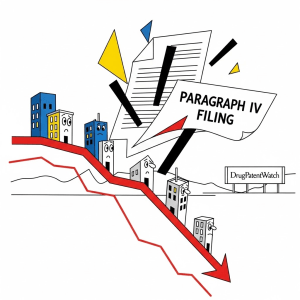
The pharmaceutical industry operates within a dual-track reality where the brilliance of molecular engineering is frequently secondary to the structural integrity of an intellectual property fortress. For the institutional investor, particularly those focusing on mid-cap pharmaceutical entities with market capitalizations between $2 billion and $10 billion, the traditional metrics of discounted cash flow and pipeline progression are insufficient when divorced from the predatory mechanics of the Hatch-Waxman Act.1 In this specialized sector, the most significant catalyst for value creation or destruction is the Paragraph IV certification—a legal declaration by a generic manufacturer that a branded drug’s patent is invalid, unenforceable, or will not be infringed by a proposed generic copy.3 This guide deconstructs the systemic financial implications of these filings, offering a sophisticated analytical framework for professionals navigating the impending 2025–2030 patent cliff, which puts an estimated $236 billion in annual revenue at risk across the global biopharma landscape.4
The Legislative Foundation: Hatch-Waxman as a Value Arbiter
To comprehend the volatility inherent in mid-cap pharma, one must recognize the 1984 Drug Price Competition and Patent Term Restoration Act, or Hatch-Waxman, not as mere regulation but as the foundational operating system of the industry.4 Before this legislation, generic manufacturers were required to conduct their own expensive and time-consuming clinical trials, a barrier that kept generic market penetration to a mere 19% of all prescriptions.5 The Act revolutionized the sector by creating the Abbreviated New Drug Application (ANDA) pathway, allowing generics to rely on the safety and efficacy data of the Reference Listed Drug (RLD) provided they could prove bioequivalence.9
For the innovator, the Act offered a “Grand Bargain”: patent term extensions (PTE) of up to five years to compensate for time lost during the FDA regulatory review process, balanced against a streamlined mechanism for generic entry.4 The “artificial act of infringement” is the pivot upon which this system turns. By designating the filing of a Paragraph IV (PIV) ANDA as a technical act of infringement, Congress enabled patent litigation to commence before any actual commercial harm occurred, providing the brand manufacturer with a 45-day window to sue and trigger an automatic 30-month stay of FDA approval.8
Certification Type
Legal Assertion
Market Impact
Paragraph I
No patent information has been filed with the FDA.
Immediate approval potential; rare for innovative drugs.
Paragraph II
The listed patent has already expired.
Immediate approval potential; indicates the end of the branded cycle.
Paragraph III
The generic will not enter the market until all patents expire.
No challenge; predictable loss of exclusivity (LOE) date.
Paragraph IV
The listed patent(s) are invalid, unenforceable, or not infringed.
“Declaration of War”; triggers litigation and potential 180-day exclusivity.
3
The Mid-Cap Sensitivity: Why Portfolio Concentration Magnifies Risk
While large-cap pharmaceutical giants like Pfizer or Johnson & Johnson possess diversified portfolios that can absorb the shock of a single patent loss, mid-cap companies often exhibit extreme revenue concentration in one or two flagship assets.1 For companies in the $2 billion to $10 billion market cap range, a Paragraph IV filing is not a tactical skirmish; it is an existential threat.4 The market capitalization of a mid-cap firm is essentially a real-time, probability-weighted assessment of its lead product’s IP moat.1
The sensitivity of these valuations stems from the “Binary Cliff” dynamic. When a generic manufacturer files a PIV certification, the stock price of the branded innovator ceases to reflect only earnings and begins to act as a weighted average of two disparate futures: a high-margin monopoly or a catastrophic revenue collapse.4 This recalibration is driven by thousands of rational investors instantly updating their models for future cash flows, often resulting in “abnormal returns”—a statistical measure of stock price movement caused specifically by the litigation event.17
Revenue Concentration Profiles in the Mid-Cap Sector (2024-2025)
Ticker
Company
Key Asset
Revenue Reliance
Current IP Status
EXEL
Exelixis
Cabometyx
~77% (H1 2024)
Settlement secured through 2030; litigation resolved.
NBIX
Neurocrine
Ingrezza
~$2.51B (FY 2025)
Reliance on single asset; facing PIV challenges.
SUPN
Supernus
Trokendi XR
High (Historical)
Transitioning to new products post-litigation settlement.
AMRX
Amneal
Generics Portfolio
N/A
Primarily a challenger; relies on 180-day exclusivity.
2
For investors, the concentration of revenue in a single asset makes the “effective patent life”—the actual period of market exclusivity—the most critical variable in any valuation model.1 Sophisticated analysts utilize tools like DrugPatentWatch to monitor “NCE-1” dates, which represent the earliest possible window for a generic to challenge a New Chemical Entity, typically occurring four years after the drug’s initial approval.6
Quantitative Modeling of Paragraph IV Impacts: rNPV and Real Options
Traditional valuation methodologies like the simple Discounted Cash Flow (DCF) are fundamentally ill-equipped to handle the discontinuous risks of pharmaceutical IP.21 The professional analyst instead employs Risk-Adjusted Net Present Value (rNPV) and Real Options Analysis (ROA) to price the probabilistic outcomes of Paragraph IV litigation.22
The rNPV Equation for Patent Litigation
The valuation of a mid-cap pharma asset $S$ is modeled as the sum of its future risk-adjusted cash flows, where the probability of success $P(Success)$ is heavily influenced by the status of the IP estate:
In this framework, $CF_t$ is the projected net cash flow, and $r$ is the discount rate reflecting the systematic risk of the asset.23 A Paragraph IV filing forces an immediate downward revision of $P(Success_t)$ for all years post-litigation. For a mid-cap company, getting the loss of exclusivity (LOE) date wrong by even a single year can shift the company’s valuation by 10% to 15%.21
Real Options and Managerial Flexibility
Real Options Analysis provides a more nuanced view of valuation by capturing “managerial flexibility”—the ability of a company to abandon a project, switch indications, or settle litigation based on emerging signals.23 For instance, a “Markman hearing” (claim construction) is a critical inflection point where a judge defines the scope of the patent claims.17 If a judge’s interpretation favors the generic manufacturer, the “option value” of the brand’s continued litigation collapses, often triggering an immediate settlement.17
Price Erosion Dynamics: The Mechanics of the “Patent Cliff”
The fiscal devastation of generic entry is driven by a mechanical erosion of pricing and market share that follows a predictable trajectory based on the number of competitors.24
Number of Generic Entrants
Average Price Erosion
Market Impact
1 Competitor
39%
Managed entry; duopoly profits for 180 days.
2 Competitors
54%
Significant margin compression; end of premium pricing.
6+ Competitors
95%+
Extreme commoditization; “race to zero.”
24
Within the first year of generic entry, a blockbuster drug can see its revenue plummet by 80% to 90%.4 Pfizer’s Lipitor serves as the textbook case: worldwide revenues fell 59% (from $9.5 billion to $3.9 billion) in the first full year of competition.4 For a mid-cap company, this erosion is often irreversible if a successor product is not already at the peak of its launch curve.6
Strategic Case Study: Exelixis and the “Malate Salt” Defense
The case of Exelixis and its flagship oncology therapy, Cabometyx (cabozantinib), illustrates how a mid-cap company can effectively leverage a layered patent portfolio to defend its valuation.18 By 2024, Cabometyx accounted for 77% of Exelixis’ total revenues, making it a primary target for generic challenger MSN Laboratories.18
In January 2023, the U.S. District Court for the District of Delaware initially ruled in favor of Exelixis on its core compound patent (‘473 patent), which expires in August 2026.28 However, the real victory for shareholders came in October 2024, when the court rejected MSN’s challenge to three “malate salt” patents set to expire in January 2030.18
Stock Reaction: Following the favorable 2030 ruling, Exelixis’ stock rose 8.6% in a single day.18
Analyst Insight: Analysts from William Blair noted that the verdict “removed all uncertainties” regarding the U.S. market exclusivity, which had been a “persistent overhang” on the shares.18
Strategic Outcome: By successfully defending these secondary patents, Exelixis extended its monopoly period by nearly four years beyond the compound patent’s expiration, a feat that adds billions to its long-term cash flow projections.18
Strategic Case Study: The Amarin API Foreclosure Failure
Contrastingly, Amarin Corporation’s experience with Vascepa (icosapent ethyl) serves as a cautionary tale for investors who rely on non-patent barriers to protect mid-cap assets.30 Amarin attempted to defend its $600 million franchise through a “methodical decade-long scheme” to lock up the global supply of icosapent ethyl API (Active Pharmaceutical Ingredient).31
The Tactic: Amarin allegedly contracted for API supply far in excess of its actual needs, paying cash to keep suppliers from contracting with potential generic competitors like Teva.31
The Outcome: The strategy failed when Amarin’s patents were invalidated in court, and the generic entrants successfully sourced API elsewhere.31
Valuation Impact: Following the patent loss and the failure of its API blockade, Amarin was forced into a massive restructuring in 2025, eliminating nearly all its commercial roles and partnering with Recordati to manage its international markets.32 By Q3 2025, Amarin reported an operating loss and a pivot toward a different operating profile, signaling the end of its period as a high-growth innovative firm.32
The Evolution of “Pay-for-Delay”: FTC Scrutiny in 2025
For high-level professionals, the regulatory environment surrounding Paragraph IV settlements is a primary source of legal risk. The Federal Trade Commission (FTC) continues to target “reverse-payment” settlements, where innovators provide compensation to generics to delay market entry.33
The FTC’s 2025 reports on fiscal years 2018–2021 highlight a shift from explicit cash payments to more complex forms of “possible compensation”.33
Quantity Selling Restrictions: The generic is allowed early entry but only for a limited volume of the drug, effectively allowing the brand and generic to “share monopoly profits”.33
No-Authorized Generic (No-AG) Commitments: The brand agrees not to launch its own “authorized generic” during the first-filer’s 180-day exclusivity window.33 This is a massive transfer of value, as an AG typically reduces the first-filer’s revenue by 40% to 52%.36
Declining Royalty Structures: Generic royalty payments are reduced or eliminated if the branded company launches its own generic, acting as a deterrent to price competition.33
Investors must view these settlements as “ticking time bombs.” While they may preserve a mid-cap company’s near-term earnings, they can trigger antitrust litigation that results in triple damages and significant reputational harm.37
Strategic Intelligence: The Role of DrugPatentWatch in Institutional ROI
In the data-driven decade of the 2020s, the “GPS” for pharmaceutical investment is the ability to transform raw patent data into actionable financial intelligence.40 Platforms like DrugPatentWatch have moved from being niche legal databases to essential tools for “alpha generation”.40
Identifying “White Spaces” and Lead Indicators
White Space Analysis: Sophisticated investors use patent landscaping to identify “white spaces”—therapeutic areas with limited patent activity but high clinical need.7 This allows them to spot undervalued mid-cap firms that are developing first-in-class therapies with a “clear runway”.41
Lead Indicators of Litigation: An analyst observing a company’s cash-to-assets ratio steadily climbing may be witnessing a management team quietly preparing for a “legal storm” before any PIV challenge is publicly announced.17
Predictive Modeling of LOE: By tracking court dockets, legal filings, and the track records of specific law firms, investors can build a probabilistic model to predict generic launch dates more accurately than by relying solely on the core patent expiration.16
The Role of Alternative Data
The modern investor’s playbook increasingly incorporates “alternative data”—such as patient-generated data from online health communities and social media—to assess the “unmet need” for a drug.26 When combined with patent intelligence, this data provides a holistic view of a drug’s commercial viability, informing the “Peak Sales” estimate in the rNPV model.23
The 2028 “Super-Cliff” and the Mid-Cap Exit Strategy
The period between 2025 and 2030 is projected to be an era of unprecedented scale for patent expirations, with 118 biologic medicines alone expected to lose protection in the U.S..6 For mid-cap companies, this “Patent Super-Cliff” represents both a threat and a massive opportunity for M&A.27
The 2026 M&A Bonanza: Deal flow is projected to potentially hit $3.9 trillion as large pharma firms seek to replenish their pipelines to offset the massive revenue erosion from assets like Keytruda and Eliquis.42
The “Oversold Incumbent” Thesis: Market volatility often leads to an overreaction to patent cliff headlines. The contrarian investor identifies mid-cap companies with “Managed Slope” strategies—such as successful “product hopping” to next-generation formulations—that are not yet priced into the stock.21
Conclusion: Mastering the IP Gauntlet
For the high-level professional, the impact of Paragraph IV filings on mid-cap pharma is the defining challenge of biopharmaceutical investment. The “artificial act of infringement” is the engine of market volatility, transforming a static patent list into a dynamic financial instrument.4 To succeed, investors must evolve beyond qualitative risk assessments and adopt a quantitative framework that integrates legal strategy with financial performance.22
The path to alpha in this sector lies in identifying the “Success Patterns” of litigation—knowing when a mid-cap company like Exelixis has a defensible “malate salt” moat versus when a company like Amarin is building its fortress on sand.5 In an environment where a single court ruling can erase billions in market capitalization, the strategic use of platforms like DrugPatentWatch is no longer optional; it is the fundamental blueprint for a defensible and profitable investment strategy in the most complex sector of the global economy.7