How hospital systems, PBMs, and self-insured employers can use IP intelligence to time generic switches and eliminate billions in avoidable branded drug spending
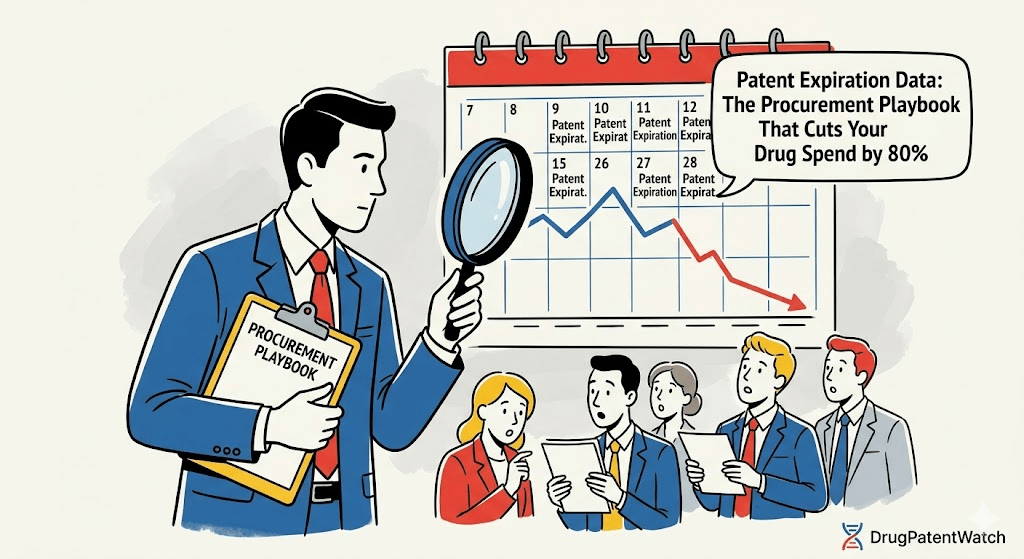
Sitting inside the FDA’s Orange Book is one of the most underutilized financial datasets in American healthcare. Every branded drug listed there carries a patent expiration date — sometimes several dozen of them. Most procurement teams glance at those dates to confirm whether a generic exists. The smarter ones use them to project, to the month, when the next 40%, 60%, or 80% price reduction will arrive.
The difference in outcomes between those two approaches is not marginal. It runs to hundreds of millions of dollars annually for large hospital systems and pharmacy benefit managers, and to tens of thousands of dollars per year for a midsize self-insured employer plan. <blockquote> “Generics and biosimilars generated $467 billion in system-wide savings in 2024 alone and $3.4 trillion over the preceding decade.” — Association for Accessible Medicines, *2025 U.S. Generic and Biosimilar Medicines Savings Report* [1] </blockquote>
Those savings did not distribute themselves evenly. Organizations with structured patent intelligence programs captured a disproportionate share. Organizations that waited for a generic to appear on their group purchasing organization’s price list before acting left real money on the table — often six to eighteen months of avoidable branded spend that no retroactive contract can recover.
This article shows you exactly how to build the intelligence infrastructure, the procurement timing model, and the formulary transition protocols that let you capture maximum savings at minimum clinical risk. It covers small-molecule generics, biosimilars, and the specific litigation dynamics — Paragraph IV certifications, 30-month stays, first-filer exclusivity — that determine when a theoretical patent expiration becomes an actual generic launch.
The analysis draws on data from DrugPatentWatch, FDA Orange Book records, company financial filings, and court dockets. The case studies are real. The timelines are live.
Part One: What You’re Actually Looking At
The Orange Book Is a Starting Point, Not an Answer
The Orange Book — formally Approved Drug Products with Therapeutic Equivalence Evaluations — has been an FDA publication since 1980. Its core function is to tell pharmacists which generic drugs are therapeutically equivalent to their brand-name counterparts and therefore substitutable. For procurement purposes, it also lists every patent that a brand-name manufacturer has declared covers its product, along with each patent’s expiration date.
Every procurement director at a hospital system, every formulary manager at a pharmacy benefit manager, and every supply chain officer at a generic manufacturer knows what the Orange Book is. Most of them use it the same way: to confirm whether a generic drug has been rated therapeutically equivalent to the brand, and to check when the listed patents expire. They pull the data, note the date, and move on.
That approach leaves enormous value on the table, as a careful read of the Orange Book’s actual design reveals. The FDA’s Orange Book lists patents because brand manufacturers self-declare them. A company has 30 days from drug approval (or patent issuance, if later) to submit a patent for listing. The FDA does not verify whether those patents are valid, whether they actually cover the approved product, or whether they are the kind of patents that a generic manufacturer could design around in six months. What the Orange Book does not do — and was never designed to do — is tell you what the listed patents actually protect, which ones are likely to survive a challenge, or which generic manufacturers have filed applications.
This distinction matters because the gap between the Orange Book’s nominal expiration date and the actual date of multi-source generic entry can span anywhere from zero to seven years, depending on patent strength, litigation outcomes, and the strategic decisions of generic manufacturers. Procurement teams that treat the Orange Book expiration date as the generic launch date are working with fundamentally incomplete information.
What you need is a second layer of intelligence: ANDA filing data, Paragraph IV certification notices, litigation status from PACER, first-filer eligibility determinations, and settlement agreements. Platforms like DrugPatentWatch aggregate these inputs into structured intelligence that transforms the Orange Book’s raw dates into probabilistic timelines — which is the actual input a procurement model needs.
How Drug Patent Protection Actually Works: The Four-Layer Stack
To time a procurement switch intelligently, you need to understand not just when patents expire, but what they protect and how those protections interact. A branded drug’s market exclusivity rests on two legally distinct systems that run simultaneously: USPTO-granted patents and FDA-granted regulatory exclusivity periods. Confusing the two is the single most common error in pharmaceutical procurement planning.
USPTO Patents
A pharmaceutical patent runs 20 years from filing date, not from FDA approval. Drug development takes years — on average, it takes 8 to 10 years just to get a new drug from lab to pharmacy shelf. That means if a company files a patent when the drug is still in early testing, they’ve already burned through half their protection before the drug even makes money.
To compensate for this erosion, manufacturers can obtain two statutory extensions. Patent Term Adjustment (PTA) adds time lost to USPTO processing delays. Patent Term Extension (PTE) adds up to five years to compensate for clinical and regulatory review time, capped at 14 years of effective post-approval exclusivity. Both extensions are listed in the Orange Book.
A typical branded drug carries patents across four categories: composition of matter (the active molecule itself), formulation (the tablet architecture, delivery mechanism, or combination), method of use (the approved indications), and process (manufacturing methods). Each category has different strategic significance. Composition-of-matter patents are the most valuable and the hardest to design around. Method-of-use patents are the most commonly challenged via “skinny labeling,” where a generic manufacturer carves out patented indications from its label. Formulation patents are frequently invalidated as obvious.
FDA Regulatory Exclusivity
Separate from patents, the FDA grants exclusivity periods that bar it from approving generic applications regardless of patent status. New chemical entity (NCE) exclusivity gives a drug five years of protection from any ANDA filing. Orphan drug exclusivity provides seven years. Pediatric exclusivity adds six months to any existing patent or exclusivity. New clinical investigation exclusivity (three years) protects supplemental approvals. These exclusivity periods are not patents — they cannot be challenged in court — and they frequently extend effective market protection well beyond what the Orange Book patent dates suggest.
The practical result: a drug with an Orange Book patent expiring in Q3 2026 might also carry a pediatric exclusivity that pushes generic entry to Q1 2027, or a new clinical investigation exclusivity from a 2023 label update that blocks ANDA approval until 2026 regardless of patent status. A procurement team that builds its budget model on the patent date alone will miss the actual window.
The Patent Thicket Problem
Brand manufacturers have become expert at layering secondary patents to extend commercial exclusivity well beyond the composition-of-matter expiration. The canonical example is AbbVie’s adalimumab (Humira). AbbVie amassed a portfolio of over 250 patent applications for Humira, which allowed it to delay biosimilar competition in the U.S. until 2023, more than two decades after the drug was first launched. By the time the composition-of-matter patent expired in 2016, AbbVie had built a portfolio of formulation, dosing, and manufacturing patents that, in combination with settlement agreements, kept all biosimilars out of the U.S. market until 2023.
The Humira timeline is the upper bound of what a patent thicket strategy can achieve. Most branded drugs face patent thickets of 20 to 80 patents rather than 250, but the principle is the same: each additional patent is another litigation hurdle, another 30-month stay trigger, another settlement negotiation. For procurement planning, the implication is that the last patent to expire — not the first — determines when the price floor arrives.
The Hatch-Waxman Architecture and What It Creates for Buyers
The Drug Price Competition and Patent Term Restoration Act of 1984 — universally called Hatch-Waxman — created the modern generic drug market. Its two core contributions remain the most important structural facts in pharmaceutical procurement.
First, it created the Abbreviated New Drug Application (ANDA) pathway, which allows generic manufacturers to demonstrate bioequivalence to an approved branded drug without repeating full clinical trials. The ANDA filer relies on the FDA’s prior finding of safety and efficacy for the reference listed drug. This dramatically compressed the cost and time to bring a generic to market, which is why before Hatch-Waxman, generics accounted for approximately 19% of U.S. prescriptions. By 2024, that figure exceeded 90%.
Second, and more consequential for procurement timing, Hatch-Waxman created the Paragraph IV certification mechanism. When a generic manufacturer files an ANDA and believes that a listed Orange Book patent is invalid or will not be infringed by its product, it files a Paragraph IV (P-IV) certification asserting this. That filing is a statutory act of patent infringement, which triggers an automatic right for the brand manufacturer to sue within 45 days. If the brand sues within that window, the FDA cannot approve the ANDA for 30 months — the “30-month stay” — regardless of whether the generic is ready to launch. If litigation commences, a 30-month stay of ANDA approval begins during which the FDA cannot approve a generic unless litigation is resolved or a settlement is reached.
The 30-month stay is why the first P-IV filing date matters as much as the patent expiration date for procurement planning. A P-IV filed today implies a potential generic approval no earlier than 30 months from now, even if the underlying patent would have expired in 12.
The third structural element is first-filer exclusivity. To incentivize these patent challenges, the Hatch-Waxman Act offers a powerful reward: the first generic company to file a “substantially complete” ANDA with a Paragraph IV certification is eligible for 180 days of market exclusivity upon launch. During that 180-day period, the FDA will not approve any subsequent ANDA — meaning the market is a temporary duopoly between the brand and the first generic. Prices typically fall 20-40% during this period. Multi-source generic competition, and the 80-90% price collapse it produces, only arrives after the 180-day exclusivity expires.
For a procurement team, this creates three distinct pricing regimes to model: branded monopoly pricing, first-filer duopoly pricing (20-40% below brand), and multi-source generic pricing (80-90% below brand). The transition dates between these regimes are the actual inputs to a savings forecast, and they require tracking first-filer status, not just patent expiration dates.
Part Two: Building the Intelligence Infrastructure
The Four-Input Patent Intelligence Model
Structuring patent expiration data into procurement-grade intelligence requires assembling four discrete inputs for each drug in your formulary. The inputs are sequential — each depends on the prior one — and they cannot be replaced by a single data source.
Input 1: The Patent Estate Map
Start with the Orange Book record for your target drug. List every patent, its expiration date, its Orange Book patent code (which tells you whether it covers the drug substance, drug product/formulation, method of use, or a combination), and whether the patent is subject to any listed PTE or pediatric exclusivity extension. This gives you the outermost boundary of potential exclusivity.
For biosimilars, the Purple Book — the FDA’s biologics equivalent of the Orange Book — performs a similar function but without patent listing (biologics patents are not publicly listed in the Purple Book). The 12-year reference product exclusivity for biologics is listed, but the underlying patent estate must be researched separately through USPTO records and BPCIA “patent dance” disclosures.
Input 2: The ANDA Filing Intelligence
Identify which companies have filed ANDAs against your target drug. The FDA’s Paragraph IV certification database, combined with brand manufacturers’ required disclosure of P-IV notices they receive, creates a partial public record. Platforms like DrugPatentWatch aggregate ANDA filings, P-IV certifications, and tentative approvals into structured, searchable data that considerably reduces the research burden. This information is scattered across FDA records, PACER court filings, and press releases, which is why structured aggregation matters.
The number of ANDA filers matters for pricing trajectory modeling. A drug with one or two ANDA filers will see a slower, shallower price decline than a drug with ten or fifteen filers. Generic market penetration follows a relatively predictable pattern for oral solid dosage forms with multiple ANDA filers. In the first month following generic entry, generic market share typically reaches 20 to 30 percent. Within six months, it is often above 70 percent. Within 12 months, it frequently exceeds 90%. For drugs with fewer filers, the curve is flatter.
Input 3: Litigation Status
For every P-IV certification, determine whether the brand manufacturer filed suit within 45 days. If it did, note the case number, the district, the trial date, and any interim court orders. District court outcomes in P-IV cases are highly variable; Third Circuit and Federal Circuit precedent review rates are material to outcome prediction. PTAB Inter Partes Review (IPR) petitions, which challenge patent validity at the patent office rather than in district court, are a separate track that can produce earlier invalidation outcomes than district court litigation.
The practical question for procurement is not who wins the litigation but when: whether the litigation resolves (by settlement, consent judgment, or final judgment) before or after the compound patent’s nominal expiration date. Settlements that set a specific generic entry date — called “authorized generic” settlements or “at-risk” settlements — are particularly valuable because they turn a probabilistic timeline into a contractual one.
Input 4: First-Filer Eligibility
The fourth input is the first-filer eligibility determination: who holds first-filer status, whether that status has been forfeited (first filers can lose their exclusivity through failure to market within a specified period or through certain types of settlements), and whether the 180-day exclusivity will be triggered before or after the compound patent’s expiration.
First-filer forfeiture is a procurement opportunity. When the first filer forfeits its 180-day exclusivity — through failure to market within a year of a court ruling or FDA approval, for example — the FDA can approve subsequent ANDAs immediately, opening the market to multi-source competition sooner than the standard timeline would suggest. Monitoring forfeiture events requires ongoing attention to FDA tentative approval letters and first-filer marketing actions.
Assembling these four inputs across a formulary of several hundred drugs is not a one-time project. ANDA filings arrive continuously, litigation outcomes change the timeline, and first-filer forfeitures can open the market unexpectedly. The supply chain intelligence function that serves a large procurement operation needs to monitor these inputs on an ongoing basis.
Building Your Patent Monitoring Dashboard
The operational question for a procurement team is not how to conduct patent analysis from scratch but how to build a monitoring system that keeps your formulary watchlist current. Three tiers of capability exist, differentiated by resource investment and expected savings yield.
Tier 1: Orange Book + FDA Paragraph IV Database (Free, Limited)
The FDA publishes its Orange Book online with patent and exclusivity data. It also maintains a searchable database of approved ANDAs with bioequivalence ratings. The Paragraph IV certifications database shows which branded drugs have been challenged. These free resources provide the raw data for a basic patent watch but require significant manual aggregation effort and provide no litigation status or first-filer analysis.
For a pharmacy team managing fewer than 50 high-cost branded drugs, Tier 1 is a workable starting point with manual research protocols. For a health system or PBM managing hundreds of drugs, the time cost of manual aggregation makes Tier 1 inefficient.
Tier 2: Structured Patent Intelligence Platforms
DrugPatentWatch and similar platforms aggregate Orange Book data, ANDA filings, P-IV certifications, litigation status, first-filer determinations, and settlement agreements into searchable databases with alert functionality. These platforms are the operational infrastructure for a serious formulary management function. They allow procurement teams to set patent expiration alert windows — 36 months, 24 months, 12 months — and receive structured notifications when new ANDA filers enter a watchlist drug, when litigation resolves, or when first-filer status changes.
The critical workflow advantage of Tier 2 platforms is the reduction of monitoring latency. A litigation settlement that moves a generic entry date six months earlier represents real procurement savings only if your team learns about it in time to renegotiate contracts, restructure formulary tiers, and activate generic substitution protocols. A platform that alerts you within days rather than weeks of a settlement filing materially changes the savings capture.
Tier 3: Dedicated IP Intelligence + Legal Counsel Partnership
Large health systems and PBMs with drug spend exceeding $500 million annually increasingly maintain partnerships with pharmaceutical IP law firms for active litigation monitoring and patent strength assessment. This tier adds interpretive capability that data platforms cannot provide: a qualified opinion on whether a specific Orange Book patent is likely to survive a P-IV challenge, based on claim construction, prior art, and district court judge assignment.
The ROI model for Tier 3 is straightforward. If a patent strength assessment on a $200 million annual drug spend reveals that the brand’s key formulation patent is likely invalid, and that conclusion drives a formulary switch 18 months earlier than planned, the savings can reach $30-40 million in a single contract cycle. A patent litigation counsel engagement costing $150,000 produces a net return of 200x in that scenario.
Formulary Intelligence vs. Procurement Intelligence: Know the Difference
One of the structural errors in pharmaceutical cost management is treating formulary decisions and procurement decisions as the same function. They are not.
Formulary management determines which drugs your plan or health system covers and at what tier. It involves clinical evidence review, therapeutic interchangeability assessment, and physician and patient communication protocols. The timeline for formulary change cycles is typically annual, with midyear updates for significant market events.
Procurement intelligence determines at what price you purchase the drugs on your formulary, from which suppliers, and under what contract terms. The timeline here is continuous — contract negotiations, generic source qualification, group purchasing organization (GPO) tier selection, and spot market monitoring all require real-time attention.
Patent expiration data feeds both functions but in different ways. For formulary management, it drives the question of when to switch tiers or preferred status. For procurement, it drives the question of when to shift purchasing volume from a branded distributor to a generic supplier, how to structure inventory around a generic launch, and whether to negotiate a pre-expiration branded price concession in exchange for delayed generic adoption.
These are different decisions with different ROI profiles. A procurement team that confuses them — treating a formulary tier change as the moment to renegotiate drug prices — loses the negotiating leverage that exists in the window between ANDA approval and generic market maturation.
Part Three: Small-Molecule Generics — The Proven Playbook
Price Erosion Mechanics: What the Data Actually Shows
The well-cited statistic that generic entry produces an 80-90% price decline within 12 months is accurate in aggregate. At the level of individual drug products, it requires significant qualification — because the speed and depth of price erosion is a function of the number of ANDA filers, the route of administration, the dosage complexity, and the degree of brand manufacturer defense.
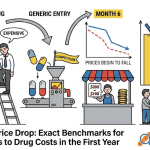
Small-molecule drugs (like Entresto or Eliquis): 80-90% price drop within 12 months. Generics capture over 90% of the market within two years.
For oral solid dosage forms (tablets and capsules) with 10 or more ANDA filers, the erosion curve is steep and fast. The authorized generic — a brand-name-manufactured generic sold under the brand company’s own label — often enters simultaneously with first-filer exclusivity to blunt the first filer’s pricing power. After the 180-day period, multi-source competition compresses margins further, and within 12-18 months, the generic market reaches a low-price equilibrium that is essentially a commodity.
For oral solid dosage forms with fewer than five ANDA filers, the curve is flatter. Price declines of 40-60% within 12 months are more typical, with slower erosion thereafter. Drugs with complex formulations (extended-release, modified-release, or combination tablets) attract fewer generic filers because development and bioequivalence demonstration costs are higher, resulting in less competitive price pressure.
Injectable generics behave differently again. The sterile manufacturing requirements, shorter shelf lives, and narrower distribution channels produce fewer filers and less extreme price declines, though the absolute dollar savings are often large because injectable drug prices in the branded market are substantially higher.
For procurement timing purposes, the practical input is the projected number of ANDA filers and the expected 180-day exclusivity window. If your target drug has 15 ANDA filers with three at tentative approval, your savings model should project multi-source competition within six to nine months of patent expiration. If it has two filers and both have triggered litigation, your model should project a shallower price decline and a longer timeline to full generic market pricing.
The 180-Day Window: When to Act and When to Wait
The 180-day first-filer exclusivity period is the most consistently mismanaged element of generic drug procurement. Three common errors occur during this window, each with material cost consequences.
Error 1: Treating first-filer pricing as the final generic price
During the 180-day window, the market is effectively a duopoly. The first generic filer has no interest in pricing at the eventual multi-source floor — its profit model depends on maintaining prices at a moderate discount to brand while volume shifts. Typical first-filer pricing runs 20-40% below the brand’s list price. A procurement team that contracts at first-filer pricing and then fails to renegotiate when multi-source competition opens leaves a 40-50 percentage point price gap uncaptured.
The correct protocol is to treat the 180-day period as a transition phase. Lock in first-filer pricing for the initial period, but build contract termination rights or automatic step-down triggers that activate when a third ANDA-approved product enters the market. Your GPO should have intelligence on when the 180-day exclusivity terminates, and your contract should reflect that structure.
Error 2: Stockpiling brand inventory before generic launch
Some procurement teams, anticipating formulary disruption around a generic launch, build up brand inventory to smooth the transition. This strategy defers the savings capture by precisely the duration of the excess inventory burn-down. A three-month brand inventory buffer at a drug with a branded cost of $5,000 per unit and a forthcoming generic price of $500 per unit represents a $4,500 per-unit loss on every unit purchased in the buffer period.
The correct protocol is to manage the brand-to-generic transition inventory to the minimum clinically necessary supply — typically two to four weeks — and shift purchasing to generic sources as soon as the first-filer product receives full approval and is available from at least one qualified supplier.
Error 3: Missing the 180-day expiration date
The 180-day period begins when the first filer commercially markets its product, not when the patent expires or when FDA approval is granted. First filers sometimes delay commercial launch after FDA approval — particularly when they are litigating the 30-month stay with the brand and await a favorable settlement. If your monitoring system is tracking patent expiration dates rather than first-filer commercial launch dates, you may miss the 180-day expiration by weeks or months, costing savings that cannot be recovered.
DrugPatentWatch and similar platforms track first-filer commercial launch events in near real-time through trade press monitoring, pharmacy wholesaler price file updates, and FDA market signal analysis. These alerts are the mechanism for triggering multi-source sourcing protocols.
Case Study: Entresto (Sacubitril/Valsartan) and the Procurement Window
Entresto is the clearest current example of a high-value generic entry event with well-documented procurement implications. Annual 2024 revenue of approximately $7.8 billion with loss of exclusivity in mid-2025. Entresto is a fixed-dose combination of sacubitril (a neprilysin inhibitor prodrug) and valsartan (an angiotensin receptor blocker). The combination’s patent thicket includes composition of matter protection on sacubitril-valsartan as a molecular complex, formulation patents on the specific tablet architecture, and method of use patents covering heart failure with reduced ejection fraction.
For procurement teams managing heart failure medication spend, the Entresto patent timeline provided roughly two years of advance notice. The core composition-of-matter patent expiration in mid-2025 was publicly visible in the Orange Book by 2023. Multiple ANDA filers — including Alembic Pharmaceutical and Laurel Labs — received FDA approval for sacubitril-valsartan formulations before the patent expiration date. Multiple manufacturers have already received FDA approval to market generic versions, including Alembic Pharmaceutical Limited, Laurel Labs Limited, and others.
The procurement timeline for a health system with Entresto on formulary should have looked like this: In Q3 2023, identify Entresto as a 24-month switch candidate and initiate formulary committee review. In Q1 2024, track ANDA filings and litigation status; note that Novartis’s litigation position was weakening. In Q3 2024, confirm first-filer ANDA approvals and build a generic transition protocol with the cardiology department. In Q4 2024, negotiate a pre-expiration branded price concession from Novartis — which was highly motivated to defend volume — as leverage for delayed generic transition. In Q1 2025, activate generic sourcing contracts with first-filer supplier. In Q3 2025, at multi-source entry, renegotiate to multi-source pricing.
A California cardiologist reported patients paying $150-$300/month for Entresto. After generics arrive, that drops to $20-$40. At the health system level, a hospital managing 500 Entresto patients on branded pricing at $400 per patient per month and switching to generic at $40 per patient per month saves $180,000 per month — $2.16 million annually — from a single drug conversion. The procurement team that executed this 18 months before the switch missed nothing; the one that waited for the generic to appear on GPO price lists missed two to three months of savings on the transition curve.
Case Study: Eliquis (Apixaban) and the Litigation Watch
Eliquis represents a different procurement scenario — a drug where patent litigation rather than patent expiration is the controlling timeline variable. BMS reported over $13 billion in 2024 Eliquis revenue. Key patents expire in 2026, though BMS and Pfizer have mounted an aggressive litigation campaign against generic challengers. Multiple Paragraph IV ANDAs have been filed, and the 30-month stay has been triggered.
Eliquis (apixaban) from Bristol Myers Squibb and Pfizer: This blood thinner brought in $13.2 billion in 2024. Its key patent expires in November 2026. With multiple generics already in the pipeline, prices will likely crash fast. Patients already pay $100-$200 a month. Generics could bring that down to $10-$20.
For procurement teams, the Eliquis situation requires a two-scenario model. Scenario A assumes litigation resolves by settlement by mid-2026, with at-risk generic entry at or near patent expiration. Scenario B assumes litigation extends to trial, delaying multi-source entry by 12-18 months beyond nominal expiration. The probability-weighted savings forecast differs by roughly 30% between the two scenarios.
The correct procurement response is to maintain enhanced monitoring of the Eliquis litigation docket, negotiate contractual flexibility with current branded suppliers to allow volume shifts without penalty when generic entry occurs, and pre-qualify at least two generic Eliquis suppliers so that procurement can move within days of a final approval or settlement announcement. A procurement team that has done supplier qualification in advance captures savings from day one of generic availability. One that begins supplier qualification after generic entry captures savings from week six or eight — a meaningful lag on a drug with $13 billion in U.S. annual branded revenue.
Pre-Expiration Negotiation: The Brand’s Vulnerable Window
One of the most valuable and least used procurement tactics is the pre-expiration brand price negotiation. Brand manufacturers know their patent cliffs. They know, with considerable precision, when generic entry will compress their revenue. In the 12-24 months before a major generic launch, they are highly motivated to negotiate volume commitments that provide revenue certainty during the transition.
The leverage dynamic is clear: a procurement team that commits to maintaining brand volume for 12 months post-generic entry in exchange for a 25-35% price reduction on current branded purchases has given the brand manufacturer something valuable (revenue predictability) and captured something valuable in return (immediate cost savings on current spend). The net present value of the price reduction on current spend often exceeds the NPV of the delayed generic switch, particularly for drugs where first-filer pricing during the 180-day window is only moderately below brand anyway.
This negotiation requires patent intelligence to execute effectively. You need to know when the brand’s leverage expires — specifically, when multi-source generic entry will make the brand uncompetitive regardless of negotiated price. A brand manufacturer who believes it has 24 months of exclusivity remaining will negotiate differently than one who knows it has 8 months. Your intelligence on litigation status, first-filer approvals, and settlement timing gives you a negotiating position that the brand’s own commercial team may not anticipate you holding.
The pre-expiration negotiation strategy is most effective for drugs meeting four criteria: annual system spend exceeding $1 million, at least two ANDA filers with tentative approvals, a nominal patent expiration within 18 months, and a brand manufacturer with significant U.S. revenue concentration in the drug. When all four criteria apply, the negotiating leverage is substantial.
Part Four: Biosimilars — A Different Animal
Why Biosimilar Economics Are Fundamentally Different
The biosimilar market requires a separate analytical framework from small-molecule generics, and procurement teams that apply small-molecule logic to biosimilar transitions routinely get the timeline and the savings projections wrong.
Biosimilars (like Humira alternatives): Slower uptake. Prices drop 30-40% initially. It takes 3-5 years to reach 75% market share because they’re harder to make and require more testing.
The structural reasons for this difference are four-fold. First, biosimilars cost vastly more to develop than small-molecule generics. Developing a biosimilar requires $100-$250 million over 7-8 years, versus $1-$4 million over 2-4 years for a typical small-molecule ANDA. This higher development cost means fewer competitors enter each market, reducing the competitive pressure that drives small-molecule price crashes.
Second, biosimilars are not automatically substitutable at the pharmacy level without additional FDA designation. Biosimilar interchangeability is a separate, higher standard that enables automatic pharmacy substitution and requires additional switching study data. Without interchangeability designation, pharmacists in most states cannot substitute a biosimilar without an explicit prescriber instruction. This requires physician-level education and prescriber workflow changes that small-molecule generic switches do not.
Third, the biologic market operates through a rebate-heavy contracting structure that gives incumbent reference products a formulary advantage during the biosimilar entry period. The formulary and rebate contracting dynamics of the U.S. biologic market, combined with the lack of universal interchangeability designations at launch, allow reference product sponsors to defend significant volume share for 18-36 months after biosimilar entry. Investors who modeled Humira’s revenue decline using small-molecule erosion curves significantly over-projected the speed of AbbVie’s revenue loss.
Fourth, the regulatory pathway for biosimilar patent disputes — the Biologics Price Competition and Innovation Act (BPCIA) patent dance — is substantially more complex than the ANDA/Paragraph IV framework. There is no public biosimilar equivalent of the Orange Book patent listing. The BPCIA outlines a complex, multi-step, and largely optional process for exchanging patent information between the biosimilar applicant and the reference product sponsor. This “dance” involves a series of confidential disclosures and negotiations to identify the patents that will be litigated in two potential waves.
For procurement teams, these differences mean that biosimilar transition timelines are longer, savings are shallower initially, and formulary management requires more active physician engagement than a small-molecule generic switch.
The Humira Lesson: Seven Years of Value Left on the Table
AbbVie’s Humira patent strategy is the most thoroughly analyzed biosimilar delay case in pharmaceutical history. Its implications for procurement planning extend well beyond adalimumab itself.
The composition-of-matter patent on adalimumab expired in December 2016. European biosimilar manufacturers entered that market in 2018, and European health systems immediately began capturing 30-40% price reductions on adalimumab spend. In the United States, AbbVie used its dense secondary patent estate to negotiate settlements with biosimilar manufacturers, the last of which prevented U.S. biosimilar entry until January 2023, more than six years after the composition-of-matter expiry. The financial result: AbbVie extracted approximately $21 billion in annual Humira revenues in 2022, its final year of U.S. market exclusivity.
The procurement lesson is not that the Humira delay was unavoidable — it was negotiated and legal, not a pharmaceutical inevitability. It is that the settlement landscape determined U.S. generic entry, and procurement teams that tracked biosimilar settlement dates (which were public) could have forecasted the 2023 entry window with reasonable accuracy. Teams that used European biosimilar entry in 2018 as their planning horizon were disappointed; teams that tracked U.S. settlement agreements knew January 2023 was coming by 2021 at the latest.
By mid-2024, CVS had converted 97% of all Humira use by its commercial customers to biosimilars, mostly Cordavis-branded, after CVS Health launched its private-label biosimilar distribution subsidiary, Cordavis, in April 2024. The health systems and PBMs that had formulary transition protocols ready for Q1 2023 captured two years of additional biosimilar savings relative to those still finalizing their physician communication plans in late 2023.
Forecasting Biosimilar Entry: The Keytruda Blueprint
Keytruda (pembrolizumab) is the drug that will define biosimilar procurement strategy for the latter half of this decade. Keytruda generated approximately $29.5 billion in global revenue in 2024, making it the world’s top-selling drug by a wide margin and the most valuable single asset in the upcoming patent cliff. Merck’s compound patent on pembrolizumab, the anti-PD-1 monoclonal antibody at Keytruda’s core, expires in the United States in 2028.
The patent estate surrounding Keytruda is among the most complex in modern pharmaceutical history. The first biosimilar manufacturers to file 351(k) applications for pembrolizumab will face a patent challenge landscape that is categorically more expensive and litigious than anything in the small-molecule generic market. Early estimates suggest that fewer than ten companies globally have the technical capability to manufacture a pembrolizumab biosimilar at commercial scale. Samsung Bioepis, Fresenius Kabi, and several Chinese biologics manufacturers have been cited as likely early filers.
The procurement implication is that Keytruda will not follow an Entresto-style timeline. The composition-of-matter patent expiration in 2028 is not the relevant date for biosimilar market entry. The relevant date is the resolution of what will be extensive BPCIA patent litigation, which historical precedent suggests could extend the effective market entry by two to four years beyond the core patent. A procurement model that budgets for Keytruda generic-equivalent pricing in 2029 or 2030 is likely too optimistic. A model assuming 2031-2032 for meaningful biosimilar market penetration is more defensible given the complexity of the patent estate and the limited number of capable manufacturers.
For Merck, the strategic response includes extending Keytruda’s commercial reach through subcutaneous formulation approval (received in 2024), combination therapy approvals, and a robust authorized biosimilar strategy that would allow Merck to participate financially in the biosimilar market it will lose to. That authorized biosimilar strategy is a procurement signal: when Merck announces an authorized biosimilar partnership, the likely biosimilar price point becomes visible, and procurement teams can begin modeling savings expectations with more precision.
The Interchangeability Question and Its Formulary Implications
For a procurement team, the single most consequential regulatory fact about any biosimilar is whether it has received FDA interchangeability designation. Interchangeability allows pharmacists to substitute the biosimilar for the reference product at the point of dispensing without a new prescriber order — the same automatic substitution mechanism that drives small-molecule generic adoption. Without it, biosimilar adoption depends on changing prescriber behavior one physician at a time.
The entry of interchangeable biosimilars changes that calculus materially, since interchangeable products can be substituted at the pharmacy level without physician intervention, replicating the small-molecule generic substitution dynamic. As a practical matter, interchangeability designation typically accelerates biosimilar market penetration by 12-24 months relative to a non-interchangeable biosimilar launching into the same market.
Procurement protocols should differentiate sharply between interchangeable and non-interchangeable biosimilar launches. For interchangeable biosimilars, the transition workflow mirrors a small-molecule generic switch: update formulary tier, notify dispensing pharmacies, and activate automatic substitution protocols. For non-interchangeable biosimilars, the transition workflow requires: physician outreach, prescriber preference documentation, prior authorization protocol updates, patient education, and monitoring for adverse event patterns — a 90-day to 180-day process rather than a 30-day one.
The Humira biosimilar market demonstrated this dynamic clearly. Multiple adalimumab biosimilars were approved before receiving interchangeability designation. The ones that received interchangeability first — Cyltezo (adalimumab-adbm) from Boehringer Ingelheim was the first to receive interchangeability designation for adalimumab — gained formulary placement advantages over non-interchangeable competitors regardless of price.
Part Five: The $300 Billion Patent Cliff and Your Procurement Calendar
The 2025-2030 Opportunity Map
Between 2025 and 2030, the industry anticipates that nearly 200 drugs, including approximately 70 blockbuster medications with annual sales exceeding $1 billion each, will lose their market exclusivity. The total revenue at risk during this window is estimated to exceed $300 billion, with some projections reaching as high as $400 billion by 2033 as foundational patents for top-selling therapies like Keytruda, Eliquis, and Opdivo lapse.
For procurement purposes, this aggregate figure is less useful than a drug-level calendar. The following represent the highest-priority generic entry events for procurement teams managing formularies with significant branded drug spend:
2025 Events
Entresto (sacubitril/valsartan, Novartis) saw its core U.S. patent expire in July 2025, with multiple ANDA approvals already in hand. This is an active procurement switch opportunity now.
Prolia/Xgeva (denosumab, Amgen): Its primary US patent expired February 19, 2025. Sandoz’s biosimilars, denosumab-bbdz (Jubbonti) and denosumab-bbgn (Wyost), were approved in March 2024 and are expected to launch May 31, 2025, under a settlement with Amgen. Samsung Bioepis’ biosimilars, denosumab-bexm (Ospomyv) and denosumab-bkzt (Xbryk), were approved in February 2025. Health systems managing large oncology and osteoporosis patient populations should have biosimilar transition protocols active.
2026 Events
Eliquis (apixaban, BMS/Pfizer): The U.S. key patent expires November 2026. Litigation status is the controlling variable. Bristol Myers Squibb and Pfizer’s blood thinner Eliquis faces European patent expiration in 2026 with sales expected to fall 15.2% this year. Begin supplier pre-qualification now.
Ibrance (palbociclib, Pfizer): A breast cancer drug with $5.4 billion in 2024 sales. Its patent expires in 2026. Like Eliquis, it’s in a crowded space. Once generics arrive, market share will shift quickly.
Januvia (sitagliptin, Merck) and Janumet (sitagliptin/metformin): Merck’s Januvia (sitagliptin) generated $2.255 billion in revenue, with generic entry expected in mid-2026 following settlement agreements. Merck’s Janumet and Janumet XR, combination products containing sitagliptin and metformin, represent an additional $1.433 billion in sales and face similar generic competition timelines.
2027-2028 Events
Stelara (ustekinumab, J&J): Biosimilar entry has begun following the expiry of key patents and settlement agreements. Multiple biosimilar manufacturers have entered the U.S. market. Procurement teams should be in active transition now, given the interchangeability timelines for ustekinumab biosimilars.
Keytruda (pembrolizumab, Merck): Core composition-of-matter patent expires 2028. Planning horizon for procurement purposes is 2031-2033 for meaningful market entry, given patent complexity. Begin tracking 351(k) biosimilar filings now to refine the timeline.
Opdivo (nivolumab, BMS): Loss of exclusivity projected for 2028. Opdivo’s loss of exclusivity is projected for 2028, compounding BMS’s simultaneous Eliquis cliff. Oncology teams should begin formulary planning for both events simultaneously.
The IRA Variable: How Medicare Negotiation Changes Procurement Calculations
The Inflation Reduction Act of 2022 introduced Medicare drug price negotiation for the first time in the program’s history, and its effects on procurement calculation are material and still unfolding.
CMS negotiated its first tranche of 10 drugs in 2023-2024, targeting the highest-spending Medicare Part D drugs. The list included Eliquis (apixaban), Jardiance (empagliflozin), Xarelto (rivaroxaban), Januvia (sitagliptin), Farxiga (dapagliflozin), Entresto (sacubitril/valsartan), Enbrel (etanercept), Imbruvica (ibrutinib), Stelara (ustekinumab), and Fiasp/NovoLog insulin products. The negotiated MFPs published in August 2024 reflected discounts of 38-79% from the drugs’ list prices.
The MFP’s commercial impact extends well beyond Medicare. Once published, the MFP is a public price point. Commercial payers and PBMs — who have long operated in information environments where the ‘true’ net price after rebates was closely guarded by both manufacturers and PBMs — now have a public, government-negotiated reference price for the highest-spending drugs.
This creates a new input for commercial procurement. If CMS has negotiated an MFP of $280 for Eliquis and your commercial contract is at $400 net of rebates, you have a documented basis for demanding price alignment. The MFP is not directly applicable to commercial payers, but it is a hard-to-dispute reference point in contract negotiations.
The IRA’s second-order effect on patent expiration timing is also significant. The IRA’s drug selection criteria target high-spending drugs without near-term generic competition. This creates an incentive for brand manufacturers to accelerate generic or biosimilar launches for drugs at risk of IRA negotiation — because IRA-negotiated prices may be lower than what the brand can negotiate commercially with a forthcoming generic launch as leverage. Procurement teams should watch whether IRA selection announcements trigger authorized generic deals for drugs previously thought to have several years of exclusivity remaining.
Part Six: Operational Protocols for the Generic Switch
The 18-Month Procurement Action Checklist
Translating patent intelligence into procurement savings requires a structured action sequence. The following 18-month protocol applies to small-molecule generics with strong savings probability (multiple ANDA filers, clear patent expiration, no significant litigation stay outstanding). Biosimilar transitions require an extended timeline — 24 to 36 months — for the physician engagement and formulary change components.
18 Months Before Projected Generic Entry
Pull the full patent intelligence profile: Orange Book record, ANDA filing count, tentative approvals, litigation status, first-filer identity, and any relevant settlement agreements. Commission a clinical therapeutic equivalence review from pharmacy and therapeutics committee if the drug lacks prior generic interchangeability review. Identify the two or three leading generic manufacturers and request DEA schedule classification, controlled substance distribution license status, and manufacturing site FDA inspection history for each. Begin the supplier qualification process. Notify the relevant clinical departments (cardiology, oncology, primary care, etc.) that a formulary transition is under planning for the target drug. Early notification prevents the political friction that delayed generic adoption in the transition window.
12 Months Before Projected Generic Entry
Complete supplier qualification for at least two generic manufacturers. Engage the brand manufacturer in pre-expiration price negotiation. Negotiate contract language that provides pricing step-down triggers based on generic market entry events (first-filer approval, multi-source entry). Draft the formulary tier change language and present to the pharmacy and therapeutics committee for approval, contingent on confirmed generic availability. Draft patient and prescriber communication templates.
6 Months Before Projected Generic Entry
Finalize generic supplier contracts with volume commitments. Set inventory run-down targets for branded stock — no more than a four-week supply at the projected generic entry date. Activate prescriber communication sequence (department chairs first, then direct prescribers). Pre-build the formulary database updates and pharmacy dispensing system changes so they can be activated within 24 hours of confirmed generic availability.
At Generic Entry
Monitor FDA approval feeds and wholesale price file updates daily in the two weeks surrounding the projected patent expiration date. Activate formulary change and dispensing system updates within 48 hours of confirmed first-filer availability. Issue patient notification letters. Begin weekly monitoring of additional ANDA approvals to identify the 180-day exclusivity expiration date. Set a calendar trigger to renegotiate to multi-source pricing 30 days before first-filer exclusivity ends.
3 Months After Generic Entry
Audit generic adoption rates by prescriber and pharmacy. Identify laggard prescribers — those still writing brand prescriptions — and engage with targeted outreach. Review step-therapy protocol compliance for new starts. Calculate realized savings versus projections and report to system leadership.
Managing Supply Risk at Generic Launch
The period immediately after a major generic launch carries supply chain risks that procurement teams often underestimate. When a patent expires on a drug with $5 billion in annual revenue, the generic manufacturers approved to produce it face a sudden demand spike. Manufacturing capacity constraints are common in the first 60-90 days.
Historical precedent shows that single-source reliance on the first-filer generic at launch creates vulnerability. If the first filer faces an FDA warning letter, a recall, or a manufacturing disruption during its 180-day exclusivity, there is no approved alternative generic available. A procurement team with a single generic supplier contract and four weeks of branded inventory can find itself scrambling to reactivate branded purchasing at full list price.
The mitigation strategy is dual-qualification: maintain two approved generic supplier relationships before launch, even if one is a secondary source with no committed volume. At minimum, identify the authorized generic manufacturer (typically the brand company itself or a licensee) as a backup source, since the authorized generic is available from day one without a 180-day exclusivity constraint.
For drugs with critical supply considerations — high patient acuity, narrow therapeutic index, or complex manufacturing — consider maintaining a strategic inventory buffer of branded stock that covers the transition period to multi-source generic pricing rather than just the period to first-filer availability. The cost of that additional buffer is the difference between branded pricing and first-filer generic pricing for the duration of the buffer period. For most drugs, this cost is a reasonable insurance premium against supply disruption.
Physician Communication: The Step That Procurement Teams Underinvest In
No procurement protocol for generic conversion succeeds without physician adoption. The clinical community’s skepticism about generic quality is not entirely unfounded — the FDA’s therapeutic equivalence standard is scientifically rigorous, but it does not apply to biosimilars in the same way, and some narrow-therapeutic-index drugs carry genuine clinical complexity in generic substitution. Procurement teams that deploy a formulary change without adequate prescriber communication will encounter prior authorization requests, direct brand prescribing overrides, and patient complaints that generate administrative costs offsetting a significant portion of the procurement savings.
The effective physician communication protocol has three components. First, clinical leadership endorsement: the pharmacy and therapeutics committee recommendation should come from a department chair or division chief rather than from pharmacy administration. Peer-to-peer communication carries substantially more weight than administrative mandates in physician behavior change.
Second, data transparency: provide prescribers with the specific FDA bioequivalence data for the target generic, the therapeutic equivalence rating (AB code for small molecules), and any clinical literature on outcomes with the generic product. Physicians who feel their clinical judgment is being respected rather than overridden are more cooperative with formulary changes.
Third, an exception pathway: make prior authorization for brand continuation straightforward but documented. Physicians who have a clear exception process they trust will use it sparingly and appropriately. Physicians who feel the process is designed to frustrate them will route around it by prescribing brand products from a non-formulary prescribing pad or requesting specialist attestation, both of which impose administrative costs that eat into procurement savings.
Part Seven: Advanced Procurement Strategies
Authorized Generics: Friend or Foe?
An authorized generic (AG) is a generic drug manufactured by the brand company under a license or directly and sold under a generic label. Brand companies typically launch AGs simultaneously with first-filer generic entry to blunt the first filer’s pricing power during the 180-day exclusivity window. The AG is not subject to the 180-day restriction because it is not an ANDA product — it launches under the brand’s own NDA.
For procurement teams, the AG creates an interesting option during the 180-day window. The AG typically prices at a 10-20% premium to the first-filer generic but is manufactured by the brand’s own facilities — addressing the minority of prescribers who have quality concerns about specific generic manufacturers. If your prescriber population skews toward brand-quality preference, the AG is a useful transitional product. If your population readily accepts generic substitution, the first-filer product at the lowest available price is preferred.
The AG also matters for multi-source generic pricing strategy. When an AG enters a multi-source market alongside three or four ANDA generics, price competition is more intense because the AG has lower-cost manufacturing from the brand’s own amortized facilities. This drives the commodity price floor lower, which benefits procurement but also drives smaller generic manufacturers out of the market — potentially concentrating supply risk in the long term. Drug shortages in the generic market are frequently the downstream result of commodity pricing that made generic manufacture uneconomical for all but the lowest-cost producers.
Using Patent Intelligence to Negotiate GPO Contracts
Group purchasing organizations serve as the primary contracting mechanism for most hospital system pharmaceutical procurement. GPO contracts aggregate volume across member institutions to achieve pricing leverage that individual hospitals cannot replicate. But GPO contract cycles are typically annual or biannual, and GPO pricing structures do not automatically capture patent expiration opportunities mid-cycle.
The strategic use of patent intelligence in GPO contracting has two dimensions. First, timing: submit GPO contract renewal requests or amendment requests in advance of confirmed generic entry events for high-spend formulary drugs. A GPO that is entering a new annual cycle for Drug X at the same time the first multi-source generic is entering the market will include generic Drug X pricing in the new cycle at a market-competitive rate. A GPO entering a cycle six months before generic entry will typically include branded Drug X pricing, with a contract amendment mechanism for generic conversion — but those amendment processes involve lag time that costs savings.
Second, leverage: use patent expiration intelligence as evidence in GPO contract negotiations. If you can show a GPO contract manager that three ANDA filers have tentative approvals for a drug with a patent expiring in four months, you have a basis for demanding that the GPO pre-position generic pricing now rather than waiting for market availability confirmation. The best GPOs have their own patent monitoring infrastructure; the best procurement professionals know when their GPO does not and supplement it.
Patent Expiration Arbitrage: Global Price Differentials
For self-insured employers with internationally mobile workforces or for health systems operating international programs, patent expiration timelines differ by jurisdiction. A drug’s composition-of-matter patent in the U.S. may not expire until 2027, while the equivalent European patent expired in 2024. European biosimilar competition for adalimumab began in 2018 — five years before U.S. entry.
Some U.S. procurement strategies have incorporated international reference pricing as a negotiating benchmark, particularly after the IRA’s most-favored nation provisions. If a drug available as a generic in Canada or Germany at 20% of the U.S. branded price is the clinically interchangeable alternative, that international price point is increasingly used as a contractual floor in commercial negotiations by sophisticated payers.
The legal and regulatory constraints on importation of internationally sourced generics into the U.S. market are real — the FDA’s personal use importation policy, the state importation programs established under IRA provisions, and the practical supply chain logistics all impose limitations. But for negotiating purposes, the international generic price is a legitimate reference point regardless of importation legality.
Paragraph IV Intelligence as a Leading Indicator
For procurement teams with a 36-month planning horizon, the ANDA Paragraph IV filing database provides the earliest possible signal of impending generic competition. The FDA received 127 ANDAs targeting 2025 expirations in 2024 alone — a 27% jump from the year before. Each of those ANDA filings, when they include a P-IV certification, is a public signal that a generic manufacturer has assessed the branded drug’s patent estate, concluded that it is challengeable, and committed the capital to file a full ANDA.
This is information with real procurement value. A P-IV filing does not guarantee generic entry — the litigation outcome is uncertain — but it is a categorical signal that generic entry is being actively pursued. A drug with five P-IV-certified ANDA filers is in a fundamentally different competitive position than a drug with zero, even if both have the same nominal patent expiration date.
The procurement implication is that P-IV filing dates — not patent expiration dates — should anchor your earliest planning triggers. When a high-spend formulary drug receives its first P-IV certification, open a procurement file. Begin supplier intelligence. Open a dialog with your GPO. The generic may be two to five years away, but the planning investment made now will determine whether you capture full savings from day one of market entry.
Part Eight: Building Organizational Capability
The Procurement Team Structure That Captures Maximum Patent Savings
The savings available from patent expiration intelligence are only capturable if the right organizational structure exists to act on them. Three functional roles are required, and they are often distributed across multiple departments in ways that create coordination failures.
The Patent Intelligence Analyst
This role maintains the formulary patent watchlist, monitors ANDA filings and litigation status, and produces monthly patent expiration horizon reports for the pharmacy and therapeutics committee and procurement leadership. In larger organizations, this role sits within pharmacy administration or pharmaceutical contracting. In smaller organizations, it is often a part-time function within the pharmacy director’s role. The annual output of this role — a forward 36-month patent expiration calendar with probabilistic generic entry dates and savings projections — is the foundational document for pharmaceutical budget planning.
The Pharmaceutical Contracting Specialist
This role translates patent expiration intelligence into contract actions: pre-expiration brand negotiations, generic supplier qualification and contracting, GPO amendment requests, and authorized generic sourcing decisions. The contracting specialist needs access to the patent intelligence analyst’s work product in real time, not through a quarterly report cycle. In organizations where these functions are separated by departmental structure, the information latency between patent intelligence and contract action is the primary source of foregone savings.
The Formulary Management Lead
This role owns the pharmacy and therapeutics committee relationship, manages the clinical evidence review process, and drives the prescriber communication protocols. The formulary management lead needs an 18-month forward view of planned generic conversions to build the clinical review calendar and the physician engagement sequence. Being notified of an impending generic switch six weeks before launch is too late to produce an effective prescriber communication campaign.
In organizations that successfully capture patent expiration savings systematically, these three roles operate from a shared patent expiration calendar with quarterly reviews, monthly data updates, and a real-time alert system for material events (litigation settlements, ANDA approvals, first-filer forfeitures). The structural investment in this coordination is modest relative to its return — a single large formulary switch executed 12 months earlier than would have occurred without coordinated intelligence generates savings that pay for the entire infrastructure.
Measuring What Matters: The Patent Savings KPI Framework
Pharmaceutical cost management without measurement is pharmaceutical cost management without accountability. The following four KPIs, tracked quarterly, provide a complete picture of whether your organization is capturing available patent expiration savings.
Generic Conversion Lag (Days)
This measures the number of days between FDA approval of the first generic equivalent and your organization’s first generic purchase at the system level. Best-in-class organizations achieve a Generic Conversion Lag of 30 days or less. Organizations without structured patent monitoring commonly run 90-180 days or longer. At $2 million per month in drug spend, the savings differential between a 30-day and a 90-day lag is $4 million annually — from a single drug.
Patent Expiration Coverage Rate
This is the percentage of drugs on your formulary with projected patent expirations in the next 36 months that have an active procurement action file — meaning a supplier qualification in process, a contracting action in negotiation, or a formulary committee review scheduled. A 100% coverage rate means no generic entry event will catch your team unprepared. Coverage rates below 70% indicate that your monitoring system is missing relevant signals.
Branded Spend in Generic-Available Categories
This measures the percentage of your total drug spend on branded products for which a therapeutically equivalent generic is available and covered on your formulary. A non-zero rate indicates formulary compliance failures — prescribers or dispensing channels routing to branded products despite generic availability. Industry benchmarks for this metric run 3-8% for well-managed formularies. Rates above 10% indicate either inadequate prescriber communication or formulary design flaws.
Pre-Expiration Savings Captured
This measures the annualized dollar value of savings captured through pre-expiration brand negotiations in the prior 12 months. It requires baseline documentation of branded prices before negotiation and post-negotiation contracted prices. This KPI is often underreported because pre-expiration savings are embedded in branded drug spend rather than reported as generic conversion savings — they never appear in a “brand to generic” transition report. Making this measure explicit ensures that the pre-expiration negotiation strategy receives organizational credit and investment.
The Self-Insured Employer’s Accelerated Playbook
Self-insured employers managing health benefits for more than 1,000 employees face a distinct version of the patent intelligence challenge. Their drug spend is typically managed through a pharmacy benefit manager (PBM) — either a large integrated PBM like Express Scripts, CVS Caremark, or OptumRx, or a transparent or pass-through PBM with a narrower scope. The employer’s direct access to patent intelligence and formulary management decisions depends entirely on the PBM contract structure.
A pass-through PBM contract, where the employer receives the full generic discount rather than a portion of it, makes patent expiration savings directly visible in claims data. A traditional spread-pricing PBM contract — where the PBM captures a portion of the brand-generic price differential as margin — obscures the savings and reduces the employer’s incentive to push for faster generic adoption.
The first step for a self-insured employer is to audit their PBM contract’s generic substitution and generic source provisions. Specifically: does your PBM contract require the use of preferred generics (which may be house-brand or rebate-generating products rather than the lowest-cost option)? Does your contract give the PBM discretion on the timing of formulary tier changes for newly approved generics? Does the contract require transparent reporting of the date of first generic switch for each drug? These provisions directly determine whether your PBM’s generic conversion timeline aligns with your financial interest or with the PBM’s own.
To navigate this period and drive immediate savings, organizations must shift from a price-centric model to a value-centric, risk-managed strategy that anticipates the maneuvers of both innovators and PBMs. The analysis of current market and policy forces suggests several actionable recommendations: Prioritize Transparency and Auditability: Employers and health plans must prioritize visibility into PBM revenue sources, rebate flows, and contract terms.
For employers with the scale to justify direct engagement, building a reference patent expiration calendar independently of the PBM — using DrugPatentWatch or a similar platform — and then auditing the PBM’s formulary action dates against that calendar is a high-value audit exercise. Discrepancies between when your calendar shows a generic was available and when your PBM first purchased it for your plan reveal foregone savings and possible conflicts of interest.
Part Nine: Emerging Dynamics That Will Change the Playbook
The IRA’s Long-Term Effect on Generic Market Formation
The IRA’s Medicare drug price negotiation program selects drugs based on high Medicare spending and the absence of generic competition. This selection criterion creates a perverse incentive at the intersection of IRA policy and generic market formation.
When a brand drug knows it is likely to be selected for IRA negotiation, it faces a choice: accept a government-negotiated MFP that may be lower than what the generic entry would produce, or accelerate generic entry (through an authorized generic deal or consent to an early settlement with ANDA challengers) to create generic competition that removes the drug from IRA eligibility. For procurement teams, this means that IRA drug selection announcements are now material events for patent expiration timeline forecasting. A drug added to the IRA negotiation list may see its brand manufacturer accelerate — rather than delay — generic competition to avoid the MFP.
This dynamic is most visible in the sitagliptin (Januvia) market. Januvia appeared on the first IRA negotiation list. Merck subsequently settled litigation with generic manufacturers on terms that produced generic entry timelines aligned with the negotiation calendar rather than later. Merck’s Januvia (sitagliptin) generated $2.255 billion in revenue, with generic entry expected in mid-2026 following settlement agreements. Procurement teams that tracked the settlement timing — enabled by IRA negotiation dynamics — had a more accurate generic entry timeline than those relying solely on patent expiration dates.
PTAB IPR: The Shortcut to Early Generic Entry
The Patent Trial and Appeal Board (PTAB) Inter Partes Review (IPR) process allows any party to petition the patent office to review the validity of an existing patent. For generic manufacturers, IPR is an alternative or supplement to Paragraph IV district court litigation. The IPR process is faster and cheaper than district court litigation, and PTAB has historically invalidated a higher percentage of challenged patents than district courts.
For procurement teams, a PTAB IPR petition filed against a key Orange Book patent is a signal that a generic manufacturer is pursuing an accelerated entry strategy. If the IPR succeeds in invalidating the challenged patent, the resulting invalidity can remove the 30-month stay barrier and accelerate generic entry by 12-24 months relative to the litigation timeline.
Monitoring PTAB IPR filings against Orange Book patents in your formulary watchlist is a lower-cost, higher-frequency intelligence activity than monitoring district court litigation. IPR petitions are public records filed through the PTAB electronic filing system and appear in patent intelligence platforms within days of filing. An IPR petition filing on a key formulation patent for a $500 million annual formulary drug should immediately trigger a procurement timeline update.
PBM Vertical Integration and Its Procurement Implications
The emergence of PBM-affiliated biosimilar distribution subsidiaries represents a structural change in the biosimilar market that procurement teams must account for. A significant strategic shift occurred in 2024 and 2025 as PBMs began launching their own private-label biosimilar distributors to capture extra hidden rebates and profits. This allows PBMs to steer utilization toward their affiliated product subsidiaries.
CVS Health / Cordavis: In April 2024, CVS launched Cordavis and altered its coverage policy to exclude branded Humira in favor of a co-licensed biosimilar. By August 2024, CVS had converted 97% of all Humira use by its commercial customers to biosimilars, mostly Cordavis-branded. Evernorth / Quallent: Express Scripts followed with Quallent Pharmaceuticals.
The implication for self-insured employers and health systems contracting with these PBMs is that the PBM’s formulary management actions around biosimilar entry may now serve the PBM’s financial interest in its own subsidiary rather than the employer’s interest in the lowest-cost biosimilar. A PBM that controls both formulary placement and a proprietary biosimilar product has an incentive to steer toward its own product — which may not be the least expensive option — rather than toward the lowest-priced biosimilar available.
The procurement response is to specify in PBM contracts that biosimilar formulary tier placement must be determined by net cost after all rebates and fees, not by the PBM’s proprietary product affiliations, and that the employer has the right to audit biosimilar formulary decisions against an independent net cost analysis. Employers who fail to include this provision may find that their PBM’s “biosimilar savings” report reflects savings relative to the branded product — while the PBM captures additional margin through its affiliated subsidiary — rather than the maximum savings available in the competitive biosimilar market.
Conclusion: Patent Intelligence Is a Procurement Discipline, Not an IT Function
The core argument of this analysis is simple and it has not changed in the 40 years since Hatch-Waxman created the modern generic market: the organizations that prepare for patent expirations systematically, with a 36-month planning horizon and four-input patent intelligence infrastructure, capture substantially more savings than those that react to generic availability after the fact.
The Congressional Budget Office estimates these expirations will save the U.S. healthcare system $312 billion between 2025 and 2035. That’s $198 billion in savings just from 2025 to 2027. That aggregate figure will not distribute itself. It will go to the purchasers who built their monitoring infrastructure, completed their supplier qualifications, and activated their formulary transition protocols in advance of generic entry. The remainder will stay in brand manufacturers’ revenue until the formulary converts — which, for many health systems, happens one to three years after generic availability, not at it.
The 2025-2030 patent cliff is the largest in pharmaceutical history. The drugs at stake — Entresto, Eliquis, Ibrance, Januvia, Stelara, and eventually Keytruda and Opdivo — are on the formularies of every major health system in the United States. The procurement decisions your organization makes about these drugs between now and 2030 will determine whether your drug spend trajectory stays flat, rises modestly, or drops materially.
The data to make those decisions is available today. The FDA Orange Book is public. DrugPatentWatch provides structured aggregation of ANDA filings, litigation status, and first-filer intelligence at a subscription cost that is a rounding error relative to the savings it can unlock. The supplier qualification and contract infrastructure is buildable in six months. The physician communication protocols are reproducible from any major academic medical center that has completed a successful formulary conversion.
What is not reproducible after the fact is the time you didn’t use. Every month of avoidable branded drug spend is a month that cannot be recaptured. Your patent expiration calendar starts now.
Key Takeaways
The Orange Book’s listed patent expiration dates are a starting point, not a procurement answer. Actual generic entry depends on ANDA filing count, Paragraph IV litigation outcomes, first-filer 180-day exclusivity, and FDA regulatory exclusivity periods that can extend effective market protection beyond patent expiration.
The three distinct pricing regimes — branded monopoly, first-filer duopoly (20-40% below brand), and multi-source generic (80-90% below brand) — require separate procurement protocols with separate contracting timelines.
Biosimilar economics are fundamentally different from small-molecule generics. Expect 30-40% initial price declines rather than 80-90%, and plan 24-36 months for physician adoption rather than 30 days for pharmacy-level substitution.
Pre-expiration brand negotiation — trading volume commitments for price reductions in the 12-24 months before generic entry — is an underutilized strategy that often delivers better NPV than waiting for the generic price floor.
The 2025-2030 patent cliff is historically unprecedented in scale. Entresto, Eliquis, Ibrance, Januvia, Stelara, and the 2028 LOE events for Keytruda and Opdivo represent the most concentrated pharmaceutical cost reduction opportunity in U.S. healthcare history. The organizations building their intelligence and contracting infrastructure now will capture the savings; those that wait will not.
PBM vertical integration in biosimilar distribution (Cordavis, Quallent) introduces a conflict of interest that requires explicit contractual protections. Ensure your PBM contracts require net-cost-basis biosimilar formulary decisions independent of PBM subsidiary affiliations.
PTAB IPR petitions and Paragraph IV filing dates — not patent expiration dates — are the earliest leading indicators of impending generic competition. Track these upstream signals to gain 12-24 months of additional planning time.
FAQ
Q: We have hundreds of drugs on our formulary. How do we prioritize which patent expirations to track first?
Apply a two-factor ranking: annual spend and likelihood of generic entry within 36 months. Any drug with annual formulary spend above $500,000 and a confirmed ANDA filer with a P-IV certification or a patent expiration within 36 months goes in Tier 1. Drugs above $100,000 in annual spend with a nominal patent expiration within 48 months go in Tier 2. Everything else can be monitored passively through a standard patent expiration calendar. In practice, most organizations find that 15-25 drugs account for 70-80% of total branded spend — and those 15-25 drugs warrant active Tier 1 monitoring. The work is concentrated, not diffuse.
Q: Our brand drug manufacturer is offering us a rebate arrangement that reduces our net cost below what we’d pay for the generic. Does this change the procurement calculus?
Sometimes, though less often than the rebate offer implies. Brand manufacturers routinely offer rebates around patent expiration specifically to delay formulary generic conversion — the rebate’s value to them is worth more than the rebate’s cost because the alternative is losing the formulary position entirely. The correct analysis compares the net-of-rebate brand price to the projected multi-source generic price — not the first-filer price — at 12 months post-generic entry. If the brand rebate produces a net cost within 20% of the eventual multi-source price, it merits serious consideration. If the gap is 50% or more, the rebate is rarely sufficient to justify maintaining branded formulary position past multi-source generic availability.
Q: How do we handle the clinical quality concerns some physicians have about specific generic manufacturers?
Acknowledge the concern, address it with data, and build an exception pathway that requires documentation. The FDA’s ANDA bioequivalence standard is rigorous, and therapeutically equivalent (AB-rated) generics have a strong clinical safety record. For narrow-therapeutic-index drugs — warfarin, levothyroxine, cyclosporine — the clinical sensitivity to formulation variability is higher, and a more conservative substitution protocol is appropriate. For most drugs, the systematic clinical evidence does not support physician preference for branded products. Provide prescribers with FDA bioequivalence documentation and the therapeutic equivalence rating, and require documented clinical rationale for brand-specific prescribing. An undocumented brand preference is not a clinical reason; it is a habit.
Q: We use a large PBM. Can we actually influence generic conversion timing, or is that entirely within the PBM’s discretion?
It depends on your contract. Many employer and health system PBM contracts include formulary management provisions that give the PBM broad discretion over formulary tier changes, including generic conversion timing. If your contract does not specify a maximum Generic Conversion Lag — the number of days from FDA generic approval to formulary tier change — the PBM can delay conversion at its discretion, and some do. Renegotiating PBM contracts to include a defined Generic Conversion Lag (30-60 days is achievable for large employers), automatic formulary tier triggers on multi-source generic entry, and independent audit rights on generic conversion dates is the most direct mechanism for recapturing PBM-held savings. Contract negotiation leverage is highest at renewal — begin renegotiation six months before your current contract expires.
Q: What is the single most common procurement mistake around patent expirations?
Conflating patent expiration with generic availability. They are not the same date, and the gap between them can be zero or it can be seven years. Teams that build budget models on the patent expiration date, without checking ANDA filing status and litigation outcomes, routinely either plan for savings that will not arrive on schedule or miss savings that are available earlier than expected because of a successful patent challenge. The foundational discipline — confirming that at least one ANDA with full (not tentative) approval exists before booking procurement savings — prevents the majority of budget forecast errors. Tentative ANDA approval means the drug is scientifically ready; full approval means it is legally cleared to launch. A procurement team that cannot distinguish between these stages will be surprised by both delayed and accelerated generic entries.
Sources
[1] Association for Accessible Medicines. (2025). 2025 U.S. Generic and Biosimilar Medicines Savings Report. DrugPatentWatch. https://www.drugpatentwatch.com/blog/beyond-the-drug-patent-cliff-how-procurement-can-drive-immediate-savings-with-generics-and-biosimilars/
[2] DrugPatentWatch. (2026, March 22). Drug patent expiration: The complete strategic guide to loss of exclusivity, lifecycle management, and the $400 billion cliff. https://www.drugpatentwatch.com/blog/the-impact-of-drug-patent-expiration-financial-implications-lifecycle-strategies-and-market-transformations/
[3] DrugPatentWatch. (2026, March 10). The patent cliff playbook: Pharmaceutical IP valuation, generic entry timing, and biosimilar strategy. https://www.drugpatentwatch.com/blog/patent-expirations-seizing-opportunities-in-the-generic-drug-market/
[4] DrugPatentWatch. (2026, March 8). Read the Orange Book, then ignore it: How smart supply chains use patent intelligence. https://www.drugpatentwatch.com/blog/read-the-orange-book-then-ignore-it-how-smart-supply-chains-use-patent-intelligence/
[5] DrugPatentWatch. (2026, February 23). The global generic drug market: Trends, opportunities, and challenges. https://www.drugpatentwatch.com/blog/the-global-generic-drug-market-trends-opportunities-and-challenges/
[6] DrugPatentWatch. (2026, March 2). Mine the Orange Book: How FDA drug patent data becomes a revenue map for pharmaceutical vendors. https://www.drugpatentwatch.com/blog/mine-the-orange-book-how-fda-drug-patent-data-becomes-a-revenue-map-for-pharmaceutical-vendors/
[7] DrugPatentWatch. (2025, November 20). Landmark Paragraph IV patent challenge decisions: A strategic playbook for generic manufacturers. https://www.drugpatentwatch.com/blog/landmark-paragraph-iv-patent-challenge-decisions-a-strategic-playbook-for-generic-manufacturers/
[8] DrugPatentWatch. (2026, February 24). Decoding the FDA Orange Book’s therapeutic equivalence (TE) codes for generic drug substitution strategy. https://www.drugpatentwatch.com/blog/decoding-the-fda-orange-books-therapeutic-equivalence-te-codes-for-generic-drug-substitution-strategy/
[9] DrugPatentWatch. (2026, March 18). The complete expert guide to FDA Orange Book and Purple Book patent research: IP strategy, exclusivity mechanics, and market entry intelligence. https://www.drugpatentwatch.com/blog/drug-patent-research-expert-tips-for-using-the-fda-orange-and-purple-books/
[10] DrugPatentWatch. (2025, November 14). Mastering the clock: A strategic guide to timing ANDA submissions using drug patent data. https://www.drugpatentwatch.com/blog/mastering-the-clock-a-strategic-guide-to-timing-anda-submissions-using-drug-patent-data/
[11] DrugPatentWatch. (2026, February 20). Generic entry uncertainty: A pain point in pharma valuations. https://www.drugpatentwatch.com/blog/generic-entry-uncertainty-a-pain-point-in-pharma-valuations/
[12] DrugPatentWatch. (2025, December 11). The patent cliff playbook: A strategic guide for policymakers on national formulary planning. https://www.drugpatentwatch.com/blog/the-patent-cliff-playbook-a-strategic-guide-for-policymakers-on-national-formulary-planning/
[13] Pharmacy Times. (2026, April). A pharmacist’s guide to blockbuster patent expirations: 2025 and beyond. https://www.pharmacytimes.com/view/a-pharmacist-s-guide-to-blockbuster-patent-expirations-2025-and-beyond
[14] Westminster Pharmaceuticals / WPRX. (2026, February 17). Post-patent pricing: How new 2026 generics will expand affordable access. https://www.wprx.com/news/post-patent-pricing-new-2026-generics
[15] National Bureau of Economic Research. (2014, September). Patent expiration and pharmaceutical prices [NBER Digest]. https://www.nber.org/digest/sep14/patent-expiration-and-pharmaceutical-prices
[16] Kim, H., Kim, D., & Lim, S. (2021). Use of budget savings from patent expiration of cancer drugs to improve affordability and accessibility. PLOS ONE. https://www.ncbi.nlm.nih.gov/pmc/articles/PMC7866447/
[17] Amin, T., & Kesselheim, A. S. (2024). 2022 CVS Caremark DOAC non-medical switch: Patient ramifications and physician advocacy. American Journal of Preventive Cardiology. https://www.ncbi.nlm.nih.gov/pmc/articles/PMC11489067/
[18] Durvasula, M., et al. (2023). Predicting patent challenges for small-molecule drugs: A cross-sectional study. PLOS ONE. https://www.ncbi.nlm.nih.gov/pmc/articles/PMC11867330/
[19] Durvasula, M., et al. (2023). The NBER Orange Book dataset: A user’s guide. International Journal of Industrial Organization. https://www.sciencedirect.com/science/article/abs/pii/S0048733323000756
[20] DrugPatentWatch. (2026, January 8). A strategic playbook for timing ANDA submissions using drug patent data. https://www.drugpatentwatch.com/blog/a-strategic-playbook-for-timing-anda-submissions-using-drug-patent-data/