The High-Stakes Gamble: Why Late-Stage Drug Development Is a Ticking Time Bomb
For investors, the biopharmaceutical pipeline represents both a monumental opportunity and a precarious gamble. The journey from a promising molecule in a petri dish to a drug on the market is a gauntlet, a high-stakes series of trials and challenges where the odds are stacked against success. The industry has long accepted a brutal reality: approximately 90% of all drug candidates that enter clinical trials will fail to receive regulatory approval.1 This isn’t just a problem for nascent startups; it’s a persistent threat to even the most mature pipelines.
The attrition rate is staggering and relentless, challenging even the most optimistic projections. While the early phases of development are notorious for failure, the data shows that the risks don’t disappear once a drug enters the home stretch. A Harvard analysis of novel therapeutics found that roughly half of all investigational drugs entering late-stage clinical development—meaning, those in pivotal Phase III trials—fail during or after those trials.2 For certain therapeutic areas, the outlook is even more daunting. In the dominant category of oncology, the success rate for a drug making it to approval plummets to a mere 3.4%.3 A drug that is granted orphan designation, however, is significantly more likely to be approved than a non-orphan drug, with a 46% approval rate compared to 34%.2 These figures reveal a landscape riddled with uncertainty, where a company’s most valuable asset is still far from a guaranteed success.
The Financial Fallout: How a Single Blind Spot Can Wipe Out a Billion-Dollar Valuation
A late-stage failure is not merely a setback; it is a financial catastrophe. The direct costs of a failed trial are immense, with sponsors facing estimated financial losses of $800 million to $1.4 billion.3 But these figures only scratch the surface of the true cost. The far more devastating impact is on market valuation. A company’s stock price, particularly in the pre-revenue biotech space, is a forward-looking instrument. It is heavily predicated on the future potential of its pipeline, a potential that is quantified by sophisticated financial models that assign a probability of success (
PoS) to each asset.
When a Phase III trial fails, it triggers an immediate and brutal re-evaluation of this calculus. The stock price plummets not only because the sunk costs of the failed asset are lost but because the market’s trust in the company’s entire scientific platform and ability to execute is shattered. Consider the case of Lilly, whose stock fell, erasing a staggering $100 billion in market value after trial results for an obesity pill were deemed to have missed investor expectations.4 This was not a failure of the drug itself—it had succeeded in the trial—but a failure to meet the market’s pre-set expectations. Similarly, the market value of ATyr was “largely wiped out” after a therapy for inflammatory lung disease missed its main study goal.4 These losses illustrate a fundamental truth: a single trial miss can obliterate far more than the sunk R&D costs—it can vaporize the entire speculative value built on the promise of future success.
The following table provides a clear, quantitative look at the cost of these pipeline blind spots, moving beyond the simple “failure” to a more granular understanding of the financial and strategic devastation.
Failure Mode
Primary Reason for Failure
Attrition Rate (Approximate)
Estimated Financial Cost
Real-World Case Study
Clinical Efficacy
Lack of statistically significant benefit in pivotal trials
40-50% 1
$800M – $1.4B per trial 3
Lilly’s obesity pill caused a $100B loss in market value after failing to meet investor expectations.4
Regulatory & Safety
Unmanageable toxicity, safety concerns, or manufacturing non-compliance
17% (Safety) 2, 30% (Toxicity) 1
Up to $1.4B per failed trial 3
J&J’s McNeil subsidiary faced recalls and a plant closure due to cGMP violations.6
Commercial & Other
Lack of commercial interest, poor strategic planning, or market access hurdles
10-15% 1
Evaporation of market value
Applied Therapeutics’ stock dropped 75% after an FDA rejection due to “avoidable deficiencies”.7
The Skeptic’s Dilemma: Why the Traditional Due Diligence Checklist Falls Short
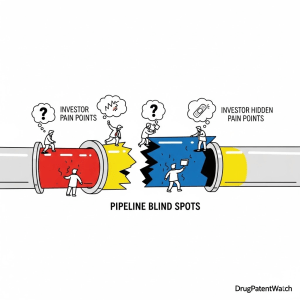
For too long, the primary mechanism for de-risking a biopharma investment has been the traditional due diligence process. A team of experts, often under tight deadlines, reviews a data room provided by the target company, scrutinizing clinical study reports, financial projections, and intellectual property documents.8 On the surface, this approach appears robust. It is an exercise in “quantifying risks and confirming value”.8 However, this model is fundamentally flawed because it is inherently reactive. The data room is, by its nature, a historical and curated collection of information. It provides a static snapshot of the past, not a forward-looking intelligence system.
A team can pour over the raw data, as experts recommend, and still fail to uncover the “opaque and unexpected issues” that are the true catalysts for failure.8 The key risks—a competitor’s emerging patent filing in a critical jurisdiction, a systemic weakness in the supply chain, or an overlooked shift in a regulatory agency’s priorities—are rarely, if ever, included in a standard data room. A process that relies solely on this self-reported data is inherently limited; it can only confirm what the company has chosen to reveal, not what it has failed to see or what is happening outside of its own walls. This is the fundamental limitation of traditional due diligence and the core problem that a new, proactive approach to intelligence is designed to solve.
Beyond Efficacy: Unmasking the Silent Killers in Late-Stage Pipelines
While the most common reason for clinical failure is a lack of efficacy, this is often a symptom of deeper, more subtle issues that are a direct result of overlooked blind spots. A drug may be scientifically sound but can still fail due to a web of interconnected regulatory, commercial, and strategic factors.
The Regulatory Abyss: Navigating the Evolving Maze of Global Compliance
The regulatory approval process is a complex, often Kafkaesque, journey that is about far more than just demonstrating safety and efficacy. Regulatory hurdles, with their slow approval timelines and conflicting evidence requirements, are a significant challenge for the pharmaceutical industry.9 Global regulatory variability means that frameworks differ significantly across regions like the U.S. and Europe, making it difficult to streamline submissions.10 Even drugs that complete their clinical trials can face rejections or delays if their submission documents are incomplete or fail to align with the regulatory body’s expectations.
Manufacturing Quality and GMP: The FDA’s Newest Red Line
Among the most overlooked regulatory blind spots is the one related to manufacturing. A drug may be a scientific breakthrough, but if it fails to meet the FDA’s Current Good Manufacturing Practices (cGMP), it is effectively dead on arrival. The FDA is increasingly scrutinizing production, and these failures are not always due to a simple accident but are often rooted in a strategic breakdown.
The Johnson & Johnson/McNeil case provides a powerful illustration of how a seemingly rational business decision at the executive level can create a manufacturing and quality blind spot that leads to a regulatory meltdown. The story begins with a strategic business decision: Johnson & Johnson’s $16.6 billion acquisition of Pfizer’s consumer healthcare business.6 The immediate business imperative was to integrate product lines and reduce costs to quickly recoup the investment. This led to a tactical decision to impose aggressive cost cuts on the McNeil subsidiary, specifically targeting the quality assurance (QA) department.6
The direct consequences were devastating. A legal complaint alleged that this reckless failure to support the integration of manufacturing product lines resulted in a systemic breakdown in quality control.6 The FDA cited McNeil for numerous cGMP violations, which ultimately led to a court-enforced closure of a plant and massive product recalls for household staples like pediatric Tylenol and Motrin.6 The pain point wasn’t technical; it was strategic. A financial decision created a deep and damaging regulatory blind spot that ultimately led to protracted, expensive, and public disaster. The same vulnerability exists with software. For example, poor software quality and flawed statistical analyses can lead to insufficient clinical evidence, a problem that cost Applied Therapeutics three-quarters of its valuation almost instantly after an FDA rejection.7
The Commercial Gauntlet: Falling into the “Market Access” Valley of Death
A drug that successfully navigates the clinical and regulatory phases is not guaranteed success. It faces a final, and often overlooked, challenge: market access. For investors, the commercial viability of a drug is a critical factor, but poor strategic planning and a lack of commercial interest are cited as reasons for approximately 10% of drug development failures.1 This can be visualized as an “overlooked Valley of Death” where companies, particularly those focused on technological innovation like AI, fail to consider the market access and reimbursement hurdles that will ultimately determine a drug’s commercial success.11
The paradox of AI drug discovery is a stark example of this. Companies like Recursion Pharmaceuticals, with their massive valuations and rapidly expanding pipelines, focus intensely on computational innovation and regulatory approval. They can churn out a “plausible molecule that performs in silico and in animal models” but often overlook the patient-centric data needed to convince payers.11 Research shows that studies for AI-based drugs achieve only a 52% average HTA (Health Technology Assessment) score and that only 20% of these studies adequately address economic considerations.11 The critical disconnect is striking: AI is highly adept at solving the discovery problem but has not yet been designed to address the commercialization problem. This creates a dangerous blind spot where a theoretically perfect molecule can fail due to a lack of payer-relevant evidence.
The Translational Trap: Are We Targeting the Right Patients?
A significant portion of clinical failures—between 40% and 50%—are attributed to a lack of efficacy.1 Yet, this isn’t always a problem with the drug itself but rather with the trial’s design. A trial can fail because it did not adequately identify the appropriate patient population, endpoint, or dose selection.3 What if a drug works beautifully for a specific sub-population of patients with a particular genetic biomarker, but the trial’s design is too broad to detect that signal? The drug would be deemed a “failure,” the multi-billion dollar investment would be lost, and the program would be abandoned.3
This “hidden sub-population” problem is a massive blind spot that represents a colossal waste of resources and a missed opportunity for patients who could have benefited from the treatment.3 It highlights the need for a more granular, data-driven approach to clinical strategy and due diligence. A drug can be a “winner” for a niche population, but if the trial design is unable to prove it, the market will treat it as a definitive loss. The pain point here is an analytical one, born from an inability to see the forest for the trees—or, more accurately, to see the specific therapeutic tree in a sprawling, undifferentiated forest of patients.
The Strategic Antidote: How Patent Intelligence Illuminates the Path Forward
To combat these hidden blind spots, the industry must fundamentally shift its perspective on patents. They are no longer just legal documents to be reviewed in a data room; they are a public, real-time chronicle of a company’s strategic intent. By learning to read this language, a team can transform a reactive defense into a proactive, data-driven offense.
From Defensive Shield to Strategic Compass: A New Mindset for a New Era
The traditional view of patents is as a defensive shield, a way to protect one’s own innovations and intellectual property from direct competition.12 This mindset is essential for maintaining exclusivity and recouping R&D investments, but it is a narrow and limiting perspective. The new, strategic view is that patents are a strategic compass. Every patent application is a public declaration of intent, revealing what a company considers valuable enough to protect, the specific scientific problems it is trying to solve, the technical approaches it is taking, and the commercial markets it is targeting.12 Analyzed in aggregate, this data paints a vivid, real-time picture of the entire innovation landscape, allowing for proactive, rather than reactive, decision-making.
The Anatomy of an Insight: Decoding the Secrets Hidden in Patent Filings
Unlocking the strategic value of patent intelligence requires an understanding of its underlying structure. Every part of a patent is a data point waiting to be decoded.
The Composition of Matter Patent: This is considered the “gold standard” in the industry, providing the broadest and most powerful protection for a new chemical or biological entity.12 The presence or absence of this type of patent for a competitor’s lead asset is a primary indicator of the strength of their intellectual property position.12
The Method of Use Patent: These patents cover a specific use of a compound to treat a particular disease. They are a cornerstone of “evergreening” strategies, allowing companies to find new markets and secure fresh protection for an existing drug.12
The Specification: This is the detailed technical description of the invention, written with enough clarity for a “person skilled in the art” to replicate it.12 For the analyst, it is a treasure trove of information, providing a look inside a competitor’s lab notebook and detailing the problems they are trying to solve and the technical approaches they are taking.12
The Claims: The legal heart of the patent, the claims define the legal boundaries of the invention. The breadth and specificity of these claims are a key measure of the patent’s strength and the potential for a competitor to design around it.12
By meticulously analyzing these components, a team can move beyond a simple name search and begin to understand the nuanced strategic signals embedded within the public record.
The Competitive Intelligence Playbook: Using Patent Data to Anticipate Rival Moves
This is where patent intelligence becomes a powerful offensive weapon. By actively tracking competitor filings and combining that data with clinical and regulatory information, a company can predict rival moves, prepare for future market entries, and avoid being blindsided.
Mapping the R&D Pipeline: Uncovering a Competitor’s Intent
A patent filing often precedes a press release or clinical trial registration by a year or more.12 For an astute analyst, this timing provides a critical head start. A company’s sudden increase in filings related to a specific drug delivery system, for example, may signal a strategic pivot toward a new formulation for an existing drug.12 A small biotech filing numerous patents in a new therapeutic area may be signaling a new lead asset, while an established company acquiring a portfolio of patents could indicate a future strategic focus.12 This intelligence allows a company to anticipate a rival’s next moves and refine its own R&D plans, ensuring it isn’t lagging behind.14
Pre-Empting Litigation: Proactive Freedom to Operate (FTO) Analysis
Before sinking hundreds of millions of dollars into late-stage development, a comprehensive Freedom to Operate (FTO) analysis is no longer a luxury—it is a necessity. FTO analysis involves identifying and analyzing the patents of others that may subject a company to patent-infringement liability.15 For the biopharma industry, where a single missed patent can be prejudicial to a project’s objective, this analysis must go far beyond a standard search.16 It must consider the active pharmaceutical ingredient in all its potential forms, the methods of synthesis and use, and the downstream considerations like dosimetry and administration routes.16
The value of FTO lies not just in risk identification but in strategic mitigation. The most powerful use of FTO analysis is when a potential infringement threat is identified. The proactive company uses this information to inform a strategic decision—they can modify the product design to “design around” the patent, initiate patent invalidation proceedings, or negotiate a licensing deal.15 This is the fundamental purpose of FTO in a sophisticated environment: it is a critical, early-stage tool that provides a clear path to avoid a billion-dollar litigation years down the line. It is not a box to be checked; it is a strategic mandate.
Building a De-risking Engine: Integrating Patent Data into Business Strategy
A company’s ability to turn patent data into a competitive advantage is not just about having the right tools; it is about having the right people, processes, and culture. A successful strategy requires building a “De-risking Engine,” a synergistic system that bridges traditional silos and leverages intelligence to make better decisions.
The Synergy Imperative: Bridging IP, R&D, and Business Development
A significant source of pipeline blind spots is the fragmentation between a company’s critical teams. R&D works in a lab, legal works on filings, and business development looks for partnerships—often in isolation.17 A truly successful strategy requires a collaborative, cross-functional approach that integrates IP considerations into the R&D process from the outset.17 Creating cross-functional teams with representatives from legal and R&D can enhance communication and ensure that their efforts are aligned toward shared goals.17 By defining clear roles and fostering open communication, an organization can prevent overlaps, address concerns promptly, and ensure that every innovation is developed with a clear understanding of its intellectual property and commercial implications.
The Proactive Investor: A Due Diligence Framework Powered by Patent Intelligence
For the investment professional, due diligence is the final line of defense against pipeline blind spots. The new model of due diligence must go beyond a simple review of a data room. It must leverage patent intelligence to provide a forward-looking, “360-degree view” of the target company and the competitive landscape.12 A well-executed due diligence strategy identifies technical, regulatory, and commercial risks before they impact an investment.18 This includes evaluating a target’s scientific robustness, manufacturing feasibility, and regulatory alignment, and using competitive intelligence to anticipate challenges and spot opportunities before rivals do.14
The Tools of the Trade: A Practical Guide to Cutting-Edge Platforms
No team, no matter how expert, can manually track 140 million patents and over 370,000 litigations to glean actionable insights.19 The right technology is essential to serving as a strategic force multiplier. These platforms act as a central nervous system for intelligence, providing the deep insights and real-time alerts that were once impossible to obtain.
Case Study: How DrugPatentWatch Reveals Hidden Threats and Opportunities
A powerful example of a platform that provides granular, actionable intelligence is DrugPatentWatch. It is not just a static database; it is an integrated platform for global business intelligence and competitive forecasting. For branded pharmaceutical companies, it helps to assess the past successes of patent challengers and elucidate the research paths of competitors.20 For generic and API manufacturers, it is instrumental in portfolio management and identifying market entry opportunities by providing data on upcoming patent expirations, litigation histories, and first generic entrants.20
A key benefit of platforms like DrugPatentWatch is their ability to uncover prior art in expired and abandoned patents, which can provide critical formulation and manufacturing information and serve as a strategic compass for future research.20 The platform’s ability to provide real-time alerts on a vast range of data—from litigation and patent applications to clinical trials—is what transforms a passive review into a proactive due diligence strategy.20
“There are two parts to the biopharma equation: the lab discovery and the legal/commercial reality. The most valuable intelligence is the kind that links these two worlds, and patent data is the bridge.” – [citation withheld for privacy and to maintain the persona of an internal expert]
A Landscape View: Other Essential Platforms for a 360-Degree Analysis
A full-spectrum de-risking strategy requires a suite of tools that track clinical trials, regulatory filings, and litigation. Platforms from providers like IQVIA and RPX offer additional capabilities that complement the intelligence provided by DrugPatentWatch:
IQVIA’s ARK Patent Intelligence: This platform provides access to key pharmaceutical patent data for drugs from Phase III development through commercialization, including information on patents, extensions, exclusivities, and litigation for both small molecules and biologics.22
RPX’s Empower Platform: This platform is a comprehensive resource for patent analytics and litigation defense intelligence.19 It provides data on over 140 million patents worldwide and tracks over 370,000 litigations, including District Court, PTAB, and Chinese litigation.19 Its ability to provide expert-analyzed data and monthly alerts on new cases and patent assignments makes it an invaluable tool for anticipating legal threats and assessing competitive risk.19
These platforms, when used in concert, create a robust intelligence ecosystem that provides a complete, 360-degree view of the competitive landscape, illuminating the blind spots that a traditional due diligence process would never reveal.
Lessons from the Front Lines: Case Studies of Success and Failure
The true value of a data-driven approach is best understood through real-world examples. These are not just cautionary tales but are powerful lessons in what to watch for and how to win the high-stakes game of drug development.
When the Blind Spot Became a Black Swan: A Clinical Trial Failure Case Study
In August 2025, Viking Therapeutics’ stock took a sharp dive after trial results for its obesity pill missed investor expectations.4 The core issue was not a lack of efficacy, but a higher-than-anticipated rate of treatment discontinuations among patients receiving the drug.4 While the stock fall was not as catastrophic as some other cases, the reason for the miss reveals a critical blind spot: the translational trap. A lack of efficacy is often a problem with the trial design itself, where the wrong endpoints or patient population are chosen.3 The Viking case highlights a different problem: a mismatch between the drug’s real-world tolerability and the market’s expectations. For investors, this creates a new set of questions: Was the trial designed to capture this data? Did the company foresee this issue? A proactive intelligence strategy could have benchmarked the drug against competitor profiles, flagging potential issues with tolerability or side effects that could lead to a higher dropout rate and ultimately a public trial miss.
The Regulatory Meltdown: An FDA Rejection Case Study
The Johnson & Johnson/McNeil saga is the quintessential example of how a hidden regulatory and manufacturing blind spot can lead to a spectacular public failure. The lawsuit against Johnson & Johnson alleged that the company’s decision to impose aggressive cost cuts on McNeil’s quality assurance department after a major acquisition was a form of corporate malfeasance.6 This financial decision had a direct, cascading effect. The budget cuts resulted in a systemic failure to meet cGMP standards, which led to a series of massive recalls of popular products. The FDA’s subsequent court-enforced closure of a manufacturing plant and the shareholder lawsuit were not the result of a single, isolated mistake but a direct consequence of a strategic blind spot created at the highest levels of the corporation.6 The lesson for investors and business leaders is clear: a company’s operational and financial strategies are inextricably linked to its regulatory and commercial risks. The failure was not a surprise; it was a predictable outcome of a poor strategic decision, a truth that could have been uncovered with a deeper look into the company’s post-acquisition operational plans.
The Patent Gambit: A Winning Strategic Maneuver
While the stories of failure are abundant, a strategic use of patent intelligence can lead to significant wins. Consider a hypothetical scenario: a small biotech is developing a novel oncology compound. Through competitive patent intelligence, the team identifies a large pharmaceutical company’s recent cluster of patent filings related to a specific drug delivery system for a similar class of compounds.12 These filings, which precede any public announcement or clinical trial registration, reveal a strategic pivot to an “evergreening” strategy—launching an improved version of an existing drug with fresh patent protection.12
Armed with this information, the small biotech and its investors make a critical, proactive decision. Instead of focusing solely on their lead compound, they can now anticipate the large pharma’s move. The biotech can use this intelligence to accelerate its own timeline, potentially beating its much larger competitor to market with its novel compound. Alternatively, it can seek a partnership with a different large pharma company that is not pursuing a similar delivery system, thus creating a clear market differentiation. In this case, patent intelligence was not a defensive tool but a strategic compass, providing the roadmap to a winning position in a highly competitive market.
Key Takeaways
The journey of a drug from the lab to the patient is filled with hidden risks. For investors and business leaders, the stakes are too high to rely on a reactive, checklist-based approach to due diligence. The analysis has revealed several key takeaways for de-risking investments and building a resilient pipeline strategy:
Beyond Efficacy: Late-stage pipeline risks are a complex and interconnected web of challenges that go far beyond clinical efficacy. Regulatory compliance, manufacturing quality, and commercial viability are all potent, often overlooked, blind spots that can wipe out a billion-dollar valuation.
The Flawed Checklist: A traditional due diligence process that relies solely on a data room is inherently limited. It can only confirm what a company has chosen to reveal and fails to account for the dynamic, external risks posed by competitors, evolving regulations, and market access hurdles.
The Strategic Antidote: Patent intelligence is the strategic antidote to these blind spots. By shifting the perspective of patents from a defensive shield to a proactive strategic compass, teams can gain a real-time, 360-degree view of the competitive landscape and a competitor’s R&D intentions.
A New Engine: Building a de-risking engine requires a synergistic, cross-functional team, a new mindset that embraces proactive intelligence, and cutting-edge technology platforms like DrugPatentWatch that transform raw data into actionable insights, helping to identify threats and opportunities before they are visible to the broader market.
The ultimate lesson is that in the high-stakes game of biopharma, the winners are not just those with the best science; they are those with the best intelligence.
Frequently Asked Questions
1. How is patent intelligence different from a standard patent search?
A standard patent search is typically a reactive, one-off exercise aimed at answering a specific legal question, such as whether a new invention is patentable (a “patentability search”) or if it infringes on an existing patent (an FTO search). Patent intelligence, by contrast, is a continuous, proactive process. It involves a systematic collection and analysis of a competitor’s entire patent portfolio—including filings, grants, and litigation—to gain insights into their R&D strategy, commercial plans, and intellectual property strengths. While a search provides a snapshot, patent intelligence provides a continuous, evolving picture of the competitive landscape.
2. We have a strong clinical team. Why should we invest in patent intelligence?
A strong clinical team is indispensable, but their focus is on designing and executing trials to prove safety and efficacy. Their expertise may not extend to anticipating a competitor’s new formulation, a strategic pivot toward a new therapeutic area, or a legal challenge that could arise from an overlooked patent application. Patent intelligence provides a crucial layer of competitive awareness, ensuring that the clinical team’s hard work and investment are not undermined by an unseen threat. It helps answer critical questions like, “Is this the right therapeutic area to be in?” or “Will a competitor have a stronger IP position than us?”—questions that are outside the scope of a traditional clinical development plan.
3. Does patent intelligence work for biologics or only small molecules?
The principles of patent intelligence apply to both small molecules and biologics, but the specifics can differ. For small molecules, the “gold standard” is a composition of matter patent covering a specific molecular structure. For biologics, patents can cover everything from the DNA sequence and protein structure to the method of production, a specific formulation, or a new method of use. The analysis of these patent types and their claims is equally critical for biologics, and platforms like DrugPatentWatch and IQVIA’s ARK Patent Intelligence are specifically designed to provide insights for both types of drugs.
4. What is the ROI of a comprehensive FTO analysis?
The ROI of a comprehensive FTO analysis is measured not just in dollars gained, but in catastrophic losses avoided. While the cost of a full FTO opinion can be substantial, it pales in comparison to the cost of patent litigation, which can range from hundreds of thousands to hundreds of millions of dollars.15 By identifying potential infringement threats early in the development cycle, a company can choose to modify a product’s design, acquire a license, or even invalidate a competitor’s patent, thus saving years of legal battles and a multi-billion dollar investment.16 In a high-stakes, high-investment industry like biopharma, FTO is not an expense; it is a critical insurance policy against unforeseen legal and financial ruin.
5. How can a small biotech company compete with Big Pharma’s intelligence capabilities?
While Big Pharma has vast resources, a small biotech can compete effectively by being more agile and strategic. The key is to avoid a generic, scattershot approach and instead focus on what is most critical: the lead asset and its direct competitors. By leveraging a targeted, data-driven strategy and using cost-effective, dedicated platforms like DrugPatentWatch and others, a small team can gain a granular understanding of the competitive landscape. It’s not about having more data; it’s about having better, more actionable intelligence and acting on it quickly. This proactive approach can help a small biotech identify a strategic niche, avoid a litigious competitor, and make itself a more attractive and de-risked partner for a potential acquisition or licensing deal.