Section 1: The Hatch-Waxman Architecture: Why Conflict Is a Feature, Not a Bug
Most people who cover pharmaceutical equities understand that patents matter. Fewer understand that the U.S. regulatory system was specifically designed to make those patents the target of structured, recurring, legally mandated conflict. That design choice — not the science, not the clinical data — is what generates the predictable market catalysts that sophisticated investors exploit.
The Drug Price Competition and Patent Term Restoration Act of 1984, sponsored by Senator Orrin Hatch and Representative Henry Waxman, created the legal architecture that governs generic drug competition to this day. Its core innovation was the Abbreviated New Drug Application (ANDA) under section 505(j) of the Federal Food, Drug, and Cosmetic Act. Before 1984, a generic manufacturer had to run its own full clinical trials to establish safety and efficacy for a copy of a brand-name drug. That requirement eliminated the economic advantage of generic manufacturing. In 1984, generics accounted for only 19% of U.S. prescriptions filled.
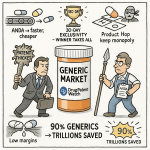
The ANDA pathway removed that barrier. A generic applicant now needs only to demonstrate bioequivalence to the Reference Listed Drug (RLD) — that its product delivers the same amount of active ingredient into the bloodstream over the same time period. Clinical trial requirements disappear. Today, generics account for over 90% of U.S. prescriptions filled, a direct consequence of this single regulatory change.
The Act was not a clean win for generics. It was a deliberate exchange. Innovator companies received two concessions that remain critically important for any IP valuation today: a mechanism for restoring patent term lost during FDA regulatory review (Patent Term Restoration, or PTR), and new forms of government-granted market exclusivity entirely independent of patent status.
The second concession is the more powerful one for analytical purposes. It creates a guaranteed monopoly window that holds even if all of a drug’s patents are successfully invalidated. That fact reshapes the entire investment calculus around patent litigation timing.
The ‘Grand Bargain’ as an IP Valuation Framework
Understanding the Act’s balance is not legal background reading; it is the foundation of a correct IP valuation model. The five-year New Chemical Entity (NCE) exclusivity period is not a patent — it is a statutory right granted by the FDA on approval. It cannot be invalidated in court. It cannot be challenged via Inter Partes Review. It simply expires. That distinction gives NCE exclusivity a fundamentally different risk profile from patent protection, and any discounted cash flow model that conflates the two will produce an incorrect valuation.
The carve-out embedded in the Act — that a generic company may submit an ANDA containing a Paragraph IV patent challenge after only four years of the five-year NCE exclusivity period — is the mechanism that converts a regulatory deadline into a market signal. It creates a specific, known date on which competitive intelligence becomes public. That date is the NCE-1.
Key Takeaways: Section 1
The Hatch-Waxman Act created two distinct value protection mechanisms for innovators: patent rights (challengeable in court) and regulatory exclusivity (not challengeable, simply time-limited). The structural carve-out forcing patent challenges to occur at the four-year mark of NCE exclusivity guarantees that competitive intelligence about patent strength becomes observable on a predictable schedule. That predictability is the foundation of every analytical framework built around NCE-1 events.
Section 2: The Orange Book as an IP Valuation Ledger
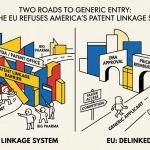
The FDA’s publication ‘Approved Drug Products with Therapeutic Equivalence Evaluations’ — universally called the Orange Book — is the official nexus linking FDA regulatory authority to the U.S. patent system. For a pharma IP team or portfolio manager, it should be read as a public valuation ledger for every approved small-molecule drug’s intellectual property position.
When an NDA holder receives FDA approval, it must list all patents it believes could reasonably be asserted against a generic ANDA applicant for its drug. The FDA performs no substantive review of these listings; it records them without assessing validity or relevance. That ministerial role means the Orange Book reflects what an innovator claims, not what a court has validated.
This distinction has practical consequences. Innovators have a strong incentive to list every patent they can reasonably justify, creating a public-facing IP fortress whose actual strength only becomes known through challenge and litigation. For a generic company preparing an ANDA, the Orange Book is both the rulebook and the target list. Every listed patent requires a formal certification from the generic applicant about its intentions.
What the Orange Book Reveals and Conceals
The Orange Book shows the quantity and type of a drug’s listed patents. It does not show patent strength, claim breadth, or vulnerability to prior art. An Orange Book listing of 12 patents may represent a robust thicket that will deter challengers for a decade, or it may represent 12 marginal secondary patents that will collapse under challenge within 18 months. The number alone is a weak proxy for value.
Sophisticated IP teams use the Orange Book as the starting point, not the conclusion, of their analysis. They cross-reference Orange Book listings against USPTO prosecution histories, international counterpart filings (particularly European Patent Office decisions, which use a stricter inventive step standard), and scientific literature to assess which patents in the portfolio carry genuine blocking power and which are what practitioners call ‘paper tigers.’
For composition-of-matter patents — those covering the active molecule itself — the bar for invalidation is high. Courts apply a ‘clear and convincing evidence’ standard in district court proceedings. For secondary patents covering formulations, polymorphs, delivery mechanisms, metabolites, or methods of use, that standard is the same in court but the factual predicate for meeting it is often much weaker. A polymorph patent covering a common crystalline form of a molecule that any competent medicinal chemist would have tried, for example, faces severe obviousness risk.
IP Valuation Implications of Orange Book Architecture
From a valuation standpoint, the Orange Book patent count is best understood as a ceiling on protection duration and a floor on litigation cost. A drug with one composition-of-matter patent expiring in 2028 and no secondary patents has a clear, dateable cliff. A drug with a composition-of-matter patent expiring in 2028 and eight secondary patents extending various exclusivity arguments to 2035 has a much more complex valuation problem — one that requires scenario-weighted discounted cash flow modeling rather than a simple cliff date.
The Inflation Reduction Act adds another layer. Under the IRA’s drug price negotiation provisions, small-molecule drugs become eligible for Medicare price negotiation nine years after approval, and biologics after 13 years. This compresses the effective exclusivity window for high-revenue drugs and changes the NPV calculation for both innovators defending patents and generics pricing their challenge. IP teams and portfolio managers who have not integrated IRA negotiation timelines into their Orange Book analysis are working with outdated valuation inputs.
Key Takeaways: Section 2
The Orange Book is a public IP ledger, not an IP quality assessment. Patent count is a starting signal, not a conclusion. Valuation requires stratifying Orange Book patents by type (composition-of-matter vs. secondary), cross-referencing international prosecution outcomes, and integrating IRA negotiation timelines into any revenue model extending past nine years from approval.
Section 3: Regulatory Exclusivity vs. Patent Protection: A Critical Distinction for IP Valuation
The single most common analytical error made by financial analysts covering pharmaceutical companies is treating regulatory exclusivity and patent protection as interchangeable. They are not. They have different legal origins, different risk profiles, different duration characteristics, and they generate different cash flow dynamics. Getting this distinction wrong produces materially incorrect IP valuations.
Patent protection is intellectual property granted by the USPTO. It gives the holder the right to exclude others from making, using, or selling the invention for 20 years from the filing date. It is challengeable in federal district court via Paragraph IV litigation, and since 2012, also in administrative proceedings before the Patent Trial and Appeal Board (PTAB) via Inter Partes Review. Courts apply a ‘clear and convincing evidence’ standard to invalidate a patent in district court. PTAB uses the lower ‘preponderance of the evidence’ standard, which produces measurably higher invalidation rates.
Regulatory exclusivity, by contrast, is a statutory right granted by the FDA on approval. The FDA is the enforcing authority, not the courts. A generic company cannot file a Paragraph IV challenge to regulatory exclusivity, because regulatory exclusivity is not a patent and has no Orange Book listing to challenge. The FDA simply will not accept a competing ANDA for review until the exclusivity expires. No lawsuit, no PTAB proceeding, no court ruling changes that outcome.
Types of Regulatory Exclusivity and Their IP Valuation Implications
New Chemical Entity (NCE) exclusivity is the most commercially significant form. It grants five years of market exclusivity to any drug containing an active moiety never before approved by the FDA. During this period, the FDA cannot accept an ANDA for review — with one exception, the Paragraph IV carve-out that creates the NCE-1 date.
New Clinical Investigation (NCI) exclusivity, also called three-year exclusivity, applies to supplemental applications where new clinical studies are essential to approval. It covers the specific condition of use studied, not the active moiety broadly. Generic companies can file ANDAs for the original indication during the three-year NCI exclusivity period for a new indication; they simply cannot get approval for the new indication itself until the exclusivity expires.
Orphan drug exclusivity grants seven years of market exclusivity for drugs treating diseases affecting fewer than 200,000 U.S. patients. Unlike NCE exclusivity, it covers only the specific orphan indication. A generic could theoretically receive ANDA approval for a non-orphan use of the same molecule during the orphan exclusivity period if one exists.
Pediatric exclusivity adds six months to the end of all existing patents and exclusivities for drugs that complete FDA-requested pediatric studies. It is one of the cheapest forms of lifecycle extension available: the cost of conducting the pediatric studies is typically a fraction of the revenue generated by six additional months of exclusivity on a blockbuster drug.
From an IP valuation standpoint, each exclusivity type carries a different cash flow profile and a different risk haircut. NCE exclusivity carries near-zero legal risk during its first four years (the FDA simply won’t accept a competing ANDA) and modest risk during the fifth year when Paragraph IV challenges can be filed but approval still cannot occur. Patent protection carries legal risk from filing date to expiry.
Key Takeaways: Section 3
Regulatory exclusivity is not challengeable the way patents are. NCE exclusivity in particular is the cleanest, most defensible period of guaranteed revenue in a drug’s lifecycle. Any DCF model that discounts NCE exclusivity cash flows at the same risk rate as post-NCE patent-protected cash flows is structurally incorrect. The two periods require different discount rates and different scenario weightings.
Section 4: The Paragraph IV Certification: Mechanics, Triggers, and Strategic Logic
A Paragraph IV certification is the legal instrument by which a generic company formally declares that an Orange Book-listed patent is invalid, unenforceable, or will not be infringed by its product. The filing of this certification on an ANDA triggers one of the most consequential sequences of events in pharmaceutical commerce.
The Hatch-Waxman Act provides four possible certifications for each Orange Book-listed patent. A Paragraph I certification states no patent information has been filed. A Paragraph II certification states the patent has already expired. A Paragraph III certification is a commitment to wait until the patent expires before marketing the generic. A Paragraph IV certification is the aggressive option: a direct challenge to the innovator’s monopoly.
The Mechanics: From Filing to 30-Month Stay
Filing an ANDA with a Paragraph IV certification is defined by statute as an ‘artificial act of infringement.’ This creates immediate legal standing for the brand company to sue for patent infringement even though no actual infringement has occurred — the generic product isn’t yet on the market. This legal construction allows the patent dispute to be litigated and potentially resolved before any commercial harm occurs.
Within 20 days of the FDA confirming the ANDA is sufficiently complete for review, the generic filer must send a formal notice letter to the NDA holder and all patent owners. This notice letter must include a ‘detailed statement’ — a complete technical and legal argument explaining why each challenged patent is invalid, unenforceable, or not infringed. In practice, these notice letters run to hundreds of pages and constitute essentially a pre-trial brief. They are the first public articulation of the legal theory the generic will pursue.
The brand company then has 45 days from receipt of the notice letter to file a patent infringement lawsuit. If it files within that window, the FDA is automatically prohibited from granting final approval to the generic ANDA for 30 months from the date of the notice letter. This 30-month stay is automatic and does not require the innovator to show likelihood of success on the merits. It is the single most valuable defensive tool available to a brand company in the Hatch-Waxman framework, providing roughly 2.5 years of guaranteed market protection while the litigation unfolds.
The stay can be shortened if the court reaches a decision before 30 months expire. It runs its full 30 months if the case is still pending. If the innovator fails to file suit within the 45-day window, there is no stay — the FDA can approve the generic as soon as it meets all regulatory requirements.
Strategic Calculus: Why Generics File Paragraph IV Even Against Strong Patents
The decision to file a Paragraph IV certification is not solely a legal judgment. It is a business decision driven by the financial magnitude of the prize at stake. A generic company that files first — or ties for first on the same day — becomes eligible for 180-day market exclusivity, a period of guaranteed duopoly with the brand that can be worth hundreds of millions of dollars for a blockbuster drug.
This creates a specific and observable dynamic: generic companies file Paragraph IV certifications at the earliest legally permissible moment (the NCE-1 date) even when their probability-of-success assessment on the legal merits is below 50%. The expected value of a 180-day exclusivity period on a billion-dollar product is high enough to justify filing on a speculative legal theory, absorbing the risk of losing, and banking on the possibility of a settlement that includes a licensed early entry date. The result is that Paragraph IV challenges have become, in the words of practitioners familiar with this space, ‘a routine part of doing business’ for the large generic manufacturers.
Key Takeaways: Section 4
A Paragraph IV filing is both a legal challenge and a business investment. The 30-month stay is automatic, giving innovators a structural defensive advantage after the lawsuit is filed — but only if they file within 45 days of the notice letter. The financial magnitude of 180-day exclusivity means generic companies will file Paragraph IV challenges on even moderately strong patents if the target drug is sufficiently large. The threshold for filing is not ‘I think I’ll win.’ It’s ‘the prize is large enough to justify the cost and risk of trying.’
Section 5: The NCE-1 Date: Reading the Starting Gun
The NCE-1 date is the day that falls exactly four years after an NCE’s FDA approval date. It is the earliest moment a generic company can submit an ANDA containing a Paragraph IV certification for that drug. Before this date, the FDA will not accept such an application; any submission is returned without review.
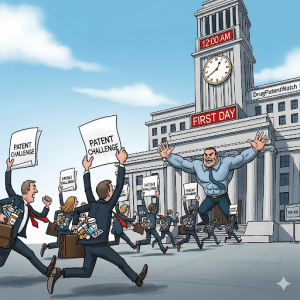
For generic companies, the NCE-1 date is the most strategically important deadline on the annual calendar for any target drug. Missing it means losing first-to-file eligibility. Because first-to-file status can be shared among all companies submitting a ‘substantially complete’ ANDA on the same calendar day, the NCE-1 date produces a predictable phenomenon: multiple generic firms, having conducted extensive but entirely independent due diligence, converge on the same filing date. Their submissions go in within hours of each other. All those who file that day share the 180-day exclusivity eligibility.
For the innovator company, the NCE-1 date is the official end of the quiet period. The arrival of Paragraph IV notice letters shortly after this date converts a theoretical competitive threat into an active legal battle requiring immediate response.
The NCE-1 Date as a Consensus Indicator
This is the analytical insight that most financial coverage of pharmaceutical patents misses. The number of companies that file on the NCE-1 date is not random noise. Each filing represents the independent conclusion of a specialized team — patent lawyers, formulation scientists, and commercial analysts — that a challenge is financially viable. Filing requires not only legal analysis of the patent claims but also successful development of a bioequivalent formulation, completion of stability testing, and assembly of a complete ANDA dossier. The aggregate cost of reaching the NCE-1 filing date for a given drug can exceed $5 million per applicant.
When four companies independently spend $5 million each and conclude simultaneously that a challenge is worth pursuing, that is a stronger statement about the perceived weakness of the innovator’s patents than any single analyst’s opinion. When zero companies file on the NCE-1 date, that is an equally strong consensus in the opposite direction: the patent portfolio is perceived as too robust to challenge economically.
The NCE-1 date converts private intelligence — dispersed across dozens of specialized legal and scientific teams across the generic industry — into a single public, observable, countable event. For an investor with the framework to interpret it, this signal arrives months or years before financial markets reprice the innovator’s revenue projections.
Key Takeaways: Section 5
The NCE-1 date is a pre-scheduled, recurring market event. The number of filers is a consensus vote by the most informed participants in the market on the vulnerability of the innovator’s patent portfolio. This consensus forms through expensive, independent analysis by competitive experts who have real skin in the game. It arrives as a public signal before financial analysts have typically updated their models.
Section 6: IP Valuation at the Patent Cliff: How Challengers Price the Prize
Before any generic company commits resources to a Paragraph IV challenge, it builds an internal NPV model for the target drug. Understanding this model is essential for investors trying to predict which drugs will attract challenges and how many. The generic firm’s calculus is the demand side of the patent challenge market.
The model starts with peak brand sales. For a drug with $3 billion in annual U.S. net revenue, the first-generic prize is estimated by working through four variables: the likely generic price (typically 20-40% below brand during 180-day exclusivity), the expected market share capture (historically 70-85% of volume during exclusive period), the duration of the exclusivity period (180 days), and the development and litigation cost to get there.
On those inputs, a first-generic launch against a $3 billion drug could generate $300-500 million in gross revenue over six months. After cost of goods and legal expenses, that translates to the kind of margin contribution that can transform a mid-sized generic company’s income statement for an entire fiscal year. The math explains why even speculative Paragraph IV challenges against apparently strong patents on sufficiently large drugs make financial sense.
The Post-Exclusivity Pricing Death Spiral and Its Valuation Implications
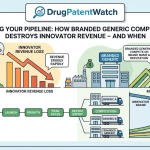
After the 180-day period ends and additional generics receive approval, price erosion is severe and fast. With two generic competitors, average prices fall roughly 50% below brand. With six or more generics in the market, price erosion reaches 80-95% below brand within 12 months. The brand drug retains a small residual market share among patients with strong physician or pharmacist preference for the innovator product, but its revenue contribution effectively ends.
This pricing dynamic has two important valuation implications. First, it confirms the outsized value of 180-day exclusivity relative to all subsequent generic market participation. A company that is the sole generic for six months will capture more revenue from that product than it will in the following five years of commodity competition. Second, it confirms the magnitude of the innovator’s revenue cliff. When multiple generics enter simultaneously at day 181, the decline can be faster than standard ‘patent cliff’ models project. The cliff is not a slope; it is often a wall.
For brand company valuation, this means the critical variable is not ‘when will generic entry occur’ but ‘will generic entry occur as a single event or as a coordinated entry by multiple competitors simultaneously?’ A drug that enters generic competition via a single first-filer during 180-day exclusivity followed by multi-generic entry at day 181 generates a different revenue curve from a drug where a settlement delays all generic entry until a single negotiated date when all challengers launch simultaneously. The latter scenario produces an immediate cliff where the former produces a step-down followed by a cliff.
Key Takeaways: Section 6
Generic firms model the prize before they file. Drugs with peak revenues above $1 billion attract near-certain Paragraph IV challenges; the expected value of the first-generic prize justifies filing even against moderately strong patents. The pricing death spiral post-180-day exclusivity is steep and fast. Innovator valuation models that project gradual post-LOE erosion are systematically too optimistic.
Section 7: The 180-Day Exclusivity Period as a Financial Asset
The 180-day exclusivity period is not just an incentive embedded in the Hatch-Waxman Act. For a first-filing generic company, it is a discrete financial asset with calculable value, specific conditions of enjoyment, and a defined set of risks that can extinguish it before it is fully monetized.
Acquiring the Asset: First-to-File Mechanics
First-to-file status attaches to the generic company (or group of companies) that submits a ‘substantially complete’ ANDA containing a Paragraph IV certification on the earliest date. All applicants who file on the same day share eligibility equally, meaning 180-day exclusivity can be split among multiple first-filers. When six generic companies file on the same NCE-1 date, all six are co-eligible first filers. If all eventually receive approval, the FDA will not approve a seventh generic during the 180-day window after the first among the six launches.
This shared eligibility structure matters commercially. A 180-day exclusivity period shared among six eligible co-filers still prevents a seventh generic from entering. But market share during the period gets distributed among however many of the six have received FDA approval and chosen to launch. The more co-filers who are approved and launch, the lower the per-company revenue during the exclusivity window.
Losing the Asset: Forfeiture Triggers
A first-filer can forfeit its 180-day exclusivity before monetizing it. The Medicare Modernization Act of 2003 established specific forfeiture provisions that eliminated much of the strategic delay behavior that had plagued the system. A first-filer forfeits 180-day exclusivity if it fails to obtain tentative FDA approval within 30 months of filing (with certain exceptions), if it enters a settlement agreement that contains a ‘pay-for-delay’ provision that courts or the FTC determine triggers forfeiture, or if it fails to market the drug within a defined period after certain triggering events. The forfeiture provisions mean that a first-filer cannot simply file on the NCE-1 date and then delay for years while collecting its exclusivity entitlement. It must actively prosecute its application.
The ‘At-Risk’ Launch: Monetizing the Asset Before Litigation Concludes
A generic company that wins at the district court level — or believes its legal position is strong enough — sometimes chooses to launch its generic product commercially before the full appeals process is complete. This is an ‘at-risk’ launch. The company monetizes its exclusivity period during the risk window. If the appeals court eventually upholds the district court’s invalidity or non-infringement finding, the company keeps all the revenue generated during the at-risk period. If the appellate court reverses and finds the patent valid and infringed, the company is liable for damages based on the brand’s lost profits during the at-risk period.
For very large drugs, the damages exposure from an unsuccessful at-risk launch can be catastrophic. Courts have assessed damages ranging from tens of millions to over a billion dollars in major cases. This creates an asymmetric risk profile: the upside of an at-risk launch is capturing six months of near-duopoly revenue; the downside is existential liability. Generic companies that pursue at-risk launches are typically well-capitalized, have high confidence in their legal position, and have modeled the damage exposure carefully. An at-risk launch by a large, credible generic firm is itself a strong signal about that firm’s legal confidence.
Key Takeaways: Section 7
The 180-day exclusivity period is a discrete financial asset that must be actively maintained and is subject to forfeiture. Co-filer dynamics dilute per-company value but do not eliminate the barrier to later entrants. At-risk launches are a high-conviction signal — they indicate the launching company believes its legal position is strong enough to absorb potential damages exposure while monetizing the exclusivity window.
Section 8: The Challenger’s Cost-Benefit Model: How Generic Firms Decide to File
Not every patent challenge is equal in its strategic intent. Understanding the different motivations behind Paragraph IV filings refines any signal interpretation.
Some filings are what practitioners call ‘prospecting’ challenges — aggressive Paragraph IV certifications filed primarily to induce a settlement from the brand company. The filer may have a weak legal case but calculates that the brand company, unwilling to accept litigation risk on even a weak challenge against a major revenue stream, will offer a licensed entry date in settlement that is earlier than the natural patent expiry. The filer accepts this date and moves on. This strategy is especially common for drugs where the 30-month stay and subsequent litigation would cost both sides tens of millions in legal fees.
Other filings are ‘conviction’ challenges — the filer has conducted deep prior art analysis, identified a specific vulnerability (a prior art reference that anticipates the claims, a clear case of obviousness, a manufacturing patent that its own process cleanly avoids), and intends to litigate to verdict if necessary. These challenges carry higher probability of success and represent a genuine threat to the innovator’s monopoly.
A third category is the ‘formulation carve-out’ challenge, where the generic company’s ANDA seeks approval only for a skinny label — a subset of approved indications not covered by method-of-use patents — in an attempt to avoid infringing those patents entirely. These challenges avoid the patents rather than attacking them directly, and they require a careful labeling strategy that may limit the generic’s commercial reach initially.
For investors interpreting the NCE-1 signal, knowing which category each filer falls into requires qualitative research that goes beyond the FDA’s Paragraph IV Certification List. Reviewing the notice letter content where it becomes public, assessing the filer’s litigation history, and analyzing the specific claims being challenged all contribute to a more accurate signal interpretation.
The Role of Law Firm Selection
Patent litigation outcomes in the Hatch-Waxman context are not randomly distributed across law firms. A small number of firms — Kirkland & Ellis, Wilmer Cutler Pickering Hale and Dorr, Fish & Richardson, Finnegan Henderson, Jones Day — handle a disproportionate share of major pharmaceutical patent litigation on behalf of both innovators and generic challengers. The choice of counsel signals the seriousness and financial commitment behind a challenge. A first-time Paragraph IV filer retaining one of these top-tier firms is more credible than the same filing backed by a regional firm without a pharmaceutical patent track record.
Similarly, the judicial district in which the brand company files its infringement suit matters. The District of Delaware and the District of New Jersey collectively handle the majority of Hatch-Waxman patent litigation. Both districts have developed pharmaceutical patent law expertise and have judges with deep familiarity with bioequivalence issues, claim construction in pharmaceutical contexts, and the procedural complexities of multi-defendant consolidation. An investor tracking a major patent battle needs to know not only which court the case is in but which specific judge is assigned, as individual judicial records on pharmaceutical patent cases can inform probability assessments.
Key Takeaways: Section 8
Not all Paragraph IV filings reflect the same legal conviction or commercial intent. Distinguishing prospecting challenges from conviction challenges materially changes the risk assessment. Law firm selection and judicial district are observable proxies for the legal seriousness behind a challenge.
Section 9: An Analyst’s Framework for Decoding NCE-1 Signals
The NCE-1 filing count is the starting variable in a multi-step analytical process. What follows is a repeatable framework for translating the raw event into a structured investment hypothesis.
Step 1: Quantify the Signal
The FDA publishes its Paragraph IV Certification List, which identifies how many ‘Potential First Applicant ANDAs’ have been submitted for each drug product. This is the first data input.
Zero filers is a bullish signal for the innovator. The absence of any challenges on the NCE-1 date reflects a broad industry consensus that the patent portfolio is robust enough that a challenge is not an economically viable business decision. The market often underestimates the duration of the resulting monopoly, particularly for secondary patents that extend well past the NCE-1 window.
One filer warrants a case-by-case assessment. A single challenge from a large, well-capitalized generic with a strong litigation track record (Teva, Sandoz, Viatris, Hikma) carries materially more weight than a challenge from a smaller, more speculative firm. A single filer could represent a unique legal angle others missed, a prospecting settlement attempt, or a ‘design-around’ formulation that avoids the composition-of-matter patents entirely.
Two to three filers is clearly bearish for the innovator. The probability that two or three independent, well-resourced teams have simultaneously concluded that the challenge is economically viable implies a developing consensus on patent vulnerability. The investor should immediately assess which specific patents are being challenged and what legal theories are being advanced.
Four or more filers is strongly bearish. This is the ‘blood in the water’ scenario. A large number of simultaneous first-day filings indicates widespread belief across the generic industry that the path to market is achievable. It also implies the drug’s commercial scale is large enough to accommodate profitable generic participation even with multiple co-exclusivity holders splitting the 180-day window.
Step 2: Qualify the Challengers
The identity, financial position, and litigation record of each challenger determines whether the signal reflects conviction or opportunism. Research each filer’s historical Paragraph IV success rate. Assess its capitalization relative to the likely litigation cost. Identify the law firms retained. Determine whether the filer is known for prosecuting cases to verdict or settling early for licensed entry dates.
Step 3: Analyze the Patent Being Challenged
The type of patent under challenge is the most important qualitative variable. A composition-of-matter patent — the foundational patent covering the active molecule — is the hardest to invalidate. Courts and PTAB have consistently found these patents difficult to challenge on obviousness grounds when the molecule itself was genuinely novel and required inventive step to discover. Challenges against composition-of-matter patents that nonetheless succeed (as in the Plavix case) typically succeed on narrow grounds specific to the prosecution history or disclosure quality.
Secondary patents are a different story. Formulation patents covering a standard extended-release matrix, polymorph patents on a common crystalline form, method-of-use patents that merely describe a previously known therapeutic effect, and metabolite patents are all highly susceptible to invalidity challenges. An NCE-1 event in which challengers are attacking only secondary patents while accepting the composition-of-matter patent suggests a more limited threat to the innovator’s exclusivity than a situation where the core molecule patent itself is under assault.
Step 4: Size the Prize
Estimate the commercial value of the 180-day exclusivity period for the target drug. Use peak U.S. net revenue as the base, apply a 70-80% volume capture assumption during the exclusivity period (validated by historical first-generic market share data), and apply a price realization of 65-75% of brand net price. Subtract an estimate of development and litigation costs. The resulting NPV estimate explains why the challengers filed and helps size the financial stakes for both sides.
Step 5: Build a Litigation Timeline
From the NCE-1 date, map the expected sequence: notice letter receipt (days to weeks after filing), brand lawsuit filing (within 45 days of notice), 30-month stay expiration (approximately 2.5 years from notice), expected trial date (often 2-3 years after filing), and potential appeals timeline (12-18 months after district court verdict). This timeline defines the investment horizon for any position constructed around the thesis.
The NCE-1 Signal Decision Matrix
Number of NCE-1 Filers
Initial Signal
Likely Innovator Patent Status
Key Next Research Step
Initial Thesis Direction
0
Strongly Bullish
Perceived as robust; challenge deemed uneconomical
Monitor for late-stage filers; assess secondary patent portfolio depth
Long Innovator; reassess at 5-year exclusivity expiry
1
Neutral to Mildly Bearish
Single novel theory or settlement attempt
Identify challenger, assess litigation track record and law firm
Hold/Monitor; await notice letter content
2-3
Bearish
Developing consensus on vulnerability of one or more key patents
Identify which patents are challenged; assess patent type (composition vs. secondary)
Short Innovator; selectively Long top-tier challengers
Assess timing of expected approval; model revenue cliff and at-risk launch probability
Strong Short Innovator; Long select first-filers with strongest litigation profiles
Key Takeaways: Section 9
The NCE-1 analytical framework is a five-step process moving from quantitative signal to qualified hypothesis. The filer count is the input, not the output. The output is a probability-weighted revenue scenario model for the innovator and an NPV estimate for the generic challenger’s 180-day exclusivity asset.
Section 10: Patent Thickets, Evergreening, and Lifecycle Management Roadmaps
A sophisticated NCE-1 analysis cannot stop at the initial filing event. For drugs with complex patent portfolios, the real analytical challenge is mapping the entire patent thicket to understand which expiries are genuinely defensible and which are vulnerable to challenge or workaround.
The Patent Thicket Defined
A patent thicket is a dense cluster of overlapping patents that collectively protect a drug well beyond the expiry of its composition-of-matter patent. The constituent patents typically include polymorph patents (covering specific crystalline forms of the active ingredient), formulation patents (covering the drug product itself, including inactive ingredients, particle size ranges, or coating compositions), dosing regimen patents (covering specific dosing schedules or combinations), metabolite patents (covering the active metabolite of a prodrug), enantiomer patents (if the drug was originally approved as a racemate and the company subsequently patented the active enantiomer), and pediatric formulation patents (often filed after completion of pediatric studies required by the FDA).
The IP valuation problem is that a patent thicket’s strength is highly non-linear. Each individual patent may be independently challengeable. But the cost of challenging twelve patents simultaneously, with the attendant litigation discovery, expert witnesses, and trial preparation for each, can exceed $50 million per defendant and take five or more years to complete. AbbVie’s Humira defense, while a biologic governed by the BPCIA rather than Hatch-Waxman, established the outer limit of this strategy: 247 patent applications, over 130 granted U.S. patents, and a thicket dense enough that every biosimilar challenger settled rather than fight through the entire portfolio. The delay to U.S. biosimilar entry was over six years past the primary patent expiry, and the estimated cost to the U.S. healthcare system was over $19 billion.
Evergreening: The Technology Roadmap
Evergreening is the practice of filing secondary patents designed to extend effective market exclusivity beyond the life of the original composition-of-matter patent. The term carries a pejorative connotation in policy discussions, but for IP teams and portfolio managers, understanding the mechanics is essential for accurate LOE (Loss of Exclusivity) date projection.
A typical evergreening technology roadmap unfolds in five phases. In Phase 1, coinciding with NDA submission or approval, the innovator files the foundational composition-of-matter patent and any process patents critical to manufacturing. Phase 2, typically in years two to four of the product’s commercial life, involves filing formulation patents once the commercial dosage form is finalized and stable. Phase 3 involves polymorph patents, filed after the drug’s solid-state chemistry is fully characterized, covering the specific crystalline form used in the commercial product. Phase 4 involves method-of-use patents for new indications identified in post-approval clinical programs, which can add three years of exclusivity per new indication via NCI exclusivity. Phase 5 involves filing patents on combination products, delivery devices (for injectable or inhaled drugs), and prodrug modifications that can extend the commercial franchise even as the original molecule enters generic competition.
For an investor modeling an innovator’s revenue profile, each phase of this roadmap represents an incremental LOE extension with a probability attached. A composition-of-matter patent expiring in 2027 combined with a well-constructed formulation patent expiring in 2031 and method-of-use patents extending to 2033 creates a staggered revenue erosion profile that differs materially from a simple 2027 cliff assumption. The probability that each secondary patent survives challenge — based on type, claim breadth, and prior art landscape — determines the appropriate probability weighting for each scenario.
The IRA’s Impact on Evergreening Economics
The Inflation Reduction Act has meaningfully changed the evergreening calculus for high-revenue drugs. Under the IRA, small-molecule drugs become eligible for Medicare price negotiation at nine years post-approval. This compresses the effective economic benefit of evergreening strategies that extend exclusivity beyond the nine-year mark for Medicare-heavy drug categories. A polymorph patent extending exclusivity from year 9 to year 13 may still prevent generic competition, but if Medicare negotiated pricing applies from year 9, the revenue protected by years 10-13 of exclusivity is materially lower than pre-IRA models assumed.
IP teams advising on litigation strategy and portfolio managers modeling LOE timelines both need to integrate the IRA negotiation timeline into their evergreening benefit calculations. The drugs most affected are those with high Medicare penetration — cardiovascular drugs, diabetes drugs, cancer supportive care drugs. Drugs primarily used by commercially insured or Medicaid populations are less directly affected by IRA negotiation provisions.
Key Takeaways: Section 10
A patent thicket’s value is not the sum of its parts; it is the deterrent created by litigation cost and duration multiplied across the full portfolio. Evergreening follows a predictable technology roadmap that investors can map and probability-weight. The IRA compresses the economic value of late-stage evergreening for Medicare-heavy drug categories, requiring model updates for any asset with projected exclusivity extending past nine years from approval.
Section 11: The PTAB Battlefield: Inter Partes Review as a Parallel Attack Vector
Since 2012, generic companies and other patent challengers have had access to a second litigation venue that operates in parallel with district court proceedings: the Patent Trial and Appeal Board (PTAB), an administrative tribunal within the USPTO. Inter Partes Review at PTAB has materially changed the strategic landscape for Hatch-Waxman litigation, and any investor tracking a major patent challenge must understand both battlegrounds.
IPR vs. District Court: Key Differences
IPR proceedings use a ‘preponderance of the evidence’ standard to establish invalidity, compared to the ‘clear and convincing evidence’ standard in district court. This lower burden of proof translates into measurably higher patent invalidation rates at PTAB compared to district courts. Academic analyses of pharmaceutical patent cases at PTAB have consistently found institution rates (the probability PTAB agrees to hear the challenge) of 60-70% and, once instituted, invalidation rates for challenged claims of 60-80%.
The scope of IPR is narrower than district court. PTAB can only consider invalidity challenges based on prior art — earlier patents and printed publications that anticipate or render obvious the challenged claims. It cannot adjudicate non-infringement, inequitable conduct, or other invalidity grounds like failure of enablement or lack of written description. These non-prior-art invalidity arguments are reserved for district court.
IPR proceedings are faster. From petition filing to a final written decision, the timeline is typically 12-18 months. District court cases run 2-4 years to trial, with appeals adding another 12-18 months. This speed advantage is significant for a generic company trying to clear the legal path to market.
The critical strategic cost of pursuing IPR is estoppel. A petitioner that loses at PTAB — or even raises arguments in an IPR that it could have raised but did not — is estopped from raising those same arguments in district court. An IPR defeat effectively forecloses an entire category of invalidity arguments for the district court litigation. This creates a difficult strategic choice: pursue the faster, cheaper PTAB track and risk closing off arguments, or proceed directly in district court where the range of challenges is broader but the timeline and cost are greater.
Many sophisticated challengers pursue both simultaneously — filing IPR petitions on prior art grounds while litigating non-infringement and other invalidity theories in district court. This parallel track maximizes the pressure on the innovator but also escalates costs for the challenger.
PTAB’s Role in IP Valuation
For an investor, a PTAB petition filed against an innovator’s key patents — even if not filed in conjunction with an ANDA — is a material event. It signals that at least one party (which could be a generic company, a biosimilar developer, or in some cases a competitor innovator) has identified a prior art vulnerability and is willing to invest in a formal challenge. An IPR institution decision (PTAB agreeing to hear the challenge) is a stronger signal, indicating that the board found at least a ‘reasonable likelihood’ that one or more claims are unpatentable.
IPR decisions at PTAB should be integrated into any ongoing patent challenge analysis. A PTAB invalidation of a key claim, even on claims that are slightly different from those being litigated in district court, can shift district court proceedings significantly. It may cause the innovator to settle on more generic-favorable terms, or it may encourage additional generic companies to file ANDAs who had previously been deterred by the strength of the patent.
Key Takeaways: Section 11
PTAB IPR proceedings offer generics a faster, cheaper attack vector with a lower evidentiary burden than district court, at the cost of narrower grounds and broad estoppel. IPR institution decisions are material events for innovator IP valuation. Parallel-track litigation — simultaneous IPR and district court proceedings — is the most aggressive and expensive generic strategy and signals strong commitment to the challenge.
Section 12: Case Studies in Action
Case Study 1: Lipitor (atorvastatin) — The Definitive Patent Cliff Playbook
Pfizer’s Lipitor was the best-selling drug in pharmaceutical history at its peak, generating over $12 billion in annual global sales. Its commercial scale made it an inevitable target for every major generic manufacturer simultaneously.
The IP Valuation Problem: Lipitor’s IP position entering the challenge phase was complex. The core composition-of-matter patent on atorvastatin calcium, U.S. Patent No. 4,681,893, had a relatively straightforward expiry in 2011. Pfizer’s defense rested on a cluster of secondary patents covering the drug’s commercial formulation and a tablet manufacturing process, as well as a suite of foreign patents in markets including Canada and Australia. The critical question for any investor in 2007-2008 was whether these secondary patents would survive challenge long enough to matter, and what settlement terms the brand would accept to avoid the uncertainty of trial.
The Signal: As Lipitor’s NCE-1 date arrived, the generic industry response was exactly what the framework predicts for a blockbuster with perceived secondary-patent vulnerability: a flood of challengers, led by Ranbaxy Laboratories as the first filer. Ranbaxy’s challenge was the credible, well-resourced, first-to-file type that carries maximum signal weight. The number and quality of challengers was a strongly bearish signal for Pfizer’s post-2011 revenue.
The Litigation and Settlement: Pfizer filed suit within the 45-day window, triggering the 30-month stay. The ensuing litigation spanned multiple years and jurisdictions. In 2008, rather than risk an adverse ruling, Pfizer settled with Ranbaxy on a comprehensive basis, granting Ranbaxy a license to launch in the U.S. on November 30, 2011 — before several secondary patents expired, but at a date of Pfizer’s choosing rather than Ranbaxy’s. This settlement was itself a signal: Pfizer concluded the risk of an earlier-than-2011 court-ordered entry outweighed the cost of the settlement concession.
Pfizer’s Lifecycle Management Response: Pfizer’s response to the Lipitor cliff is now a standard case study in pharmaceutical lifecycle management. It launched an authorized generic through a partnership with Watson Pharmaceuticals, capturing a portion of the generic market revenue that would otherwise go entirely to Ranbaxy during the 180-day exclusivity period. It implemented aggressive patient co-pay reduction programs (‘Lipitor for You’), rebate programs to PBMs, and formulary positioning agreements with managed care organizations to maintain branded Lipitor’s market presence beyond what any prior patent cliff model would have predicted. The combination of authorized generic launch and aggressive patient assistance programs preserved a meaningful revenue stream for Pfizer even as Ranbaxy’s generic captured 70%+ of volume within weeks of launch.
Investment Implications: The NCE-1 framework correctly identified the strongly bearish signal years before the 2011 cliff. An investor who initiated a short position in Pfizer based on the multi-filer NCE-1 signal in 2007, sized appropriately, and monitored the settlement announcement to confirm the 2011 entry date would have had a well-timed and well-defined short thesis. The complementary long position in Ranbaxy — sized to reflect the 180-day exclusivity prize — was complicated by Ranbaxy’s ongoing FDA manufacturing compliance issues, which eventually delayed its U.S. launch and nearly forfeited its first-filer exclusivity. This highlights an important execution risk for generic long positions: manufacturing and quality compliance issues at the generic firm are a real and underappreciated risk factor that can delay or eliminate the prize even after a legal victory.
Case Study 2: Plavix (clopidogrel) — The ‘At-Risk’ Launch and Its Consequences
Plavix, marketed by Sanofi-Aventis and Bristol-Myers Squibb, was a $9 billion annual franchise at its peak. Its patent challenge by Apotex, a Canadian generic manufacturer, introduced the pharmaceutical investment community to the binary risk profile of an at-risk launch.
The Signal: Apotex was a single challenger, which initially suggested an ambiguous rather than strongly bearish signal for Sanofi/BMS. But the quality of the challenger mattered: Apotex was well-capitalized, had retained experienced pharmaceutical patent counsel, and had identified what it believed was a genuine invalidity argument against the key clopidogrel bisulfate salt patent.
The Litigation: The district court in 2011 made a decision that inverted the expected outcome: it found the clopidogrel bisulfate patent both infringed and invalid on grounds of obviousness and lack of utility — a ruling that found against the innovator on the merits while simultaneously finding for the innovator on infringement. The net result was a patent invalidation.
The At-Risk Launch: Emboldened by the district court’s invalidity holding and before any appellate review, Apotex launched its generic clopidogrel commercially. Over several months before a consent order halted the launch, Apotex shipped enough product to capture a significant portion of the market. When the Second Circuit Court of Appeals later reversed the district court’s invalidity finding and upheld the patent, Apotex faced treble damages exposure for the at-risk period. The eventual damages award was substantial, illustrating precisely why at-risk launches are high-stakes bets rather than free options.
Investment Implications: For investors, the Plavix case teaches the importance of tracking the full appellate timeline, not just the district court verdict. A district court ruling favorable to the generic challenger is an investable event, but it is not a final event. Sizing a position based on a district court win without discounting for appellate reversal risk produced catastrophic results for investors who went heavily long Apotex on the district court decision. The lesson is that positions built on litigation outcomes must be dynamically sized down, not up, when at-risk commercial actions increase the binary asymmetry of the remaining legal question.
Case Study 3: Humira (adalimumab) — The Ultimate Thicket Defense
Humira is a biologic governed by the BPCIA’s biosimilar pathway, not Hatch-Waxman. But its IP strategy is the defining case study for any analyst thinking about secondary patent portfolios and the economics of patent thicket litigation deterrence.
The Strategy: AbbVie filed 247 patent applications on adalimumab and its commercial product, ultimately securing over 130 granted U.S. patents. The vast majority were secondary patents covering formulations, concentrations, dosing regimens, manufacturing processes, and combination therapies. The composition-of-matter patent on adalimumab expired in the U.S. in 2016. AbbVie’s thicket extended protection arguments well into the 2030s.
IP Valuation of the Thicket: The economic power of AbbVie’s thicket was not that any single secondary patent was strong enough to win in court. It was that the aggregate cost and duration of litigating over 100 patents simultaneously was prohibitive for any single biosimilar developer. Face $500 million in combined litigation costs and a seven-year timeline to clear the portfolio, or settle for a licensed U.S. entry date. Every biosimilar challenger settled. The first biosimilars reached the U.S. market in January 2023, over six years after the primary patent expired. The thicket was estimated to have preserved approximately $19 billion in U.S. revenue that would otherwise have been competed away.
The Contrast with European Outcomes: AbbVie held far fewer secondary patents in Europe, where patent offices apply a stricter inventive step standard. Biosimilars launched in Europe in 2018, five years before U.S. entry. This geographic divergence is itself a signal methodology: when a drug’s primary patent expires in Europe and biosimilars immediately launch while U.S. exclusivity continues, the U.S. secondary patent portfolio is the only barrier — and the extent to which it can be maintained is a direct IP valuation question.
Investment Implications: The Humira case permanently changed how sophisticated investors model patent thicket scenarios. A high filer count at the NCE-1 date against a Humira-like thicket may still resolve in the innovator’s favor, not because any individual patent is strong but because the litigation economics favor settlement. Investors who mechanically apply ‘four filers equals bearish’ without analyzing the patent thicket depth will systematically over-discount innovator revenue in thicket scenarios.
Case Study 4: Tirzepatide (Mounjaro/Zepbound) — The Forthcoming Signal
Eli Lilly’s tirzepatide, approved as Mounjaro for type 2 diabetes and Zepbound for obesity, represents one of the most watched upcoming NCE-1 events in the industry. Its NCE-1 date falls in May 2026 — which, at the time of this writing, is imminent.
The IP Position: Tirzepatide is listed with three Orange Book patents. This relatively lean portfolio, for a drug that generated approximately $13 billion in 2024 global revenue, creates an interesting analytical tension. The commercial prize is enormous — making challenges financially rational even against moderately strong patents. The patent count is low enough that the litigation cost to clear the portfolio is manageable. Both factors point toward a robust challenge environment.
What to Watch: The number of ANDA filers on tirzepatide’s NCE-1 date will be one of the most closely watched signals in pharma IP in 2026. A flood of filers would set up one of the highest-stakes 180-day exclusivity races in the history of the Hatch-Waxman framework. It would also set up a major short thesis on Eli Lilly’s U.S. GLP-1 revenue projections for the 2030-2032 window, the period when generic tirzepatide could realistically reach the market if challenges succeed. Conversely, zero or minimal filers would be a strongly bullish signal for Lilly’s long-term revenue durability and would prompt re-evaluation of sell-side models that currently assume a 2031 cliff.
Section 13: The Biosimilar Parallel: BPCIA Patent Dance and Its Investment Implications
Biologic drugs, including monoclonal antibodies, therapeutic proteins, and complex peptides, are governed by a separate statute: the Biologics Price Competition and Innovation Act of 2009 (BPCIA). The BPCIA established the biosimilar approval pathway and its own patent dispute resolution process, known colloquially as the ‘patent dance.’ For investors tracking the pharmaceutical patent landscape, the BPCIA framework is not an afterthought — it governs the fastest-growing and most commercially significant segment of the drug market.
The BPCIA vs. Hatch-Waxman: Key Structural Differences
The BPCIA provides 12 years of reference product exclusivity for the originator biologic, compared to Hatch-Waxman’s five-year NCE exclusivity for small molecules. No biosimilar application can be approved until the 12-year exclusivity expires, and no application can even be submitted until four years post-approval. There is no equivalent of the NCE-1 Paragraph IV challenge; the BPCIA’s four-year submission window does not carry a patent challenge obligation.
The ‘patent dance’ is a pre-litigation information exchange process. Once a biosimilar application is accepted for review by the FDA, the reference product sponsor (the originator) and the biosimilar applicant enter into a multi-step exchange of information: the biosimilar applicant provides its full application to the originator, the originator identifies patents it believes could be asserted, and the parties negotiate a list of patents to litigate immediately. The resulting ‘patent dance’ can take six months to a year, and participation has been a contested legal question — the Supreme Court held in Sandoz v. Amgen (2017) that biosimilar applicants are not required to engage in the dance, though there are strategic consequences for opting out.
The IP Valuation Challenge for Biologics
Valuing a biologic’s IP position is materially more complex than valuing a small-molecule patent portfolio. The molecule itself is typically a large, complex protein that cannot be exactly replicated — biosimilars are ‘highly similar’ but not identical. This creates additional regulatory hurdles (interchangeability designation requires additional clinical data) and potential physician and patient resistance that does not affect small-molecule generic substitution. Market penetration by biosimilars has historically been slower in the U.S. than in Europe, where mandatory substitution policies and centralized tendering drive faster conversion.
The 12-year exclusivity period is the foundation of any biologic IP valuation. Secondary patent portfolios and patent thickets add upside to the exclusivity duration, as the Humira case demonstrated. But the baseline protection is structurally longer than for small molecules, which compresses the relative importance of secondary patent challenges for biologics compared to Hatch-Waxman drugs.
For portfolio managers with significant biologic exposure, the key valuation variables are the timing of reference product exclusivity expiry (known, dateable), the density of the secondary patent thicket (requires Orange Book equivalent analysis of the patent landscape), the number of biosimilar developers in active development (public from FDA’s Purple Book and company pipelines), and the projected rate of market penetration for approved biosimilars (historically variable and slower in the U.S. than Europe).
Key Takeaways: Section 13
The BPCIA framework provides longer baseline exclusivity for biologics but involves a more complex, less predictable patent resolution process than Hatch-Waxman. Biosimilar market penetration in the U.S. has been systematically slower than in Europe, requiring conservative modeling assumptions. The Humira case is the dominant case study for how thicket construction can extend commercial exclusivity far past the primary reference product exclusivity expiry.
Section 14: Building a Surveillance System with DrugPatentWatch
The analytical framework in Sections 9 and following is only as good as the data that feeds it. Translating this framework into actual investment decisions requires systematic, real-time access to regulatory filings, Orange Book patent data, litigation records, and NCE-1 calendars. Standard financial terminals do not provide this data at sufficient depth or speed.
The Data Integration Problem
An investor tracking NCE-1 events manually would need to monitor the FDA’s Paragraph IV Certification List (updated periodically but not in real time), cross-reference each new filing against the Orange Book (a separate FDA publication), pull prosecution histories from the USPTO’s Patent Center, track court docket entries through PACER, and monitor PTAB petition filings through the Patent Center IPR/PGR tracking system. Each of these data sources uses different identifiers, different nomenclature, and different update frequencies. Manual integration is slow, error-prone, and requires specialized expertise in pharmaceutical regulatory and patent data.
DrugPatentWatch addresses this problem by aggregating and linking these disparate data sources into a unified platform. The platform maps Orange Book patent listings to ANDA filings to litigation records to PTAB proceedings, allowing a researcher to see the complete IP and litigation history of a drug from a single interface.
NCE-1 Calendar: Systematic Monitoring
DrugPatentWatch maintains a curated list of drugs with upcoming NCE-1 dates, including the number of protecting Orange Book patents for each. This calendar is the raw material for building a proactive catalyst watchlist. An investor can identify NCE-1 events 12-18 months in advance, conduct pre-NCE-1 due diligence on the target drug’s patent portfolio and commercial profile, size a preliminary position in advance of the filing event, and then update the position when the filer count becomes public.
The platform’s alert system enables real-time monitoring. Customizable alerts for specific drugs, companies, or therapeutic categories push notifications when a Paragraph IV certification is filed and made public by the FDA. This alert latency is the primary differentiator from standard financial news coverage, which typically reports on Paragraph IV filings hours or days after the FDA data becomes available.
Litigation Tracking: Following the Signal Through Its Lifecycle
The NCE-1 filing is the beginning, not the end, of the investment thesis lifecycle. DrugPatentWatch integrates litigation data that allows an investor to track the complete sequence: from notice letter receipt confirmation, to lawsuit filing by the brand, to Markman (claim construction) hearing dates and rulings, to district court decisions, to appellate proceedings, and ultimately to settlement or verdict.
The platform’s historical database enables the construction of predictive models. An investor can research the district court success rate for specific patent types, the track record of specific law firms in pharmaceutical patent litigation, and the historical correlation between PTAB IPR outcomes and subsequent district court proceedings. This type of historical analysis is the basis for probability-weighting the scenarios in any DCF model built around a patent challenge thesis.
Section 15: The NCE-1 Watchlist: Upcoming Catalysts for 2025-2026
The following table presents drugs with upcoming NCE-1 dates, drawn from DrugPatentWatch data. Each represents a pre-scheduled catalyst event for the investment framework.
Brand Name
Generic Name
Innovator
NCE-1 Date
Orange Book Patents
2024 Estimated U.S. Revenue
WELIREG
belzutifan
Merck Sharp Dohme
August 2025
2
~$500M (est.)
KORSUVA
difelikefalin acetate
Vifor Intl
August 2025
12
~$50M (est.)
QULIPTA
atogepant
AbbVie
September 2025
5
~$700M (est.)
LIVMARLI
maralixibat chloride
Mirum
September 2025
8
~$100M (est.)
SCEMBLIX
asciminib HCl
Novartis
October 2025
4
~$600M (est.)
LEQVIO
inclisiran sodium
Novartis
December 2025
9
~$400M (est.)
CIBINQO
abrocitinib
Pfizer
January 2026
3
~$500M (est.)
PYRUKYND
mitapivat sulfate
Agios Pharmaceuticals
February 2026
9
~$100M (est.)
CAMZYOS
mavacamten
Bristol Myers Squibb
April 2026
2
~$300M (est.)
MOUNJARO / ZEPBOUND
tirzepatide
Eli Lilly
May 2026
3
~$13B global (est.)
VTAMA
tapinarof
Organon
May 2026
11
~$150M (est.)
AMVUTTRA
vutrisiran sodium
Alnylam Pharmaceuticals
June 2026
13
~$700M (est.)
Source: DrugPatentWatch NCE-1 database; revenue estimates based on public company disclosures.
Analyst Notes on the Watchlist:
Tirzepatide (Mounjaro/Zepbound) is the commercial headline event. With only three Orange Book patents protecting a drug with global revenues that could reach $20 billion annually by peak, the challenge environment will be intense. The lean patent count relative to commercial scale is the defining characteristic, and the NCE-1 event in May 2026 should attract extensive analyst coverage.
AMVUTTRA (vutrisiran) is notable for a different reason: 13 Orange Book patents for a drug with relatively modest revenues creates an inverse challenge environment. The commercial prize may not justify the cost of challenging a dense portfolio, suggesting limited NCE-1 activity despite the patent count.
KORSUVA with 12 patents on a drug with limited commercial scale also illustrates that patent count alone is insufficient signal. The prize has to be large enough to justify the challenge cost.
Section 16: Investment Strategy: Constructing and Managing Event-Driven Positions
The NCE-1 framework generates three primary investment structures. Each has a different risk profile, a different holding period, and different monitoring requirements.
Structure 1: Long-Short Pairs Trade
The most risk-controlled application is a simultaneous long position in the leading first-filing generic challenger and a short position in the innovator company. The goal is to isolate the return attributable to the patent challenge outcome, hedging out broad market and sector movements.
Pairs trade construction requires careful attention to position sizing. The innovator’s patent-protected drug typically represents a portion — sometimes a small portion — of a diversified company’s total revenue. A Paragraph IV challenge against a drug representing 15% of an innovator’s revenue should generate a 15% short position against the innovator’s total market cap, not a 100% short. The generic challenger, by contrast, may be generating the majority of its expected market cap accretion from the 180-day exclusivity prize, justifying a larger proportional long position relative to the commercial prize.
Structure 2: Event-Driven Long on Pure-Play Generic
For transformative 180-day exclusivity events — where the target drug’s revenue is large enough to materially change the generic company’s financial profile — a standalone long position in the first-filing generic is the highest-conviction expression of the thesis. Barr Laboratories’ Prozac challenge is the historical template: a single 180-day exclusivity period roughly doubled the company’s gross margins for a fiscal year.
This structure requires confidence in two independent variables: that the generic company will win or settle on favorable terms, and that its manufacturing and regulatory compliance position is clean enough to actually launch on time. Generic manufacturer FDA Form 483 observations, Warning Letters, and import alerts are material risks to the launch timeline and should be monitored throughout the holding period.
Structure 3: Short Innovator at Catalyst Confirmation
A simpler approach is to initiate a short position in the innovator company only after the NCE-1 signal is confirmed — that is, after the filer count becomes public and is assessed as strongly bearish. This trades some alpha (the position is initiated after the signal, not before) for reduced binary risk (the investor is not exposed to the possibility of zero challengers, which would invalidate the thesis before it begins).
Position sizing for an innovator short should account for the realistic timeline to revenue impact. If the NCE-1 date is in 2026, the earliest possible generic entry (after a successful challenge) is roughly 30 months later, in late 2028 or early 2029. The stock will react partially at each litigation milestone, but the full revenue impact will not appear in earnings for several years. This long time horizon means the short position carries significant mark-to-market risk before the thesis fully plays out.
Dynamic Position Management: Key Milestones
The holding period for any NCE-1 investment spans years, not months. Active position management requires monitoring and responding to several key milestones:
Notice letter receipt is typically the first post-filing milestone. It confirms the brand company has received the Paragraph IV notification and the 45-day clock is running.
Brand lawsuit filing confirms the 30-month stay is active and defines the litigation structure. The court district and the assigned judge become known at this point.
Markman (claim construction) hearing outcomes are intermediate signals. A Markman ruling that broadly construes the innovator’s claims is bearish for the generic; a narrow construction often favors the challenger.
PTAB institution decisions on any parallel IPR petitions are high-impact signals, given the lower evidentiary bar and faster timeline at PTAB. An institution decision covering key claims should trigger position size review.
Settlement announcements define the entry date and end the binary litigation risk. The settlement terms — particularly the licensed entry date relative to natural patent expiry — determine the magnitude of the catalyst.
At-risk launch announcements introduce new binary risk. A generic company launching at risk is betting heavily on its legal position. The position analysis shifts to: what is the appellate reversal probability, and what are the damages if it occurs?
District court verdicts and appellate decisions are the final binary events. Each requires an immediate position reassessment.
Section 17: Risk Register: What Kills the Thesis
No investment thesis based on patent litigation is deterministic. A complete analytical framework requires explicit mapping of the risks that can invalidate the position.
Litigation Outcome Risk
The most direct risk is that the innovator wins the patent case. A composition-of-matter patent that appears susceptible to an obviousness challenge may be upheld at trial based on secondary considerations: long-felt unmet need, failure of others, unexpected results, or commercial success. These doctrines allow a patent holder to introduce evidence that the invention was not as obvious as it appears from the prior art alone. An innovator that can demonstrate its molecule solved a problem that had eluded the industry for decades, or produced clinical results that were genuinely surprising to practitioners in the field, has a credible defense against an obviousness challenge even when the prior art is strong.
The probability of a patent victory is not uniformly distributed by patent type. Composition-of-matter patents upheld at trial are relatively common, particularly for innovative mechanism-of-action drugs where the prior art does not clearly point toward the specific molecule. Secondary patent victories are less common at trial (which is why most cases settle rather than proceed to verdict on secondary patent claims), but they do occur.
Settlement Risk: Favorable Terms for the Innovator
Settlement is the most common outcome of Paragraph IV litigation. This is generally positive for the investment thesis, as it confirms the innovator accepted some risk of an early entry date rather than gambling on full litigation. But settlement terms vary widely. An innovator that settles by granting a licensed entry date only six months before the natural patent expiry has effectively defended its entire commercial franchise. An investor holding a short thesis based on an expected 2028 generic entry who receives a settlement announcement granting entry in 2030 has a thesis that has been partially, but not fully, invalidated.
Settlement terms are often confidential at announcement, disclosed only partially (the licensed entry date may be announced but not the financial consideration exchanged). Full terms sometimes become public only through subsequent litigation between the settling parties or through FTC review. This information asymmetry means settlement announcements require careful analysis of what is disclosed vs. what is implied.
Manufacturing and Regulatory Compliance Risk for the Generic
A generic company’s FDA compliance status is a material variable that financial analysts frequently underweight. The FDA can delay ANDA approval, issue Warning Letters, or impose import alerts on manufacturing facilities for Good Manufacturing Practice (GMP) deficiencies entirely unrelated to the patent challenge. Ranbaxy’s experience with Lipitor is the defining example: its first-filer exclusivity nearly forfeited because of FDA manufacturing compliance problems at its Indian facilities, problems that were entirely independent of the patent litigation. A long position in a first-filing generic challenger needs to include monitoring of that company’s FDA inspection history and any open Form 483 observations at the specific facility intended for production of the challenged drug.
Legislative and Policy Risk
The Hatch-Waxman framework is periodically subject to proposed reforms. Patent linkage modifications, changes to the 30-month stay mechanism, alterations to the 180-day exclusivity forfeiture provisions, and IRA-related modifications to the exclusivity economics are all live policy discussions. Any significant reform to the framework changes the incentive structure for both innovators and challengers, potentially invalidating investment theses built on the current mechanics.
The Estoppel Trap for PTAB Track Strategies
A generic company that pursues an IPR petition and loses — or raises arguments at PTAB that it could have raised but did not — is estopped from advancing those arguments in district court. This estoppel effect can be devastating to a parallel litigation strategy. An investor tracking a generic company pursuing both IPR and district court proceedings needs to understand which arguments are being raised in each venue, because an IPR loss that triggers broad estoppel may effectively end the district court case even if the company formally continues litigating.
Conclusion: The NCE-1 Signal as a Durable Analytical Edge
The NCE-1 date is a pre-scheduled, recurring, publicly observable market event that reveals the collective expert assessment of the most informed participants in the pharmaceutical patent market. The filer count is not noise; it is a consensus signal formed through expensive, independent analysis by teams with real financial stakes in the outcome. The framework for interpreting this signal — quantifying the filer count, qualifying the challengers, analyzing the patent type, sizing the commercial prize, and building a litigation timeline — is repeatable, data-driven, and applicable to every NCE approved by the FDA.
The signal is probabilistic, not deterministic. Patent litigation outcomes are uncertain by nature. The analytical edge comes not from predicting outcomes with certainty but from identifying situations where the market has not yet priced the probability distribution correctly. An innovator’s stock that carries a patent cliff ten years away in the consensus model but faces a 60% probability of early generic entry based on NCE-1 signal analysis is mispriced. The work of identifying and quantifying that mispricing is what generates alpha.
Execution requires specialized data. The FDA’s public databases, while technically accessible, do not provide the integrated, real-time, litigation-linked intelligence that this type of analysis requires. Platforms like DrugPatentWatch, which aggregate Orange Book data, Paragraph IV certification history, litigation records, and PTAB proceedings into a unified analytical environment, are the operational infrastructure for this strategy.
The landscape will continue to evolve. BPCIA biosimilar patent dance litigation is maturing and producing a growing body of case law. IRA negotiation timelines are reshaping the economic incentives for both innovator evergreening and generic challenge strategies. PTAB institution rates are subject to policy shifts that can change the attractiveness of the IPR track. And the GLP-1 class, with tirzepatide’s NCE-1 approaching and semaglutide’s patent position under scrutiny, will dominate the next several years of NCE-1 signal analysis.
Through all of these changes, the fundamental structure will hold: where there are valuable statutory monopolies protected by patents, organized challengers will emerge at the first legally permitted moment to contest them. The NCE-1 date is where that contest becomes public. For investors who understand what they are reading when the filings come in, it is one of the most reliable early-warning signals in pharmaceutical investing.
Data sources: DrugPatentWatch NCE-1 database; FDA Orange Book; FDA Paragraph IV Certification List; USPTO Patent Center; company public filings. Revenue estimates are approximations based on public disclosures and may not reflect current actuals.