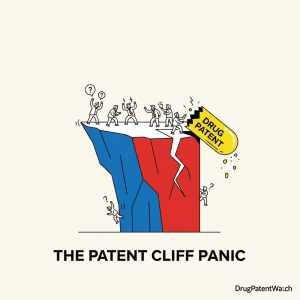
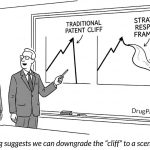
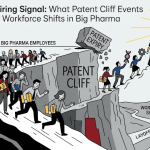
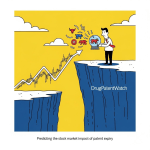
The term “patent cliff” has served as a powerful and often terrifying metaphor in the pharmaceutical industry. It paints a picture of a precipitous drop, a catastrophic loss of revenue from a blockbuster drug that, for years, has been the bedrock of a company’s profitability and innovation engine. For stakeholders across the biopharma ecosystem—from IP and R&D teams to business development professionals and investors—this isn’t an abstract concept; it is an existential threat, a pain point that requires not panic, but a clear, data-driven strategy. The pharmaceutical industry is now bracing for a new, unprecedented wave of patent expirations, threatening to put over $200 billion in annual revenue at risk through 2030.1 This looming storm, far from being a simple legal or financial problem, represents a fundamental business challenge that will reshape the competitive landscape for years to come. The question is no longer if a company will face this challenge, but how it will be prepared to navigate it.
The Anatomy of a Patent Cliff: A Fundamental Industry Driver
Defining the Phenomenon: A Collision of Patents and Exclusivity
At its core, a patent cliff is the abrupt decline in sales that a pharmaceutical company experiences when a drug’s exclusive rights expire, enabling competitors to produce and sell cheaper versions.4 For a blockbuster drug—a term defined as a product with annual sales exceeding $1 billion—this event can trigger a sharp, sudden, and often catastrophic decline in revenue.5 This is not a slow, gentle slope of market share erosion; it is a dramatic shift. In many cases, a branded drug can lose up to 80% of its revenue within the first year of facing generic or biosimilar competition.1 For innovator companies that have built their fortunes on the back of a few star products, this drop can feel like the ground falling out from beneath their feet.
While a U.S. patent is typically granted for 20 years from the date of filing, this figure is profoundly misleading.6 The extensive research, development, and regulatory approval processes—which can take 10 to 15 years—consume a massive portion of that patent term, dramatically shortening the period of effective market exclusivity to an average of 7 to 12 years.6 A drug’s shield of exclusivity is not a single wall but a layered defense, comprised not only of the core patent but also of other protections, such as New Chemical Entity (NCE) exclusivity or Orphan Drug exclusivity, which can extend the market monopoly even after the primary patent has fallen.6 The strategic management of these layered defenses is what separates a company that survives a cliff from one that falls over it.
The Innovation-Exclusivity-Reinvestment Cycle
The very economic engine of the pharmaceutical industry is built upon a delicate balance: the “Innovation-Exclusivity-Reinvestment Cycle”.10 The development of a new drug is an incredibly long, costly, and risky endeavor, with the average time to market exceeding 10 years and the financial investment often running into the billions of dollars.11 For every successful drug that makes it to market, dozens, if not hundreds, of others fail in the lab or in clinical trials.13 The patent system provides the necessary incentive and mechanism for this model to work: a temporary, legally protected monopoly that allows the innovator company to set prices that reflect the high costs of R&D and generate the profits required to fund the next generation of breakthroughs.10 The patent cliff is the moment this cycle concludes for a specific product, transferring market value from the innovator to the generic and biosimilar manufacturers.9 This is why the event is so significant—it forces companies to prove that their business model is sustainable beyond a single product, that they have a robust, ongoing innovation pipeline to replace lost revenue.13
A Brief History of Blockbuster Cliffs
To understand the present, we must look to the past. The industry has experienced several significant “patent cliff” periods, with the most notable occurring in the early 2010s.14 This wave saw the expiration of patents for many small-molecule blockbuster drugs, including Pfizer’s Lipitor, the world’s best-selling drug for a number of years.14 Lipitor, which reached peak sales of $12.9 billion in 2006, accounted for 27% of Pfizer’s revenue at one point.14 When its patent expired, it represented a major test of resilience for the company. Other high-profile drugs like Bristol-Myers Squibb’s Plavix and AstraZeneca’s Seroquel and Nexium also lost exclusivity during this period, collectively putting billions of dollars in revenue at risk and leaving major pharmaceutical companies scrambling to offset the losses.5 These historical events served as a stark preview of what the current, and even more complex, patent cliff holds in store.
The Looming Storm: Quantifying the 2025-2030 Patent Cliff
A Billion-Dollar Reckoning: Scope and Scale of the Impending Wave
The current wave of patent expirations is projected to be the most severe in history, dwarfing previous cliffs in both scale and complexity.2 Between 2025 and 2030, nearly 200 blockbuster drugs are expected to lose patent protection, putting a colossal $400 billion in revenue at risk.2 This isn’t a problem for a single company but a systemic challenge for the entire industry.17 The financial ramifications are substantial, forcing major players to adapt and find new sources of growth.1
To put this into perspective, here is a look at some of the top-selling drugs that will face patent expiration in the coming years.
Drug (Brand & Generic)
Innovator Company
Therapeutic Area
Projected U.S. Patent Expiry
Keytruda (pembrolizumab)
Merck & Co.
Oncology
2028
Eliquis (apixaban)
BMS / Pfizer
Cardiology
2026-2029
Opdivo (nivolumab)
Bristol-Myers Squibb
Oncology
2028
Eylea (aflibercept)
Regeneron / Bayer
Ophthalmology
2025–2026
Enbrel (etanercept)
Amgen
Immunology
2025
Trulicity (dulaglutide)
Eli Lilly
Diabetes / Obesity
2027
Xarelto (rivaroxaban)
J&J / Bayer
Cardiology
2026
Prolia / Xgeva (denosumab)
Amgen
Bone Health / Oncology
2025–2026
Entresto (sacubitril/valsartan)
Novartis
Cardiology
Mid-2025 (July)
Ibrance (palbociclib)
Pfizer
Oncology
2027
The concentration of risk is undeniable. The William Blair report estimates that from 2023 through the end of 2025, nearly 50 products will lose patent protection, eroding aggregate sales from $162.8 billion to just $67 billion by 2029.18 This loss is expected to disproportionately affect companies like Bristol Myers Squibb, Pfizer, AstraZeneca, Novartis, and Regeneron, where assets accounting for over 30% of their collective 2024 revenues are at risk.18
Navigating the Oncology Cliff: A High-Stakes Therapeutic Area
This patent cliff is notably different from previous waves due to its heavy concentration in high-value therapeutic areas like oncology.17 With immuno-oncology leaders like Merck’s Keytruda, Bristol Myers Squibb’s Opdivo, and Johnson & Johnson’s Darzalex approaching loss of exclusivity, tens of billions in annual revenue are at risk.19 This is particularly challenging for companies heavily reliant on a few oncology assets, as the high-value therapies and pricing premiums in this field make them acutely vulnerable to market erosion.19
The looming oncology cliff creates a profound and complex dynamic. The competitive pressure from biosimilars is acting as a powerful force, polarizing R&D strategy across the industry. On one hand, it forces companies to invest in higher-risk, truly novel, first-in-class modalities where scientific differentiation can be a new form of patent protection.20 On the other hand, it incentivizes sophisticated, defensive R&D programs focused on developing patentable “bio-betters” that aim to transition the market to an improved product before the original faces biosimilar competition.20 The long-term implication is a potential cultural shift in the R&D pipeline from a focus on incremental improvements and “me-too” drugs to a push for more scientifically differentiated, high-risk assets.1 This is the “innovation squeeze,” where the very threat of revenue erosion is simultaneously accelerating the development of future breakthroughs.
Case Study: The Humira Cliff—A Masterclass in Delayed Erosion
No discussion of the patent cliff is complete without a deep dive into AbbVie’s Humira. As one of the best-selling drugs of all time, Humira’s patent expiration was arguably the most significant in pharmaceutical history.1 After generating over $200 billion in total revenue over its lifetime and reaching a peak of $21.24 billion in sales in 2022, its patent journey provides a masterclass in strategic maneuvering.18
Tactics and Outcomes: The Strategic Use of Patent Thickets
While Humira’s principal U.S. patent expired in 2016, AbbVie’s multi-faceted strategy successfully delayed widespread U.S. biosimilar competition for seven more years.22 The cornerstone of this approach was the “patent thicket”—the filing of over 130 additional patents covering everything from manufacturing methods and formulations to new delivery methods.7 A significant number of these patents—90%—were filed after the drug was already on the market, with half of them filed after 2014 but before the original patent expired.22 This extensive late-stage patenting made it nearly impossible for biosimilar makers to enter the U.S. market without risking costly infringement litigation.16
The Humira case highlights the fine line innovator companies must walk. From a business perspective, the strategy was a resounding success, delaying competition and generating billions in additional revenue.22 It demonstrated the power of intellectual property not just as a legal shield but as a core business tool for extending a product’s lifecycle and maximizing its value.11 However, this strategy also attracted significant public and regulatory scrutiny.7 Advocacy groups and critics labeled the practice as “systemic abuse” and “anticompetitive” for artificially inflating drug prices and delaying patient access to more affordable alternatives.7 For pharmaceutical companies, a legal victory in the courtroom must be weighed against increasing public pressure and potential antitrust challenges, which can damage brand reputation and create long-term regulatory risks.7
Analyzing the Financial Aftermath
Even with its masterful delay tactics, Humira still faced the inevitable. The financial aftermath provides a powerful data point on the true meaning of a patent cliff. After reaching its peak in 2022, Humira’s sales plummeted to $14.04 billion in 2023 and further to $8.99 billion in 2024.18 This rapid and significant decline demonstrates that while a strategic IP defense can delay the inevitable, it cannot prevent it. The cliff is real, and the fall is still sharp.
Beyond the Cliff Edge: Forecasting Revenue Erosion with Precision
The Mechanics of Decline: Small Molecules vs. Biologics
The speed and intensity of revenue erosion are not uniform across the pharmaceutical landscape; they are heavily dependent on the type of drug.
Small Molecules: These are traditional, chemically synthesized drugs, typically taken as pills or tablets.24 Historically, small-molecule drugs face an immediate and dramatic decline in sales upon patent expiration.1 The entry of generic competitors, which can be chemically synthesized to be identical to the original drug, can cause prices to plummet by 80% or more within the first year.13 With multiple generic entrants, market share can dwindle by as much as 73% within just a few weeks of loss of exclusivity.7
Biologics: Unlike small molecules, biologics are complex medicines derived from living cells.1 When their patents expire, they face competition from biosimilars, which are not identical but are “highly similar” to the original product and have no clinically meaningful differences.26 Due to their manufacturing complexity, higher regulatory hurdles, and unique market dynamics, biosimilars generally gain market share more slowly.1 The result is a less precipitous drop in revenue for the originator drug, with market share losses of 30% to 70% expected in the first year.16 Price reductions for biosimilars are typically in the 10% to 50% range, far less than the 50% to 80% seen with small-molecule generics.10
A Predictive Model: Key Variables in Revenue Erosion
Accurate forecasting requires a nuanced model that accounts for a multitude of variables. It is not enough to simply know a patent expiration date; one must understand the context in which the LOE event will occur.27
Number of Competitors: The most significant variable in the price erosion curve is the number of competitors.28 Studies have consistently shown that drug prices decline rapidly as more generic or biosimilar manufacturers enter the market. A market with three to five generic competitors can see prices fall by 15% to 40%, while a market with 10 or more competitors can experience price declines of 70% to 80% relative to the pre-generic entry price.28
Regulatory and Pricing Environment: Global regulatory variations and pricing environments play a critical role.10 In the U.S., where the market is more competitive, price declines are often more aggressive.28 In contrast, in markets with more regulated pricing, such as in Europe or China, the price drops may be more moderate and generic uptake may be slower.10
Drug Type and Delivery Mechanism: The characteristics of the drug itself can dictate the speed of erosion.27 A simple, retail-based pill will face rapid substitution, whereas a complex biologic that is “buy-and-bill” and administered in a hospital setting may retain market share longer due to the higher barriers to entry for competitors and the established relationships with healthcare providers.27 Furthermore, complex drug formulations like long-acting injectables, metered-dose inhalers, or transdermal patches can increase physician and patient loyalty and are more difficult for competitors to replicate.9
Leveraging Data and Analytics: Tools for Strategic Insight
Turning patent data into a competitive advantage requires sophisticated tools and a strategic perspective. Platforms like DrugPatentWatch are designed to provide this level of comprehensive intelligence. They offer a single source of truth on patents, suppliers, generics, litigation, and regulatory filings, allowing companies to predict patent expiration dates and identify first-time entrants.7
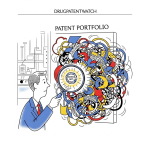
The most valuable intelligence lies not just in the expiration dates themselves but in the signals embedded within a company’s patenting activity.7 An organization’s IP strategy is a clear proxy for its commercial intent. A high number of patents associated with a single drug, a large family size with patents filed in multiple jurisdictions, or a broad claim scope are not just legal metrics; they are strategic signals of a company’s commitment to defending an asset and a leading indicator of its post-expiration strategy.30 For example, when a company continues to file new patents on a drug years after its initial launch, it often signals an aggressive “evergreening” strategy aimed at extending its monopoly.22 By meticulously analyzing these data points, professionals can move beyond a reactive stance and build predictive models of the competitive landscape.30 This approach transforms patent data from a historical record into a forward-looking, predictive business tool.
A Proactive Playbook: Strategic Imperatives for Navigating LOE
The inevitability of the patent cliff necessitates a proactive, multi-pronged strategic response that begins years before the expiration date.7 A successful strategy cannot be confined to a single department; it must be a coordinated effort spanning R&D, legal, and commercial operations.19
Strategic Pillar I: Fortifying the Pipeline Through Diversification
The most effective long-term solution to the patent cliff is to launch new, innovative products before the old ones fall off the edge.1 The high revenues from today’s blockbusters are the financial fuel for this perpetual reinvestment.10
Accelerating Internal R&D: From Molecules to Modalities
Companies must invest heavily in accelerating the development of innovative drugs to replace the revenue lost from expiring patents.1 This involves a renewed focus on internal R&D, from early-stage target selection to late-stage clinical development, to ensure a robust, resilient pipeline.19 Merck, for instance, is proactively positioning new assets like Winrevair as key pillars in its future growth strategy to offset the anticipated revenue loss from its blockbuster Keytruda’s patent expiration in 2028.16
The M&A Advantage: Acquiring Innovation and Scale
For many large pharmaceutical companies, mergers and acquisitions (M&A) are a critical strategy to quickly acquire innovative biotech assets, diversify their portfolios, and boost revenue.1 This strategy can fast-track the development and launch of new treatments, bypassing the lengthy and risky in-house R&D process.16 The acquisition of smaller, mid-sized companies with strong patent portfolios is a key part of this approach, as defensible IP is a clear signal of valuable assets and a strong driver of deal value.11 Merck’s acquisition of Verona Pharmaceuticals to strengthen its respiratory portfolio is a prime example of this strategy in action.16
The Power of Partnerships and In-Licensing
Beyond full acquisitions, companies can also fill pipeline gaps and gain access to new intellectual property through strategic partnerships and in-licensing deals.16 These collaborations allow companies to bring products to market more quickly without initiating early-stage discovery efforts, providing a flexible and powerful tool for pipeline diversification.16
Strategic Pillar II: Masterful Lifecycle Management and Evergreening
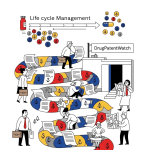
Lifecycle management is a comprehensive, multi-year approach to extend a product’s life and maximize its value as exclusivity approaches.22
The Art of Reformulation and New Delivery Systems
One of the most effective strategies is reformulation, which involves modifying the original drug to create new and improved versions that offer distinct advantages.30 These modifications can include developing sustained-release formulations, transitioning from oral tablets to transdermal patches or inhalers, or altering a drug’s composition to improve efficacy or safety.9 These innovations can improve patient compliance, secure new patents, and effectively blunt the impact of generic competition. Examples include Eli Lilly’s once-weekly Prozac or Bristol-Myers Squibb’s once-daily Glucophage XR, both of which were reformulated to extend their patent protection and market life.34
Pursuing New Indications and Clinical Extensions
Another powerful approach is to identify new therapeutic applications for an existing drug.30 By conducting new clinical trials to demonstrate efficacy in treating additional conditions, a company can secure new patents and market exclusivity periods for these novel uses.30 This not only extends the drug’s patent life but also broadens its potential market, sometimes opening up entirely new therapeutic categories that can compensate for revenue losses in the original indication.30
Authorized Generics: The Ultimate Defensive Play
The Authorized Generic (AG) is a strategic, and seemingly counterintuitive, defensive move. An AG is a generic version of a branded drug launched by the original manufacturer, often either before or at the same time as the first independent generic competitor.14
Launching an AG seems like an act of self-cannibalization, as it directly competes with the company’s own branded product. However, this is a strategic move, a defensive weapon.27 By introducing its own generic, the innovator can control a portion of the post-LOE market, capture some of the revenue from the flood of generic prescriptions, and strategically protect market share rather than ceding the entire market to outside manufacturers.6 The move is designed to control price erosion and retain a foothold in the market, providing a clear example of how a data-driven decision can transform a perceived weakness into a defensive strength.
Loss of exclusivity is not just a legal or R&D problem; it is a fundamental commercial challenge that requires a complete rethinking of a brand’s market access strategy.8
Dynamic Pricing and Rebate Strategies
As a brand nears the end of its lifecycle, companies often adopt “surge pricing,” gradually increasing a drug’s wholesale acquisition cost (WAC) in the 12 to 18 months before LOE to maximize earnings.8 In the post-LOE landscape, a company can deploy deep rebates and innovative contracting, such as “brand-for-generic” models, to defend its position on a payer’s formulary and retain volume.8
Building Enduring Brand Loyalty and Patient Programs
Generic manufacturers have a clear price advantage. The challenge for innovators is to create value beyond the pill itself.30 Companies can build enduring brand loyalty by offering patient support services, copay assistance programs, and educational resources.30 These programs can reduce patient out-of-pocket expenses to levels equivalent to those of expected generic competitors, creating a relationship with the patient that can survive the availability of lower-cost alternatives.30
Lessons from the Brink: Case Studies in Crisis and Resilience
Gleevec and EpiPen: The Reality of Rapid Price Erosion
The case of the anti-cancer drug Gleevec (imatinib) is a powerful example of the immediate and severe impact of generic competition.25 Following its patent expiration in 2016, the drug’s price, which was initially approximately $100,000 annually, plummeted by over 80% within two years.25 This dramatic price drop fundamentally altered the market, making the drug more accessible to a wider patient population. Similarly, the EpiPen case demonstrated how public backlash and the entry of generics can force a company to reconsider its pricing and resort to aggressive marketing strategies to remain competitive.25
Pfizer and Lipitor: A Multifaceted Response to the Original Cliff
The expiration of Lipitor’s patent in the early 2010s was a critical test case for Pfizer.14 The company faced the challenge head-on with a multi-pronged strategy that included direct-to-consumer marketing to maintain brand recognition, a complex pricing and rebate strategy, and the use of an authorized generic to mitigate losses.15 Pfizer’s response provides a valuable historical example of how a company can use a combination of commercial and legal tactics to navigate an impending cliff.
When Strategy Fails: The Entresto Patent Challenge in India
While proactive strategies can extend exclusivity, they are not foolproof. The global IP landscape is a complex chessboard, and a successful challenge in one major market can have global ripple effects. Novartis’s heart failure drug Entresto, a major revenue driver for the company, faced a significant setback when the Indian Patent Office revoked its patent, citing a lack of novelty and an attempt at “evergreening”.35 The decision opened the door for generic competition in India, where the patent regime has a provision specifically designed to prevent the patenting of minor modifications.35 This case demonstrates that a company’s IP defense must be as global and multi-layered as its commercial strategy. A vulnerability in one country can expose the entire portfolio, underscoring the importance of understanding the specific nuances of each regulatory environment.
The Data-Driven Advantage: Turning Patent Intelligence into ROI
Core Patent Data Points for Competitive Intelligence
The ability to accurately forecast revenue erosion and anticipate a competitor’s next move is predicated on a deep understanding of patent intelligence.7 Key data points to track include:
Patent Count and Family Size: The total number of patents linked to a specific drug and the number of related patents filed across various international jurisdictions provide a clear measure of the scope and robustness of a drug’s intellectual property protection.30
Forward Citations: The number of times a patent is cited in subsequent patents indicates its foundational importance and influence on future innovation. A high number of forward citations is often a proxy for a patent’s value.30
Claim Breadth: The scope of a patent’s claims, particularly independent claims that cover multiple therapeutic uses, can significantly enhance its value and make it more difficult for competitors to challenge.30
Building an LOE “Situation Room”
A proactive organization must establish a cross-functional “situation room” comprised of R&D, legal, and commercial professionals.27 This team would use purpose-built analytics to monitor the LOE landscape in real time, tracking competitor entries, pricing, and uptake.7 By constantly analyzing data from platforms like DrugPatentWatch, this team can create scenario models and pivot quickly when they experience success or failure.27 This data-driven approach moves a company from reactive crisis management to proactive strategic planning, ensuring that decisions are made with the full context of the market dynamics.
“The imminent patent cliff, which could put over $200 billion in annual revenue at risk, is a transformative event that necessitates a fundamental cultural shift within pharmaceutical organizations from siloed operations to an integrated, data-driven approach to product lifecycle management.”
— DrugPatentWatch
Key Takeaways
The Patent Cliff is a Predictable, Existential Threat: It is a recurring phenomenon that will have a profound financial impact on the entire industry, forcing a reckoning for companies reliant on a few key blockbusters.
Proactive Planning is a Necessity, Not an Option: Strategic responses, from pipeline diversification to lifecycle management, must begin years ahead of a drug’s patent expiration to effectively mitigate revenue erosion.
This Wave is Unique Due to Biologics: The dominance of biologics in the current cliff means that the dynamics of revenue erosion will differ from previous waves, offering both new challenges and opportunities.
A Successful Strategy is Multi-Faceted: There is no single silver bullet. A comprehensive and resilient approach requires a coordinated effort across R&D, IP, and commercial operations, with each function playing a critical role.
Data is the Ultimate Competitive Advantage: The tools and data exist to turn a perceived crisis into a competitive advantage. By leveraging real-time patent intelligence, companies can accurately forecast risk, anticipate competitor moves, and make informed decisions that secure long-term value.
Conclusion: A New Era of Innovation and Competitive Strategy
The patent cliff is an engine of creative destruction. It forces the pharmaceutical industry to be more agile, innovative, and data-driven.3 While the risks are significant and the financial stakes are immense, the outcome is not yet written. The companies that are best positioned to survive and thrive will be those that actively invest in late-stage pipelines, accelerate clinical execution, and embrace a culture of strategic, data-driven action.16 By viewing the patent cliff not as a threat but as an opportunity for strategic renewal, these organizations can reset for long-term, innovation-led growth and emerge stronger, more focused, and better positioned for the next era of medicine.
Frequently Asked Questions (FAQ)
Q: How does a company’s valuation change in the years leading up to a major patent expiration?
A: As a drug approaches its loss of exclusivity, the market begins to discount its future revenue, which can lead to a decline in the innovator company’s valuation. This is because a significant portion of the company’s earnings is tied to a revenue stream that is projected to fall off a cliff. A company with a strong pipeline of new, innovative products or a clear, aggressive M&A strategy to offset the loss can help to stabilize or even grow its valuation, as the market gains confidence in its long-term financial resilience.
Q: What is the “generics paradox” and how does it affect pricing?
A: The “generics paradox” describes a phenomenon, particularly observed in markets like China, where the entry of generics does not always lead to a significant price decline for the originator brand.29 In some cases, the originator drug’s price may even increase slightly as the company shifts its focus to a smaller, more loyal patient base willing to pay a premium for the branded product. This runs counter to the typical erosion curve seen in the U.S. and highlights the importance of tailoring a strategy to specific regional market dynamics.
Q: How does the Inflation Reduction Act (IRA) in the U.S. complicate patent cliff strategies?
A: The Inflation Reduction Act adds another layer of uncertainty to a drug’s post-LOE revenue curve by introducing government-mandated price negotiation for certain high-cost drugs.16 For innovator companies, this means that even if a drug is still under patent, its revenue can be subject to compression and new pricing rules. This forces companies to rethink their pricing and market access strategies even before the patent expiration date hits, making early planning more critical than ever before.
Q: How do smaller pharma companies use their IP portfolio to attract M&A and partnerships as a hedge against future cliffs?
A: For smaller or mid-sized pharmaceutical companies, a strong, defensible patent portfolio is a core asset that can attract investment and partnership opportunities.11 A robust portfolio signals to potential acquirers or partners that a company has valuable, defensible intellectual property that can serve as a new revenue stream and a hedge against future LOE events. This proactive approach can secure a profitable exit or a partnership that provides the resources needed to navigate a future cliff event.
Q: What role does a drug’s delivery mechanism play in its post-LOE success?
A: A unique delivery system is a powerful component of an effective “evergreening” strategy. A complex delivery mechanism, such as a metered-dose inhaler, a transdermal patch, or a long-acting injectable, creates a significant barrier to entry for generic or biosimilar competitors, as they must not only replicate the drug but also the device and its manufacturing process.9 This can improve patient compliance, be a source of a new patent, and serve as a cornerstone of a lifecycle management strategy.
Effects of Generic Entry on Market Shares and Prices of Originator Drugs: Evidence from Chinese Pharmaceutical Market – PMC – PubMed Central, accessed September 17, 2025, https://pmc.ncbi.nlm.nih.gov/articles/PMC12209137/