The Myth of the “Clean” Patent Expiry in Pharmaceuticals
1. The Strategic Illusion of the Calendar Date
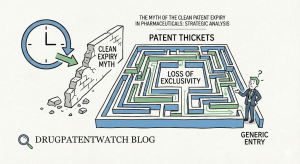
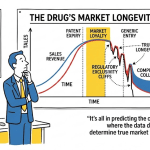
Pharmaceutical patent expiration is frequently misunderstood as a singular, binary event governed by a fixed date on a calendar. The prevailing assumption among generalist investors and market observers is that a drug enjoys twenty years of protected monopoly, followed immediately by a “cliff” where revenue plummets to near zero as generic competitors flood the market. This “clean expiry” narrative is empirically false. It ignores the structural, legal, and regulatory realities that define the modern pharmaceutical lifecycle. The transition from exclusivity to competition is rarely a sudden drop; it is a complex, engineered erosion governed by a dense web of secondary patents, regulatory exclusivities, and strategic litigation.
The financial stakes of this misunderstanding are substantial. Between 2025 and 2030, the global pharmaceutical industry faces a wave of patent expirations that places an estimated $200 billion to $400 billion in branded drug revenue at risk.1 However, the actual trajectory of this revenue—whether it vanishes in a single fiscal quarter or erodes slowly over a decade—depends on factors that are invisible to those who focus solely on the statutory patent term. Understanding these factors requires dissecting the mechanisms of “effective patent life,” the architecture of “patent thickets,” and the evolving regulatory landscape that governs the entry of generic and biosimilar competitors.
This report analyzes the mechanics of pharmaceutical exclusivity. It examines how innovator companies construct defensive fortresses around their key assets, how generic challengers attempt to dismantle them, and how recent policy shifts—from the Inflation Reduction Act (IRA) to the Federal Trade Commission’s (FTC) crackdown on device patents—are fundamentally altering the calculus of drug valuation. For the strategic planner or investor, the ability to distinguish between a “clean” expiry and a managed decline is the primary determinant of accurate forecasting.
1.1 The Disconnect Between Statutory and Commercial Reality
The foundational error in pharmaceutical valuation lies in conflating the statutory patent term with commercial exclusivity. A United States patent grants a term of 20 years from the date of filing.2 In most industries, this provides a substantial period of market protection. In pharmaceuticals, however, the patent application is typically filed during the discovery phase, often years before a molecule enters clinical trials. The subsequent development process—comprising preclinical toxicology, three phases of human clinical trials, and FDA review—consumes a significant portion of the patent term before the product generates a single dollar of revenue.
Data indicates that the average drug development timeline spans 10 to 13 years.1 Consequently, by the time a drug receives FDA approval and reaches the market, the remaining patent life is frequently reduced to between 7 and 12 years.1 This compressed timeline, known as the “Effective Patent Life” (EPL), creates a structural economic deficit. Companies must recoup research and development investments—which average $2.6 billion per approved new molecular entity—within this shortened window.4
This economic imperative drives the aggressive lifecycle management strategies observed across the industry. Innovators cannot rely on the primary Composition of Matter (CoM) patent alone to deliver a sufficient return on investment. Instead, they must deploy a multi-layered strategy involving secondary patents and regulatory exclusivities to extend the commercial tail of the asset. The “expiry date” listed in public databases often reflects only the primary patent, failing to account for the secondary barriers that effectively determine the date of generic entry.
1.2 The Two Pillars of Market Protection
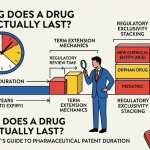
A rigorous analysis of Loss of Exclusivity (LOE) distinguishes between the two distinct legal frameworks that protect pharmaceutical assets: intellectual property rights (patents) and regulatory exclusivities. While these mechanisms often run concurrently, they are governed by different statutes and adjudicated by different bodies.
Patents are property rights granted by the U.S. Patent and Trademark Office (USPTO). They provide the right to exclude others from making, using, or selling the invention. Patents can cover the active ingredient, the method of use, the formulation, or the manufacturing process. They are private rights that must be enforced through litigation.
Regulatory Exclusivities are statutory prohibitions granted by the FDA that prevent the agency from approving competing products for a specific period. These exclusivities operate independently of patents. Crucially, a regulatory exclusivity can block generic competition even if all relevant patents have expired or been invalidated.2
Protection Mechanism
Granting Body
Standard Duration
Trigger Event
Composition of Matter Patent
USPTO
20 Years (from filing)
Filing of Patent Application
New Chemical Entity (NCE)
FDA
5 Years (Data Exclusivity)
FDA Drug Approval
Orphan Drug Exclusivity (ODE)
FDA
7 Years (Market Exclusivity)
Approval for Rare Disease Indication
Biologic Exclusivity (BPCIA)
FDA
12 Years
FDA Biologic Approval
Pediatric Exclusivity
FDA
+6 Months (Add-on)
Completion of Pediatric Studies
New Clinical Investigation
FDA
3 Years
Approval of New Indication/Use
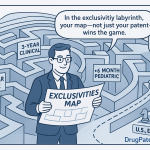
The “true” date of generic entry is determined by the latest-expiring barrier in this stack. For example, a drug may have a patent expiring in 2026, but if it secures Orphan Drug Exclusivity for a new indication that runs until 2028, generic entry for that indication is barred until the later date. Conversely, a drug may have regulatory exclusivity expire, but remain protected by a robust patent thicket.
Industry Insight
“Patents and exclusivity work in a similar fashion but are distinct from one another and governed by different statutes… Patents can be issued or expire at any time regardless of the drug’s approval status. Exclusivity attaches upon approval of a drug product if the statutory requirements are met.”
— U.S. Food and Drug Administration 2
Understanding this duality is essential for accurate forecasting. Analysts who rely solely on patent expiration dates frequently underestimate the duration of market dominance for key assets.
2. The Architecture of the Patent Fortress
Innovator companies employ a systematic approach to extending exclusivity, moving beyond the reliance on a single Composition of Matter patent. This strategy involves the construction of a “patent thicket”—a dense web of secondary patents designed to create legal and technical hurdles for potential competitors.
2.1 The Logic of the Thicket
A patent thicket is not merely a collection of intellectual property; it is a strategic deterrent. By filing patents on every aspect of a drug’s lifecycle—from its chemical synthesis and crystalline forms to its delivery mechanisms and dosing regimens—companies create a labyrinth that competitors must navigate.
The primary Composition of Matter patent is the strongest barrier, covering the active molecule itself. However, as this patent approaches expiration, the value shifts to secondary patents. These may cover:
Polymorphs: Specific crystalline structures of the molecule that offer improved stability or solubility.7
Formulations: Specific combinations of the active ingredient with excipients, such as extended-release mechanisms or enteric coatings.9
Methods of Use: Patents protecting the use of the drug for a specific medical indication.7
Manufacturing Processes: novel methods for synthesizing the drug that increase yield or purity.
The strategic value of the thicket lies in the cost and complexity it imposes on challengers. A generic manufacturer filing an Abbreviated New Drug Application (ANDA) must certify against every unexpired patent listed in the FDA’s Orange Book. If an innovator lists dozens of patents, the generic firm must demonstrate that each one is either invalid or not infringed. This multiplies the legal costs and creates multiple grounds for litigation, delaying market entry even if the primary patent is successfully challenged.
2.2 Case Study: Humira and the Wall of Patents
The defense of Humira (adalimumab) by AbbVie serves as the definitive example of the patent thicket strategy. Humira, a biologic treatment for autoimmune conditions, became the world’s best-selling drug, generating over $200 billion in lifetime revenue.10 While the primary patent covering the adalimumab molecule expired in the United States in 2016, biosimilar competition did not enter the U.S. market until 2023.
This seven-year extension of monopoly was achieved through an aggressive filing strategy. Research indicates that AbbVie filed over 247 patent applications related to Humira in the U.S., securing more than 130 granted patents.11 Crucially, 89% of these applications were filed after the drug was first approved, and nearly 50% were filed more than a decade after the initial launch.11
These secondary patents covered formulation changes, dosing regimens for specific indications (such as rheumatoid arthritis vs. Crohn’s disease), and manufacturing processes. While individual secondary patents might be vulnerable to invalidation, the aggregate weight of the portfolio forced biosimilar competitors to settle. In Europe, where the patent landscape is stricter and thickets are harder to enforce, biosimilars launched in 2018—four years earlier than in the U.S. This disparity highlights the effectiveness of the thicket strategy within the U.S. legal framework.
2.3 Product Hopping: Strategic Migration
When patent thickets alone are insufficient, companies may employ “product hopping” (also known as “evergreening” through reformulation). This involves introducing a modified version of a drug shortly before the original version loses patent protection, and then migrating patients to the new product.
The goal of product hopping is to circumvent state substitution laws. In most states, pharmacists are permitted (or required) to automatically substitute a generic equivalent for a branded drug if the two are “therapeutically equivalent” (AB-rated). However, if the innovator changes the dosage form—for example, from a tablet to a capsule—the generic version of the tablet is not substitutable for the capsule.
Hard Switching vs. Soft Switching
Hard Switch: The company withdraws the original product from the market entirely, forcing patients to switch to the new, patent-protected version. This removes the “reference listed drug” that generics rely on.
Example: In the case of Namenda (memantine), Allergan attempted to discontinue the immediate-release (IR) tablet in favor of a new extended-release (XR) capsule prior to the IR patent expiration. The goal was to convert the patient base to the XR version, for which no generic existed. This tactic faced significant antitrust scrutiny, as it effectively eliminated consumer choice.9
Soft Switch: The company leaves the original product on the market but ceases all marketing and promotion, shifting resources entirely to the new version. This relies on persuasion rather than coercion but achieves a similar goal of reducing the addressable market for the incoming generic.9
Common reformulation strategies include shifting from immediate-release to extended-release formulations, changing the route of administration (e.g., oral to sublingual), or combining two existing drugs into a single fixed-dose combination pill.9 While companies argue these changes provide clinical benefits such as improved adherence, critics and regulators view them as primarily exclusionary tactics designed to reset the exclusivity clock.
3. The Biologic Paradigm: Slope vs. Cliff
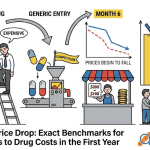
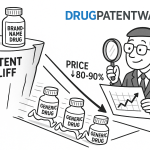
The dynamics of patent expiration differ fundamentally between small-molecule drugs and biologics. Small molecules—chemically synthesized compounds like Lipitor or Plavix—typically face a “patent cliff,” where revenue drops by 80-90% within months of generic entry due to automatic pharmacy substitution and rapid price erosion.1 Biologics—large, complex molecules derived from living cells—face a “biologic slope,” characterized by a slower rate of erosion.
3.1 Complexity and the Biosimilar Pathway
The Biologics Price Competition and Innovation Act (BPCIA) established the approval pathway for biosimilars. Unlike generics, which are identical copies of their reference drugs, biosimilars are “highly similar” but not identical due to the inherent variability of biological manufacturing processes.13
This distinction creates higher barriers to entry. Developing a biosimilar requires significantly more capital and technical expertise than developing a generic small molecule. While a generic might cost $1-5 million to develop, a biosimilar can cost between $100 million and $250 million. This high cost limits the number of competitors entering the market, preventing the rapid commoditization seen in small molecules.
3.2 The Patent Dance
Litigation for biologics follows a unique protocol known as the “patent dance.” Unlike the transparent system for small molecules, where relevant patents are listed publicly in the FDA’s Orange Book, the BPCIA mandates a private exchange of information between the biosimilar applicant and the reference product sponsor.14
When a biosimilar application is accepted, the applicant provides its dossier to the innovator. The innovator then lists the patents it believes are infringed. The two parties engage in a structured negotiation to determine which patents will be litigated immediately and which will be deferred.
This opacity makes forecasting biologic LOE particularly challenging for investors. Since the patents asserted are not publicly known until litigation begins, there is no definitive “expiration list” to consult. The timeline is determined by confidential settlements and the outcome of the private negotiation process.
3.3 The Interchangeability Evolution (2025 Update)
A critical factor limiting biosimilar uptake has been the “interchangeability” designation. Historically, a biosimilar could not be substituted by a pharmacist without a specific prescription unless it was designated as “interchangeable” by the FDA. Achieving this designation required expensive “switching studies,” in which patients were switched back and forth between the reference product and the biosimilar to prove there was no loss of efficacy or safety risk.
In October 2025, the FDA introduced draft guidance that fundamentally alters this landscape. The agency announced it would effectively eliminate the requirement for switching studies to demonstrate interchangeability.15 The FDA now considers that modern analytical technologies are sufficient to demonstrate that a biosimilar is highly similar to the reference product, rendering human switching trials unnecessary.17
Implications of the 2025 Guidance:
Reduced Development Costs: Eliminating switching studies removes a major financial hurdle, encouraging more competitors to seek interchangeability.
Automatic Substitution: As more biosimilars achieve interchangeable status, they will be eligible for automatic pharmacy substitution (subject to state laws), mirroring the dynamic of the small-molecule market.
Acceleration of Erosion: This regulatory shift is expected to steepen the “biologic slope,” accelerating market share loss for reference biologics and bringing the market dynamics closer to the traditional patent cliff.
4. Regulatory Countermeasures and Antitrust Enforcement
The strategy of extending exclusivity through “junk” patents and procedural delays has triggered a forceful response from regulators. The Federal Trade Commission (FTC), in particular, has aggressively targeted practices it views as anticompetitive, focusing on “improper” Orange Book listings and sham citizen petitions.
4.1 The Crackdown on Device Patents
A common tactic for extending the life of drug-device combination products (such as asthma inhalers or epinephrine injectors) has been to list patents covering the mechanical device in the FDA Orange Book. Listing a patent in the Orange Book is powerful because it triggers an automatic 30-month stay on generic approval if the patent is challenged.
The FTC has argued that the Orange Book statute only permits the listing of patents that claim the drug itself, or a method of using the drug. Patents claiming purely mechanical components of a device (e.g., a dose counter or a cap mechanism) do not meet this criterion.
The Teva Inhaler Case (2024-2025)
In late 2024 and early 2025, the FTC challenged over 300 patents held by major pharmaceutical companies, including Teva, GSK, and AstraZeneca, alleging they were improperly listed device patents.19 This campaign culminated in a pivotal decision by the U.S. Court of Appeals for the Federal Circuit, which affirmed a district court order requiring Teva to delist five patents for its ProAir HFA inhaler.21
The court ruled that for a patent to be listable, it must claim the “drug” for which the application was submitted. Since the asserted patents covered mechanical device components and did not claim the active ingredient (albuterol sulfate), they were improperly listed. Following this ruling and continued FTC pressure, Teva and other manufacturers delisted over 200 patents.19
This precedent significantly weakens the “device wall” strategy. Companies can no longer rely on mechanical patents to block generic competition for drug-device combinations, forcing them to rely on the strength of their chemical and formulation IP.
4.2 Citizen Petitions as Delay Tactics
The “Citizen Petition” process allows any interested party to request that the FDA take action on a scientific or regulatory matter. While intended to protect public health, this mechanism has been weaponized to delay generic competition.
Brand companies frequently file petitions shortly before a generic is due for approval, raising concerns about the generic’s safety or bioequivalence testing. The FDA is statutorily required to review these petitions. Although the agency denies the vast majority of petitions filed by competitors—data indicates a denial rate of 92%—the review process itself can cause delays.23
Recent legislative and regulatory efforts have sought to curb this abuse. The “Stop STALLING Act” and other measures aim to penalize the filing of sham petitions.25 Furthermore, the FDA acts to prioritize the review of petitions that appear to be submitted for the purpose of delay. Despite these efforts, petitions remain a tool in the defensive playbook, though one that now carries higher antitrust risks.
5. The Inflation Reduction Act: A Statutory Cliff
The enactment of the Inflation Reduction Act (IRA) introduced a new variable into the exclusivity equation: Medicare price negotiation. This policy creates a “statutory cliff” that operates independently of patent expiration.
5.1 The 9 vs. 13 Year Distinction
Under the IRA, the Centers for Medicare & Medicaid Services (CMS) are authorized to negotiate “maximum fair prices” for selected high-spend drugs. The eligibility for negotiation is based on the time elapsed since FDA approval:
Small Molecule Drugs: Eligible for negotiation 9 years after approval.
Biologics: Eligible for negotiation 13 years after approval.26
This timeline effectively caps the period of unconstrained pricing power, regardless of the remaining patent life. A small molecule drug may have valid patents extending to year 14 or 15, but if it is selected for negotiation at year 9, its revenue potential is curtailed.
5.2 Strategic Implications
The disparity between the 9-year and 13-year windows creates a powerful incentive for pharmaceutical companies to prioritize the development of biologics over small molecules. A four-year difference in monopoly pricing represents billions of dollars in potential revenue for a blockbuster product.
Industry analysts warn that this policy could skew investment away from small molecules, which are often essential for treating conditions where oral administration is preferred or where the target is intracellular (and thus inaccessible to large-molecule biologics).26 For investors, the IRA negotiation eligibility date is now as critical a metric as the patent expiration date. It represents a hard cap on the “clean” revenue period, necessitating the adjustment of long-term cash flow models.
6. Strategic Forecasting and Valuation
In this volatile environment, accurate valuation requires moving beyond simple deterministic models. Investors and strategists must employ probabilistic forecasting that accounts for the “N” factor (number of competitors), the risk of at-risk launches, and the specific dynamics of the asset in question.
6.1 The “N” Factor: Modeling Price Erosion
The rate of price erosion following LOE is strongly correlated with the number of generic competitors entering the market ($N$).
$N = 1$ (Generic Duopoly): When only a single generic enters (often due to 180-day exclusivity for the first filer), the price erosion is moderate. The generic typically prices at a 15-30% discount to the brand, and the brand retains significant market share.27
$N = 2-3$: As additional competitors enter, prices drop to approximately 50% of the brand price.
$N \geq 4$ (Commoditization): When four or more generics enter, the market commoditizes. Prices collapse to 10-20% of the original brand price, and the brand’s market share evaporates.27
Valuation models must estimate $N$ based on the number of tentative approvals listed in the FDA Orange Book and the litigation status of potential challengers.
6.2 Supply Chain Forensics and Data Intelligence
Advanced intelligence platforms like DrugPatentWatch provide critical data for refining these forecasts. By integrating patent data with supply chain intelligence, analysts can identify early signals of generic entry.
Process Patent Analysis: Monitoring patent filings for manufacturing processes (e.g., spray drying, lyophilization) can reveal which Contract Development and Manufacturing Organizations (CDMOs) generic companies are partnering with.29
Litigation Tracking: Monitoring docket updates can identify “at-risk” launches—where a generic launches before patent litigation is resolved. These launches are high-risk/high-reward events that can accelerate the cliff.27
Table 2: Comparative Valuation Dynamics
Metric
Small Molecule (The Cliff)
Biologic (The Slope)
Typical Price Erosion (Year 1)
80% – 90%
15% – 40%
Primary Driver of Erosion
Automatic Pharmacy Substitution
Payer Formulary Pressure
Number of Competitors (N)
High (>10 is common)
Low (typically <5)
Impact of Patent Thicket
Moderate (generics can design around)
High (harder to clear all process patents)
Regulatory Key
Orange Book Listing
Interchangeability Designation
7. Case Studies in Exclusivity Management
7.1 Lipitor (Pfizer): The Archetypal Cliff
Lipitor (atorvastatin) stands as the classic example of a small-molecule patent cliff. As the world’s best-selling drug with peak sales of nearly $13 billion, its expiration was a seismic event for Pfizer.
The Event: The primary U.S. patent expired in November 2011.
The Strategy: Pfizer employed an “Authorized Generic” strategy, launching its own generic version through a subsidiary to capture a portion of the generic market revenue. They also offered aggressive rebates to pharmacy benefit managers (PBMs) to keep the branded version on formularies for a limited time.
The Outcome: Despite these efforts, the structural forces of the small-molecule market prevailed. Sales plummeted by roughly 80% within the first year as multiple generics entered the market.4 This case underscores the brutality of the cliff for small molecules once the legal barriers fall.
7.2 Revlimid (Celgene/BMS): The Volume-Limited Settlement
Revlimid (lenalidomide), a treatment for multiple myeloma, presents a model of a “managed exit.” Facing patent challenges, the innovator negotiated settlements that allowed for a controlled, volume-limited entry of generics.
The Strategy: Rather than facing a sudden flood of unrestricted generics, the settlements allowed a generic competitor to launch with a restricted volume share (e.g., a mid-single-digit percentage of the market) starting years before full patent expiration. This volume cap increased incrementally over time until full, unrestricted entry occurred at a later date.
The Outcome: This strategy converted the vertical cliff into a stepped slope, preserving billions in revenue during the transition period. It demonstrates the power of litigation settlements to engineer market dynamics.30
7.3 Teva ProAir (The Failed Device Defense)
As detailed in Section 4, the defense of Teva’s ProAir HFA inhaler illustrates the limits of the “device wall” strategy.
The Strategy: Teva listed patents covering the mechanical dose counter and inhaler mechanism in the Orange Book to block generics.
The Outcome: The FTC and courts rejected this approach, forcing the delisting of the patents. This removal of the 30-month stay barrier accelerated the timeline for generic competition.21 This case serves as a warning that reliance on non-drug patents is becoming increasingly untenable.
8. Key Takeaways
The “Clean” Expiry is a Myth: A drug’s commercial life is rarely defined by a single patent expiration date. It is determined by the interaction of patent thickets, regulatory exclusivities, and litigation settlements.
Effective Patent Life is Short: Due to long development timelines, the actual period of market exclusivity is typically 7 to 12 years, creating immense pressure to extend protection through secondary patents.
Biologics Face a Steeper Slope: The FDA’s 2025 guidance eliminating “switching studies” for interchangeability will lower barriers to entry for biosimilars, likely accelerating price erosion and making the biologic market behave more like the small-molecule market.
Regulatory Environment is Hostile: The FTC’s crackdown on “improper” Orange Book listings (specifically device patents) has removed a key defensive tool for drug-device combinations.
The IRA Creates a New Cliff: The Inflation Reduction Act establishes a statutory price negotiation eligibility date (Year 9 for small molecules, Year 13 for biologics) that acts as a hard cap on pricing power, independent of patent status.
Data-Driven Forecasting is Essential: Investors must utilize platforms like DrugPatentWatch to monitor litigation, patent filings, and regulatory actions to accurately model the number of competitors ($N$) and the timing of entry.
FAQ: Five Questions on Pharmaceutical Exclusivity
Q1: How does the “One Patent Rule” for Patent Term Extension (PTE) affect strategy?
A: Under U.S. law, a company can apply for a Patent Term Extension (PTE) to restore time lost during FDA review, but it can only apply this extension to one patent per product. This forces a strategic choice. Innovators almost invariably choose the strongest Composition of Matter patent. However, if this patent is later invalidated in court, the extension is lost with it. This concentration of value on a single asset makes the validity of that specific patent a binary risk factor for the drug’s longevity.
Q2: Why is the “skinny label” strategy used by generics?
A: A “skinny label” (section viii carve-out) allows a generic to seek approval for a drug for some but not all of the brand’s approved indications. If a brand has a method-of-use patent on a specific indication (e.g., heart failure) but not on the original indication (e.g., hypertension), the generic can launch with a label that omits the patented use. This allows the generic to enter the market years early. Brands often sue, arguing that the generic will inevitably be used off-label for the patented indication, leading to complex litigation.
Q3: How does “Authorized Generic” entry impact the “first filer” exclusivity?
A: When the first generic company files a successful patent challenge, it is granted 180 days of market exclusivity. During this period, no other generic can enter. However, the brand company can launch its own generic version (an “Authorized Generic” or AG) during this window. The AG competes directly with the first filer, often cutting the first filer’s projected revenue by 40-50%.31 This significantly reduces the bounty for challenging patents, potentially discouraging future challenges.
Q4: What is the significance of the “Purple Book”?
A: The “Purple Book” is the FDA’s list of licensed biological products, analogous to the “Orange Book” for small molecules. However, historically, the Purple Book did not list patents. While recent legislation has improved transparency, it still lacks the direct linkage between patents and regulatory stays found in the Orange Book. This makes it harder to use the Purple Book as a definitive roadmap for patent expiration, reinforcing the need for specialized intelligence.
Q5: How will the elimination of switching studies for interchangeability impact payers?
A: Payers (insurers and PBMs) are the biggest beneficiaries. Without the need for expensive switching studies, more biosimilars will be designated as interchangeable. This allows payers to mandate “lowest net cost” policies more aggressively, as pharmacists can substitute the cheaper biosimilar automatically. This shifts leverage away from the innovator and toward the payer, likely compressing the “gross-to-net” spread for branded biologics.