The FDA lets you extend only one patent per drug approval. Most companies leave years of exclusivity on the table by picking the wrong one. Here is how to get the selection right.
The patent term extension (PTE) system was built to fix one problem: drug companies spend up to 12 years in development and FDA review while their patent clock keeps ticking. By the time a new drug hits pharmacy shelves, its composition of matter patent may have fewer than eight years left. Congress created PTE in 1984 to compensate for that lost time. The mechanism is straightforward. The execution is not.
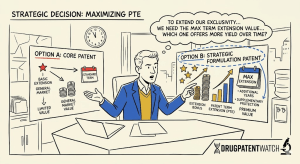
Federal law permits only one PTE per approved product, and only one PTE per patent [1]. That means if a company holds six Orange Book patents on a new drug, it must nominate exactly one for extension. The decision is irrevocable. Choose wrong — extend a formulation patent when the composition of matter patent had more commercial leverage — and you have permanently surrendered years of effective exclusivity. The downstream cost, in revenue that competitors capture earlier than necessary, can run into hundreds of millions of dollars.
This article walks through the statutory framework for PTE, the tactical criteria that determine which patent yields maximum value, the mistakes companies make most often, and how to use patent expiry data from sources like DrugPatentWatch to model the competitive impact of each candidate patent before the selection window closes.
The Statutory Architecture of Patent Term Extension
PTE lives in 35 U.S.C. Section 156, inserted by the Drug Price Competition and Patent Term Restoration Act of 1984 — commonly called the Hatch-Waxman Act [1]. The provision applies to four categories of regulated products: human drugs, medical devices, food or color additives, and animal drugs. For human pharmaceuticals, the mechanism allows extension of any patent that claims the approved drug, a method of using the drug, or a method of manufacturing it — subject to a set of eligibility filters that eliminate most patents from consideration.
The Five Eligibility Requirements
A patent must satisfy all five of the following conditions to qualify for PTE. First, the patent must not have previously been extended. A patent can receive only one PTE, ever, regardless of how many subsequent approvals may rely on it. Second, the patent must have at least one claim that covers the approved product or a method of using or manufacturing it. Claims that cover only inactive excipients, packaging, or unrelated inventions do not qualify. Third, the patent must still be in force on the date the PTE application is filed. Expired patents cannot be extended, even retroactively. Fourth, permission to commercially market the product must have been the first permitted commercial marketing under the provision that required the regulatory review — meaning PTE is available only for the first approval of a given active ingredient; subsequent approvals of new formulations or indications of the same molecule do not qualify for a new PTE. Fifth, the PTE application must be filed within 60 days of the FDA’s product approval [1].
That 60-day window is where companies most frequently lose PTE eligibility through administrative failure. The USPTO does not issue reminders. The FDA does not notify patent holders that the clock has started. A company relying on internal calendar systems without a dedicated IP docketing workflow will miss the filing window and forfeit the extension entirely.
How the Extension Duration Is Calculated
The extension period has two components and two caps. The first component is half the time between the date the IND application became effective (the start of the clinical testing period) and the date the NDA or BLA was submitted to the FDA. The second component is the full length of the FDA regulatory review period, measured from the date of NDA or BLA submission to the date of approval [1].
The sum of those two components gives the raw extension, subject to two constraints. The total extension cannot exceed five years under any circumstances. And the remaining patent term after extension — measured from the approval date — cannot exceed 14 years. If adding the full calculated extension would push the post-approval term above 14 years, the extension is trimmed to bring the post-approval term exactly to 14 years. The 14-year cap is the more commonly binding constraint for drugs with long clinical development histories.
The Diligence Deduction
One frequently overlooked element of the PTE calculation is the diligence deduction. Any period during the regulatory review in which the applicant failed to act with due diligence reduces the extension dollar-for-dollar [1]. The USPTO examines the prosecution history of the NDA or BLA when calculating PTE duration and deducts periods of applicant-caused delay — failure to respond to FDA information requests, extended periods without substantive activity, or unexplained gaps in the review correspondence. A company that takes four months to respond to a standard FDA information request during review may lose those four months from its PTE calculation. For a drug generating $3 million per day in revenue, four months represents $360 million in unextended exclusivity.
Why Selecting the Wrong Patent Is So Common
The nominal decision — pick the patent that expires latest — sounds simple. The practical decision is complicated by four factors that interact in ways most legal teams do not fully model.
First, the latest-expiring patent is not always the most commercially valuable. A composition of matter patent expiring in 2031 may be more valuable than a formulation patent expiring in 2034, because the formulation patent covers only one dosage form while the composition of matter patent blocks all generic entry regardless of formulation. Extending the formulation patent by three years gives you three years of exclusivity for one product line. Extending the composition of matter patent by five years gives you five years of exclusivity across every formulation the generic might attempt.
Second, the patent selected for PTE must claim the approved product. If the approved drug is a specific enantiomer and your composition of matter patent claims only the racemate, that patent may not qualify. A formulation patent that explicitly claims the enantiomer at the approved dose may be the only available option regardless of what you would prefer to extend.
Third, not all eligible patents will still be in force by the time PTE is filed. Companies that prosecuted multiple continuation applications from an early priority date may hold patents with short remaining terms due to terminal disclaimers tying them to an earlier-expiring parent. Those patents may expire before the 60-day filing window closes.
Fourth, litigation risk attaches to the selected patent immediately. Once a patent is listed in the Orange Book and extended via PTE, it becomes a target for Paragraph IV certification challenges. Selecting a patent with a vulnerable claim construction or a thin prosecution history invites an early generic challenge that could unravel the extension value you have just fought to secure.
The Four Patent Categories and Their Extension Value Profiles
Composition of Matter Patents
Composition of matter patents covering the active pharmaceutical ingredient are generally the highest-value candidates for PTE. They are also the most commonly selected, for the right reasons. A composition of matter patent blocking the API blocks every generic formulation simultaneously, making it the broadest possible protection. Its commercial leverage is not limited to the approved formulation or the approved indication.
The limitation is timing. Composition of matter patents are typically filed earliest — often during preclinical research or lead optimization, several years before an IND is submitted. That early filing date means a large portion of the 20-year term has already elapsed before the drug is even approved. PTE can add up to five years, but if the composition of matter patent’s remaining term at approval is already only three years, the maximum five-year extension produces a post-approval term of eight years. A formulation patent filed five years later, with eight years remaining at approval, would produce a post-approval term of 13 years with maximum PTE — five years more of exclusivity for the same investment in an extension application.
This is the core tension. The broadest patent may not produce the most exclusivity. Companies need to model remaining term explicitly, not assume the composition of matter patent is always the right choice.
Method of Use Patents
Method of use patents covering the approved therapeutic indication are eligible for PTE and may be the best selection in specific circumstances: when the composition of matter patent’s remaining term is short, when the API is a known compound previously approved for a different indication, or when the new indication is itself the commercially valuable asset and is not claimed in any composition of matter patent.
Method of use patents have a structural limitation that buyers and licensees rarely appreciate. They block only the approved indication. A generic that carves out the patented indication from its labeling using a section viii statement — submitting an ANDA that explicitly excludes the approved use — can potentially enter the market without infringing the method of use patent, relying on physician off-label prescribing to capture commercial share anyway. The FDA’s practice of permitting skinny labels has been challenged in litigation and is not uniform across drugs, but it is a real risk that reduces the commercial certainty of extending a method of use patent.
A company selecting a method of use patent for PTE should have already assessed whether the approved indication can be carved out by a generic. If it can, the PTE value is substantially lower than the nominal extension period suggests.
Formulation and Manufacturing Process Patents
Formulation patents become the strategic selection when the composition of matter patent has an unfavorable remaining term or is legally vulnerable. A formulation patent filed during Phase II or Phase III development may have 14 to 16 years of remaining term at approval. Adding up to five years of PTE can produce a post-approval term of 19 years — limited in practice to the 14-year cap, meaning the extension would be trimmed to bring total post-approval life exactly to 14 years from the approval date.
The commercial limitation is scope. A formulation patent blocks only the specific formulation it claims. A generic that develops a different but bioequivalent formulation — different excipients, different release mechanism, different particle size — may escape the patent entirely. Formulators are sophisticated. A formulation patent describing a specific sustained-release matrix may be designed around in 18 months by a generic development team. Extending a formulation patent with narrow claims is a high-cost, low-certainty strategy for maintaining exclusivity.
Process patents covering the manufacturing method are rarely optimal PTE candidates for small molecule drugs. A generic that develops an alternative synthesis route does not infringe a process patent regardless of the product it produces, provided the process is different. For biologics, where the manufacturing process and the product are functionally inseparable, process patents carry more weight — but biologics are subject to the BPCIA’s 12-year exclusivity period, which typically renders PTE selection less consequential.
The Decision Framework: How to Select the Right Patent
Patent selection for PTE requires a structured analysis that most legal teams run informally and too quickly. The following framework turns the decision into a modelable comparison. Run it for every eligible patent before the 60-day window opens — which means beginning the analysis at NDA submission, not at approval.
Step One: Build the Eligibility Filter
Pull every patent listed in the Orange Book for the approved drug and add any unlisted patents that claim the drug, a method of use, or a method of manufacture. For each patent, confirm four things: the patent is still in force, it has not previously received PTE, it has at least one claim that reads on the approved product, and the approval represents the first permitted commercial marketing of the active ingredient. Any patent failing one of these tests is eliminated from consideration.
This step typically reduces the candidate list significantly. Terminal disclaimers will have expired some patents. Earlier approvals of the same moiety — even a different salt or ester — may disqualify the composition of matter patent if the FDA has previously approved that moiety. Companies that have pursued aggressive continuation strategies sometimes find that their strongest patents are ineligible because of an overlooked approval from a different therapeutic program in the pipeline.
Step Two: Calculate Remaining Term and Maximum Extension for Each Candidate
For each eligible patent, calculate the remaining patent term at the approval date. Then calculate the maximum PTE extension that could be applied. The extension is the lesser of: five years, or the amount that would bring the post-approval term to exactly 14 years. The calculation requires the IND effectiveness date, the NDA submission date, and the approval date. Apply the diligence deduction conservatively — assume the FDA will identify at least some applicant-caused delay.
The output is two numbers for each patent: the effective expiry date without PTE and the effective expiry date with maximum PTE. The difference between those two dates is the number of additional exclusivity days the PTE adds for that specific patent. Convert that to revenue using the drug’s daily net revenue forecast.
Step Three: Assess Commercial Scope of Each Candidate
The best patent is not necessarily the one that adds the most calendar days. It is the one whose claims cover the most commercially significant aspect of the product — the aspect most likely to be copied by a generic and most difficult to design around.
Score each candidate patent on two dimensions. First, breadth of blocking power: does the patent block all generic versions of the drug (composition of matter), one indication (method of use), or one formulation (formulation patent)? Second, vulnerability to design-around: how difficult is it for a generic to produce a bioequivalent product that does not infringe this patent? A composition of matter patent with narrow claims to a specific polymorph is less blocking than one claiming the API in any form. A formulation patent with specific excipient concentrations is more vulnerable to design-around than one claiming a broad class of polymer matrices.
Step Four: Stress-Test for Litigation Exposure
Every patent selected for PTE and listed in the Orange Book becomes a Paragraph IV target. A generic that files a Para IV certification against the extended patent triggers a 30-month stay of FDA approval and forces a patent infringement lawsuit that the brand company must prosecute. The brand company wins only if the patent is valid and the generic infringes. If the selected patent is one with a difficult prosecution history, blocking prior art, or claims that are arguably obvious in light of earlier patents, the Para IV challenge may succeed — eliminating the PTE value entirely through an adverse court judgment.
Before finalizing the selection, patent litigation counsel should conduct a freedom-to-operate analysis on each candidate from the generic’s perspective. The question is: would a competent generic litigation team be able to invalidate this patent or design around it within the extension period? If the answer is yes, the patent’s effective exclusivity value is lower than its nominal expiry date suggests, and a more defensible patent may be a better selection even with a shorter remaining term.
Patent Category Comparison: Selection Criteria at a Glance
Patent Type
Blocking Breadth
Design-Around Risk
Typical PTE Yield
Composition of matter
Highest: all generics
Low (if broad claims)
Low-to-mid (early filing)
Method of use
Medium: one indication
High (skinny label carve-out)
Medium (mid-development filing)
Formulation
Low: one dosage form
High (alternative formulation)
High (late-stage filing)
Manufacturing process
Lowest: one route only
Very high (alternative route)
High (late-stage filing)
The Role of Prior Approvals: The Disqualification Trap
The most dangerous eligibility trap in PTE selection is the prior approval disqualification. Section 156 requires that the PTE applicant demonstrate that the regulatory review for which they seek extension was the first permitted commercial marketing of the active moiety under the provision requiring that review [1]. For human drugs under the Federal Food, Drug, and Cosmetic Act, this means the drug must be a new molecular entity — the first-ever NDA approval for that active ingredient.
The FDA’s definition of ‘active moiety’ for PTE purposes matches its definition for new molecular entity (NME) exclusivity under 21 C.F.R. 314.108: the molecule responsible for the physiological or pharmacological action of the drug substance, after removal of the appended portion of the molecule that causes it to be an ester, salt (including a salt with hydrogen or coordination bonds), or other noncovalent derivative. A different salt of a previously approved API is not a new active moiety. A prodrug that converts to a previously approved active moiety in the body is not a new active moiety. Companies that approve a new formulation of an existing drug and file for PTE on the composition of matter patent will be denied if any prior NDA approval exists for that moiety.
The 505(b)(2) Application and PTE Eligibility
A 505(b)(2) NDA — the application pathway that allows reliance on published literature or the FDA’s previous findings of safety and effectiveness for an existing drug — creates a specific PTE complication. A company filing a 505(b)(2) NDA for a new formulation, new route of administration, or new indication of an existing drug can potentially seek PTE for patents claiming the new aspects of the product. But the composition of matter patent on the underlying API is ineligible, because the API has already been approved.
The eligible patents in a 505(b)(2) context are typically method of use patents for the new indication or formulation patents for the new delivery form. Both have the commercial limitations described earlier. A company building its commercial strategy around a 505(b)(2)-approved product with no composition of matter exclusivity must rely on those narrower patents or on data exclusivity, not on the broad API protection that PTE of a composition of matter patent would provide.
Real Cases: When the Selection Decision Changed Revenue Forecasts
The Nexium Problem: Esomeprazole and the Salt Controversy
AstraZeneca’s omeprazole (Prilosec) lost patent protection in the early 2000s. AstraZeneca’s follow-on, esomeprazole (Nexium), was the S-enantiomer of omeprazole — a new active moiety eligible for its own NDA and PTE analysis. AstraZeneca filed for PTE on the composition of matter patent claiming esomeprazole as a specific compound distinct from the racemate [2]. The PTE extended the composition of matter patent, providing a post-approval exclusivity runway during which esomeprazole faced no generic API competition.
Generic manufacturers challenged the composition of matter patent on the grounds that esomeprazole was obvious in light of the racemic omeprazole. The Paragraph IV litigation extended over several years. AstraZeneca’s decision to extend the composition of matter patent rather than a method of use or formulation patent meant the litigation was fought over the most valuable claim: the compound itself. Winning or losing that litigation had binary consequences for the entire commercial franchise, not just one formulation or one indication. This illustrates both the reward and the risk of selecting the broadest patent for extension.
Shire’s Vyvanse: Using PTE to Bridge to Lifecycle Management
Shire’s lisdexamfetamine dimesylate (Vyvanse) received FDA approval for ADHD in 2007. The product is a prodrug: lisdexamfetamine itself is inactive and converts to d-amphetamine in the body. The prodrug structure was specifically designed to extend the duration of action and reduce abuse potential compared to immediate-release amphetamine salts. Shire held composition of matter patents on lisdexamfetamine as a distinct molecular entity [3].
The PTE selection for Vyvanse required analysis of whether lisdexamfetamine qualified as a new active moiety for PTE purposes, given that its active metabolite (d-amphetamine) was a well-known compound. The FDA and USPTO agreed that lisdexamfetamine itself — not its metabolite — was the active moiety for regulatory purposes, making the composition of matter patent eligible for PTE. Shire extended the composition of matter patent, securing a broader exclusivity window during which no generic could enter regardless of formulation approach. This distinction — prodrug versus metabolite as active moiety — is a recurring issue in PTE eligibility analysis.
“The average effective patent life for a new drug at the time of NDA approval is approximately 11.5 years, of which roughly 8 to 9 years remain after accounting for typical FDA review periods and patent term restoration.” — Grabowski, H., Long, G., & Mortimer, R. (2014). Recent trends in brand-name and generic drug competition. Journal of Medical Economics, 17(3), 207-214 [4]
Botox and the Method Patent Question
Allergan’s onabotulinumtoxinA (Botox) presented an unusual PTE analysis because the product is a biologic of extraordinary complexity — a purified botulinum toxin type A produced by Clostridium botulinum. The composition of matter is difficult to characterize in conventional chemical patent terms, and the relevant patents included both product claims on the toxin complex and method of use claims on the specific therapeutic applications [5].
For the 1989 approval of Botox for strabismus and blepharospasm, the PTE analysis had to navigate the fact that botulinum toxin type A as a therapeutic had been previously studied, though not previously approved under an NDA. The method of use patents covering specific therapeutic applications became particularly relevant for subsequent approvals. When Allergan sought approval for cosmetic use of Botox in 2002, the composition of matter patents from the original approval were not eligible for a new PTE on that basis — the active moiety had already been approved. The company’s exclusivity for the cosmetic indication depended on method of use patents covering the aesthetic application and on regulatory data exclusivity from the supplemental NDA, not on PTE of a composition of matter patent.
How DrugPatentWatch Supports PTE Selection Analysis
Modeling the value of each candidate patent before selecting requires accurate data on patent expiry dates, filing dates, and existing Orange Book listings. DrugPatentWatch provides this data in a format designed for competitive intelligence analysis — pulling Orange Book patent listings for approved drugs, showing expiry dates, and tracking Paragraph IV certification filings and litigation outcomes against each listed patent [6].
The practical application for PTE selection: before the 60-day window opens, pull the drug’s full patent landscape from DrugPatentWatch and cross-reference it with internal patent records. Check for any Para IV certifications already filed against candidate patents by competitors who may have begun generic development before the brand’s NDA was even approved. A patent with an active Para IV challenge is a compromised PTE candidate. The litigation history on similar patents in the same therapeutic area can also indicate how courts have treated analogous claim constructions — information relevant to the litigation risk assessment in Step Four of the selection framework.
For companies conducting due diligence on a potential acquisition target or licensing deal, DrugPatentWatch’s PTE tracking data shows which patents have already received extensions, what the effective expiry dates are after extension, and whether any subsequent Paragraph IV challenges have been filed against the extended patent. This data converts a complex IP question into a financial model: how many years of protected exclusivity remain, and what revenue does each year represent given current market share and pricing?
The USPTO’s Review Process: What Happens After You File
The PTE application is filed with the USPTO within 60 days of FDA approval. It must include the patent number, the NDA or BLA number, the active ingredient, the date of the first permitted commercial marketing (the approval date), and a calculation of the claimed extension period [7]. The USPTO publishes the PTE application in the Official Gazette and invites public comment. Interested parties — typically potential generic entrants or competitors — can challenge the PTE application during a comment period.
The USPTO conducts its own independent calculation of the regulatory review period, separate from the applicant’s submitted calculation. The USPTO requests the IND effectiveness date, NDA submission date, and approval date from the FDA directly. It applies the diligence deduction by reviewing the FDA administrative record for the NDA. If the USPTO’s calculation produces a shorter extension than the applicant claimed, the applicant receives the shorter period. There is no mechanism to receive a longer period than the USPTO calculates, even if the applicant believes the diligence deduction was applied incorrectly — the applicant can only seek administrative reconsideration.
Interim Extension Pending PTE Determination
When a PTE application is filed and the underlying patent would otherwise expire before the USPTO completes its review, the patent holder can request an interim extension under 35 U.S.C. 156(d)(5) [1]. The interim extension keeps the patent in force for one year at a time, renewable up to five times, while the USPTO completes its review. Interim extensions are granted if the application is filed on time, the patent is otherwise eligible, and an NDA is pending. They are automatic in practice — the USPTO rarely denies a properly filed interim extension request.
The interim extension matters most for drugs with short-remaining-term patents at the time of NDA approval. If the composition of matter patent has two years left when the NDA is approved and the USPTO review takes 18 months, the interim extension keeps the patent alive during review. Without it, the patent would expire before the PTE was granted, and an expired patent cannot be extended.
Strategic Filing of Continuation Patents to Expand PTE Options
A company with a single early-filed composition of matter patent and nothing else has one PTE candidate and no strategic flexibility. Companies that build broader patent portfolios — through continuation applications, continuation-in-part applications, and divisional applications — create more options. But they must do so with PTE eligibility in mind, because poorly structured continuation practice can inadvertently eliminate PTE candidates through terminal disclaimers.
Terminal Disclaimers and Their PTE Impact
A terminal disclaimer is a statement filed during prosecution to overcome a double patenting rejection. It disclaim the portion of a continuation patent’s term that extends beyond the expiry date of the parent patent. The result: the continuation patent expires on the same day as the parent. Terminal disclaimers are routine in pharmaceutical patent prosecution. Their PTE consequence is significant: a continuation patent subject to a terminal disclaimer tied to a parent that expires in 2027 will also expire in 2027 — regardless of its own filing date. If the parent has only three years left at drug approval and the continuation’s terminal disclaimer ties its expiry to the parent, the continuation offers no advantage in remaining term over the parent.
Companies filing continuations with PTE strategy in mind should evaluate whether each terminal disclaimer is necessary — whether the double patenting rejection could be overcome by claim differentiation instead — and should assess the expiry date implications before disclaiming. Once filed, a terminal disclaimer cannot be withdrawn.
Filing New Patents on Approved Drugs
After NDA approval, a company can continue filing new patents covering aspects of the approved drug that have not yet been patented: new crystalline forms identified during commercial manufacturing, new methods of use discovered in post-approval clinical work, new combination formulations developed for patient convenience. These post-approval patents are not eligible for PTE — the first-approval requirement eliminates them — but they are eligible for Orange Book listing and will be challenged by any generic filer via the Paragraph IV process.
This post-approval filing strategy is separate from and complementary to PTE. PTE extends one existing patent. Post-approval filing adds new patents that the PTE calculation cannot reach but that still create litigation friction for generic entrants. An analyst building a competitive timeline for a drug should account for both: the PTE-extended patent, which provides the longest single runway, and the post-approval patents, which force additional Para IV litigation and potentially trigger additional 30-month stays.
Common Mistakes and How to Avoid Them
Mistake One: Beginning the Analysis at Approval
The 60-day window opens at approval. The analysis needs to be complete before approval. A company that waits for the approval letter to begin patent selection is already behind. The IND effectiveness date is fixed and known years in advance. The NDA submission date is known. The only unknown is the approval date, but that can be modeled with reasonable precision based on PDUFA dates, standard review timelines, and known FDA communication patterns. Run the full PTE selection analysis at NDA submission. Update it when the PDUFA date is set. Have a decision ready to file on the day the approval arrives.
Mistake Two: Ignoring the 14-Year Cap
Companies with strong late-filing formulation patents sometimes calculate a maximum five-year extension without checking whether the 14-year cap would trim that extension. A formulation patent with 11 years of remaining term at approval can only receive three years of PTE (because 11 + 3 = 14). Selecting that patent instead of a composition of matter patent with six years remaining at approval (which could receive five full years of PTE to reach the maximum) would yield 14 years of post-approval life either way — but the composition of matter patent provides broader protection for those same 14 years.
Mistake Three: Underestimating the Diligence Deduction
Legal teams that calculate PTE duration without a careful review of the NDA administrative record will overestimate the extension. The diligence deduction for typical large-molecule NDA reviews can subtract several months. For complex biologics with lengthy CMC deficiency cycles, the deduction can exceed a year. Build a conservative estimate by reviewing the NDA correspondence history and identifying every period of extended FDA-applicant interaction where the applicant’s response time exceeded 30 days.
Mistake Four: Extending a Vulnerable Patent
The most expensive mistake is extending a patent that a well-funded generic will invalidate within two years of the extension. A Para IV challenge that succeeds eliminates the PTE value entirely. A patent with blocking prior art, a double patenting vulnerability that survived prosecution only through a terminal disclaimer, or claims that depend entirely on a claim construction rejected in analogous litigation at the PTAB is a PTE candidate that will not hold. IP litigation counsel should be part of the selection team, not brought in after the decision.
Key Takeaways
PTE is a one-shot decision. Federal law permits one extension per approved product and one extension per patent. The selection is irrevocable. Getting it wrong permanently reduces effective exclusivity.
The 60-day filing window starts at approval and runs with no FDA notification. Docketing this deadline before NDA submission, not after approval, is the first operational requirement of a functional PTE program.
The broadest patent is not always the best PTE candidate. A composition of matter patent filed during preclinical research may have so little remaining term that even a maximum five-year extension produces fewer years of post-approval exclusivity than a formulation patent filed during Phase III. Model remaining term explicitly for every eligible patent.
The 14-year cap trims extensions for late-filed patents. Any patent with more than nine years of remaining term at approval will have its PTE extension trimmed — five full years would push it above 14 years post-approval. Verify the cap applies before assuming you receive the maximum extension.
Method of use patents are vulnerable to section viii skinny-label carve-outs. Extending a method of use patent that covers a carve-out-eligible indication hands a generic the blueprint for entering the market before the PTE expires. Litigation counsel must assess carve-out risk before the selection is finalized.
Litigation risk attaches the moment a patent enters the Orange Book. The selected PTE patent becomes a Paragraph IV target. Run a validity and infringement analysis from the generic’s perspective on each candidate before selecting. Extending a patent a generic can kill wastes the entire PTE opportunity.
DrugPatentWatch data on existing Para IV certification filings and litigation outcomes for comparable patents provides the competitive intelligence needed to assess litigation risk at scale. Treat it as a required input to the selection framework, not a post-decision reference.
FAQ
1. Can a company apply for PTE on a patent that is not listed in the Orange Book?
Yes. Orange Book listing and PTE eligibility are separate requirements under separate statutory provisions. Orange Book listing is required under 21 C.F.R. 314.53 for patents claiming an approved drug product or a method of using it. PTE eligibility under 35 U.S.C. 156 requires that the patent claim the approved product, a method of use, or a method of manufacture — but does not require that the patent already appear in the Orange Book at the time of the PTE application. A manufacturing process patent, for example, is eligible for PTE but is not listed in the Orange Book (the Orange Book lists only product and method of use patents). Companies should review their entire patent portfolio for PTE eligibility, not just the patents they have already listed.
2. What happens to a patent’s term if the FDA approval is delayed beyond the PDUFA goal date?
A delay in FDA approval beyond the standard review period does not automatically increase PTE duration beyond the five-year cap. The PTE calculation is based on actual dates — the real IND effectiveness date, the real NDA submission date, and the real approval date — not on projected dates or on any assumptions about what the review period should have been. A drug that sits in FDA review for four years instead of one year accumulates more regulatory review time in the PTE calculation, potentially generating a longer calculated extension. But the five-year cap and the 14-year post-approval ceiling still apply. A four-year review period does not produce a four-year extension if the calculation otherwise exceeds five years or if the 14-year cap is hit. The diligence deduction also applies to the extended review period — any applicant-caused delay during the additional review time reduces the extension.
3. Can a generic company challenge a PTE award after it has been granted by the USPTO?
Yes, through two routes. First, during the USPTO’s PTE review process, any person can submit written comments within 60 days of the public notice of the PTE application. Those comments can challenge eligibility, calculation methodology, or the diligence analysis. Second, after the PTE is granted, a generic company can challenge the PTE in district court as part of Paragraph IV patent litigation. A successful Para IV challenge can result in a court ruling that the extended patent is invalid, unenforceable, or not infringed — eliminating the PTE value even though the USPTO had granted the extension. The USPTO’s grant of PTE does not immunize the patent from subsequent judicial invalidity findings. A court can declare a patent invalid whether or not it has been extended, and an invalid patent provides no exclusivity regardless of its formal expiry date.
4. How does PTE interact with pediatric exclusivity if both apply to the same patent?
Pediatric exclusivity adds six months to whatever protection exists at the end of a patent or exclusivity period. If a patent receives PTE and the brand company also holds a pediatric exclusivity grant, the six months attaches to the end of the PTE period — not to the original patent expiry date. The result is a sequential stack: original patent term, then PTE extension, then six-month pediatric add-on. The USPTO and FDA coordinate to ensure that the pediatric exclusivity applies to the correct endpoint. For drugs with both PTE and pediatric exclusivity, the effective expiry date is the PTE-extended date plus six months. This compounding effect means that a maximum five-year PTE plus a pediatric grant produces five years and six months of additional post-approval exclusivity on the selected patent.
5. Is PTE available for patents claiming biologics approved under a BLA rather than an NDA?
Yes. Section 156 explicitly covers products approved under the Public Health Service Act, which governs BLA approvals for biologics. The eligibility requirements are the same as for NDA-approved drugs: the patent must claim the approved product, a method of using it, or a method of manufacturing it; the BLA approval must represent the first licensure of that biological product; and the application must be filed within 60 days of licensure. The complication for biologics is that the BPCIA’s 12-year exclusivity period typically runs longer than any PTE extension on a biologic’s patents, making PTE selection less commercially significant for most large-molecule products than it is for small molecules. For biologics with short-remaining-term patents and no composition of matter protection extending close to the 12-year BPCIA window, PTE on a manufacturing process patent or a formulation patent may still add meaningful exclusivity beyond the BPCIA period.
Citations
[1] 35 U.S.C. § 156. Extension of patent term. United States Code. Drug Price Competition and Patent Term Restoration Act of 1984, Pub. L. 98-417, 98 Stat. 1585.
[2] In re Esomeprazole Magnesium Patents Litigation, MDL No. 1514 (D.N.J. 2005).
[4] Grabowski, H., Long, G., & Mortimer, R. (2014). Recent trends in brand-name and generic drug competition. Journal of Medical Economics, 17(3), 207-214. https://doi.org/10.3111/13696998.2014.877464
[5] Allergan, Inc. v. Sandoz Inc., 796 F.3d 1293 (Fed. Cir. 2015).
[6] DrugPatentWatch. (2024). Pharmaceutical patent and exclusivity data. https://www.drugpatentwatch.com
[7] 37 C.F.R. § 1.720-1.791. Patent term extension and adjustment. Code of Federal Regulations.