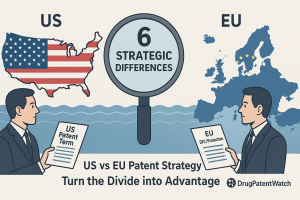
Every year, pharmaceutical companies forfeit billions in recoverable IP value not because their science failed, but because their patent strategy misread which jurisdiction’s rules actually govern their asset. The United States and the European Union are not regional variants of a single global system. They are structurally different legal architectures, each built on a distinct theory of what patents are for and who they protect. Getting that wrong — at the drafting stage, the filing stage, or the post-grant challenge stage — is the kind of mistake that does not show up until a generic launches five years early.
This guide is written for IP counsel, R&D leads, portfolio managers, and the dealmakers who price patent estates in M&A and licensing transactions. It dissects seven high-stakes areas of US-EU divergence with the level of technical specificity those professionals require. Each section includes an IP valuation lens, a set of key takeaways, and, where relevant, an investment strategy framework for analysts.
Part 1: What Can Actually Be Patented — The Foundational Divergence
The Surface-Level Alignment That Masks a Deep Divide
Both the USPTO and the EPO require novelty, inventive step (non-obviousness in US parlance), and industrial applicability (utility in the US). These terms look identical on paper. The application diverges sharply when examiners and courts apply them to pharmaceutical subject matter — specifically, to how a drug is used and how a patient is diagnosed.
The EPO’s problem-and-solution approach to inventive step tends to produce more predictable outcomes than the USPTO’s ‘person having ordinary skill in the art’ standard, which remains susceptible to hindsight-contaminated analysis. This predictability gap has real IP valuation consequences. A European patent that has survived a structured inventive-step analysis during prosecution carries less validity risk than its US counterpart, a factor that sophisticated acquirers price into deal terms.
Medical Methods: The US Permits What Europe Prohibits by Design
In the US, a claim reading ‘A method of treating [Disease X] comprising administering [Compound Y] to a patient in need thereof’ is valid patentable subject matter. The Supreme Court confirmed this category in Mayo Collaborative Services v. Prometheus Laboratories, Inc., 566 U.S. 66 (2012), even as that same decision created catastrophic problems for diagnostic claims (addressed below). US method-of-treatment patents are the primary vehicle for protecting new indications, new dosing regimens, and new patient stratifications. They are also highly enforceable: a generic manufacturer that carves a patented indication out of its label through a ‘skinny label’ strategy still faces potential induced infringement liability post-GSK v. Teva, 7 F.4th 1320 (Fed. Cir. 2021).
The EU excludes this category entirely. Article 53(c) of the European Patent Convention bars patents on ‘methods for treatment of the human or animal body by surgery or therapy and diagnostic methods practised on the human or animal body.’ The rationale is not that such methods are uninventive. It is an explicit policy choice to keep the physician’s clinical judgment free from patent constraints. This is a different philosophy from the US, not an inferior one — and it has a direct drafting consequence.
Purpose-Limited Product Claims: The EU Mechanism That Replicates US Outcomes
The EPC’s workaround for the method-of-treatment exclusion is the purpose-limited product claim, which comes in two forms. A ‘first medical use’ claim — ‘Substance X for use as a medicament’ — covers any compound entering medicine for the first time. More commercially significant is the ‘second medical use’ claim format codified through EPO case law: ‘Substance X for use in the treatment of Disease B.’ This claim type allows an innovator to protect a new indication for a known drug, a new dosing regimen for an already-approved therapy, or a new patient subpopulation identified through biomarker research.
The commercial protection offered by a European second medical use claim is functionally equivalent to a US method-of-treatment patent. A generic manufacturer is barred from marketing the product specifically for that patented use. The key drafting discipline is that the ‘use’ must be clearly defined and technically supported — the EPO will not allow a vague purpose-limited claim to serve as a de facto broad method claim.
For any global drug application, the patent must contain both claim formats from day one. A US application drafted to optimize method-of-treatment claims, without corresponding Swiss-style or EPC 2000-style purpose-limited product claims for Europe, leaves European rights structurally weaker. This is a common and correctable error.
IP Valuation Lens: Method-of-Treatment Patents as Lifecycle Assets
In any acquisition or licensing valuation of a pharmaceutical patent estate, method-of-treatment patents in the US warrant a higher risk-adjusted value than their nominal claim scope suggests, for one specific reason: they are the primary evergreening tool. A product whose compound patent expires in year 8 post-launch but carries method patents running to year 14 retains meaningful market protection. Buy-side IP diligence should map every method claim against expiry dates, pending Paragraph IV certifications, and any PTAB petitions already filed. A dense US method patent portfolio with no corresponding EU second medical use claims signals a drafting strategy that was not globally coordinated — and that discount should be reflected in the European asset valuation.
Key Takeaways: Patentable Subject Matter
The US permits direct method-of-treatment claims; the EU requires purpose-limited product claims to achieve the same commercial outcome. Both formats must appear in every global application from the filing date. Neither jurisdiction protects a broader category than the other in absolute terms — they use different legal mechanisms to reach similar commercial endpoints, with drafting discipline as the differentiating variable.
Part 2: The Grace Period vs. Absolute Novelty — Where Innovation Cultures Collide
The US Grace Period: A 12-Month Safety Net With Global Consequences
Under 35 U.S.C. Section 102(b)(1), an inventor’s own public disclosure does not count as prior art against them, provided a patent application is filed at the USPTO within 12 months of that disclosure. This grace period survived the America Invents Act of 2011 and applies to both pre-AIA and AIA applications, though with some technical differences in scope.
The practical effect is significant. A biotech startup can present preclinical data at AACR, post a preprint, or run a detailed investor roadshow — all without permanently surrendering patent rights, as long as a US application follows within 12 months. For university technology transfer offices, this means academic publication does not automatically foreclose commercialization.
The EU’s Absolute Novelty Standard: No Forgiveness, No Exceptions
The EPO operates under an unforgiving rule: any public disclosure of the invention before the application’s filing date destroys novelty for the purposes of a European patent, regardless of who made the disclosure. The narrow exceptions — display at an officially recognized international exhibition, or ‘evident abuse’ by a third party — cover a negligible fraction of real-world disclosure scenarios.
A 2022 EPO survey found that 7% of US-based applicants reported that prior EPO applications had failed specifically because of their own pre-filing disclosures. That number understates the actual cost, because it counts only applications that were filed and rejected, not the much larger category of rights that were never filed after a disclosure made international patenting unviable.
The consequences for university spinouts are severe. The ‘publish or perish’ incentive structure of academic research runs directly against absolute novelty requirements. A comprehensive survey of European technology transfer offices found that a supermajority believed a grace period was needed, and more than half reported feeling frequently at risk of losing patent rights due to pre-filing disclosure by their own researchers.
The US Provisional Application as the Global Filing Bridge
The standard tool for managing this divergence is the US provisional patent application. A provisional application is a relatively low-cost filing that secures a priority date without starting the 20-year term clock. Once on file, the inventor can publicly disclose without jeopardizing rights in absolute novelty jurisdictions, provided the non-provisional US application and any foreign filings claim priority within 12 months of the provisional’s filing date.
The mechanics matter. The provisional must adequately support every claim eventually filed in the non-provisional. A thin provisional — filed quickly to create a date before a conference presentation, but lacking technical depth — creates a priority date that may not withstand a written description challenge. For biologic drug applications in particular, the provisional should document the full amino acid sequence, relevant cell line data, and any characterization data for the molecule, not just a concept-level description.
The PCT (Patent Cooperation Treaty) application extends the timeline further. Filing a PCT application at the 12-month mark delays the major national-phase filing costs by an additional 18 months (30 months from the priority date in most jurisdictions), allowing the innovator to assess commercial viability before committing to per-country translation and filing fees.
Investment Strategy Note: Priority Date Integrity as a Due Diligence Variable
In buy-side IP diligence, the integrity of the priority date chain is one of the highest-risk items to verify. A patent that claims priority to a provisional which does not support a key claim is vulnerable to validity attack under 35 U.S.C. Section 112 in the US and analogous written description rules at the EPO. If a target company’s lead asset carries a priority date based on a minimalist provisional, and significant technical detail was added only at the non-provisional stage, that gap could allow a challenger to antedate the patent’s effective filing date to a point after a prior art disclosure. This is not a theoretical risk — it has materialized in multiple PTAB proceedings and EPO oppositions. Diligence should always compare provisional and non-provisional filings side by side.
Key Takeaways: Novelty Standards
The single highest-return, lowest-cost IP risk mitigation a company can implement is a ‘file before you talk’ protocol enforced across R&D, medical affairs, and business development. The US provisional application is the mechanism. Without it, a conference abstract or investor presentation can permanently foreclose European rights. With it, the company retains full global optionality.
Part 3: Patent Term Restoration — PTE vs. SPC, and the Manufacturing Waiver That Changes the Endgame
The Shared Problem: Regulatory Delay Consumes Patent Life
A 20-year patent term measured from the application filing date sounds generous. For a drug that enters Phase I trials 3 years after filing and reaches approval 10 years later, the effective patent life from launch to expiry is approximately 10 years — and in many cases, significantly less. Both the US and EU created compensation mechanisms to address this erosion. They operate differently in legal form, administrative process, and strategic scope.
US Patent Term Extension: A Direct Extension of the Patent Itself
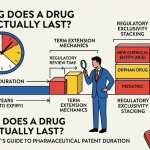
The Hatch-Waxman Act of 1984 created the US Patent Term Extension (PTE) mechanism. A PTE is a direct extension of the underlying patent’s term, not a separate right. The calculation uses a defined formula: one-half of the clinical testing phase plus the full regulatory review phase, minus any time attributable to applicant delay. The maximum extension is 5 years, capped so that total effective post-approval patent life does not exceed 14 years.
Critical operational rules: only one patent per approved product is eligible for a PTE, the PTE covers only the approved product (not all claims of the patent), and the 60-day application window after FDA approval is absolute. Missing that window forfeits the right entirely. The USPTO and FDA coordinate on PTE applications, with the FDA certifying the regulatory approval date and the USPTO calculating and granting the extension.
For a major small-molecule drug, the correct patent to elect for PTE is often not the compound patent (which may still have substantial life remaining) but a formulation or method patent whose expiry date would otherwise precede the compound patent’s, thereby creating a gap in market protection. PTE strategy is a discrete subspecialty of pharmaceutical IP, and the selection decision should involve both IP counsel and commercial forecasting teams.
EU Supplementary Protection Certificate: A Separate IP Right That Outlasts the Patent
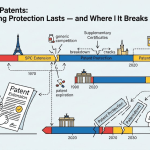
The EU Supplementary Protection Certificate (SPC) is legally distinct from a patent extension. It is a sui generis IP right, granted by national patent offices in individual EU member states, that takes effect the day after the underlying basic patent expires. The calculation: (Date of first EEA marketing authorization minus patent filing date) minus 5 years, capped at 5 years of additional protection. Total exclusivity, including the patent and SPC, typically targets 15 years from the first EEA marketing authorization.
The SPC’s national character is both a burden and a strategic lever. An innovator must file separate SPC applications in each EU member state where protection is desired. Each application requires a filing fee and local counsel. For a blockbuster drug, maintaining SPCs in Germany, France, Italy, Spain, the Netherlands, and other major markets is expensive but straightforward. For a niche drug with geographic market concentration, selective SPC filing is a legitimate cost management strategy — protecting high-revenue markets while forgoing others.
The EU is implementing a centralized SPC application procedure through the EUIPO, designed to issue a ‘unitary SPC’ providing protection across all participating member states with a single application. This reform reduces administrative friction significantly and eliminates the risk of procedural variations between national offices affecting SPC validity.
The SPC Manufacturing Waiver: An Industrial Policy Decision With Direct Competitive Consequences
The SPC manufacturing waiver, introduced through EU Regulation 2019/933, created a targeted exception to SPC rights that has no US equivalent. Before the waiver, an EU-based generics manufacturer could not produce an SPC-protected drug for any purpose during the SPC term — even for export to markets where the drug was off-patent. Indian and Chinese manufacturers faced no such restriction, and the EU argued this placed its domestic industry at a structural competitive disadvantage.
The waiver carves out two activities from SPC infringement liability. First, manufacturing for export: an EU-based company may produce a generic or biosimilar version of the SPC-protected product during the SPC term, provided the product is exclusively destined for markets outside the EU where no patent or SPC protection is in force. Second, stockpiling: in the final six months of the SPC term, the same manufacturer may produce and accumulate product for a day-one launch within the EU market, the moment the SPC expires.
Compliance requirements are specific. The manufacturer must notify the SPC holder and the relevant national authority of its intent to manufacture under the waiver, and exported product must bear a designated EU export logo to prevent diversion back into the protected EU market. Violations of the anti-diversion provisions are enforceable as SPC infringement.
For originator companies, the waiver requires recalibrating SPC-era lifecycle management. The final two years of SPC protection are no longer a sealed market. Competitors are legally building inventory and relationships in export markets that the originator also serves, and they are preparing for a day-one EU launch with warehoused product. The commercial implication is that generic entry in the EU will be faster and better-organized post-waiver than it was pre-waiver. Originator companies that respond only with standard SPC enforcement, without a coordinated last-mile strategy for the SPC expiry period, will lose significant market share earlier.
IP Valuation Lens: PTE and SPC as Core Asset Duration Drivers
In a DCF-based valuation of a pharmaceutical asset, the PTE and SPC duration directly sets the ceiling on the revenue stream’s protected duration. A 5-year SPC on a drug with peak revenues of $2 billion annually represents a notional value of $10 billion in protected revenue — before discounting, competitive erosion modeling, or lifecycle management assumptions. Analysts should verify: (1) whether the SPC application was filed on time and correctly, (2) whether any third parties have challenged the SPC’s validity, and (3) whether the manufacturing waiver has already triggered competitor filings under the notification requirement. All three variables affect the asset’s real effective exclusivity duration.
Key Takeaways: Patent Term Restoration
PTE and SPC protect the same economic interest but through structurally different mechanisms. The EU’s manufacturing waiver is a deliberate policy choice that advances the expiry of effective exclusivity for originators by enabling day-one launch preparation during the SPC’s final six months. Lifecycle management strategy for late-stage products must account for this new competitive dynamic.
Part 4: Post-Grant Patent Challenges — Two Arenas With Fundamentally Different Weapons
Choosing the Right Forum: IPR vs. EPO Opposition
When a competitor’s patent blocks market entry, two primary administrative forums exist for challenge: the Patent Trial and Appeal Board (PTAB) in the US, through either Inter Partes Review (IPR) or Post-Grant Review (PGR), and the EPO’s opposition division. These forums differ not just in cost and procedure but in their underlying purpose. Understanding that difference determines which forum to file in, in what sequence, and with what expectations.
The US PTAB: An Efficient Mechanism for Killing ‘Bad’ Patents
An IPR petition can be filed against any US patent after the 9-month PGR window closes. Its scope is narrow: only novelty and obviousness challenges based on prior art consisting of patents or printed publications. Discovery is limited but not absent — expert depositions are permitted. Official fees alone can exceed $50,000 for a petition covering multiple claims, and full proceedings with expert witnesses and attorneys routinely cost several hundred thousand to over $1 million. The PTAB earned the ‘patent death squad’ characterization from its early statistics, and recent data does not substantially soften the nickname.
In fiscal year 2024, the institution rate for bio/pharma IPR petitions ran at approximately 73%. Of all petitions reaching a final written decision across all technology areas, roughly 68% resulted in all challenged claims being found unpatentable, with only about 16% fully surviving. These figures reflect a forum that is structurally hostile to patent survival in its current form.
The estoppel consequences are severe. A petitioner who files an IPR is subsequently barred from raising in any civil action any invalidity argument they raised, or could have reasonably raised, in the IPR. This is the most significant strategic constraint on IPR use: filing a weak or incomplete petition can permanently foreclose stronger invalidity arguments in district court litigation. A petitioner must commit its full best case before filing, or accept that a failed IPR leaves them in a worse position than never having filed.
EPO Opposition: Lower Cost, More Outcomes, No Estoppel
An EPO opposition must be filed within 9 months of grant, costs €880 in official fees (trivial compared to IPR), and can cover virtually any ground of invalidity — not just novelty and obviousness, but also insufficiency of disclosure, extension beyond original disclosure, and lack of patentable subject matter. The proceeding is entirely paper-based with no discovery.
The outcome statistics are more nuanced than PTAB data. 2023 EPO opposition data shows a near-even three-way split: 31% of opposed patents revoked entirely, 37% maintained in amended form, 32% maintained as granted. For a challenger, the probability of materially changing the competitive landscape is approximately 68% — either full revocation or a narrowing of claims that reduces the commercial scope of the patent. For a patentee, roughly a third of patents survive exactly as filed.
Claim amendment is central to the EPO opposition process and is actively encouraged. The patentee can file auxiliary requests presenting progressively narrower claim sets. This means that a strong opposition that would defeat the broadest claims can still result in a narrowed patent that provides commercially meaningful protection. For the challenger, winning on the main request but losing on an auxiliary request is a partial victory, not a complete one.
The absence of estoppel in the EPO system is strategically significant. A challenger who loses an EPO opposition can raise the exact same invalidity arguments in national court litigation, or, increasingly, before the UPC. This creates a meaningful asymmetry compared to the US system: the EPO opposition carries minimal downside risk beyond the cost of the proceeding itself.
The Coordinated Global Challenge Strategy
The standard sophisticated approach for a generic or biosimilar manufacturer facing a blocking patent in both the US and EU is to file the EPO opposition first. The opposition costs are low, the grounds are broad, the patentee’s full defense strategy is disclosed through their response, and the outcome informs whether to commit to an IPR. If the EPO opposition reveals that the patentee’s best validity defense is weaker than anticipated, the IPR becomes more attractive. If the patent survives the opposition with little amendment, the cost-benefit calculation for an IPR shifts against filing.
For companies preparing Paragraph IV certifications in the US, the EPO opposition also serves as a discovery mechanism. The patentee’s claim construction arguments and secondary consideration evidence presented in the EPO proceedings are public record and can be reviewed by the challenger’s US litigation team before the Paragraph IV notice letter is sent.
IP Valuation Lens: Pending Challenges as Discount Factors
Any patent facing a filed IPR petition or EPO opposition carries a measurable validity discount. Buy-side M&A teams should quantify this as follows: identify the institution rate for the specific technology area and petitioner quality, model the probability of a final written decision unfavorable to the patent, and apply that probability against the asset’s projected revenue stream. A pending IPR on a patent protecting $500 million in annual revenue, with a 70% probability of a material outcome adverse to the patentee, represents a material contingent liability that should reduce enterprise value by a calculable amount, not simply be noted as a risk factor.
Key Takeaways: Post-Grant Challenges
The EPO opposition is the correct first-move tool in a coordinated global challenge: low cost, broad grounds, no estoppel, and a built-in disclosure of the patentee’s defense strategy. The US IPR is the appropriate follow-on commitment when opposition proceedings suggest a patent is genuinely vulnerable. Treating them as interchangeable or filing in the wrong sequence is a strategic error with real financial consequences.
Part 5: Regulatory Exclusivity — The Non-Patent Protection Layer That Anchors US Commercial Strategy
The Bolar Exemption: The Foundation for Generic Timeline Planning
Before competing products can launch, generic and biosimilar manufacturers must conduct bioequivalence studies and compile regulatory dossiers during the innovator’s protected period. Both the US and EU permit this activity under research exemptions that prevent it from constituting patent infringement.
In the US, the Hatch-Waxman ‘Safe Harbor’ under 35 U.S.C. Section 271(e)(1) covers a broad range of activities ‘solely for uses reasonably related to the development and submission of information under a Federal law which regulates the manufacture, use, or sale of drugs.’ The Supreme Court in Merck KGaA v. Integra Lifesciences I, Ltd., 545 U.S. 193 (2005), interpreted this broadly to include early-stage preclinical research performed with a ‘reasonable basis for believing’ the compound might become the subject of an FDA submission.
In the EU, the Bolar exemption’s scope has historically varied across member states. The proposed EU Pharma Package addresses this directly, harmonizing and clarifying that the Bolar exemption covers all activities necessary to prepare marketing authorization applications, health technology assessment submissions, and pricing and reimbursement dossiers. Critically, the proposal extends the exemption explicitly to third-party active pharmaceutical ingredient (API) suppliers, resolving a longstanding ambiguity about whether API manufacturers faced infringement risk when supplying generic companies conducting Bolar-exempt activities.
US Regulatory Exclusivity: Longer, Tiered, and More Predictable
The US system of regulatory data and market exclusivity operates through distinct, non-overlapping tiers, each tied to a specific category of innovation:
Biologics receive 12 years of market exclusivity from the date of first FDA approval, the most commercially significant exclusivity right in the US system. The FDA is barred from approving a biosimilar for this period. This exclusivity runs independently of any underlying patent protection and can provide market protection even after all relevant patents have expired or been invalidated.
New Chemical Entity exclusivity grants 5 years of data protection for a new small-molecule drug containing an active ingredient never before approved by the FDA. During the first 4 years, a generic manufacturer cannot even submit an Abbreviated New Drug Application (ANDA) citing the innovator’s data. An ANDA with a Paragraph IV certification challenging the innovator’s patents can be submitted in year 4, but not earlier.
New clinical indication exclusivity provides 3 years for any approved change requiring new clinical trials — a new indication, a new dosage form, a new patient population. This protection is narrow, covering only the new indication or change rather than the product as a whole.
Orphan Drug Exclusivity grants 7 years of market exclusivity for drugs treating rare diseases (US definition: fewer than 200,000 patients). The exclusivity bars FDA approval of the same drug for the same orphan indication — a narrower bar than biologics exclusivity, but highly valuable in rare disease markets where the total patient population is small enough that a single sponsor can often maintain market exclusivity even after protection expires.
Pediatric exclusivity adds 6 months to any existing patent or regulatory exclusivity when the manufacturer completes FDA-requested pediatric studies, regardless of the study outcome.
EU Regulatory Exclusivity: The 8+2+1 Framework Under Pressure
The EU’s standard exclusivity formula is structured as 8 years of data protection plus 2 years of market exclusivity, with a potential 1-year extension. During the initial 8-year data protection period, a generic company cannot cross-reference the innovator’s preclinical and clinical data in its own marketing authorization application. In years 9 and 10, the generic company can complete its application review, but cannot market the product. The optional 11th year is available only if the innovator obtains approval for a new indication during the first 8 years and that indication provides a ‘significant clinical benefit’ over existing therapies — a bar the EMA applies with genuine rigor.
For biologics, the EU framework’s baseline protection is 10 years compared to the US’s 12, a 2-year gap that compounds significantly in terms of discounted revenue. The EU does not have a direct equivalent of the US biologics market exclusivity structure; SPCs provide the primary mechanism for extending a biologic’s protected period, but they are tied to the underlying patent and are subject to validity challenges.
The EU Pharma Package proposals would restructure this framework significantly, reducing the baseline data protection period and requiring innovators to ‘earn back’ additional exclusivity by launching in all EU member states within a defined timeframe, conducting comparative clinical trials, or addressing high unmet medical need. The proposals remain under legislative development, but the policy trajectory is clear: the EU is treating regulatory exclusivity as a conditional reward tied to meeting broader public health objectives, not as an automatic right.
The US-First Commercialization Imperative
The combination of longer, more predictable US exclusivities and the EU’s move toward contingent exclusivity structures reinforces a calculus that most global pharmaceutical companies have already internalized: the US is the primary anchor market for high-value drug launches. A new biologic with 12 years of US market exclusivity and a well-managed patent estate has a predictable revenue runway that can generate the capital to finance EU launches, HTA processes, and the complex, country-by-country reimbursement negotiations that characterize European market access.
This is not an argument against EU market entry. It is an observation about sequencing and risk management. A drug that has established its clinical profile and commercial infrastructure in the US launches in Europe with far more data supporting HTA submissions and a more credible negotiating position on price.
Investment Strategy Note: Exclusivity Duration as the Primary Valuation Driver
For analysts building revenue models for pharmaceutical assets, regulatory exclusivity duration is the most defensible variable to model precisely because it is set by statute and is not subject to the uncertainty of patent validity. A biologic with 12 years of US market exclusivity has a known minimum revenue protection period. The risk layer above that floor — patent thicket durability, Paragraph IV litigation outcomes, biosimilar interchangeability designations — is what drives the valuation range above the floor. Getting the floor right is the starting point for any credible pharmaceutical asset valuation.
Key Takeaways: Regulatory Exclusivity
The US offers materially longer and structurally more predictable regulatory exclusivity than the EU, particularly for biologics. Proposed EU reforms will widen that gap further by making EU exclusivities conditional on policy compliance. For any portfolio manager or acquirer, the biologics exclusivity duration in the US is the single most important non-patent variable to identify and verify early in diligence.
Part 6: Evergreening, Patent Thickets, and the Structural Reasons They Work in the US but Not in Europe
Defining the Pharmaceutical Patent Thicket
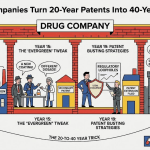
A patent thicket is a ‘dense web of overlapping intellectual property rights’ that competitors must navigate to commercialize a product. In pharmaceutical lifecycle management, this translates to a deliberate strategy of filing large numbers of secondary patents around a single drug — covering formulations, manufacturing processes, methods of use, drug delivery devices, specific polymorphs, and patient subpopulations — to extend effective market exclusivity well past the primary compound patent’s expiry date.
The critical distinction between a legitimate secondary patent and a thicket patent is inventive step. A genuinely novel formulation that provides a clinical benefit — better bioavailability, reduced side effects, a meaningful dosing improvement — warrants patent protection. A polymorph patent that covers a crystalline form with no demonstrated clinical advantage over the existing form, filed primarily to extend exclusivity, is a different category. Both can be valid patents. The strategic function is not the same.
Case Study: AbbVie’s Humira — The Clearest Transatlantic Comparison in the Literature
Humira (adalimumab), AbbVie’s TNF-alpha inhibitor, generated cumulative worldwide revenues exceeding $200 billion and became the archetype for pharmaceutical thicket strategy. The comparison between AbbVie’s US and EU patent postures is the most thoroughly documented illustration of how structural system differences produce dramatically different competitive outcomes.
In the US, AbbVie filed over 247 patent applications related to Humira. Analysis by I-MAK found that approximately 80% of the resulting granted patents were not patentably distinct from each other, frequently linked through terminal disclaimers that allow a patent claiming an obvious variant of another AbbVie patent to coexist in the portfolio. The result: biosimilar manufacturers faced a thicket of more than 130 granted patents, the vast majority of which would have required individual litigation to invalidate. The economic calculus was straightforward — litigating 130 patents at multi-million dollars per case meant total potential litigation exposure measured in hundreds of millions of dollars. Every major biosimilar manufacturer chose to settle, accepting delayed US entry dates in exchange for licenses. Biosimilars did not enter the US market until January 2023, nearly seven years after the primary adalimumab compound patent expired.
In the EU, AbbVie held only 76 patent applications related to Humira, producing a far less dense portfolio that presented no comparable deterrent to biosimilar manufacturers. Biosimilars launched in Europe in late 2018, approximately five years before US biosimilar entry. The cost difference to the US healthcare system from that five-year delay has been estimated at $19 billion or more in above-market drug spending.
This is not a story about AbbVie’s legal strategy being more sophisticated in one market than the other. It is a story about structural system differences enabling a strategy in the US that the EU’s architecture prevents.
Why the US Enables Thickets and the EU Does Not
Four structural features of the US system make it hospitable to patent thickets:
First, the continuation application practice at the USPTO allows an applicant to file a new application claiming priority to an earlier application, presenting new or differently structured claims, without forfeiting the original filing date. This is the mechanism through which a single original disclosure can spawn dozens of patents over years or decades. The EPO permits divisional applications in limited circumstances but does not have an equivalent to the US continuation practice’s scope.
Second, the USPTO’s terminal disclaimer mechanism, while designed to prevent the extension of monopoly through obvious variants, paradoxically enables the thicket by allowing multiple slightly-different patents to coexist. A terminal disclaimer requires only that the patents expire on the same date — it does not prevent a dozen patents covering marginally distinct formulations from all landing on the Orange Book for the same drug.
Third, US patent claims can often be drafted more broadly than their EPO equivalents. The EPO examines claim breadth relative to the technical contribution disclosed in the application, applying the ‘support’ requirement in Article 84 EPC and the written description requirement under Article 83 EPC strictly. This routinely forces narrowing amendments that reduce the EPO grant’s commercial reach compared to the original claim.
Fourth, and most importantly, US patent litigation costs are so high that they function as a deterrent independent of any patent’s actual validity. A biosimilar manufacturer with a strong invalidity case against a specific Humira polymorph patent still faces the prospect of litigating that case through district court and Federal Circuit appeal, at a cost that can easily exceed $15-20 million per patent. Multiplied across a 130-patent thicket, no rational economic actor can justify that expenditure when a negotiated settlement is available.
The EU’s structural barriers to thickets are equally concrete. The EPO’s ‘added matter’ doctrine under Article 123(2) EPC prohibits adding any new subject matter to an application after the filing date. This prevents the incremental, claim-by-claim expansion that characterizes US continuation practice. An attempt to file a European divisional claiming a formulation variation not fully disclosed in the original application will be rejected for added matter, even if the variation seems technically obvious.
The EPO’s inventive step examination for secondary patents is also substantially stricter than the USPTO’s non-obviousness analysis in practice. A pharmaceutical polymorph that provides no unexpected technical benefit over the known amorphous form will typically fail the EPO’s inventive step examination. The same application might survive at the USPTO if the claim is drafted around a sufficiently specific crystalline characteristic.
Antitrust Risk: The Emerging US Constraint on Thicket Strategy
The Humira thicket, while it survived specific antitrust challenges, created a sustained legal and regulatory scrutiny that is reshaping the risk calculus for aggressive secondary patenting. The FTC and DOJ have increased focus on pharmaceutical patent settlement practices following the Supreme Court’s FTC v. Actavis decision, 570 U.S. 136 (2013), which established that pay-for-delay settlements are subject to antitrust review. A large patent thicket, if challenged as an antitrust violation through the theory that accumulating weak, non-distinct patents constitutes exclusionary conduct, represents a new and evolving litigation risk. Companies building thickets around blockbuster drugs should obtain antitrust counsel review of their continuation strategy, not only IP counsel review.
The USPTO’s proposed rule changes targeting terminal disclaimer practices would, if finalized, directly reduce the ability to build duplicate patent families. These proposals are actively contested but represent a regulatory trend that originator companies must account for in long-range portfolio planning.
Key Takeaways: Evergreening and Thickets
The US patent thicket strategy works because continuation practice, broad claim drafting, and high litigation costs create a deterrent environment that forces settlement regardless of individual patent strength. The same strategy does not transplant to Europe because the EPO’s added matter doctrine, stricter inventive step examination, and lower litigation costs remove the structural prerequisites. Originator companies planning long-term US lifecycle management must account for both increasing antitrust scrutiny and proposed USPTO rule changes targeting continuation practice.
Part 7: The Unified Patent Court — Europe’s New Enforcement Architecture and Its Strategic Implications
What the UPC Is and Why It Changed Everything
The Unified Patent Court (UPC) launched in June 2023 and is now the single most consequential structural change to European patent practice in fifty years. It is an international court with jurisdiction over infringement and revocation actions covering, as of 2025, 17 EU member states. For pharmaceutical companies operating in Europe, it replaces a fragmented, expensive, country-by-country litigation system with a centralized forum that is both more powerful and more dangerous than what preceded it.
The UPC’s key asymmetry is that both its primary benefits and its primary risks are ‘all-or-nothing’ in geographic scope. A successful infringement action at the UPC can yield a pan-European injunction covering all 17 member states in a single proceeding. A successful revocation action — whether filed by a competitor or as a counterclaim to an infringement action — can invalidate the same patent across the entire UPC territory in a single proceeding. There is no middle ground.
The Opt-Out Mechanism and Pharmaceutical Industry Behavior
The UPC Agreement gives patent owners a transitional period during which they can ‘opt out’ their existing European patents and pending European applications from UPC jurisdiction, effectively electing to keep those patents in the national court system where they were already enforceable. The opt-out can be withdrawn, allowing later re-entry into UPC jurisdiction.
The pharmaceutical industry’s response to the UPC’s launch has been measurably more cautious than other technology sectors. Most major originator companies — including Novartis, Roche, Pfizer, and AstraZeneca — opted out substantial portions of their European patent portfolios, particularly their highest-value crown-jewel patents. The rationale is straightforward: a patent protecting several billion dollars in annual revenue is not the correct asset on which to test a new court’s jurisprudential tendencies with a revocation risk that is pan-European in scope.
This caution is producing a bifurcated landscape. High-value pharmaceutical patents are being litigated in national courts under familiar rules and well-established case law. Lower-value patents, patents nearing expiry, and patents on products with limited commercial significance are being litigated or challenged in the UPC, where costs per country covered are lower and the emerging case law provides increasing guidance.
EPO Oppositions and UPC Proceedings: Parallel Battlefronts That Cannot Be Ignored
A critical feature of the current European landscape is the simultaneous availability of EPO opposition proceedings and UPC revocation actions for the same patent. The UPC has made clear in its early decisions that it will not automatically stay its proceedings to await the outcome of a parallel EPO opposition. The two forums proceed independently, and the first to reach a substantive decision does not bind the other.
This creates a strategic complexity with no US equivalent. A patentee defending a commercially significant European patent may simultaneously be managing an EPO opposition (technical proceedings before a technically trained opposition division, with claim amendment available) and a UPC revocation action (judicial proceedings before legally-trained judges, with different procedural rules and no equivalent claim amendment flexibility). These are not duplicative proceedings — they are simultaneous battles in different arenas, each requiring dedicated resources and coordinated strategy.
For challengers, this dual-track option is a material advantage. An EPO opposition is the lower-cost, technically deep proceeding that can narrow or revoke the patent and generates prior art analysis that informs the UPC proceeding. A UPC revocation action moves faster and, if successful, eliminates the patent pan-Europeanly with immediate commercial effect. A well-resourced challenger can file both concurrently, allocate resources based on how each proceeding develops, and use the proceedings’ interaction to maximum effect.
The UPC’s emerging preliminary injunction jurisprudence is also relevant to pharmaceutical strategy. Early UPC decisions have been somewhat reluctant to grant preliminary injunctions in pharmaceutical cases where a pending EPO opposition creates ‘reasonable doubt’ about patent validity. This means that an EPO opposition, even if ultimately unsuccessful, can serve as a defensive mechanism against UPC-based preliminary injunctions during the opposition period — a tactical use of the EPO forum that did not exist before the UPC launched.
Early UPC Statistics and What They Tell Practitioners
In the UPC’s first two years of operation, pharmaceutical and life science cases constituted a meaningful share of the case load. German local divisions (Munich and Dusseldorf) have been the most active venues, consistent with those cities’ historical dominance in European pharmaceutical patent litigation. The UPC’s Court of Appeal issued its first substantive decisions in 2024, beginning to build the predictable case law that will eventually make UPC litigation more strategically calculable.
Several notable features of early UPC pharmaceutical cases are worth tracking. The court has applied a relatively strict standard for establishing imminent infringement risk in preliminary injunction applications, which has limited the use of the UPC as an early-stage injunction tool. This may evolve as the court’s understanding of pharmaceutical commercialization timelines develops. The UPC has also signaled that it will apply independent validity analysis rather than simply deferring to EPO examination conclusions — a meaningful signal that EPO grant does not guarantee UPC survival.
Investment Strategy Note: UPC Exposure as a Portfolio Risk Variable
For M&A diligence or licensing valuation purposes, a target company’s UPC opt-out status is now a standard due diligence item. A high-value European patent that has not been opted out and is not otherwise protected through national-route filing is exposed to a single-proceeding pan-European revocation risk. That exposure should be quantified: identify the patent’s contribution to the asset’s European revenue stream, estimate the probability of a credible revocation challenge being filed in the UPC, and model the revenue impact of a successful revocation across 17 member states simultaneously. This is a categorically different risk profile from the pre-UPC era, when a revocation had to be pursued country by country.
Key Takeaways: UPC and European Enforcement
The UPC is simultaneously a more efficient enforcement tool and a more dangerous revocation forum than anything that preceded it in Europe. The pharmaceutical industry’s cautious response — opting out crown-jewel patents — is rational but not permanent. As UPC case law develops and the court’s behavior becomes predictable, selective re-entry of high-value patents into UPC jurisdiction will become more attractive. Companies that develop UPC expertise early will be positioned to use the court offensively, not just defensively.
Synthesis: A Framework for Coordinated Global Pharmaceutical IP Strategy
The Strategic Architecture That Integrates All Seven Dimensions
The seven divergences analyzed above are not independent variables. They interact, and the interaction effects are where the most significant strategic value is either captured or lost.
The foundational operational rule is the provisional application, filed before any public disclosure, with sufficient technical depth to support all claims that will eventually be prosecuted. This single discipline preserves global optionality and is the precondition for everything else.
From there, claim architecture must be drafted with both US and EU requirements simultaneously in view. Method-of-treatment claims for the US, purpose-limited product claims for Europe, and in vitro diagnostic claims for both. A claim set that is drafted to satisfy only one jurisdiction forces expensive and often ineffective prosecution corrections later.
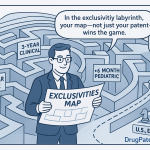
Exclusivity mapping — identifying the precise expiry dates of patents, PTEs, SPCs, and regulatory exclusivities in each key market — is the scaffolding on which commercial forecasts and lifecycle management decisions are built. A drug with a compound patent expiring in 2027 but a valid SPC running to 2030 in Germany, combined with 12 years of US biologics exclusivity running to 2031, has a completely different commercial risk profile than one whose primary protection in all markets expires simultaneously. That difference must be captured precisely, not approximated.
Post-grant challenge strategy should be coordinated globally. An EPO opposition is typically the correct first action; an IPR or Paragraph IV certification is typically the higher-stakes follow-on. The information generated by EPO proceedings informs US litigation strategy in ways that the reverse does not apply, because EPO proceedings generate a more thorough technical record at lower cost.
Enforcement strategy in Europe now requires a UPC decision for every patent in the portfolio: opt-out or retain. That decision should be made per asset, based on the patent’s commercial significance, its validity confidence level, and the likelihood of third-party challenge, not as a portfolio-wide default.
The Data Infrastructure That Makes This Possible
Managing this complexity across hundreds of patents, dozens of markets, and multiple pending proceedings requires integrated pharmaceutical patent intelligence infrastructure. The variables that matter — expiry dates for patents and SPCs, pending Paragraph IV certifications, filed IPR petitions, EPO opposition status, UPC opt-out registrations, regulatory exclusivity codes and expiry dates, competitor pipeline positions — are individually public but practically inaccessible without systematic aggregation and monitoring.
Platforms like DrugPatentWatch provide exactly this integrated view. A generic manufacturer assessing a target molecule can use the platform to identify the full US and EU patent estate, map SPC filings across member states, track any pending IPR or EPO challenge by third parties, and correlate patent expiry with regulatory exclusivity codes to determine the true date of open market entry. For an originator’s lifecycle management team, the same intelligence reveals which assets competitors are targeting through Paragraph IV certifications and EPO oppositions, informing both defensive litigation posture and commercial forecasting.
The companies that operate from integrated, real-time patent intelligence rather than periodic manual analysis make better and faster decisions at every stage of the IP lifecycle. In a field where a single miscalculation about a patent’s expiry date or an unexpected Paragraph IV filing can represent a multi-billion dollar revenue exposure, that intelligence infrastructure is not a cost center. It is a core competitive asset.
Frequently Asked Questions
Should a company always file first in the US?
For most innovators with global ambitions, yes. A US provisional application secures a worldwide priority date cheaply and fast, preserves the ability to disclose publicly without losing European rights (provided PCT or direct European filing follows within 12 months), and gives the company maximum flexibility to assess commercial viability before committing to expensive national filings. The only exception is where the primary market is non-US and the US is a secondary consideration — rare in pharmaceutical development.
How should companies decide whether to opt their European patents into or out of UPC jurisdiction?
The opt-out decision should be made patent by patent, not portfolio-wide. High-value patents protecting active commercial products should generally be opted out until the UPC develops more predictable pharmaceutical case law. Patents with clear validity confidence and a competitor who is likely to infringe across multiple EU member states simultaneously may be better retained in UPC jurisdiction, since the UPC’s pan-European injunction is a far more efficient enforcement tool than national court-by-court litigation. The decision should be revisited annually as UPC jurisprudence matures.
Is EU regulatory exclusivity still worth building a commercial strategy around, given the proposed reforms?
Yes, but with modified assumptions. The EU’s 8+2+1 framework currently provides 10 years of effective protection for most new medicines, which remains commercially significant even if shorter than the US biologics standard. The proposed reforms, if enacted, will make that protection conditional and less predictable. The response is not to abandon EU commercialization but to build the patent and SPC estate more rigorously, since those rights are not subject to the same policy conditions as regulatory exclusivity.
When is an EPO opposition preferable to a US IPR, and when is the reverse true?
File an EPO opposition first when the primary strategic goal is narrowing the patent’s claim scope rather than killing it entirely, when budget is constrained, when the invalidity argument relies on technical ground that benefits from a technically trained examining division rather than administrative patent judges, or when the US IPR filing decision has not yet been made and the opposition will generate information about the patentee’s defense strategy. File a US IPR when the patent’s invalidity is highly confident and the goal is clean elimination, when the patent is US-only in commercial relevance, or when parallel Paragraph IV litigation is already underway and the IPR is being used to accelerate an invalidity finding.
How does the SPC manufacturing waiver change day-one biosimilar launch planning?
The waiver means that during the final 6 months of an SPC’s term, EU-based manufacturers can legally produce and stockpile biosimilar product for day-one EU launch. For biosimilar developers, this requires advancing commercial manufacturing readiness timelines relative to pre-waiver planning. Product must be fully manufactured, filled, and ready to ship on SPC expiry day, not simply in clinical supply form. For originator companies, the implication is that biosimilar day-one launches in the EU will be larger and better-organized than they were before the waiver, requiring more aggressive commercial and pricing strategies to defend market share in the immediate post-SPC period.