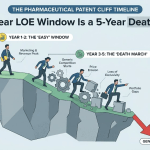
The pharmaceutical industry is currently navigating a period of unprecedented volatility, standing on the precipice of a “patent cliff” of tectonic magnitude. Between 2025 and 2030, industry analysts project that nearly 70 high-revenue products will lose market exclusivity, placing a colossal $236 billion in annual branded revenue at risk.1 This is not merely a cyclical downturn; it is a structural transformation of the market’s value proposition, driven by the expiration of patents on biologic blockbusters, the aggressive legislative interventions of the Inflation Reduction Act (IRA), and a Federal Trade Commission (FTC) that has declared war on the “junk patents” that historically sustained monopolies.
For the pharmaceutical strategist—whether defending a brand’s fortress or commanding a generic challenger’s assault—the ability to forecast the precise moment of generic entry is no longer an operational exercise in supply chain management. It is a fundamental competency of financial survival. A forecast error of a single quarter for a blockbuster drug like Eliquis (apixaban) or Stelara (ustekinumab) represents a variance of hundreds of millions of dollars in revenue, a swing capable of altering stock valuations, forcing R&D restructuring, or triggering hostile takeovers.2
This report serves as a comprehensive operational manual for the modern forecaster. We move beyond the rudimentary “patent expiration date” entered into a spreadsheet. Instead, we dissect the probabilistic realities of litigation, the game-theoretic models of settlement negotiation, the statistical nuances of uptake curves, and the regulatory bottlenecks that define the actual date of launch. We explore how sophisticated players are leveraging platforms like DrugPatentWatch to synthesize disparate legal and regulatory signals into actionable intelligence, transforming data into a decisive competitive advantage.4
Part I: The Statistical Foundation – Beyond the Naïve Forecast
Before one can navigate the legal and regulatory minefields that determine the timing of a launch, one must master the quantitative engines that predict the magnitude of the impact. The industry has long relied on intuition and “analog” experience—looking at how a similar drug performed a decade ago. However, the sheer velocity of modern market erosion, where generic penetration can exceed 90% within weeks, demands a more rigorous statistical architecture.
The Hierarchy of Time Series Models in Pharmaceutical Forecasting
Forecasting generic uptake involves predicting a “regime change” in a time series—a sudden, non-linear shift from a monopoly state to a competitive equilibrium. Standard econometric models often fail to capture this shock. Research into pharmaceutical life cycles suggests that while simple models have their place, strategic accuracy requires matching the methodology to the forecast horizon.
The Baseline: Naïve and Moving Average Limitations
At the foundational level, analysts often employ Naïve Forecasting. This method operates on the assumption that the sales of the next period will mirror the most recent period. While this serves as a useful benchmark to test the accuracy of more complex models, it is catastrophically inadequate for the dynamic “shock” of a generic launch. It fails to capture the S-curve of adoption or the rapid decay of brand pricing, assuming instead a stability that does not exist in a post-LOE (Loss of Exclusivity) world.5
A step up in sophistication is the Moving Average. By smoothing out random noise over a selected number of past periods—typically a three-to-six-month rolling window—analysts attempt to identify the underlying trend. This method remains widely used for mature products with stable, seasonal demand, such as established allergy medications or flu vaccines. However, in the context of a new generic launch, the moving average suffers from significant “lag.” When market share flips by 80% in 90 days, a moving average provides a rearview mirror perspective when a forward-looking radar is essential. It smooths the cliff edge into a gentle slope, leading to massive inventory overstocks for brands and stock-outs for generics.5
Capturing Trend and Seasonality: Holt-Winters and Exponential Smoothing
To address the limitations of static averages, sophisticated forecasters turn to Exponential Smoothing and Holt-Winters methods. Unlike simple moving averages, exponential smoothing assigns exponentially decreasing weights to older observations, making the model significantly more responsive to recent shifts in demand—a critical feature when monitoring the initial weeks of a generic launch.
Holt’s Linear Method extends this by introducing a trend factor, allowing the model to project the trajectory of growth or decline. This is particularly useful for oncology drugs or chronic therapies where diagnosis rates drive a consistent upward trend in total market volume, even as the brand’s share within that market erodes. For example, the demand for a generic oncology drug will grow not just because it is cheaper, but because the underlying patient population is expanding due to better diagnostics.5
For markets with distinct annual patterns, the Holt-Winters Method adds a seasonality component. This is crucial for respiratory drugs or anti-infectives. The multiplicative version of Holt-Winters is often favored in high-growth therapeutic areas, where seasonal fluctuations grow proportionally with the total market size. Research indicates that while Holt-Winters produces accurate short-term (annual) forecasts, for longer strategic horizons of 2-5 years, simpler models like “Naïve with Drift” can sometimes outperform complex smoothing techniques by avoiding the amplification of short-term noise into long-term errors.6
The Gold Standard: Diffusion Models and ARIMA
For strategic planning, particularly when forecasting the uptake of a new generic entrant, the industry standard remains the Bass Diffusion Model. Unlike time series methods that rely on the product’s own history, the Bass Model predicts adoption based on the interaction between “innovators” (early adopters) and “imitators” (those influenced by social proof).
In the context of generics, the “Innovation Coefficient” ($p$) models the rate at which pharmacies and payers force an immediate switch—the “cliff” effect driven by formulary mandates. The “Imitation Coefficient” ($q$) represents the slower, word-of-mouth adoption often seen in complex generics or biosimilars where physician confidence must be built over time.
Additionally, ARIMA (Auto-Regressive Integrated Moving Average) models are employed for their ability to handle non-stationary data. By “differencing” the time series to stabilize the mean and variance, ARIMA can model the complex autocorrelation structures found in prescription data. However, the complexity of ARIMA requires expert tuning; an improperly specified model can “overfit” historical data, predicting phantom cycles that do not exist.7
Analog Forecasting: The “Evented” Approach
Pure statistical models often fail when facing a “singularity” event like a patent expiry where no direct historical data exists for that specific drug. Here, the industry relies on Analog Forecasting. This method involves selecting historical “twins”—drugs that share key characteristics with the target asset—and using their erosion curves as a proxy.
The most predictive analogs share the same therapeutic area (e.g., statins vs. oncology), route of administration (oral vs. injectable), and competitive density (number of generic entrants). Analysts utilize databases like IQVIA’s Analogue Planner to filter thousands of historical launches, identifying cohorts that match the target drug’s profile. This allows for the creation of an “evented” forecast: combining a baseline market volume forecast (growing due to demographics) with an analog-derived market share curve.8
Comparison of Statistical Forecasting Methods
Method
Best Use Case
Strengths
Weaknesses
Naïve Forecasting
Stable, mature generics; baseline benchmark.
Simple, zero cost, easy to explain.
Fails to capture trends, seasonality, or shocks.
Moving Average
Seasonal products; smoothing inventory noise.
Smooths out random volatility.
Lags behind actual trend changes; poor for rapid launches.
Holt-Winters
Products with strong trend and seasonality (e.g., flu drugs).
Captures complex seasonal patterns and growth trends.
Requires extensive historical data; sensitive to outliers.
ARIMA
Strategic multi-year planning; complex time series.
Handles non-stationary data; robust for longer horizons.
Mathematically complex; risk of overfitting.
Bass Diffusion
New product launches; biosimilar uptake.
Models the social/formulary dynamics of adoption.
Difficult to estimate coefficients without prior data.
Analog/Evented
Pre-launch forecasting; patent expiry modeling.
Leverages real-world history of similar drugs.
success depends entirely on the quality of the selected analogs.
Part II: The Legal Battlefield – Quantifying the “When”
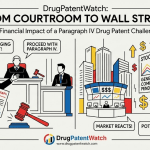
If statistical models tell us how a generic will launch (the curve), legal intelligence tells us when (the date). In the modern pharmaceutical industry, the launch date is not fixed; it is a variable dependent on the outcome of a high-stakes chess match played in federal courts. The transition from brand exclusivity to generic competition is governed by the Hatch-Waxman Act, a legal framework that balances innovation incentives with price competition.
The Mechanics of the Paragraph IV Certification
The Drug Price Competition and Patent Term Restoration Act of 1984 (Hatch-Waxman) created the Abbreviated New Drug Application (ANDA), allowing generics to bypass clinical trials by proving bioequivalence. Crucially for forecasters, it established the mechanism for patent challenges: the Paragraph IV (PIV) Certification.
When a generic manufacturer files an ANDA with a PIV certification, they are asserting that the brand’s listed patents are invalid, unenforceable, or will not be infringed by the generic product. This filing is, in effect, a declaration of legal war.
The 30-Month Stay: Upon receiving notice of a PIV certification, the brand manufacturer has 45 days to file a patent infringement lawsuit. This filing triggers an automatic 30-month stay of FDA approval. For a forecaster, this 30-month period acts as a provisional “floor” for the generic launch date. The FDA is legally barred from approving the generic until this stay expires, or until a district court rules in favor of the generic. This mechanism provides brands with a guaranteed window of exclusivity to litigate their claims.10
180-Day Exclusivity: To incentivize generics to undertake the risk of litigation, the first company to file a substantially complete ANDA with a PIV certification is granted 180 days of market exclusivity. During this six-month window, no other generic can enter the market. This period is the most lucrative phase of the generic lifecycle, often generating hundreds of millions in profit—sometimes exceeding the profits of the next ten years combined. For the forecaster, this means the initial erosion curve will be a “step function”: a moderate price drop (15-30%) during the first six months, followed by a vertical cliff (90%+ drop) once the 180 days expire and multiple competitors flood the market.10
The “Patent Thicket” and the Art of Evergreening
A common and fatal forecasting error is assuming a drug loses exclusivity when its primary “Composition of Matter” (CoM) patent expires. In reality, innovator companies construct “patent thickets”—dense, overlapping webs of secondary patents covering formulations, dosing regimens, polymorphic crystal structures, and methods of use.
Strategists utilize “continuation” applications to create a cascade of patents with staggered expiration dates, effectively “evergreening” their monopoly. A generic challenger might successfully invalidate the original molecule patent, only to be blocked by a secondary patent covering a specific extended-release mechanism or a method of treating a specific patient sub-population.
Forecasting Implication: A robust model must evaluate the legal strength of each patent in the thicket. Tools like DrugPatentWatch are indispensable in this phase, allowing analysts to visualize the entire “exclusivity stack.” By identifying which specific patent serves as the “linchpin” holding the monopoly together, forecasters can weigh the probability of a successful challenge. For example, method-of-use patents are generally easier to carve out (“skinny labeling”) or invalidate than composition patents.4
Predicting Litigation Outcomes with Machine Learning
The industry is moving beyond qualitative legal opinions (“we think we have a 60% chance”) to quantitative litigation analytics. By scraping data from PACER (federal court records) and specialized platforms, analysts use machine learning algorithms to predict case outcomes.
Feature Engineering: These predictive models incorporate a vast array of variables: the specific judge assigned to the case (identifying “pro-patent” vs. “pro-generic” judicial tendencies), the historical win rates of the law firms representing each side, the intrinsic characteristics of the patent (e.g., citation counts, claim breadth), and the number of concurrent challengers.
Algorithmic Success: Studies using Random Forest and Elastic Net algorithms have demonstrated over 80% accuracy in predicting whether a drug will face a PIV challenge based on its market size and therapeutic class. These models generate a “Probability of Success” (PoS) score for the generic challenger, which is then fed into Monte Carlo simulations to generate a risk-adjusted launch date distribution rather than a deterministic guess.12
The “At-Risk” Launch: High Stakes Gambling
Perhaps the most dramatic variable in generic forecasting is the “At-Risk” launch. This occurs when a generic receives FDA approval and chooses to launch its product before the patent litigation is fully resolved—typically after winning a district court decision but while the appeal is still pending.
The Calculus of Risk: If the generic launches at-risk and subsequently loses the appeal, they are liable for massive damages—often calculated as the brand’s lost profits, which can be triple the generic’s revenue. However, if they wait, they forfeit months of sales and potentially their first-mover advantage.
The Plavix Case Study: The cautionary tale of Plavix (clopidogrel) looms large in every boardroom. In 2006, generic manufacturer Apotex launched an at-risk generic version of the blockbuster blood thinner. They flooded the market for just 23 days before an injunction halted sales. In those three weeks, they sold enough product to cripple Bristol-Myers Squibb’s sales for months. However, Apotex eventually lost the patent trial and was forced to pay over $442 million in damages.
Strategic Modeling: Forecasters use Game Theory and Real Options Analysis to model this decision. If the generic calculates that the potential profit from the 180-day exclusivity period significantly outweighs the risk-weighted damages, they may pull the trigger. A forecast that ignores the possibility of an at-risk launch misses the “tail risk” of a sudden, catastrophic revenue drop for the brand.3
Part III: Regulatory Hurdles – The Hidden Delays
Even after the legal battles are won in the courtroom, regulatory friction within the FDA can delay a launch by months or years. These administrative bottlenecks are often manipulated by brand companies as a secondary line of defense.
Citizen Petitions: The Weaponization of Safety
A potent, often overlooked tool in the brand defense playbook is the Citizen Petition (CP). Section 505(q) of the FD&C Act allows any interested person to petition the FDA to take or refrain from taking administrative action. While intended to allow the public to raise legitimate safety concerns, CPs have been weaponized by pharma companies to delay generic approvals.
The Tactic: A brand files a petition raising complex scientific objections to the generic’s application—often arguing that the generic requires additional, onerous bioequivalence testing or tighter specifications on impurities—just days or weeks before the generic is expected to launch. The FDA is legally required to review and respond to these petitions.
The Impact: Although the FDA denies the vast majority of these petitions (often explicitly labeling them as “sham” petitions submitted solely to delay competition), the review process itself burns valuable time. Studies indicate that these petitions can delay generic entry by hundreds of days, costing the healthcare system billions in lost savings.
Case Study: Arcutis and Zoryve (2023-2024)
A recent example of this strategy involves Arcutis Biotherapeutics and its topical PDE4 inhibitor Zoryve (roflumilast). In late 2023, facing potential generic competition, Arcutis filed a citizen petition (Docket No. FDA-2023-P-5364) arguing that generic versions of roflumilast cream must use specific inactive ingredients, such as Transcutol (diethylene glycol monoethyl ether), to ensure safety and efficacy. The petition claimed that differences in formulation could affect the drug’s safety profile. While the FDA has historically been skeptical of such “sameness” arguments for inactive ingredients, the filing of the petition forced the agency to conduct a substantive review, creating a “shadow timeline” for generic approval. For a forecaster, monitoring FDA dockets for such filings is critical; a filed CP is a leading indicator of a delay strategy and often signals that the brand lacks confidence in its patent position.19
REMS and Restricted Access
Risk Evaluation and Mitigation Strategies (REMS) are FDA-mandated safety programs for drugs with serious safety concerns. Brands have historically exploited REMS to deny generic developers access to the drug samples needed for bioequivalence testing, arguing that selling the samples to a generic company would violate the strict safety protocols of the REMS program. While the CREATES Act was passed to close this loophole and facilitate sample access, it remains a friction point. Litigation over sample access can delay the start of generic development by years, pushing the entire launch timeline to the right. Forecasters must identify if a target drug is subject to REMS (e.g., Thalomid, Isotretinoin) and adjust development timelines accordingly.23
FDA Backlogs and Inspection Compliance
The FDA’s Office of Generic Drugs (OGD) faces chronic workload challenges. Receiving a “Tentative Approval” is not the same as a “Full Approval.” A generic cannot launch until its manufacturing facility passes a pre-approval inspection (PAI). In 2024, the industry saw a decline in full ANDA approvals and an increase in median approval times, driven partly by the complexity of new filings and the backlog of facility inspections. A sophisticated forecast tracks the compliance status of the generic’s specific manufacturing plant. A warning letter issued to a facility in Gujarat or a 483 observation in New Jersey can indefinitely delay a launch, even if the patents have expired and the citizen petitions have been denied.24
Part IV: Market Erosion Dynamics – The Cliff vs. The Slope
Once the generic launches, the central question shifts from “when” to “how fast.” The speed and depth of brand erosion depend entirely on the nature of the molecule and the market.
Small Molecules: The Vertical Cliff
For traditional oral solid dosage forms (tablets and capsules), the erosion is catastrophic, immediate, and nearly total.
Mechanism: This dynamic is driven by automatic substitution laws in the U.S., which allow (and often mandate) pharmacists to swap the brand-name drug for an AB-rated generic without physician intervention.
The Curve:
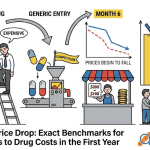
Phase 1 (The Step): During the 180-day exclusivity period with a single generic competitor, the brand typically loses 30-40% of its market share. The generic price is usually 15-30% lower than the brand.
Phase 2 (The Cliff): Once the 180 days expire and multiple generics (often 6 to 10+) enter the market, the price collapses. With six or more competitors, the generic price drops to 5-10% of the brand price. The brand’s market share plummets to a “stub” of less than 5%, comprised mostly of patients who medically require the brand (“Dispense as Written”).
Forecasting Rule: Analysts model this as a “step function” drop at Month 1 followed by a vertical cliff at Month 7. The revenue curve resembles a capitalization table more than a sales forecast.10
Biosimilars: The Gradual Slope
Biologics—large, complex molecules produced in living cells—do not face a patent cliff; they face a “patent slope.”
No Automatic Substitution: Unlike small molecules, biosimilars are generally not automatically substitutable at the pharmacy counter unless they have achieved the high regulatory bar of “Interchangeability.” Adoption relies on convincing physicians to prescribe the biosimilar and, more importantly, convincing PBMs to cover it.
The Curve: Erosion is slower and shallower. A biosimilar might capture only 40-60% market share after three years, compared to 90% in three months for a small molecule.
Price Erosion: Prices typically drop only 30-50%, not 90%. Brand manufacturers defend their market share by building “rebate walls”—offering aggressive volume-based rebates to PBMs to keep the biosimilar off the formulary or in a disadvantaged tier.
Forecasting Nuance: The key variable here is not just “launch date” but “payer access.” A forecast must model the net price competition and the likelihood of the biosimilar securing “preferred” status on major formularies. The launch is less of a volume game and more of a contracting battle.25
Complex Generics: The Middle Ground
Complex generics—drugs with difficult-to-copy formulations, such as inhalers, long-acting injectables, or topical creams—occupy a strategic middle ground.
Barriers to Entry: Proving bioequivalence for a topical cream (showing it penetrates the skin at the same rate and depth) is scientifically harder than for a pill dissolving in the stomach. This limits the number of competitors capable of entering the market.
The Curve: Instead of 10 generics launching on Day 1, the market might see 2 or 3 competitors launching over the course of a year. Price erosion settles at approximately 50-70% of the brand price, rather than 95%.
Supply Chain Constraints: Unlike oral solids, which can be manufactured in massive quantities, complex generics often face manufacturing difficulties. Shortages are common, leading to price instability and slower uptake curves. Forecasting these products requires analyzing the manufacturing capacity and technical track record of the specific generic applicants.28
Market Erosion Comparison Matrix
Feature
Small Molecule Generics
Biosimilars
Complex Generics
Substitution
Automatic (Pharmacy level)
Prescriber/Payer driven
Automatic (usually)
Price Erosion
>90% (with multiple entrants)
30% – 50%
50% – 70%
Market Share Loss
>90% in <12 months
40% – 60% in 3 years
Gradual, supply-constrained
Key Barrier
Patent Litigation
Payer Rebates / Physician Trust
Manufacturing / Bioequivalence
Forecast Model
“Cliff” (Step function)
“Slope” (Diffusion curve)
Hybrid (Step with slow tail)
Part V: Policy Winds – The Structural Disruptors
External policy shocks are currently forcing a fundamental recalibration of all long-term pharmaceutical forecasts. The “rules of the game” are being rewritten in real-time.
The Inflation Reduction Act (IRA) and the “Pill Penalty”
The Inflation Reduction Act (IRA) has introduced a massive distortion in the market known as the “Pill Penalty.”
The Mechanism: The IRA authorizes Medicare to negotiate prices for top-spending drugs. Crucially, small molecule drugs become eligible for negotiation 9 years after approval, whereas biologics are protected for 13 years.
The Impact: This 4-year differential fundamentally alters the investment thesis. Forecasters are observing a shift in R&D capital away from small molecules toward biologics. For the generic industry, this implies a future “supply cliff”—fewer small molecules developed today means fewer generic opportunities in the 2030s.
Negotiation as “De Facto” LOE: The “Maximum Fair Price” (MFP) set by the government acts as a premature loss of exclusivity. If the government negotiates the brand price down significantly before patent expiry, the profit margin for a potential generic competitor shrinks. If the MFP is set low enough, it may disincentivize generic entry entirely, as the return on investment for litigation and development becomes negligible. Models must now include “IRA Negotiation Year” as a critical node alongside “Patent Expiry Year”.30
FTC Crackdown: Ending “Pay-for-Delay”
The Federal Trade Commission (FTC) has launched an aggressive campaign against anti-competitive practices, specifically targeting “Pay-for-Delay” settlements (where a brand pays a generic to delay its launch) and improper Orange Book listings.
Trend: The era of easy settlements is ending. The FTC has issued warning letters to companies listing patent types that don’t belong in the Orange Book (e.g., device patents or REMS patents) to trigger 30-month stays.
Forecasting Implication: The assumption that “they will just settle for a later date” is increasingly risky. We are moving toward a more binary landscape: either the generic wins the litigation and launches early, or they lose and are blocked. The “negotiated middle ground” is shrinking, increasing the volatility of launch dates. Forecasters must assign a higher probability to “at-risk” launches and litigation verdicts rather than settlement scenarios.34
Part VI: Strategic Forecasting in Action – Case Studies
The Cautionary Tale: Plavix (Clopidogrel)
The Setup: Bristol-Myers Squibb’s Plavix was a titan of the cardiovascular market, generating $4 billion annually. Apotex, a generic challenger, filed a PIV certification challenging the validity of the key patent.
The Event: In 2006, after settlement talks collapsed under regulatory scrutiny, Apotex made the audacious decision to launch “at-risk.”
The Result: Apotex flooded the channel for just 23 days before a court injunction halted them. In those three weeks, they shipped enough product to satisfy market demand for months, crippling Plavix sales. However, Apotex ultimately lost the patent trial. They were liable for BMS’s lost profits and settled for over $442 million.
Forecasting Lesson: A model based solely on “patent expiration” would have missed this event entirely. A probabilistic model incorporating “litigation volatility” and game theory would have flagged the high risk of an at-risk launch following the breakdown of settlement talks. It highlights the need to model “tail risks” that have low probability but massive impact.3
The Current Battlefield: Xarelto (Rivaroxaban)
The Setup: Bayer’s Xarelto is a blockbuster anticoagulant. The primary composition of matter patent was set to expire in August 2024, but was extended to February 2025 due to pediatric exclusivity.
The Twist: A key dosage patent (the ‘053 patent), which would have protected the drug until late 2025, was revoked by courts in Europe and heavily challenged in the U.S.
The Launch: As projected by current data, the first generic 2.5mg tablets received FDA approval in March 2025.
Forecasting Lesson: This case illustrates the fragmented nature of global IP. While the patent fell in Europe, the U.S. market protection held longer due to specific pediatric exclusivity provisions. It underscores that accurate forecasting requires a country-by-country legal analysis; a generic launch in Germany does not guarantee an immediate launch in the U.S..37
The Regulatory Play: Zoryve (Roflumilast)
The Setup: Arcutis’s Zoryve faced potential generic challenges.
The Tactic: Arcutis filed a Citizen Petition in late 2023, raising highly technical arguments about the safety of excipients in generic formulations.
The Outcome: The petition created a “shadow” timeline. Even if a generic applicant proved bioequivalence, the FDA was administratively burdened with reviewing and responding to the petition before granting final approval.
Forecasting Lesson: Monitor the FDA docket. A filed CP is a leading indicator of a delay strategy. It forces the forecaster to add a “regulatory delay buffer” (typically 150 days) to the expected approval timeline, regardless of the patent status.19
Part VII: Advanced Toolkit – Turning Data into Competitive Advantage
To move from “guessing” to “forecasting,” industry professionals utilize a specific stack of intelligence tools and methodologies.
DrugPatentWatch: The Rosetta Stone of IP
In the fragmented world of pharmaceutical IP, DrugPatentWatch acts as a central intelligence hub. It integrates:
Orange Book Data: Identifying the “exclusivity stack” (patents + regulatory exclusivity).
Litigation Feeds: Tracking PIV filings, court dockets, and judge assignments in real-time.
Market Data: Estimating the value of the “prize” (market size) to determine the likelihood of a challenge. For a forecaster, this platform transforms disparate data points—a court filing in Delaware, a patent term extension in Virginia, a tentative approval in Maryland—into a coherent, actionable timeline. It allows for the visualization of the “patent cliff” not as a single date, but as a crumbling wall with specific weak points.4
Monte Carlo Simulation: Embracing Uncertainty
Rather than predicting a single date (e.g., “July 15, 2026”), advanced teams use Monte Carlo Simulation.
Methodology: The simulation runs thousands of scenarios using probability distributions for key variables.
Litigation Win Probability: e.g., Beta distribution (mean 60%).
Settlement Probability: e.g., 30%.
FDA Approval Timeline: Normal distribution centered on 10 months.
Citizen Petition Delay Risk: Binary flag (Yes/No).
Output: The result is a probability distribution of launch dates. “There is a 90% confidence interval that the generic will launch between Q2 2026 and Q4 2026.” This allows finance teams to hedge risk and plan budgets with a clear view of the “worst-case” (early launch) and “best-case” (delayed launch) scenarios.1
Physiologically Based Pharmacokinetic (PBPK) Modeling
For complex generics, where proving bioequivalence is the primary hurdle, forecasters use PBPK modeling. This in silico method simulates how a drug dissolves and permeates the body. By modeling the generic formulation against the brand, companies can predict the likelihood of passing the FDA’s bioequivalence tests before running expensive clinical trials. A high PBPK success score increases the probability of an on-time launch; a low score suggests formulation struggles and potential delays.45
Key Takeaways
The Date is a Distribution, Not a Point: Never rely on a single patent expiration date. The true launch date is a probability function of litigation outcomes, regulatory stays, and settlement negotiations. Use Monte Carlo simulations to quantify this range.
Litigation is the Primary Driver: For high-value drugs, the courtroom matters more than the lab. Track Paragraph IV certifications, judge profiles, and legal win rates as closely as clinical trial results.
Biosimilars $\neq$ Generics: Do not apply small-molecule erosion curves to biologics. The “slope” of biosimilar uptake is defined by payer contracts, rebate walls, and physician behavior, not just pharmacy substitution.
Policy Shifts are Accelerating: The IRA and FTC actions are structural disruptors. The “Pill Penalty” will fundamentally alter the supply of future generics, and the crackdown on “pay-for-delay” is making launch dates more volatile.
Use the Right Tools: Leverage platforms like DrugPatentWatch to synthesize legal data and statistical models to quantify the unknown. Intuition is not a strategy.
FAQ: Expert Insights
Q1: How does the “Skinny Label” strategy affect generic launch forecasting?
A: “Skinny labeling” (Section viii carve-out) allows a generic to launch by omitting a specific patented indication from its label. For example, if a drug is approved for both Heart Failure (off-patent) and Diabetic Nephropathy (on-patent), the generic can launch with a label only for Heart Failure.
Forecast Impact: This allows generics to launch years before the full patent thicket expires. Forecasters must analyze the revenue split between indications. If 80% of the brand’s volume is for the off-patent indication, a skinny label launch effectively destroys the brand franchise, even if the patent technically holds.
Q2: Why do “Authorized Generics” (AGs) matter in my erosion model?
A: An Authorized Generic is the brand company’s own generic version, launched to compete with the generic entrants.
Forecast Impact: The launch of an AG effectively splits the generic market. It reduces the profitability for the independent generic (the first-filer), disincentivizing them from challenging future patents. In your model, an AG launch means the brand company retains a portion of the generic revenue stream, slightly mitigating the “cliff.”
Q3: Can AI predict the outcome of a Paragraph IV lawsuit better than a lawyer?
A: Surprisingly, often yes—in terms of raw probability. AI models trained on thousands of patent cases can identify patterns (e.g., “Judge X in District Y rules for the generic in 70% of bioequivalence disputes”) that human lawyers might miss due to cognitive bias. However, AI struggles with “novel” legal arguments. The best approach is “Centaur Forecasting”: AI sets the baseline probability, and human legal experts adjust for case-specific nuances.
Q4: How does the “30-month stay” interact with the “180-day exclusivity”?
A: These are distinct but interacting clocks. The 30-month stay stops the FDA from approving the generic while litigation is ongoing. The 180-day exclusivity is a reward for the first challenger, blocking other generics from launching for 6 months after the first one enters.
Scenario: If the litigation drags on for 40 months, the 30-month stay expires, and the generic can launch at-risk. If they win the case at month 35, they launch, triggering their 180-day clock. Forecasting requires aligning these two timelines to see if they overlap or run consecutively.
Q5: What is the “Pill Penalty” in the Inflation Reduction Act, and why should I care?
A: The “Pill Penalty” refers to the IRA’s provision that makes small molecule drugs eligible for price negotiation 9 years after approval, versus 13 years for biologics.
Strategic Impact: This 4-year gap is massive in present-value terms. It forces companies to prioritize biologic R&D. For generic forecasters, this means the “feedstock” of future generic opportunities (small molecules) may shrink in the 2030s as the industry pivots to biologics, which face slower biosimilar erosion but higher barriers to entry.
On Absorption Modeling and Food Effect Prediction of Rivaroxaban, a BCS II Drug Orally Administered as an Immediate-Release Tablet – MDPI, accessed December 11, 2025, https://www.mdpi.com/1999-4923/13/2/283