Introduction: Beyond Legal Jargon – Why Patent Searching is a Core Business Competency
The pharmaceutical industry operates at a unique nexus of profound scientific discovery, immense financial investment, and high-stakes risk.1 It is a domain where the journey from a single promising molecule to a market-approved, life-saving therapy can take over a decade and consume billions of dollars in capital.2 In this unforgiving landscape, a company’s success or failure often hinges not just on the brilliance of its science, but on its ability to strategically protect and leverage its intellectual property (IP). Within this ecosystem, pharmaceutical patents are far more than mere legal documents; they are the fundamental pillars upon which the entire drug development model is built. They are the essential legal and financial instruments that enable companies to recoup their staggering investments, attract further capital, and ultimately, fuel the engine of future innovation.1
For the modern business professional operating within this sphere—be it in business development, competitive intelligence, R&D portfolio management, or investment—understanding the intricacies of the patent system is no longer a peripheral skill delegated solely to the legal department. It has become a core business competency. And at the heart of this competency lies the art and science of drug patent searching.
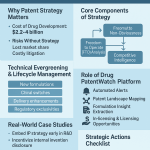
Historically, patent searching may have been viewed through a narrow, defensive lens: a necessary but cumbersome legal check to avoid infringement before a product launch. This perspective is now dangerously obsolete. The strategic paradigm has shifted. Today, sophisticated market leaders understand that patent searching is a proactive, offensive tool for value creation. It is the primary mechanism for gathering competitive intelligence, mapping technological landscapes, identifying untapped market opportunities, and making data-driven strategic decisions that can define a company’s trajectory for years to come.6
The very structure of the pharmaceutical business model demands this strategic evolution. Patents are the foundational financial assets of any innovator company. They are explicitly designed to provide a period of market exclusivity, allowing a firm to set prices that can recover the “substantial costs in research and development”. This exclusivity makes a patented drug a tangible asset that can be “worth millions of dollars,” offering a “clear path to profitability for investors” and serving as a crucial “insurance policy” to de-risk the monumental capital required for clinical trials.1 If patents are the core financial and strategic assets, then the act of searching, analyzing, and interpreting those assets cannot be a mere administrative task. It must be a central business function, deeply integrated into every stage of the drug lifecycle.
A company’s sophistication in patent searching, therefore, serves as a direct proxy for its strategic maturity. An organization that only conducts a “freedom to operate” search at the eleventh hour is playing defense, reacting to a landscape that has already been shaped by others. In contrast, a market leader leverages patent intelligence from the earliest stages of discovery to guide R&D, monitor competitors’ pipelines in near real-time, identify potential acquisition targets, and anticipate market shifts long before they appear in financial reports or press releases. This report is designed to equip you, the business professional, with the foundational knowledge and strategic frameworks necessary to make that leap—to transform patent data from a legal hurdle into your most powerful competitive weapon.
Part I: The Strategic Landscape of Pharmaceutical Patents
The Bedrock of Biopharma: Understanding the Purpose and Power of a Drug Patent
To effectively search for and interpret drug patents, one must first grasp their fundamental purpose and the powerful economic forces they command. A drug patent is not merely a certificate of invention; it is a carefully constructed legal and economic instrument designed to solve a specific market failure inherent in pharmaceutical innovation.
The Quid Pro Quo: Exclusivity in Exchange for Innovation
At its core, the patent system represents a grand bargain, a quid pro quo between society and the innovator. Society grants the inventor a temporary, legally enforceable monopoly—the exclusive right to make, use, sell, and import their invention for a defined period, typically 20 years from the date of filing.5 In exchange for this powerful grant of exclusivity, the inventor must publicly disclose their invention in sufficient detail to enable a person “skilled in the art” to replicate it.11
This exchange is the engine of the pharmaceutical industry. The promise of a temporary monopoly provides the powerful financial incentive necessary for companies to commit the immense resources required for drug R&D. Without this protection, a competitor could simply wait for an innovator to spend a decade and billions of dollars proving a drug is safe and effective, then reverse-engineer the molecule and sell a copy at a fraction of the price, completely undercutting the innovator’s ability to recoup their costs. The patent, therefore, acts as a shield, ensuring that the fruits of a long, expensive, and high-risk endeavor can be harvested, with those profits then being reinvested into the next wave of research.2 This system is so foundational that even non-profit institutions and universities will patent their discoveries to make them attractive assets for for-profit partners who can fund the costly later stages of clinical development.
The Inherent Tension: Innovation vs. Access
This system, however, contains an inherent and unavoidable tension. The very mechanism that fuels innovation—market exclusivity—is also the primary driver of high drug prices.5 As the sole source for a particular drug, the patent holder faces no direct competition, allowing them to set a price based on what the market will bear and what is needed to recover their vast investment. The direct impact of this monopoly is starkly illustrated the moment a patent expires. The entry of generic competitors invariably leads to a “significant drop in drug costs,” making life-saving medicines more accessible to the general population.
This dynamic creates a constant push-and-pull in the public and political spheres. Critics argue that innovator companies engage in practices to “unduly extend the period of exclusivity” to “keep drug prices high,” often for minor improvements that offer little additional therapeutic benefit. Innovator companies counter that robust and predictable patent protection is the only way to justify the continued pursuit of high-risk research into diseases like cancer, Alzheimer’s, and rare genetic disorders.2
For the business professional, this is not a philosophical debate to be observed from the sidelines. This “tension” is a core, predictable feature of the market and represents a significant and ongoing business risk. The public and political pressure over drug pricing can lead to policy changes, increased regulatory scrutiny from bodies like the Federal Trade Commission (FTC), and aggressive reimbursement negotiations from payers.9 Therefore, a successful IP strategy is incomplete without a corresponding market access and public affairs strategy that can articulate and defend the value of the innovation to all stakeholders—patients, physicians, payers, and policymakers. Managing this tension is as critical as managing the patent portfolio itself.
A Fortress of Protection: The Anatomy of a Modern Drug Patent Portfolio
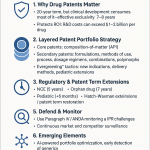
In the modern pharmaceutical landscape, a blockbuster drug is rarely protected by a single patent. Instead, it is shielded by a multi-layered “fortress” of intellectual property, a strategically constructed portfolio of different patent types designed to protect the asset from every conceivable angle and throughout its entire commercial lifecycle. This evolution from a “molecule-centric” to a “lifecycle-centric” IP strategy is one of the most significant developments in the industry. Understanding the different components of this fortress is essential for any meaningful patent analysis.
The Crown Jewel: Composition of Matter Patents
The foundational layer of protection, often considered the “gold standard” or “crown jewel” of a drug’s IP portfolio, is the composition of matter patent.16 This type of patent, also known as an active pharmaceutical ingredient (API) or compound patent, covers the core chemical entity itself.17 Its power lies in its breadth; if the molecule is present in a product, the patent applies, regardless of how it was manufactured, what it is formulated with, or for which disease it is being used.16 This provides the most robust and “iron-clad” protection against generic competition during its term. For investors and competitors alike, the status and remaining term of the core composition of matter patent is the single most important piece of IP intelligence for a new drug.
Expanding the Moat: Formulation, Delivery, and Combination Patents
Building upon this foundation, companies expand their protective moat with patents on subsequent innovations. Formulation patents protect the unique combination of the active ingredient with other components (excipients) that make up the final drug product.17 This could cover an extended-release tablet that allows for once-daily dosing, a specific coating that improves stability, or a novel delivery mechanism like a transdermal patch.19 These patents are strategically vital for improving patient compliance and can provide additional years of market exclusivity even after the core compound patent has expired.16
Similarly, combination patents protect therapies that combine two or more active ingredients into a single product.4 This is particularly common in complex diseases like HIV/AIDS or cancer, where multi-faceted therapeutic approaches are required.
New Tricks for an Old Drug: Method-of-Use Patents
A powerful strategy for lifecycle management involves securing method-of-use patents.16 These patents do not protect the drug itself but rather a specific, novel method of using it to treat a particular disease or condition.9 For instance, a company might discover that a drug originally approved and patented for treating hypertension is also highly effective at preventing migraines. By conducting new clinical trials and securing a method-of-use patent for this new indication, the company can gain a fresh period of market exclusivity specifically for the use of that drug in treating migraines, even if the original compound patent is nearing expiration.
The “How-To”: Process and Manufacturing Patents
Process patents protect the specific method of manufacturing a drug, rather than the drug product itself.17 While historically viewed as less potent for small-molecule drugs (as competitors could potentially “design around” the process to create the same final molecule), they are absolutely critical in the world of biologics. Biologic drugs, such as monoclonal antibodies, are large, complex molecules produced in living systems. The manufacturing process is incredibly intricate and is considered to define the final product. A strong portfolio of process patents can create a formidable barrier to entry for biosimilar competitors, who must demonstrate that their product is highly similar to the innovator’s without infringing on these manufacturing secrets.9
The “Patent Thicket” Strategy: Layering IP for Maximum Defense
When these different patent types are combined, they form what is known as a “patent thicket”—a dense, overlapping portfolio of numerous patents covering a single product. Critics often label this strategy as “evergreening,” arguing it is used to unfairly extend monopolies beyond the original 20-year term for trivial innovations.9 From a business strategy perspective, however, it is the logical execution of a lifecycle-centric IP approach. The initial composition of matter patent is not the end of the IP story; it is the beginning. The subsequent layering of formulation, method-of-use, and process patents is a deliberate, long-term business plan to build a multi-layered fortress around a blockbuster asset, maximizing its value and creating significant legal and financial hurdles for any potential competitor.9 Analyzing a drug’s patent protection, therefore, requires mapping out this entire thicket, not just looking at a single patent’s expiration date.
The Patent Cliff and the Generic Wave: An Adversarial Symbiosis
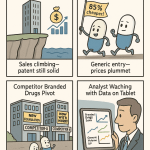
The culmination of a drug’s patent lifecycle is a dramatic and market-redefining event known as the “patent cliff”. This term describes the sharp and often precipitous decline in a blockbuster drug’s sales revenue that occurs upon the loss of its primary patent protection and the subsequent market entry of low-cost generic versions.14 Once the monopoly is removed, fierce price competition ensues, and it is not uncommon for the original branded drug to lose upwards of 80-90% of its market share within a year or two.
This dynamic creates a fascinating and predictable adversarial relationship between the innovator and generic sectors. The innovator’s greatest financial threat—the expiration of its patents—is the generic industry’s foundational business model. Generic companies do not engage in the high-risk, high-cost discovery R&D of innovator firms. Instead, their strategy revolves around identifying high-value drugs with approaching patent expiries, developing bioequivalent versions, and challenging the innovator’s patents to enter the market at the earliest possible moment.14
This creates a highly structured and cyclical “game” governed by the rules of patent law and FDA regulations. Innovator companies will invariably use the strategies described above—building patent thickets and leveraging every available extension—to prolong their market exclusivity for as long as possible. Generic companies, in turn, will meticulously search for weaknesses in that patent fortress, looking for invalidity arguments or non-infringing formulations that can provide a pathway to early market entry.14 For any business professional in this industry, this dynamic is not chaotic; it is a predictable cycle. Understanding the timing, strategies, and legal levers that define this adversarial symbiosis is essential for accurate financial forecasting, strategic planning, and competitive assessment in both the branded and generic pharmaceutical markets.
Part II: Navigating the Patent and Exclusivity Lifecycle
The 20-Year Illusion: Deconstructing the True “Effective Patent Life”
One of the most critical concepts for any business professional in the pharmaceutical industry to understand is the vast difference between a patent’s statutory term and its effective life. While the law grants a patent term of 20 years from the date of filing, this number is, for all practical purposes, an illusion when it comes to market exclusivity.11
The clock on that 20-year term starts ticking the moment the initial patent application is filed with the U.S. Patent and Trademark Office (USPTO). However, pharmaceutical companies must file for patent protection very early in the development process, often as soon as a promising molecule is identified in preclinical research.4 What follows is a long, arduous, and capital-intensive journey through multiple phases of clinical trials and a rigorous regulatory review process by the Food and Drug Administration (FDA) before the drug can be legally marketed.
This development timeline is a massive “time sink” that directly erodes the patent term. The entire journey from initial discovery to market launch takes, on average, 12 to 15 years. This means that a substantial portion of the 20-year statutory term—often 10 to 15 years—is consumed before the company can generate a single dollar of revenue from the patented product. Consequently, the actual period during which the innovator company enjoys exclusive sales after market launch, known as the “effective patent life,” can be “closer to 7 to 10 years” in many instances.14
This fundamental mismatch between the 20-year legal term and the ~10-year commercial reality creates immense financial pressure. It is the single most powerful economic force shaping the strategic behavior of the innovator pharmaceutical industry. When a company has only a decade or less to recoup a multi-billion dollar R&D investment, every day of market exclusivity becomes incredibly valuable. This “effective life” dilemma is the primary driver behind nearly every major business and IP strategy in the sector. It necessitates high launch prices to have any hope of achieving a return on investment within the compressed “recoupment window,” and it provides a powerful incentive to pursue every available legal and regulatory mechanism to extend that window, giving rise to the lifecycle-centric IP strategies and patent thickets discussed previously.
Clawing Back Time: A Professional’s Guide to Patent Term Extensions and Regulatory Exclusivities
In recognition of the unique burden that pre-market regulatory review places on the effective life of pharmaceutical patents, the U.S. legal and regulatory framework provides several mechanisms to restore or add periods of market protection. For the business strategist, these are not mere legal technicalities; they are critical assets that must be understood, planned for, and factored into any valuation or competitive model. These protections fall into two distinct categories: patent term extensions granted by the USPTO and regulatory exclusivities granted by the FDA.
The Hatch-Waxman Bargain: Patent Term Extension (PTE)
The landmark Drug Price Competition and Patent Term Restoration Act of 1984, commonly known as the Hatch-Waxman Act, fundamentally reshaped the pharmaceutical landscape.25 It created the modern abbreviated pathway for generic drug approval, but in a crucial bargain with the innovator industry, it also created a mechanism to partially compensate for the erosion of patent life due to regulatory delays. This mechanism is
Patent Term Extension (PTE).28
PTE allows the owner of a patent covering an FDA-approved drug to restore a portion of the patent term that was lost during the drug’s clinical testing and regulatory review phases.25 The calculation is generally as follows:
One-half of the time spent in the clinical testing period (the time between the Investigational New Drug (IND) application becoming effective and the submission of the New Drug Application (NDA)).
The full time spent in the regulatory review period (the time between the NDA submission and its approval by the FDA).
However, this restoration is subject to several important statutory limits:
The total extension period cannot exceed five years.28
The total remaining patent term after the extension is applied cannot exceed 14 years from the date of the drug’s approval.28
The application for PTE must be submitted to the USPTO within a strict 60-day window following the drug’s marketing approval.27
Only one patent can be extended for any given drug approval, making the selection of which patent to extend a critical strategic decision for the innovator company.
Beyond Patents: Understanding FDA Regulatory Exclusivities
Entirely separate from the patent system administered by the USPTO are regulatory exclusivities, which are granted by the FDA upon the approval of a new drug.30 These are statutory prohibitions that prevent the FDA from approving a competing generic drug for a specified period, regardless of the patent status of the innovator product. These exclusivities can run concurrently with patents and provide a distinct and vital layer of market protection.30
This independence from the patent portfolio makes regulatory exclusivities a critical strategic backstop or “insurance policy” for innovator companies. A patent can be challenged in court and invalidated at any time, potentially opening the door to immediate generic competition. However, if a period of regulatory exclusivity is still in effect, the FDA is barred from approving a generic, providing a guaranteed floor of market protection even if the patent fortress is breached. For an investor or competitor, calculating a drug’s true loss of exclusivity (LOE) date requires a two-part analysis: determining the expiration date of the relevant patents (including any PTE) and determining the expiration date of any applicable FDA exclusivities. The true LOE date is the later of these two.
The most common and strategically important types of FDA exclusivity include:
New Chemical Entity (NCE) Exclusivity: A drug containing an active ingredient never before approved by the FDA is granted five years of data exclusivity from the date of its approval.1 During this period, the FDA cannot even accept an Abbreviated New Drug Application (ANDA) from a generic manufacturer for the first four years (if the generic challenges a patent).
Orphan Drug Exclusivity (ODE): To incentivize the development of treatments for rare diseases (affecting fewer than 200,000 people in the U.S.), the FDA grants seven years of market exclusivity to a drug approved with an orphan designation.1
New Clinical Investigation Exclusivity: A drug can receive three years of exclusivity for a new application, such as for a new indication, dosage form, or strength, if new clinical investigations were essential to the approval.
Pediatric Exclusivity (PED): This is a powerful incentive to encourage drug testing in children. If a company conducts pediatric studies requested by the FDA, it is granted an additional six months of exclusivity. Critically, this six-month period is tacked on to all existing patents and exclusivities for that active ingredient, making it a highly valuable extension.29
180-Day Generic Exclusivity: As an incentive for generics to challenge innovator patents, the Hatch-Waxman Act grants a 180-day period of market exclusivity to the first generic company that successfully files an ANDA with a Paragraph IV certification (a challenge to the innovator’s patent).
Part III: The Art and Science of the Search: A Practical Guide
Defining Your Mission: From Broad Landscapes to Surgical Strikes
Before a single keyword is entered into a database, the most critical step in any patent search is to clearly define the business objective. The “why” behind the search dictates the “how”—the scope, the methodology, the tools used, and the interpretation of the results. Different business questions require fundamentally different types of searches, ranging from broad, exploratory analyses to highly targeted, surgical strikes.
Patentability/Novelty Search
This is the foundational search conducted early in the R&D process. It addresses the core question: “Is our invention new, and can we secure a patent for it?” The goal is to uncover any “prior art”—existing patents, publications, or other public disclosures—that might prevent a patent from being granted on the grounds that the invention is not novel or is obvious.32 A thorough patentability search saves immense time and resources by preventing investment in R&D for an invention that cannot be protected.
Freedom-to-Operate (FTO) Search
As a product moves closer to commercialization, the FTO search becomes paramount. It answers the critical risk-mitigation question: “Can we launch our product without infringing on someone else’s active, in-force patents?”.35 Unlike a patentability search, which looks at all prior art, an FTO search focuses specifically on the claims of unexpired patents in the specific jurisdictions where the product will be marketed.37 A negative FTO opinion, which identifies a “blocking patent,” is a major red flag that can halt a product launch, trigger costly litigation, or force a company to license technology from a competitor.35
Invalidity/Validity Search
This is an offensive or defensive search that asks the litigation-focused question: “Is a competitor’s patent weak enough to be challenged and invalidated?”.32 A generic company planning a market entry will conduct an invalidity search to find prior art that the original patent examiner may have missed, which could be used to invalidate the innovator’s patent in court or through a proceeding like an
Inter Partes Review (IPR) at the USPTO’s Patent Trial and Appeal Board (PTAB). Conversely, an innovator company might conduct a validity search on its own patents before asserting them in a lawsuit to understand their strengths and weaknesses.
Competitive Intelligence & Landscaping
This is the most strategic and forward-looking type of search. It answers broad business questions: “What are our competitors working on? Where is the technology heading? And where are the untapped opportunities (‘white spaces’)?”.7 A patent landscape analysis involves searching and analyzing all patents within a defined technology area to map out the competitive environment, identify key players, track R&D trends over time, and discover areas with low patenting activity but high commercial potential.41
While all these search types are vital, they exist on a clear hierarchy of strategic value. Patentability and FTO searches are foundational, defensive necessities—they establish what a company can and cannot do, preventing negative outcomes like wasted R&D spending or infringement lawsuits. Competitive intelligence and landscaping, however, are proactive, opportunity-seeking activities that drive growth. They are about understanding what others are doing and what your company could be doing. A company that routinely performs landscaping analyses is playing offense, using patent data to actively shape its long-term business and R&D strategy, indicating a shift from a reactive, legal-centric view of IP to a proactive, business-centric one.
Your Search Arsenal: Choosing the Right Tools for the Job
Once the mission is defined, the next step is to select the appropriate tools. The patent information landscape is vast, and the choice of database can significantly impact the efficiency, accuracy, and strategic value of a search.
The Public Domain: Free Government Databases
Several government patent offices provide powerful search tools free of charge, making them an indispensable resource for any professional.
USPTO Patent Public Search: The official database for U.S. patents and published applications, replacing older tools like PatFT and AppFT. It offers both basic and advanced search interfaces with full query options.43
Espacenet (European Patent Office): An exceptional global resource providing access to over 150 million patent documents from around the world. Its features include machine translation and tools like the Global Dossier, which allows users to view the prosecution history of patent families across multiple offices.
PATENTSCOPE (World Intellectual Property Organization): The primary repository for published international Patent Cooperation Treaty (PCT) applications, offering an early look at inventions seeking global protection. It also includes the national patent collections of many participating offices.46
While these free databases offer incredible breadth, their utility for high-stakes strategic analysis can be limited. They often present raw, uncurated data and may lack the advanced analytical and visualization tools needed to extract business intelligence efficiently.48
The Commercial Powerhouses: Subscription-Based Intelligence Platforms
Commercial patent databases offer significant advantages over their free counterparts by investing heavily in data curation, advanced search functionalities, and powerful analytics. Platforms like CAS STNext, Clarivate’s Derwent World Patents Index (DWPI), IQVIA, and PatSeer provide value-added features such as:
Cleaned and Standardized Data: Correcting errors in assignee names and legal status information.
Advanced Search Capabilities: Including sophisticated chemical structure and biologic sequence searching.
Integrated Non-Patent Literature: Combining patent data with scientific journal articles and conference proceedings.
Analytics and Visualization Tools: Generating patent landscape maps, trend analyses, and competitive dashboards.49
The Specialist Advantage: Why Integrated Platforms are Crucial for Pharma
For the pharmaceutical industry, a third category of specialized intelligence platforms offers the highest strategic value. Platforms such as DrugPatentWatch are designed specifically for the biopharma ecosystem. Their key advantage is the deep integration of disparate but critically linked datasets. They don’t just provide patent information; they connect it directly to:
FDA Regulatory Data: Including Orange Book listings, exclusivities, and tentative approvals.
Litigation Records: Tracking patent challenges in District Courts and at the PTAB.53
Clinical Trial Information: Linking patents to drugs in development.53
Commercial Data: Including drug prices and sales histories.
This integration creates a holistic intelligence picture that is essential for answering complex, pharma-specific business questions. It allows a user to move seamlessly from a patent’s expiration date to its litigation history, its associated clinical trials, and the commercial performance of the drug it protects—a capability impossible to replicate efficiently using general-purpose databases.53
For business professionals who must justify subscription costs, the value proposition is clear. While free tools are suitable for basic lookups, answering strategic questions about market entry timing, competitive threats, or licensing opportunities requires the curated, integrated intelligence that only a specialized commercial platform can provide.
Mastering the Craft: Core Search Methodologies Explained
An effective patent search is rarely a single query. It is an iterative, multi-modal process where different search methodologies are combined to build a comprehensive picture of the prior art and competitive landscape. The results from one technique often become the starting point for the next, creating a virtuous cycle of discovery and refinement.
Keyword Searching
The most intuitive approach is searching by keywords. This involves brainstorming a list of terms that describe the invention, including scientific names, brand names, generic names, synonyms, and related therapeutic concepts.57 For example, a search for a new painkiller might include terms like “analgesic,” “pain relief,” “anti-inflammatory,” and “nociception inhibitor”. While essential, keyword searching is notoriously prone to both missing relevant documents (if the right synonym isn’t used) and retrieving irrelevant “noise” (if a term has multiple meanings).
Classification Searching (CPC/IPC)
To overcome the ambiguity of keywords, professional searchers rely heavily on patent classification systems. These are hierarchical, language-independent coding systems maintained by patent offices to categorize inventions by their technical area.19 The two main systems are the
International Patent Classification (IPC) and the more granular Cooperative Patent Classification (CPC), which is jointly managed by the EPO and USPTO.61 For example, the CPC class
A61K 31/ covers “Medicinal preparations containing organic active ingredients,” while C07D covers “Heterocyclic compounds”. Searching by classification code allows for a much more structured and comprehensive retrieval of all patents within a specific technology domain, regardless of the specific keywords used by the inventors.
Assignee & Inventor Searching
This is a powerful competitive intelligence technique focused on tracking the patenting activity of specific entities.1 By searching for a company’s name in the “assignee” field, one can retrieve its entire patent portfolio, revealing its R&D focus, key technologies, and strategic direction.64 Similarly, searching for key scientists in the “inventor” field can track the work of influential researchers, even as they move between companies or academic institutions.
Citation Searching
Citation searching is a highly effective method for navigating the web of interconnected innovations. Every patent cites earlier documents (“backward citations”) that are considered relevant prior art, and in turn, is cited by later patents (“forward citations”) that build upon its technology.57
Backward Citation Search: Following the trail of backward citations from a known relevant patent is an excellent way to find foundational prior art and understand the technological lineage of an invention.67
Forward Citation Search: Analyzing the patents that cite a key patent is a strong indicator of that patent’s importance and influence. A patent that receives many forward citations is likely a significant piece of technology that others are actively trying to improve upon or design around.66
A truly comprehensive search integrates these methods. A searcher might begin with keywords to find a few highly relevant patents. They would then analyze those patents to identify the most relevant CPC classifications and key assignees. New searches would be run using these classifications and assignee names. Finally, forward and backward citation searches would be performed on the most critical documents to uncover related art that was missed in the initial queries.
Constructing the Perfect Query: A Primer on Search Syntax
To effectively execute these methodologies, a searcher must speak the language of the database. This involves using specific operators and syntax to construct precise queries that maximize relevant results (recall) while minimizing noise (precision).
Boolean Logic (AND, OR, NOT)
These are the fundamental grammatical operators for combining search terms 69:
AND: Narrows a search. A AND B retrieves documents containing both term A and term B.
OR: Broadens a search. A OR B retrieves documents containing either term A, term B, or both. This is essential for combining synonyms (e.g., (aspirin OR acetylsalicylic acid)).
NOT: Excludes terms. A NOT B retrieves documents containing term A but not term B. This should be used with caution as it can inadvertently exclude relevant results.
Parentheses () are used to group terms and control the order of operations, just as in mathematics.69 For example,
(cancer OR oncology) AND antibody is a very different search from cancer OR (oncology AND antibody).
Wildcards & Truncation (*,?)
Wildcards are symbols used to search for variations of a word root, which is crucial for capturing plurals, different tenses, and related terms.60
The asterisk * is a common truncation symbol that stands for zero or more characters. For example, immuno* would find immunology, immunotherapy, immunomodulatory, and immune.
The question mark ? often stands for a single character. For example, t?re could find both tire and tyre.
Proximity Operators (NEAR, ADJ)
Proximity operators are a more precise way to connect concepts than a simple AND.60 They require terms to appear within a certain number of words of each other, ensuring they are discussed in the same context.
NEAR/n or /n: Finds terms within ‘n’ words of each other, in any order. For example, (extended NEAR3 release) would find “extended-release,” “release that is extended,” and “extended three-day release.”
ADJ/n or PRE/n: Finds terms within ‘n’ words of each other, but only in the specified order. For example, (gene ADJ2 therapy) would find “gene therapy” and “gene replacement therapy” but not “therapy for a gene.”
Beyond Keywords: The Necessity of Chemical Structure and Biologic Sequence Searching
For life sciences inventions, text-based searching alone is fundamentally inadequate. The novelty of a new drug often lies in its precise molecular structure or biological sequence, which cannot be reliably captured with keywords alone. Advanced search techniques are therefore not a luxury, but a necessity.
Searching by Structure
For small-molecule drugs, the most definitive search is a chemical structure search.57 Specialized commercial databases like CAS STNext, Questel’s Orbit Chemistry, and others contain databases where chemical structures from millions of patents have been indexed.50 Users can draw a chemical structure using a dedicated tool and search for patents containing 76:
Exact Match: The precise structure drawn.
Substructure: Larger molecules that contain the drawn structure as a fragment.
Similarity: Molecules that are structurally similar to the query structure.
Markush Search: A highly specialized search that looks for generic or “Markush” structures in patent claims, which use variables (e.g., “R1 is an alkyl or a halogen”) to claim a whole family of related compounds.76
Conducting a structure search is non-negotiable for any serious patentability or FTO analysis involving a chemical compound.
Searching by Sequence
For biologic drugs—such as antibodies, gene therapies, or RNA-based medicines—the equivalent is a biologic sequence search.57 The invention is defined by a specific sequence of amino acids (for proteins) or nucleotides (for DNA/RNA). Specialized databases, such as Clarivate’s Derwent SequenceBase (GENESEQ) or those accessible via STN, allow users to input a sequence (often in FASTA format) and use algorithms like BLAST (Basic Local Alignment Search Tool) to find patents containing identical or similar sequences.80
A significant challenge in this area is that many patent applications disclose sequences within the text or figures without including a standardized, machine-readable “Sequence Listing” file. This creates an information gap, as an estimated 18% of biosequence patent applications in 2021 were filed without a formal listing. This highlights the value of advanced commercial databases that use proprietary methods, including machine learning, to identify and index these “hidden” sequences, providing a more comprehensive view of the patent landscape.
Part IV: From Data to Decisions: Turning Patent Intelligence into Competitive Advantage
The ultimate goal of any patent search is not to generate a list of documents, but to produce actionable intelligence that informs business decisions. This requires the ability to interpret the search results and apply them to real-world strategic scenarios. For the business professional, this means learning how to read a patent with a strategist’s eye and understanding how different search types are deployed in critical situations like generic challenges, R&D planning, and M&A due diligence.
How to Read a Patent Without a Law Degree: A Strategist’s Guide
A patent document can be an intimidating legal text, but understanding its basic anatomy allows a non-lawyer to extract the most strategically vital information. A patent typically consists of three main parts: the front page, the specification and drawings, and the claims.
Deconstructing the Document: Front Page, Specification, and Drawings
The Front Page: This is the cover sheet containing key bibliographic data. For a strategist, the most important fields are the Filing Date (which sets the 20-year term), any Priority Information (which can establish an earlier “effective filing date” for determining prior art), and the Assignee (the owner of the patent at the time of grant).85
Drawings and Specification: The specification is the detailed written description of the invention.12 It must be detailed enough to teach a person skilled in the field how to make and use the invention. The Detailed Description section is the meatiest part, explaining the invention’s components and providing examples.84 Critically, the specification serves as the “dictionary” for the patent; any terms used in the claims must be interpreted in light of how they are described in the specification.85
The Heart of the Matter: Why the Claims Define the Monopoly
Without question, the claims are the most important part of the patent from a legal and business perspective.84 The claims are a series of numbered sentences at the end of the document that define the precise legal boundaries of the invention—what the patent owner has the exclusive right to prevent others from doing.85 Infringement is determined by comparing a competitor’s product or process directly against the language of the claims.
It is crucial to understand two key aspects of claim structure:
Independent vs. Dependent Claims:Independent claims are broad and stand on their own. Dependent claims are narrower and refer back to an independent claim, adding further limitations or features.85 A product that infringes a narrow dependent claim must also, by definition, infringe the broader independent claim it depends on.
Transitional Phrases: The word connecting the preamble of a claim to its body has immense legal significance. The term “comprising” is open-ended, meaning the invention includes the listed elements but can also include additional, unlisted elements. This is the broadest and most common language. In contrast, “consisting of” is closed-ended, meaning the invention has only the listed elements and nothing more, making it much easier to design around.
Reading Between the Lines: What a Patent Doesn’t Tell You
A common pitfall is to assume a single patent document tells the whole story. It does not. A granted patent will not tell you its current legal status—for example, whether the required maintenance fees have been paid to keep it in force, or if it has been invalidated in a court proceeding. It also won’t tell you if ownership has been transferred since it was granted. This is another reason why relying on specialized databases that track legal status and assignment data, like those offered by DrugPatentWatch, is critical for accurate business intelligence.
Case Studies in Action: Applying Patent Search to Real-World Scenarios
The true power of patent searching is revealed when its methodologies are applied to solve complex business problems. The following case studies illustrate how different search types are deployed in high-stakes pharmaceutical scenarios.
Case Study 1: The Generic Challenger – Mapping a Path to Market Entry
Scenario: A leading generic pharmaceutical company is targeting a blockbuster small-molecule drug that generates over $5 billion in annual sales. The drug’s core composition of matter patent is set to expire in five years, but it is protected by a “patent thicket” of over a dozen secondary patents on formulations, methods of use, and manufacturing processes.
Application of Patent Searching: The generic company’s goal is to launch its product “at risk” before all the secondary patents expire. Their strategy is a multi-pronged intelligence operation:
Landscape and FTO Analysis: First, they conduct a comprehensive patent landscape to identify every single patent and published application related to the drug. This is followed by a meticulous Freedom-to-Operate (FTO) analysis of their proposed generic formulation to ensure it does not literally infringe the claims of any of the innovator’s in-force patents.36
Invalidity Search: For any patents their product might infringe, the company launches an aggressive invalidity search. The goal is to find “killer” prior art—a publication or earlier patent that was not considered by the USPTO examiner—that proves one of the innovator’s key secondary patents is not novel or is obvious.
Strategic Litigation: Armed with this prior art, the generic company files an ANDA with a Paragraph IV certification, asserting that the innovator’s patents are invalid or not infringed. This act is a technical act of patent infringement and triggers a lawsuit from the innovator.22 The generic company then uses the prior art found in its invalidity search to challenge the patent’s validity in court or in an IPR proceeding at the PTAB.54 A successful challenge can invalidate the patent, clearing the path for a lucrative early market entry years before the patent’s scheduled expiration.
Case Study 2: The Innovator – Scouting for White Space and In-Licensing Opportunities
Scenario: A mid-sized biotechnology company with expertise in protein engineering wants to develop a new therapeutic for autoimmune diseases, a notoriously crowded and competitive field. They cannot afford to compete head-to-head with the large pharmaceutical companies that dominate the space.
Application of Patent Searching: The company’s strategy is to use patent intelligence to find a niche where they can establish a dominant IP position.
Patent Landscape Analysis: They conduct a broad patent landscape analysis of the entire autoimmune therapy space. Using advanced visualization tools, they map thousands of patents based on their technology (e.g., monoclonal antibodies, small molecule inhibitors), biological target (e.g., TNF-alpha, JAK, IL-17), and assignee (the company that owns the patent).92
White Space Identification: The landscape map reveals that certain biological targets, like TNF-alpha and JAK kinases, are heavily patented by a few major players, making them high-risk areas. However, the analysis also reveals a “white space”: a newly discovered biological pathway with strong scientific validation but very few patent filings.7
In-Licensing and R&D Strategy: This data-driven insight allows the company to pivot its R&D strategy, focusing its resources on developing novel therapeutics for this less-crowded target. Simultaneously, they conduct assignee and inventor searches within this niche, identifying the key academic labs that published the foundational science. They discover a university that has filed a provisional patent application on a promising compound. The biotech company then moves quickly to negotiate an exclusive in-licensing agreement for the technology, securing the foundational IP for their new R&D program.
Case Study 3: The Investor – Conducting IP Due Dligence for a High-Stakes Acquisition
Scenario: A large pharmaceutical company is considering acquiring a small, clinical-stage biotech for $1 billion. The biotech’s entire value is tied to a single drug candidate for a rare cancer, which has shown promising Phase II clinical data.
Application of Patent Searching: Before committing to the acquisition, the large pharma’s business development team initiates a rigorous IP due diligence process, which is heavily reliant on patent searching.
Validity Assessment: The team first conducts a deep validity search on the biotech’s core composition of matter patents. They need to be confident that these patents are strong and can withstand challenges from future generic competitors. They are looking for any undisclosed prior art that could render the patents invalid.
Freedom-to-Operate (FTO) Analysis: Next, they perform a comprehensive FTO search to ensure that the drug candidate—including its formulation, its manufacturing process, and its specific method of use for treating the rare cancer—does not infringe any third-party patents.35 Discovering a “blocking patent” owned by a competitor could be a deal-breaker, as it might prevent the drug from ever being commercialized.
Portfolio and Lifecycle Analysis: Finally, they analyze the full patent portfolio to forecast the drug’s potential for long-term market exclusivity. They verify the patent expiration dates, including any potential PTE. They assess the global coverage of the patent family. They also look for a lifecycle management strategy—has the biotech filed any secondary patents on new formulations or uses that could extend exclusivity? The results of this multi-faceted patent analysis are a primary input into the financial model used to value the acquisition, directly impacting the final price offered.
Conclusion: The Future-Focused IP Strategist
In the dynamic and fiercely competitive world of pharmaceuticals, the ability to navigate the complex patent landscape is no longer a niche skill but a fundamental requirement for strategic success. As we have explored, drug patent searching has evolved far beyond a simple legal check. It is a powerful engine for competitive intelligence, a critical tool for risk mitigation, and a vital compass for guiding research and development. From deconstructing the “20-year illusion” of patent life to understanding the strategic dance between innovators and generics, the insights gleaned from patent data are indispensable for making informed, high-stakes business decisions.
The modern IP strategist—whether in business development, R&D, or investment—must be fluent in the language of patents. They must understand not only the different types of patents that form a protective fortress around a drug but also the regulatory exclusivities that provide a crucial secondary shield. They must master the craft of the search itself, adeptly combining keyword, classification, assignee, and citation methodologies, and know when to deploy specialized tools for chemical structure and biologic sequence analysis.
Looking ahead, the field of patent intelligence will only become more sophisticated. The rise of artificial intelligence and machine learning is already transforming the landscape, offering unprecedented power to analyze millions of documents, predict technological trends, and uncover hidden connections.21 These technologies will not replace the human strategist; rather, they will empower them. The future-focused professional will be the one who can leverage these powerful tools to ask smarter questions, to move beyond raw data to generate profound insights, and to translate those insights into a winning strategy that secures a durable competitive advantage. In the end, the companies that thrive will be those that recognize that the patent database is not just a legal archive; it is a real-time map of the future of medicine. Learning to read that map is the key to navigating the maze and winning the race.
**”Companies that use patent data for trend forecasting are 2.3 times more likely to be market leaders in their respective fields.” – McKinsey & Company report **
Key Takeaways
Patents are Core Business Assets: In the pharmaceutical industry, patents are not just legal protections; they are fundamental financial instruments that enable R&D investment, secure market position, and drive company valuation.
Searching is a Strategic Function: Effective patent searching has evolved from a defensive, legalistic task into a proactive, strategic business function for competitive intelligence, risk management, and opportunity identification.
Understand the “Effective Patent Life”: The statutory 20-year patent term is misleading. Due to lengthy R&D and regulatory review, the actual market exclusivity period (effective patent life) is often only 7-12 years, a reality that drives nearly all industry IP strategy.
Patents and Exclusivities are Distinct: A drug’s market protection is determined by two separate systems: patents from the USPTO and regulatory exclusivities from the FDA. The true loss-of-exclusivity date is the later of the two, and exclusivities can act as an “insurance policy” if patents are invalidated.
A Drug is Protected by a Portfolio, Not a Single Patent: Modern IP strategy involves building a “patent thicket” of multiple, layered patents (composition of matter, formulation, method-of-use, process) to create a robust, long-lasting defense against competitors.
The “Why” Dictates the “How”: The business objective determines the type of search required. Key search types include Patentability (can we patent it?), Freedom-to-Operate (can we launch it?), Invalidity (can we challenge their patent?), and Landscaping (what is the competitive environment?).
Use the Right Tools for the Job: While free public databases (USPTO, Espacenet) are useful, specialized commercial platforms like DrugPatentWatch provide critical, integrated intelligence by linking patent data with regulatory, litigation, clinical, and commercial information essential for pharma-specific business decisions.
Master a Multi-Modal Search Approach: A comprehensive search is an iterative process that combines keyword, classification (CPC/IPC), assignee/inventor, and citation searching. For life sciences, chemical structure and biologic sequence searching are non-negotiable.
Frequently Asked Questions (FAQ)
1. What is the single biggest mistake companies make when it comes to patent searching?
The most common and costly mistake is treating patent searching as a one-time, late-stage event. Many companies wait until they are ready to commercialize a product to conduct a Freedom-to-Operate (FTO) search. By this point, millions of dollars and years of R&D have already been invested. Discovering a “blocking patent” at this late stage can be catastrophic, forcing a costly product redesign, an unfavorable licensing deal, or even the complete abandonment of the project. The best practice is to integrate patent searching into the entire R&D lifecycle, starting with a patentability and landscape search at the conceptual stage to guide innovation, and conducting periodic FTO updates at key development milestones.
2. My company is small with a limited budget. Are commercial patent intelligence platforms really worth the cost over free databases?
This is a classic “cost vs. value” question. While free databases like USPTO’s Public Search and Espacenet are incredibly powerful and essential tools, their primary function is document retrieval. For a small biotech or pharma company where every decision is critical, the value of a commercial platform lies in its efficiency and integration. Specialized platforms like DrugPatentWatch save hundreds of hours of manual work by cleaning data, standardizing assignee names, and, most importantly, integrating patent data with crucial business context like FDA Orange Book listings, clinical trial data, and litigation status. The cost of a subscription can often be justified by avoiding a single bad decision based on incomplete or misinterpreted data, making it an investment in risk mitigation and strategic clarity.
3. How early in the R&D process should we start thinking about patent searches?
Patent searching should begin at the very inception of an R&D project. Before a single experiment is run, a patent landscape analysis should be conducted to understand the competitive environment, identify key players, and spot “white space” opportunities where there is room to innovate. This is immediately followed by a patentability search to ensure the initial concepts are novel and have the potential for strong IP protection. This “search-first” approach ensures that R&D resources are directed toward projects that are not only scientifically promising but also commercially viable and protectable, preventing the costly mistake of “reinventing the wheel” or pursuing an unpatentable idea.
4. We just received an FTO report that identified a high-risk “blocking patent.” What are our immediate next steps?
First, do not panic. An FTO report identifying a potential issue is the system working as intended—it’s an early warning. The immediate next steps are strategic and multi-faceted:
Legal Validation: Have your patent attorney conduct a deep-dive analysis of the blocking patent’s claims to confirm whether your product truly infringes. The claims, not the abstract or general description, define the patent’s scope.
Validity Challenge: Simultaneously, commission an exhaustive invalidity search to find prior art that could be used to challenge and invalidate the blocking patent.
Design-Around: Work with your R&D team to determine if your product can be modified to avoid the specific language of the patent’s claims. This “design-around” can be the most effective solution.
Licensing: If the patent is valid and a design-around is not feasible, approach the patent owner to negotiate a license. The data from your validity search can provide leverage in these negotiations.
Monitor Status: Track the legal status of the patent. The owner may fail to pay maintenance fees, or it may expire sooner than anticipated.
5. How is AI changing the landscape of patent searching, and what should my team be doing to prepare?
Artificial intelligence is rapidly transforming patent searching from a manual, labor-intensive process to a more automated and analytical one. AI-powered tools are now capable of performing semantic searches that understand context (not just keywords), automatically classifying patents into technology clusters, and even predicting a patent’s potential importance based on factors like citation velocity. To prepare, your team should:
Embrace the Tools: Begin experimenting with commercial platforms that incorporate AI features. Understand their capabilities and limitations.
Focus on Strategic Questions: As AI handles more of the “heavy lifting” of data retrieval, the value of the human analyst will shift toward strategic interpretation. Focus on training your team to ask better business questions, to synthesize insights from the data AI provides, and to translate those insights into actionable recommendations for R&D and business development. The future is a human-machine partnership where AI provides the data, and the strategist provides the wisdom.